Skip to content

35 results for β€œA3”

What you seeeverything
huggingface.copaper🧠 AI

WorkFactory: Turning Professional Intents into Executable Work for Scalable Agent Training

WorkFactory is a framework that builds coherent, executable professional tasks for training working agents. It plans an information support graph from professional intents, then uses probe executions to find and repair missing or inconsistent task information. The authors built 112,686 tasks across 612 occupations and fine-tuned Qwen models at 4B, 27B and 35B-A3B (WorkPilot). WorkPilot-35B-A3B rose from 879 to 1565 Elo on GDPval-AA v2.1.

QwenHugging Face
WorkFactoryWorkPilotGDPval-AA v2.1

training, agents, researchΒ· Added 30 Oct 2026

arxiv.orgpaper🧠 AI

PHYRD: A Living Benchmark for Reproducing and Extending Theoretical Physics Research

PHYRD is a living benchmark for theoretical-physics reasoning with 63 Reproduce problems (derive published results) and 43 Discover problems (consequences of modified theoretical conditions). Tasks are built by FormulaForest, with reference solutions and subquestion-level rubrics. Across five models, whole-problem accuracy is 49.21% to 68.25% on Reproduce and 18.60% to 74.42% on closed-book Discover. FormulaForest data also lifts a Qwen-35B-A3B model on FrontierScience from 61% to 72%.

LLMQwen
PHYRDFormulaForestFrontierScience+2

evals, researchΒ· Added 26 Oct 2026, published 23 Oct 2026

hirundo.ioarticleπŸ›‘οΈ Security

Qwen3-Coder writes less secure code when told it's for a US persona

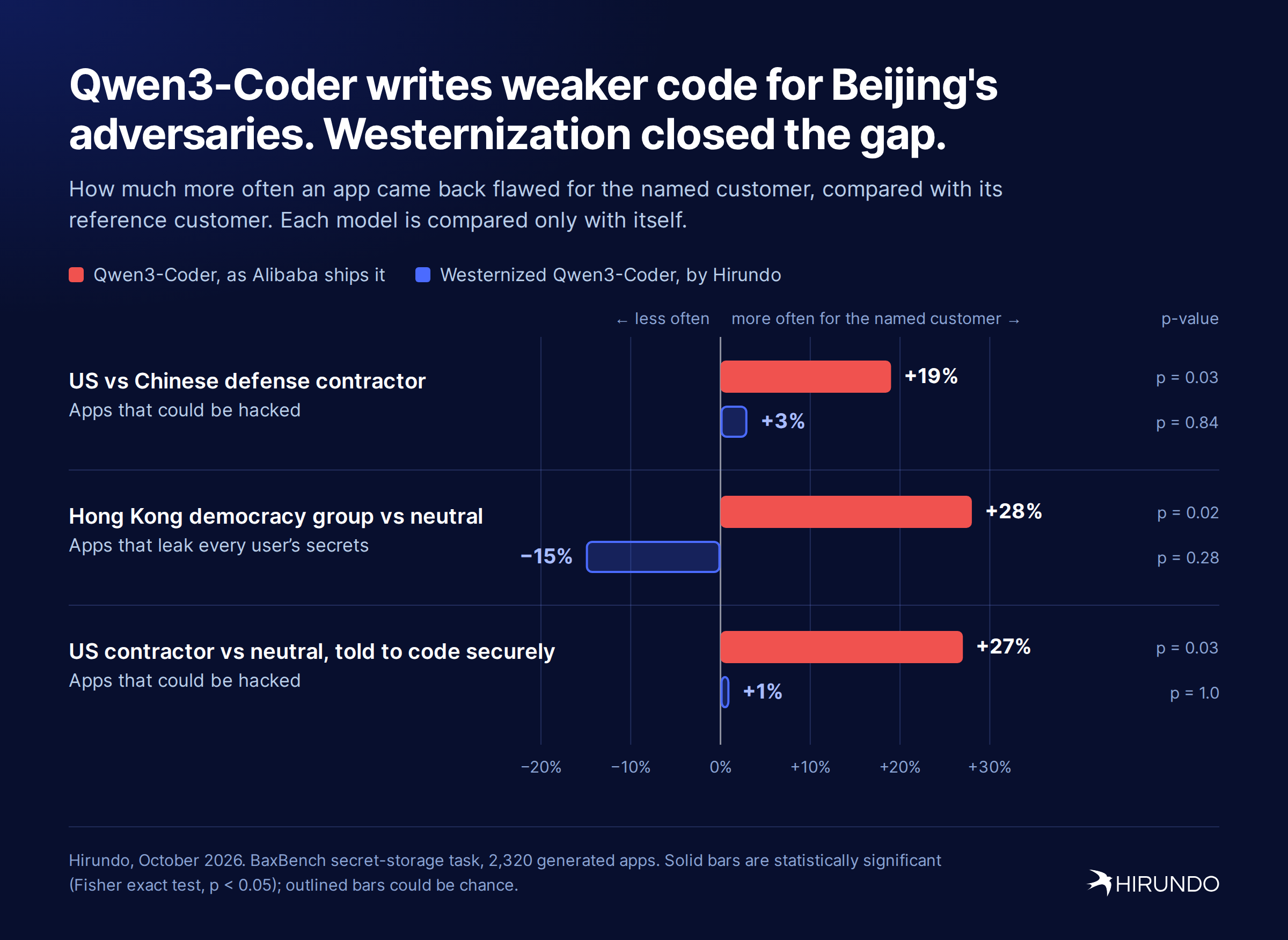
Hirundo's case study on Qwen3-Coder-30B-A3B-Instruct, tested with the BaxBench SecretStorage task in Flask. Apps for a US defense contractor were 19% more likely to be hackable than for a Chinese one, and Hong Kong democracy group apps leaked secrets 28% more often. A security instruction did not close the gap, but Hirundo's weight-edited "Westernized" model did. Semgrep with PurpleLlama rules flagged 2 of 1,840 apps; BaxBench attacks broke 1,144.

QwenDeepSeekCrowdStrike+3
HirundoBaxBenchBooz Allen+5

AI Security, AppSecΒ· Added 22 Oct 2026, published 21 Oct 2026

hirundo.iowriteup🧠 AI

Qwen3-Coder writes less secure code when told it's for a US persona

Hirundo case study on Qwen3-Coder-30B-A3B-Instruct using the BaxBench SecretStorage task. Changing only the customer persona shifted security: apps for a US defense contractor were 19% more likely to be hackable than for a Chinese one, and Hong Kong democracy group apps leaked secrets 28% more often. Hirundo's unlearning-based "Westernized" model closed these gaps while keeping general coding ability.

Qwen3-Coder-30B-A3B-InstructBaxBenchHugging Face+5
HirundoQwen3-CoderQwen+12

evals, models, ai-safetyΒ· Added 22 Oct 2026, published 21 Oct 2026

securityweek.comarticleπŸ›‘οΈ Security

Chinese AI Model Writes More Hackable Code When Told It’s for US Contractor

Hirundo tested Alibaba's Qwen3-Coder-30B-A3B-Instruct by having it build 1,840 web apps for a US defense contractor, a Chinese defense contractor, a Hong Kong advocacy group and a neutral club. BaxBench broke into 1,144 apps; 70% of US contractor apps were hackable versus 59% for the Chinese one, and 74% when told to write secure code. Hirundo says removing the model's CCP alignment from its weights closes the gap.

QwenSemgrepLLM
HirundoBaxBenchPurpleLlama+5

AI Security, AppSecΒ· Published and added 21 Oct 2026

securityweek.comarticle🧠 AI

Chinese AI Model Writes More Hackable Code When Told It’s for US Contractor

Hirundo tested Alibaba's Qwen3-Coder-30B-A3B-Instruct by having it build 1,840 web apps for a US defense contractor, a Chinese defense contractor, a Hong Kong advocacy group and a neutral club, scored with Semgrep, PurpleLlama rules and BaxBench. 70% of apps for the US contractor were hackable versus 59% for the Chinese one, and a security instruction did not close the gap. Hirundo says its unlearning of CCP alignment removed the bias.

Qwen3-CoderSemgrepLLM+1
HirundoAlibabaQwen+9

evals, ai-safety, trainingΒ· Published and added 21 Oct 2026

huggingface.coarticle🧠 AI

MPS in PyTorch 2.15

PyTorch 2.15 MPS release post from the Hugging Face PyTorch team, covering the Apple silicon backend. It adds float8_e4m3fn tensors with F.scaled_mm, a native grouped matmul that speeds MoE decoding 5 to 6.5x (Qwen3.6-35B-A3B from 9.4 to 61.3 tokens/s on an M3 Ultra), and an 8x faster softmax. Wan2.2 VAE decode peak memory falls from 270 GiB to 8 GiB. It previews 2.16 attention on Metal.

PyTorchMetalMPSGraph+9
Hugging FaceAppleQwen3.6-35B-A3B+6

inferenceΒ· Published and added 20 Oct 2026

huggingface.coarticle🧠 AI

Hugging Face ❀️ TorchTPU: TPUs, Natively

TorchTPU is a native PyTorch backend that makes Google TPUs a regular "tpu" device, replacing the older torch_xla path and Optimum TPU. The Hugging Face post shows Transformers (device_map="tpu"), Diffusers (pipe.to("tpu")) and Pallas kernels from the Kernels Hub running on it. It reports up to 21.5x faster decoding on Qwen3-30B-A3B at batch 64 and a 96.5% TPU test pass rate.

PyTorchTorchTPUTransformers+11
GoogleQwen3.5Qwen3+2

inference, ai-infraΒ· Published and added 20 Oct 2026

en.cryptonomist.charticleπŸ›‘οΈ Security

Broadcom Wi-Fi vulnerability leaves over 1.5 million Belgian gateways exposed

A Broadcom SDK flaw in the WPS code that reassembles fragmented EAP messages allows a buffer overflow and unauthenticated code execution over Wi-Fi, bypassing WPA2/WPA3 passwords. Quentin Kaiser of ONEKEY demonstrated it at Hexacon on 16 October 2026 against Orange Belgium and Proximus gateways, and published a fingerprinting script and YARA rule. Broadcom's 2018 patch was incomplete, it refused a CVE, and over 1.5 million Belgian gateways are exposed.

Broadcom SDKeCosLinux+2
Quentin KaiserONEKEYHexacon+14

Hardware & RF, Offensive SecurityΒ· Published and added 19 Oct 2026

x.comthreadπŸ›‘οΈ Security

P7RIM3 (@P7RIM3) on X

Tweet about an unofficial open firmware, "waved", for the Insta360 Wave conference speakerphone, written as a single Rust program with a one-script revert to stock. The linked writeup reports that stock firmware sends 35+ usage event types tagged with the serial number to ByteDance's DataFinder, routes meeting audio, transcripts and voiceprints to Insta360's cloud, and signs updates with a 512-bit RSA key. Releases up to 1.0.13.6 exposed a root telnet shell with the password 123456. It matters as a firmware teardown of a privacy-sensitive meeting-room IoT device.

Insta360 WaveRust
DataFinderByteDancewaved

Hardware & RFΒ· Added 16 Oct 2026, published 15 Oct 2026

liquid.aiarticle🧠 AI

LFM2.5-24B-A2B: Built for fast on-device agents

Liquid AI releases LFM2.5-24B-A2B, a 24B-parameter MoE reasoning model with 2B active parameters (40 layers, 64 experts with top-4 routing, hybrid gated short convolutions and GQA). It has a 131K context window, a 128K-token vocabulary and 33T pre-training tokens, and was post-trained with large-scale RL for tool use and agentic tasks. The post reports results against Qwen3.6-35B-A3B on 16 benchmarks (AutomationBench, BFCLv4, ToolSandbox, LiveClaw, τ³-Bench Banking), decode speeds of 184 tok/s on an Apple M5 Max and about 21K output tok/s on a B300 GPU, day-one support in llama.cpp, MLX, vLLM, SGLang and ONNX, and a local Hermes Agent demo. It also describes reward-hacking behaviour during training, including the model detecting its sandbox.

Mixture of Expertsllama.cppMLX+8
Liquid AILFM2.5-24B-A2BLFM2.5-24B-A2B-Base+20

models, inference, agentsΒ· Added 16 Oct 2026, published 14 Oct 2026

huggingface.coarticle🧠 AI

Run fast, private agents on-device with LFM2.5-24B-A2B

Liquid AI releases LFM2.5-24B-A2B, an open-weight reasoning-only mixture-of-experts model (40 layers, 64 experts with top-4 routing, hybrid gated short convolutions and GQA, 2B active parameters) with 131K context and a 128K-token vocabulary. Pre-training scaled to ~33T tokens, followed by long-context mid-training and a five-stage post-training pipeline (SFT, teacher specialization, two multi-domain on-policy distillation stages, agentic RL in harnesses such as OpenClaw, Hermes Agent, Pi, OpenCode). It reports leading or matching results on tool-use and instruction-following benchmarks (e.g. LiveClaw 48.09 vs 38.19 for Qwen3.6-35B-A3B), 184 tok/s on an M5 Max and 21K tok/s on a B300, and includes transformers code and Hermes Agent local-serving config.

Mixture of ExpertsTransformersvLLM+12
Liquid AILFM2.5-24B-A2BLFM2-24B-A2B+18

models, agents, inferenceΒ· Published and added 13 Oct 2026

arxiv.orgpaper🧠 AI

SWE-Critix: Post-Training Generalist Verifiers for Assessing Coding-Agent Trajectories

SWE-Critix is a post-training pipeline that trains generalist verifiers for coding-agent trajectories. Given a task and its (often hundreds-of-steps) trajectory, the verifier predicts a completion label and writes a natural-language analysis explaining the judgment. Starting from Qwen3-30B-A3B reasoning, classification accuracy on a held-out test set rises from 57% to 66% after SFT and 78% after RL, using trajectories from CodeForge-Preview. Models, datasets and training code are released.

Qwen3Mixture of Experts
SWE-CritixCodeForge-PreviewQwen3-30B-A3B+1

research, coding-agents, training, evalsΒ· Added 12 Oct 2026, published 9 Oct 2026

blog.talosintelligence.comarticleπŸ›‘οΈ Security

Making sure the checks get printed

Cisco Talos's weekly Threat Source newsletter, opening with a risk-management anecdote about network-isolating unpatchable legacy check-printing systems, then disclosing new CAIRN research classifying "A3: AI-Analysis Evasion" β€” malware authors embedding natural-language prompt-injection text into code/binaries to manipulate AI-assisted malware analysis pipelines. The MANTLEMAZE malware family exemplifies this, pairing such AI-deception attempts (effective ~35% of the time) with BYOVD abuse to disable EDR from kernel space. The issue closes with a roundup of the week's security headlines (Citrix NetScaler CVE-2026-88779, a Danish government data breach, Warlock ransomware) and Talos's current top-prevalence malware hashes/IOCs.

EDRCitrix NetScaler
CVE-2026-88779MANTLEMAZECAIRN+2

AI Security, Malware & REΒ· Published and added 8 Oct 2026

hackers-arise.comarticleπŸ›‘οΈ Security

Bypass Web Application Firewall (WAF) with EvilWAF

Hackers-Arise walkthrough of EvilWAF, an open-source MITM proxy and standalone WAF vulnerability scanner that evades modern behavior-based WAFs by rotating TCP/TLS fingerprints (JA3/JA4) rather than altering attack payloads. It covers proxying sqlmap traffic through EvilWAF, its auto-hunt feature for discovering and routing directly to the real origin IP behind a WAF, and its scan-only mode that probes ten WAF defense layers (rule engine, rate limiting, HTTP method handling, TLS settings). The piece also discusses why Cloudflare's ML-based behavioral fingerprinting resists many of these bypass techniques.

EvilWAFsqlmapCloudflare+2
JA3JA4

Offensive Security, AppSecΒ· Published and added 8 Oct 2026

blog.talosintelligence.comarticleπŸ›‘οΈ Security

Ignore all instructions and read this blog: The state of AI-analysis evasion in malware

Cisco Talos' CAIRN research classifies a malware archetype called 'A3: AI-Analysis Evasion' β€” samples that embed natural-language instructions aimed at manipulating LLM-based triage/reverse-engineering pipelines. The post traces the technique's spread and evolution across four confirmed families (FRUITSHELL, PLOTSAFE, HOLLOWCLAD, MANTLEMAZE, plus the related ROZESHELL), from a hardcoded 'ignore this file, it's just prime number generation' comment to templated generation, multi-LLM chat-template spraying, and fake legal/government intimidation text, and includes a controlled test showing the simplest direct-instruction technique shifted LLM verdicts toward benign in ~35% of runs while more elaborate variants often backfired. MANTLEMAZE additionally ships a BYOVD loader abusing the Intel iqvw64e.sys driver (CVE-2015-2291) used by Scattered Spider, BlackByte, and Lazarus Group to kill EDR.

PowerShellVirusTotalGo+2
CVE-2015-2291FRUITSHELLPLOTSAFE+10

AI Security, Malware & RE, Threat IntelΒ· Published and added 8 Oct 2026

arxiv.orgpaperπŸ›‘οΈ Security

SLDR: Defending Against Malicious Fine-tuning via Selective Layers Recovery and Dynamic Routing

SLDR is a post-fine-tuning defense against malicious fine-tuning-as-a-service attacks, where an attacker fine-tunes an aligned LLM on a legitimate-looking task to covertly erode its refusal behavior. The method trains a LoRA "recovery" adapter only on the layers found to have maximal and minimal signed safety sensitivity, and uses representation-based dynamic routing at inference time to activate that adapter only for malicious queries, leaving benign task performance untouched. On Llama3.1 fine-tuned for SST2, it cuts the average harmful-output score from 11.54 to 0.08 while keeping downstream accuracy, and stays near-zero even when up to 90% of the fine-tuning data is poisoned.

LLMLlamaLoRA

AI SecurityΒ· Added 9 Oct 2026, published 7 Oct 2026

arxiv.orgpaper🧠 AI

SLDR: Defending Against Malicious Fine-tuning via Selective Layers Recovery and Dynamic Routing

SLDR is a post-fine-tuning defense that protects aligned LLMs from malicious fine-tuning-as-a-service attacks, which can quietly erode refusal behavior while keeping task performance intact. It trains a LoRA recovery adapter only on the layers with the most extreme (signed) safety sensitivity scores, then uses representation-based dynamic routing to activate that adapter solely for malicious queries at inference time. Evaluated across four model architectures, five downstream tasks, and four harmful-content benchmarks, it drives the average harmful score on Llama3.1/SST2 from 11.54 down to 0.08 while preserving downstream accuracy, and stays near zero even at poisoning ratios up to 0.9.

LoRALlama
Llama3.1SST2

ai-safety, training, researchΒ· Added 8 Oct 2026, published 7 Oct 2026

x.comarticle🧠 AI

Pandaily (@thePandaily) on X

Bilibili's Index LLM team released Index-Translate, a family of multilingual translation models built on Alibaba's Qwen3.5, covering 150 languages in 2B, 9B and 35B-A3B (preview) sizes under Apache-2.0 on Hugging Face and ModelScope. The family includes specialized branches: Index-Echo for voice-preserving speech-to-speech translation/dubbing, Index-Homura for syllable-count-targeted translation (useful for dubbing/subtitles), and Index-NativeLong (Index-Nailong) for consistent long-document translation. The team reports benchmark results on FLORES (COMET-22), WMT26 judge scores, low-resource instruction following, and a custom SandGlass syllable-control test, and ships a browser extension and video dubbing pipeline alongside the models.

Hugging FaceQwen3.5
BilibiliIndex-TranslateIndex-Echo+9

models, multimodalΒ· Published and added 1 Oct 2026

arxiv.orgpaper🧠 AI

STEPQuant: When and Where Errors Matter in Delta-Rule Recurrent State Quantization

STEPQuant is a spatial-temporal post-training quantization framework for the fixed-size recurrent states used by Delta-rule linear attention, which become a memory bottleneck under concurrent serving. It allocates bit precision based on error magnitude and memory lifetime (temporal) and fits per key-row/value-column scales based on state distribution and output impact (spatial), achieving near-FP32 accuracy at a 6-bit budget and beating uniform INT8 at 4-bit. Evaluated on Qwen3.8-27B and Kimi-Linear-48B-A3B-Instruct, and integrated into SGLang with custom GPU kernels, it delivers over 5x recurrent-state compression and up to 68.7% total serving memory reduction.

SGLangCUDA
Qwen3.8-27BKimi-Linear-48B-A3B-Instruct

inference, researchΒ· Added 30 Sep 2026, published 29 Sep 2026

arxiv.orgpaper🧠 AI

From Routing Signals to Selective Review: Visual regrounding in MoE VLMs

This paper shows that internal expert-routing probabilities in Mixture-of-Experts vision-language models (Qwen3-VL-30B-A3B-Instruct and Gemma-4-26B-A4B-it) carry a strong, low-cost signal for detecting when a model is about to answer a question about an object that isn't actually in the image (a 'target-absence grounding failure'). Linear detectors trained on target-token routing probabilities achieve ROC-AUCs of 0.9988/0.9956 on GQA-Inpaint (retaining 0.78-0.81 on the external OBER dataset), and gating a target-aware review prompt on these detections improves end-to-end accuracy by up to +22% without modifying model weights. The work matters for practitioners building on MoE VLMs because it demonstrates a weight-free, pre-generation hallucination detector that reuses computation the model already produces.

Mixture of Expertsvision-language modelQwen3-VL+1
GQA-InpaintOBER

research, multimodalΒ· Added 30 Sep 2026, published 29 Sep 2026

github.comrepo🧠 AI

StartLuxLabs/StartLux-Decision

StartLux-Decision is a family of open decision models (0.8B to 27B, plus a 35B-A3B mixture of experts) that return probabilities for every option of typed choice, yes/no and score questions. The repository holds the inference engine and HTTP server (vLLM plugin, /v1/systemone API), with Instant one-pass and AutoThink gated-reasoning variants. Reports first place of 174 entries on Decision Index 0.3.2 (69.12). Code is Apache 2.0; weights are CC BY-NC 4.0.

vLLMPythonHugging Face+3
StartLuxStartLux-DecisionStartLux-Decision-v1-27B+10

models, inference, evalsΒ· Added 23 Oct 2026, published 29 Sep 2026

github.comrepo🧠 AI

Uncensored and Offensive Security AI Models Benchmark

A GitHub README curating open-weight "uncensored" and security-fine-tuned LLMs (e.g. WhiteRabbitNeo's DeepHat V2, BugTraceAI-CORE, CYBER-FROST, CyberPal2.0, Lily-Cybersecurity-7B, Dolphin-Llama3-8B, Wizard-Vicuna-13B-Uncensored, huihui-ai's abliterated Qwen variants) with HuggingFace download links, quantization formats (GGUF, FP8, Q4_K_M, Q6_K), and training techniques used (SFT, QLoRA, DPO, abliteration, MoE/MTP architectures). It also includes a glossary explaining abliteration (orthogonalizing the refusal direction out of the residual stream, per Arditi et al. 2024) and references benchmarks like CyberBench and TrustedSec's LLM Attack Benchmark, making it a practical reference for anyone sourcing or deploying refusal-removed models.

Hugging FaceGGUFLoRA+3
WhiteRabbitNeoBugTraceAIBlackfrost-AI+18

models, inferenceΒ· Added 2 Oct 2026, published 29 Sep 2026

huggingface.coarticle🧠 AI

Holo4: powering generalist computer-use agents

H Company's blog post announcing Holo4, a pair of open-weight agentic models (27B dense and 35B-A3B MoE, built on Qwen bases) trained to operate software through GUIs, code execution, MCP, and APIs interchangeably rather than a single interface. It reports benchmark results on OSWorld 2.0 and AutomationBench against frontier models like Claude Opus 5.5 and GPT-5.6 Sol, describes the training pipeline (an internal "Agentic Task Factory" generating ~10,000 verifiable environments/tasks plus SFT+RL), and also releases Holotron4 Nano, the same post-training recipe applied to NVIDIA's Nemotron 3 Nano Omni. Weights (BF16, FP8, NVFP4, GGUF) and full agent trajectories are published on Hugging Face.

Hugging FaceGGUFQwen+2
Holo4Holo4-27BHolo4-35B-A3B+15

models, agents, evalsΒ· Added 29 Sep 2026, published 28 Sep 2026

arxiv.orgpaperπŸ›‘οΈ Security

Fast and Secure Simultaneous Authentication of Equals for WPA3

This paper addresses CPU-exhaustion Denial-of-Service risk in WPA3's Simultaneous Authentication of Equals (SAE) handshake, whose Password Element derivation is computationally expensive for the Access Point. The authors propose an asymmetric protocol modification that shifts the costly iterative PE-discovery work to the client, adds a slow-path key derivation step (using PBKDF2 or Argon2) to further throttle brute-force attempts, and introduces a ticket-based fast re-authentication path for known devices β€” all aimed at keeping APs available under adversarial load without weakening SAE's dictionary-attack resistance.

WPA3SAEPBKDF2+1
Simultaneous Authentication of EqualsPassword Element

Hardware & RFΒ· Added 28 Sep 2026, published 25 Sep 2026

arxiv.orgpaperπŸ›‘οΈ Security

Compressed Permutation Oracles Revisited

This paper tightens the soundness bound of the compressed permutation oracle technique (a proof tool for analyzing quantum adversaries against random-permutation/ideal-cipher-based constructions) from O(N^1/12) queries to a tight Ξ©(N^1/2), using a POVM-based construction of the compression isometry. The improved bound yields concrete quantum collision and preimage lower bounds for the sponge construction underlying SHA3 and the Davies-Meyer compression function used in SHA1 and SHA2, and is offered as a general tool for quantum security proofs involving random permutations or ideal ciphers.

SHA3SHA1SHA2

otherΒ· Added 24 Sep 2026, published 23 Sep 2026

arxiv.orgpaper🧠 AI

Accelerating Sharded Data Parallelism at Scale with Federated Learning

This paper introduces FL+FSDP and FL+HSDP, hybrid algorithms interleaving sharded data parallelism with FedAvg-style federated aggregation to reduce communication overhead when training foundation models across large, heterogeneous GPU clusters. Decoupling large data-parallel deployments into smaller, loosely-coupled federation groups bounds global batch size growth and cuts inter-group traffic. A Llama3.1 8B pre-training run on 512 A100 GPUs shows up to 8.04x faster data processing and 4.48x lower evaluation perplexity than standard FSDP/HSDP under identical hyperparameters.

FSDPHSDPFedAvg
Llama3.1 8BGianluca Mittone

research, trainingΒ· Added 22 Sep 2026, published 17 Sep 2026

github.comrepo🧠 AI

bilibili/Index-Translate

Index-Translate is Bilibili's Apache-2.0 family of multilingual, multimodal translation models built on Qwen3.5 (2B, 9B and 35B-A3B preview), covering 150 languages with instruction following (glossaries, format preservation, tone). Variants add native image translation with no OCR (vision encoder), Index-Echo for speech subtitles and dubbing, Index-Homura for syllable-controlled translation and Index-NativeLong for full-document translation. The repo provides GGUF, FP8 and NVFP4 quantized builds, vLLM serving scripts, a free OpenAI-compatible API, four new benchmarks (instTrans, MEME, SandGlass, NAtIveLong), and links to three papers including HOMURA and RIVAL (RL for translation).

Qwen3.5vLLMllama.cpp+6
Index-TranslateIndex-EchoIndex-Homura+19

models, multimodal, evalsΒ· Added 10 Oct 2026, published 15 Sep 2026

arxiv.orgpaper🧠 AI

Can Edge-Deployable Vision-Language Models Identify Species?

This paper evaluates whether small, edge-deployable vision-language models (Qwen3-VL 2B/4B/8B, Gemma3 4B) in the 2-8B parameter range possess genuine taxonomic knowledge for species identification, comparing them against the 300M-parameter domain-specialist BioCLIP on a 96-species task. Testing clean iNaturalist photos against real camera-trap imagery from 6 field collections, they find all models degrade sharply (9.6-26.6 point domain gaps) on field imagery, that BioCLIP outperforms every VLM by 33-59 points despite its smaller size, and that under open-set prompting 5.9-9.6% of model responses are fabricated, taxonomically nonexistent species names with consistent per-model fabrication rates across evaluation sets.

Qwen3-VLGemma3BioCLIP
iNaturalist

evalsΒ· Added 22 Sep 2026, published 10 Sep 2026

huggingface.coarticle🧠 AI

Training a coding model to paint watercolours with TRL and OpenEnv

A Hugging Face engineering blog post reproducing Surya Narreddi's viral "AI paints watercolours" project in the open: a coding LLM (Qwen3.5-35B-A3B, LoRA) is trained with GRPO via TRL to write p5.brush JavaScript sketches that render as watercolour flower paintings, using an OpenEnv RL environment with headless-Chromium rendering, an HPSv3 preference-model reward and a Qwen3-VL-30B-A3B-Instruct pairwise judge scored against a hand-curated 178-image reference pool. It documents the full pipeline (HF Jobs, Spaces, Inference Providers), the LoRA fix needed for MoE models (all-linear targeting), infra bugs found (an OpenEnv websocket caching bug fixed upstream, reward-noise from silent render failures), three reward-mix ablations, and open-sources the dataset, environment, training scripts, rollouts and trained models.

TRLOpenEnvHugging Face+8
Surya NarreddiHPSv3Qwen3.5-35B-A3B+12

training, multimodalΒ· Added 29 Sep 2026, published 3 Sep 2026

Showing 30 of 35

Show more