Skip to content

37 results for “Remote code execution”

What you seeeverything
unit42.paloaltonetworks.comadvisory🛡️ Security

Threat Brief: Critical Vulnerabilities in PHP: CVE-2026-109618, CVE-2026-109619 (Updated October 29)

Unit 42 threat brief on PHP2Shell, two PHP remote code execution flaws, CVE-2026-109618 and CVE-2026-109619 (CVSS 4.0 9.2), both caused by longjmp() error handling that leaves memory uninitialized or freed. Cortex Xpanse counted over 22.6 million exposed instances. The 29 October 2026 update says attackers chained PHP2Shell with a Linux kernel privilege escalation against internet-exposed PAN-OS management interfaces. An earlier 23 October claim of post-compromise activity was retracted on 25 October.

PHPPAN-OSLinux kernel+2
CVE-2026-109618CVE-2026-109619PHP2Shell+2

Threat Intel, AppSec· Added 30 Oct 2026, published 29 Oct 2026

cisa.govadvisory🛡️ Security

Hitachi Energy TRO600 series products

ICSA-26-302-02 is a CISA republication of Hitachi Energy PSIRT advisory 8DBD000224 on the TRO600 series. It covers CVE-2026-10756 and CVE-2026-106087, which allow remote code execution and disclosure of sensitive information. Affected versions are TRO600 up to 9.2.1.6 and 9.1.1.0, plus 9.2.2.1 and 9.1.2.0. The page gives no per-CVE detail or CVSS scores, only general ICS hardening advice. Released 27 October 2026.

Hitachi Energy TRO600
CVE-2026-10756CVE-2026-106087Hitachi Energy PSIRT 8DBD000224+1

Hardware & RF· Added 29 Oct 2026, published 28 Oct 2026

orca.securityadvisory🛡️ Security

Node.js Brotli Decoder Out-of-Bounds Write Threatens Remote Code Execution Across All Supported Versions

CVE-2026-111497 is a high-severity out-of-bounds write in the Node.js Brotli decoder, reported by Orca Security. It affects all supported release lines (22.x, 24.x, 26.x) and can be triggered by malformed Brotli data processed through node:zlib or fetch(). Impacts named are crashes, memory disclosure and remote code execution in cloud workloads; patching is advised. The fetched text covers only the executive summary.

Node.jsBrotli
CVE-2026-111497

AppSec· Published and added 27 Oct 2026

cisa.govadvisory🛡️ Security

EPICS Base

CISA ICS advisory ICSA-26-300-01 (October 27, 2026) covers EPICS Base release 7.0.10 and earlier, with CVE-2026-114595 through CVE-2026-114598. Flaws include integer overflow, length parameter inconsistency and type confusion, allowing denial of service, memory corruption, information disclosure or remote code execution (CVSS v3.1 9.8). The fix is EPICS Base 7.0.11, with patches in epics-base and pvDataCPP pull requests.

EPICS BaseCVSS
CVE-2026-114595CVE-2026-114596CVE-2026-114597+5

AppSec· Added 29 Oct 2026, published 26 Oct 2026

cisa.govadvisory🛡️ Security

CISA: Critical Vulnerabilities in PHP Require Immediate Patching

CISA alert on CVE-2026-109618 and CVE-2026-109619 ("php2shell"), unauthenticated remote code execution flaws affecting PHP installations serving web requests, including mod_php, PHP-FPM, php-cgi, FrankenPHP and LiteSpeed. Fixed in PHP 8.5.12, 8.4.27, 8.3.36 and 8.2.35. Updated 23 October 2026 with a Sigma rule, partner advisories (NSA, NCSC-UK, ASD ACSC, NCSC-NL, NCSC-NZ, Cyber Centre) and guidance to inventory PHP, patch internet-facing systems first, and watch for PHP workers spawning shells. No in-the-wild exploitation had been observed.

PHPApachePHP-FPM+3
CVE-2026-109618CVE-2026-109619PHP2Shell+2

AppSec, Blue Team & Detection· Added 24 Oct 2026

aikido.devadvisory🛡️ Security

Node2Shell: Node.js Brotli vulnerability allows remote code execution (CVE-2026-111497)

Node2Shell (CVE-2026-111497) is an out-of-bounds write in the Brotli decoder bundled with Node.js and Bun, triggered by malformed compressed input and rated high by Node.js, with possible remote code execution. Fixed in Node.js 22.23.4, 24.22.1 and 26.12.1 and Bun 1.4.4. The post covers exposure via Express 5, body-parser 2.x, fetch() and node:zlib, stopgaps, and a timeline with public proofs of concept on 22 October 2026.

Node.jsBunExpress+3
CVE-2026-111497Node2ShellCWE-787+1

AppSec· Published and added 22 Oct 2026

x.comadvisory🛡️ Security

EMITS (@emits_ca) on X

CVE-2026-107406 is a memory overflow in Citrix NetScaler that allows remote code execution when SAML is configured, rated 9.5 out of 10. The post from emits.ca calls it the fourth NetScaler bulletin in a week. It warns that the previous week's SAML patch does not cover it, and that fixes need NetScaler 14.1-73.46 or later, or 13.1-64.29 or later. The full advisory is on emits.ca.

Citrix NetScaler
CVE-2026-107406

Cloud & Infra, Identity & Access· Added 22 Oct 2026, published 21 Oct 2026

endorlabs.comadvisory🛡️ Security

PHP2Shell: Critical vulnerabilities in PHP (CVE-2026-109618, CVE-2026-109619) | Endor Labs

PHP2Shell is the name for two critical PHP core memory-safety flaws, CVE-2026-109618 and CVE-2026-109619, that allow unauthenticated remote code execution. Fixes ship in PHP 8.2.35, 8.3.36, 8.4.27 and 8.5.12. Wiz researchers demonstrated RCE against WordPress, Drupal and Joomla, and Apache with mod_php is the highest risk. The post covers inventory, container rebuilds, Cloudflare WAF rules and temporary exposure reduction.

PHPWordPressDrupal+3
CVE-2026-109618CVE-2026-109619PHP2Shell+4

AppSec, DevSecOps· Published and added 21 Oct 2026

watchtowr.comadvisory🛡️ Security

PHP Remote Code Execution ("PHP2Shell" CVE-2026-109618 & CVE-2026-109619)

PHP2Shell is the name for CVE-2026-109618 (out-of-memory corruption) and CVE-2026-109619 (stale global state), two unauthenticated PHP remote code execution flaws rated CVSS 4.0 9.2. Details leaked before the 21 October 2026 patch release, and watchTowr's honeypots saw exploitation. The page lists fixed versions (8.5.12, 8.4.27, 8.3.36, 8.2.35), states that .ini mitigations do not work, gives a timeline, and describes compromise checks.

PHPApacheFrankenPHP+2
CVE-2026-109618CVE-2026-109619PHP2Shell+3

AppSec, Threat Intel· Added 28 Oct 2026, published 21 Oct 2026

orca.securityadvisory🛡️ Security

Critical PHP “PHP2Shell” RCE Vulnerabilities Allow Unauthenticated Remote Code Execution (CVSS 9.2)

PHP2Shell is the informal name for CVE-2026-109618 and CVE-2026-109619 (CVSS v4.0 9.2), unauthenticated remote code execution flaws in the PHP core runtime. Patches for branches 8.2 to 8.5 were scheduled for 21 October at 14:00 UTC, while PHP 8.1 and older get no fix; about 884,000 internet-facing hosts run those versions. watchTowr reproduced CVE-2026-109618, no public PoC existed at writing, and Sansec expects mass exploitation within 15 minutes of release.

PHP
CVE-2026-109618CVE-2026-109619PHP2Shell+4

AppSec· Published and added 21 Oct 2026

github.comadvisory🛡️ Security

PHP 8.2.35

PHP 8.2.35 is a security release of the PHP 8.2 branch that fixes two critical vulnerabilities, CVE-2026-109618 and CVE-2026-109619, which can allow unauthenticated remote code execution. The notes say no complete mitigations exist and updating is the only safe choice. PHP 8.2 reaches end of life on 31 December 2026, after which it gets no security fixes.

PHP
CVE-2026-109618CVE-2026-109619

AppSec· Added 22 Oct 2026, published 21 Oct 2026

huntress.comadvisory🛡️ Security

Rapid Response: php2shell, Leaked Critical PHP Vulnerabilities (CVE-2026-109618 & CVE-2026-109619)

Huntress rapid-response post on php2shell, two leaked critical PHP core vulnerabilities (CVE-2026-109618 and CVE-2026-109619, CVSS v4.0 9.2 each) reported as remote code execution. The PHP team moved its security release to 21 October 2026, 14:00 UTC, after the leak. It lists hunting cues such as php-fpm, php-cgi or apache2 spawning shells, interpreters or download tools, plus inventory and patch steps. No root cause, affected versions, PoC or IOCs were public at writing.

PHPHuntressWordPress+2
CVE-2026-109618CVE-2026-109619php2shell+4

Blue Team & Detection, Threat Intel, AppSec· Published and added 21 Oct 2026

aikido.devadvisory🛡️ Security

Critical vulnerabilities in PHP (PHP2SHELL)

PHP2SHELL is Aikido Security's advance notice of two critical remote code execution flaws in PHP itself, CVE-2026-109618 and CVE-2026-109619, both CVSS v4.0 9.2, with all versions treated as affected. The PHP security team will release fixes at 14:00 UTC on 21 October 2026, a day early after details leaked on 20 October. The post withholds exploitation details and workarounds.

PHPCVSS
CVE-2026-109618CVE-2026-109619PHP2SHELL+1

AppSec· Published and added 21 Oct 2026

horizon3.aiadvisory🛡️ Security

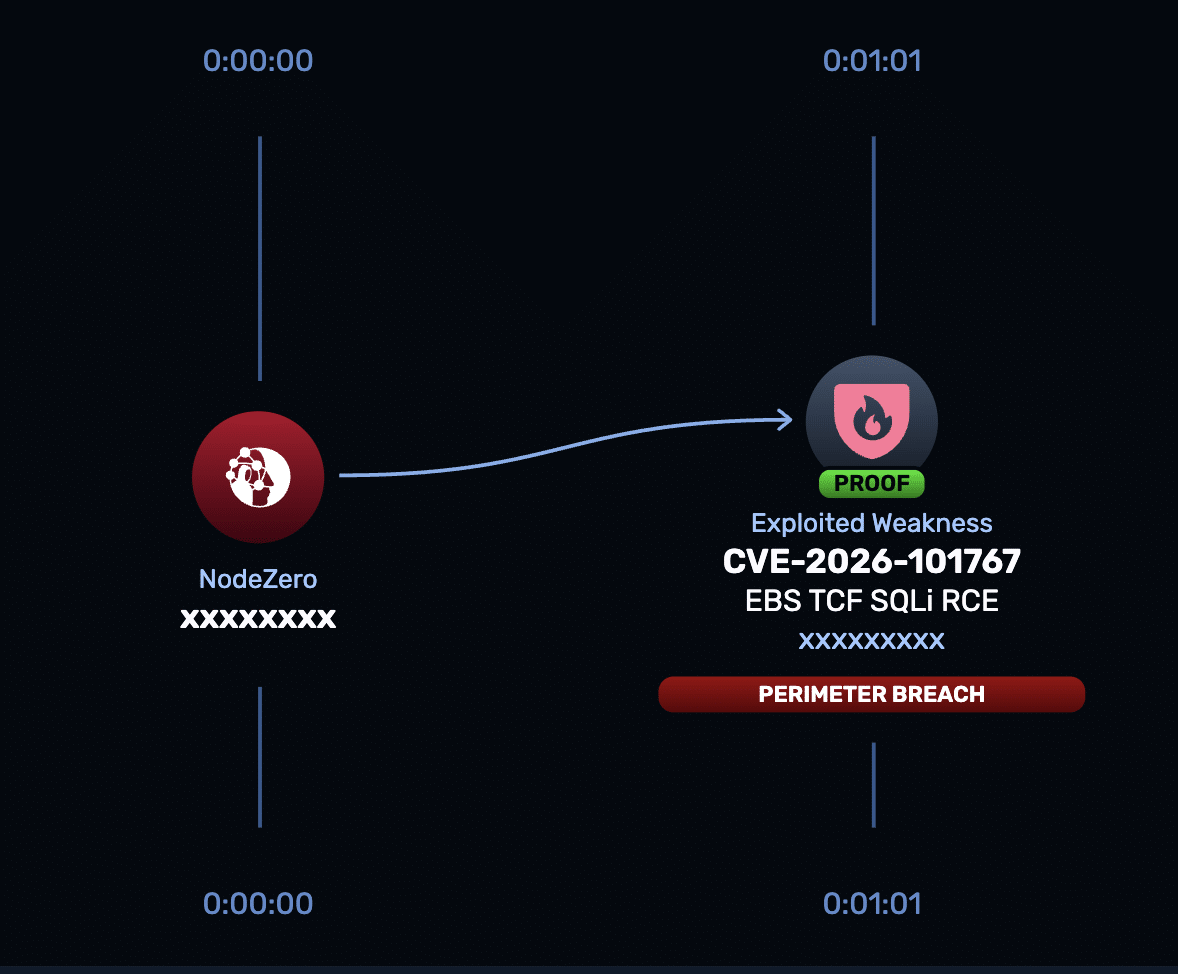
CVE-2026-101767 | Oracle E-Business Suite TCF SQL Injection and Remote Code Execution

CVE-2026-101767 is an unauthenticated SQL injection in the Oracle E-Business Suite Thin Client Framework servlet (/OA_HTML/AppsTCFServer, oracle.apps.fnd.tcf.SocketServer), CVSS 3.1 9.8. It runs SQL as the APPS user and chains to OS commands as the EBS account. Affects 12.2.3 to 12.2.15, fixed in the Oracle October 2026 CPU (20 October 2026). The page lists mitigations, IOCs and a timeline.

Oracle E-Business SuiteCVSS
CVE-2026-101767CWE-89Horizon3.ai+3

AppSec, Offensive Security, Blue Team & Detection· Added 29 Oct 2026, published 20 Oct 2026

watchtowr.comadvisory🛡️ Security

Frequently Asked Questions About PHP Remote Code Execution (PHP2Shell CVE-2026-109618 & CVE-2026-109619)

PHP2Shell is the name for CVE-2026-109618 and CVE-2026-109619, two unauthenticated remote code execution flaws in PHP, both CVSS v4.0 9.2. One stems from out-of-memory corruption during request setup, the other from stale global state reused by the next request. watchTowr reports exploitation since 21 October 2026, lists fixed releases (8.5.12, 8.4.27, 8.3.36, 8.2.35) and says PHP 5 is also affected. PHP says no configuration change fully mitigates.

PHPApacheCVSS
CVE-2026-109618CVE-2026-109619PHP2Shell+3

AppSec, Threat Intel· Added 30 Oct 2026, published 20 Oct 2026

x.comadvisory🛡️ Security

S2W_DailyThreat (@S2W_DailyThreat) on X

S2W post on CVE-2026-97229, a CVSS 10.0 remote code execution flaw in the GitLab CE/EE CI/CD regex compiler, disclosed October 13, 2026. Insufficient regex validation plus an integer overflow during encoding conversion lets an attacker who can add CI/CD config use a malicious regex and a UTF-8 repository path to run commands as the git user. Affects self-managed 19.2 before 19.2.8, 19.3 before 19.3.5 and 19.4 before 19.4.2. Rapid7 published analysis and a public PoC exists, with no in-the-wild exploitation confirmed as of October 15. No workaround exists, so patch or restrict access to a management network or VPN.

GitLabCVSS
CVE-2026-97229Rapid7S2W+1

AppSec, DevSecOps· Added 17 Oct 2026, published 16 Oct 2026

rapid7.comadvisory🛡️ Security

CVE-2026-97229: Critical Unauthenticated Remote Code Execution in GitLab

Rapid7 analysis of CVE-2026-97229, a CVSS 10.0 integer overflow (CWE-190) in the Onigmo regex compiler used by GitLab CE/EE's CI/CD regex handling. A crafted regex in a .gitlab-ci.yml passes validation as US-ASCII, then is recompiled for a UTF-8 repository path, producing invalid instructions that give code execution as the git user. Rapid7 reproduced it on GitLab CE 19.4.1 with ASLR (patched in 19.4.2); despite the vendor's "unauthenticated" rating, the attacker needs to commit a malicious config to a public project, which self-registration allows. No in-the-wild exploitation is confirmed, and Rapid7 recommends urgent upgrades.

GitLabRubyCVSS
CVE-2026-97229CWE-190Onigmo+1

AppSec, DevSecOps· Published and added 13 Oct 2026

securityweek.comadvisory🛡️ Security

Citrix Urges Immediate Patching of Critical NetScaler Vulnerability

Citrix disclosed CVE-2026-107406 (CVSS 9.5), a critical memory overflow in NetScaler ADC and NetScaler Gateway that can lead to remote code execution or denial of service when appliances are configured as a SAML SP or SAML IdP, also affecting Secure Private Access Hybrid deployments using NetScaler. Patches are available in versions 14.1-73.46, 13.1-64.29, and the corresponding FIPS/NDcPP builds; Citrix says it is not aware of exploitation yet but urges immediate upgrades. The bulletin follows two other recently exploited NetScaler RCE/DoS zero-days (CVE-2026-88771, CVE-2026-88772) used against government, financial, education, legal, and professional-services organizations, and a separate DoS zero-day (CVE-2026-88779).

Citrix NetScalerSAML
CVE-2026-107406CVE-2026-88779CVE-2026-88771+1

AppSec, Identity & Access· Published and added 9 Oct 2026

blog.talosintelligence.comadvisory🛡️ Security

Microsoft, Adobe, Apple, and Foxit vulnerabilities

Cisco Talos discloses eight vulnerabilities patched by vendors: a Photoshop installer privilege escalation (CVE-2026-48388), a macOS CoreWLAN information disclosure bug, two Foxit Reader flaws including a JavaScript CBF_Widget remote code execution (CVE-2026-57256) and an Array use-after-free (CVE-2026-91799), and four Windows kernel-driver bugs — NETIO.sys information disclosure (CVE-2026-50475), two Cloud Files Mini Filter Driver issues (use-after-free CVE-2026-58613 and type confusion CVE-2026-80093), and a tcpip.sys out-of-bounds read (CVE-2026-49177). Each advisory gives the affected version and trigger mechanism, and Talos notes Snort coverage is available for detection.

Adobe PhotoshopmacOSFoxit Reader+2
CVE-2026-48388CVE-2026-57256CVE-2026-91799+12

AppSec, Offensive Security· Published and added 7 Oct 2026

x.comadvisory🛡️ Security

lee1981 (@lee1981b) on X

Analysis of CVE-2026-105844, a CWE-1321 prototype-pollution vulnerability in @payloadcms/plugin-import-export that the vendor says can lead to unauthenticated remote code execution. It covers affected ranges (stable 3.0.0–3.87.x, canary 4.0.0-canary.0–canary.26), the fix (3.88.0 / 4.0.0-canary.27), the patched field-path guard against __proto__/constructor/prototype segments, and a six-step SOC hunting/triage playbook with two offline Python scripts for inspecting npm package trees and triaging request field-paths for prototype-sensitive values.

Payload CMSnpmCVSS+3
CVE-2026-105844CWE-1321GHSA-qf28-8hc6-vwrp+1

AppSec, Blue Team & Detection· Added 8 Oct 2026, published 7 Oct 2026

cisa.govadvisory🛡️ Security

Critical Zero-Day Vulnerabilities Exploited in Citrix NetScaler ADC, Gateway

CISA alert amplifying Citrix's disclosure of ten NetScaler ADC and Gateway vulnerabilities (CVE-2026-88771 to CVE-2026-88779 and CVE-2026-107406). CVE-2026-88771 and CVE-2026-88772 are critical zero-days enabling independent remote code execution and are exploited globally; CVE-2026-88779 is a SAML SP/IdP denial-of-service that can force a reboot to trigger code injected via CVE-2026-88771. It advises checking for compromise before patching, preserving forensic evidence, forwarding logs to a SIEM, restoring a pre-compromise backup and rotating all secrets, and links a CISA SIGMA detection rule.

Citrix NetScalerSIEMSigma
CVE-2026-88771CVE-2026-88772CVE-2026-88773+9

Threat Intel, Blue Team & Detection· Added 28 Sep 2026

osv.devadvisory🛡️ Security

Vulnerability Database - OSV

CVE-2026-91931 is a critical remote code execution vulnerability in Flowise versions before 3.1.4, triggered through the platform's Custom MCP feature which invokes npx to run Model Context Protocol servers. A fix is available in 3.1.4; the flaw scores 9.0 (Critical) on CVSS, indicating an attacker can achieve arbitrary code execution likely via unsanitized input to the npx invocation path.

FlowiseModel Context Protocolnpm
CVE-2026-91931

AI Security, AppSec· Added 26 Sep 2026

github.comadvisory🛡️ Security

Flowise MCP Security Bypass Enables RCE

GHSA advisory detailing three bypasses in Flowise's Custom MCP Server security controls (validateCommandFlags and validateArgsForLocalFileAccess in packages/components/nodes/tools/MCP/core.ts) that combine to achieve remote code execution: an unblocked `docker build` subcommand that pulls and runs a remote Dockerfile, a missing `--yes` long-flag alias on the npx blocklist (only `-y` was blocked) enabling arbitrary npm package execution, and a Unix absolute-path regex that fails to catch double-leading-slash paths (`//root/...`), allowing `node` to execute an uploaded local file. Any authenticated Flowise user (or an API key with chatflow view/update rights) can chain these to fully compromise the host via a prediction API call.

FlowiseDockerNode.js+2
validateCommandFlagsvalidateArgsForLocalFileAccess

AI Security, AppSec· Added 26 Sep 2026

rapid7.comadvisory🛡️ Security

CVE-2026-94127: Critical Unauthenticated RCE in F5 BIG-IP APM

Rapid7's ETR writeup covers CVE-2026-94127, a critical heap-based buffer overflow (CVSS 9.8) in F5 BIG-IP Access Policy Manager that allows unauthenticated remote code execution via crafted traffic. Exploitation requires a virtual server with both an APM access policy and an OAuth profile configured, affects the data plane (including Appliance mode), and has been added to CISA KEV; F5 provides hotfixes for the 21.1.0, 17.5.0, and 17.1.0 release trains plus an iRule workaround for those unable to patch immediately.

F5 BIG-IPCVSSCISA KEV+1
CVE-2026-94127

Cloud & Infra, Identity & Access· Added 7 Oct 2026, published 23 Sep 2026

wordpress.orgadvisory🛡️ Security

WordPress 7.1.2 Release (CVE-2026-87902 path-traversal RCE fix)

WordPress 7.1.2 patches CVE-2026-87902 (GHSA-7hp8-65ch-5whp), a critical unauthenticated path-traversal flaw where page template resolution can be manipulated to include an attacker-chosen readable local PHP file outside the active theme directory. Under certain server and active-theme preconditions this local file inclusion escalates to remote code execution. The security fix was backported to all WordPress branches back to 4.7; discovery credited to researcher Robert Ressl.

WordPressPHP
CVE-2026-87902GHSA-7hp8-65ch-5whppath traversal+2

AppSec· Added 28 Sep 2026, published 22 Sep 2026

aikido.devadvisory🛡️ Security

StyleSmuggler fix: patch the Magento and Adobe Commerce RCE

Aikido Security's writeup on "StyleSmuggler," a remote code execution vulnerability in Magento and Adobe Commerce, covering the fix/patch for the flaw. Page content was not retrieved, so specifics of the exploitation technique and affected versions could not be confirmed directly.

MagentoAdobe Commerce
StyleSmuggler

AppSec· Published and added 7 Sep 2026

huntress.comadvisory🛡️ Security

PaperCut Zero-Day: Active Exploitation and Pre-Auth RCE

Huntress details active exploitation of an authorization-bypass flaw in PaperCut NG/MF (CVE-2026-81578) chained with an unsafe dynamic class-loading vulnerability in the database connection utilities (CVE-2026-82078) to achieve unauthenticated remote code execution in the PaperCut Application Server. The writeup covers Huntress's own observed intrusions (base64-encoded recon commands, dropped Java .class payloads decompiled with Fernflower, log-wiping behavior, and an Apache Derby pwn database indicator), a reproduced PoC achieving SYSTEM-level code execution via pc-app.exe, and detailed patching, evidence-preservation, and hunting guidance across PaperCut's staged emergency patches.

PaperCutWindows
CVE-2026-81578CVE-2026-82078pc-app.exe

Threat Intel, AppSec, Blue Team & Detection· Added 3 Sep 2026, published 28 Aug 2026

orca.securityadvisory🛡️ Security

Critical Elementor Pro File Upload Flaw Enables Unauthenticated Remote Code Execution on WordPress Sites

CVE-2026-32475 (CVSS 9.0) is an unauthenticated arbitrary file upload leading to RCE in Elementor Pro's Forms module (versions up to 4.2.1), caused by the extension-blocklist check and the file-move step running in two separate loops with different empty-file handling, letting a two-part file submission bypass the blocklist and drop a PHP webshell into the public wp-content/uploads/elementor/forms/ directory. The post also flags related WordPress core CVE-2026-65640 (CVSS 8.8, fixed in 7.0.4), an Author-level RCE via malicious PostScript upload requiring Imagick and Ghostscript. Fix: upgrade Elementor Pro to 4.2.2+ and WordPress core to 7.0.4, and audit the uploads/elementor/forms directory for planted PHP files.

WordPressPHPOrca Security+1
CVE-2026-32475CVE-2026-65640arbitrary file upload+1

AppSec· Added 3 Sep 2026, published 20 Aug 2026

github.comadvisory🛡️ Security

AI Security Briefing

GHSA-3pvh-63gf-j9mw discloses an authenticated remote code execution vulnerability in LangBot, an open-source AI chatbot/agent framework, caused by its MCP Server Configuration feature. Because LangBot's mcp.py uses Anthropic's StdioServerParameters to launch MCP servers, any authenticated user can add a "STDIO" MCP entry with an arbitrary shell command and have it executed on the server, enabling data exfiltration, reverse shells, or full host compromise (CWE-78 OS command injection).

Model Context ProtocolPythonLangBot
GHSA-3pvh-63gf-j9mwCWE-78

AI Security, AppSec· Published and added 17 Jul 2026

orca.securityadvisory🛡️ Security

Orca Security: Maximum-Severity Adobe ColdFusion RCE

Orca Security writeup covering CVE-2026-48282, a maximum-severity remote code execution vulnerability in Adobe ColdFusion. The page content could not be retrieved, so technical details (root cause, exploitation vector, affected versions) are unconfirmed beyond the title.

Adobe ColdFusionOrca Security
CVE-2026-48282

AppSec· Published and added 15 Jul 2026

Showing 30 of 37

Show more