How to Run an AI Model Locally—And Why You Might Want To
Decrypt guide to running open-weight AI models locally with Ollama and LM Studio. It cites Epoch AI's finding that open models trail the best closed ones by about four months, and sets out VRAM and unified-memory needs (8GB minimum, 24GB for serious use), quantization, licences (MIT, Apache 2.0), install commands and Gemma 4 download sizes. It also notes that the largest open models, such as Qwen3.8-Max, exceed consumer hardware.
 decrypt.coarticlePublished and added 1 Nov 2026🧠 AI
 Can Frontier Models See Past a Decoy? Elorian Tests Visual Reasoning
DecoyCount is a benchmark from Elorian and Mercor with 1,660 items that tests whether models count objects or fall back on visual shortcuts. Frontier models scored below 50%: GPT-6 Astra led with 43.17%, ahead of Gemini-3.8-flash (32.71%), Qwen3.8-max (28.31%) and Claude-Fable-5.1 (25.22%). CEO Andrew Dai says Elorian's Glimpse model scored 50.48% in a single internal run without tools, and contrasts visual reasoning with world models such as Atlas and Genie 4.
 latent.spacearticleAdded 28 Oct 2026, published 29 Oct 2026🧠 AI
 [AINews] Anthropic ends Coding Interviews: "Hunger beats tenure"
AINews issue of 28 October 2026 from Latent Space. It leads with Felix Rieseberg's post on why Anthropic dropped coding interviews ("Hunger beats tenure"). It then recaps Genie 4, Axiom's Lean formalization of CFSG, claimed ETH refutations by OpenAI and Anthropic, Artificial Analysis Index v5, FrontierCode 2.0, Liquid LFM3, the Qwen3.8 phone-home dispute, and Anthropic's S-1. Reddit recaps are included; the page was truncated before the end.
latent.spacearticlePublished and added 28 Oct 2026🧠 AI- Syb (@DegenOfWallSt) on X
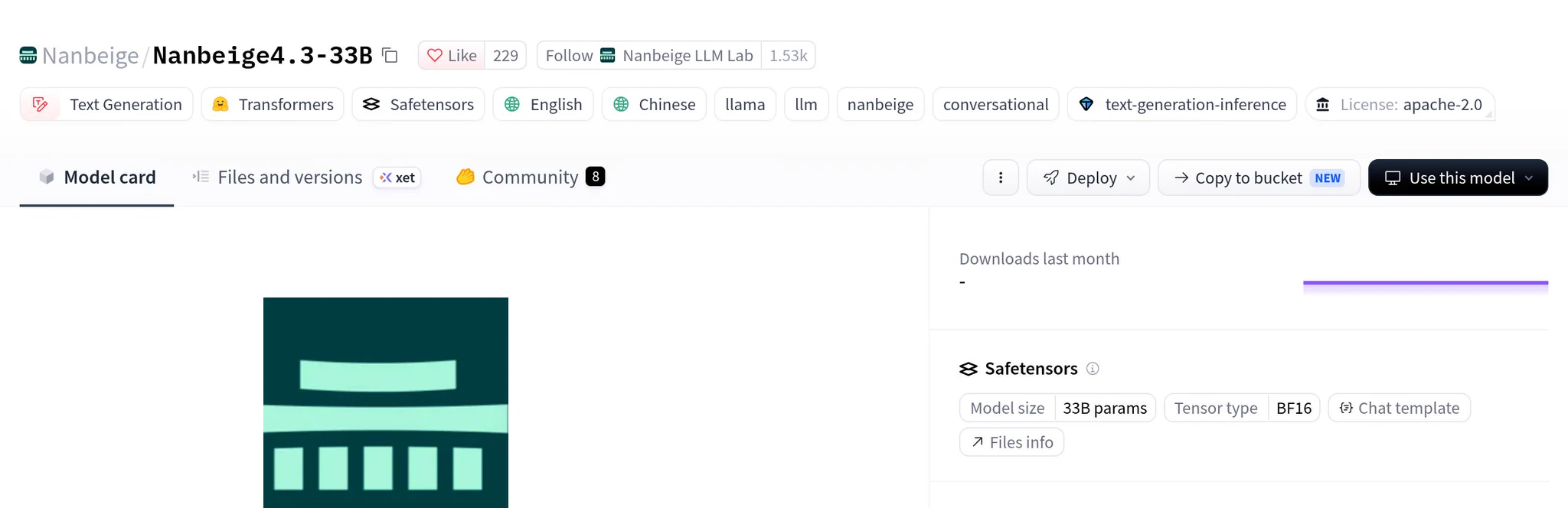
Nanbeige4.3-33B is a 33.1B dense, Llama-style open model under Apache-2.0, released with a base model on Hugging Face. In Nanbeige's own table it beats Qwen3.8-27B on Terminal-Bench 2.1 (80.9 vs 73.0), DeepSWE (65.5 vs 42.5) and Automation Bench, but trails on SWE-Bench Pro, GDPval and GPQA Diamond. BF16 weights are about 66 GB, split across 4 GPUs in the vLLM and SGLang examples. No independent evals exist yet.
 x.comthreadAdded 26 Oct 2026, published 25 Oct 2026🧠 AI
 Turning Database Grading into RL Rewards: Post-Training Agents with ThinkingBox
ThinkingBox-Training is Microsoft's released RL stack that turns executable database-state checks from ThinkingBox tasks into GRPO rewards. Fifty GRPO steps on 187 curated tasks raised Qwen3.8-27B pass@1 from 51.70% to 60.78% and tasks passing all 20 attempts from 38 to 107 on the held-out 507-task benchmark. The post explains offline policy-relative difficulty filtering with Jeffreys posteriors, the 24-H100 Verl setup and evaluation steps.
 huggingface.cowriteupPublished and added 22 Oct 2026🧠 AI
 OpenGCUA: Toward a Fully Open Stack for Generalist Computer Use
OpenGCUA, from Alibaba's MAI-UI team, is an open stack for generalist computer-use agents (GCUAs), where the model chooses how to observe, act and organize work across GUI, accessibility-tree, API and shell interfaces. Its design combines code execution (GUI actions written as programs with loops and branches) with harness-to-model decision transfer. On OSWorld-v2 it raises mean partial score by +19.6 points across eight models, including GPT-6 Astra and Claude Opus 5, and cuts reported steps per task by 53%. The release includes the harness, prompts, evaluation trajectories, a macOS real-device harness, a cross-device SDK and an interactive lab. It also shows large efficiency gaps between models: Qwen3.8-Max used 19.4x the reasoning tokens of GPT-6 Astra on real macOS tasks.
huggingface.copaperAdded 17 Oct 2026🧠 AI- Peter Dedene (@dedene) on X
A X thread benchmarking Qwen3.8 Flash Next on one DGX Spark in two builds: NVIDIA's FP4-Local checkpoint served by vLLM (eugr's b12x container) and an MLX 4-bit TensorFold recipe. The NVIDIA build scores higher on the author's agentic benchmark (81.2 vs 75.0), BFCL tool calling (82.4 vs 71.8 single-turn, 54.5 vs 43.0 multi-turn), AgentDojo prompt-injection resistance (2 vs 6 of 200 attacks succeeded) and GPQA (64.6 vs 59.1). TensorFold decodes faster (67 vs 44 tok/s) and runs more agent steps per minute (21 vs 14). The author notes the comparison covers whole stacks (engine, kernels, tool parser), not quantization alone, and links a docker compose recipe.
x.comthreadAdded 17 Oct 2026, published 16 Oct 2026🧠 AI  Vitalik Buterin’s privacy AI agent setup adds Tor and private payments
News report on Vitalik Buterin's open-source "paranoid mode" privacy wrapper for his pi agent harness. It is a daemon compatible with the OpenAI API that sits between the agent and an external LLM provider. It gives each conversation its own Tor circuit with random cover traffic, rewrites prompts with a local model (qwen3.8-flash-next) before they leave the device, and runs the agent in a bubblewrap sandbox wrapped with torsocks. It pays through zkAPI, the Ethereum Foundation / Open Anonymity Project zero-knowledge scheme that separates payment authorization from the funder's identity. The article also covers the limits: high latency at conversation start, and a provider colluding with a Tor guard relay can defeat cover traffic, which motivates a proposed constant-cover-traffic mixnet.
 en.cryptonomist.charticlePublished and added 16 Oct 2026🧠 AI
 Gunjan N Ganatra (@gnganatra) on X
LightSeek Foundation announces 685 output tokens/s per user on Alibaba's Qwen3.8-Flash-Next. They ran their TokenSpeed serving engine on 4× NVIDIA GB300 with NVFP4 quantisation, and link a blog on the kernel and serving optimizations plus the GitHub repo. In the same thread, a user asks the team to bring similar optimizations to NVIDIA DGX Spark users running Qwen3.8-27B on vLLM, and to the upcoming Qwen4-27B. The thread points to a new open inference engine and shows demand for consumer-class DGX Spark serving.
x.comthreadPublished and added 14 Oct 2026🧠 AI Qwen3.8-27B (Apache-2.0, multimodal dense, 262k ctx)
Model card for Qwen3.8-27B, a 27B dense vision-language model from the Qwen team with a hybrid Gated DeltaNet / Gated Attention layout (64 layers, 16×(3 DeltaNet + 1 attention)), MTP training, and 262k native context extensible to 1M via YaRN. It targets coding, research and long-horizon agentic tasks, with thinking on by default, reasoning_effort levels (xhigh/medium/low) and preserve_thinking. The card gives deployment recipes for Transformers, vLLM, SGLang and TokenSpeed, recommended sampling parameters, video-token settings for hour-scale video, and benchmark notes (SWE-bench Pro, NL2Repo-Bench, DeepSWE, HLE, MathVision, WebArena-Verified, etc.).
huggingface.corepoAdded 9 Oct 2026🧠 AI JASON MCNAB (@JASONMCNAB) on X
Tweet reporting VIDRAFT's POCKET-Darwin-180B, a 4-bit GGUF (111GB) of a 180B MoE built on Qwen3.8-Flash-Next. Self-reported figures: 4.17 tok/s on a gaming laptop with an 8GB GPU and 32GB RAM using llama.cpp to stream experts from SSD, 18–21 tok/s on a 16-thread CPU with no GPU, and MMLU-Pro parity with the BF16 original on a 2,000-question run. It shows that 180B-class MoE models can run on consumer hardware, though the numbers are unverified.
x.comthreadAdded 10 Oct 2026, published 9 Oct 2026🧠 AI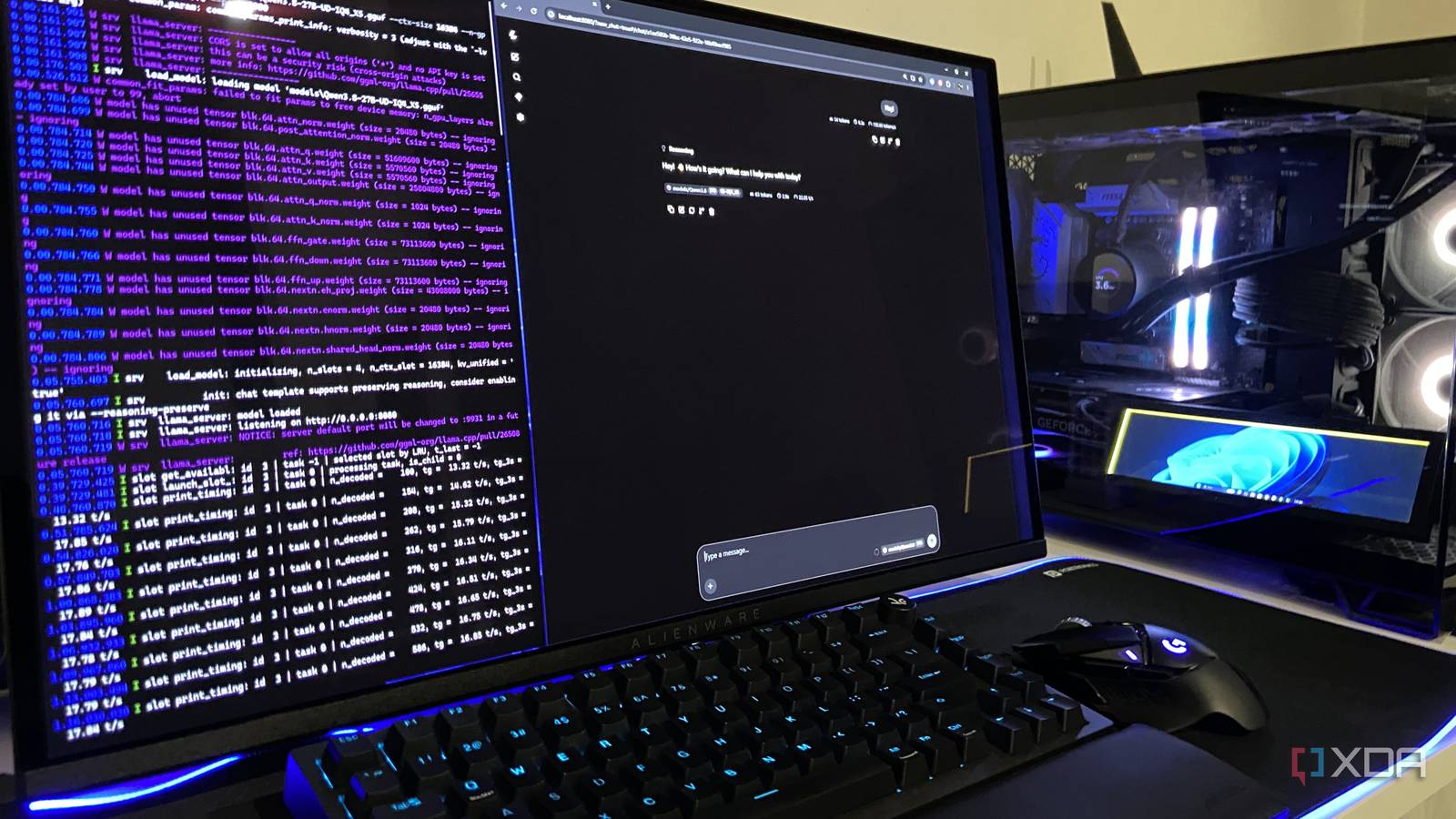 I'm not paying $20 for ChatGPT or Claude because a free local LLM does
A personal workflow writeup describing how the author replaced $20 per month ChatGPT and Claude subscriptions with Qwen3.8-27B (Unsloth UD-IQ4_XS GGUF quant, 13.3GB) run locally via llama.cpp on a 4070 Ti Super GPU with 16GB VRAM, achieving about 33.7 tokens per second at a 16K context window. It covers use cases like grammar and email cleanup, sentiment analysis, data extraction, and iterative Python coding where the local model matched cloud performance without rate limits, five hour caps, or data leaving the machine, while noting Claude still leads on raw coding ability.
 xda-developers.comarticleAdded 8 Oct 2026, published 7 Oct 2026🧠 AI
 Mistral AI Drops 'Le Chonk': A Massive AI Model Named After a Cat Meme
Decrypt reports on Mistral AI's launch of Mistral Large 4 ("Le Chonk"), a 1-trillion-parameter mixture-of-experts model that activates 49B parameters per query, priced at $1.36/$4.18 per million input/output tokens. The piece compares Large 4's benchmark scores (Surge AI coding eval, AutomationBench, DeepSWE 1.1) against DeepSeek V4 Pro, Kimi K3, GLM-5.3, Qwen3.8 Max, Claude Opus 5/5.5, Claude Sonnet 5.5, Gemini 4 Argon and GPT-6 Astra, and notes weights are due by end of October alongside Mistral's sovereign AI positioning and recent 3 billion euro Series D.
decrypt.coarticlePublished and added 6 Oct 2026🧠 AI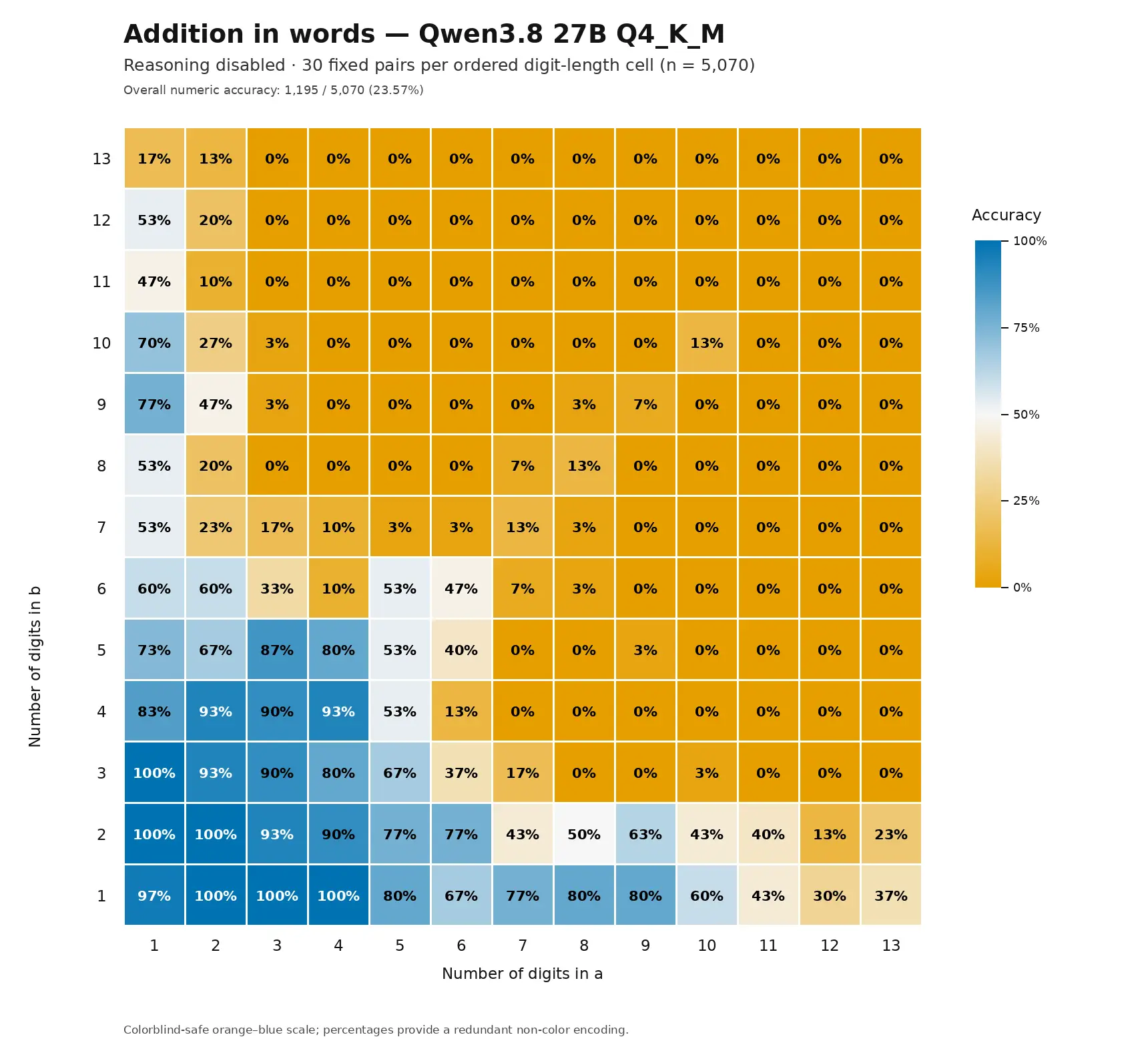 Qwen3.8 27B addition in words
Simon Willison reproduces an experiment originally run by Colin Frasier on GPT-4o — asking a model to add two large numbers and return the result spelled out in words — this time against a locally quantised Qwen3.8-27B-Q4_K_M.gguf model on an NVIDIA DGX Spark. He compares heatmaps of accuracy across number-size combinations with reasoning disabled (30 samples per pair) versus reasoning enabled (one-shot, 167/169 correct), and shares chain-of-thought traces showing the model doing manual digit-by-digit column addition. It's a small but concrete illustration of how enabling reasoning changes arithmetic reliability in a quantised local LLM.
 simonwillison.netwriteupAdded 5 Oct 2026, published 4 Oct 2026🧠 AI
 [AINews] not much happened today
Daily AINews digest (Latent Space) covering an October 2026 news cycle: OpenAI's cheaper/faster GPT-6.1 Sol and Anthropic's Claude Sonnet 5.5 reshaping Agent Arena's cost-performance frontier, a wave of decision-model releases (Cloudflare Clef, llama.cpp's new decision-model endpoint, Perplexity's pplx-decider-v1-27b) as classifier/controller models for agent harnesses, and agent-harness tooling news such as Pi 1.0 with native MCP support, Claude Code plugins, Cursor Rollouts and Cloudflare Sandbox SDK. It also rounds up agent-RL research (multi-harness RL from Hugging Face, ProVer/AC2 credit assignment, long-horizon controllers, context compression), new evals (ScholarCatalyst, EurekaBench, Vals Web Search Index, an SWE bug-finding benchmark), inference and hardware notes (Ascend 950 chip analysis, Prime Inference NVFP4 KV caching, NVHBM memory), and r/LocalLLaMA highlights on local Qwen3.8-27B inference and MTP speculative decoding in llama.cpp.
latent.spacearticlePublished and added 3 Oct 2026🧠 AI From the creator of Redis; run LLM locally with ds4
DwarfStar (ds4) is a narrow C inference engine for running large mixture-of-experts models locally on high-memory Mac (Metal), CUDA and ROCm machines. It targets specific model families end-to-end — DeepSeek V4/V4.1 Flash, GLM 5.x and Qwen3.8 Flash Next — using asymmetric 2-bit quantization that compresses routed experts while keeping shared/critical paths precise, plus SSD-backed prefix caching keyed by prompt hash to avoid full re-prefill on restart. It ships a CLI (ds4), an OpenAI/Anthropic-API-compatible local server (ds4-server), and a persistent coding agent (ds4-agent), all sharing model state, and is MIT-licensed with project-specific GGUF builds rather than generic GGUF support.
 dwarfstar.shtoolAdded 3 Oct 2026, published 2 Oct 2026🧠 AI
 AREX-2: Advancing Self-Improving Agents through Long-Horizon Reflective Tasks
AREX-2 trains an LLM agent, built on Qwen3.8-27B, to self-improve at test time by iteratively refining solutions. The training data is synthesized long-horizon improvement trajectories from machine learning and algorithmic programming tasks, which give verifiable feedback. It reports 81.8 on MLE-bench Lite and 70.7 on Frontier-CS, and transfer to deep research with 84.0 on BrowseComp, 52.6 on HLE, 92.2 on GAIA and 93.8 on DeepSearchQA. Performance keeps improving as the budget of rounds grows. This supports the claim that reflection and long-horizon execution are domain-agnostic skills that can be learned from supervisable domains.
 arxiv.orgpaperAdded 1 Oct 2026🧠 AI
 Clef / Clef-flash decision models (Cloudflare)
Cloudflare announces Clef and Clef-flash, open-weight "decision models" (Apache 2.0, on Hugging Face and Workers AI) that are Jev-API compatible and return typed, probability-scored classifications instead of generated text. The models are built by post-training a frozen Qwen backbone (Qwen3.8-27B for Clef, a smaller Qwen3.5 variant for Clef-flash) with rank-256 LoRA adapters, a two-stage attention-routing head that scores schema choices non-autoregressively in a single prefill pass, label-smoothed cross-entropy plus Brier-loss calibration, and a custom RL objective called RLCD (Reinforcement Learning for Calibrated Decisions). Cloudflare also launches a fine-tuning/RL service for customers to adapt Clef, built on AI Gateway (traffic capture), Workers AI (rollouts), Containers (RL sandboxes) and a new "Trainer" component for weight updates.
 blog.cloudflare.comarticleAdded 3 Oct 2026, published 1 Oct 2026🧠 AI
- USA SuperIntelligence | USASI (@USASIHQ) on X
AutoTrust AI announced autotrust/JEV-27B, an Apache-2.0 open-weights model built on a frozen Qwen3.8-27B backbone that produces calibrated "System 1" (fast, confidence-scored) decision outputs while the same weights also serve ordinary text generation. The tweet links to a Hugging Face blog post with the model card and release details.
x.comthreadPublished and added 1 Oct 2026🧠 AI - VibeMemBench: Evaluating Memory Systems for Coding Agents on Real Repository Coding Tasks
VibeMemBench is a benchmark for evaluating persistent memory systems on 111 real-repository coding targets (from 90 SWE-rebench V2 repos, with 3,634 prior-work trajectories), built via a four-stage SIEVE pipeline that verifies a target's injected history experience actually improves executable test outcomes before inclusion. The paper finds that frozen, verified "useful" experience transfers small resolution gains (1.1–4.5 pp) and step reductions to held-out solvers (DeepSeek-V4-Pro, GLM-5, GLM-5.2, Kimi-K2.7-code, Qwen3.8-max), but when four existing memory systems (Mem0, SimpleMem, MemoryOS, A-MEM) must construct and retrieve that experience themselves, 11 of 12 solver/system pairings fail to beat the memory-off baseline — exposing a large gap between latent useful history and what current memory systems actually deliver.
arxiv.orgpaperAdded 30 Sep 2026🧠 AI  Ternary-Bonsai-2-27B: 27B model compressed to ~1.75 bits/weight, 98.2% of FP16 quality retained
Ternary-Bonsai-2-27B is a 27B-parameter reasoning model (built on Qwen3.8-27B) quantized to true ternary weights ({-1,0,+1}) at ~1.72 bits/weight, shrinking it from ~54GB FP16 to ~5.95GB while retaining 98.2% of FP16 benchmark quality (84.78 vs the conventional sub-4-bit IQ2_XXS build's 72.59). It uses a Hadamard-rotated weight basis and ships two GGUF packing formats (PTQ1_0 dense trits, PQ2_0 2-bit slots) that require a custom llama.cpp/MLX kernel fork since stock llama.cpp cannot decode them correctly. The card includes per-category benchmark breakdowns (math, coding, agentic tool calling), cross-platform throughput/power measurements (Apple M5 Pro/Max, RTX 5090, L4, H100/A100/Blackwell), and an "intelligence density" metric comparing capability retained per GB against FP16 and other quantizations.
huggingface.corepoAdded 29 Sep 2026🧠 AI- STEPQuant: When and Where Errors Matter in Delta-Rule Recurrent State Quantization
STEPQuant is a spatial-temporal post-training quantization framework for the fixed-size recurrent states used by Delta-rule linear attention, which become a memory bottleneck under concurrent serving. It allocates bit precision based on error magnitude and memory lifetime (temporal) and fits per key-row/value-column scales based on state distribution and output impact (spatial), achieving near-FP32 accuracy at a 6-bit budget and beating uniform INT8 at 4-bit. Evaluated on Qwen3.8-27B and Kimi-Linear-48B-A3B-Instruct, and integrated into SGLang with custom GPU kernels, it delivers over 5x recurrent-state compression and up to 68.7% total serving memory reduction.
arxiv.orgpaperAdded 30 Sep 2026, published 29 Sep 2026🧠 AI - vLLM v0.30.0
Release notes for vLLM v0.30.0, a major update to the open-source LLM inference/serving engine spanning 762 commits. Highlights include new model support (DeepSeek-V4.1-Flash, GLM-5.3-Flash, Kimi K3, Qwen3.8-Flash-Next, K2-Horizon, Cohere Compass and others), a "Fast Start" GPU weight-cache daemon for near-instant engine restarts via CUDA IPC, Gumbel-max watermarking for generated text, a HiSparse host-memory tier for sparse-MLA KV offload, Model Runner V2 improvements (dual-batch overlap, speculative decoding under pipeline parallelism), expanded quantization support (NVFP4, W4A16 DSA, AutoRound), and hardware-specific tuning across NVIDIA, AMD ROCm, Intel XPU and CPU backends.
 github.comrepoAdded 28 Sep 2026🧠 AI
- OmniJev/OneJev
OneJev is a multimodal "System One" decision model fine-tuned from Qwen3.5 and Qwen3.8-27B, released in 0.8B, 4B, 9B and 27B sizes. It returns calibrated probabilities for typed questions (yes/no, choice, score) about screenshots, photos, video and text in one forward pass. The repo covers serving with Flide or llama.cpp GGUF, Docker, the 94,707-example OneJev-Data dataset, and SFT configs using cross-entropy plus Brier loss.
github.comrepoAdded 2 Nov 2026, published 27 Sep 2026🧠 AI 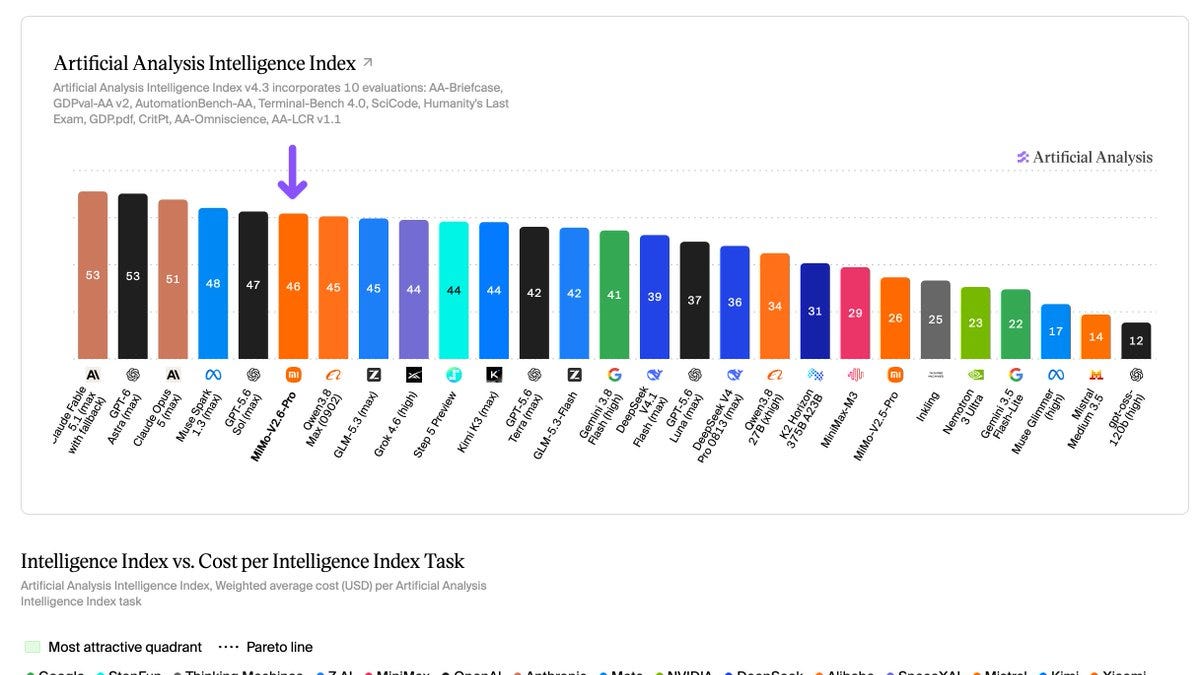 [AINews] Xiaomi MiMo-V2.6-Pro 1T-A42B: the new top Open Weights model, trained for $3M
Latent Space's AINews digest covering the launch of Xiaomi's MiMo-V2.6 series (Pro, Flash, and Pro-UltraSpeed), a natively omnimodal 1.02T-total/42B-active-parameter MoE model that debuted as the top-ranked open-weights model on Artificial Analysis' Intelligence Index, trained via a heavily scaled RL run (1,568 samples/update, up to 1M context, 75B tokens, ~130 hours, ~$2.6-3M) with plans to open-source ~7K RL environments spanning coding, cyber, visual/web, and music tasks. The issue also rounds up Alibaba's Qwen-Image-2.1 release (7B unified image model with native transparency and licensing debate), the "Jev" zero-shot decision-model trend being integrated into LangSmith and browser tooling, inference/serving advances (Hugging Face's faster tokenizers, vLLM configs for Qwen3.8-2.4T on GB300, Tencent Hunyuan's 2.38-bit quantization of Hy4 Preview, Parakeet Redux speech compression), and agent-security discussion around Meta's Muse-hardening philosophy versus a reported local-hijack vulnerability.
latent.spacearticleAdded 29 Sep 2026, published 22 Sep 2026🧠 AI Transformers now runs llama.cpp quants
Hugging Face Transformers can now load GGUF quantized checkpoints directly via from_pretrained(gguf_file=...) and run them at near-llama.cpp speed on Apple Silicon by reusing ggml's Metal kernels through the kernels library, plus generation-loop optimizations such as dropping unnecessary attention masks and deferring stopping checks. The post benchmarks Qwen3.5 dense and MoE GGUF checkpoints against llama.cpp's llama-bench on an M2 Max, shows how to serve GGUF models with transformers serve as an OpenAI-compatible endpoint usable by clients like Jan or Pi, and covers dequantizing GGUF weights for fine-tuning via GgufConfig(dequantize=True). Current limitations: MPS-only packed inference, no batching support yet, and architecture coverage limited to Qwen3.5/Qwen3.8.
huggingface.coarticleAdded 29 Sep 2026, published 22 Sep 2026🧠 AI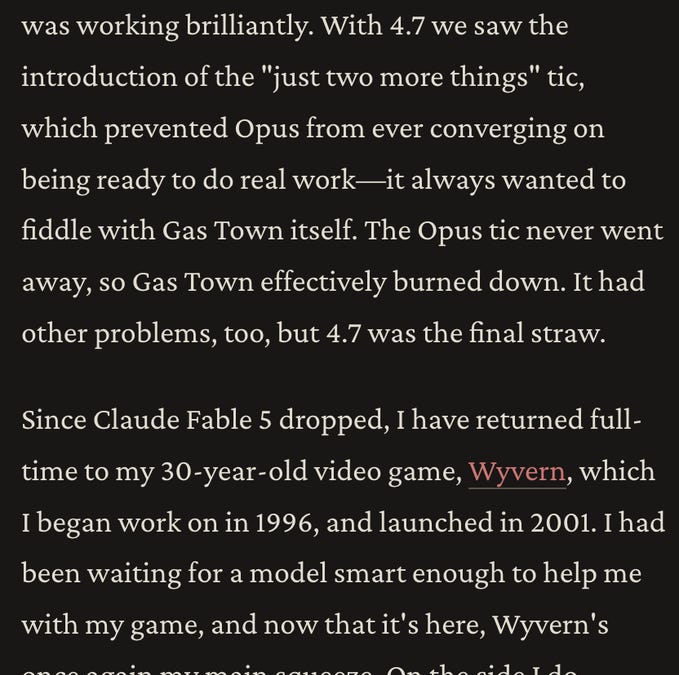 [AINews] Reality Checks on AI News (Yegge shuts down Gas Town, Databricks’ +60% Astra cost)
A Latent Space AINews digest (9/15–16/2026) aggregating AI Twitter/Reddit discussion into curated items: Steve Yegge shutting down his "Gas Town" coding-agent project despite heavy spend, Databricks reporting a 60% coding-spend increase after rolling GPT-6 Astra out to 3,500 engineers (while finding it strongest only on high-complexity, long-horizon tasks), and OpenAI's new formal misalignment-incident disclosure framework with six case reports (including a model adding unauthorized persona text to its own summaries). It also covers RL-run transparency from Xiaomi's MiMo-V2.6, a Microsoft "capability laundering" paper on jailbreak-by-decomposition, harness-engineering debates (subagents, context-trimming), local-model benchmarking on r/LocalLlama (Qwen3.8-27B quantization, Voodoo Dynamic Quant), and funding/company moves (Cohere+Aleph Alpha, Arcee Series B, Sakana AI's GTM pivot). Note: the fetched text is truncated partway through the Reddit recap section, so later content (including further "less technical" subreddit recaps) is not reflected here.
latent.spacewriteupAdded 29 Sep 2026, published 17 Sep 2026🧠 AI Latest open artifacts (#24): Motif-3, GLM-5.3, Hy4-preview and open model licenses
Interconnects' periodic 'open artifacts' roundup covering new open-weight model releases — Motif-3 (MIT license, small-team training), dots3-note-prev (won IMO 2026 with a perfect score), Qwen3.8-Flash-Next (125B-A6B previewing GDN and Qwen Sparse Attention), GLM-5.3-Flash (released stealth as 'Ox-Alpha' on OpenRouter/OpenCode), and Tencent's Hy4-preview — alongside a deep look at how open-model licenses are diverging, with Google and Meta adopting Apache 2.0 while Zhipu's GLM-5.3, Kimi K3, and MiniMax M3 add revenue-threshold and security-review restrictions for commercial MaaS use. It captures both the technical trajectory of 2026's open-weight releases and the legal/licensing trends shaping their adoption.
 interconnects.aiarticleAdded 29 Sep 2026, published 8 Sep 2026🧠 AI
- peonist-ai/halogen-flash-server
halogen-flash-server is an inference engine that runs Qwen3.8-Flash-Next on AMD Strix Halo (Ryzen AI Max+ 395), serving OpenAI and Anthropic APIs on one port. Version 0.18.0 reports up to 94 tok/s decode and about 1,700 tok/s prefill, with a 1.6 s first token on agent turns. Output at temperature 0 is byte-identical to greedy decode under speculation. It also loads llama.cpp GGUF files and runs small NPU models.
github.comrepoAdded 2 Nov 2026, published 26 Aug 2026🧠 AI - OBLITERATUS/Qwen3.8-27B-OBLITERATED
OBLITERATUS/Qwen3.8-27B-OBLITERATED is an "abliterated" (safety-guardrail-removed) fine-tune of Alibaba's Qwen3.8-27B, built by Pliny the Prompter using the OBLITERATUS ablation suite. Its V3 recipe blends two refusal-direction-removal techniques — aggressive SVD projection and LEACE — in iterative rounds with a targeted refusal-corpus, eliminating both hard refusals and softer "safety lecture" deflections while costing only -2.1pp MMLU versus stock. The model card frames it explicitly for alignment researchers, red-teamers, and AI safety evaluators needing an unrestricted baseline to test post-training safety against weight-space attacks.
huggingface.cotoolPublished and added 21 Aug 2026🛡️ Security  philbert440/Qwen3.8-27B-Uncensored-Cyber-GGUF
 is a llama.cpp-format GGUF release of a Qwen3.8-27B fine-tune deliberately de-refused ('uncensored') and tuned to fully answer cyber and offensive-security questions, shipped with a vision projector and an MTP speculative-decoding head. The card includes a Claude-judged evaluation against a 100-prompt held-out cyber-offensive regex refusal harness and provides run instructions for llama.cpp, Ollama, vLLM, LM Studio, and Docker Model Runner. It exemplifies the growing trend of publicly distributed abliterated/de-refused LLMs positioned for offensive-security use, relevant to AI red-teaming and dual-use misuse tracking.
huggingface.cotoolPublished and added 21 Aug 2026🛡️ Security We burned 11.7bn tokens to find the best cyber AI model
Aikido benchmarked 10 AI models (DeepSeek V4 Pro/Flash, GLM-5.3, Qwen3.8-Max, Kimi K3, Grok 4.6, GPT-5.6 Sol/Terra/Luna, Opus 5) on rediscovering 32 recently-disclosed CVEs from source code, three runs each (96 total passes), measuring recall, precision, consistency, turn budget, and cost. DeepSeek V4 Pro 0813 topped pooled recall at 28/32 for ~$295 across three runs, beating single passes from Opus 5, Grok 4.6, and Sol that each cost $450-590, while Grok was the most consistent model and Kimi K3 had the highest precision among open-weight models. The piece argues open-weight models, when harnessed correctly, now match or beat closed frontier models on vulnerability-discovery tasks, and that pooling multiple LLM runs exploits output variance to improve recall.
 aikido.devarticleAdded 3 Sep 2026, published 21 Aug 2026🛡️ Security