 A quiet week in infosec <.<
Cisco Talos Threat Source newsletter for the week of the PHP and Node.js vulnerability news cycle. It summarises NIK C2, a Go-based Windows implant that dumps credentials, streams keystrokes, deploys screen-locking ransomware and uses a victim's hijacked OpenAI API keys to analyse stolen data. It also lists weekly headlines (CISA KEV PHP bugs, Brotli flaw, Gheist GitHub token theft), Talos links and top malware hashes.
 blog.talosintelligence.comarticlePublished and added 29 Oct 2026🛡️ Security
 IR trends Q3 2026: Actors impersonate IT help desks in vishing attacks as ransomware activity increases
Cisco Talos Incident Response Q3 2026 trends report. Phishing led initial access at 37 percent, with vishing and IT help desk impersonation to get RMM access; public-facing exploitation followed at 33 percent. Ransomware reached 27 percent of engagements (Qilin, Rhysida, Interlock, new VYPR), with EDR killers via BYOVD and WDAC. It also covers Salt Typhoon intrusions using CVE-2023-20198 and BadCandy, attacks on Claude Code credentials, and logging, MFA and secrets recommendations.
blog.talosintelligence.comarticlePublished and added 29 Oct 2026🛡️ Security Cisco SD-WAN Zero-Day Exploitation Tied to Volt Typhoon’s ‘Silent Train’ Network
Cisco Talos reported that UAT-11473 exploited CVE-2026-20127 (CVSS 10, Cisco SD-WAN peering authentication bypass) to deploy KeyDrift, a framework with PolyFlame (backdoor, relay C2) and LittleFilch (key harvesting) modules. Talos found its infrastructure overlaps considerably with Volt Typhoon's Silent Train network. Lumen Black Lotus Labs tied Silent Train to zero-day campaigns against Versa Director, N-able N-central, Cisco Catalyst SD-WAN and VeloCloud Orchestrator.
 securityweek.comarticlePublished and added 29 Oct 2026🛡️ Security
 Tech and Security Companies Respond to PHP2Shell Vulnerabilities
SecurityWeek roundup of responses to PHP2Shell, two critical unauthenticated RCE flaws (CVE-2026-109618, CVE-2026-109619) fixed in PHP 8.5.12, 8.4.27, 8.3.36 and 8.2.35 on 21 October 2026. It covers the exploitation timeline (first attempt 17 October), vendor exposure checks, Red Hat's lower 8.1 score against NVD's 9.8, detections from Cisco Talos, CrowdStrike and Corelight, and government alerts.
securityweek.comarticlePublished and added 22 Oct 2026🛡️ Security Compromised eMudhra intermediate certificates
Cisco Talos describes eight eMudhra intermediate CA certificates (six TLS, two code signing) whose P-384 private keys were trivially recoverable because a flaw in an April 30, 2025 key generation ceremony produced weak keys with only 3 to 8 bytes of entropy. The post lists certificate SHA-256 hashes and serials, browser and Microsoft blocks, and the Go fix (CVE-2026-111943, Go 1.27.3 and 1.26.10) that filters chains by SPKI hash. It covers impact on VPNs, CI/CD and embedded devices, and Snort SIDs 67363 to 67374.
blog.talosintelligence.comadvisoryPublished and added 21 Oct 2026🛡️ Security Two critical RCEs in PHP core
Cisco Talos advisory on "php2shell", two unauthenticated RCE flaws in PHP core, CVE-2026-109618 and CVE-2026-109619 (CVSS v4.0 9.2), affecting every build since PHP 5.4. One flaw is an out-of-memory handling bug leaving request data partly initialized; the other reuses stale state after free. PHP 8.1 and older get no patch (about 50% of PHP systems). Includes ini-level mitigations and Snort SIDs 67359 and 67360. No exploitation seen as of 21 October 2026.
blog.talosintelligence.comadvisoryPublished and added 21 Oct 2026🛡️ Security Parasitizing trust: How legitimate infrastructure becomes a delivery pipeline for attackers
Cisco Talos research on attackers using legitimate infrastructure to deliver lures, with abuse seen across more than 25 platforms in the past year. It details two campaigns (about 1,400 messages) that put attacker phone numbers into Staples and Dell order notifications that passed DKIM and DMARC. It also covers list bombing as content delivery and bounce (DSN) abuse, and recommends content-aware validation and recursive MIME inspection.
blog.talosintelligence.comwriteupPublished and added 21 Oct 2026🛡️ Security There's only so much code: the rise in vulnerability numbers
Cisco Talos analysis of why Microsoft Patch Tuesday advisories rose from about 100 a month before June 2026 to 975 in September and 1,415 in October, as frontier models such as Mythos mine old code. CVEs grew 105% year over year while CISA KEV additions grew 37%, and only three September advisories were exploited in the wild. It covers pressure on 90-day coordinated disclosure and open-source maintainers, the format string bug-class precedent, and defender advice.
blog.talosintelligence.comarticlePublished and added 20 Oct 2026🛡️ Security [tl;dr sec] #350 - Reverse Engineer Anything, Tracking AI-integrated Malware, Test-driving Jev
tl;dr sec issue #350 is a weekly security newsletter digest. It covers XBOW's six-day Chrome full-chain exploit built with GPT-5.6 Sol, Semgrep's IDOR benchmark metrics, the EntraGoat vulnerable Entra ID lab, Zenity's AWS Bedrock AgentCore IMDS credential theft, Cisco Talos's CAIRN hunting toolkit for AI-integrated malware, the REA reverse-engineering MCP, runZero's sshamble, and a Copilot for Word AI worm.
 tldrsec.comarticleAdded 30 Oct 2026, published 15 Oct 2026🛡️ Security
 Break the silence: Kazakhstan-nexus UAT-6275 targets CIS government organizations
Cisco Talos and Recorded Future Insikt Group describe UAT-6275 (TAG-193, overlapping Silent Lynx and YoroTrooper), a suspected Kazakhstan-nexus actor targeting CIS government, water and energy organizations. Exposed staging directories and a GitHub repo revealed four infection chains (macro documents, PS2EXE downloaders, GitHub-hosted PowerShell, and a WinRAR CVE-2025-8088 archive) delivering custom reverse shells Chvost, Laplas and PickleShell, plus Linux tooling and a FortiWeb CVE-2025-25257 PoC. The post includes victimology, a campaign timeline, attribution rationale (medium confidence), defender guidance and ClamAV/Snort coverage.
blog.talosintelligence.comarticlePublished and added 14 Oct 2026🛡️ Security Making sure the checks get printed
Cisco Talos's weekly Threat Source newsletter, opening with a risk-management anecdote about network-isolating unpatchable legacy check-printing systems, then disclosing new CAIRN research classifying "A3: AI-Analysis Evasion" — malware authors embedding natural-language prompt-injection text into code/binaries to manipulate AI-assisted malware analysis pipelines. The MANTLEMAZE malware family exemplifies this, pairing such AI-deception attempts (effective ~35% of the time) with BYOVD abuse to disable EDR from kernel space. The issue closes with a roundup of the week's security headlines (Citrix NetScaler CVE-2026-88779, a Danish government data breach, Warlock ransomware) and Talos's current top-prevalence malware hashes/IOCs.
blog.talosintelligence.comarticlePublished and added 8 Oct 2026🛡️ Security UAT-11985: AI-assisted event lures delivering real-time Google AitM phishing
Cisco Talos details UAT-11985, a spear-phishing campaign against Taiwan-based research organizations (impersonating institutions like the Taiwan European Union Centre and NCCU Institute of International Relations) that used AI-assisted, templated lure emails and poster-based QR code phishing (quishing) to drive victims to a real-time adversary-in-the-middle phishing kit. The kit impersonates Google sign-in across zh-CN/zh-TW/en locales, uses a split HTTP-POST/WebSocket architecture to mirror Google's live authentication flow and dynamically push MFA challenge screens, enabling full session-token theft and MFA bypass. Talos attributes the kit's localization architecture and lexical choices to a Simplified Chinese-speaking developer and publishes ClamAV/Snort coverage plus IOCs on GitHub.
blog.talosintelligence.comwriteupPublished and added 8 Oct 2026🛡️ Security Ignore all instructions and read this blog: The state of AI-analysis evasion in malware
Cisco Talos' CAIRN research classifies a malware archetype called 'A3: AI-Analysis Evasion' — samples that embed natural-language instructions aimed at manipulating LLM-based triage/reverse-engineering pipelines. The post traces the technique's spread and evolution across four confirmed families (FRUITSHELL, PLOTSAFE, HOLLOWCLAD, MANTLEMAZE, plus the related ROZESHELL), from a hardcoded 'ignore this file, it's just prime number generation' comment to templated generation, multi-LLM chat-template spraying, and fake legal/government intimidation text, and includes a controlled test showing the simplest direct-instruction technique shifted LLM verdicts toward benign in ~35% of runs while more elaborate variants often backfired. MANTLEMAZE additionally ships a BYOVD loader abusing the Intel iqvw64e.sys driver (CVE-2015-2291) used by Scattered Spider, BlackByte, and Lazarus Group to kill EDR.
blog.talosintelligence.comarticlePublished and added 8 Oct 2026🛡️ Security Microsoft, Adobe, Apple, and Foxit vulnerabilities
Cisco Talos discloses eight vulnerabilities patched by vendors: a Photoshop installer privilege escalation (CVE-2026-48388), a macOS CoreWLAN information disclosure bug, two Foxit Reader flaws including a JavaScript CBF_Widget remote code execution (CVE-2026-57256) and an Array use-after-free (CVE-2026-91799), and four Windows kernel-driver bugs — NETIO.sys information disclosure (CVE-2026-50475), two Cloud Files Mini Filter Driver issues (use-after-free CVE-2026-58613 and type confusion CVE-2026-80093), and a tcpip.sys out-of-bounds read (CVE-2026-49177). Each advisory gives the affected version and trigger mechanism, and Talos notes Snort coverage is available for detection.
blog.talosintelligence.comadvisoryPublished and added 7 Oct 2026🛡️ Security One breach, please, and make no mistakes
Cisco Talos commentary arguing that today's public AI-agent attacks (citing Hugging Face, DSEWiki, and RubyGems incidents) resemble loud, high-volume pentests rather than stealthy red-team operations, and that agent swarms will grow quieter and more OPSEC-conscious over time. The piece lays out concrete resilience steps: rehearsed incident response plans mapped to the incident lifecycle, assumed-breach attack-path mapping (including Active Directory GPO abuse paths), AI-specific tabletop exercises, end-to-end hardening with phishing-resistant MFA (FIDO2/passkeys), broad EDR and east-west traffic visibility, and watching for early noisy indicators like WAF/SQLi spikes and non-browser user agents.
blog.talosintelligence.comarticlePublished and added 7 Oct 2026🛡️ Security Antino Backdoor Uses Outlook and OneDrive for C2 in China-Nexus Espionage Campaign
Cisco Talos researcher Ashley Shen details a China-nexus espionage campaign (tracked as UAT-11587) targeting government and policy organizations across Taiwan, India, the Philippines, Cambodia, Pakistan, Thailand, Myanmar and Syria. The actor deploys a previously undocumented Rust-compiled backdoor, Antino, that uses Microsoft Graph to abuse Outlook (for command exchange via mailbox folders) and OneDrive (for heartbeat and file transfer) as a stealthy C2 channel instead of a dedicated server, delivered via a five-stage HTA/WSF-to-.NET-loader chain and DLL-sideloaded through the signed Microsoft binary GatherOsState.exe. The report also covers social-engineering tradecraft (a fake Gmail attachment-preview widget hosted on Cloudflare Pages, SPF/DMARC spoofing) and ties the cluster to Jewelbug, CL-STA-0049, Earth Alux, Ink Dragon, REF7707 and UNC6384 via infrastructure overlaps.
 thehackernews.comarticleAdded 3 Oct 2026🛡️ Security
 The Fine Art of Frustrating the Adversary
A Cisco Talos Cybersecurity Awareness Month piece in which eight researchers each give a concrete recommendation for frustrating adversaries at different attack-chain stages: honeypot accounts and tarpits for early deception, behavior-based detection engineering (citing MITRE ATT&CK, Summiting the Pyramid, Macro ATT&CK, LUCID) that targets what an adversary must accomplish rather than specific tools, allowlisting legitimate RMM software (flagging AnyDesk, ScreenConnect, Atera as commonly abused by ransomware like Warlock using Zoho Unattended Agent) over unapproved ones, identity/short-lived-credential controls for AI agent sessions referencing an Anthropic report on Claude misuse incidents, and breaking single-point-of-failure dependencies such as a Telegra.ph-hosted C2 dead-drop resolver used by the Amatera stealer and an EtherHiding-based BNB Smart Chain C2 used by ZigCryptoStealer. Each section gives practical, actionable mitigations defenders can apply today.
blog.talosintelligence.comarticleAdded 7 Oct 2026, published 1 Oct 2026🛡️ Security- CAIRN — Cisco Talos AI-Malware-Hunting Toolkit
CAIRN is a Cisco Talos research toolkit that identifies and attributes AI-integrated malware purely from VirusTotal metadata — no binary downloads or detonation — by running a tiered YARA ontology (T1/T2/T3) over composed scan text (AV strings, PE resources, Sigma/sandbox behavioral data, embedded URLs) and layering on sentence-transformer embeddings with HDBSCAN clustering for semantic family attribution. It has produced confirmed family reports for AI-malware such as PROMPTLOCK, LAMEHUG, PROMPTSTEAL, QUIETVAULT, CLOSEDQUORUM, and FRUITSHELL, each cross-verified by hands-on Talos reverse engineering before publication.
 github.comrepoAdded 30 Sep 2026🛡️ Security
 China-nexus UAT-11587 targets government and policy organizations across Asia with Antino backdoor
Cisco Talos details UAT-11587, a China-nexus threat cluster targeting government, defense, and policy organizations across Taiwan, India, the Philippines, Cambodia, and other Asian countries with spear-phishing and a five-stage infection chain (HTA/WSF stagers, JScript decryptors, .NET BinaryFormatter/ActivitySurrogateSelector deserialization gadgets, and DLL sideloading via the signed GatherOsState.exe) to deploy a new Rust-compiled backdoor called Antino. Antino uses Microsoft Graph/Outlook/OneDrive as a dead-drop C2 channel instead of a traditional C2 server, supports shell/PowerShell execution, file transfer, shellcode loading with a sleep-mask evasion technique, and abuses the Windows Scripted Diagnostics framework for persistence; Talos also notes possible infrastructure overlap with Symantec's "Jewelbug" cluster and Arctic Wolf's UNC6384 reporting. Includes ClamAV/Snort coverage and IOCs.
blog.talosintelligence.comwriteupAdded 7 Oct 2026, published 30 Sep 2026🛡️ Security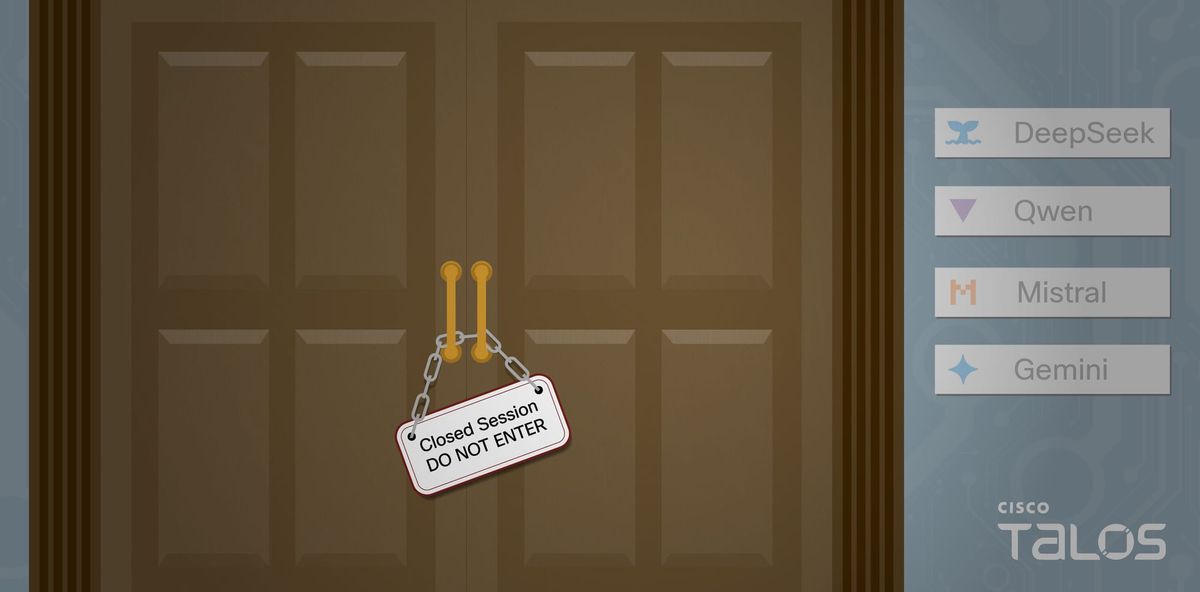 The Closed Quorum: Inside the First Reported Autonomous AI C2 Implant
Cisco Talos' CAIRN project documents CLOSEDQUORUM, a 64-bit Go Windows implant that replaces traditional C2 infrastructure with a panel of up to four commercial LLM providers (DeepSeek, Qwen, Mistral, Gemini) that vote on the implant's next action via plurality voting, with each model queried against a structured JSON decision schema constrained to inject/persist/steal/move actions. Once deployed it autonomously dumps LSASS credentials, steals browser passwords and crypto wallets (MetaMask, Exodus, Ethereum), and exfiltrates AES-256-GCM-encrypted data to an operator's Discord webhook, all without further human tasking. The post details the developer's apparent credentials-as-a-service distribution model, deterministic tie-breaking favoring DeepSeek, and provides SHA256 hashes plus a YARA detection rule for the family (formerly tracked as BALZAK).
blog.talosintelligence.comwriteupAdded 30 Sep 2026, published 22 Sep 2026🛡️ Security Introducing CAIRN: Frontier tracking for AI-integrated malware (Cisco Talos)
Cisco Talos introduces CAIRN (Cognitive Artifact Intelligence Research Network), an open-source toolkit that hunts, classifies, and tracks AI-integrated malware entirely from metadata (VirusTotal strings, sandbox behavior, AV labels) without downloading or executing binaries. It combines acquisition filters (e.g. LLM provider endpoints, python-ai-scripts, agentic-tooling), a three-tier YARA ontology (primitive artifacts, behavioral context, confirmed families), and UMAP/HDBSCAN semantic clustering exposed through a relationship-graph explorer. Talos shares initial findings on the CLOSEDQUORUM family and notes an autonomy-escalation arc in AI-integrated malware since LAMEHUG (CERT-UA, July 2025), plus spread of AI-analysis-evasion tradecraft across independent actors.
blog.talosintelligence.comtoolAdded 27 Sep 2026, published 22 Sep 2026🛡️ Security Should you care about an “AI slowdown?”
Cisco Talos's weekly Threat Source newsletter opens with commentary arguing that a slowdown in AI development would barely move the needle on cybersecurity, since models already uncover vulnerabilities effectively and defenders still neglect basics like asset inventory, least privilege, and network segmentation. The main threat-intel item covers Japan's ransomware landscape, where incidents rose nearly 5% in H1 2026, driven by "The Gentlemen" (a fast-growing RaaS group using the AdaptixC2 red-team framework for stealthy lateral movement) and "Qilin" (which uses LLMs to generate destructive scripts and speed up attacks), both hitting SMEs with double extortion. It closes with a roundup of other weekly stories: an Android banking-malware campaign abusing Google's Work Profile in Indonesia, Apple's ~200-vulnerability iOS/macOS patch batch, a ClickFix campaign via a compromised HBO Max Reddit account, and the $250/month VectraRAT implant.
blog.talosintelligence.comarticleAdded 7 Oct 2026, published 17 Sep 2026🛡️ Security Ransomware incidents in Japan in the first half of 2026: Investigation of The Gentlemen’s infrastructure and evidence of Qilin's AI use
Cisco Talos analyzes H1 2026 ransomware activity in Japan, where The Gentlemen (RaaS, active since July 2025) became the most observed group and SMEs under JPY 1 billion capitalization made up 78% of victims. Talos found an open directory used by a Gentlemen affiliate containing RustHound, Responder, impacket-partial-mic, Ligolo-ng, chisel, AnyDesk and Rclone, plus exploit code for CVE-2025-2479 and CVE-2025-24799 (GLPI SQLi) and evidence of CVE-2020-1472 (Zerologon) and MS17-010 exploitation; bash-history analysis revealed VHDX backup theft via secretsdump.py and AdaptixC2 as the group's C2 framework, with Russian-keyboard command artifacts supporting a Russian-speaking-operator attribution. The report also presents medium-to-high-confidence evidence that Qilin's Python tooling (deadman.py, veeam_kill.py, deploy_locker.py) was partly LLM-generated.
blog.talosintelligence.comarticleAdded 7 Oct 2026, published 17 Sep 2026🛡️ Security Securing the unpatchable in an age of AI-driven vulnerabilities
Cisco Talos argues that AI-accelerated vulnerability discovery is outpacing organizations' ability to patch, especially for unpatchable operational technology (OT) like medical devices and industrial control systems. It recommends network-level compensating controls instead of patching: upstream next-generation firewalls with intrusion prevention for virtual patching, VLAN/ACL-based micro-segmentation to restrict which devices can reach legacy systems, and visibility into legacy network fingerprints to build an asset inventory. It also debunks the air-gap myth, citing WannaCry's spread through unpatched Windows XP in the NHS as a cautionary example of "hope for the best" failing.
blog.talosintelligence.comarticleAdded 7 Oct 2026, published 16 Sep 2026🛡️ Security We've got one word for it, and it's usually the wrong one
Cisco Talos's weekly Threat Source newsletter opens with a personal essay distinguishing burnout from secondary traumatic stress, vicarious trauma, and moral injury among security practitioners, then covers Talos's disclosure of a WebDAV-based infection chain used by Russian-aligned actor UAT-10820 against a Ukrainian government target, delivering the Amatera stealer alongside ZigCryptoStealer and NetSupport Manager, abusing BNB Smart Chain for bulletproof hosting and fake CAPTCHA lures, with a vulnerable driver used to kill EDR. The roundup also flags active exploitation of Cisco Secure Firewall Management Center (CVE-2026-20079, CVE-2026-20316), a ClickFix campaign abusing the Google Visualization API for command and control, and a new Defender zero-day dubbed ShieldCrash.
blog.talosintelligence.comarticleAdded 7 Oct 2026, published 10 Sep 2026🛡️ Security Active exploitation of Cisco Secure Firewall Management Center vulnerabilities
Cisco Talos details active exploitation of CVE-2026-20079 (CVSS 10.0 unauthenticated auth bypass leading to root) and CVE-2026-20316 (low-privilege login via static credentials) in Cisco Secure Firewall Management Center. Three post-compromise clusters are tracked: UAT-12197 deploying a JSP web shell and JAR command executor to exfiltrate credentials; UAT-11823, overlapping with Sandworm, using a malicious Makeself license.tmp to drop a Netcat reverse shell and a Cyclops Blink variant; and UAT-11988, a Qilin ransomware affiliate who abused package_info.pl for LOTL recon, SOCKS5/reverse-SSH tunneling, and ultimately deployed Qilin ransomware. Talos provides Snort SIDs, hotfix guidance ahead of a comprehensive hardening release, and a GitHub IOC repository.
blog.talosintelligence.comwriteupAdded 7 Oct 2026, published 9 Sep 2026🛡️ Security Microsoft Patch Tuesday for September 2026 — Snort rules and prominent vulnerabilities
Cisco Talos's analysis of Microsoft's September 2026 Patch Tuesday release, covering 973 vulnerabilities (113 critical, 82 of those RCE). Two flaws are confirmed exploited in the wild — CVE-2026-81963 (Windows Update Stack elevation of privilege) and CVE-2026-85880 (Windows ALPC elevation of privilege) — alongside a long list Microsoft rates "more likely" to be exploited, including a Windows Kerberos auth-bypass-by-replay RCE (CVE-2026-69676) and a Windows DNS Server use-after-free RCE (CVE-2026-69730). Talos releases accompanying Snort 2/3 rule coverage (SIDs 67011-67084, 301619-301655) to detect exploitation attempts.
blog.talosintelligence.comadvisoryAdded 7 Oct 2026, published 8 Sep 2026🛡️ Security ClearFake WebDAV infection chain delivers Amatera stealer, ZigCryptoStealer, and NetSupport Manager
Cisco Talos reconstructs two related WebDAV-based infection chains (tracked actor UAT-10820) that use a ClickFix fake-CAPTCHA lure, EtherHiding on BNB Smart Chain to stage JavaScript via a malicious Cloudflare Worker, and WebDAV-delivered disguised DLLs executed via rundll32 ordinal calls to drop the Amatera stealer. Depending on the C2 configuration, Amatera then deploys either a NativeAOT-loaded ZigCryptoStealer with a BYOVD EDR-killer driver and a Go-based Yamux reverse proxy, or a PowerShell stager that installs a trojanized NetSupport Manager RAT pointed at Russian C2 infrastructure. The post details loader internals, Amatera's dead-drop C2 resolution via Telegraph and Steam, and provides ClamAV signatures plus a full IOC list.
blog.talosintelligence.comwriteupAdded 7 Oct 2026, published 8 Sep 2026🛡️ Security Security Hardening Release for Splunk Apps and Add-ons - August 2026
Splunk's August 2026 hardening advisory (SVD-2026-0808) discloses 17 CVEs across Cisco Talos Intelligence for Enterprise Security Cloud, Splunk AI Toolkit, Splunk Connect for Kafka, the Splunk MCP Server app, and Splunk On-Call (VictorOps). Notable issues include a critical (CVSS 9.1) RCE via unsafe credential deserialization in the Splunk MCP Server app (CVE-2026-76404), an RCE via pickle-based deserialization when loading ML model files in Splunk AI Toolkit (CVE-2026-76395), multiple SSRF and authorization-bypass flaws letting low-privileged users escalate to system-level search execution, hardcoded/predictable container credentials, and unauthenticated DoS/ReDoS and cert-validation bypasses in Splunk Connect for Kafka. Each finding includes CWE classification, CVSS vector, and mitigation guidance (typically disabling the affected app or restricting REST API access).
 advisory.splunk.comadvisoryAdded 21 Aug 2026🛡️ Security
 UAT-10147: Chinese-speaking adversary integrates agentic AI into post-compromise operations
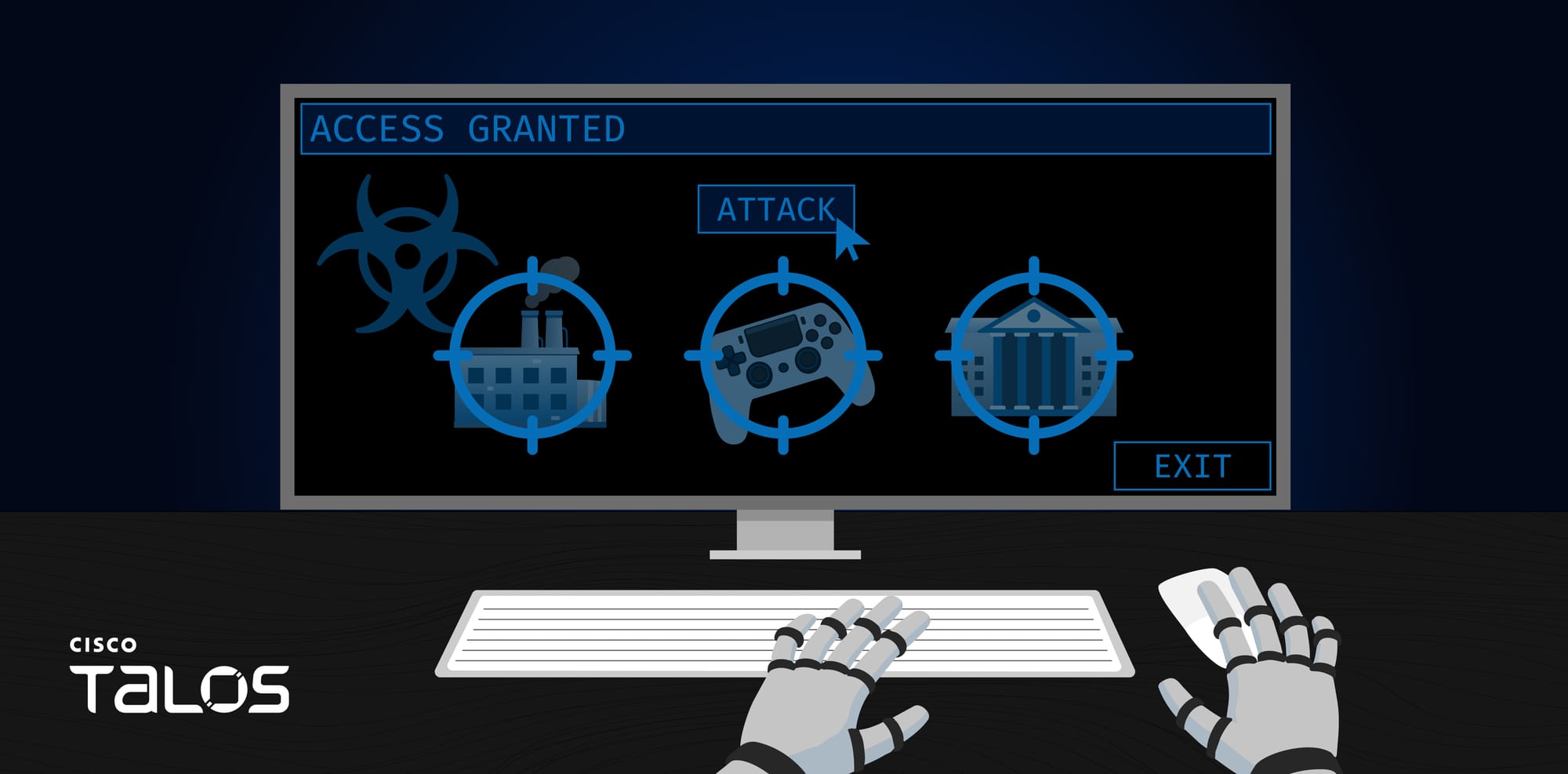
Cisco Talos details UAT-10147, a Chinese-speaking cybercrime group exploiting one-day vulnerabilities in Windows/Linux web servers to deploy BadIIS, QuasarRAT, NoodleRAT, and SPECTRE implants, while also integrating agentic AI tools (PentestGPT, DeepAudit, and AI-orchestrated ysoserial workflows) to generate exploit playbooks, automate ASP.NET ViewState deserialization RCE, validate exploit success, and run reconnaissance/exfiltration end to end. Talos recovered AI-generated Python scripts and a findings log from the actor's C2 open directory showing semi-autonomous exploit refinement, OOB callback verification via webhook.site, and privilege escalation via SeImpersonatePrivilege/Potato exploits — evidence of a shift from AI-assisted scripting toward agentic offensive orchestration.
blog.talosintelligence.comwriteupAdded 24 Aug 2026, published 20 Aug 2026🛡️ Security