 Bulletproof Host Virtualine Loses Its Domain to FBI Seizure
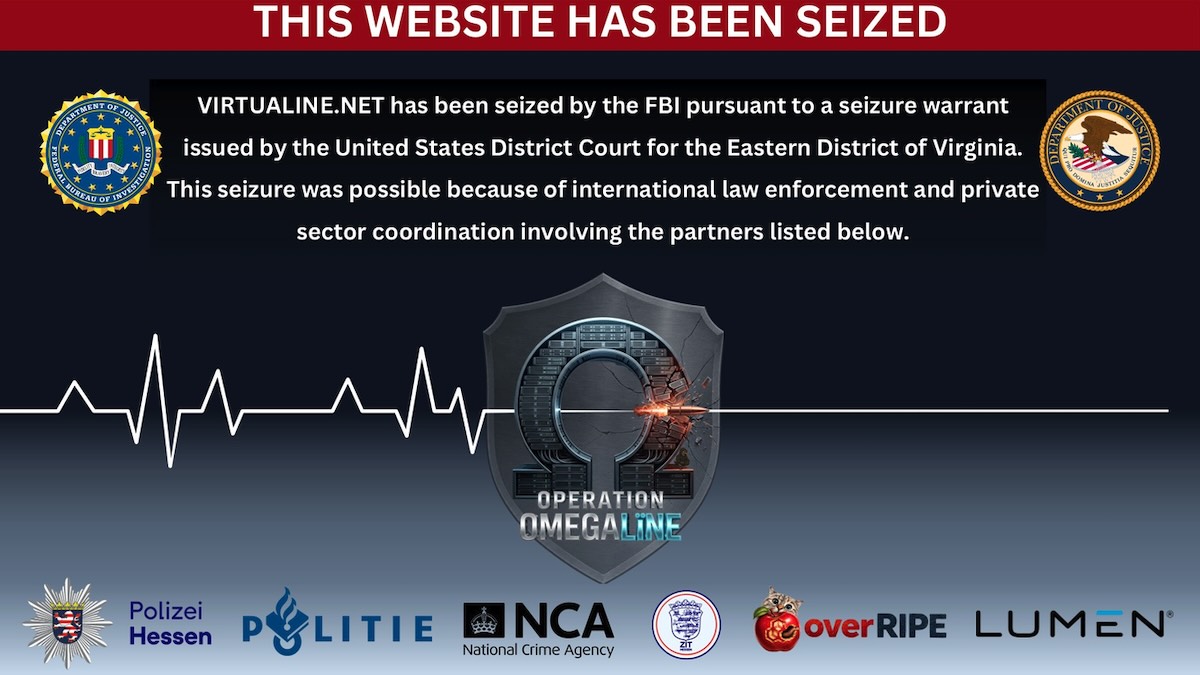
Virtualine is a Russian-speaking bulletproof hosting provider whose domain virtualine.net the FBI seized. Court documents say it hosted phishing, spam, carding and illicit content, and ignored abuse reports. TRM Labs says it received more illicit-attributed cryptocurrency than any other labeled bulletproof host, mostly from a Russian drug marketplace (44%) and a sextortion scheme (17%), and later from StealC operators in 2026.
 securityweek.comarticlePublished and added 30 Oct 2026🛡️ Security
 Police seize Virtualine bulletproof service tied to ransowmare, cybercrime
Virtualine, a bulletproof hosting service also operating as Secury, Massgod, Spamhouse, Lanedo and Omegatech, had its main domain seized by the FBI with German, Dutch and UK partners. Chainalysis and TRM Labs traced its Bitcoin payments to ransomware (5% of flows), a Russian drug market (about 44%), sextortion and the StealC infostealer. Dutch police seized dozens of servers in Limburg and recovered data on over 3,000 customers.
 bleepingcomputer.comarticleAdded 30 Oct 2026, published 28 Oct 2026🛡️ Security
 Unwrapping Retail Peak Season Cyber Threats
Unit 42 overview of cyber threats facing retailers in the 2026 peak shopping season, split into enterprise threats (ransomware, data extortion, DDoS, digital skimming) and guest threats (account takeover, gift card fraud, AI-powered attacks). It cites 565 retail ransomware victims claimed as of 30 September 2026 and past incidents such as CosmicSting (CVE-2024-34102) skimming and the Noname057(16) DDoSia attacks. Each threat has defensive recommendations.
 unit42.paloaltonetworks.comarticleAdded 30 Oct 2026, published 28 Oct 2026🛡️ Security
 South Korea Arrests Seven in First Big AI-Assisted Hacking Case
Seoul Metropolitan Police arrested seven people in October 2026 over a campaign that used generative AI to breach about 90 organizations and steal 8.2 million records. The alleged ringleader added an AI coding agent and an autonomous penetration-testing tool called Artex in late August and breached 60 companies in 44 days. Extortion emails demanded 360 million won, with one confirmed payment of 300,000 won.
 decrypt.coarticlePublished and added 26 Oct 2026🛡️ Security
- Have I Been Pwned (@haveibeenpwned) on X
Have I Been Pwned post announcing the Sharecare breach, tied to an August ShinyHunters extortion campaign. It allegedly exposed 318k email addresses, mostly business contacts, plus some Brazilian health plan member data. 73% of the addresses were already in HIBP. This adds another health-sector victim to the ShinyHunters extortion record. The business contact data is likely to be reused for phishing.
 x.comthreadAdded 15 Oct 2026, published 12 Oct 2026🛡️ Security
 Insider Cyber Extortion Plot Against Industrial Firm Lands Engineer in Prison
SecurityWeek reports that Daniel Rhyne, a core infrastructure engineer, was sentenced to 32 months for sabotaging and extorting his employer, an industrial firm in New Jersey. In November 2023 he planted scheduled tasks on the domain controller that deleted 13 domain admin accounts and reset passwords on 301 domain users, 254 servers and 3,284 workstations, mostly to 'TheFr0zenCrew!'. He then emailed a 20 bitcoin (about $750,000) ransom demand. Internal log correlation with physical access records, plus FBI work, traced the activity to his home IP address.
securityweek.comarticlePublished and added 10 Oct 2026🛡️ Security Oracle Health Data Breach Tally Climbs to Nearly 20 Million
New Texas attorney general filings put the toll of the 2025 Oracle Health (Cerner) breach at nearly 20 million affected individuals, far above earlier estimates. The attacker, a lone extortionist known as 'Andrew', used stolen customer credentials to access an old legacy Cerner server not yet migrated to Oracle Cloud and exfiltrated patient data including SSNs and medical records, then demanded cryptocurrency ransom while threatening public leak sites.
securityweek.comarticlePublished and added 8 Oct 2026🛡️ Security Qilin Ransomware Suspect Arrested in Japan, Extradited to Germany
A 28-year-old Russian national believed to be a core member of the Qilin ransomware-as-a-service gang was arrested in Osaka, Japan in May and extradited to Germany on October 2, wanted for a September 2024 attack on a German logistics company that netted over 160000 dollars in crypto extortion. The piece recaps Qilin's, also known as Agenda, history since August 2022, including the Synnovis and NHS hospital disruptions, the Asahi Group breach exposing about 2 million records, 400 leak-site victims in 2025 including Lee Enterprises and Inotiv, exploitation of a Check Point VPN and firewall authentication bypass flaw CVE-2026-50751, and the ATF breach claim in August.
securityweek.comarticlePublished and added 7 Oct 2026🛡️ Security Engineer Gets 32 Months for Bitcoin Extortion Plot Against His Own Employer
A former core infrastructure engineer, Daniel Rhyne, was sentenced to 32 months for extorting his own New Jersey employer: he created a hidden virtual machine on the company network, reset passwords on hundreds of accounts to "TheFr0zenCrew!", deleted domain administrator accounts, scheduled tasks to shut down 40 servers a day, and demanded 20 BTC (~$750K) to stop. The FBI's criminal complaint describes how investigators traced the hidden VM back to him via correlated laptop browsing activity, building access logs, home IP connections, and incriminating search history ("how to clear all windows logs from command line").
decrypt.coarticlePublished and added 7 Oct 2026🛡️ Security ASOS Confirms Cyberattack, Data Breach
ASOS confirmed attackers compromised a third-party platform used for customer communications, sending UK users rogue mobile notifications claiming "we have fully compromised the Snowflake instance" and threatening to leak data unless engaged. ASOS says only basic user info (names, contact details) may have been exposed, with no impact to payment cards or passwords. A newly surfaced group calling itself Xuanye Group claimed the attack on Telegram; researchers note the extortion-via-direct-notification tactic and possible Snowflake angle mirror the 2024 ShinyHunters mass-extortion campaign against Snowflake customers.
securityweek.comarticlePublished and added 7 Oct 2026🛡️ Security Trump Mobile leaks data of Donald Trump staffers
Ransomware/extortion group BYOD leaked data on 3,615 Trump Mobile customers, including names, emails, phone numbers, addresses and order details, including several Trump Organization staff and advisors. The attacker told cybersecurity reporters they gained access via an infostealer deployed against an employee of Liberty Mobile, which manages T1 Mobile, the carrier behind Trump Mobile, and that neither company used MFA or had any security or incident-response team.
 protos.comarticlePublished and added 6 Oct 2026🛡️ Security
 Police Arrest 16-Year-Old Suspected of Running KillSec, Seize Leak Site
Spanish, German and Romanian authorities, coordinated by Europol and Eurojust, arrested three suspects including a 16-year-old alleged administrator of the KillSec ransomware/extortion group and seized its dark web leak site and servers. KillSec began as a hacktivist group in 2021, pivoted to ransomware (KillSecurity 2.0/3.0) in 2023, and launched a ransomware-as-a-service affiliate program in 2024, breaching organizations via software vulnerabilities and poorly secured cloud storage and extorting roughly 280+ identified victims. Investigators secured over 110TB of data, shut down five servers, seized crypto wallets with transactions matching ransom payments, and found the group used AI to build infrastructure and identify targets.
 thehackernews.comarticleAdded 3 Oct 2026🛡️ Security
 Spanish Police Arrest 16-Year-Old Accused of Running KillSec Ransomware Group
Spanish police arrested a 16-year-old Romanian national in Alicante suspected of administering the KillSec ransomware group, part of a coordinated multinational Operation KillSwitch led by the FBI San Juan field office and Hamburg's State Criminal Police Office. Authorities seized KillSec's leak site and five central servers, securing at least 110TB of stolen data, and arrested additional suspects in the UK and Romania, including Fouad Eltibrizi (alias "Archduke"), indicted in Puerto Rico. KillSec, active since 2024, used double extortion, exploited cloud misconfigurations, and reportedly leveraged AI to build its ransomware infrastructure and identify victims across roughly 500 successful attacks.
decrypt.coarticlePublished and added 2 Oct 2026🛡️ Security Storm-3168: Agentic-driven cloud attacks using compromised service principals
Microsoft Security Research documents an Azure-focused campaign by Storm-3168 (aka JADEPUFFER, discovered by Sysdig as the first documented agentic ransomware operation), using two compromised service principals to enumerate an Azure tenant and then execute a seven-minute destructive sequence deleting 100+ Storage Accounts, a Key Vault, a Function App, and attempting (unsuccessfully, due to API version mismatch) to delete Azure SQL databases. Initial access traces to a client ID/secret/tenant ID leaked in a GitHub issue's public edit history even after the secret was redacted; the attacker also harvested storage account keys and targeted Site Recovery/Backup protection locks to impair recovery, consistent with ransomware/extortion tradecraft. The post includes a MITRE ATT&CK mapping (T1190, T1078.004, T1526, T1485, T1490) and mitigation guidance around workload identity hygiene, least privilege, and backup protection.
 microsoft.comwriteupAdded 7 Oct 2026, published 25 Sep 2026🛡️ Security
 Detecting and countering misuse of AI: September 2026
Anthropic Threat Intelligence report covering misuse of Claude disrupted between December 2025 and August 2026 across seven harm areas. The visible cyber section details a Russian espionage actor (GTG-20006, linked to Midnight Blizzard) that used AI agents to rebuild malware flagged by security products, ran DNS hijacking via hotel WiFi vendors, and used device-code phishing against Microsoft 365. It also covers ShinyHunters-affiliated smash-and-grab extortion (GTG-50014), a Chinese-speaking exploit-foundry group running agent swarms for appliance zero-day research (GTG-10007), and fraudulent AI resellers that harvest API keys (GTG-50021). IOCs are included. Only the first 40k of ~220k characters were seen.
 anthropic.comarticleAdded 18 Sep 2026🛡️ Security
 Should you care about an “AI slowdown?”
Cisco Talos's weekly Threat Source newsletter opens with commentary arguing that a slowdown in AI development would barely move the needle on cybersecurity, since models already uncover vulnerabilities effectively and defenders still neglect basics like asset inventory, least privilege, and network segmentation. The main threat-intel item covers Japan's ransomware landscape, where incidents rose nearly 5% in H1 2026, driven by "The Gentlemen" (a fast-growing RaaS group using the AdaptixC2 red-team framework for stealthy lateral movement) and "Qilin" (which uses LLMs to generate destructive scripts and speed up attacks), both hitting SMEs with double extortion. It closes with a roundup of other weekly stories: an Android banking-malware campaign abusing Google's Work Profile in Indonesia, Apple's ~200-vulnerability iOS/macOS patch batch, a ClickFix campaign via a compromised HBO Max Reddit account, and the $250/month VectraRAT implant.
 blog.talosintelligence.comarticleAdded 7 Oct 2026, published 17 Sep 2026🛡️ Security
 Passkey-themed social engineering leads to identity and cloud compromise
Microsoft Security Research details an active campaign (since May 2026) where attackers use voice-phishing and SMS lures impersonating IT helpdesk passkey/SSO enrollment requests to drive victims into AiTM or device-code phishing flows, compromising Microsoft 365 identities. Post-compromise, actors register attacker-controlled MFA methods (e.g., software OTP tokens) for persistence, conduct systematic Microsoft Graph reconnaissance across users, groups, roles, and SharePoint/OneDrive/Exchange, then exfiltrate data at a measured pace using automated Node.js/python-httpx tooling while evading detection through IP rotation and anonymous proxies. The post includes real audit-log JSON examples, multiple KQL hunting queries for GraphAPIAuditEvents/CloudAppEvents, full MITRE ATT&CK mapping, and attributes the initial-access tradecraft to Storm-3121 and Storm-3032, which feed into ShinyHunters/Falcon and Helix extortion operations.
microsoft.comwriteupAdded 3 Oct 2026, published 9 Sep 2026🛡️ Security Cloud Threat Highlights: H1 2026
Wiz's H1 2026 cloud threat report documents a 60% jump in significant incidents driven by a doubling of supply-chain attacks (TeamPCP's npm/PyPI/GitHub Actions credential-harvesting spree, its open-sourced Shai-Hulud worm spawning Miasma/Hades/Megalodon/IronWorm follow-ons, North Korea's axios and @mastra trojanizations) and by growing attacks on AI infrastructure, including exposed unauthenticated MCP servers, LiteLLM/Dify/Langflow/n8n/Ollama vulnerabilities, and cryptominers deployed via a Langflow RCE. It also profiles JINX-0163, a cloud-native extortion group targeting non-human identities (service accounts/IAM roles) across AWS/Azure/GCP/Okta/Snowflake linked to the "FulcrumSec" extortion brand, and closes with concrete detection techniques for stolen access keys, Kubernetes VM Run Command abuse, GCP org-policy tampering, and CloudTrail user-agent/boto3 credential-provenance mismatches.
 wiz.iowriteupAdded 3 Sep 2026, published 6 Aug 2026🛡️ Security
 UNC6671 Rebrands: Multi-Brand Vishing Extortion Targets Financial Services and Enterprise Cloud Environments
UNC6671 is a vishing and extortion cluster that GTIG links to the BlackFile, Redact, Pink, Helix and Falcon brands through shared passkey-themed AiTM phishing domains and identical templates. Callers pose as IT helpdesk on personal phones, harvest credentials and MFA tokens, then script data theft from Microsoft 365 and Okta. The post covers targeting shifts to financial and legal firms, 141.65 BTC in ransom payments, hardening guidance and Okta/M365 detections.
 cloud.google.comarticleAdded 29 Oct 2026, published 6 Aug 2026🛡️ Security
 AI Security Briefing
Sysdig's Threat Research Team documented JADEPUFFER, an attack it says was run end-to-end by an AI agent without human operators. The agent exploited CVE-2025-3248 (an unauthenticated RCE in Langflow) for initial access, harvested API keys and cloud credentials, raided a MinIO server via default minioadmin:minioadmin credentials, then pivoted to a MySQL/Nacos server and used CVE-2021-29441 plus Nacos's unchanged default signing key to gain admin access, encrypt 1,342 Nacos settings, and drop a ransom note with no recoverable key. Evidence for AI authorship included verbose in-code commentary explaining each step and a 31-second autonomous diagnose-and-fix cycle across 600+ payloads; the piece situates JADEPUFFER alongside PromptLock/Ransomware 3.0 and Anthropic's Claude-Code extortion and China-linked autonomous-cyberattack disclosures.
thehackernews.comwriteupPublished and added 18 Jul 2026🛡️ Security- AI Security Briefing
Sysdig blog post describing "JadePuffer," a proof-of-concept agentic AI system designed to autonomously discover and exfiltrate databases and behave like automated ransomware. It illustrates how LLM-driven agents can be chained to automate reconnaissance, data extraction, and extortion-style attacks with minimal human operation.
 sysdig.comarticlePublished and added 18 Jul 2026🛡️ Security
- It’s Not Safe To Pay SafePa
Huntress details two firsthand incident-response engagements against SafePay, a closed (non-RaaS) double-extortion ransomware group active since late 2024 that has claimed 270+ victims in 2025. The writeup covers the intrusion chains (RDP access, Defender disabling via LOLBins, ShareFinder.ps1 share discovery, WinRAR/FileZilla staging and exfiltration, regsvr32-loaded locker.dll encryption), reverse-engineers the ransomware binary showing heavy code overlap with leaked LockBit Black source (including a Cyrillic-language kill switch, XOR string obfuscation, token impersonation via DuplicateToken/ZwSetThreadInformation, and custom anti-analysis thread creation), and provides Sigma detection rules for Defender-tampering-via-GUI and the CMSTPLUA/ICMLuaUtil COM UAC bypass technique.
 huntress.comwriteupAdded 3 Sep 2026, published 17 Jul 2026🛡️ Security
 When a vendor's breach becomes yours: lessons from the Klue incident
Snyk discloses and analyzes a supply-chain breach at Klue, a market-intelligence SaaS platform, in which attackers used a long-forgotten integration-prototype credential to gain a foothold, then harvested OAuth tokens used for Klue's Salesforce integrations to directly query and exfiltrate customer CRM data across multiple downstream organizations (also affecting Recorded Future, Tanium, Huntress, and Jamf). Extortion attempts followed the exfiltration, and Snyk confirms it was among the affected customers, with impact limited to business contact fields and support-case titles/descriptions in its Salesforce environment. The piece illustrates how a single stale non-human credential and standing OAuth tokens can turn one vendor compromise into a multi-tenant cascade.
 snyk.ioarticleAdded 3 Sep 2026, published 23 Jun 2026🛡️ Security
- Cybercrime Breaches Klue: Salesforce Data Impacted for Many Victims, including Huntress
Huntress details its investigation into the Klue supply-chain breach, in which a threat actor calling itself Icarus compromised the market-intelligence platform Klue via a long-dormant integration credential, then stole OAuth tokens to pivot into downstream customers' Salesforce and Gong instances, exfiltrating CRM data (contacts, price quotes, opportunity notes) from Huntress and dozens of other companies. The writeup includes IOCs, extortion-email analysis, attribution to Icarus via matching Session Messenger IDs, identification of bulletproof-hosted (AS200593/PROSPERO OOO) leak infrastructure, and IR guidance (log review, session revocation, phishing awareness) for other affected Klue customers.
huntress.comwriteupAdded 3 Sep 2026, published 18 Jun 2026🛡️ Security  Socket: TeamPCP + BreachForums Launch $1,000 Contest for Supply Chain Attacks
Socket reports that TeamPCP and the owner of BreachForums are running a $1,000-Monero contest rewarding whoever compromises the highest-download open-source package using the Shai-Hulud worm, with smaller compromises also counting toward the score. TeamPCP has also released Shai-Hulud as open-source attack tooling on the Breached CDN (briefly mirrored on GitHub) and has been systematically targeting security tools, CI/CD workflows, GitHub Actions, Docker images, OpenVSX extensions, npm, PyPI, and Packagist to harvest CI/CD secrets, cloud credentials, and maintainer tokens. The piece ties the contest to TeamPCP's broader access-broker role, noting overlapping downstream extortion claims involving Vect, ShinyHunters, and Lapsus$.
 socket.devarticlePublished and added 20 May 2026🛡️ Security
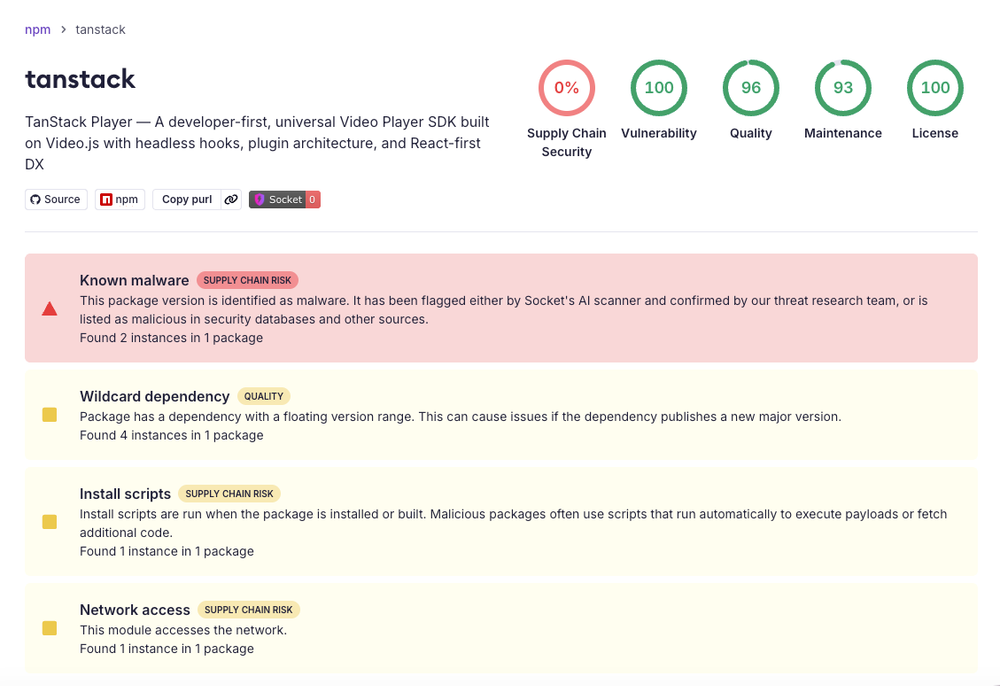 TanStack npm Brand-Squat
Socket's research team identified the unscoped npm package tanstack (not the legitimate @tanstack/* scope) as a brand-squat impersonating the TanStack project. Maintainer sh20raj pushed versions 2.0.4-2.0.7 within a 27-minute window containing an obfuscated postinstall script that reads .env, .env.local, .env.production and all .env.* files and POSTs them to an attacker-controlled Svix ingest URL used as a one-way dead-drop. TanStack creator Tanner Linsley confirmed no affiliation, cited a prior $10,000 extortion demand for the package name, and noted an ongoing trademark dispute; the maintainer later claimed the exfiltration code was accidental AI agent testing left in by mistake.
socket.devwriteupPublished and added 6 May 2026🛡️ Security- Tradecraft Tuesday Recap | Huntress
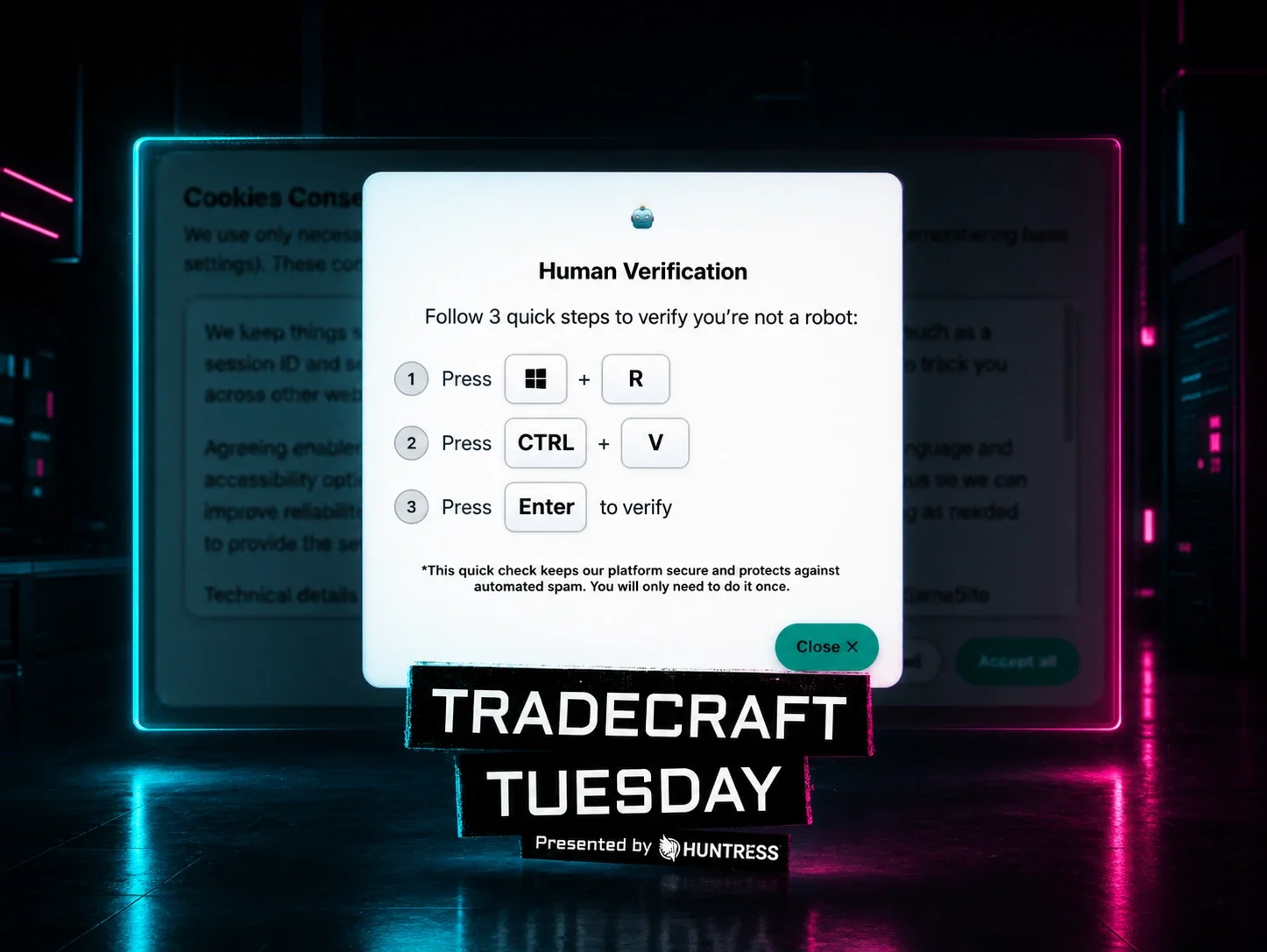
Recap of Huntress's Tradecraft Tuesday webinar featuring CISO Chris Henderson and Brian Milbier, covering active mass-exploitation of a critical React remote code execution flaw (CVE-2025-55182, dubbed "React2Shell") that is dropping cryptominers, the PeerBlight Linux backdoor, tunneling tools, and a Kaiji botnet variant, with GreyNoise data showing exploitation volume approaching Log4Shell scale. It also details the ClickFix technique for tricking users into self-executing malware via fake "human verification" prompts, and "living off trusted sites" phishing that abuses legitimate PayPal/DocuSign/OneDrive senders to bypass reputation-based email filters, closing with a practical hardening checklist (MFA, passkeys, password managers, credit freezes) and coverage of AI-driven sextortion, deepfake romance scams, and pig-butchering fraud.
huntress.comarticleAdded 3 Sep 2026, published 23 Dec 2025🛡️ Security - AWS Ransomware
A DFIR case study of an AWS S3 extortion incident where an attacker deleted a customer's buckets after reconnaissance (GetSendQuota, ListBuckets, GetBucketVersioning, etc.) and left a Bitcoin ransom note bundled with a Linux 'recovery' binary. Analysis with strace and Ghidra reveals the recovery tool is a complete fake: it never contacts AWS or the network, instead sleeping via clock_nanosleep and fabricating account/bucket details from a bundled aws.txt file to pressure the victim into paying. The post also shares specific CloudTrail event names defenders should monitor to detect similar pre-deletion recon activity.
 dfir.chwriteupAdded 3 Sep 2026, published 21 Feb 2024🛡️ Security