- TCP Use-After-Free: CVE-2026-98432 / CVSS 9.8
CVE-2026-98432 is a use-after-free in the Linux IPv4 TCP handshake, rated CVSS 3.1 9.8 and reachable by a remote unauthenticated peer on kernels back to 4.4. The post lists fixed stable releases (October 2026) and distribution patch status as of 31 October 2026, plus kernel and MPTCP listener checks. It gives interim nftables and iptables rules that drop IPv4 packets carrying options, and notes Anthropic's claim that Claude wrote a working exploit.
 atlasum.netadvisoryAdded 1 Nov 2026, published 31 Oct 2026🛡️ Security
 4 real? Tracking exploitation and patching of eMudhra’s weak keys
Cloudflare's follow-up on eMudhra's eight trivially recoverable intermediate CA keys (such as 4, 56 and 66), disclosed 19 October 2026. Pingora logging showed about 22,000 handshakes with the weak keys, including about 160 forged certificates made within hours of disclosure. Probes on 50 million challenge pages show many bots, old browsers and Android WebView still trust the chain.
 blog.cloudflare.comwriteupPublished and added 30 Oct 2026🛡️ Security
 CVE-2026-98432: Linux TCP Use-After-Free Risk and Patch Validation
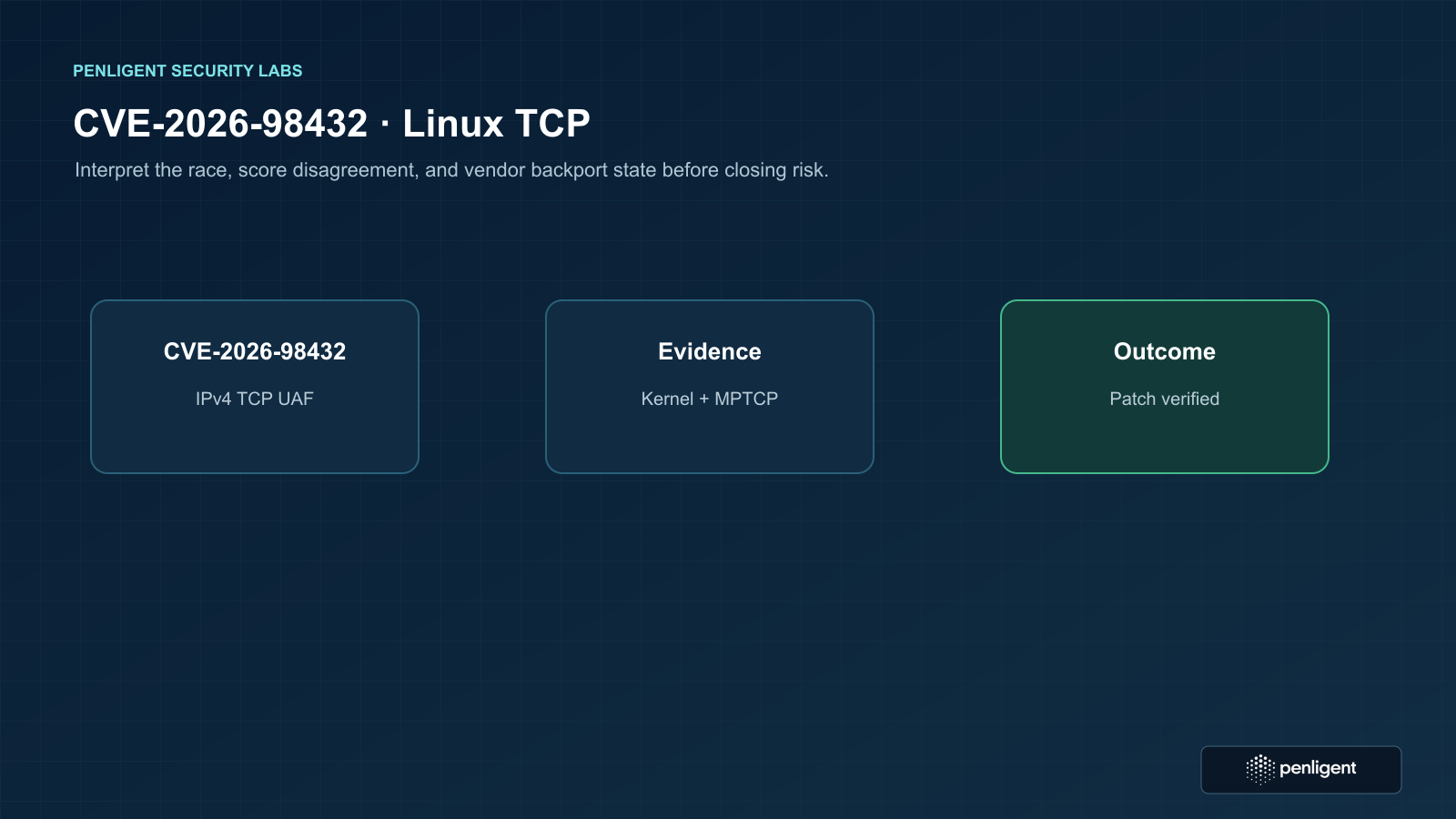
CVE-2026-98432 is a use-after-free in the Linux kernel IPv4 TCP handshake path: a request socket's ireq_opt pointer moves to the child socket as inet_opt and is freed with kfree() while a retransmitted-SYN CPU still reads it under RCU. The fix (commit e3f33b0a1d89) uses kfree_rcu(). The page covers CVSS 9.8 versus vendor scores, Anthropic's MPTCP root-exploit lab demo, per-distribution patch checks, MPTCP listener inventory and detection guidance. The page was truncated before its mitigation section.
 penligent.aiarticleAdded 31 Oct 2026, published 30 Oct 2026🛡️ Security
- AGTP (@AGTPinsights) on X
AGTP's X thread summarizes Meta's Muse Spark 1.3 Evaluation Report. Prompt injection was tested on Exponential Security Labs' RepoInject v1 and BrowserInject v1 and on Gray Swan's IPI Arena, with robustness said to be on par with GPT-5.6 Sol. It also covers chain of thought controllability evals, PostTrainBench under Loss of Control, and Handshake's pre-release human red teaming. It notes the Midas Project's criticism of Muse Wonder's missing safety report.
 x.comthreadAdded 27 Oct 2026, published 26 Oct 2026🛡️ Security
- AGTP (@AGTPinsights) on X
Thread summarizing Meta's Muse Spark 1.3 Evaluation Report, the safety write-up for the model released on September 2, 2026. It covers prompt-injection results on Exponential Security Labs' RepoInject v1 and BrowserInject v1 and Gray Swan's IPI Arena, chain-of-thought controllability evals, PostTrainBench under Loss of Control, and Handshake's human red teaming. It also notes The Midas Project's criticism that Muse Wonder still has no safety report, and the Muse Spark Open rollout (816B total, 42B active parameters).
x.comthreadAdded 27 Oct 2026, published 26 Oct 2026🧠 AI  Verifiable Post-Quantum TLS Handshake: Recognizing Implementation Errors of Cryptographic Verification Steps
PQCD-TLS is a post-quantum TLS handshake that binds confirmation codes into chained key derivation, so a faulty signature or KEM verification step causes a key mismatch and handshake failure. The authors build confirmation-code frameworks for ML-DSA and Falcon signatures and for ML-KEM, HQC and DAWN, with unpredictability proofs. Across 48 configurations, handshake latency overhead stays below 1%.
 eprint.iacr.orgpaperAdded 24 Oct 2026, published 21 Oct 2026🛡️ Security
- Post-Quantum Certificate-Based PSK Provisioning for WireGuard via Mutual TLS, DTLS, and QUIC: Design and Performance Study
The paper proposes a post-quantum architecture for WireGuard that leaves the core protocol unchanged. A mutually authenticated TLS 1.3 control channel runs over TCP, UDP (DTLS) or QUIC and uses ML-KEM key establishment, with X.509 certificates from a PKI signed with ML-DSA. A shared secret derived from the session's exported keying material is injected into WireGuard's native PSK interface. A Tamarin model of the TLS–WireGuard composition layer checks secrecy, binding and provisioning-order properties and identifies the conditions needed for secure deployment. The authors benchmark handshake latency and CPU time for classical, pure-PQ and hybrid key establishment across the three transports, and compare against the Rosenpass PQ WireGuard baseline.
eprint.iacr.orgpaperAdded 15 Oct 2026, published 14 Oct 2026🛡️ Security  MCP spec 2026-07-28 changelog (stateless protocol, MRTR, Sampling/Roots deprecated)
Official changelog for the Model Context Protocol 2026-07-28 specification. Major changes: protocol-level sessions and the initialize handshake are removed to make MCP stateless, with version and capabilities carried in _meta on every request, plus a new server/discover RPC and subscriptions/listen replacing the GET stream and resource subscribe calls. It introduces Multi Round-Trip Requests (InputRequiredResult) in place of server-initiated sampling, roots and elicitation requests, moves tasks into an extension, and deprecates Roots, Sampling, Logging, HTTP+SSE and Dynamic Client Registration. Minor changes add cache hints (ttlMs/cacheScope), new Mcp-Method/Mcp-Name headers, OpenTelemetry trace context, RFC 9207 iss validation and an error-code allocation policy.
 modelcontextprotocol.ioadvisoryAdded 10 Oct 2026🧠 AI
- ThreatWire (@ThreatWire_) on X
Post announcing a public PoC for CVE-2026-13043, a critical flaw (CVSS 4.0 9.3, scored by WatchGuard) in PSKMAD, the kernel memory access driver of WatchGuard Endpoint Security on Windows. The access-control handshake can be bypassed (CWE-306/CWE-798), letting a local authenticated attacker send privileged commands and read kernel and other processes' memory. Fixed in 8.00.26.0012; the PoC author and LOLDrivers frame the signed driver as BYOVD material, which WatchGuard does not say. The post notes it is not in CISA KEV, has no reported in-the-wild exploitation, and that ThreatWire has not run the PoC.
x.comthreadAdded 11 Oct 2026, published 10 Oct 2026🛡️ Security  Someone Scraped 5.6 Billion TikTok Videos and Put the Data on Hugging Face for Free
A developer using the handle "hashfunction" published a 460GB Hugging Face dataset of metadata (captions, hashtags, sound IDs, engagement counts, AI-generation flags) for roughly 5.6 billion public TikTok videos spanning July 2014 to October 2026, released under CC BY-NC 4.0. The data was reportedly pulled from TikTok's private mobile API using spoofed device identities and TLS handshakes rather than TikTok's official, application-gated Research Tools, in apparent violation of TikTok's terms of service; commercial access, creator profiles, daily updates, and the $1,699 scraper source code are sold via datasocial.ai. The piece situates this alongside other scraped TikTok-metadata dumps on Hugging Face and ongoing litigation (Reddit v. Perplexity/SerpApi) over large-scale AI training-data scraping.
 decrypt.coarticlePublished and added 6 Oct 2026🧠 AI
- Someone Scraped 5.6 Billion TikTok Videos and Put the Data on Hugging Face for Free
Decrypt reports that a developer going by "hashfunction," operating under the datasocial account, published a 460GB Parquet dataset of metadata for ~5.6 billion public TikTok videos (captions, hashtags, sound IDs, engagement counts, AI-generated flags) on Hugging Face under CC BY-NC 4.0. The data was obtained by hitting TikTok's private mobile API using generated Android device identities, reverse-engineered request signatures, and a spoofed TLS handshake, bypassing the ToS clause that bars automated scraping; datasocial.ai sells the scraper's source code for $1,699 and offers commercial access, creator profiles, and daily updates. The piece situates this against TikTok's gated official Research Tools and the ongoing Reddit v. Perplexity/SerpApi scraping lawsuit.
decrypt.coarticlePublished and added 6 Oct 2026🛡️ Security - lee1981 (@lee1981b) on X
CyberForge CVE-of-the-Day #070 on CVE-2026-61500 in Rejetto HFS 3.0.0–3.2.0. The default Koa session-signing key came from Math.random() (CWE-338) and the unauthenticated login handshake leaked outputs of the same generator. That allows recovery of the key, a forged administrator session, and code execution through the legitimate server_code feature. It covers scoring (CVSS 9.8/9.3, EPSS, KEV status), the 3.2.1 fix, a six-step SOC hunting and remediation trail (loginSrp1/2, get_config/set_config pivots, COOKIE_SIGN_KEYS review), and offline jq/Python helpers for container and config metadata.
x.comwriteupAdded 9 Oct 2026, published 6 Oct 2026🛡️ Security - Role-Specific Signature Placement in TLS 1.3: Cost Propagation and PQC Migration
An IACR eprint paper evaluating all 13-cubed ways to assign 13 post-quantum/traditional signature parameter sets across the Root, Intermediate and Leaf roles of a TLS 1.3 certificate chain, holding the algorithm set fixed and varying only placement. Across 286 three-algorithm groups, median max/min ratios reach 2.085x for TLS handshake latency, 4.310x for certificate body size and 4.551x for path-validation cost purely from role order, with Leaf placement mattering far more than Root/Intermediate swaps. It also shows that looking only at Certificate-message size can misrank candidates such as ML-DSA-65 versus SLH-DSA-SHAKE-192s once the Leaf signature in CertificateVerify and full authentication-path cost are included, arguing PQC certificate-chain design must account for role-specific cost under real network/load conditions.
eprint.iacr.orgpaperAdded 8 Oct 2026, published 5 Oct 2026🛡️ Security - Post-Quantum Command Authentication for Unmanned Systems: A KpqC Feasibility Study under Real-Time and Bandwidth Constraints
This paper evaluates whether Korean post-quantum crypto candidates (HAETAE, AIMer, SMAUG-T, NTRU+) and NIST PQC standards (ML-KEM, ML-DSA, SLH-DSA) can replace classical ECDSA/ECDH in the authentication and key-establishment path of ROS2/DDS-Security for UAV/UGV command channels. The authors build a feasibility envelope mapping each algorithm's key/signature size and handshake latency against real command-link constraints (message rate, MTU, latency deadline, bandwidth), then validate it with authentication-handshake measurements over emulated constrained links on a two-node testbed, producing a classical→NIST→KpqC comparison and per-channel-budget application guidance.
eprint.iacr.orgpaperAdded 8 Oct 2026, published 5 Oct 2026🛡️ Security - Measuring Parallel Execution of Classical–PQC Component Pairs in Hybrid TLS 1.3
An IACR ePrint paper benchmarks whether running the classical and post-quantum components of hybrid TLS 1.3 key exchange (ECDHE–ML-KEM) and Composite ML-DSA signatures in parallel on separate pthread worker threads reduces handshake latency versus sequential execution. Across three RFC 10024 ECDHE–ML-KEM groups with server and mutual authentication, parallelism sped up all six tested conditions on a standard ARM and x86 system (1.04×–1.28×), with the largest gains in signature stages where component times are balanced, but slowed every condition on a low-power x86 system (0.80×–0.92×) because thread wake/wait overhead outweighed savings. The authors conclude that component independence alone doesn't guarantee a speedup and that parallelization decisions must be validated per target environment.
eprint.iacr.orgpaperAdded 8 Oct 2026, published 5 Oct 2026🛡️ Security  The MCP Ecosystem Is Speaking Five Revisions at Once
A dated research report (Pennyforge, 2026-10-02) that probes the live MCP ecosystem to show it is fragmented across five spec revisions at once: it POSTs initialize/server/discover calls against 186 deduplicated endpoints pulled from the official MCP registry's v0 API, plus 10 popular npm stdio servers spawned via npx. It finds only ~9.7% of responding endpoints speak the new stateless 2026-07-28 wire (which removes Mcp-Session-Id, the initialize handshake, and adds server/discover), that the flagship @modelcontextprotocol/server npm packages still only speak the older 2025-06-18 revision, and documents a "version-echo" methodology pitfall where servers negotiate within a supported range rather than reporting a fixed version — illustrated with a parallel failure mode found in the x402 payment protocol.
 dev.towriteupPublished and added 2 Oct 2026🧠 AI
 Citrix NetScaler CVE-2026-88772 — DTLS preauth memory overflow
watchTowr Labs reverse-engineers CVE-2026-88772, a preauth DTLS memory overflow in Citrix NetScaler ADC/Gateway's nsppe binary, exploited in the wild as a zero-day and fixed in Citrix bulletin CTX697096. The writeup walks through patch diffing between build 14.1-73.30 and 14.1-73.37, crafting malicious DTLS handshake fragments that trick NetScaler's reassembly logic into copying about 174KB of NSB chain data into a 35,840-byte scratch buffer, and the full exploitation path from crash to a fake-vtable hijack, ROP-based mprotect call, and shellcode execution, plus a public detection artefact generator.
 labs.watchtowr.comwriteupAdded 1 Oct 2026, published 29 Sep 2026🛡️ Security
 No Time to Pwn: CVE-2026-72018 Linux Kernel LPE | XBOW
XBOW's technical write-up on CVE-2026-72018, an out-of-bounds write in the Linux kernel's SMC-D/DIBS loopback code (dibs_loopback driver) that lets an unprivileged user with CAP_NET_ADMIN escalate to root. The bug stems from an unvalidated peer-controlled dmbe_idx/dmbe_size offset computation (smcd_conn_save_peer_info -> smc_ism_write -> dibs_lo_move_data memcpy) that XBOW turned into a reliable LPE by MITM-forging CLC handshake fields via nftables NFQUEUE and grooming kernel cred structures with a 16-byte zero-write primitive alone. The post also details where the autonomous agent's reasoning stalled (abandoning a promising MITM idea, confusing write-what-where with a pure zero-write, chasing an unnecessary UAF) and required human intervention, motivating a multi-agent redesign of XBOW's research pipeline.
 xbow.comwriteupAdded 30 Sep 2026, published 28 Sep 2026🛡️ Security
 Fast and Secure Simultaneous Authentication of Equals for WPA3
This paper addresses CPU-exhaustion Denial-of-Service risk in WPA3's Simultaneous Authentication of Equals (SAE) handshake, whose Password Element derivation is computationally expensive for the Access Point. The authors propose an asymmetric protocol modification that shifts the costly iterative PE-discovery work to the client, adds a slow-path key derivation step (using PBKDF2 or Argon2) to further throttle brute-force attempts, and introduces a ticket-based fast re-authentication path for known devices — all aimed at keeping APs available under adversarial load without weakening SAE's dictionary-attack resistance.
 arxiv.orgpaperAdded 28 Sep 2026, published 25 Sep 2026🛡️ Security
 EarlyAttestationBleed Paper Review (TEE attestation bugs)
A Flashbots researcher reviews the EarlyAttestationBleed paper (Muhammad Usama Sardar and Songbo Bu), which uses ProVerif formal analysis to uncover three attestation-verification bugs in confidential-computing deployments: Cocos AI's TDX verifier fails to actually compare the REPORT_DATA value despite computing it correctly, Cocos AI's SEV-SNP validator skips the comparison entirely when an empty expected-input value is passed, and Edgeless Systems' Contrast workload-policy logic can be tricked into accepting container images from untrusted host-controlled storage due to a rebase mistake. All three were implementation bugs (not protocol design flaws) and have since been fixed; the post also summarizes the paper's broader concerns about "early attestation" — exposing hardware details pre-authentication, lack of post-handshake re-attestation for long-lived sessions, and handshake-timeout tradeoffs from added attestation latency.
 collective.flashbots.netwriteupAdded 2 Oct 2026, published 23 Sep 2026🛡️ Security
- Ashmmmm/crockTail
crockTail is a passive OSINT tool that, given a domain, aggregates DNS records, IP/ASN ownership, TLS certificate details, WHOIS data, and crt.sh certificate-transparency history into a single report. It layers analysis on top of the raw data: plain-language warning/info observations (near-expiry or expired certs, recently registered domains, unusual reissuance, historical subdomains from CT logs), multi-resolver (Google vs Cloudflare) DNS cross-verification to flag possible tampering, and a 0-100 confidence score per scan based on module success and cross-check agreement. It supports batch domain queries and query logging, and is explicitly limited to passive lookups and a standard TLS handshake, no port scanning or active probing.
 github.comrepoAdded 30 Sep 2026, published 25 Aug 2026🛡️ Security
 The New MCP Roadmap
The Model Context Protocol Core Maintainers publish an updated roadmap covering five priority areas: agentic messaging primitives (server-initiated events, maturing the Tasks extension SEP-2663), HTTP-native transport unification (including local servers over Streamable HTTP/stdio), agent identity and enterprise security (DPoP, Workload Identity Federation, ID-JAG grant, token exchange, engagement with IETF OAuth and WIMSE working groups), improved tool-call result primitives and progressive tool discovery, and SDK developer experience. It also recaps the previous roadmap's shipped work in the 2026-07-28 spec release — removal of protocol-level sessions/handshake for stateless horizontal scaling, server/discover, cacheable list results, Multi Round-Trip Requests (SEP-2322), issuer validation, issuer-bound client credentials, and Client ID Metadata Documents (CIMD).
 blog.modelcontextprotocol.ioarticleAdded 7 Oct 2026, published 22 Aug 2026🧠 AI
- From Screen Share to Root Access: Breaking Down CVE-2026-43760 and CVE-2026-65400 on macOS
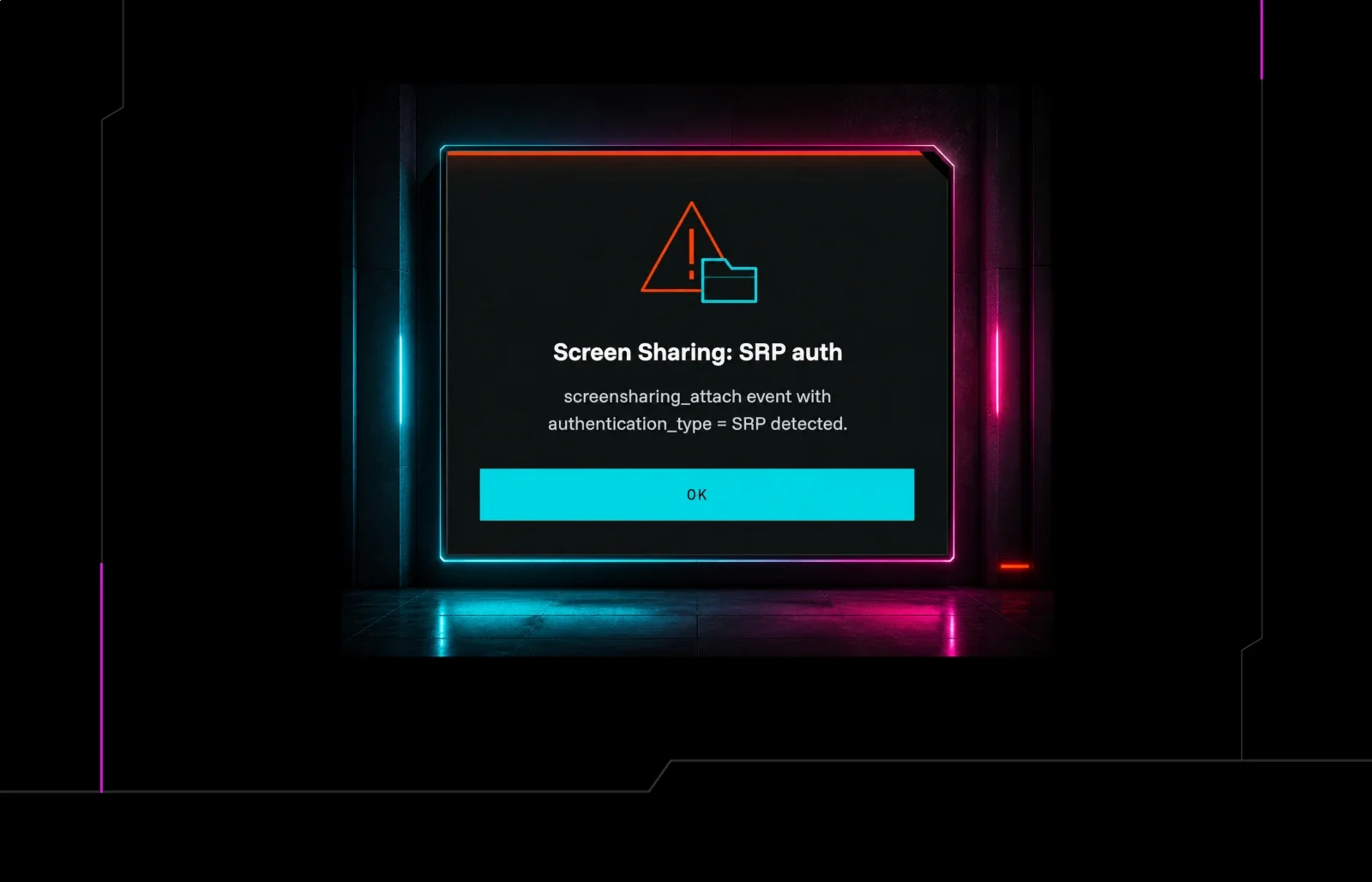
Huntress breaks down two macOS Screen Sharing (screensharingd/RFB) vulnerabilities patched by Apple: CVE-2026-43760, an authenticated confused-context bug letting legacy-VNC users read/write arbitrary files as root, and CVE-2026-65400, a pre-authentication bug in the SRP handshake that lets an unauthenticated remote attacker read/write any filesystem artifact as root and achieve remote code execution via LaunchDaemons or shell startup file persistence. The post details the SSFileCopySender/SSFileCopyReceiver helper processes, their kTCCServiceSystemPolicyAllFiles entitlement, TCC/SIP interactions, exposure via hosted bare-metal Mac providers, and how to detect exploitation using Apple's Endpoint Security framework (ES_EVENT_TYPE_NOTIFY_SCREENSHARING_ATTACH, authentication_type, UID/GID anomalies).
 huntress.comwriteupAdded 3 Sep 2026, published 7 Aug 2026🛡️ Security
 MCP spec 2026-07-28: the stateless revolution (Cloudflare)
Cloudflare explains the MCP 2026-07-28 specification, which removes the mandatory stateful session handshake (Mcp-Session-Id) from the core protocol so MCP servers can run as ordinary stateless HTTP workloads (e.g. a single Cloudflare Worker) instead of requiring sticky sessions or Durable Objects. It covers the new Multi Round-Trip Requests (MRTR) model replacing stream-based elicitation, new Mcp-Method/Mcp-Name HTTP headers for gateway-level routing and caching, tightened authorization (CIMD preferred over DCR, RFC 9207 issuer checks, RFC 8707 audience binding), a formal Active/Deprecated/Removed feature lifecycle, and the createMcpHandler API graduating into the official TypeScript SDK, with testimonials from Sentry, Linear, and Anthropic's MCP lead.
blog.cloudflare.comarticleAdded 2 Oct 2026, published 6 Aug 2026🧠 AI- CVE-2026-59950
CVE-2026-59950 (CVSS 7.6) affects the MCP Python SDK's deprecated mcp.server.websocket.websocket_server transport, which accepted WebSocket handshakes without validating Host or Origin headers, giving no SDK-level way to restrict which origins could connect to applications exposing that transport. This is a classic CSWSH-style origin-validation flaw (CWE-346, CWE-1385) fixed in mcp 1.28.1.
 nvd.nist.govadvisoryPublished and added 17 Jul 2026🛡️ Security
- The 2026-07-28 MCP Specification Release Candidate
The MCP (Model Context Protocol) team announces the 2026-07-28 spec release candidate, the largest revision since launch, which removes the protocol-level session/handshake in favor of a stateless request model and restructures server-to-client interactions. The security-relevant core is a set of authorization SEPs that harden OAuth 2.0/OIDC usage: clients must validate the `iss` parameter per RFC 9207 to mitigate authorization-response mix-up attacks, declare `application_type` during Dynamic Client Registration to avoid redirect-URI misclassification, bind credentials to the issuing authorization server, and clarify scope accumulation during step-up auth. A related change requires that server-initiated requests (e.g. elicitation prompts) only be issued while actively processing a client-originated call, closing a class of out-of-nowhere prompt/consent issue for agentic clients.
blog.modelcontextprotocol.ioarticleAdded 28 Jul 2026, published 21 May 2026🛡️ Security