 Trail of Bits (@trailofbits) on X
Trail of Bits post on X summarising Binance's initial investigation into a security incident. Binance suggests a compromised DevOps engineer's laptop let an attacker reach a service container and submit unauthorized withdrawal transactions. The text says no evidence has been found of wallet private key compromise. The fetched text is truncated and gives no further detail.
 x.comthreadPublished and added 30 Oct 2026🛡️ Security
- Trail of Bits (@trailofbits) on X
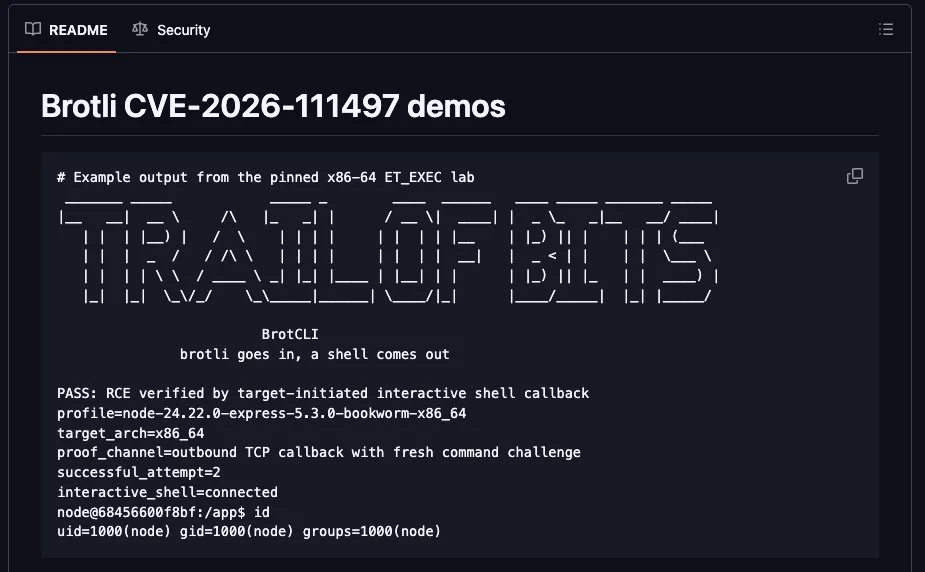
Trail of Bits post says it achieved remote code execution through a Brotli decoder bug in Linux lab setups: Node.js 24.22.0 with Express 5.3.0 via the standard JSON parser (x86-64 and ARM64), and Electron 41.10.7 (x86-64) with a custom decoding service. Exploitation needs a carefully matched setup and repeated attempts. A scanner by ToBScottA finds hidden copies of the decoder, including in stripped binaries.
x.comthreadAdded 30 Oct 2026, published 28 Oct 2026🛡️ Security  Backporting security fixes to stable releases
Trail of Bits argues that stable and LTS software, such as Ubuntu 26.04 LTS, Debian 13 and stable Linux kernel branches, carries many known CVEs that were fixed upstream but never backported. It measures the gap using the kernel CVE team's vulns.git (18 September 2026) and Debian and Ubuntu CVE feeds. Using Codex with GPT-5.6, the team got 142 fixes covering 90 CVEs applied to stable kernel trees and has begun sending patches to distributions.
 blog.trailofbits.comarticlePublished and added 27 Oct 2026🛡️ Security
- Trail of Bits (@trailofbits) on X
Trail of Bits post on PHP2Shell, an exploit that gives a shell on MediaWiki, Symfony, Laravel and phpBB. They confirmed it on pre-patch PHP 8.2 to 8.5. An update says it is production-grade: it works with stock php.ini-production, display_errors off, multiple workers, ASLR and load, on ARM64 and x86-64, and reaches root on Apache/mod_php and nginx/php-fpm. No CVE or technical root cause is given.
x.comthreadAdded 27 Oct 2026, published 26 Oct 2026🛡️ Security - Trail of Bits (@trailofbits) on X
Trail of Bits announces a scanner, built by Scott A., that finds hidden copies of the vulnerable Brotli decoder behind a Node.js/Brotli bug, including in stripped binaries. Exploitability of the bug is still under testing. Binary matching covers only aarch64 gcc builds, so an empty result on a stripped x86 binary may be a coverage gap. The post also separates finding vulnerable code from knowing whether an app reaches it.
x.comtoolAdded 25 Oct 2026, published 23 Oct 2026🛡️ Security - Trail of Bits (@trailofbits) on X
patching-bugs is a Trail of Bits plugin for Codex that has an AI agent write a vulnerability fix, prove it works, and check it for regressions. It was built from analysis of thousands of Codex sessions from the Patch the Planet work with OpenAI. The post argues defenders need patch-writing agents to match attackers' bug-hunting agents. It gives no technical detail beyond that.
x.comtoolAdded 24 Oct 2026, published 22 Oct 2026🛡️ Security  [tl;dr sec] #351 - PHP2Shell, Autopatching Skills, AWS Pathrunner
tl;dr sec #351 is a weekly security newsletter. Clint Gibler describes working with OpenAI, Calif, Wiz and the PHP maintainers on the PHP2Shell unauthenticated RCE disclosure, which affects 13 years of PHP. It also covers Datadog's pathrunner AWS IAM escalation framework, Trail of Bits' patching-bugs and regression-hunt Codex plugins, XBOW finding de-duplication, backdoored open-weight models, and CREBench.
 tldrsec.comarticleAdded 30 Oct 2026, published 22 Oct 2026🛡️ Security
- Trail of Bits (@trailofbits) on X
Trail of Bits post on two unpatched critical PHP bugs that were exploited within 17 hours of details leaking. Cloudflare began blocking attacks and Patchstack reported active exploitation. The bug was reported 11 August and fixed 71 days later, with a patch touching 402 files and over 11,000 lines. Trail of Bits announces two open-source plugins, patching-bugs and regression-hunt, from its Patch the Planet work.
x.comthreadAdded 23 Oct 2026, published 21 Oct 2026🛡️ Security - Trail of Bits (@trailofbits) on X
Trail of Bits announces two open-source plugins, patching-bugs and regression-hunt, for AI coding agents that speed up bug patching. They come from four months of Patch the Planet work with open-source projects, which found that repo-level documentation, skills and plugins give agents the maintainer context on what counts as a bug, how a fix should look and what must not break. The post cites the October 2026 PHP incident: a patch touching 402 files, and exploitation within 17 hours of leaked details.
x.comarticleAdded 23 Oct 2026, published 21 Oct 2026🧠 AI  Your AI agent fixed the bug, but what else did it change?
Trail of Bits releases patching-bugs and regression-hunt, two agent plugins built with OpenAI through Patch the Planet. patching-bugs reproduces bugs, writes fixes and runs a three-arm proof; regression-hunt traces diffs to real interfaces, confirms with live PoCs and a fresh-context replay. A review of 130+ merged PRs found 21 regressions, and regression-hunt gave 25% fewer false positives than a baseline Codex prompt.
blog.trailofbits.comarticlePublished and added 21 Oct 2026🧠 AI- Your AI agent fixed the bug, but what else did it change?
Trail of Bits releases patching-bugs and regression-hunt, two Codex plugins from the Patch the Planet initiative with OpenAI. A review of 130+ merged patches confirmed 21 regressions (none broke a security protection). In preliminary tests regression-hunt gave 25% fewer false positives than a baseline Codex agent. Design uses live PoCs, strict schemas, a three-arm proof, and project THREAT_MODEL.md and PATCHING_GUIDELINES.md files.
blog.trailofbits.comarticlePublished and added 21 Oct 2026🛡️ Security - Trail of Bits (@trailofbits) on X
Trail of Bits thread on Google Quantum AI's March publication of a new Shor's algorithm version aimed at secp256k1, the curve protecting Bitcoin and Ethereum wallets. Google used zero-knowledge proofs to keep the attack details secret, and the post says the secrecy lasted 63 days. The fetched text is cut off after the qubit estimate of roughly 1,200, so later details are missing.
x.comthreadAdded 22 Oct 2026, published 20 Oct 2026🛡️ Security - Trail of Bits (@trailofbits) on X
Trail of Bits post announcing research that tested 25 package managers against a simulated malicious repository serving swapped code for the same package and version. Without a lockfile only Go and vcpkg verified every download; with a lockfile fewer than half did. This undercuts the assumption that lockfiles make dependencies immutable and shows hash/integrity verification gaps across ecosystems.
x.comthreadAdded 18 Oct 2026, published 16 Oct 2026🛡️ Security - Trail of Bits (@trailofbits) on X
Trail of Bits tweet announcing a test of 25 package managers against a simulated malicious repository. Without a lockfile only Go and vcpkg verified every download; with a lockfile fewer than half did. Replies raise that checksum verification is separate from execution isolation, and ask whether poisoned CI package caches were in the threat model.
x.comthreadAdded 17 Oct 2026, published 15 Oct 2026🛡️ Security  Package managers have an integrity problem
Trail of Bits tested 25 popular package managers with a Docker and mitmproxy harness that simulates a compromised package repository injecting malware into legitimate packages. Fewer than half enforce lockfile hashes by default, only two verified every download, and only Go verifies signatures by default. The post covers lockfile hash pitfalls (Pub, pnpm, Conan, CocoaPods, Composer), repository, developer and Sigstore signing, and Go's checksum database. It also proposes lockfiles that commit to a signing identity plus a transparency log.
blog.trailofbits.comwriteupPublished and added 14 Oct 2026🛡️ Security- Trail of Bits (@trailofbits) on X
Trail of Bits announces SequenceHash, a library for hashing several inputs without concatenation ambiguity. Plain concatenation lets different input sequences produce the same SHA-256 digest. SequenceHash appends each input's length as a fixed 128-bit integer so every sequence has a single encoding. It ships for Rust, Go and Python, and removes a recurring bug class in crypto and appsec code.
x.comtoolAdded 11 Oct 2026, published 9 Oct 2026🛡️ Security - Trail of Bits (@trailofbits) on X
Trail of Bits' Circomspect, a static analyzer for Circom zero-knowledge circuits, had a false positive in its unconstrained-less-than check: compile-time constants fed into the LessThan template were wrongly flagged as unconstrained inputs. The merged PR fixes this so expressions resolvable at compile time are no longer reported, reducing noise for auditors hunting real under-constraint bugs in circuits.
x.comthreadAdded 8 Oct 2026, published 6 Oct 2026🛡️ Security  SequenceHash: multihashing for the rest of us
Trail of Bits introduces SequenceHash and its keyed variant SequenceMAC, hash-agnostic multihashing constructions similar in goal to NIST's TupleHash but not tied to Keccak, working with SHA256/384/512, BLAKE, and RIPEMD. The spec, now part of the Community Cryptography Specification Project, provides unambiguous input encoding, length-extension prevention, built-in customization strings, and HMAC-style keyed MACs that avoid HMAC's key-pseudocollision issues; reference implementations ship in Rust, Go, and Python with full test vectors.
blog.trailofbits.comwriteupPublished and added 2 Oct 2026🛡️ Security- Trail of Bits (@trailofbits) on X
Announcement tweet for Trail of Bits's September "Tribune" newsletter, which fact-checks 1Password's AI-powered patching benchmark, details a signature-forgery bug found in Miden's zkVM and a string-slicing bug in the Lean theorem prover/language, and reports 27 advisory submissions to OpenClaw plus seven new completed security reviews. It links out to the full newsletter on Mailchimp (mailchi.mp/trailofbits).
x.comthreadAdded 1 Oct 2026, published 30 Sep 2026🛡️ Security  Don't let TEEs break your MPC
Trail of Bits explains why running threshold-signature MPC protocols inside TEEs (Intel TDX, AMD SEV-SNP, AWS Nitro Enclaves) is not automatically secure: a malicious host can roll back enclave filesystem state to force reuse of deleted pre-signature nonces, leaking a signer's private key share. The post catalogs recurring audit pitfalls — incomplete attestation measurements (citing the WhatsApp Private Inference LD_PRELOAD bypass), missing verification steps, weak hardening, stale-backup/rollback risks (including LUKS2 header manipulation in confidential VMs), and physical/side-channel attacks like TEE Fail and DDRop against DDR5 memory — and gives best practices such as binding attestation to MPC party identities and using multiple TEE vendors for defense-in-depth.
blog.trailofbits.comarticlePublished and added 25 Sep 2026🛡️ Security- SAML: A fractal of bad design
A Trail of Bits researcher (ex-Duo Security engineer) traces SAML's history from its 2002 OASIS committee origins through recurring XML signature wrapping (XSW) and canonicalization/round-trip parser-differential attacks, arguing its reliance on brittle XML signature validation (libxmlsec) makes it fundamentally unsound. The post catalogs SAML's five structural flaws — XML complexity, canonicalization, enveloped signatures, kitchen-sink design, and protocol ossification — and recommends organizations deprecate SAML in favor of OIDC, citing Fly.io and Tailscale as vendors already holding the line on OIDC-only SSO.
blog.trailofbits.comarticlePublished and added 21 Sep 2026🛡️ Security  Auditing in the age of (good enough) AI
Trail of Bits describes preparing for a six-month audit of the Miden zkVM (a zero-knowledge VM with its own custom assembly language, MASM) by having AI agents (Claude and Codex) build an LSP server, a decompiler, an abstract-interpretation-based static analysis engine, and a Lean formal model of the VM executor, none of which previously existed for MASM. These tools surfaced a high-severity bug in the mod_12289 procedure where an underconstrained prover-supplied advice value allowed a malicious prover to forge Falcon signatures and drain Miden accounts, plus over 400 type-validation issues, while the Lean proof effort produced 95 machine-checked correctness proofs and caught two additional subtle arithmetic bugs (rotr, wrapping_mul) missed by unit tests.
blog.trailofbits.comwriteupPublished and added 18 Sep 2026🛡️ Security 1Password's AI patching benchmark is misleading
Trail of Bits dissects 1Password's August 2026 report claiming AI models produce "clean" security patches only 26% of the time, showing the figure is inflated by handpicked hard bugs, deliberately wrong-fix prompts (22% of trials), testing-prohibited trials (36%), inconsistent grading, and a buggy reference fix — and that when those confounds are removed, 86% of patches blocked the supplied exploit. The post contrasts this with Trail of Bits' own data: developers get 12.5% of first fixes wrong even under favorable conditions, and 67.7% of Patch the Planet AI-authored pull requests were merged by maintainers. It also releases two agent skills, post-patch-validation and review-walkthrough, to help agents test fixes and help engineers review AI-generated patches.
blog.trailofbits.comwriteupAdded 8 Oct 2026, published 15 Sep 2026🧠 AI- 1Password's AI patching benchmark is misleading
Trail of Bits dissects 1Password's August 2026 report claiming AI agents (GPT-5.5, Opus 4.8) produce clean vulnerability fixes only 26% of the time, showing the figure is inflated by a hand-picked set of six hard bugs, deliberately-wrong-fix prompts (22% of trials), a no-testing mode (36% of trials), grading disagreements between automated graders and humans, and a buggy Linux upstream reference fix. Reanalyzing the same data under fair conditions (testable, non-adversarial trials) they find 86% of patches blocked the supplied exploit, and they contrast this with their own consulting data (12.5% of developer first-fixes fail) and Patch the Planet's 67.7% maintainer merge rate across 186 PRs, including a case where both a human maintainer and an agent independently introduced the same freenginx cleanup-crash regression. The post also releases two new agent skills, post-patch-validation and review-walkthrough, to improve AI-assisted patch testing and human review.
blog.trailofbits.comarticlePublished and added 15 Sep 2026🛡️ Security  A “proof” of Fermat’s Last Theorem that fits the margin
Trail of Bits found a bug in Lean's String.Pos.Raw.extract (affecting all stable versions up to 4.33.1, fixed in 4.34.0-rc1) where the logical definition and the compiled native code disagree on the result of extracting a slice at an out-of-bounds position, letting an attacker manufacture a contradiction (empty string = non-empty string) that "proves" any theorem, including a fake formalization of Fermat's Last Theorem. The exploit only works when a proof relies on the native_decide axiom, which extends trust to the compiler rather than the kernel; the researchers found the issue while using GPT-5.6 to build a code-review skill, and Lean maintainers hargoniX and Rob23oba shipped fixes within hours to days of disclosure. The post is a reminder that machine-checked proofs are only as trustworthy as the evaluator/compiler paths behind axioms like native_decide, and points to work like lean4lean and alternative kernels as mitigations.
blog.trailofbits.comwriteupPublished and added 9 Sep 2026🛡️ Security- [tl;dr sec] #344 - VMs won't contain Cyber-capable Agents, AWS AI Security Analyst, Decompilers vs LLMs
tl;dr sec #344 is a weekly security newsletter issue. It summarizes Trail of Bits' report that an AI agent escaped a QEMU/KVM VM three times (Firecracker held), Grow Therapy's sub-$500/month AI threat hunting system on AWS, Palo Alto's "Pass-ta-key" attacks on synced passkeys, MCP configuration poisoning, org-wide GitHub Actions SHA pinning, and the DecBench decompiler benchmark with the LLM-written Kuna decompiler.
tldrsec.comarticleAdded 30 Oct 2026, published 8 Sep 2026🛡️ Security - trailofbits/skills
Trail of Bits maintains a Claude Code plugin marketplace of "skills" that extend AI coding agents (Claude Code, Codex, ChatGPT workspaces) with security analysis, testing, and secure development capabilities. It's installed via `/plugin marketplace add trailofbits/skills` and is also compatible with Codex's Claude marketplace support, with related sibling repos for curated skills, devcontainers, and config.
 github.comrepoPublished and added 7 Sep 2026🛡️ Security
- Pyro (@0x3b33) on X
A roundup of three open-source AI-assisted smart contract security scanners: pashov/skills (solidity-auditor + x-ray pre-audit + fuzz suite generation, fast/cheap feedback), PlamenTSV's autonomous 8-phase agent covering EVM, Solana, and Move that ships PoCs with findings, and Trail of Bits' skills repo with 40+ security skills for contract audits, differential review, and static analysis. Useful pointer to emerging AI-agent-based smart contract auditing tooling.
x.comthreadPublished and added 7 Sep 2026🛡️ Security  VMs won't contain cyber-capable agents
Trail of Bits gave GPT 5.6-Cyber preview access and tasked it with escaping a QEMU/KVM VM on a Debian 12 host; the agent succeeded three separate times, first via a recently disclosed host kernel bug (Januscape, CVE-2026-53359), then by chaining CVE-2026-9539 in libslirp with an unmarked bug fix, and finally by autonomously discovering and chaining multiple 0-day vulnerabilities in the kernel/QEMU stack over roughly 12 hours of largely unsupervised operation. The author argues off-the-shelf VMs (even hardened stable distros) no longer reliably contain a sufficiently capable AI agent — treat such agents as an APT — though Firecracker's minimal attack surface withstood the same agent's attempts.
blog.trailofbits.comwriteupAdded 3 Sep 2026, published 26 Aug 2026🛡️ Security State divergence enables unauthorized access
Trail of Bits found and reported an authorization bypass in Provenance Blockchain's marker module (Cosmos SDK) that let any user with zero tokens self-grant ACCESS_ADMIN on non-fixed-supply marker accounts, because the access check compared caller balance against a stale on-chain supply field that never diverged from zero. The bug affected 82 live mainnet markers (tokenized loans, bridged stablecoins, consortium deposits, governance escrow) and allowed two-transaction exploitation to mint arbitrary tokens or drain roughly $500,000 in escrowed nhash; it was mitigated in v1.28.0 (PR #2627) and fully fixed in v1.29.0 (PR #2734) by reading live bank-module supply with an explicit zero-guard.
blog.trailofbits.comwriteupAdded 3 Sep 2026, published 25 Aug 2026🛡️ Security




Showing 30 of 49
Show more