 aws.amazon.comarticle
GuardDuty Extended Threat Detection has added five new indicators to surface attack sequences
Explains five new indicator types (MALICIOUS_PACKAGE, MISCONFIGURATION, REACHABILITY, SENSITIVE_DATA, VULNERABILITY) that GuardDuty Extended Threat Detection attaches to attack sequence findings, sourced from Inspector, VPC Reachability Analyzer, Macie and Security Hub. Walks through an EKS compromise (AttackSequence:EKS/CompromisedCluster) that only became a CRITICAL finding thanks to the new context, and a cryptomining EC2 case. Lists observed CVEs with EPSS scores, frp/Burp Collaborator artifacts, and response advice such as EPSS-weighted patching, isolating reachable hosts and rotating IAM credentials.
What it is
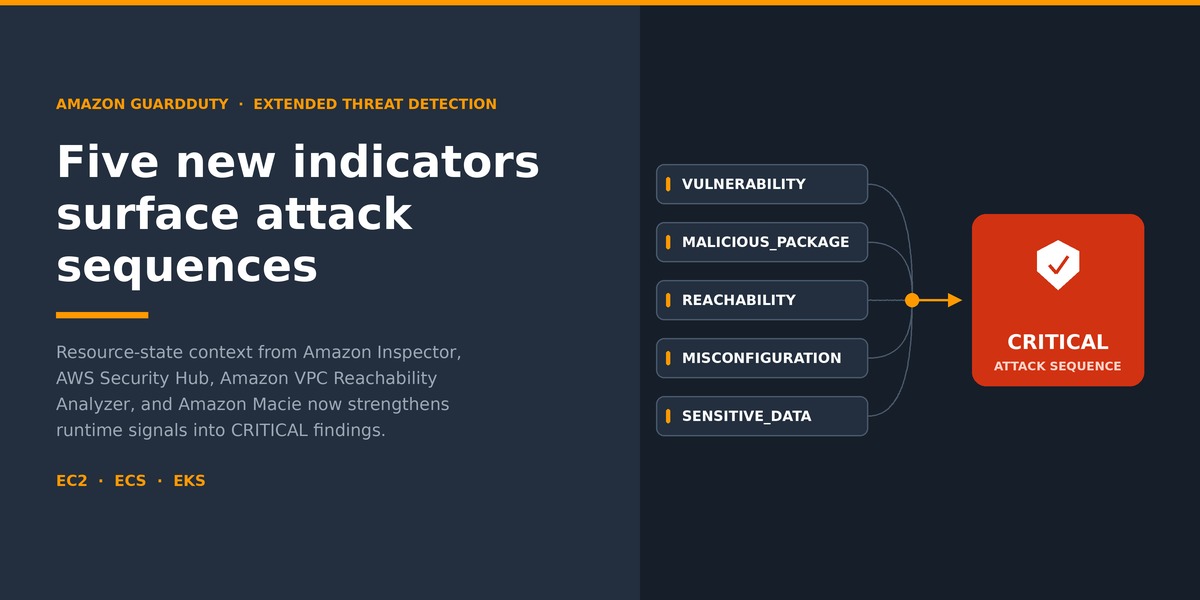
On May 20, 2026, GuardDuty Extended Threat Detection began attaching five resource-state indicators to attack sequence findings: MALICIOUS_PACKAGE, MISCONFIGURATION, REACHABILITY, SENSITIVE_DATA and VULNERABILITY. They matter mainly for runtime findings on EC2, ECS and EKS. A weak runtime signal that previously stayed below the Critical threshold can now be promoted when it lands on a host with the right exposure.
How it works
The page says AWS reports roughly one in four prioritized runtime-process attack sequences are now net-new. The network IOC surface barely changed. The anchor is a GuardDuty Runtime Monitoring signal, and the indicators add resource-state context to it.
flowchart LR
    A[Weak runtime signal] --> E[CRITICAL attack sequence]
    B[High-EPSS CVEs] --> E
    C[Malicious package] --> E
    D[IMDSv1 / internet-reachable] --> E
The EKS example ran over 8 days with eleven findings. It included 55 EKS_AUDIT_LOGS signals, and one external IP (198.51.100.69) authenticated as four IAM identities. No offensive-tool path matched, so the pre-launch EKS_MALICIOUS_PROCESS rule never fired. These indicators tipped it into AttackSequence:EKS/CompromisedCluster:
- MALICIOUS_PACKAGE: Inspector MAL-2022-4933.
- VULNERABILITY: 42 CVEs on the cluster, including CVE-2022-1471 (EPSS 0.94) and CVE-2022-37434 (EPSS 0.92).
- REACHABILITY: cluster API endpoint and 3 of 5 worker nodes internet-reachable.
- MISCONFIGURATION: IMDSv1 still exposed on all 5 nodes.
The EC2 cryptomining case would have fired anyway. There the indicators only added remediation context: CVE-2007-4559 (Python tarfile, EPSS ~0.9) on two of three instances.
Preconditions
Indicators populate only if the source services are already enabled:
| Indicator | Requires |
|---|---|
| VULNERABILITY, MALICIOUS_PACKAGE | Inspector on EC2 and EKS |
| MISCONFIGURATION | Security Hub (AWS Foundational Security Best Practices) |
| REACHABILITY | VPC Reachability Analyzer on production VPCs |
| SENSITIVE_DATA | Macie |
| Anchor signals | GuardDuty Runtime Monitoring on EC2, ECS, EKS |
If those services are already on, the indicators appear automatically. Otherwise you get no new context.
What to do
- Check the Indicators tab of attack sequence findings, or
GetFindingsJSON, for the new values. - Treat MALICIOUS_PACKAGE plus a high-priority VULNERABILITY as an ongoing risk. Contain the exposure and rotate every IAM credential, instance profile or IRSA-bound role that could have been exposed.
- Patch by EPSS, not CVSS alone. The finding's VULNERABILITY list is already filtered to high-EPSS CVEs. In the EKS case, over 100 worker-node CVEs were mostly low priority by EPSS.
- Isolate internet-reachable hosts that carry exploitable vulnerabilities.
- Hunt for the observed artifacts:
- Linux/frp (Fast Reverse Proxy) used as a C2 tunnel, often disguised as
kuboard-agentorkuboard-agent-server. It was also seen under/var/lib/containerd/io.containerd.snapshotter.v1.overlayfs/snapshots/.../usr/bin/. - Burp Collaborator callbacks matching
<35-char base32>[.]oastify[.]com. - One external IP authenticating as several distinct human IAM identities across EKS, ECS and EC2 in a short window. This was the most common identity signature in the new EKS class.
- Other CVEs seen in the first-week sample: CVE-2024-4577 (EPSS 0.97+), CVE-2025-29927, CVE-2024-34351, CVE-2023-44487.
Caveats
- Because frp binaries sit in the container image and on the node, rebuilding a node from an unpatched AMI is not sufficient remediation.
- EPSS values are point-in-time, so later findings will show current scores.
- The page says the indicators don't change runbooks for attack sequences that already occurred, only new findings.
- The "one in four" figure and the "many customer accounts" claim are AWS's own first-week observations. The page gives no method or sample size.
- The oastify co-occurrence with frp is described only as "probably a second tool or actor."
Organisations named here
- AttackSequence:EC2/CompromisedInstanceGroup
- AttackSequence:EKS/CompromisedCluster
- IMDSv1
- kuboard-agent
- MAL-2022-4933
CVEs named here
- CVE-2022-1471
- CVE-2024-4577
- CVE-2024-34351
- CVE-2025-29927
- CVE-2023-44487
- CVE-2022-37434
- CVE-2007-4559
Technologies named here
- Amazon EC2
- Amazon ECS
- Amazon Inspector
- Amazon VPC Reachability Analyzer
- Amazon EKS
- Amazon Macie
- Amazon EKS worker nodes exposing IMDSv1
- AWS Security Hub
- Amazon EKS cluster API endpoint internet-reachable
- GuardDuty Runtime Monitoring
- EPSS
- SnakeYAML, PHP-CGI, Next.js, zlib, Python tarfile, HTTP/2
- CVSS
- GuardDuty Investigation
- Burp Collaborator
- MITRE ATT&CK mapping
- Amazon GuardDuty
- AWS
- frp
Techniques named here
- MITRE ATT&CK
- Out-of-band callbacks via Burp Collaborator
- Cryptomining network IOC
- EPSS-weighted vulnerability prioritization
Threat actors named here
- HackTool family Linux/frp
- Malicious package MAL-2022-4933
- Cryptomining activity to a known mining/misc destination
Also named here
- oastify.com
Related in Cloud & Infra


 orca.securityarticle
Orca Security: GenAI Risks in Cloud Environments

 aikido.devwriteup
Google API keys keep working after you delete them

 attackthesoc.comarticle