Skip to content

70 results for β€œSAST”

What you seeeverything
oversecured.comarticleπŸ›‘οΈ Security

Inside mobile taint analysis: how source-to-sink tracking finds real data-leak paths | Oversecured Blog

Oversecured explains taint analysis for Android and iOS apps and contrasts it with pattern-matching SAST such as MobSF. It covers source, flow and sink, cross-component tracking over Intents, flag-based sanitizer modeling and implicit intent simulation. The case study is an unsafe Class.forName().newInstance() on a Serializable transportFactoryClassName field in Google's com.google.auth.oauth2 credential classes, which Google fixed with a $3,133.70 bounty.

AndroidiOSOversecured+3
intent redirectionpath traversalSSRF+4

Mobile Security, AppSecΒ· Added 29 Oct 2026

oversecured.comarticleπŸ›‘οΈ Security

Android deep link vulnerabilities: how intent filters lead to account takeover | Oversecured Blog

Oversecured's article on Android deep-link vulnerabilities covers five patterns: custom scheme hijacking, open redirect into WebView, limited and full intent redirection, and domain takeover via an expired whitelist entry. It shows bypass payloads, intent selector abuse, and the HierarchicalUri reflection bypass. It also compares what SAST and DAST can find and gives a checklist for pentesters.

AndroidOAuthChrome+1
deep link hijackingcustom scheme hijackingopen redirect+8

Mobile Security, AppSecΒ· Added 29 Oct 2026

oversecured.comarticleπŸ›‘οΈ Security

SDK security in mobile apps: the attack surface your team didn

Oversecured guide to SDK security in mobile apps, built around Microsoft's April 2026 disclosure of an intent redirection flaw in EngageLab's EngageSDK (50 million installs, fixed in 5.2.1). It covers SDK attack surfaces (exported components, WebViews, deep links, hardcoded secrets, payment crypto), a canhub image cropper file-overwrite example, why source-only SAST misses SDK code, and MASVS and PCI DSS expectations.

AndroidEngageSDKOversecured+3
intent redirectionEngageSDK intent redirectionMTCommonActivity+11

Mobile Security, Supply Chain, AppSecΒ· Added 29 Oct 2026

endorlabs.comwriteupπŸ›‘οΈ Security

Endor Labs AI SAST Finds Two Apache Kafka Zero-Days: Unbounded Memory Allocation from Brokers to Kafka Streams | Endor Labs

Endor Labs AI SAST found three unbounded memory allocation flaws in Apache Kafka, fixed under CVE-2026-114349 (DefaultRecord decoder, a ~90-byte compressed batch that kills consumers, brokers and the log cleaner) and CVE-2026-111551 (ListDeserializer and Kafka Streams AssignmentInfo decoding). The post gives code, reproducers and payload bytes. Remediation: upgrade to 4.2.2, 4.3.2 or 4.4.0, set max.decompressed.message.bytes, restrict write and group ACLs, and alert on DeadThreadCount.

Apache KafkaKafka StreamsJava+1
CVE-2026-114349CVE-2026-111551denial of service+4

AppSecΒ· Published and added 28 Oct 2026

blog.cloudflare.comarticleπŸ›‘οΈ Security

What took the Internet offline in Q3 2026

Cloudflare's Q3 2026 review of the 49 Internet disruptions seen by Cloudflare Radar between July and September 2026. Government-directed shutdowns led with 19 (18 exam shutdowns in Iraq), followed by 14 power outages and 5 natural disasters. It gives traffic-drop figures and durations for Cuba, Honduras, Ukraine, Guam, Colombia, Ethiopia's Tigray region and others, including a Honduran interconnection facility power failure that cut HTTP traffic 63%.

Cloudflare
Iraq exam shutdownsTigray shutdownSuper Typhoon Bavi+10

otherΒ· Added 29 Oct 2026, published 27 Oct 2026

securitylabs.datadoghq.comarticleπŸ›‘οΈ Security

Code security for new coders

Code security for new coders is a Datadog Security Labs primer for vibe coders on first-party versus third-party code, hardcoded secrets and software supply chain risk (vulnerable and malicious dependencies). It lists security questions to put to a coding agent before and after code is written. It also defines SCA, SAST, IAST, DAST, IaC scanning and secret scanning, and cites the PHP2Shell vulnerabilities.

Datadog Code SecurityGuardDogSupply Chain Firewall+1
PHP2ShellOWASP

Learning, AppSec, Supply ChainΒ· Added 29 Oct 2026, published 26 Oct 2026

securitylabs.datadoghq.comarticle🧠 AI

Code security for new coders

Code security for new coders is a Datadog Security Labs primer for vibe coders building with coding agents. It lists setup and follow-up security questions to ask the agent, such as OWASP top 10 reviews, hardcoded secrets and outdated packages. It also explains first-party versus third-party code, supply chain risk, and SCA, SAST, IAST, DAST, IaC and secret scanning tools.

PHPGitHub ActionsDocker+2
DatadogOWASPPHP2Shell+2

coding-agents, promptingΒ· Added 29 Oct 2026, published 26 Oct 2026

arxiv.orgpaper🧠 AI

SentryBench: A Cost-Sensitive Benchmark for Adversarial Robustness of Tool-Using LLM Agents in Public-Safety Deployments

SentryBench is a benchmark for tool-using LLM agents in public-safety deployments. It scores attack success, over-refusal (missing a real emergency) and over-reaction (unwarranted action) on a cost-sensitive frontier, using real emergency-call transcripts, disaster messages and injection payloads. Across 840 episodes on three frontier models and three defenses, refuse-more caution pushed over-refusal to 100 percent on two models, while a trust-gating wrapper gave the lowest harm.

LLM
SentryBencharXiv

evals, ai-safety, agentsΒ· Added 27 Oct 2026, published 25 Oct 2026

endorlabs.comarticleπŸ›‘οΈ Security

What Is SAST? Static Analysis in the Age of AI-Generated Code | Endor Labs

Explainer on Static Application Security Testing. It covers how SAST builds an AST and runs taint analysis from sources to sinks, which flaw classes it catches (SQLi, XSS, hardcoded secrets, weak crypto) and which it misses (IDOR and other access-control bugs). It compares SAST with DAST and SCA, cites false-positive and false-negative figures (91% false positives in a 2025 study of about 3,000 repositories; 47–80% of vulnerabilities missed), and argues for reachability analysis and reasoning-based AI SAST. It ends with evaluation criteria and a rollout plan; the vendor's own benchmark claims are preliminary.

Endor Labs
OWASPOWASP Top 10IDOR+4

AppSec, LearningΒ· Published and added 12 Oct 2026

endorlabs.comarticleπŸ›‘οΈ Security

Guide to Implementing Software Supply Chain Security | Endor Labs

Vendor-authored guide that defines a software supply chain as developers, code, dependencies, AI models, containers and CI/CD pipelines. It walks through program components: OSS governance, SAST vs reachability-based SCA, AI model security, SBOM/VEX (NTIA minimum elements, SPDX vs CycloneDX), secrets scanning, CI/CD hardening, and signing/attestation with Cosign/Sigstore. It cites figures such as 95% of vulnerabilities sitting in transitive dependencies and only 1% of SBOMs being fully NTIA-conformant. Each section closes with an Endor Labs product pitch, so treat the framing as vendor-flavoured. The fetched text was truncated, so the final attestation/provenance section was not seen.

Endor LabsSBOMCycloneDX+3
Executive Order 14028NISTCISA+15

Supply Chain, DevSecOps, LearningΒ· Published and added 12 Oct 2026

endorlabs.comarticleπŸ›‘οΈ Security

The OWASP Top 10 Gets Modernized | Endor Labs

Commentary on the 2025 OWASP Top 10 update presented at OWASP Global AppSec in Washington, D.C. Broken Access Control stays #1, Security Misconfiguration and the new Software Supply Chain Failures category (replacing Vulnerable and Outdated Components) rise to #2 and #3, and Cryptographic Failures, Injection and Insecure Design drop. The author adds context on agentic AI and MCP identity and authorization, AI-assisted SAST, non-human identities, CISA Secure-by-Default, OWASP SPVS, and slopsquatting and AI coding assistant risks.

Model Context Protocol
OWASPOWASP Top 10 2025Broken Access Control+8

AppSec, Supply ChainΒ· Published and added 12 Oct 2026

endorlabs.comarticle🧠 AI

Context Engineering for Application Security | Endor Labs

Endor Labs whitepaper on using context engineering to make AI coding assistants produce secure code. It covers secure prompting (priming, decomposition, refinement with design-spec and test-first patterns), reusable system rules such as Cursor rules and the CSA R.A.I.L.G.U.A.R.D. framework, and external SAST/SCA tools wired in through MCP servers with a rule that triggers scans. It also covers the costs and risks: extra token use, models ignoring rules, untrusted community rules, and MCP server supply-chain threats. It cites figures such as 62% of AI-generated solutions containing flaws and a 77.5% reduction in weaknesses from recursive prompting.

CursorModel Context ProtocolClaude+1
Endor LabsOWASPCloud Security Alliance

prompting, coding-agents, llm-appsΒ· Published and added 12 Oct 2026

endorlabs.compaperπŸ›‘οΈ Security

State of Dependency Management 2025 | Endor Labs

Endor Labs' 2025 State of Dependency Management report examines how AI coding agents and MCP servers add supply chain risk. Researchers analysed 10,663 GitHub MCP server repositories and tested AI-generated dependency recommendations across PyPI, npm, Maven and NuGet, finding agents import vulnerable or non-existent packages. MCP servers are immature: 75% are built by individuals, 41% lack license info, and 82% use sensitive APIs. The report advises treating AI-generated code as untrusted third-party input subject to code review, SAST/SCA and dependency governance.

Model Context ProtocolGitHubPyPI+3
Henrik Plate

Supply Chain, AI SecurityΒ· Published and added 12 Oct 2026

endorlabs.comarticleπŸ›‘οΈ Security

Context Engineering for Application Security | Endor Labs

Endor Labs whitepaper on using context engineering to make AI coding assistants write secure code. It covers four techniques: secure prompts (priming, decomposition, refinement with design-spec and test-first patterns), system rules (with sample rules and the CSA R.A.I.L.G.U.A.R.D. framework), external security tools wired in over MCP (with an example Cursor SAST rule), and RAG. It also covers MCP server threats and five defensive pillars, Cursor Hooks, and CISO-level recommendations. It matters because it gives practical guardrails for stopping missing-authorization, rate-limiting and hallucinated-dependency problems at generation time.

CursorModel Context ProtocolEndor Labs+2
slopsquattingR.A.I.L.G.U.A.R.D.Cloud Security Alliance+3

AI Security, AppSecΒ· Published and added 12 Oct 2026

snyk.ioarticleπŸ›‘οΈ Security

Frontier models found the vulnerabilities. Only the attacker found the chains.

Snyk benchmarks its Evo Continuous Offensive Security (COS) agent against Claude Security running Mythos on TaintedPort, a public deliberately vulnerable web app with 57 known vulnerabilities and 15 known exploit chains. Evo COS, run gray-box against the live URL plus source, confirmed 10 of 15 exploit chains with runnable proofs of concept β€” for example chaining an SSRF flaw with a hardcoded JWT signing secret into full admin account takeover β€” while Claude Security, reasoning over source code alone (white-box), found one additional critical bug but could not prove the vulnerabilities were actually reachable and chainable at runtime. The post argues that proving exploitability requires exercising the live application, not just reading code, and frames SAST-style code review and DAST-style live attack as complementary.

SnykClaude Security
Evo Continuous Offensive SecurityMythosSSRF+1

AppSec, AI SecurityΒ· Published and added 7 Oct 2026

stepsecurity.ioarticleπŸ›‘οΈ Security

SubQuery npm package (@subql/common) compromised with credential-stealing payload

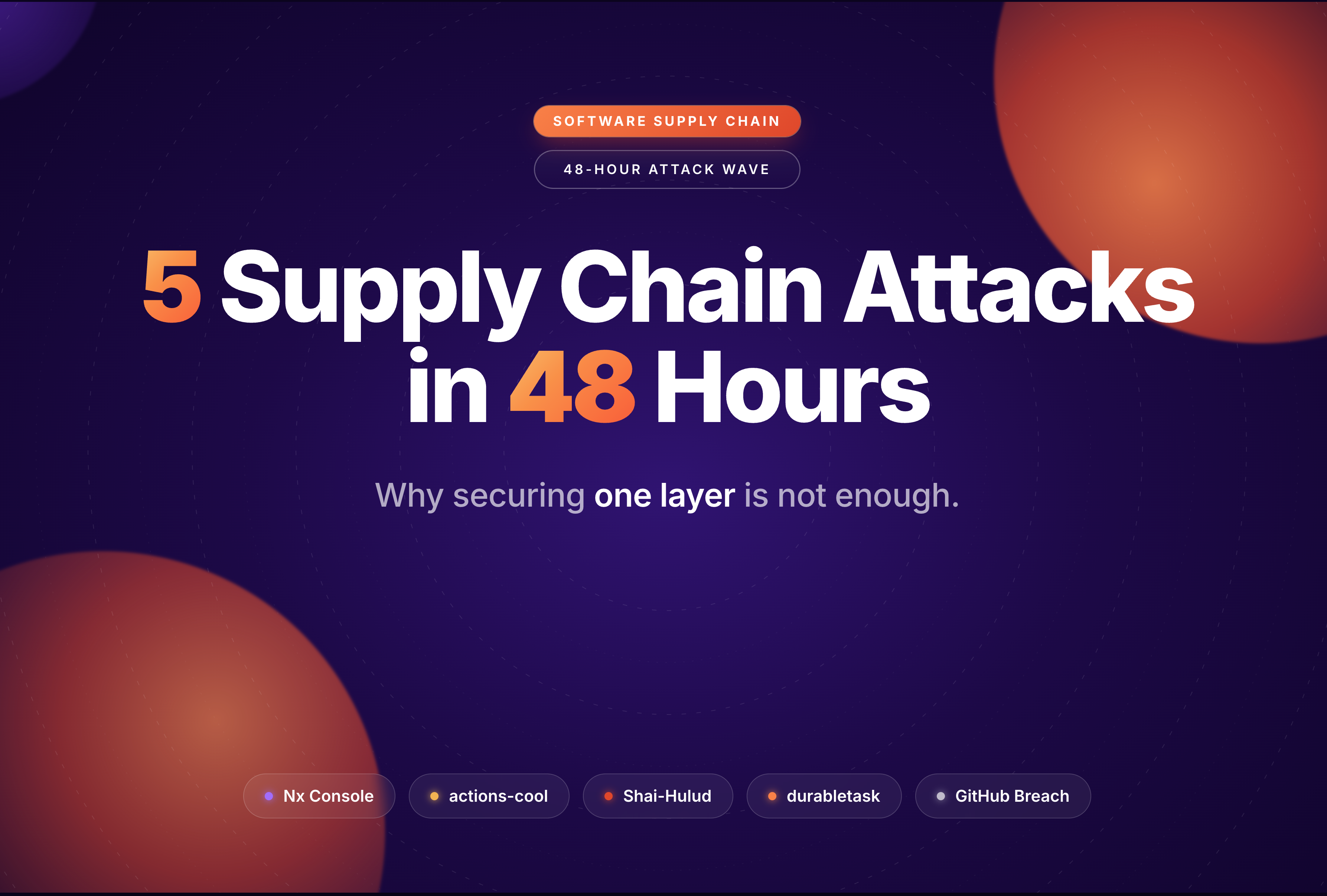
StepSecurity recaps a 48-hour (May 18-19, 2026) software supply-chain attack wave that hit every pipeline layer at once: the Nx Console VS Code extension (2.2M installs) stealing tokens from GitHub/npm/AWS/1Password, the trusted GitHub Action actions-cool/issues-helper hijacked via tag replacement, a trojanized Microsoft durabletask PyPI package pulled within a 35-minute discovery window, a self-replicating Shai-Hulud npm worm, and GitHub's own disclosure that ~3,800 internal source repos were exfiltrated. The piece argues traditional SCA/SAST/EDR/CNAPP tooling missed all of it because none monitor CI/CD runner runtime behavior (e.g., attackers reading /proc/pid/mem to extract secrets) or developer-machine IDE extensions, and ties the incidents to StepSecurity's Harden Runner, Dev Machine Guard, Compromised Actions Policy and Secure Registry controls.

GitHub ActionsVS Codenpm+6
Shai-HuludTeamPCPNx Console+3

Supply Chain, DevSecOps, Threat IntelΒ· Added 6 Oct 2026

snyk.ioarticle🧠 AI

Why AI Coding Agents Keep Writing Broken Access Control

Snyk argues AI coding agents reliably write broken access control (BOLA/IDOR, OWASP's top category since 2021) because the facts needed to add an ownership check β€” what an object belongs to, who may access it, where tenant boundaries sit β€” are tacit product knowledge that exists nowhere in the code or prompt an agent sees. It explains why SAST tools catch patterned sub-categories like path traversal or SSRF but structurally cannot catch CWE-639/862/863 (missing or incorrect authorization), since there's no bad pattern to match, and proposes reasoning over an assembled "application-context graph" of architecture, data flows and trust boundaries instead. It closes with a five-step team checklist (inventory ID-accepting endpoints, document ownership rules, add authorization-specific PR review, write cross-tenant tests, run deep contextual analysis) and pitches Snyk's Evo Agentic AppSec as the tool built around that approach.

SnykOWASPEvo Agentic AppSec+1

coding-agentsΒ· Published and added 1 Oct 2026

snyk.ioarticleπŸ›‘οΈ Security

Why AI Coding Agents Keep Writing Broken Access Control

Snyk explains why AI coding agents reliably ship broken object-level authorization (BOLA/IDOR) bugs: the ownership rule that would prevent them (e.g. "invoices belong to organizations") lives in the product's data model and team knowledge, not in the prompt or surrounding code, so the agent produces code that is correct for the stated task but lets any authenticated user access other tenants' objects. The piece maps the flaw to CWE-639/862/863, contrasts it with pattern-matchable classes like SSRF and path traversal that SAST handles well, and lays out five concrete team actions (endpoint inventory, documented ownership rules, explicit authz review questions, per-resource cross-tenant tests, and periodic deep contextual analysis), while pitching Snyk's "application-context graph" and Evo Agentic AppSec as the tool for the pattern-less gap.

Snyk
BOLAIDORCWE-639+5

AppSec, AI SecurityΒ· Published and added 1 Oct 2026

x.comthread🧠 AI

Average AI Bro (@AverageAiBro) on X

An X post presenting Reversecore MCP, an MCP server that wraps authorized reverse-engineering, malware-analysis, forensics and SAST-style tools such as radare2. The user picks a profile, points it at a sample, and the agent gets structured results back in the session without driving the tools by hand. It is a concrete example of profile-based tool exposure for specialized toolchains, offered as a free alternative to a commercial IDA setup. The post stresses authorized analysis only.

Model Context Protocolradare2IDA+1
Reversecore MCP

mcpΒ· Added 1 Oct 2026, published 30 Sep 2026

x.comtoolπŸ›‘οΈ Security

Average AI Bro (@AverageAiBro) on X

Reversecore MCP is an MCP server that exposes authorized reverse-engineering, malware-analysis, forensics, and SAST-style tooling to an AI agent through selectable profiles, returning structured results for a given binary sample. It targets the gap between hand-driving tools like radare2 and paying for a commercial IDA Pro-based workflow, letting an agent query a toolchain directly instead of a human operator switching between tools.

Model Context Protocolradare2IDA Pro+1

Malware & REΒ· Added 1 Oct 2026, published 30 Sep 2026

securityboulevard.comarticleπŸ›‘οΈ Security

973 MCP Packages, 71% Single-Maintainer: A Practitioner

Suzu Labs guide to securing AI developer workflows across three surfaces: AI-generated code (Veracode 45% vulnerable, a formal-verification study at 55.8%), the MCP supply chain and credential exposure, and prompt injection in the context window. It cites 973 npm MCP packages (71% single-maintainer), 24,008 secrets in MCP configs on public GitHub, and the March 2026 axios hijack by UNC1069 that dropped WAVESHAPER.V2 and tampered with MCP configs. It lists CVEs for Copilot, Cursor and Claude Code, and gives controls: SAST on every commit, env/vault credential references, pinning MCP versions, minimal agent permissions, `.cursorignore`/Claude deny rules, and monitoring IDE DNS traffic.

Model Context ProtocolnpmCursor+3
CVE-2025-53773CVE-2026-22708CVE-2025-55284+9

AI Security, Supply Chain, DevSecOpsΒ· Added 26 Sep 2026

github.comrepoπŸ›‘οΈ Security

nealbridges/VulnHunter

A maintained, harness-portable fork of Capital One's open-source VulnHunter β€” an agentic AI tool that performs attacker-first forward analysis on source code to find exploitable vulnerabilities, falsify weak findings, and produce evidence-backed PoCs rather than pattern-matched SAST alerts. This fork adds containerized (Docker-based) exploit validation, measured-impact PoCs (rows leaked, amplification factor, etc.), and portability across agent harnesses (Claude Code, Codex, Grok, etc.) via environment-contract prompt files, plus an unattended operator (vulnhunter-run) and batch-scanning/benchmark harness tested against OWASP NodeGoat, Juice Shop, and WebGoat.

Claude CodeDockerPython+4
Capital OneOWASP NodeGoatOWASP Juice Shop+1

AI Security, AppSecΒ· Added 6 Oct 2026, published 22 Sep 2026

github.comrepoπŸ›‘οΈ Security

Shor

Shor is a source-available, multi-tenant autonomous pentesting platform where a ~17-agent LLM pipeline (discovery, hypothesis, adversarial screening jury, exploitation, proof replay) attacks a target URL and optionally its connected source repo. It wields 30+ real offensive tools (sqlmap, dalfox, nuclei, jwt_tool, hydra, ffuf, etc.) plus SAST/secret/SCA tools (Semgrep, Gitleaks, TruffleHog, OSV-Scanner, Trivy) in white-box mode, and only reports findings whose PoC is deterministically re-executed and confirmed by a code-enforced safety layer under a signed Rules of Engagement, with scan authorization gated behind single-use human-minted tokens on its MCP/automation surface.

SemgrepGitleaksTruffleHog+3
MITRE CAPECPolyForm Noncommercial License 1.0.0

Offensive Security, AppSec, AI SecurityΒ· Added 22 Sep 2026, published 19 Sep 2026

adversa.aiarticleπŸ›‘οΈ Security

What is an agent harness (and how do you secure one)?

Adversa AI argues that AI agent security lives in the harness, the loop, tool executors, context/memory management, approval gates and sandbox wrapped around an LLM, not in the model itself, and catalogs nine recurring harness failure classes. It details the firm's own research: SymJack (a symlink-based approval-prompt bypass that let six tested coding agents write attacker-controlled MCP config), GuardFall (shell-matcher bypass exploitable in 10 of 11 open-source agents tested), and TrustFall (MCP servers auto-executing on folder-trust acceptance in Claude Code, Gemini CLI, Cursor CLI and GitHub Copilot CLI), plus references to IDEsaster's 30+ AI-IDE vulnerabilities, a Hugging Face download-counter side channel (CVE-2026-54316), and Novee Security's Black Hat findings on credential leakage across Gemini CLI/Codex trust boundaries. It closes with concrete mitigations: Meta's Agents Rule of Two, allowlisting over blocklisting, treating agent config as executable code, and chain-of-event monitoring mapped to the OWASP Top 10 for Agentic Applications.

Claude CodeCursorGemini CLI+3
CVE-2026-54316SymJackGuardFall+10

AI SecurityΒ· Added 7 Oct 2026, published 14 Sep 2026

endorlabs.comwriteupπŸ›‘οΈ Security

AI SAST Finding: Path Traversal in OpenClaw via LLM Guardrail Bypass | Blog | Endor Labs

Endor Labs details GHSA-r5fq-947m-xm57, a high-severity path traversal (CVSS 8.8) in OpenClaw's apply_patch tool that allows arbitrary file write/delete when sandboxRoot isn't configured, tracing the vulnerable code path from resolvePatchPath() through resolvePathFromCwd() to fs.writeFile/fs.rm. Because the tool is only invoked via LLM decision, the researcher bypassed the model's safety guardrails by injecting fabricated function_call/function_call_output entries into the /v1/responses conversation history, tricking the LLM via in-context learning into emitting a real malicious tool call with a traversal payload. This illustrates how LLM safety training can be the sole runtime control gating dangerous tool arguments, and how that control can be defeated with conversation history injection.

OpenClawEndor Labs
GHSA-r5fq-947m-xm57CWE-22

AppSec, AI SecurityΒ· Published and added 11 Sep 2026

endorlabs.comarticleπŸ›‘οΈ Security

Common C/C++ Vulnerabilities: A Practical Guide to Prevention | Blog | Endor Labs

Endor Labs guide to C/C++ memory-safety and input-handling vulnerabilities β€” buffer overflow (CWE-787/120/121), use-after-free (CWE-416), null pointer dereference (CWE-476), integer overflow (CWE-190), and format string bugs (CWE-134) β€” with vulnerable/fixed code snippets for each. It surveys detection tooling (Coverity, CodeQL, Clang Static Analyzer, AFL++/libFuzzer with ASan/UBSan, OSS-Fuzz) and argues that build-system complexity (Bazel, CMake, Conan, vcpkg) and high SAST false-positive rates make reachability analysis necessary, closing with a pitch for Endor Labs' AURI reachability engine.

Endor LabsCodeQLAURI+1
CWE-787CWE-416CWE-476+4

AppSec, LearningΒ· Published and added 11 Sep 2026

endorlabs.comwriteupπŸ›‘οΈ Security

AI SAST in Action: Finding Real Vulnerabilities in OpenClaw | Blog | Endor Labs

Endor Labs describes applying its AI SAST engine to the open-source OpenClaw AI agent framework, tracing data flows from attacker-controlled sources (HTTP params, config, conversation history, external API responses) through transformations to dangerous sinks like command execution and file operations. The team validated findings by deploying OpenClaw in Docker and building working proof-of-concept exploits, confirming 7 vulnerabilities spanning HTTP handlers, business logic, tool dispatch, and low-level implementation layers, now reported to maintainers via responsible disclosure with technical details pending patch release.

Endor LabsOpenClawDocker

AppSec, AI SecurityΒ· Published and added 11 Sep 2026

endorlabs.comarticleπŸ›‘οΈ Security

Cursor Security: How to Secure AI-Generated Code in 2026 | Blog | Endor Labs

Endor Labs blog post detailing seven security risks specific to Cursor's AI code generation that its built-in controls (workspace trust, SOC 2, privacy mode) don't cover: indirect prompt injection via files/comments, malicious .cursorrules files creating persistent backdoors, AI-suggested typosquatted or outdated dependencies, hardcoded credential leakage in generated test/boilerplate code, cross-project context poisoning via repository indexing, and unreviewed agent auto-run execution. It contrasts Cursor's native controls with what external AppSec tooling (pitched as Endor Labs' AURI) needs to fill, recommending dependency pinning, egress filtering, secret-scanning pre-commit hooks, and reachability-based SCA/SAST.

CursorEndor Labs
AURI

AI Security, Supply ChainΒ· Published and added 11 Sep 2026

endorlabs.comarticleπŸ›‘οΈ Security

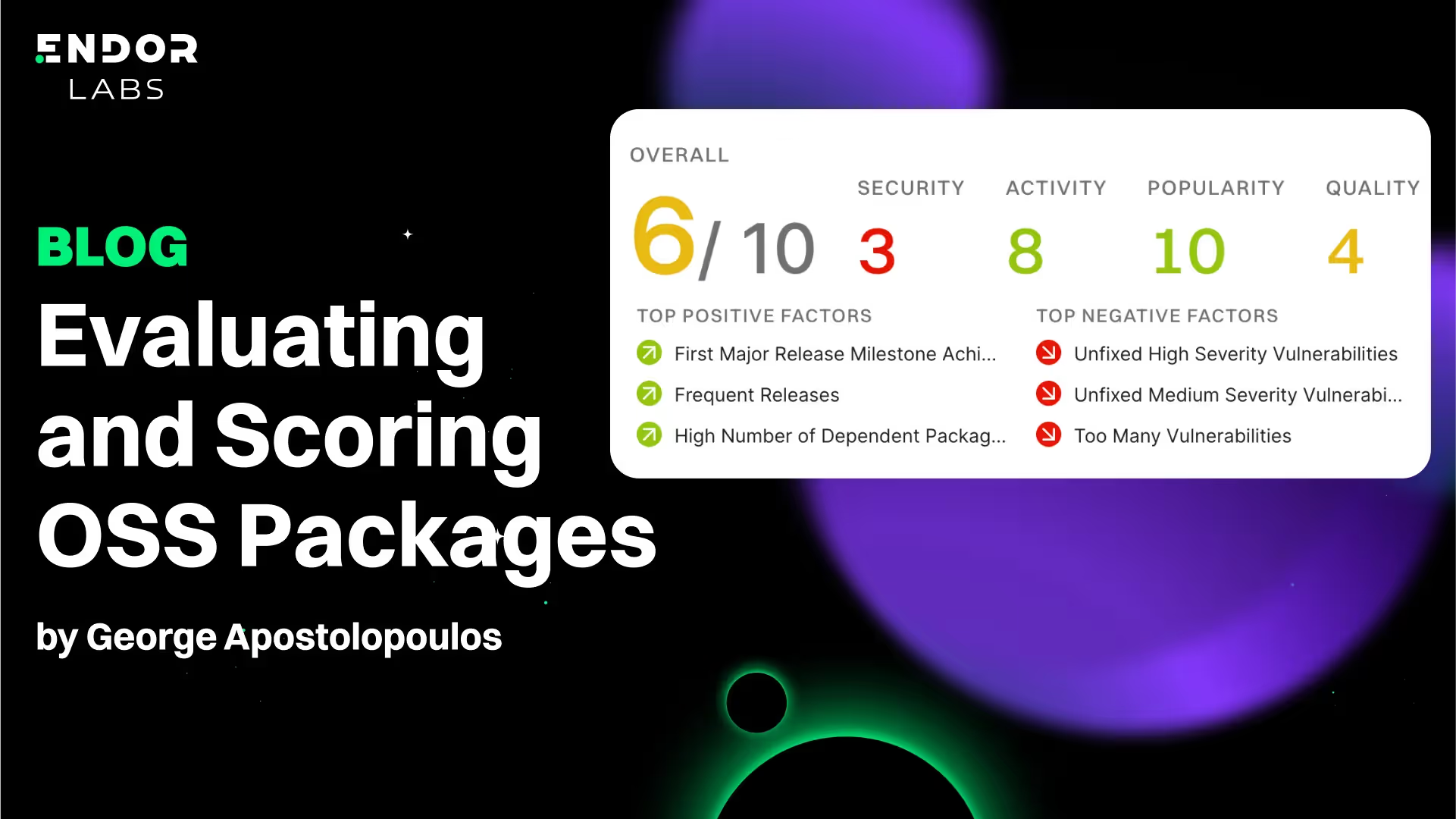
Evaluating and Scoring OSS Packages | Endor Labs | Blog | Endor Labs

Endor Labs blog post detailing their "Endor Score" methodology for evaluating open source package risk, distinguishing operational risk (activity, popularity, licensing, code quality) from security risk (vulnerabilities, secrets, malicious code, security practices). It argues against compressing everything into a single opaque score, favoring transparent, deterministic "facts" (e.g., recent commit counts, normalized SAST findings) that users can combine into custom policies, and discusses pitfalls like event-selection bias, threshold selection, and the unproven predictive power of these signals.

Endor LabsDependabotGitHub+2
OpenSSF ScorecardGoogle Assured Open Source SoftwareOWASP Top 10 Risks for Open Source Software+1

Supply ChainΒ· Published and added 11 Sep 2026

endorlabs.comarticleπŸ›‘οΈ Security

How Endor Labs AI SAST Learns What Matters to Your Organization | Blog | Endor Labs

Endor Labs explains how its AI SAST product incorporates context beyond source code β€” automatically-ingested Infrastructure as Code (Dockerfiles, Terraform, CloudFormation, Kubernetes/Helm) and repository files (AGENTS.md, CLAUDE.md, skills files), plus optional analyst feedback and natural-language threat-model/architecture context β€” to build a deployment-aware model of an application and cut false positives. It cites a benchmark of 192 verified vulnerabilities across 8 projects, claiming 2.6x more true positives than the next tool (Claude Opus 4.7) and 63 findings no other tool caught, and walks through customer examples where external-auth annotations and WAF-mitigated XSS severity were tuned via this context.

Endor LabsTerraformDocker+2
Opus 4.7

AppSec, AI SecurityΒ· Published and added 7 Sep 2026

Showing 30 of 70

Show more