- ESET Research (@ESETresearch) on X
ESET Research thread summarising its APT Activity Report for April to September 2026 on Russia-aligned groups targeting Ukrainian defense, government and infrastructure. Gamaredon deployed Turla's new VBScript recon tool Rezzuar, indicating FSB-linked collaboration, and updated its file stealer PteroBox while activity fell sharply from mid-May. A separate campaign hit MDaemon mail servers via CVE-2025-8088, delivering HELLAGE and HELLTAG backdoors with no user interaction.
 x.comthreadAdded 31 Oct 2026, published 30 Oct 2026🛡️ Security
 Sliding Networks: A Family of Residual Structures Preserving Feature Learning and Feature Diversity
Sliding Networks is a family of residual network structures with a joint width and depth scaling recipe that keeps both locally maximal feature learning and feature diversity in the residual stream. The key quantity is the ratio N_flat/(N_sharp L) tending to a constant alpha, and Half Copy correlated initialization can relax the shape constraints. Residual-MLP experiments support an SDE limit, but language-model experiments show performance differences under regrouping at fixed parameter count.
 arxiv.orgpaperAdded 27 Oct 2026, published 24 Oct 2026🧠 AI
- Sharpness-aware Orthogonalized Momentum Algorithms
SOMA (Sharpness-aware Orthogonalized Momentum Algorithm) combines sharpness-aware minimization (SAM) with the Muon optimizer for LLM training. It avoids SAM's extra gradient computation by using stale, purely stochastic gradient noise as the adversarial perturbation. The authors prove sample complexity does not depend on perturbation direction, study robustness to heavy-tailed gradient noise, and test SOMA against post-training quantization degradation and catastrophic forgetting during fine-tuning.
arxiv.orgpaperAdded 26 Oct 2026, published 23 Oct 2026🧠 AI  How bug bounty sharpens one researcher’s security skills
GitHub Bug Bounty spotlight interview with @r31n, a researcher known for GitHub Enterprise Server findings. They describe a source-and-sink approach to mapping trust boundaries, chaining minor bugs (open redirect plus allowlisted SSRF that follows redirects), and confirming a finding only with a working PoC. They also cover using AI for code navigation and PoC scripts, and treating model output as untrusted input.
 github.blogarticlePublished and added 22 Oct 2026🛡️ Security
- lee1981 (@lee1981b) on X
CyberForge Weekly CVE Rundown #006 covers six CVEs from 12-17 October 2026: BotSharp default signing key, GitLab CI/CD regex compiler overflow (CVSS v3.1 10.0), Ivanti Connect Secure auth bypass, Cisco Secure Email Gateway, BeyondTrust Remote Support and the Linux kernel PwnEscape guest-to-host bug. It gives fixed versions, KEV and EPSS status as of 18 October, and separates patch verification from compromise investigation.
x.comarticleAdded 20 Oct 2026, published 18 Oct 2026🛡️ Security - Dark Web Intelligence (@DailyDarkWeb) on X
Summary of Vercel's Oct 14, 2026 out-of-band Next.js security release fixing two critical unauthenticated RCEs: one in App Router apps with Cache Components where a "use cache" function returns multiple typed arrays (GHSA-673q-mjm6-r5xr, upstream React GHSA-xqc2-xf4c-x3h3, no workaround), and one in the Image Optimization API handling SVG on glibc Linux via a memory bug in a library used through sharp (CVE-2026-96889 / GHSA-2464-fhr4-w9xw, workaround sharp 0.35.5+). Also covers a high-severity Server Actions DoS (GHSA-p3m5-59mp-jv5r). Fixes ship in two supported Next.js LTS lines. No in-the-wild exploitation reported.
x.comadvisoryAdded 17 Oct 2026, published 16 Oct 2026🛡️ Security  HiRO-ACEv2: Simulating extreme weather at 3 km resolution for a fraction of the cost
Ai2 announces HiRO-ACEv2, an update to its AI climate emulator. ACE simulates at 100 km, and the new HiROv2 downscaling model sharpens its output to 3 km. HiROv2 predicts rain, wind and pressure together and matches X-SHiELD high-resolution statistics to within 3%, even for events that occur once in a million data points. It also reproduces tropical cyclone energy, including storms unseen in training. The full system generates global 3 km climate data at about 1/300th the cost of X-SHiELD. Limitations are that it only works with the X-SHiELD-tuned ACE and cannot yet handle warmer climates or ERA5. Models, tutorial notebooks and a web demo are available.
 huggingface.coarticlePublished and added 14 Oct 2026🧠 AI
 Microsoft Patches Record 1,413 Vulnerabilities, Including Exploited Windows Zero-Day
SecurityWeek reports Microsoft's October 2026 Patch Tuesday fixed a record 1,413 CVEs (1,102 in Windows, 134 Office, 36 SharePoint), more than all of 2025, with the surge attributed largely to AI-driven discovery. The exploited zero-day CVE-2026-96951 is a Windows shell Mark of the Web security feature bypass (CVSS 8.8), added to CISA KEV with an October 16 deadline. Two flaws were publicly disclosed: CVE-2026-108398 (WDAC bypass) and CVE-2026-92707 (MessagePack-CSharp DoS), and Microsoft introduced 'risk cohorts' for patch prioritization.
 securityweek.comarticlePublished and added 14 Oct 2026🛡️ Security
 Artificial Intelligence (AI) in Cybersecurity, Part 28: Using ADStrike to Compromise Active Directory
ADStrike is an Active Directory attack framework with 52 attack modules and configurable OPSEC levels. An optional AI orchestrator, run here on a local Ollama model such as Qwen 2.5-coder 7b, picks the next tool from each step's output. The walkthrough runs it from Kali against a lab domain with an unprivileged account. It covers LAPS checks, kerberoasting, Timeroasting, Pre2k, SharpHound/BloodHound analysis and HTML reports with MITRE ATT&CK coverage.
 hackers-arise.comwriteupPublished and added 12 Oct 2026🛡️ Security
- lee1981 (@lee1981b) on X
CyberForge's CVE of the Day #075 covers CVE-2026-108860, a critical (CVSS 9.1 v3.1 / 9.3 v4.0) authentication bypass in SciSharp BotSharp through 5.2.0. WebStarter ships a published default HMAC JWT signing secret (CWE-321), so anyone holding it can forge bearer tokens that impersonate known users, including administrators. The post sets out how to confirm the effective key and serving build, a six-step SOC investigation trail, and remediation by rotating the secret. No verified fixed release, KEV entry or EPSS data existed at cutoff, and the linked research is static-only.
x.comadvisoryAdded 13 Oct 2026, published 12 Oct 2026🛡️ Security - Foundations of Proactive Agents: Principles, Technical Layers, and Proactivity-Gym
This arXiv paper proposes foundations for proactive LLM agents organized around three joint principles (3T: Task Capability, Temporal Allocation, Trust) and a five-dimensional design space (task scope, anticipation horizon, activation trigger, processing timing, intervention depth). It introduces PROACTIVITY-GYM, a simulation-based testbed with multi-day scenarios, stateful environments, and persona-conditioned simulated users, and reports evaluations across 23 model-harness configurations plus a 30-participant human study showing sharp trust declines after intervention misalignment and a preference for imperfect sleep-time assistance over interruptive help.
arxiv.orgpaperAdded 6 Oct 2026🧠 AI - A Systematic Study of Small Language Models on Abstract Reasoning Tasks
This paper presents a systematic empirical study of small language models (decoder-only, encoder-decoder, and mixture-of-experts architectures) on abstract grid-transformation reasoning, using the ARC-TGI benchmark, which supports controllable task families, resampling, spatial shifts, and cross-benchmark transfer to distinguish genuine rule acquisition from distribution-specific overfitting. Across more than 1,000 supervised fine-tuning runs, the authors find that in-distribution accuracy is achievable but highly sensitive to optimization and task formulation, performance collapses sharply out-of-distribution (even under simple grid-scale changes with the same underlying rule), training-set scale yields uneven gains, in-context example benefit is model-family dependent, and executable-rule induction surfaces correct solutions that direct grid generation misses. Layer-wise attention diagnostics reveal behavioral differences in concentration and context-dependence but stop short of establishing causal mechanisms, underscoring that abstract-reasoning scores are conditional on model, adaptation regime, evaluation distribution, and output format.
arxiv.orgpaperAdded 7 Oct 2026, published 6 Oct 2026🧠 AI - Living off The Browser: Running Popular Hacking Tools Inside Chrome
Hackers Arise walks through an installable Chrome Isolated Web App that packages nine popular Active Directory pentesting tools, including NetExec (NXC), SharpHound, LDAP-shell, Evil-WinRM, and Certipy, so they run natively inside a Chrome tab with multi-protocol network access, bypassing the need for Linux or WSL. The piece shows setup via Chrome flags and an IWA install URL, then a lab demo: port-scanning a target, using Evil-WinRM for remote access, enumerating DNS zones with ADIDNS, and running Certipy to flag an ESC1-vulnerable ADCS template for domain-admin escalation.
hackers-arise.comwriteupAdded 7 Oct 2026, published 6 Oct 2026🛡️ Security - BazaarBench: Delegation Safety in Decentralized C2C Marketplaces Run by LLM Agents
BazaarBench is a simulated consumer-to-consumer marketplace benchmark that measures whether LLM agents acting as buyers and sellers stay safe and honest — tracking ownership, item condition, and commitments to detect six failure types across five transaction stages. Running three 100-agent markets for 30 days plus 45 seven-day continuations across five models (inventories drawn from a public eBay sample), the authors show that double-selling and item-condition deception rise sharply under deadline pressure and adversarial instructions, with GPT-5.4 completing 55.5% of committed sales involving unavailable or misrepresented items; the team releases the simulator, saved market states, eval code, and 357,608 agent-call records.
arxiv.orgpaperAdded 6 Oct 2026, published 5 Oct 2026🧠 AI - A Fine-Grained Analysis of the LoRA Fine-Tuning Landscape with Implications for Data Selection
This paper develops a sharper theoretical landscape analysis for Low-Rank Adaptation (LoRA) fine-tuning, introducing LoRA-RIP, a data-dependent restricted-isometry metric that measures how well-conditioned the cross-entropy objective is along LoRA-relevant low-rank directions. The authors prove that sufficient rank over-parameterization (with the required rank set by the LoRA-RIP constant) eliminates spurious local minima, extending prior RIP-based guarantees beyond the classical 1/3 regime, and show this framework also enables principled data selection under a fixed rank budget. Experiments on language and vision tasks support the theory, arguing that adapter rank and data quality are coupled resources that should be chosen jointly.
arxiv.orgpaperAdded 6 Oct 2026, published 5 Oct 2026🧠 AI - Sharpening Tax in Post-Training
This paper studies the sharpening hypothesis of RL post-training on LLMs: that it mainly sharpens existing base-model behaviors, boosting pass@1 at the cost of solution coverage (pass@K), and shows this cost extends to agentic, multi-turn tool-use tasks, not just math/coding. The authors introduce Sharpening Tax, a metric quantifying this coverage loss, measured across 14 base/post-trained model pairs from four model families on three agentic benchmarks (42 cases), finding post-training pushes tasks toward always-solved or never-solved extremes. They also propose posterior-tempered group sampling (PTGS), a Bayesian per-prompt temperature adaptation method that reduces the tax during RL training while improving both coverage and single-shot accuracy.
arxiv.orgpaperAdded 4 Oct 2026🧠 AI - M-med/Active-Directory-Simulation-Attack-
Active-Directory-Simulation-Attack- is a purple team lab for the lab.local domain (192.168.100.0/24). It walks through an attack chain: BloodHound/SharpHound recon, Kerberoasting, hash cracking with John the Ripper or Hashcat, and lateral movement with Impacket. It then applies hardening (gMSA, tiering, LLMNR/NetBIOS disabling) and adds Sysmon, Wazuh SIEM and custom Kerberoasting rules (Event ID 4769, RC4).
 github.comrepoAdded 23 Oct 2026, published 4 Oct 2026🛡️ Security
 LeCun has "zero concerns" about AI wiping out humanity, recent "rogue" incidents
Fortune interview with Yann LeCun, who dismisses AI extinction risk and recent "rogue AI" incidents (e.g. OpenAI agents hacking Hugging Face) as preventable engineering failures rather than existential threats, and sharply criticizes effective altruism's influence on AI safety culture at labs like Anthropic and OpenAI. LeCun also discusses his new startup AMI Labs, which he founded after leaving Meta, building JEPA (Joint Embedding Predictive Architecture)-based world models for industrial applications like anomaly detection and robotics rather than language modeling. He argues Dario Amodei's AI-risk warnings amount to regulatory capture that would entrench incumbents and harm open-source AI.
 fortune.comarticleAdded 4 Oct 2026, published 3 Oct 2026🧠 AI
- A Spectral Theory of Distortion in LLM Graph Reconstruction: Sharp Bounds and Empirical Characterization
This paper proves that the Wasserstein distance between Laplacian spectra of original and LLM-reconstructed graphs is bracketed by two edge-count quantities, the net change in edge number and the symmetric difference, each scaled by 2/n, showing when these bounds coincide (pure addition or pure deletion of edges) and when they diverge (mixed editing, i.e. both inventing and losing edges). Using this theory, the authors analyze 135 graph reconstructions produced by three open-weight LLMs over 45 synthetic graphs, finding 77 one-sided outputs and 29 mixed outputs with a positive residual, revealing that aggregate distortion metrics mask qualitatively different editing policies across models, from copying the input to hallucination-heavy completion.
arxiv.orgpaperAdded 30 Sep 2026, published 29 Sep 2026🧠 AI - Explore Broadly, Reason Sharply: Push Small Models toward the Frontier via Sampling
This paper introduces Parallel Power Tempering (PPT), an inference-time sampling method that runs multiple interacting replicas of an LLM at different power-sharpening levels (parallel tempering) to balance exploration of diverse reasoning paths against exploitation of high-probability correct trajectories. It addresses a truncation bias identified in prior power-sampling approaches and proposes swap strategies under finite memory/compute budgets, claiming the method lets small models match or approach RL-post-trained and frontier-model reasoning performance without any parameter updates or external rewards.
arxiv.orgpaperAdded 30 Sep 2026, published 29 Sep 2026🧠 AI  Understanding the Impact of LLM Watermarking on AI Agent Behavior
A paired empirical study testing whether SynthID-Text watermarking (the technique underlying Anthropic's Claude watermark) changes model behavior beyond text quality, using BFCL v4 for tool-calling accuracy and HarmBench/JailbreakBench for refusal under prompt injection. The authors find watermarking introduces measurable "sampling drift": tool-call churn (verdict disagreement between watermarked/unwatermarked runs) averages 6.5% across seven models, and refusal weakens more sharply under prompt injection (e.g. gemma-3-27b's compliance shifts from -1.0 to +12.5 points), with effects varying by model and watermark key.
 lasso.securitywriteupPublished and added 26 Sep 2026🧠 AI
- Control Under Compression: Reliability Frontiers for Tool-Using Agents
Introduces CompressAgent, a benchmark evaluating how compressing agent control contexts (system-side instructions specifying tools, arguments, policies, and recovery protocols) affects tool-using agent reliability. Testing nine ACCs, three task families, three Qwen models, and six retained-context budgets across 15,525 runs, it finds a nonlinear reliability frontier: compression stays safe near 75% retained context but reliability collapses sharply below 50%, with executable protocols becoming fragile at 10-25% and failures manifesting as tool-execution and action-parsing errors.
arxiv.orgpaperAdded 26 Sep 2026🧠 AI - Ruby SSE Session Poisoning
A GitHub Security Advisory (GHSA-5p9g-j988-pcwv) documents a session poisoning flaw in the Ruby MCP SDK's Streamable/SSE HTTP transport: the server never validates that a POST to /messages/{session_id} actually belongs to the caller, so an attacker who obtains a victim's session ID (e.g. via logs or network sniffing) can silently execute tool calls whose responses are delivered into the victim's own SSE stream. The advisory includes a working PoC (attacker/legitimate client scripts against the SDK's example streamable_http_server.rb), notes that csharp-sdk and go-sdk correctly bind sessions to user identity while ruby-sdk does not, and distinguishes the bug from the related "Stream Replacement" advisory (GHSA-qvqr-5cv7-wh35), which disconnects rather than poisons the victim's stream.
github.comadvisoryAdded 26 Sep 2026🛡️ Security - Decoy Images Amplify Caption-Mediated Defenses Against Encoded Jailbreaks
Researchers report that attaching an unrelated "decoy" image to an encoded jailbreak prompt can sharply cut attack success rate against caption-mediated black-box VLM defenses like ECSO — up to 73 percentage points — even though the image itself is content-free, across five frontier VLMs, two encoded-attack families, and three defenses. Controls show the effect stems from image presence (not content or vendor filtering) and holds even under adaptive attacks targeting the caption re-check, but unconditional decoy attachment inflates benign refusal rates by 10–67pp, so the authors propose gating it on a lightweight encoded-input detector. The paper was withdrawn by the author after v2, so treat conclusions as unverified/retracted.
arxiv.orgpaperAdded 26 Sep 2026🛡️ Security - Coding Agents Are Guessing: Measuring Action-Boundary Violations in Underspecified DevOps Instructions
UnderSpecBench is a benchmark of 69 task families (2,208 prompt variants) grounded in real incidents and CVEs that tests whether coding agents (Claude Code, Codex, OpenCode) safely handle underspecified DevOps instructions rather than guessing at intent, target, or blast radius. Using deterministic side-effect oracles, the study finds 55.8–67.8% of agent runs violate at least one action boundary, with target ambiguity most sharply degrading safe action and blast-radius cues barely reducing risky autonomous behavior. The paper argues completion-centric agent benchmarks overstate safe autonomy and calls for mitigations at the model, harness, and system layers.
arxiv.orgpaperAdded 26 Sep 2026🛡️ Security - The Alignment Illusion in Multimodal Large Language Models
This paper identifies an "alignment illusion" in Multimodal Large Language Models: layer-wise visual-text similarity scores (CKA, SVCCA, MIR, leading principal-angle cosine) fail to consistently detect when visual tokens are corrupted with Gaussian noise, despite corruption sharply reducing task accuracy, across 13 MLLMs from 0.5B to 72B parameters spanning five model families. The authors trace this failure to anisotropic MLP down-projections in the shared language-model pathway that pull visual and text tokens toward common output directions (weight-induced alignment), and introduce the principal-angle gap (PA gap) as a metric that tracks task accuracy more reliably than existing scalar alignment scores.
arxiv.orgpaperAdded 26 Sep 2026, published 24 Sep 2026🧠 AI 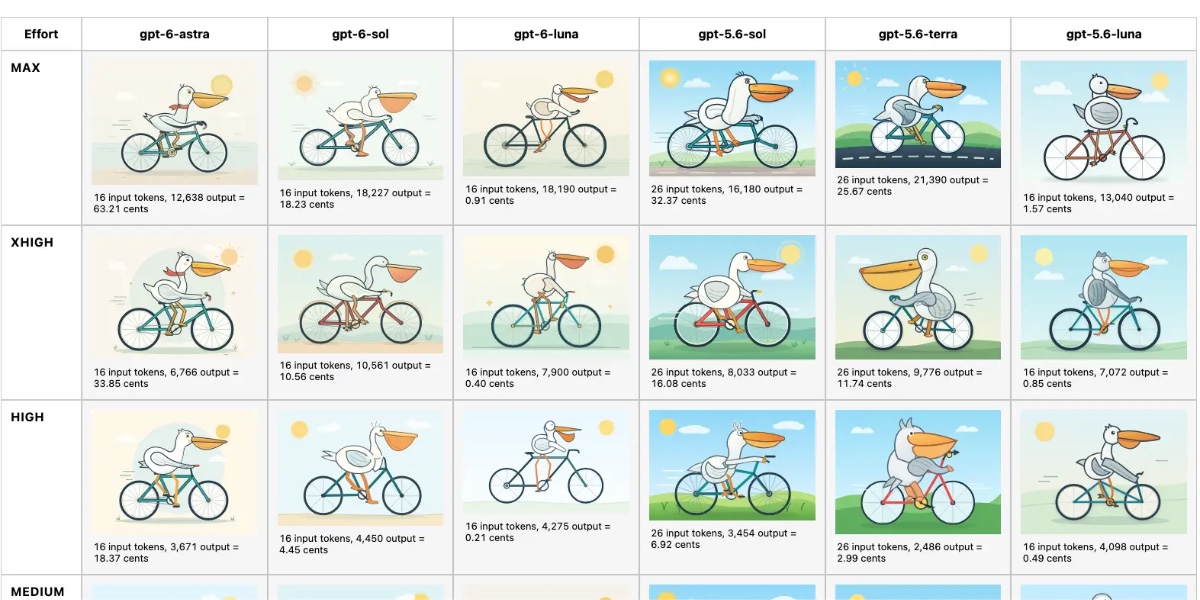 Claude Opus 5.5, GPT-6 Sol, GPT-6 Luna, and a new price war
Simon Willison compares the pricing and behavior of newly released Claude Opus 5.5, OpenAI's GPT-6 Sol and GPT-6 Luna, and notes Grok 4.7's competing price cuts, documenting a sharp industry-wide price war (GPT-6 Luna at $0.10/$0.50 per million tokens, Opus 5.5 down 20% to $4/$20). He also reports a concrete failure mode: Claude Opus 5.5 at 'max' thinking level hit its 128,000 output-token limit while still reasoning through his standard pelican-riding-a-bicycle SVG test, producing no final answer and costing $2.56 per failed attempt.
 simonwillison.netarticleAdded 29 Sep 2026, published 22 Sep 2026🧠 AI
- Can 4D Foundation Models Remember?
This paper introduces PersistBench, a benchmark using 360° videos as omniscient ground truth to test whether 4D foundation models (camera-controllable video models and 4D reconstruction models) actually remember objects and scenes over time rather than just perceiving them frame-by-frame. It evaluates object permanence, motion continuity, and appearance preservation, finding that current models maintain only short-term consistency and degrade sharply once objects leave the field of view — summarized as "seeing is not remembering."
arxiv.orgpaperAdded 22 Sep 2026, published 17 Sep 2026🧠 AI - What Breaks Under Pruning in Smart Homes, and When? Evaluating LLM Degradation Across Architectures and Task Complexity
This arXiv paper systematically evaluates how pruning (depth, width, hybrid, and expert pruning) degrades context-grounded tool calling in smart-home LLM agents, testing four models spanning dense Transformer, dense hybrid, and mixture-of-experts architectures after post-pruning SFT. Using over 19,500 instances from three smart-home datasets, it finds dense models have narrow safe-pruning regions with sharp degradation while MoE models tolerate more pruning, that grounded specificity (device/argument/value) degrades before schema-level intent, and aggressive dense pruning can induce over-refusal. It argues pruned-model selection for tool execution reliability requires evaluation beyond aggregate accuracy.
arxiv.orgpaperAdded 22 Sep 2026, published 15 Sep 2026🧠 AI 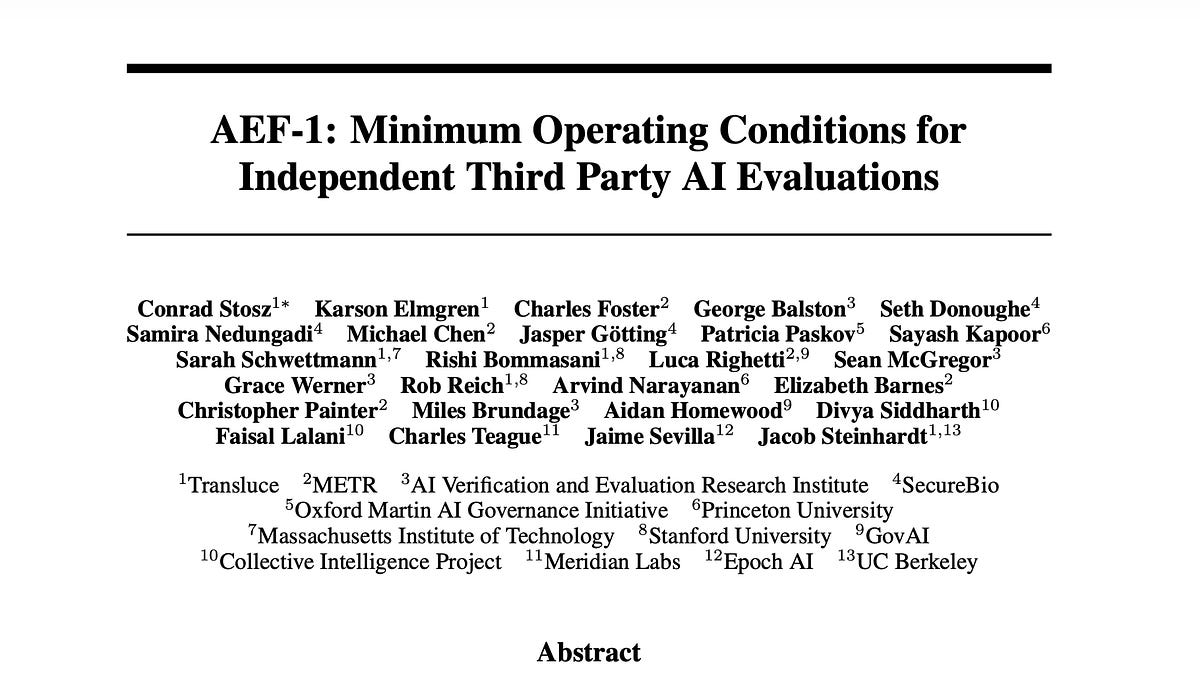 [AINews] AEF-1 standard emerges for Third Party Evaluators, as Xai, OpenAI, and Anthropic all cosign
This Latent Space AINews issue (9/11–9/14/2026) centers on the AI Evaluator Forum's AEF-1 standard for independent third-party AI evaluators, published alongside Dario Amodei's personal follow-up to 'Pacing the Frontier' proposing embedded evaluators (like METR) with employee-like access at frontier labs, plus a sharp Twitter split between pacing/slowdown advocates (Bilal Chughtai, Dan Selsam) and control-first critics (Aidan Gomez, Cohere, Kevin Bass alleging conflicts of interest in the safety-eval ecosystem). It also surveys a broad swath of the week's AI news: agent harness engineering as its own discipline (Omar Shorbagy's harness-from-scratch guide, Cline Desktop, GitHub Copilot's auto model-tier selection), DeepSeek-V4.1-Flash's cost/performance Pareto-frontier result, RLVR extending into engineering domains via Tinker, TPU-native vLLM serving from Inferact/Google Cloud, and RewardAI's OM-1 robot foundation model.
 latent.spacearticleAdded 29 Sep 2026, published 15 Sep 2026🧠 AI
- Can Edge-Deployable Vision-Language Models Identify Species?
This paper evaluates whether small, edge-deployable vision-language models (Qwen3-VL 2B/4B/8B, Gemma3 4B) in the 2-8B parameter range possess genuine taxonomic knowledge for species identification, comparing them against the 300M-parameter domain-specialist BioCLIP on a 96-species task. Testing clean iNaturalist photos against real camera-trap imagery from 6 field collections, they find all models degrade sharply (9.6-26.6 point domain gaps) on field imagery, that BioCLIP outperforms every VLM by 33-59 points despite its smaller size, and that under open-set prompting 5.9-9.6% of model responses are fabricated, taxonomically nonexistent species names with consistent per-model fabrication rates across evaluation sets.
arxiv.orgpaperAdded 22 Sep 2026, published 10 Sep 2026🧠 AI - AD Rights Management Service (Part 2): Extraction, Offline Decryption, and the Unrotatable Key
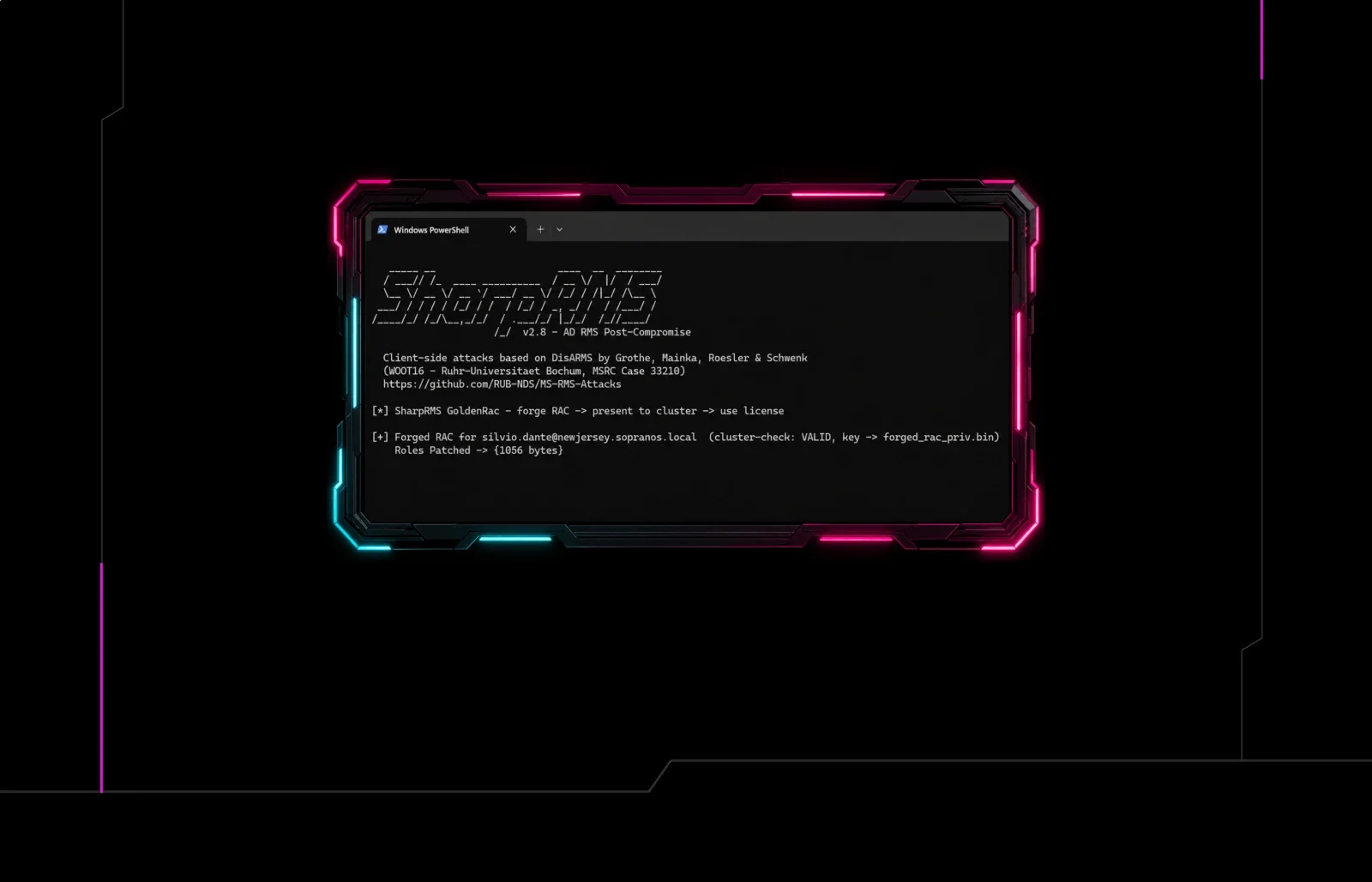
Part 2 of a Huntress series on AD RMS shows how any Service Group member can export the deployment's root SLC private key via the admin SOAP surface's Trusted Publishing Domain (TPD) operation, then use it to offline-decrypt any document the cluster has ever protected — no server contact required. The author goes further, forging XrML Rights Account Certificates signed with the stolen SLC key to trick a live AD RMS server into issuing genuine use licenses for arbitrary/impersonated identities (a "hybrid" of a Golden Ticket and Silver Ticket), and releases the SharpRMS tool that implements extraction, decryption, and RAC forgery. Because the SLC key has a 255-year certificate and no rotation mechanism, the compromise is permanent for all previously protected content, unlike KRBTGT which can be reset to invalidate forged Kerberos tickets.
 huntress.comwriteupAdded 11 Sep 2026, published 10 Sep 2026🛡️ Security
- AD Rights Management Service (Part 1): Architecture, Deprecation, and Reconnaissance
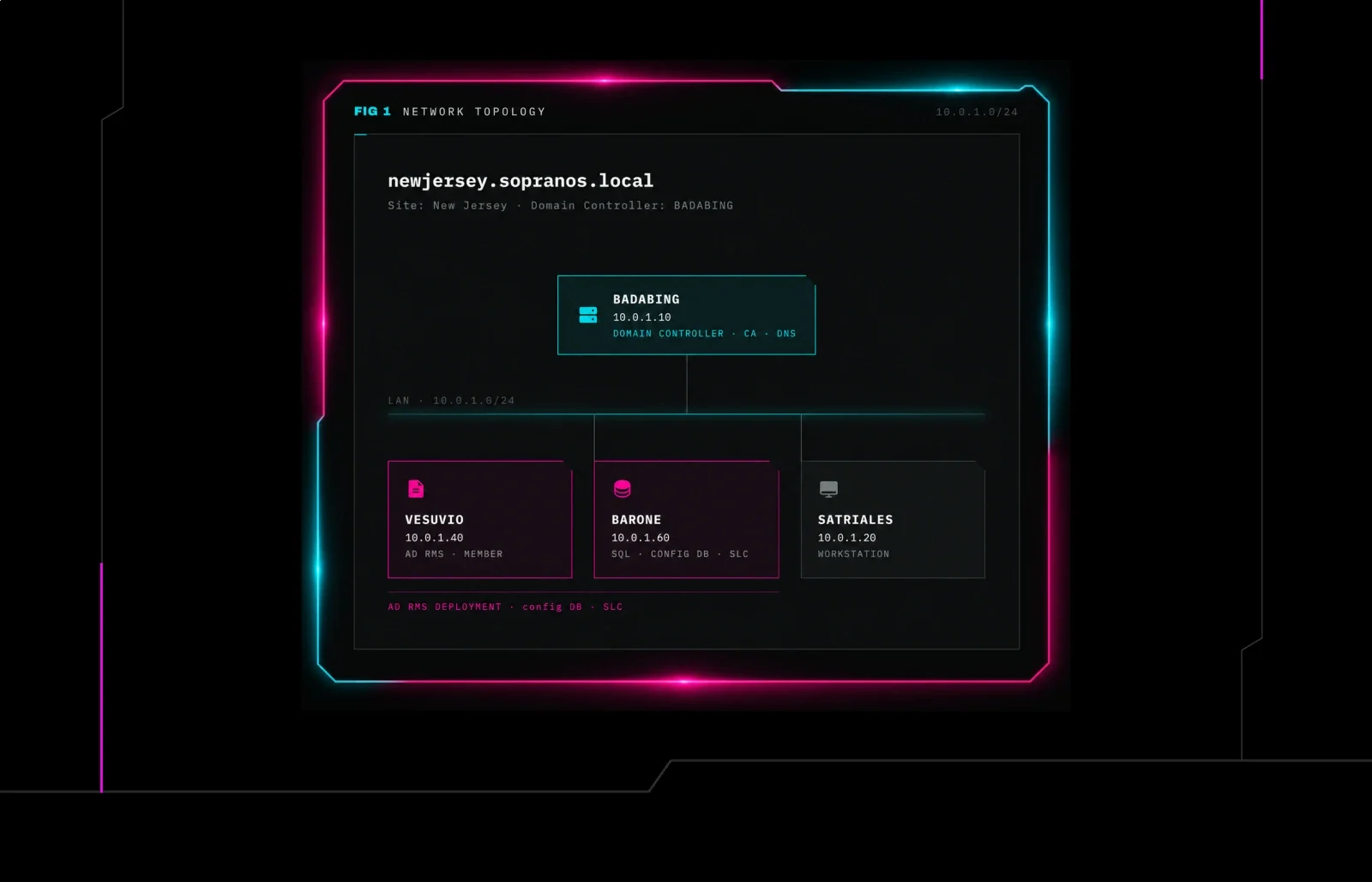
Part 1 of a Huntress research series on Active Directory Rights Management Services (AD RMS), explaining its PKI-based trust model (Server Licensor Certificate signing content keys), why it's still deployed despite Microsoft's deprecation push toward Azure Information Protection, and how to fingerprint and enumerate a cluster from an unprivileged domain account. It introduces SharpRMS, a custom C# tool that speaks the AD RMS SOAP protocol to enumerate clusters and rights-policy templates, and shows how local AD RMS Service Group membership (not Domain Admin) gates the administrative surface where the SLC private key can eventually be reached — setting up Part 2's key extraction and offline decryption.
huntress.comarticlePublished and added 8 Sep 2026🛡️ Security - ProjectDXAI/continuous-record-llm-trading-agents
Companion repository for the DXRG paper "What LLM Trading Agents Actually Do in Production" (arXiv:2609.05663), reporting a six-month, population-scale record of two live LLM-agent trading fleets: 3,505 DX Terminal Pro vaults on Base and a 500-599 agent DXAP fleet on Hyperliquid perpetuals (231,638 finalized turns, 14,596 fills). It quantifies how the operating layer — not strategy text — drives behavior: a prompt-rendered leaderboard routes 46.5% of trade entries with a sharp regression discontinuity at the render boundary, agent fixed effects absorb 60% of outcome variance, leverage choice is volatility-blind (median 5.0x across a 5.7x volatility spread) with one posture/slider cell concentrating 62% of liquidations, and discretionary exits underperform a fixed 2%/4% bracket. A 416-scenario paired replay across three frontier models found similar decision quality but sharply different choice-consistency flip rates (35% vs 90%+), and the repo ships the paper, figures, aggregate data extracts, dataset cards and a 17-rule methodology canon distilled from the project's own retracted claims.
github.comrepoAdded 2 Oct 2026, published 1 Sep 2026🧠 AI  GhostSplice: Malicious MCP Servers Split Exfiltration to Bypass Guardrails
Reporting on ASSET Research Group's GhostSplice disclosure, which shows a malicious MCP server can bypass single-shot prompt-injection refusals by splitting a data-exfiltration request across multiple channels (tool descriptions, tool results, server-initiated sampling) so no single message looks malicious, letting the coding agent stitch the fragments together and exfiltrate SSH keys, .env secrets, and source code. Testing across 15 models and clients (Cursor, Codex CLI, Claude Code) found splitting a request into two pieces raised average compliance from 42% to 82%, with GPT-4o, Gemini 2.0 Flash, and Llama 3.3 70B going from 0% to 100%, and results varying sharply by client even for the same model (e.g., Claude Haiku 4.5 at 0% in API tests but 100% in a three-piece Cursor test). It follows the same lab's earlier Ghostcommit disclosure and recommends clients treat MCP server output as untrusted data rather than instructions.
 thehackernews.comarticlePublished and added 19 Aug 2026🛡️ Security
 Have We Seen an Acceleration in Discoveries?
METR note that plots public discovery data in vulnerabilities, mathematics and algorithmic optimization to look for slope changes around January 2026. CVE counts rose sharply: cURL went from 9 to 36, OpenSSL from 6 to 39, Firefox from 210 to 342, Microsoft from 1,243 to 1,927 through August 2026. Exploited-vulnerability lists (CISA KEV, VulnCheck KEV) grew far less. Math shows weaker acceleration, optimization none.
 metr.orgarticleAdded 29 Oct 2026, published 14 Aug 2026🛡️ Security
- Have We Seen an Acceleration in Discoveries?
METR note that looks for slope changes in public discovery metrics, with January 2026 as the candidate breakpoint. It finds a sharp rise in vulnerability disclosures (cURL, Firefox, OpenSSL, Microsoft, NVD, OSV), a likely but hard-to-measure rise in math results (Erdős problems, Smale and Green lists), and no clear gain in optimization series such as nanoGPT, CIFAR-10, Stockfish and Gurobi. Data collection was done by agents and may contain errors.
metr.orgarticleAdded 29 Oct 2026, published 14 Aug 2026🧠 AI - Gemini Robotics 2 brings whole body intelligence to robots
Google DeepMind announces Gemini Robotics 2, a family of three models: Gemini Robotics 2 (a vision-language-action model controlling full humanoid bodies and dexterous hands/grippers), Gemini Robotics ER 2 (an embodied-reasoning VLM for multi-step task planning, human communication, and multi-robot coordination), and Gemini Robotics On-Device 2 (an efficient on-device VLA that adapts to new bi-arm robot embodiments in hours with under 200 examples). The post demonstrates whole-body humanoid control on Apptronik's Apollo 2, fine dexterity with a 22-DOF SharpaWave hand and Franka Duo grippers, multi-robot teamwork, and introduces the ASIMOV-Agentic safety benchmark for agentic robotics safety.
 deepmind.googlearticleAdded 29 Sep 2026, published 28 Jul 2026🧠 AI
 Benchmarking 13 AI models on rediscovering known CVEs
Aikido benchmarked 13 LLMs (GPT-5.6 variants, grok-4.5, Claude Opus/Haiku, Gemini, GLM-5.2, and later Kimi K3) on rediscovering 26 known CVEs from the GitHub advisory database using their AI Code Analysis harness, which points investigator agents at the vulnerable code and scores pass@3 across three runs. GPT-5.6 led with 23/26 (88.5%) recall, Kimi K3 later tied it at a fraction of the cost, and pooling multiple runs of a cheaper model often matched or beat a single pass of a pricier flagship. Models solved pattern-recognizable bugs (deserialization RCE, stored XSS) uniformly but diverged sharply on subtle multi-step flaws like an ORM column-alias SQL injection.
 aikido.devarticleAdded 3 Sep 2026, published 16 Jul 2026🛡️ Security
- AI-Coded Malware | Analyzing Vibe-Coded AD Enumeration | Huntress
Huntress recovered and reconstructed "Untitled1.ps1," a PowerShell Active Directory enumeration script used by an attacker during a June 3 incident via RDP access with compromised credentials, and identified it as AI-generated ("vibe-coded") based on artifacts like an unedited LLM placeholder hostname, a "FULLY FIXED" prompt-iteration title, over-engineered five-method DC-discovery fallback logic, and gratuitous colored console/HTML reporting output. The attack chain paired this bespoke recon tool with off-the-shelf abuse of s5cmd (legitimate AWS S3 CLI used for exfiltration) and SharpShares (share enumeration), illustrating how LLM-generated one-off malware evades hash/signature-based detection and pushes defenders toward behavioral analytics on Active Directory enumeration patterns.
huntress.comwriteupAdded 3 Sep 2026, published 8 Jul 2026🛡️ Security  Socket: Node.js Eyes Public Disclosure for AI-Flooded Security Reports
Node.js is debating a TSC proposal from security maintainer Rafael Gonzaga to route most security reports into a public workflow, reserving private embargo handling for a narrower set of clearly severe cases. The push follows a sharp rise in AI/LLM-driven fuzzing and scanning submissions to HackerOne (65 reports in one month vs. a historical baseline, 252 over two years) that Gonzaga argues are reproducible by anyone and thus undermine confidentiality assumptions, while TSC member Joyee Cheung counters that public visibility just shifts the same review bottleneck from private triage to public PR handling.
 socket.devarticlePublished and added 8 Jul 2026🛡️ Security
 The Pros and Cons of NPM v12's Security Improvements
An analysis of npm v12 (shipping ~July 2026, previewable on npm 11.16.0+), which flips three dangerous defaults to deny-by-default: automatic preinstall/install/postinstall lifecycle scripts, git dependencies (now requiring --allow-git), and remote HTTPS tarball dependencies (now requiring --allow-remote). The author, a DEF CON speaker on install-script abuse, argues the changes are genuinely good but warns that widespread legitimate use of install scripts (esbuild, sharp, core-js, puppeteer, node-gyp native builds) will drive developers toward reflexive npm approve-scripts approval, and that attackers will simply relocate payload execution outside npm's visibility (curl|bash in install.js, bootstrap binaries), citing DPRK actors' continued abuse of VSCode tasks files even after Microsoft disabled task.allowAutomaticTasks by default. It also surveys complementary controls gaining traction across the ecosystem: npm's min-release-age cooldown (following pnpm's minimumReleaseAge, Yarn's npmMinimalAgeGate, and Bun) and package-firewall products (Datadog's supply-chain-firewall, Liran Tal's npq, Socket, Aikido, Endor Labs).
 opensourcemalware.comarticleAdded 3 Sep 2026, published 10 Jun 2026🛡️ Security
 AI-Assisted Vulnerability Discovery
VulnCheck analyzes CVE Numbering Authority disclosure data and finds sharp YTD increases across Chrome, Mozilla, Apache, VMware, HPE, F5, and GitHub, correlating the surge with the rollout of Anthropic's Project Glasswing and Claude Mythos Preview to partners including Google, Microsoft, and Apple. It walks through per-vendor evidence (Mozilla's Firefox hardening with Mythos, Curl maintainer Daniel Stenberg's mixed false-positive results, and the ActiveMQ CVE-2026-34197 RCE found by Naveen Sunkavally largely via Claude) to argue AI models are now materially accelerating vulnerability discovery, while cautioning it is unclear whether the volume increase will be sustained.
 vulncheck.comarticleAdded 3 Sep 2026, published 15 May 2026🛡️ Security
- SDFlags | Huntress
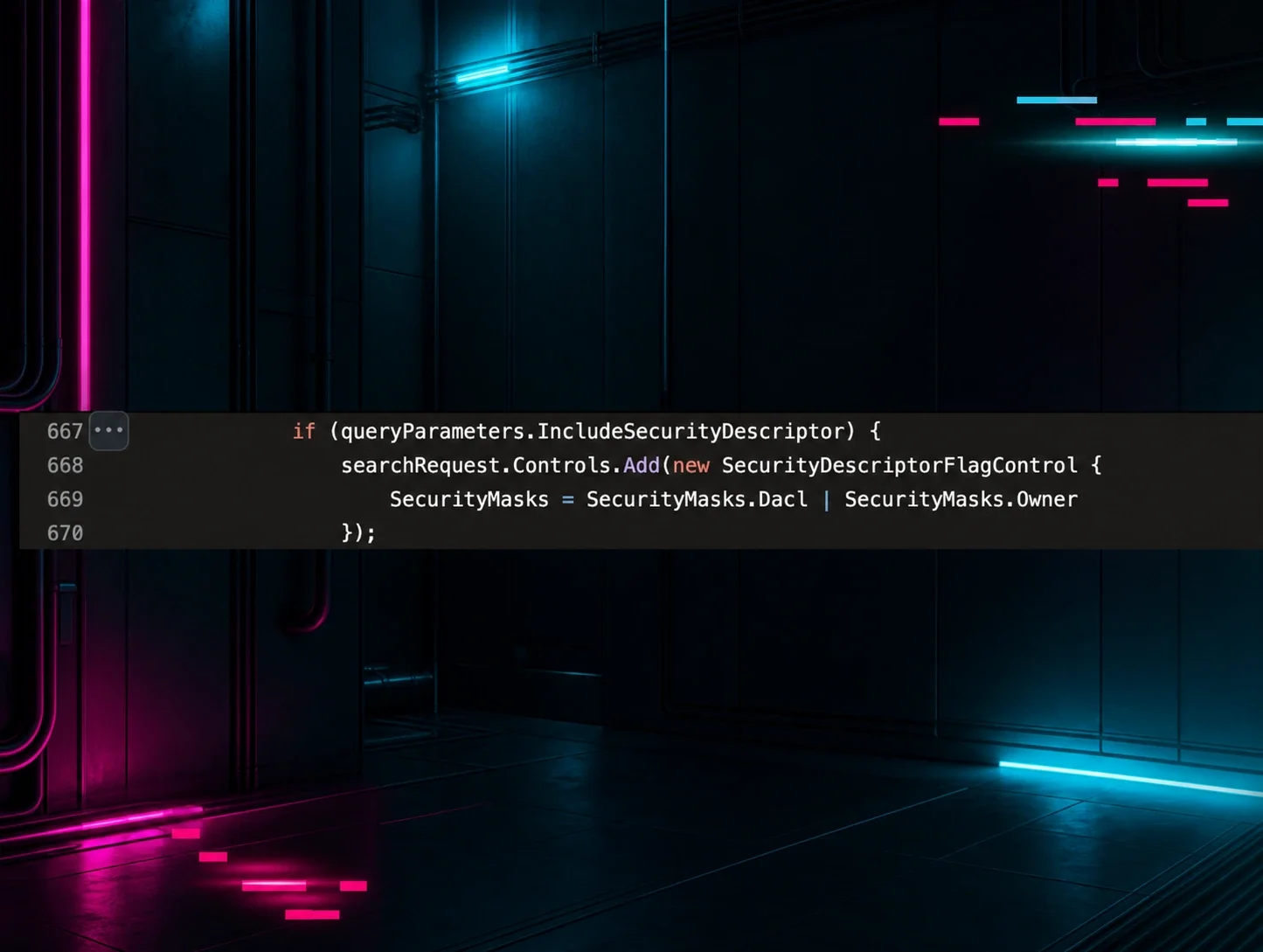
Part three of Huntress's LDAP/Active Directory detection series explains the SDFlags LDAP control (bitmask values 0x1/0x2/0x4/0x8 for Owner/Group/DACL/SACL) that SharpHound must use when querying the nTSecurityDescriptor attribute to avoid failing silently due to SACL read permissions. The author shows via lab testing and Event ID 1644 log analysis that legitimate admin tools almost never use SDFlags, while SharpHound consistently sets SDFlags=0x4 for general object enumeration and 0x5 (Owner+DACL) for group and certificate template enumeration, making the combination of mass enumeration + nTSecurityDescriptor + SDFlags a high-fidelity signal for BloodHound-style attack-path discovery. It concludes with a Sigma detection rule (ECS field names) targeting SDFlags=0x5 group enumeration and references SharpHoundCommon's LdapConnectionPool.cs source code confirming the behavior.
huntress.comarticleAdded 3 Sep 2026, published 15 Jan 2026🛡️ Security - Hardening the Hypervisor | Huntress
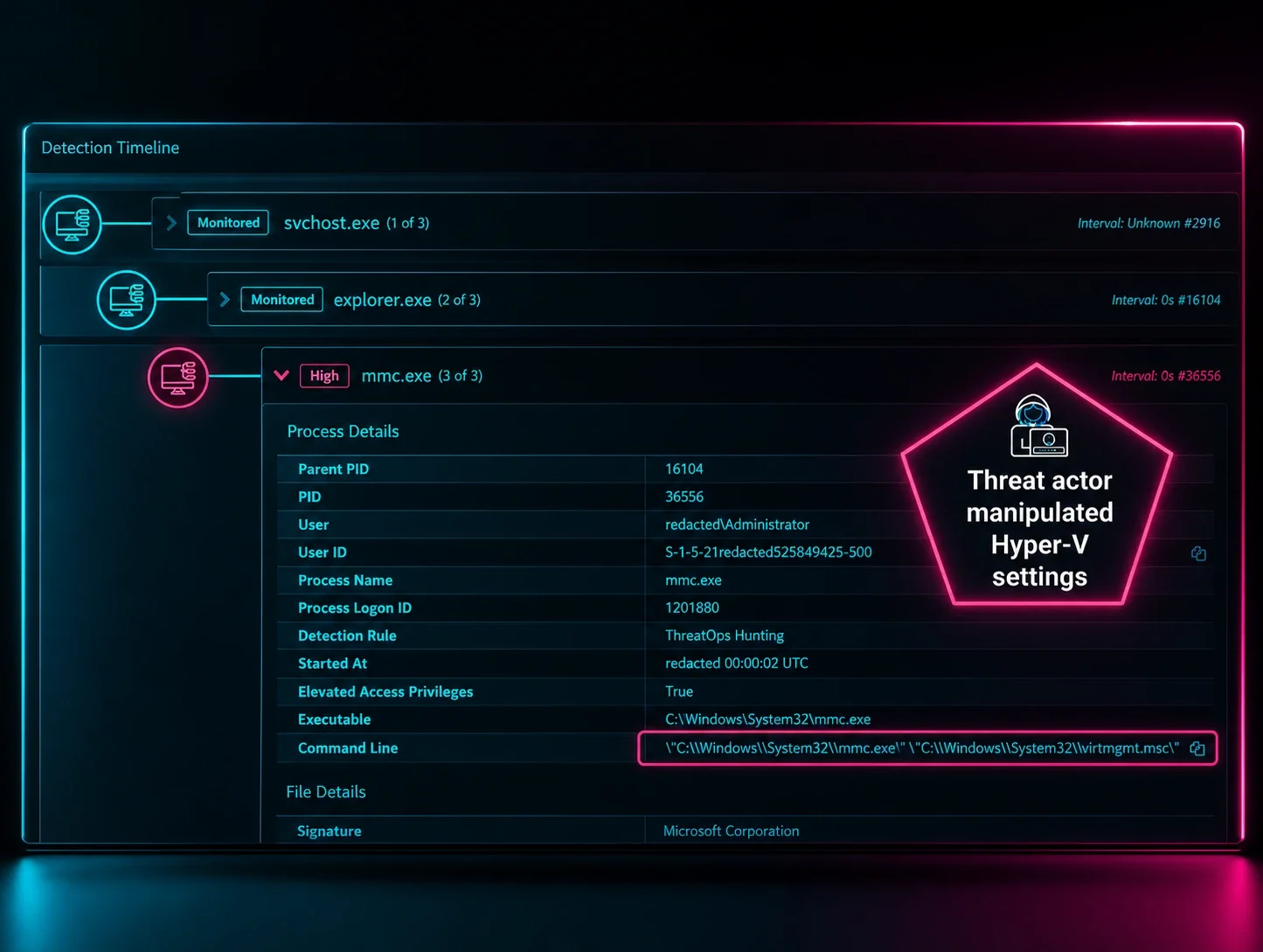
Huntress details a sharp 2025 rise in hypervisor-targeted ransomware (from 3% to 25% of malicious-encryption cases), driven mainly by the Akira group abusing ESXi and Hyper-V management interfaces to bypass endpoint EDR and encrypt VMs at scale. It provides hardening guidance: local non-AD ESXi accounts, MFA, jump boxes, least privilege, VMkernel.Boot.execInstalledOnly and lockdown mode, patching against CVE-2024-37085 and disabling exposed SLP (port 427, abused by ESXArgs), immutable 3-2-1 backups, and forwarding ESXi logs to a SIEM.
huntress.comarticleAdded 3 Sep 2026, published 8 Dec 2025🛡️ Security - Manual Configuration Manager (SCCM) credential harvesting
A step-by-step method for harvesting Configuration Manager (SCCM/MECM) credentials by pulling DPAPI-encrypted secret policy blobs (Network Access Accounts, task sequences, collection variables) via WMI or the local CIM repository, then exfiltrating DPAPI master keys and LSA SYSTEM/SECURITY/SAM hives for fully offline decryption with Impacket's dpapi and secretsdump modules. The approach avoids running known SCCM-abuse tools like SharpDPAPI on-target, reducing signature-based detection while still noting which steps (registry hive backup, DPAPI folder copy, WMI queries) a SOC could realistically catch.
 bencteux.frwriteupAdded 3 Sep 2026, published 5 Oct 2025🛡️ Security
 Using a C# Shellcode Runner and ConfuserEx to Bypass UAC
A red-team engagement writeup describing how to convert djhohenstein's CSharp SetThreadContext shellcode runner into a DLL, using the DllExport NuGet package and x64 Release build settings, so it can be loaded via rundll32.exe. The DLL and a modified chryzsh Aggressor script implementing the SilentCleanup scheduled-task DLL-hijack UAC bypass are then run through ConfuserEx to evade Windows Defender detection, enabling a Cobalt Strike beacon to escalate from a medium-integrity to high-integrity token without a UAC prompt.
 hausec.comwriteupAdded 3 Sep 2026, published 30 Oct 2020🛡️ Security