 Binance hack: how a compromised developer laptop can lead to a $6.3 billion breach
Aikido Security's analysis of the roughly $6.3 billion Binance incident, which Binance says may have started with a compromised DevOps engineer's laptop. It sets out what is known (no private key leak, TraderTraitor attribution by TRM Labs and Chainalysis, additional breach points) and a plausible chain from laptop credentials to a withdrawal service. It compares the 2025 Bybit theft and lists mitigations.
 aikido.devarticlePublished and added 30 Oct 2026🛡️ Security
 Ghost in the PHP2Shell: Why coordinated disclosure and patching will start moving faster
Aikido's analysis of the PHP2Shell disclosures (CVE-2026-109618 and CVE-2026-109619), published October 2026. It covers the timeline: the CVE IDs leaked on 20 October, PHP moved its release to 21 October, and Amazon reports exploitation attempts from 17 October. It cites Censys data (32.5 million services still affected on 27 October) and argues that AI-driven discovery and exploit building call for shorter embargoes and faster patching.
aikido.devarticleAdded 28 Oct 2026, published 29 Oct 2026🛡️ Security How to patch PHP2Shell with free Aikido Images
Aikido Images are free patched PHP container images on public ECR (public.ecr.aws/aikido-dev/php) that backport the PHP2Shell fixes for CVE-2026-109618 and CVE-2026-109619 into release lines 5.5 to 8.5, except 8.0. Upstream fixed 8.2 to 8.5 in October 2026 and left 8.1 and older unpatched. The post shows docker pull and Dockerfile FROM changes, then rebuild, restart, session.upload_progress.enabled=0 and compromise checks.
aikido.devarticlePublished and added 26 Oct 2026🛡️ Security Billy Lee (@billyozno) on X
LiteLLM 1.107.0 on PyPI shipped malware in all 7 wheels, the package's second supply-chain attack this year. It steals SSH keys, cloud credentials, browser passwords, AI tool configs and API keys, and installs a backdoor that polls for commands hourly. The GitHub source is clean, so a hijacked build or publish step is suspected. PyPI quarantined the release, but Aikido says the Docker image litellm/litellm:1.107.0 was still live. Indicators are cook.pth, cook.py and sitecustomize.py in site-packages. The advice is to rotate reachable keys and pin 1.106.2.
 x.comthreadAdded 23 Oct 2026, published 21 Oct 2026🛡️ Security
 Software supply chain security best practices for 2026
Aikido's guide to software supply chain security controls for 2026, tied to real incidents. It covers a 48-hour package cooldown, ignore-scripts, lockfile enforcement, SHA and digest pinning, scoped tokens, FIDO2, developer endpoint protection, extension allowlists, agent sandboxing, MCP server vetting, slopsquatting, signed SBOMs and rotation drills. Examples include the March 2026 axios compromise and the March 2025 tj-actions/changed-files attack.
aikido.devarticleAdded 22 Oct 2026, published 21 Oct 2026🛡️ Security Critical vulnerabilities in PHP (PHP2SHELL)
PHP2SHELL is Aikido Security's advance notice of two critical remote code execution flaws in PHP itself, CVE-2026-109618 and CVE-2026-109619, both CVSS v4.0 9.2, with all versions treated as affected. The PHP security team will release fixes at 14:00 UTC on 21 October 2026, a day early after details leaked on 20 October. The post withholds exploitation details and workarounds.
aikido.devadvisoryPublished and added 21 Oct 2026🛡️ Security Your CVE is reachable. But is it exploitable?
Explains why a reachable vulnerable function in a dependency is not necessarily exploitable, and how exploitability analysis extends SCA reachability analysis. It walks through CVE-2021-23337 (lodash _.template command injection) across three apps with different outcomes. It notes that a verdict can change with code, for example via prototype pollution and the follow-up CVE-2026-4800. A closing section describes Aikido's CVE Exploitability Analysis.
aikido.devarticleAdded 19 Oct 2026, published 17 Oct 2026🛡️ Security- AikidoSec/safe-chain
Aikido Safe Chain is an open-source local proxy and shell-alias wrapper for npm, yarn, pnpm, bun, pip, uv, poetry, pipx and pdm. It checks every package download, including deep dependencies, against the Aikido Intel malware feed and blocks malicious packages before install. It also enforces a configurable 48-hour minimum package age by suppressing too-new versions in registry metadata. It supports custom registries and a self-hosted malware-list mirror, and has CI/CD install recipes for GitHub Actions, Azure Pipelines, CircleCI, Jenkins, Bitbucket and GitLab.
 github.comrepoAdded 17 Oct 2026🛡️ Security
 Tensorlake npm Package Compromised to Spread Shai-Hulud Worm
The tensorlake npm package, version 0.5.144 released 8 October 2026, carried a new Shai-Hulud worm variant, per Aikido's analysis. A preinstall script runs node lib/setup.mjs, downloads Bun and launches lib/Math_Symbol.js, which steals cloud, CI/CD, SSH, Vault, browser and crypto-wallet secrets. It reaches C2 iseekaigogo[.]com or an Ethereum smart-contract dead drop, and has a wipe dead-man's switch tied to a GitHub token.
 cybersecuritynews.comarticleAdded 19 Oct 2026, published 8 Oct 2026🛡️ Security
 tensorlake NPM package compromised with Shai Hulud worm
Aikido details a new Shai-Hulud worm wave that compromised the tensorlake npm package (v0.5.144, 100k+ lifetime installs) via a hijacked GitHub maintainer identity. The malware's preinstall script drops the Bun runtime to run an obfuscated payload that exfiltrates CI/cloud secrets, browser crypto-wallet extension data (via a bundled HackBrowserData binary), uses a blockchain dead-drop (an Ethereum contract queried via public RPC nodes) to resolve a fallback C2, and includes a GitHub-token-triggered dead-man's switch that wipes infected machines. The post includes full IOCs: file hashes, the C2 domain iseekaigogo[.]com, and the threat actor's wallet/contract addresses.
aikido.devwriteupPublished and added 8 Oct 2026🛡️ Security When Models Turn Brutal
A vendor thread from ZeroShieldAI argues the patch window has collapsed because AI models can now find and weaponize vulnerabilities faster than defenders can fix them. It cites ZeroDayBench (success jumping from ~13% on blind zero-days to 78% once patch location is known), Aikido Security's benchmark where DeepSeek V4 Pro found 28 of 32 recent CVEs for about 98 dollars per run, a Unit 42 finding that 92% of AI-discovered flaws are logic bugs fuzzers miss, and a Hugging Face stat that 16 of the top 300 models advertise removed safety guardrails with 16.8M downloads. It promotes an attached 6-page case study and lists five defender recommendations: treat disclosure as exploit day, maintain SBOM/AIBOM, inventory models and agents, gate agent tool calls with policy, and red-team code and AI apps.
x.comthreadPublished and added 1 Oct 2026🛡️ Security Mini Shai-Hulud Worm Compromises TanStack, Mistral AI, Guardrails AI & More Packages
The Hacker News details the "Mini Shai-Hulud" campaign by threat actor TeamPCP, which compromised npm and PyPI packages from TanStack, UiPath, Mistral AI, OpenSearch and Guardrails AI via a chained GitHub Actions attack (pull_request_target abuse, cache poisoning, OIDC token extraction), now tracked as CVE-2026-45321 (CVSS 9.6). The worm mints npm publish tokens directly from stolen OIDC credentials to self-propagate — the first documented case of a worm producing validly SLSA Build Level 3-attested malicious packages — and deploys an obfuscated credential stealer with IDE persistence hooks, a GitHub Actions secret-exfiltration workflow, and a dead-man's-switch that runs "rm -rf" if its rogue npm token is revoked. Over 170 packages and 400+ attacker-controlled repos have been identified across npm and PyPI, with findings credited to Aikido Security, Endor Labs, SafeDep, Socket, StepSecurity, Snyk, Wiz and Microsoft.
 thehackernews.comarticleAdded 26 Sep 2026🛡️ Security
- Novel supplychain.local Go worm appears
Aikido Security reports on a novel worm, apparently written in Go and referencing a "supplychain.local" domain, that spreads via malicious packages published to npm and PyPI under the name memtensor. The page content could not be retrieved, so specifics of the propagation mechanism and payload are unconfirmed beyond the title and URL.
aikido.devwriteupPublished and added 23 Sep 2026🛡️ Security - shai-hulud-detect: multi-ecosystem npm/PyPI/Composer/Crates/Go/Hex/RubyGems supply-chain worm scanner
shai-hulud-detect is a dependency-free Bash scanner that checks projects against a 5,782-entry list of compromised npm, PyPI, Composer, Crates, Go, Hex, and RubyGems package versions, plus content-pattern indicators of compromise (malicious file hashes, C2 domains, dead-man's-switch artifacts, forged commits, suspicious lifecycle hooks) tied to the Shai-Hulud supply-chain attack waves. It supports single-project and bulk scanning, CI-friendly exit codes, JSON/log output for pipeline gating, and a --check-host mode to detect the May 2026 gh-token-monitor/kitty-monitor persistence daemons that wipe hosts if their monitored GitHub token is revoked (with a documented safe remediation order). Detection is read-only; new package entries are sourced from named threat-research firms (Socket, StepSecurity, Aikido, Snyk, JFrog, Wiz, Semgrep, SafeDep, GitGuardian, OX Security) and cited in PRs.
github.comrepoAdded 23 Sep 2026🛡️ Security  Cyber Resilience Act is here! Myth busting and first impressions
Aikido Security walks through the EU Cyber Resilience Act's newly live Single Reporting Platform (SRP), which as of September 11 requires manufacturers to report actively exploited vulnerabilities or severe incidents within 24 hours, with follow-up notifications at 72 hours and a final report 14 days after a fix ships. The post corrects common misconceptions — you don't report every vulnerability found, the 14-day clock starts at remediation not discovery, SRP submission alone isn't sufficient (affected users must also be notified), and pre-registration isn't required before you have something to report — and flags the upcoming harmonised standards EN 40000-1-1 and EN 40000-1-3 as the next thing to track ahead of the December 2027 full-compliance deadline. It also notes the EU is using CRA-collected data to build its own EUVD as an alternative to the backlog-plagued NIST NVD.
aikido.devarticlePublished and added 23 Sep 2026🛡️ Security Graphalgo campaign spreads to Terraform providers and Go Modules
Aikido documents the Graphalgo malware campaign's expansion beyond NPM into two malicious Terraform providers (gocommunity-io/dockerd and the kreuzwerker/docker typosquat kreuzwenker/docker) and two Go modules (gocommunity.io/orderedbtree, gogets.dev/btreex), marking the first observed systematic Terraform provider malware distribution. The payload is a Go port of Graphalgo sharing blockchain infrastructure, Slack C2, and a public key with prior JS/NPM samples; it activates only under specific hash-gated runtime conditions (targeted attack indicator), then deploys a Go RAT with dual C2 channels — an Ethereum (Arbitrum Sepolia) smart-contract dead drop and Slack bot messaging — plus self-delete and remote code execution capabilities. The threat actor also stood up two fake Go package ecosystem websites (gocommunity.io, gogets.dev) to socially engineer developers and backdated Git commits to obscure module publication timing.
aikido.devwriteupPublished and added 22 Sep 2026🛡️ Security Introducing Aikido Altar: the model that makes sovereign security intelligence possible
Aikido details how it built Altar, an open-weight security model derived from GLM-5.3 for its on-prem/air-gapped Aikido Machine pentesting appliance. They compressed the 1.51TB parent model to 328GB using AWQ W4A16 quantization and Cerebras REAP expert pruning (removing 88 of 256 routed experts), calibrated on internal pentest-harness traces and multilingual text to preserve reasoning and coding capability. On an internal 32-vulnerability CVE benchmark, Altar retained 92% of the full-precision parent's vulnerability coverage (23/25 vs 25/32) at roughly a third of the storage.
aikido.devarticlePublished and added 21 Sep 2026🛡️ Security- Betterleaks — secrets scanner from the Gitleaks creator
Betterleaks is a configurable, fast secrets scanner maintained by the original Gitleaks author and team, capable of scanning git history, local filesystems, stdin, GitHub/GitLab orgs and specific PRs/MRs, Hugging Face models/datasets, and public S3/R2 buckets. Detection rules use regex plus an Expr (with legacy CEL compatibility) based prefilter/filter/validate pipeline, allowing entropy checks, keyword gating, and live API validation of found credentials (e.g. checking a GitHub PAT against api.github.com). It's used in production by projects like Aikido Security and shipped inside MegaLinter.
github.comrepoAdded 18 Sep 2026🛡️ Security  Betterleaks: Gitleaks creator's open-source secrets scanner successor
Betterleaks is a new open-source secrets scanner built by Gitleaks' original creator (now Head of Secrets Scanning at Aikido) as a drop-in replacement for Gitleaks. It adds CEL-based rule validation, a BPE-tokenization "token efficiency" filter that hits 98.6% recall on the CredData benchmark versus 70.4% for entropy-based detection, default double/triple-encoding handling, parallelized git repo scanning, and a pure-Go (no CGO/Hyperscan) implementation, with v2 plans for auto-revocation, permissions mapping, and LLM-assisted classification.
aikido.devarticleAdded 18 Sep 2026🛡️ Security Dependabot vs Renovate
A comparison of GitHub's Dependabot and the open-source Renovate bot as automated dependency-update tools, covering setup, platform/monorepo support, PR noise, and how each handles security advisories versus transitive dependencies. The article argues both tools only bump version numbers rather than assessing exploitability, using the xz-utils backdoor, compromised chalk/debug npm packages, and a breaking lodash 4.18.0 patch as examples of why blind auto-updates can introduce new risk, then pitches Aikido Security's reachability-based backporting and AutoFix as the fix.
aikido.devarticleAdded 15 Sep 2026, published 14 Sep 2026🛡️ Security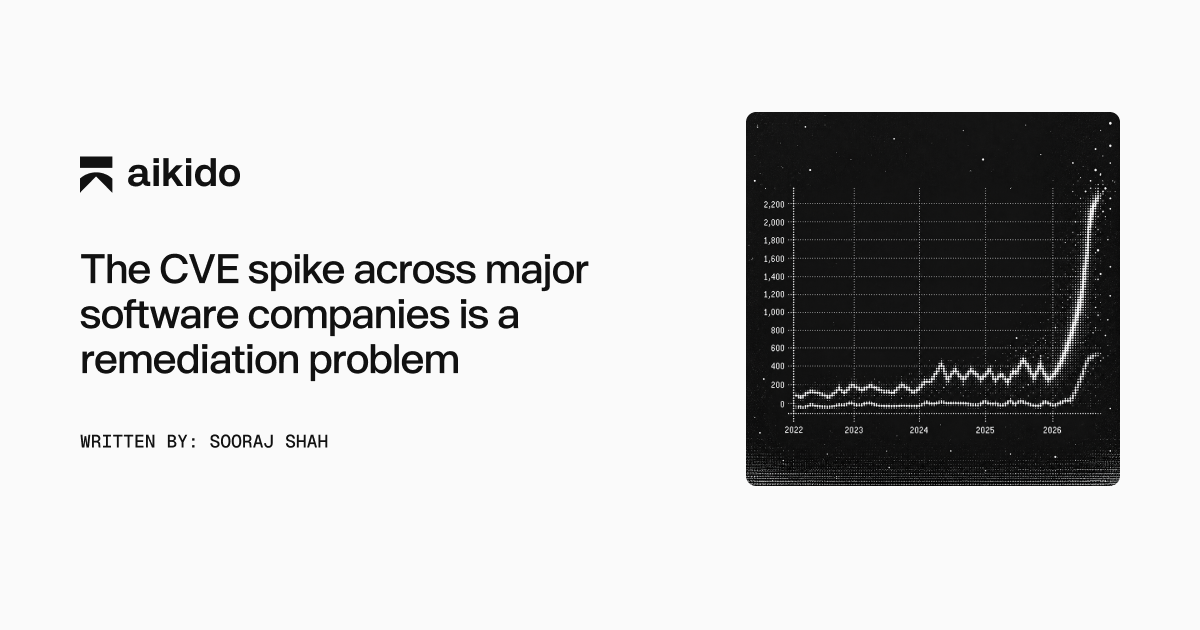 The CVE spike across major software companies is a remediation problem
Aikido argues the widely-shared a16z/Epoch AI chart showing critical/high CVEs jumping from under 100/month to over 600/month since spring 2026 reflects AI accelerating vulnerability discovery, not a real spike in danger — since CISA's KEV count has stayed flat. It details how NIST's NVD, overwhelmed by volume, let its scoring backlog balloon from 13,000 to 27,000 CVEs in 18 months and pivoted to only prioritizing federal/critical/KEV-listed CVEs, while Verizon's 2026 DBIR found only 26% of confirmed actively-exploited KEV vulnerabilities were fully remediated in 2025 (down from 38%) with median patch time rising to 43 days. It illustrates the point with StyleSmuggler, an unauthenticated RCE hitting Adobe Commerce and Magento Open Source that had no CVE or vendor advisory, which Aikido Intel flagged and Aikido Libraries auto-patched more than 24 hours before Adobe's own hotfix.
aikido.devarticlePublished and added 10 Sep 2026🛡️ Security Compromised Flutter package on pub.dev contains XCSSET malware
Aikido Security discovered a variant of the XCSSET macOS worm hidden in universal_file_viewer, a Flutter file-preview package on pub.dev (~500 downloads) — the first compromised package found on that registry. The infection was not a targeted supply-chain attack but resulted from the maintainer's machine being infected with XCSSET, which auto-injects malicious build hooks into every Gradle, Xcode, and git project it finds; the poisoned example/ directory (Android Gradle build, iOS/macOS Xcode project files) shipped in the package tarball. The writeup details XCSSET's four-stage infection chain, its android_finder/git_finder/replicator_finder propagation modules, Launchpad-tile persistence, and theft modules targeting Chrome, Safari, Firefox, Telegram, Notes, and clipboard data, plus C2 domain and file-artifact IOCs.
aikido.devwriteupPublished and added 8 Sep 2026🛡️ Security Shai-Hulud Rises From the Dead after 111 days
Aikido Security reports that the Shai-Hulud npm worm payload (SHA256 e37e3dd...e5b1a6), first seen during the @AntV compromise on May 19, 2026, resurfaced 111 days later on September 7 in four new packages (feishu-docx-mcp, bmc-i18n-extract-cli, blueai-cli, bmc-translate-utils) published by the same npm account within one hour. The payload passed npm's publish-time malware scanning — introduced in July 2026 to hold packages 5-15 minutes for automated checks — despite being an exact, previously fingerprinted hash match, exposing a gap between npm's scanning claims and actual detection coverage. The writeup includes full IOCs: C2 domain t.m-kosche.com, preinstall script running `bun run index.js`, persistence via .vscode/tasks.json and .claude/settings.json, and stolen-token-based republish behavior.
aikido.devwriteupPublished and added 7 Sep 2026🛡️ Security StyleSmuggler fix: patch the Magento and Adobe Commerce RCE
Aikido Security's writeup on "StyleSmuggler," a remote code execution vulnerability in Magento and Adobe Commerce, covering the fix/patch for the flaw. Page content was not retrieved, so specifics of the exploitation technique and affected versions could not be confirmed directly.
aikido.devadvisoryPublished and added 7 Sep 2026🛡️ Security Dirty Frag (CVE-2026-43284): the Linux kernel bug that turns read access into root
Aikido's analysis of "Dirty Frag," a set of Linux kernel bugs (CVE-2026-43284 in IPsec/XFRM ESP, CVE-2026-43500 in RxRPC, and the later variant CVE-2026-46300 "Fragnesia") that let a low-privileged local attacker write to the page cache of a read-only file they can only read, such as /usr/bin/su, and escalate to root. It explains the missing shared-memory check in splice()-fed ESP/RxRPC code paths, why the flaw reaches most kernel versions and distros via backports, how it enables container-to-node escapes in Kubernetes, and gives concrete host exposure checks (uname -r, lsmod grep for esp4/esp6/rxrpc, sysctl user.max_user_namespaces) plus detection guidance via audit logs and EDR.
aikido.devwriteupAdded 5 Sep 2026, published 4 Sep 2026🛡️ Security MECCHA CHAMELEON can't hide from the RCE
Aikido researchers found a delayed RCE in the Unreal Engine 5-based game MECCHA CHAMELEON, exploitable via a malicious Steam Workshop map. A Blueprint-exposed audio recording function allowed arbitrary file writes via path traversal, a null-byte trick stripped the auto-appended .wav extension to drop an .exe into the Windows Startup folder, and PCM audio samples were crafted byte-for-byte to smuggle a polyglot WAV/HTA payload that launches mshta.exe and runs arbitrary code on reboot. The issue was patched in the game's 4.0.0 update.
aikido.devwriteupPublished and added 3 Sep 2026🛡️ Security The dark figure of supply chain detection
Aikido Security argues that string/IOC-based malware detection suffers from survivorship bias (the 'dark figure' of undetected supply-chain attacks) and proposes an adapted version of David Bianco's Pyramid of Pain for package ecosystems, where durable detection requires behavioral baselines mapped per package type rather than hashes or known-bad strings. It illustrates the approach with a real incident: a malicious version of the popular npm package Keyv (600M+ downloads) that executed obfuscated JS, downloaded the Bun runtime, and ran a second obfuscated payload at install time, caught by behavioral/technique-level analysis in Aikido's sandbox despite heavy obfuscation defeating static analysis.
aikido.devarticleAdded 3 Sep 2026, published 1 Sep 2026🛡️ Security Popular code generator for TanStack Query hit by supply chain worm
Aikido Security details a self-propagating npm worm that compromised a popular TanStack Query code generator package, injecting malicious postinstall scripts that harvest secrets and republish themselves to other packages maintained by infected developers. The incident reflects a broader wave of npm supply-chain worm attacks hitting widely-used JavaScript tooling.
aikido.devwriteupAdded 3 Sep 2026, published 28 Aug 2026🛡️ Security Securing Docker images
Aikido Security's guide to hardening Docker images explains where container vulnerabilities come from (base OS layers like Debian/glibc that ship far more than an app needs), citing CVE-2023-4911 (Looney Tunables in glibc) and the xz-utils backdoor as cautionary examples for version-pinning decisions. It lays out hardening steps such as multi-stage builds, removing unused packages, non-root users, read-only filesystems, dropping Linux capabilities, pinning base images by digest, generating SBOMs, and signing/verifying images, then pitches Aikido Images, which backports CVE patches onto the same pinned base image version instead of forcing a migration to a new hardened distro.
aikido.devarticleAdded 3 Sep 2026, published 28 Aug 2026🛡️ Security Software supply chain security requires decisions rather than defaults
Aikido Security argues that supply-chain security should be driven by deliberate decisions rather than defaulting to "always upgrade," using the xz-utils backdoor (versions 5.6.0/5.6.1, where CISA advised downgrading rather than patching) and the 2026 lodash 4.18.0 release (which broke the _.template code path within a day of shipping a fix for an arbitrary code injection vulnerability, forcing a deprecation back to 4.17.21 before the real fix landed in 4.18.1) as evidence that neither blind pinning nor blind upgrading is inherently safe. It advocates backporting specific CVE fixes onto already-running versions instead of forcing full upgrades, and treating SBOMs as continuously maintained baselines rather than one-time compliance artifacts, closing with a promotion of Aikido Libraries' backporting capability.
aikido.devarticleAdded 3 Sep 2026, published 26 Aug 2026🛡️ Security

Showing 30 of 89
Show more