 New Android SMS of Death exploit can remotely crash unpatched phones
CVE-2026-58882, "SMS of Death", is a zero-click Android denial-of-service flaw in WapPushOverSms.decodeWapPdu, where an unchecked header-length value becomes negative and triggers a NegativeArraySizeException that crashes com.android.phone. A malformed eight-byte WAP Push message to port 2948 can drop calls, including emergency calls, and about 20 messages caused reboot loops. A PoC is public. Google patched Android 14 through 17 in October 2026, but Android 12 and 13 remain vulnerable.
 bleepingcomputer.comarticlePublished and added 31 Oct 2026🛡️ Security
 Critical Linux kernel flaw allows remote root attacks on MPTCP servers
CVE-2026-98432 is a use-after-free race condition in the Linux kernel IPv4 TCP code (tcp_v4_syn_recv_sock, ireq_opt), affecting kernels back to 4.4 and rated 9.8 by the kernel CVE team (Red Hat rates it 5.9). Anthropic researchers say an unreleased Claude model built an exploit that bypassed KASLR and got remote root on an MPTCP listener in about 53 minutes. The article lists distro patch status and CIQ's nftables mitigation for IP options; disabling MPTCP alone does not help. No in-the-wild exploitation is reported.
bleepingcomputer.comarticlePublished and added 30 Oct 2026🛡️ Security- PHP2Shell Attacks Root Palo Alto Firewalls but Fail Against WordPress
PHP2Shell (CVE-2026-109618 and CVE-2026-109619) has been exploited for over a week. A China-linked group chained it with the Fragnesia Linux kernel privilege escalation to root at least 25 Palo Alto Networks PAN-OS firewalls with exposed management interfaces. Defiant had seen no confirmed WordPress compromise by 28 October 2026 despite 77,000 requests, and Cato and watchTowr report few successful attackers.
 securityweek.comarticlePublished and added 30 Oct 2026🛡️ Security
 In Other News: Anthropic Breach Dispute, UEFI Flaw Hits Most Servers, Cloudflare AI Data Leak
SecurityWeek's weekly roundup of 30 October 2026 covers CVE-2026-97631, a 16-year-old buffer overflow in TianoCore EDK II that affects PXE network boot on most servers. It also covers a Cloudflare Workers AI cross-tenant leak caused by an SGLang bug, Anthropic's dispute with Cathedral over a bug bounty intrusion, and fake AI bots probing for secrets. Other items include AI-assisted ransomware (Gold Ogre, Aur0ra), the NIK C2 framework, and North Korean IT worker sanctions.
securityweek.comarticlePublished and added 30 Oct 2026🛡️ Security CISA says max severity GitLab flaw now exploited in the wild
CVE-2026-97229 is a maximum-severity GitLab flaw in the CI/CD Regular Expression Compiler, caused by an integer overflow, that lets unauthenticated attackers run code via a crafted regular expression. CISA added it to the KEV Catalog and ordered federal agencies to patch under BOD 26-04. GitLab fixed it in CE/EE 19.4.2, 19.3.5 and 19.2.8, and Shadowserver tracks about 2,800 exposed CE instances.
bleepingcomputer.comarticlePublished and added 30 Oct 2026🛡️ Security Fresh WordPress Vulnerability in Attackers’ Crosshairs
A WordPress core race condition in the update process, patched in WordPress 7.1.4 on 28 October 2026, allows unauthenticated remote code execution with high attack complexity. New files unpack into a predictable, web-accessible staging directory. Defiant's Wordfence logged over 18,500 requests for staged setup-config.php paths in 21 hours, with no confirmed compromises. No CVE is assigned yet. The release fixes 22 flaws in total.
securityweek.comarticlePublished and added 30 Oct 2026🛡️ Security Drupal Commerce Core Vulnerability Exploited Against Online Stores
CVE-2026-118539 is a highly critical access bypass in the Drupal Commerce Core module (over 42,000 sites), exploited in the wild. Unauthenticated attackers can abuse insufficiently protected routes and entity fields, and Drupal rated it 21 out of 25. Fixes are in 3.3.13 and 8.x-2.41, and admins should audit orders. The article also covers 38 other Drupal advisories from 28 October and the 14 October RCE bugs CVE-2026-108097 and CVE-2026-108099.
securityweek.comarticlePublished and added 30 Oct 2026🛡️ Security Drupal warns of critical Commerce Core flaw exploited in attacks
Drupal Commerce Core has a critical missing-authorization flaw, CVE-2026-118539, that unauthenticated attackers exploit in the wild. It affects versions 0.0.0 to 2.41 and 3.0.0 to 3.3.13. Drupal urges upgrading to 3.3.13 (or 8.x-2.41 on the older branch) and auditing orders for inconsistencies. The article also recalls CVE-2026-9082, exploited in May and added to CISA KEV, and two RCE patches (CVE-2026-108097, CVE-2026-108099).
bleepingcomputer.comarticlePublished and added 30 Oct 2026🛡️ Security Max-Severity GitLab Vulnerability Exploited Against Alpine Linux
CVE-2026-97229 is a CVSS 10 code execution flaw in Onigmo, Ruby's regular expression engine, reachable through crafted CI/CD configuration in GitLab. Attackers used it against Alpine Linux's GitLab on 20 and 21 October 2026 and failed; Alpine rebuilt the instance and found no tampering with aports or packages. Self-managed installs with their own Ruby need Ruby 3.3.13, 3.4.12 or 4.0.9, not just GitLab 19.3.6. CISA added it to KEV.
securityweek.comarticlePublished and added 30 Oct 2026🛡️ Security TeamViewer Flaw Could Let Malicious Hosts Take Over Support Technicians’ Machines
CVE-2026-111585 (CVSS 8.8) is an integer overflow in the remote-control screen processing of TeamViewer clients on Windows, macOS, Linux and Android. A malicious or compromised host can announce an oversized screen surface (for example 32768 by 32768 at 32 bpp), forcing a software decode path and an out-of-bounds write that crashes the viewer or runs code. Remedio's research shows a pointer overwrite routed to WinExec. Version 15.83 fixes it, along with CVE-2026-92372, CVE-2026-92374 and six local privilege escalation bugs.
securityweek.comarticlePublished and added 30 Oct 2026🛡️ Security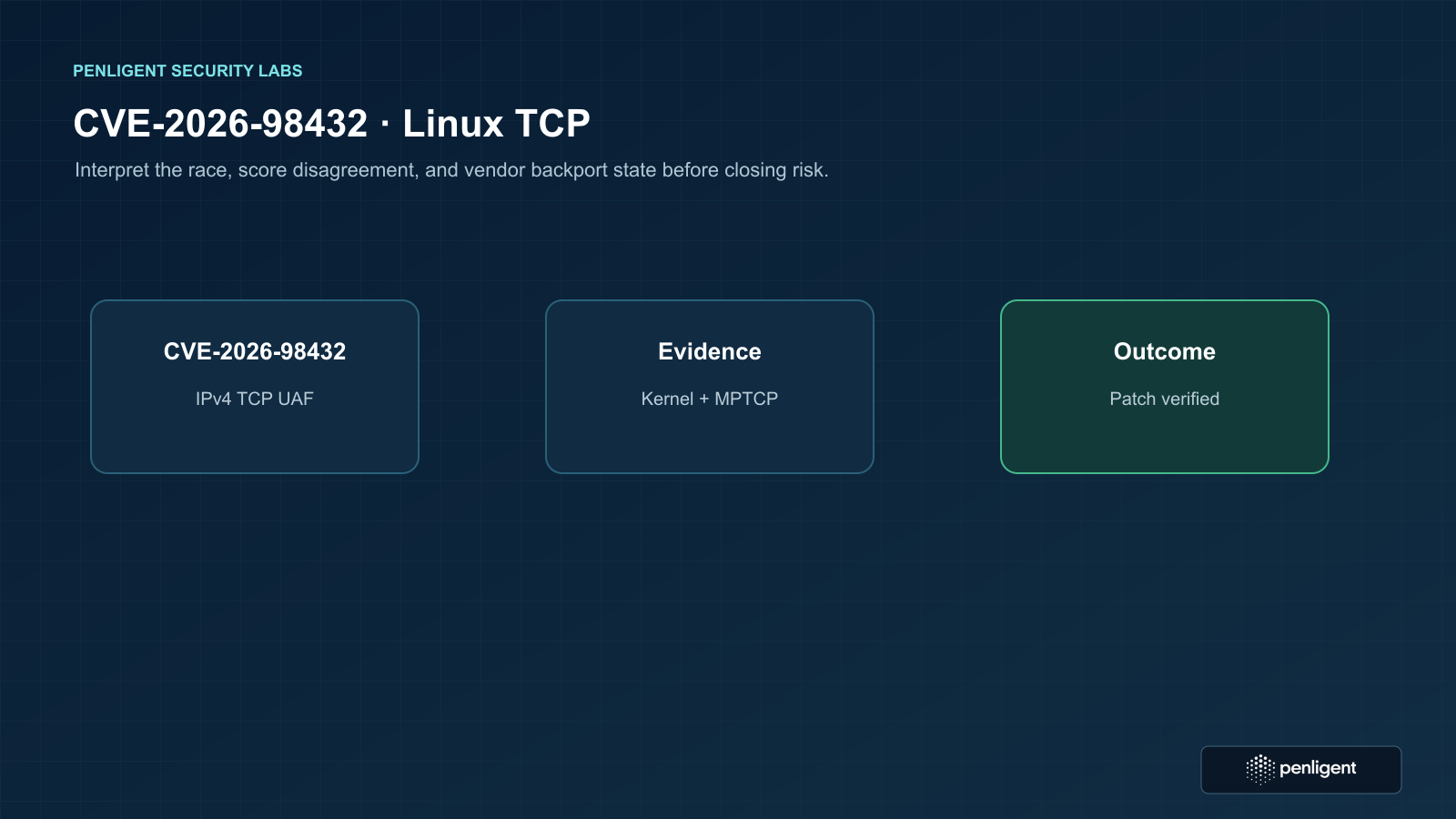 CVE-2026-98432: Linux TCP Use-After-Free Risk and Patch Validation
CVE-2026-98432 is a use-after-free in the Linux kernel IPv4 TCP handshake path: a request socket's ireq_opt pointer moves to the child socket as inet_opt and is freed with kfree() while a retransmitted-SYN CPU still reads it under RCU. The fix (commit e3f33b0a1d89) uses kfree_rcu(). The page covers CVSS 9.8 versus vendor scores, Anthropic's MPTCP root-exploit lab demo, per-distribution patch checks, MPTCP listener inventory and detection guidance. The page was truncated before its mitigation section.
 penligent.aiarticleAdded 31 Oct 2026, published 30 Oct 2026🛡️ Security
 Rekt - News or Hype?
Rekt News piece tracing three AI-security headlines back to their sources. It covers Justin Drake's October 2026 "bunker mode" warning about AI breaking ECDSA, OpenAI's report of a model spending Sepolia test ETH from a default developer mnemonic, and Wiz's "70% of the Internet" claim for PHP CVE-2026-109618 and CVE-2026-109619. It closes with four questions for checking a claim.
 rekt.newsarticleAdded 29 Oct 2026🛡️ Security
 Vulnerabilities that lead to account takeover in banking and fintech mobile apps | Oversecured Blog
Oversecured guide to eight vulnerability categories that lead to account takeover in mobile banking and fintech apps: WebView JavaScript bridge token leakage, Intent Redirection, hardcoded tokens, deeplink hijacking, insecure token storage, localhost OAuth listeners, AIDL abuse and weak biometric auth. It includes a WebView PoC based on Samsung SmartThings CVE-2022-30746 and maps findings to OWASP MASVS, PCI DSS and PSD2. It argues taint analysis plus dynamic PoC is needed to find multi-component chains.
 oversecured.comarticleAdded 29 Oct 2026🛡️ Security
 What are shell vulnerabilities? PHP2Shell, Node2Shell (HTTP2Shell), React2Shell and Log4Shell explained
Explainer on "shell" vulnerabilities, the -Shell naming for RCE flaws that began with Log4Shell (CVE-2021-44228). It compares memory-corruption bugs (PHP2Shell, CVE-2026-109618 and CVE-2026-109619; Node2Shell, CVE-2026-111497, in the Brotli decoder) with design-flaw bugs (Log4Shell, React2Shell, CVE-2025-55182). It covers shared traits, exposure through inherited components, and Brotli patch status across runtimes and distributions.
 aikido.devarticleAdded 30 Oct 2026, published 29 Oct 2026🛡️ Security
 Hackers exploit Cisco SD-WAN flaw to deploy custom KeyDrift malware
UAT-11473, a newly tracked APT cluster, exploits CVE-2026-20127, a max-severity authentication bypass in Cisco Catalyst SD-WAN Controllers (patched February 2026), to deploy the KeyDrift malware framework. KeyDrift's PolyFlame runs inside vdaemon processes, and LittleFilch hooks SSL_read to extract AES-256 IPsec keying material, saved to /var/tmp/vdaemon.bin and sent over UDP. Targets include space, defense and policy organizations. Talos sees overlap with Volt Typhoon's Silent Train network but makes no definitive link.
bleepingcomputer.comarticleAdded 30 Oct 2026, published 29 Oct 2026🛡️ Security IR trends Q3 2026: Actors impersonate IT help desks in vishing attacks as ransomware activity increases
Cisco Talos Incident Response Q3 2026 trends report. Phishing led initial access at 37 percent, with vishing and IT help desk impersonation to get RMM access; public-facing exploitation followed at 33 percent. Ransomware reached 27 percent of engagements (Qilin, Rhysida, Interlock, new VYPR), with EDR killers via BYOVD and WDAC. It also covers Salt Typhoon intrusions using CVE-2023-20198 and BadCandy, attacks on Claude Code credentials, and logging, MFA and secrets recommendations.
 blog.talosintelligence.comarticlePublished and added 29 Oct 2026🛡️ Security
 CISA warns of Fragnesia Linux flaw chained in PHP2Shell attacks
Fragnesia (CVE-2026-46300) is a Linux kernel XFRM ESP-in-TCP logic bug in the Dirty Frag class that gives local attackers root, with a public PoC. CISA added it to the KEV catalog and ordered federal patching under BOD 26-04. Attackers chain it with PHP2Shell (CVE-2026-109618, CVE-2026-109619) to implant PHP webshells. Dream Security tied the chain to 25 rooted servers in the US, Japan, Taiwan and South Korea.
bleepingcomputer.comarticleAdded 30 Oct 2026, published 29 Oct 2026🛡️ Security Adobe, Veeam, Juniper Networks Patch Critical Vulnerabilities
SecurityWeek roundup of patches from Adobe, Veeam and Juniper Networks covering over three dozen vulnerabilities. Adobe fixed 12 flaws (eight critical in Campaign Classic), Veeam fixed nine (including a cross-tenant RCE in Backup for Microsoft 365), and Juniper fixed 18 in Session Smart Router and Conductor. None were reported exploited. Juniper said CVE-2026-109618 (PHP2Shell) affects Junos OS but is not exploitable there.
securityweek.comarticlePublished and added 29 Oct 2026🛡️ Security New Cisco firewall zero-day exploited to crash SSL VPN devices
CVE-2026-76418 is a high-severity denial-of-service zero-day in Cisco ASA and Threat Defense (FTD) software, exploited in the wild in October 2026. Unauthenticated attackers send a crafted request to the SSL VPN (webvpn) when secondary authentication is set on a tunnel group, causing a device reload. Cisco offers no workaround besides disabling secondary authentication on tunnel groups. Shadowserver sees over 51,000 exposed ASA SSL VPN devices.
bleepingcomputer.comarticleAdded 30 Oct 2026, published 29 Oct 2026🛡️ Security Cisco SD-WAN Zero-Day Exploitation Tied to Volt Typhoon’s ‘Silent Train’ Network
Cisco Talos reported that UAT-11473 exploited CVE-2026-20127 (CVSS 10, Cisco SD-WAN peering authentication bypass) to deploy KeyDrift, a framework with PolyFlame (backdoor, relay C2) and LittleFilch (key harvesting) modules. Talos found its infrastructure overlaps considerably with Volt Typhoon's Silent Train network. Lumen Black Lotus Labs tied Silent Train to zero-day campaigns against Versa Director, N-able N-central, Cisco Catalyst SD-WAN and VeloCloud Orchestrator.
securityweek.comarticlePublished and added 29 Oct 2026🛡️ Security Attackers Exploit Second Cisco Firewall VPN Zero-Day Since August
CVE-2026-76418 (CVSS 8.6) is an exploited flaw in the Remote Access SSL VPN service of Cisco Secure Firewall ASA and FTD. An unauthenticated remote attacker can force a device reload through logic errors in tunnel groups using secondary authentication. Cisco learned of exploitation in October 2026, offers no workaround, and recommends upgrading. It is the second ASA/FTD DoS zero-day after CVE-2026-20349 in August.
securityweek.comarticlePublished and added 29 Oct 2026🛡️ Security Ghost in the PHP2Shell: Why coordinated disclosure and patching will start moving faster
Aikido's analysis of the PHP2Shell disclosures (CVE-2026-109618 and CVE-2026-109619), published October 2026. It covers the timeline: the CVE IDs leaked on 20 October, PHP moved its release to 21 October, and Amazon reports exploitation attempts from 17 October. It cites Censys data (32.5 million services still affected on 27 October) and argues that AI-driven discovery and exploit building call for shorter embargoes and faster patching.
aikido.devarticleAdded 28 Oct 2026, published 29 Oct 2026🛡️ Security- Chinese Hackers Quietly Used Low-Severity ESXi Logging Flaw as Zero-Day
CVE-2026-41709 is a low-severity insufficient-logging flaw in VMware ESXi that lets a logged-in administrator perform operations without audit entries. CISA added it to the KEV catalog, and CrowdStrike reported that China-nexus actor Warp Panda used it as a zero-day against US organizations, including law firms, to cut audit visibility. The article also covers exploitation of vCenter bugs CVE-2026-59309 and CVE-2026-59310 and lists the fixed ESXi builds.
securityweek.comarticlePublished and added 29 Oct 2026🛡️ Security  Unwrapping Retail Peak Season Cyber Threats
Unit 42 overview of cyber threats facing retailers in the 2026 peak shopping season, split into enterprise threats (ransomware, data extortion, DDoS, digital skimming) and guest threats (account takeover, gift card fraud, AI-powered attacks). It cites 565 retail ransomware victims claimed as of 30 September 2026 and past incidents such as CosmicSting (CVE-2024-34102) skimming and the Noname057(16) DDoSia attacks. Each threat has defensive recommendations.
 unit42.paloaltonetworks.comarticleAdded 30 Oct 2026, published 28 Oct 2026🛡️ Security
 Chrome and Firefox Updates Patch Over 200 Vulnerabilities
Chrome 156 and Firefox 159 security updates fix over 200 vulnerabilities. Chrome 156 patches 52 flaws, four critical, including CVE-2026-118306, a FileSystem memory corruption bug that allows code execution outside the sandbox via a crafted HTML page. Firefox 159 fixes 167 flaws, 108 high severity, mostly use-after-free, plus Thunderbird and ESR releases. No in-the-wild exploitation is reported.
securityweek.comarticlePublished and added 28 Oct 2026🛡️ Security TLS Flaws Found in GoAhead Web Server Used in Hundreds of Millions of Devices
FoxIO disclosed three TLS flaws in the GoAhead embedded web server from EmbedThis, used on hundreds of millions of IoT, OT and network devices. CVE-2026-115881 (CVSS 9.1) leaves revoked client certificates accepted under mTLS with OpenSSL; CVE-2026-115884 (7.4) bypasses chain-length limits with LibreSSL; a third Mbed TLS bug (5.9, no CVE) weakens TLS 1.2 DHE. GoAhead 6.1.1 fixes the OpenSSL and Mbed TLS issues, and FoxIO released PoC code and fingerprints.
securityweek.comarticlePublished and added 28 Oct 2026🛡️ Security China-Linked Hackers Exploit PHP2Shell to Root Firewalls
A China-linked actor chained PHP2Shell (CVE-2026-109618, CVE-2026-109619) with the Fragnesia Linux kernel privilege escalation (CVE-2026-46300) to root firewalls and drop PHP webshells, per Dream. Using FOFA, the actor narrowed 19,000 firewalls to 240 targets and rooted 24 on 23-24 October. On two US government-affiliated devices it used a reverse SSH tunnel, hit the firewall management server, and attempted LDAP and Active Directory abuse.
securityweek.comarticlePublished and added 28 Oct 2026🛡️ Security- TLP Is Not a Suggestion
Akamai SIG argues that vendors and researchers broke embargo norms during the October 2026 PHP2Shell leak, when the PHP fix shipped a day early on 21 October. It explains the four TLP 2.0 labels, tabulates past embargo breaks (Heartbleed, a collapsed six-month kernel-era embargo, the Alibaba Cloud and MIIT case), and lists seven practices, such as no proofs of concept or CVE numbers before the fix.
 akamai.comarticleAdded 30 Oct 2026, published 28 Oct 2026🛡️ Security
 Long-Hidden Flaws Patched in EPICS Research Facility Control Software
Four vulnerabilities in EPICS Base 7.0.10 and earlier, the control-system toolkit used at ITER and the Advanced Photon Source, were disclosed by CISA. CVE-2026-114595 (CVSS 9.8) is an integer overflow that could allow remote code execution, though only an out-of-bounds heap write and crash were demonstrated. All flaws sit in Channel Access and pvAccess handling (TCP 5064 and 5075), need no authentication, and are fixed in 7.0.11.
securityweek.comarticlePublished and added 28 Oct 2026🛡️ Security Hackers Start Probing Fresh Oracle EBS Vulnerability
CVE-2026-101767 is a CVSS 9.8 unauthenticated SQL injection in the Application Object Library of Oracle E-Business Suite, patched in Oracle's October 2026 CPU and reported by Horizon3.ai. Defused decoys logged the first exploratory attempts on 27 October 2026, and the flaw could lead to remote code execution. The article recalls CVE-2026-46817 attacks in June and last year's Cl0p zero-day campaign against EBS.
securityweek.comarticlePublished and added 28 Oct 2026🛡️ Security
Showing 30 of 240
Show more