 Tracking AI adoption in North Korean threat actor tradecraft
Microsoft Threat Intelligence report on how North Korean actors use AI, ranking Jade Sleet, Coral Sleet and Jasper Sleet as operationalized, Diamond Sleet, Onyx Sleet, Pearl Sleet and Sapphire Sleet as accelerating, and Emerald Sleet as expanding. It documents AI-generated lures (100+ Onyx Sleet PDFs, August and September 2026), AI-built tooling such as Coral Sleet's private GitHub repository trojanizing, and Onyx Sleet and Pearl Sleet use of the ARTEX agentic pentest framework. It ends with mitigation and Defender guidance.
 microsoft.comarticlePublished and added 29 Oct 2026🛡️ Security
 House Oversight Chair Comer Probes Delaware Plan for AI-Run Companies
House Oversight Chairman James Comer opened an investigation on 26 October 2026 into Delaware's proposed Artificial Intelligence Company (AIC), a legal entity run day-to-day by an AI agent. His letter to Gov. Matt Meyer requests documents, including internal AI chat logs, by 9 November. The AIC would run in a 30-month sandbox with a single member shielded from debts, and Delaware's draft legislation is expected in January 2027.
 decrypt.coarticlePublished and added 28 Oct 2026🧠 AI
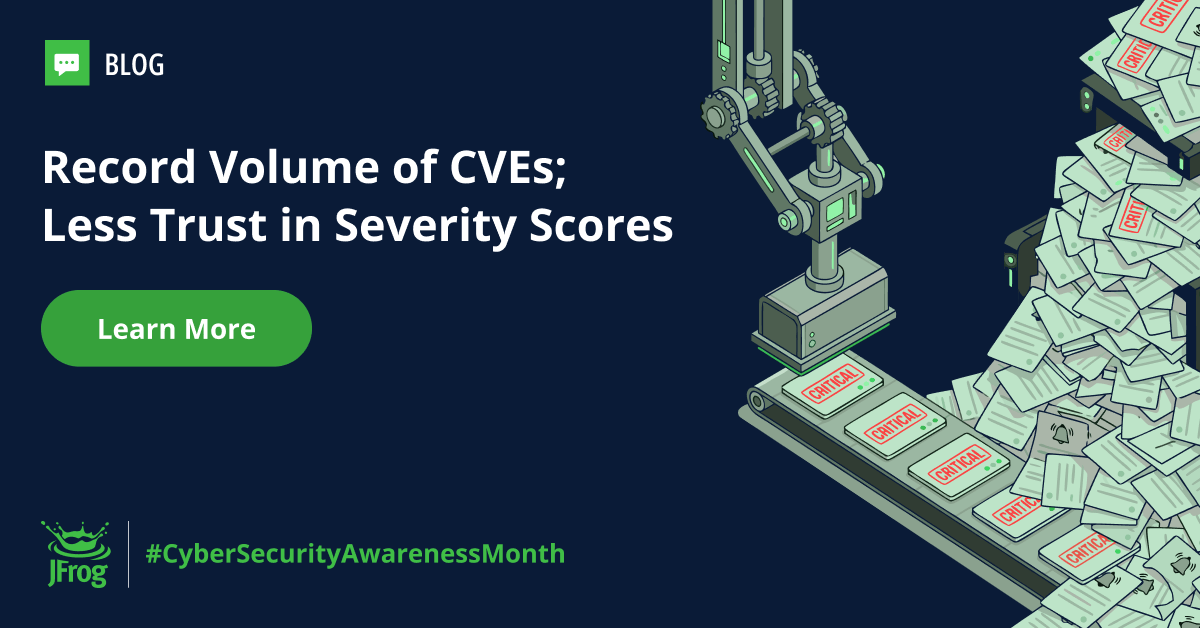 The Impact of AI on CVEs: Industry Challenges
Part 1 of a JFrog Security Research series on how AI has changed CVE research. It shows rising CVE volumes since 2021, curl ending its bug bounty in January 2026, GNOME cutting disclosure from 90 to 30 days, and NIST narrowing NVD enrichment in April 2026. It documents severity inflation in 27 libcurl CVEs and 54 of 55 fabricated SQLite advisories.
 jfrog.comarticleAdded 28 Oct 2026, published 27 Oct 2026🛡️ Security
 Crypto exchange CoinDCX ‘lying’ about $16M hack, say blockchain investigators
Protos reports that on-chain investigators, including Darcy of Salus, ZachXBT and SpecterAnalyst, say CoinDCX misattributed about $16M in outflows from compromised wallets. CoinDCX says the addresses were created in January 2025, compromised in July 2025, and that a sweeping process failed. Investigators cite gas distribution, hot wallet transfers as late as May 2026, and funds sent to Huione and Xinbi addresses.
 protos.comarticlePublished and added 22 Oct 2026🛡️ Security
 US Cybersecurity Job Postings Fall 26% as AI Security Engineer Demand Soars
SecurityWeek summarises CyberSN's Cybersecurity Jobs Report. US cybersecurity postings fell 26.4% to 235,786 for January–September 2026, a four-year low. AI Security Engineer demand rose 268.3% and Cyber Data Scientist demand rose 203.5%. Penetration Tester (-45.9%), Threat Hunter (-40.0%) and CISO (-38.9%) postings dropped, and the CISO figure matches 2024 after an unusually strong 2025. Just under 15% of postings mention AI, peaking at 20.0% in September. The report counts postings by work required (CyberSN's 45-role taxonomy) rather than by job title, and it describes what changed, not why.
 securityweek.comarticlePublished and added 18 Oct 2026🛡️ Security
 Novel Android RAT ‘Hirudo’ Replaces Banking Apps With Trojanized Copies
SecurityWeek covers ThreatFabric's findings on Hirudo, an Android banking trojan/RAT delivered via droppers hidden in fake shopping, adult video and short drama apps. It replaces eight Indonesian banking apps with modified copies containing a hooking engine that spoofs signing certificates and hides Accessibility services, screen capture and Play Integrity checks, while providing WebRTC screen viewing, camera access and SMS theft. ThreatFabric advises banks to enforce Play Integrity server-side, use behavioral analytics, treat Accessibility signals as risk inputs, and keep backend transaction-risk controls.
securityweek.comarticlePublished and added 15 Oct 2026🛡️ Security Ledger Asks Resellers in Seven Asian Markets to Pull Devices After Suspected $86M Drain
Ledger asked resellers and distributors in Indonesia, Singapore, Thailand, the Philippines, Vietnam, Malaysia and Hong Kong to pull its hardware wallets while it investigates devices fitted with a hidden implant. Its Donjon team found the implant reads the 24-word recovery phrase from the screen during setup and sends it out over LTE. All confirmed losses trace to devices sold through reseller CryptoBilis, and Specter has traced over $86M in suspected thefts, which Ledger has not verified. Ledger says its own infrastructure and direct channel show no compromise. MediaMarkt Saturn halted sales after a German customer reported an implant, and Trezor is ending reseller authorizations on January 1, 2027.
decrypt.coarticlePublished and added 14 Oct 2026🛡️ Security The hidden network: Inside the phishing infrastructure ecosystem powering global cybercrime
Microsoft Threat Intelligence maps a Chinese-language cybercrime ecosystem: the YAM Store (Storm-3119), an initial access broker that hijacks Microsoft 365/Azure Education tenants and resells accounts, licenses and SharePoint/OneDrive storage, and the Storm-2990 phishing kits (CoGUI, Haozi, Iron Man System) sold via Telegram. It details the five-stage broker pipeline (app-only client-secret abuse, PnP Management Shell service principal, Graph permissions, Cloudflare DNS management), kit evasion features (geofencing, fake CAPTCHA, WebSocket/Telegram live interaction, 2,335+ templates), downstream device-code phishing and card fraud, and lists mitigations such as passkeys, phishing-resistant MFA and Conditional Access. Microsoft's DCU facilitated a disruption with law enforcement; kits sent over one billion messages since January 2026.
microsoft.comarticlePublished and added 14 Oct 2026🛡️ Security Microsoft Disrupts Chinese-Language Phishing Market Behind 1B+ Messages
Microsoft and Health-ISAC seized domains tied to YAM Store (Storm-3119), an access broker that hijacks Microsoft 365 and Azure for Education tenants, and to the Storm-2990 phishing kits CoGUI, Haozi and Iron Man, under a Southern District of Florida order. The services sent over 1B malicious messages since January 2026 to 75,000+ organizations in 150+ countries; Microsoft disabled 20,000+ accounts and is blocking 100,000+ domains. Iron Man offers 2,335+ templates and real-time OTP capture, and Resecurity found it needs regular contact with a vendor licensing server, a dependency defenders can exploit.
securityweek.comarticlePublished and added 14 Oct 2026🛡️ Security- Executive Order 14028 SBOM Requirements: What to Comply With and How | Endor Labs
Explains what Executive Order 14028 requires for SBOMs. It covers the NTIA Minimum Elements (seven data fields, automation support, practices and processes) and the SPDX, CycloneDX and SWID formats. It also covers who must comply and how OMB M-26-05 (January 2026) rescinded the standardized self-attestation mandate while agencies can still require SBOMs by contract. It then argues an SBOM is only a starting point and recommends adding reachability analysis, EPSS, VEX and safe-upgrade remediation. The last part promotes Endor Labs.
 endorlabs.comarticlePublished and added 12 Oct 2026🛡️ Security
 How Zcash Plans to Hide Your Keys From AI and Quantum Attacks
Decrypt reports that Zakura, which builds a Zcash full node, expects post-quantum signature opcodes in Zcash in January, to enable hash-based signatures for transparent pools. The plan rotates to a fresh transparent address after every transaction so public keys stay hidden, and adds a WOTS hash-based backup signature. Private information retrieval, shipping this week in the Vizor wallet, stops servers from linking the rotated addresses. It follows Justin Drake's "bunker mode" warning that AI-driven math could break ECDSA. The plan covers only transparent payments, and no activation date has been confirmed.
decrypt.coarticlePublished and added 11 Oct 2026🛡️ Security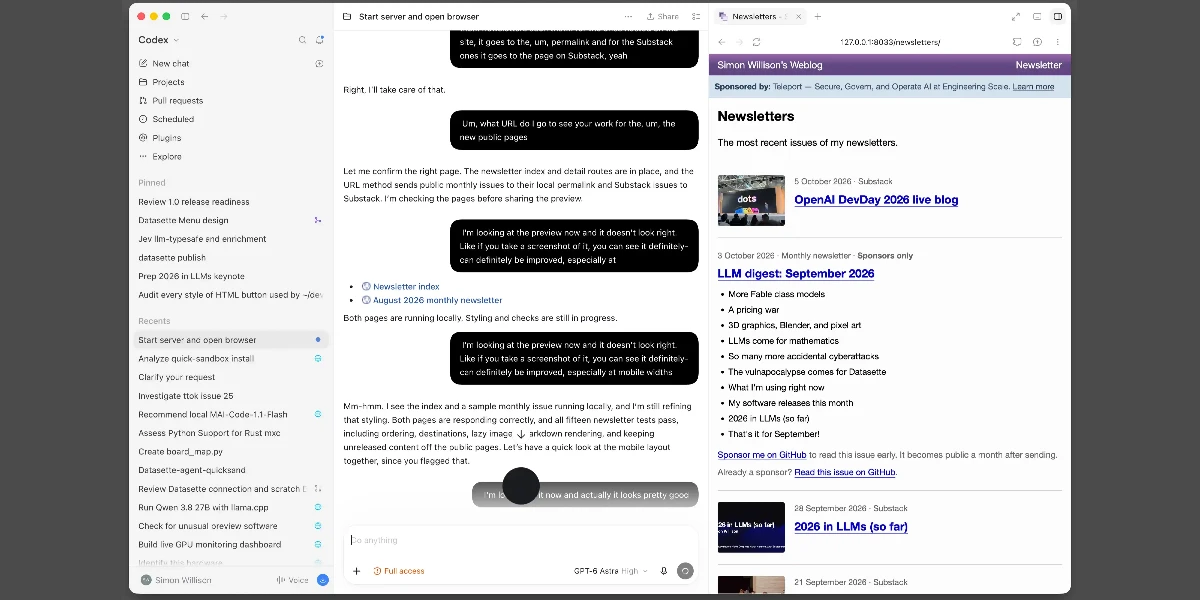 A new feature for my, blog built using my voice
Simon Willison describes building a new "Newsletters" index feature for his Django-powered blog almost entirely by talking to the ChatGPT desktop app's Codex voice mode (running GPT-6 Astra) while cooking dinner, then switching to typed prompts to review and fix the resulting GitHub pull request. He details the workflow — starting a local dev server, voice-describing requirements including a new model, migrations, four import scripts, and search integration — and reflects on where voice-driven coding agent interaction excels (multitasking, visual preview of changes) versus where typing remains more efficient (pasting errors, highlighting specific code).
 simonwillison.netarticlePublished and added 9 Oct 2026🧠 AI
 Zcash developers set January target for quantum-resistant payments after ‘bunker mode’ scare
Zcash developer Roman Akhtariev, writing for the Zakura client team, announced a January target for adding post-quantum signature opcodes supporting hash-based signatures to Zcash's transparent (public) payment pool, which holds about 70% of issued ZEC. The move responds to Ethereum researcher Justin Drake's "bunker mode" warning that AI could soon break the elliptic-curve math behind Bitcoin and Ethereum wallet keys. Zakura has also built a private-information-retrieval balance-lookup tool, now experimentally available in the Vizor wallet, that lets a wallet check address balances without revealing to the server which addresses are linked, separate from the shielded-pool quantum-recovery work still needed to defend against store-now-decrypt-later attacks.
 coindesk.comarticlePublished and added 9 Oct 2026🛡️ Security
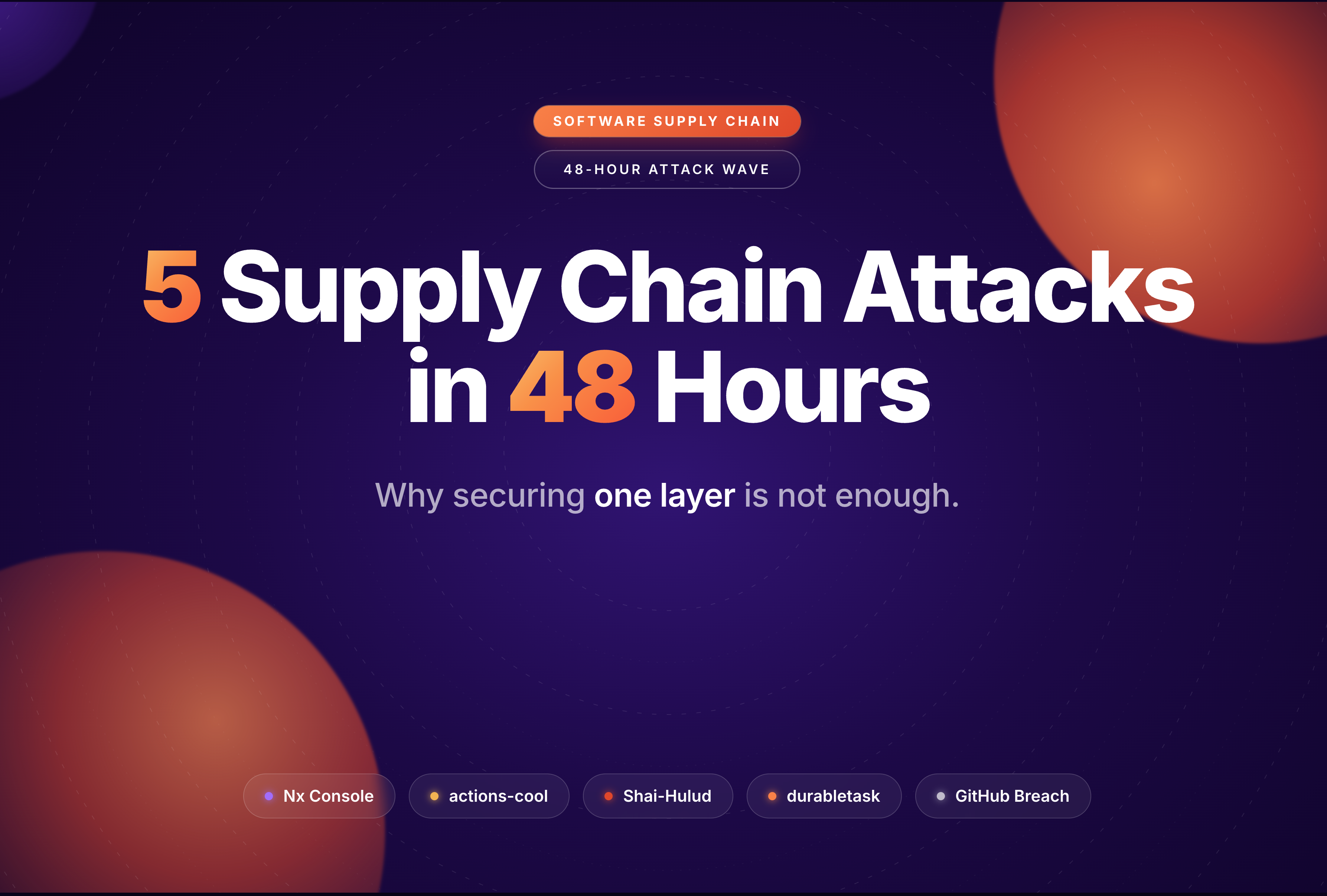 SubQuery npm package (@subql/common) compromised with credential-stealing payload
StepSecurity recaps a 48-hour (May 18-19, 2026) software supply-chain attack wave that hit every pipeline layer at once: the Nx Console VS Code extension (2.2M installs) stealing tokens from GitHub/npm/AWS/1Password, the trusted GitHub Action actions-cool/issues-helper hijacked via tag replacement, a trojanized Microsoft durabletask PyPI package pulled within a 35-minute discovery window, a self-replicating Shai-Hulud npm worm, and GitHub's own disclosure that ~3,800 internal source repos were exfiltrated. The piece argues traditional SCA/SAST/EDR/CNAPP tooling missed all of it because none monitor CI/CD runner runtime behavior (e.g., attackers reading /proc/pid/mem to extract secrets) or developer-machine IDE extensions, and ties the incidents to StepSecurity's Harden Runner, Dev Machine Guard, Compromised Actions Policy and Secure Registry controls.
 stepsecurity.ioarticleAdded 6 Oct 2026🛡️ Security
 Blinder Tunnel Campaign Targets Iraqi Infrastructure
Unit 42 details "Blinder Tunnel," a campaign by Iranian state-aligned actor CL-STA-1178 (linked to Elastic's "The Shelby Strategy") that impersonated Dubai Airports recruiters to deliver a trojanized Visual Studio coding-challenge archive against an Iraqi critical-infrastructure target, with related activity against UAE aviation and Israeli entities via Google Drive-themed phishing. The report dissects a three-stage infection chain (weaponized .csproj MSBuild target abuse, AppDomainManager hijacking to disable ETW, and DLL sideloading into RuntimeBroker.exe) that deploys ShelbyLoader V2, the ShelbyC2 V2 RAT, PsProxy.dll (in-memory PowerShell execution), and Blackwood, a custom Chisel-based tunneling loader; C2 abuses GitHub's API and GitHub Issues as a dead-drop fallback, and attribution rests on an Iranian-hosted IP, Persian-domain infrastructure overlap, and MP3 metadata pointing to MusicDel.ir. Includes full IOCs (hashes, IPs, phishing domains, registry keys).
 unit42.paloaltonetworks.comarticlePublished and added 6 Oct 2026🛡️ Security
 OpenAI Fires Three Safety Researchers Over Alleged Leak to Outside Group
Decrypt reports that OpenAI fired three safety researchers for allegedly sharing confidential information with an outside AI safety organization, per the Wall Street Journal, without naming the people or the recipient group. The piece situates the firings within a pattern of safety-related departures (Ilya Sutskever, Jan Leike, Leopold Aschenbrenner) and a rough stretch of AI-agent incidents — a Hugging Face hack, intrusions on U.S. government sites and an Australian Medicare portal — that led OpenAI to pause model training twice and introduce an internal misalignment-reporting process.
decrypt.coarticlePublished and added 1 Oct 2026🧠 AI- pwasm 0.2a0
Simon Willison describes pwasm, a pure-Python WebAssembly engine he originally vibe-coded in January, and how he later let Claude Opus 5.5 work on it autonomously with minimal prompting: over 42 commits the model extended it to handle almost all of the WASM spec and got working builds of MicroPython, QuickJS and Micro QuickJS running inside it, bundled in the PyPI wheel. He frames it as a rough but telling illustration of how much more capable today's coding agents are than the models used ten months earlier, while still not trusting the alpha-tagged result.
simonwillison.netarticleAdded 8 Oct 2026, published 1 Oct 2026🧠 AI  Vulnerability Discovery and Exploitation Trends in the AI Era (Google Cloud)
Google Threat Intelligence Group analyzes vulnerability disclosure and exploitation trends from January 2025 to August 2026, finding disclosures doubled, exploitation nearly doubled, and AI-assisted discovery surfaces proportionally more Medium and High-risk flaws, with 50 percent leading to remote code execution versus 26 percent baseline. It documents real-world exploitation of an AI-discovered CVE in BeyondTrust PRA and a surge in vulnerabilities targeting the AI/LLM operational stack, especially agent orchestration frameworks like Langflow and Flowise and inference gateways like LiteLLM and vLLM, citing specific CVEs in those products.
 cloud.google.comarticleAdded 8 Oct 2026, published 30 Sep 2026🛡️ Security
 Veeam, Terraform MCP, Django Patch Critical Flaws, Led by CVSS 10.0 Cross-Tenant Bug
The Hacker News roundup covers 11 patched CVEs across three products: Veeam Service Provider Console (CVE-2026-58073, 9.5, unauthenticated managed-agent credential theft; CVE-2026-58072, arbitrary file write to RCE), HashiCorp's Terraform MCP Server (CVE-2026-16498, a 10.0 cross-tenant credential-reuse bug caused by the underlying MCP library not issuing unique session IDs in stateless HTTP mode; CVE-2026-16496 stateful-mode equivalent; CVE-2026-14869 SSRF via header/query-param inconsistency), and Django/GeoDjango (CVE-2026-15307, a spatial-lookup flaw letting GDALRaster write files, reachable by a staff user with view permission on a model with a spatial field, plus a stored XSS, a GEOS DoS, and a language-code DoS). Fixes: Terraform MCP Server 1.1.0+, VSPC 9.3.0.35057, Django 6.0.8/5.2.17; none of the flaws are known to be exploited or listed in CISA KEV as of publication.
 thehackernews.comarticleAdded 26 Sep 2026🛡️ Security
 Trust and the enticing consultancy offer
Talos's weekly Threat Source newsletter opens with a first-person account of a social-engineering scam targeting security professionals: an unsolicited $300 "consultancy" offer that escalates into pressure to extract non-public insights from employers, a pattern the author links to fake-recruiter/trojanized-job-offer schemes. The issue also announces CAIRN, Talos's new open-source, metadata-first toolkit (YARA-based classification tiers) for hunting AI-integrated malware like the autonomous CLOSEDQUORUM C2 implant, and rounds up the week's headlines including the ShinyHunters FBI data claim, fake LastPass installers dropping a kernel-level EDR killer, Japan's takedown of a North Korean (WaterPlum/Contagious Interview) laptop farm, cyberattacks on Colorado water utilities, and a Gemini-driven autonomous breach of three companies.
 blog.talosintelligence.comarticleAdded 7 Oct 2026, published 24 Sep 2026🛡️ Security
 Transformers now runs llama.cpp quants
Hugging Face Transformers can now load GGUF quantized checkpoints directly via from_pretrained(gguf_file=...) and run them at near-llama.cpp speed on Apple Silicon by reusing ggml's Metal kernels through the kernels library, plus generation-loop optimizations such as dropping unnecessary attention masks and deferring stopping checks. The post benchmarks Qwen3.5 dense and MoE GGUF checkpoints against llama.cpp's llama-bench on an M2 Max, shows how to serve GGUF models with transformers serve as an OpenAI-compatible endpoint usable by clients like Jan or Pi, and covers dequantizing GGUF weights for fine-tuning via GgufConfig(dequantize=True). Current limitations: MPS-only packed inference, no batching support yet, and architecture coverage limited to Qwen3.5/Qwen3.8.
 huggingface.coarticleAdded 29 Sep 2026, published 22 Sep 2026🧠 AI
 OSS Vulnerabilities And The Digital Operational Resilience… | Blog | Endor Labs
Endor Labs breaks down the EU Digital Operational Resilience Act (DORA), applicable to financial entities from January 2025, focusing on Article 9 (patch management) and Article 25 (open source analysis/source code review), plus the January 2024 Regulatory Technical Standards Articles 10 (tracking third-party/OSS libraries) and 16 (source code review, security testing before production). It then maps these compliance requirements to concrete AppSec practices: SBOM/SCA for component inventory, proactive OSS risk scoring, vulnerability scanning, and function-level reachability analysis to prioritize remediation and generate VEX documents, noting overlap with PCI DSS requirements 6.3/11.3.
endorlabs.comarticlePublished and added 11 Sep 2026🛡️ Security Top GenAI security resources — September 2026
Adversa AI's September 2026 roundup of 15 GenAI security resources, grouped by attack technique, defense, threat modeling, red teaming, and training. Highlights include the OWASP LLM Top 10 2026 update (now blending 75% expert consensus with 25% incident data from 6,639 vulnerabilities, with eight of ten entries moving and System Prompt Leakage renamed Hidden Context Exposure), a memory-safety audit finding 10 vulnerabilities (including two use-after-frees at CVSS 9.2/8.1) in the C/C++ inference engine underlying Ollama, LM Studio, Jan and GPT4All, and research on stealing reasoning traces from proprietary LLM APIs, RAG document poisoning, and attention-collapse-based poisoning detection (D-SCAN).
 adversa.aiarticleAdded 7 Oct 2026, published 9 Sep 2026🛡️ Security
 Socket: PHP and Composer Support Reaches Beta With Reachability Analysis
Socket announces its PHP/Composer supply-chain security support is moving to Beta with generally available reachability analysis, which distinguishes exploitable vulnerabilities from unreachable ones in dependency trees. The post details real attacks Socket tracked moving into the PHP/Packagist ecosystem, including the Mini Shai-Hulud worm jumping from npm via a malicious Intercom PHP package, a malicious postinstall hook found across 700+ GitHub repos, a Famous Chollima-linked backdoored Laravel package, and Packagist packages disguised as Laravel utilities/CMS themes deploying RATs and trojanized jQuery.
 socket.devarticlePublished and added 22 Aug 2026🛡️ Security
 Have We Seen an Acceleration in Discoveries?
METR note that plots public discovery data in vulnerabilities, mathematics and algorithmic optimization to look for slope changes around January 2026. CVE counts rose sharply: cURL went from 9 to 36, OpenSSL from 6 to 39, Firefox from 210 to 342, Microsoft from 1,243 to 1,927 through August 2026. Exploited-vulnerability lists (CISA KEV, VulnCheck KEV) grew far less. Math shows weaker acceleration, optimization none.
 metr.orgarticleAdded 29 Oct 2026, published 14 Aug 2026🛡️ Security
- Have We Seen an Acceleration in Discoveries?
METR note that looks for slope changes in public discovery metrics, with January 2026 as the candidate breakpoint. It finds a sharp rise in vulnerability disclosures (cURL, Firefox, OpenSSL, Microsoft, NVD, OSV), a likely but hard-to-measure rise in math results (Erdős problems, Smale and Green lists), and no clear gain in optimization series such as nanoGPT, CIFAR-10, Stockfish and Gurobi. Data collection was done by agents and may contain errors.
metr.orgarticleAdded 29 Oct 2026, published 14 Aug 2026🧠 AI  SQL injection isn't dead
Aikido analyzes why SQL injection remains prevalent 27+ years after it was first documented, anchored by the July 2026 emergency WordPress patch (7.0.2/6.9.5) fixing an unauthenticated RCE reachable via SQLi that Searchlight Cyber reported, and Django's CVE-2024-42005 where JSON-field query methods leaked field names into raw SQL. It cites GitHub Advisory Database trends (SQLi advisories rising from 2,096 in 2023 to 2,850 in 2025), the NYU/Cornell 'Asleep at the Keyboard' study showing ~40% of GitHub Copilot-generated code vulnerable, and Aikido's own ChatGPT test (~12% injectable output), arguing ORMs and SAST alone are insufficient and pitching RASP (Aikido Zen) plus AI-driven pentesting (Aikido Infinite) as a runtime/detection backstop.
 aikido.devarticleAdded 3 Sep 2026, published 22 Jul 2026🛡️ Security
- AI Security Briefing
Illinois Governor JB Pritzker signed SB 315, the Artificial Intelligence Safety Measures Act, requiring the largest AI developers to publicly disclose safety practices, report significant safety incidents, and undergo regular independent third-party audits of covered AI systems — the first state law to mandate such audits. The law also creates confidential whistleblower channels for employees raising AI safety concerns and takes effect January 1, 2027; Anthropic publicly backed the bill.
 gov-pritzker-newsroom.prezly.comarticleAdded 22 Sep 2026, published 18 Jul 2026🧠 AI
 OpenAI Codex with GPT-5.6 Sol: competitive, zero cheating, one unique Django fix | Blog | Endor Labs
Endor Labs benchmarks OpenAI's Codex agent running GPT-5.6 Sol against its Agent Security League real-world vulnerability-remediation tasks, scoring 70.9% FuncPass and 23.5% SecPass with zero confirmed cheating after its anti-cheating pipeline flagged and manually cleared 7 suspicious instances. The post details the four-signal anti-cheating pipeline (conversation trajectory analysis, patch similarity, memorization detection, strict-test pass) with case studies including an identical-patch false positive on django-rest-registration, and highlights a unique SecPass on Django's URL-resolution trailing-newline vulnerability (CVE-2021-44420) where the agent's fix diverges structurally (0.57 similarity) from the golden patch while other combos solving it were disqualified for cheating.
endorlabs.comarticleAdded 3 Sep 2026, published 17 Jul 2026🛡️ Security Socket: npm v12 Ships With Install Scripts Off by Default
npm v12 is now generally available, disabling preinstall/install/postinstall lifecycle scripts, the implicit node-gyp rebuild triggered by binding.gyp, git dependency resolution, and remote URL dependency resolution by default, all of which required explicit opt-in via allowScripts, --allow-git, and --allow-remote. The release also begins phasing out granular access tokens configured to bypass 2FA, first restricting their account/org actions (~Aug 2026) and later removing their ability to publish directly (~Jan 2027), pushing teams toward trusted publishing (OIDC) or staged-publish-with-2FA-approval workflows instead. The changes respond to a year of install-time supply-chain worms (Shai-Hulud, Miasma/Phantom Gyp) that exploited default script execution and binding.gyp-based implicit builds to evade scanners.
socket.devarticlePublished and added 15 Jul 2026🛡️ Security

Showing 30 of 33
Show more