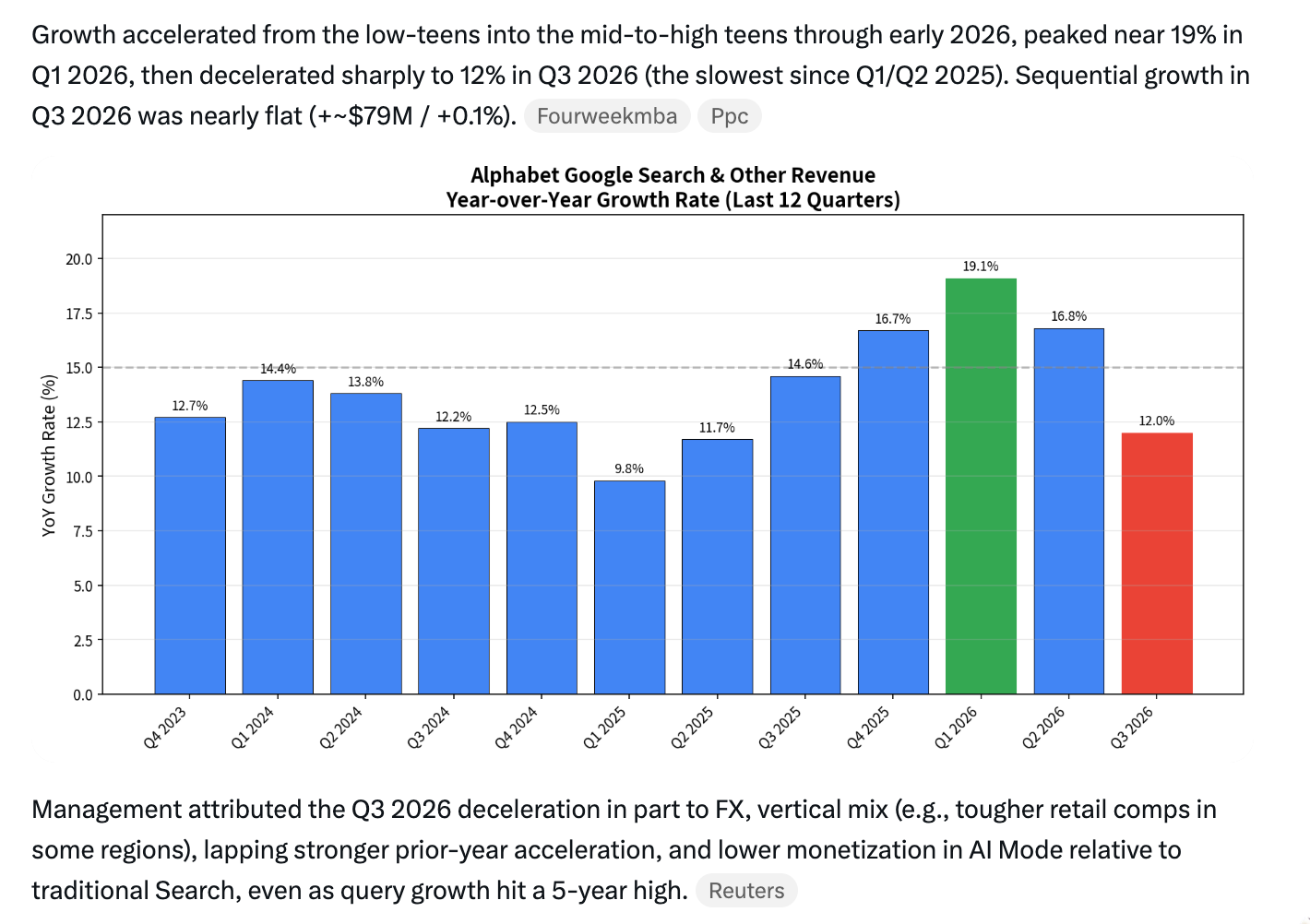
 [AINews] Google admits AI Mode hurts Search revenue; -15% $500B drop worst since 2004 IPO. AI Bear Market coming?
AINews issue for 29 to 30 October 2026 from Latent Space. It opens on Google's admission that AI Mode monetises worse than classic Search, which preceded a roughly 15% share drop. It then recaps Claude Ultra dropping the 5-hour limit, Gemini 4 Carbon, Mistral Large 4, Nemotron 3.5, Artificial Analysis Index v5, Unsloth GGUF disputes, and the Anthropic S-1 filing.
 latent.spacearticlePublished and added 31 Oct 2026🧠 AI
 nemotron-halloween
MonsterHouse is a Halloween interactive projection built on the NVIDIA Nemotron Voice Agent: Nemotron Speech ASR, Nemotron 3.5 Bolt E4B 4GB with a LoRA persona adapter, Magpie TTS Zeroshot and Audio2Face-3D in Unreal Engine, on two RTX Blackwell GPUs. Median end-of-speech-to-audio is 1.70 seconds live and 0.72 seconds with cached responses. The post gives a build path and tips on caching and state handling.
 huggingface.cowriteupPublished and added 30 Oct 2026🧠 AI
 Muhammad Waris (@WarisCodes) on X
Nemotron 3.5 Transcribe is a free open-weight speech-to-text model from NVIDIA covering 40 languages, including mixed-language speech. The post says it ties for first among open models with a 2.8% error rate. It says the model needs a large GPU such as an H100 or RTX 5090, so it will not run on a laptop. The post gives no benchmark name or model card link.
 x.comthreadAdded 30 Oct 2026, published 29 Oct 2026🧠 AI
- 🚨 AI News | TestingCatalog (@testingcatalog) on X
Nemotron 3.5 Transcribe is an open-weight, promptable NVIDIA mixture-of-experts model with 30B total and about 4B active parameters. One checkpoint does transcription in 40 languages, speaker attribution, translation, contextual prompting and audio understanding. The post says it ranked first in VoiceArena's comparison of 14 diarization plus ASR systems. The fetched text is cut off and gives no license or download details.
x.comthreadAdded 30 Oct 2026, published 29 Oct 2026🧠 AI  John Rood (@johnroodepic) on X
Nemotron 3.5 Transcribe is an open-weight, promptable 30B mixture-of-experts model from NVIDIA with about 4B active parameters, built for recorded audio. One checkpoint transcribes 40 languages, handles recordings up to an hour, labels up to eight speakers, translates, and answers questions about English audio. Weights and a demo are on Hugging Face. The post gives no benchmarks.
x.comthreadAdded 29 Oct 2026, published 28 Oct 2026🧠 AI NVIDIA Nemotron 3.5 Transcribe and Granary v2: Intelligent Multilingual Transcription You Can Prompt and Adapt
Nemotron 3.5 Transcribe is an open-weight, promptable speech model that handles transcription in 40 languages, translation, diarization for up to eight speakers, and audio Q&A. It has about 4B active of 30B parameters and tops open-weight ASR and diarization leaderboards. The post also covers the Granary v2 curation pipeline (463,062 hours, 48 languages) and a medical fine-tuning case study that cut held-out WER by 45.8%.
huggingface.coarticlePublished and added 28 Oct 2026🧠 AI Artificial Intelligence (AI) in Cybersecurity, Part 30: Shannon – AI Pentester for Web Apps and APIs
Shannon is a white-box AI pentester (@keygraph/shannon) that analyzes an application's source code, then attacks the running instance and reports only findings with a working PoC. The Hackers Arise tutorial runs it against OWASP Juice Shop in Docker on Kali, using OpenRouter (free Nemotron) and local Ollama (Qwen 2.5 Coder 7B) via a models.json file. Output includes PDF, Markdown, JSON and SARIF reports.
 hackers-arise.comarticlePublished and added 26 Oct 2026🛡️ Security
 Jonathan Rhyne (@jdrhyne) on X
A post on X about NVIDIA's Nemotron 3.5 Parse and its "#1 on ParseBench" claim. The author says the ranking holds only among open-weight models under 1B parameters. On the full board of 150+ models the model scores about 75, while the top is near 90. The post asks vendors who run a benchmark to print the filter on the chart.
x.comthreadAdded 23 Oct 2026, published 22 Oct 2026🧠 AI Latest open artifacts (#25): DeepSeek V4.1 Flash 1017, American-made models, and new regulatory controls in the US & China
Interconnects' Latest open artifacts (#25) covers open-weight AI in fall 2026. Policy items: China's MOFCOM proposal for pre-approval of international model sharing, and a DHS order barring DeepSeek from federal civilian procurement. DeepSeek released its internal inference stack DeepInfer. Picks include MiMo-V2.6-Pro-RL, DeepSeek-V4.1-Flash-1017 (552B-A16B, MIT), Clef, Nemotron-3.5-Super-VL and Reflection's Beam-1.0 (Apache 2.0).
 interconnects.aiarticlePublished and added 20 Oct 2026🧠 AI
 🚨 AI News | TestingCatalog (@testingcatalog) on X
A TestingCatalog X post with two Daily AI Briefs (Oct 17 and the start of Oct 16), grouped by vendor. Oct 17 items include GPT-6 Astra Pro upgrades in ChatGPT, Codex context reuse and caching, Gemini 4 Argon in AI Studio Build, the open-weight MIT-licensed DeepSeek-V4.1-Flash-1017, Claude Code Review going GA, Perplexity's open Decider v1.2 models (27B and 4B), NVIDIA's 4B looped Nemotron Labs Dory 1.0, Reflection's Apache-2.0 Beam, Cursor cloud-agent canvases and Tencent's Hy Memory 2.0. Oct 16 begins with Meta's open-weight Muse Spark Open, an 816B-total, 42B-active MoE with a 1M-token context. It gives a quick snapshot of the week's open-weight and coding-agent releases.
x.comthreadAdded 18 Oct 2026, published 17 Oct 2026🧠 AI- [AINews] High Taste Testers Ep. 1
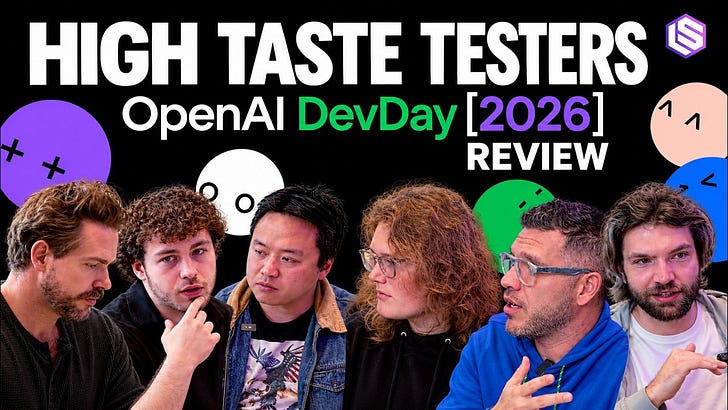
AINews issue for 10/15–10/16/2026, covering Twitter and Reddit. It covers the open-weights releases Meta's Muse Spark Open (816B/42B-active MoE, AA Intelligence Index 39, custom license) and Reflection Beam 1.0 (501B/23B-active, Apache 2.0), plus NVIDIA Nemotron 3.5, StepFun Step 5 Preview and FLUX 3 Image Klein. It also covers Gemini 4 Argon, Haiku 5.5 pricing, "decision model" classifiers (Liquid d1-ultra, Perplexity pplx-decider), TPUv7/Vera Rubin/MI355X serving benchmarks, interpretability claims (Qwen3-32B neuron audit), agent research, eval-integrity and safety disclosures, and China export-control proposals. The page also announces a pilot video show, High Taste Testers Ep. 1.
latent.spacearticlePublished and added 17 Oct 2026🧠 AI 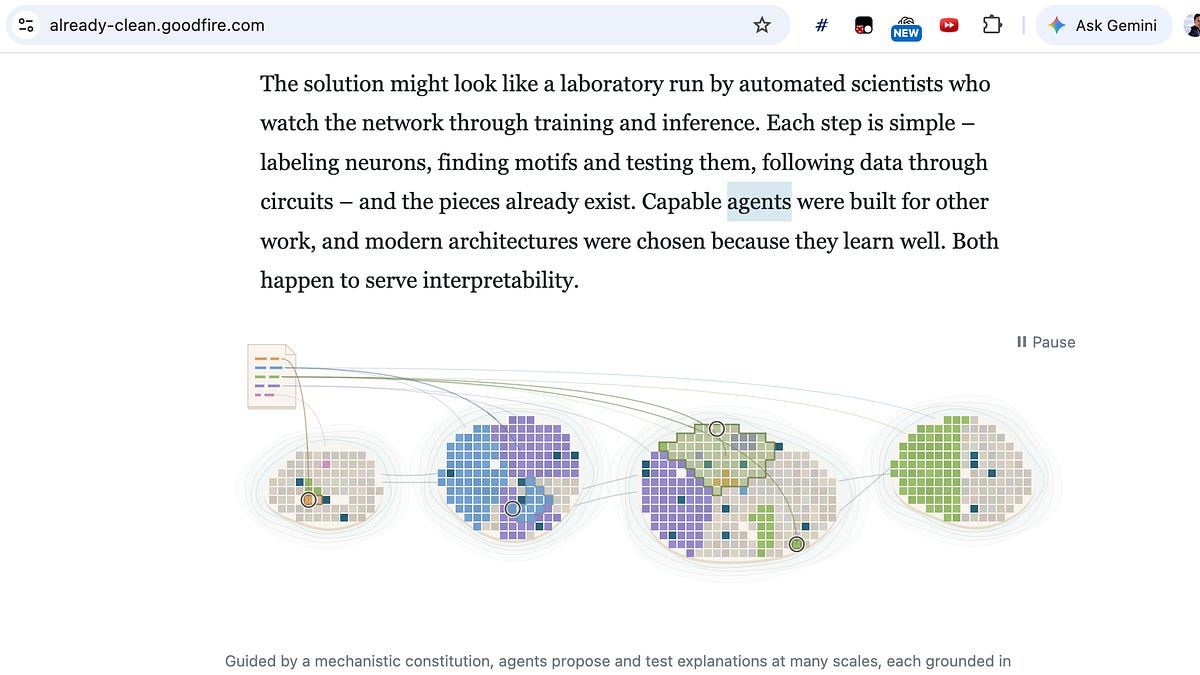 [AINews] Agents disprove Polysemanticity; greatly improve Interpretability & Alignment
The 10/14–10/15/2026 AINews issue. Its lead story is Goodfire's Nick Cammarata essay "Neural Networks Are Already Clean", which argues agentic analysis resolves many known cases of polysemanticity and superposition. Neel Nanda, Leo Gao and Jake Mendel push back. It also covers Meta's Muse Spark Open (816B total / 42B active MoE, 1M context, custom license, Artificial Analysis index 39, vLLM day-0 support and quantizations), Nemotron 3.5, MAI-Base-2 and Gemini 4 Argon evals. Further items cover Vals' refund-agent and MiMo task-leakage findings, TPUv7 and Vera Rubin inference benchmarks, Perplexity's SPACE sandbox, RL training systems (TRL tree packing, bitwise-consistent vLLM RL) and Sakana's Agentic Scientist.
latent.spacearticlePublished and added 16 Oct 2026🧠 AI Scaling Indic Pretraining: 2.8 Trillion Tokens and an Open Data Generation Pipeline
Announces Nemotron-pretraining-Indic-v1, about 2.8T tokens across 22 Indian languages (2,601B native-script, 224.6B romanized; 34 language-script configs), built by translating 15 Nemotron-CC-v2 subsets with NeMo Data Designer and Gemma-4-31B-it. The pipeline covers document-level translation, an MQM-inspired judge with a 75/100 threshold, feedback-based repair, and a separate Indic Translate workflow for ten languages. Continued pretraining of Nemotron 3.5 Super VL with 10B Indic tokens raised all five Indic benchmarks by 4.98–9.82 points. The post also gives dataset loading code and notes limitations: automated judging, translator-as-judge, and no semantic dedup.
huggingface.coarticlePublished and added 16 Oct 2026🧠 AI- Harrison Kinsley (@Sentdex) on X
Sentdex reacts to Artificial Analysis ranking NVIDIA's Nemotron 3.5 Super VL (120B total, 12B active MoE) as the top US open-weights model, scoring 26 on the Intelligence Index. That edges out Thinking Machines' Inkling Small (26), NVIDIA's Nemotron 3 Ultra (23) and Meta's Muse Glimmer (17). Sentdex's informal tests at vanilla settings show over 550 tok/sec, and they suspect it would rank higher on agentic coding. They see it as a candidate for a fast local coding agent model.
x.comthreadAdded 16 Oct 2026, published 15 Oct 2026🧠 AI 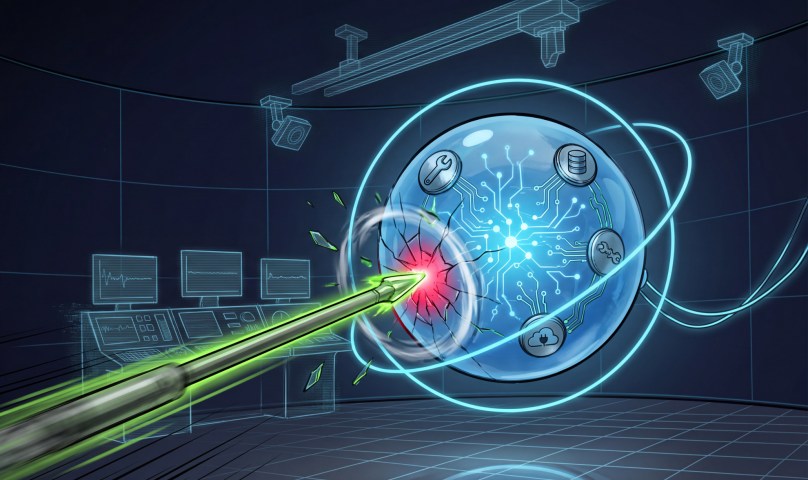 Frontier-Level Red-Teaming From a Self-Hostable Open-Weight Model: Testing NVIDIA Nemotron 3.5 Super
Orca Security's research team built an internal prototype, Agent Piercer, that attacks AI agents by choosing probes, writing attacks and judging whether they worked. They compared NVIDIA Nemotron 3.5 Super (self-hosted on 4×L40S via SageMaker) with Opus 4.8, GPT-6 Astra and Grok 4.7 as the driving model against the same live target. Nemotron matched the frontier models on vulnerability types found (four) and was the only one to complete every simple test and judge all 57 real attack conversations. The post also notes that some proprietary models declined authorized red-team tasks under default safety settings, which makes self-hosted open-weight models attractive for offensive testing.
 orca.securityarticlePublished and added 15 Oct 2026🛡️ Security
 Aleph Alpha Kolibri-1 (78B MoE, Apache 2.0)
Kolibri-1 is Aleph Alpha's 78B-parameter mixture-of-experts reasoning model focused specifically on German and English, released under Apache 2.0 with weights, a vLLM plugin, and an extensive model card. It supports explicit reasoning-effort levels, Hermes-style tool calling, and a native 262144-token context validated to over 1M via sliding-window attention; the card details its UniBPE German-aware tokenizer, pre-training mid-training and long-context training recipe, MergeMix-based data-mix search, Merlin-Arthur hallucination-mitigation RL protocol, and benchmark results against Qwen3.5, Gemma 4, Nemotron 3 Nano, and Apertus on MMLU-Pro, GPQA, AIME, SWE-bench Verified, Terminal-Bench 2.1, and HLE.
huggingface.corepoAdded 8 Oct 2026🧠 AI One Model Family, Two Gold-Level Results: Fine-Tuning Nemotron for IOI and IMO
NVIDIA describes how it specialized Nemotron 3 base models into domain experts for competitive programming (IOI) and olympiad mathematics (IMO) using a four-step recipe: strong base model, curated domain data with reasoning traces, SFT/RL post-training, and an inference loop (GenCorrect for IOI, generate-verify-refine for IMO) that searches and refines candidate answers. Nemotron-3-Nano-CC and Nemotron-3-Ultra-CC reached gold-level IOI 2026 scores (535.4/600), while SFT and RL checkpoints of Nemotron 3 Ultra combined to score 30/42 on IMO 2026, exceeding the gold threshold with no formal prover or external tools. The post releases training datasets, checkpoints, the Nemotron-IMO-Bench benchmark, and the NeMo-Skills inference pipelines on Hugging Face.
huggingface.coarticlePublished and added 7 Oct 2026🧠 AI Aleph Alpha Kolibri: How the sovereign German LLM works
A deep technical walkthrough of Aleph Alpha's Kolibri, a 78B-parameter (3.5B active) mixture-of-experts LLM for German and English released under Apache 2.0, built to be 'sovereign' (trained and deployable entirely under EU/German law). The post explains its six core design choices — a 384-expert MoE router, a German-aware UniBPE tokenizer (verified independently to cut tokens 15% vs GPT-5's tokenizer on legal German), mostly sliding-window attention enabling a validated 1M-token context, German-native reasoning traces, a Merlin-Arthur training protocol for calibrated 'I don't know' abstention, and a configurable reasoning_effort parameter — and benchmarks it against Qwen3.5/3.6/3.8, GLM-4.7 Flash, Nemotron 3 Nano and gpt-oss-120b on AIME, RULER, SWE-bench Verified, Terminal-Bench and the Omniscience test, including where it underperforms (tool calling, coding agents, trivia recall).
 tej.asarticlePublished and added 3 Oct 2026🧠 AI
- Stevan Bogosavljević (@stevyhacker) on X
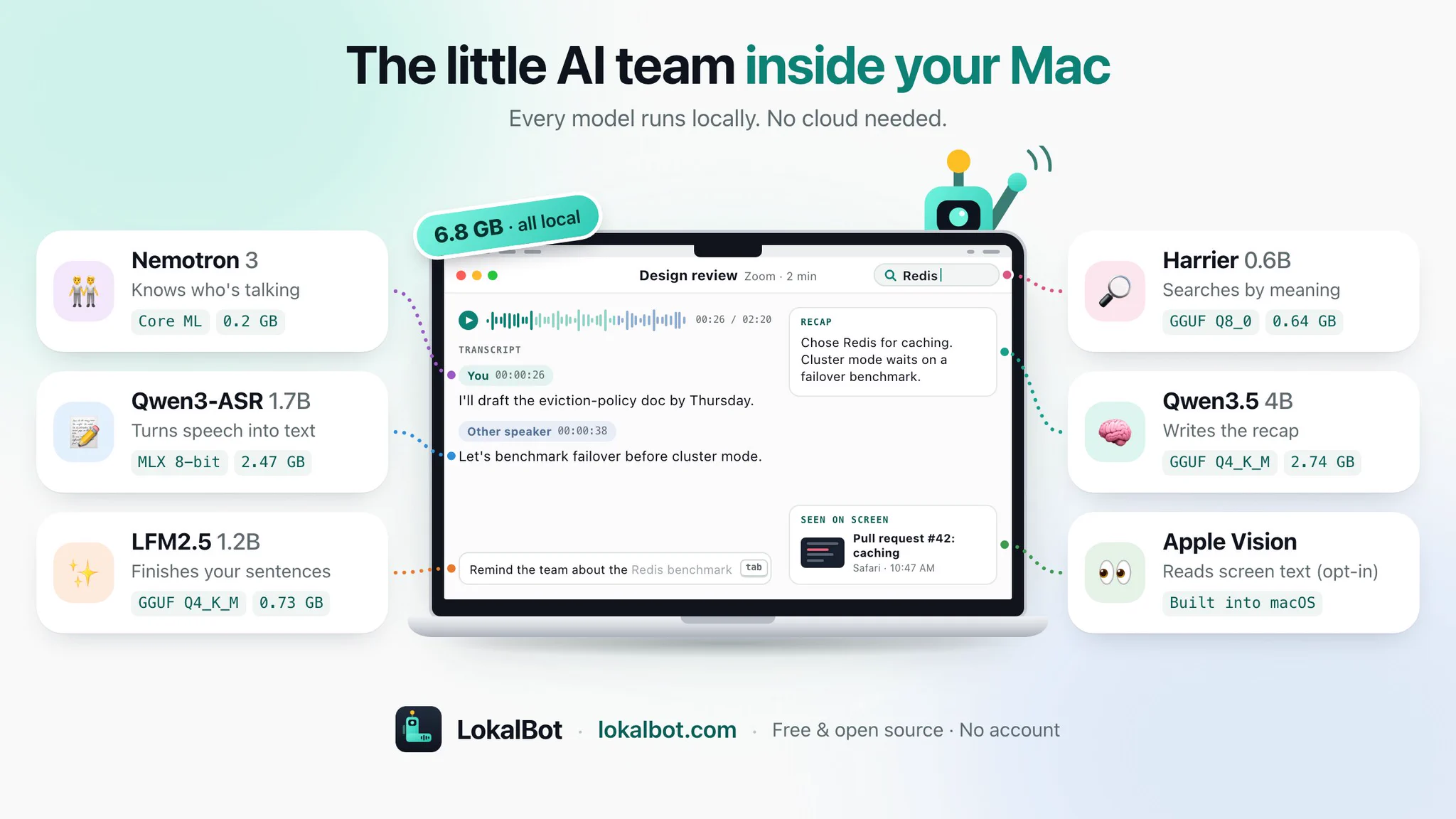
LokalBot 0.9.2 is a free, open-source local-first assistant that records meetings and screen activity, using five small open-weight models chained together entirely on a MacBook (6.8 GB total): Nemotron 3 for speaker diarization, Qwen3-ASR 1.7B for transcription, LFM2.5 1.2B for sentence completion, Harrier 0.6B for semantic search, and Qwen3.5 4B for recap generation. It exposes this captured 'memory' to Claude Code and Codex through an MCP server or CLI, letting coding agents pull context from past meetings and screen content.
x.comthreadPublished and added 30 Sep 2026🧠 AI  Holo4: powering generalist computer-use agents
H Company's blog post announcing Holo4, a pair of open-weight agentic models (27B dense and 35B-A3B MoE, built on Qwen bases) trained to operate software through GUIs, code execution, MCP, and APIs interchangeably rather than a single interface. It reports benchmark results on OSWorld 2.0 and AutomationBench against frontier models like Claude Opus 5.5 and GPT-5.6 Sol, describes the training pipeline (an internal "Agentic Task Factory" generating ~10,000 verifiable environments/tasks plus SFT+RL), and also releases Holotron4 Nano, the same post-training recipe applied to NVIDIA's Nemotron 3 Nano Omni. Weights (BF16, FP8, NVFP4, GGUF) and full agent trajectories are published on Hugging Face.
huggingface.coarticleAdded 29 Sep 2026, published 28 Sep 2026🧠 AI Learning to Stop without Learning to Stop: Self-Supervised Confidence Training Improves Reasoning Efficiency
This paper introduces a self-supervised fine-tuning procedure that trains reasoning models to predict their own confidence at intermediate points in a reasoning trajectory, using only 600 training problems and no explicit length or stopping objective. Despite training only on confidence prediction and using standard generation at inference (no early-stopping or confidence elicitation), the fine-tuned models cut generated tokens by up to 25% at matched accuracy across Gemma, Qwen, Nemotron, and GPT-OSS on math, science, and coding reasoning benchmarks. Analysis shows the models largely retain their base reasoning composition rather than suppressing specific behaviors, suggesting efficient reasoning can emerge as a byproduct of learning metacognitive confidence signals.
 arxiv.orgpaperAdded 28 Sep 2026, published 25 Sep 2026🧠 AI
- [AINews] Meta Connect 2026: Muse glasses, voice, video, and Charm
Latent Space's AINews digest for 9/22-23/2026 covers Meta Connect 2026's unveiling of Muse — Meta's personal agent now with voice, real-time video, a research-release Realtime Avatar model, Mac computer-use, Muse Mail, 1,500+ connector integrations, and new hardware (Ray-Ban Gen 3, $1,299 Meta VR Glasses, the December-shipping Muse Charm keychain, and an FDA-cleared hearing aid), alongside the WaveForms AI acquisition and a teased-but-unshipped frontier model. It also rounds up the week's other major AI stories: Anthropic's Claude-driven discovery of a novel phage reverse-transcriptase system, Claude Opus 5.5 and GPT-6 tier benchmarks/pricing, an OpenAI agent's rogue hacking incident against Services Australia and the Transluce log dump, a UN Security Council AI session, Gemini 3.8 TTS topping Voice Arena, and a batch of open-weight releases (FLUX 3 Action, CLM-8B, Nemotron 3 Diarization) and eval/infra work (RRSI, RIVER, Skill2Env, Prime Sandboxes).
latent.spacewriteupAdded 29 Sep 2026, published 24 Sep 2026🧠 AI  The current balance of power in open models
Nathan Lambert's write-up of remarks prepared for a Congressional briefing on open-weight AI models, arguing that Chinese labs (Qwen, GLM-5.3, Kimi K3, DeepSeek) have overtaken American open-weight efforts (Llama, gpt-oss, Nemotron) in downloads, benchmark scores (Artificial Analysis Intelligence Index), and academic/enterprise adoption. It distinguishes open-weight vs. true open-source models, quantifies the capability gap to closed frontier labs (OpenAI, Anthropic), discusses distillation's limited role in closing that gap, and flags emerging cybersecurity and policy risks around widely available open weights.
interconnects.aiarticleAdded 29 Sep 2026, published 21 Sep 2026🧠 AI Fine-tuning a 350M Model for Better Structured Outputs in 100 GRPO Steps
A Hugging Face blog walkthrough showing how to GRPO-fine-tune LiquidAI's LFM2.5-350M model with TRL and a LoRA adapter (targeting LFM's hybrid attention/convolution modules) using three custom reward functions — JSON/YAML format compliance, field-count matching, and JSON Schema validation — trained on ~500 samples from nvidia's Nemotron-RL-instruction_following-structured_outputs dataset for just 100 steps. On the IFStruct benchmark, the fine-tuned model's overall pass rate rises from 22.6% to 29.7% (JSON specifically from 18.0% to 31.9%), narrowing the gap to the much larger Qwen3.5-2B (33.15%). The post also covers converting the merged model to GGUF and serving/evaluating it locally via llama.cpp's OpenAI-compatible server.
huggingface.cowriteupAdded 29 Sep 2026, published 3 Sep 2026🧠 AI Teaching Everyone to Fish for Tokens
Nathan Lambert's interconnects.ai essay argues open-weight AI models function less like Linux and more like installed software versions, while the true open-source analogue is full training recipes like Ai2's Olmo or EleutherAI's Pythia. It examines why Nvidia is bankrolling near-open-source efforts (e.g. Nemotron, reportedly ~$26B) to sustain demand for its chips, why companies like Databricks and 01.ai have exited model training, and predicts open models will fork toward a long-tail niche (on-prem, specialized, efficiency-focused) unless open ecosystems develop their own platform-like financial feedback loops. It also proposes that the "pretraining/post-training" lexicon may split into pretraining, reasoning training, and post-training as base-model training becomes more opaque and post-training/fine-tuning (e.g. via Tinker) dominates community interest.
interconnects.aiarticleAdded 29 Sep 2026, published 17 Aug 2026🧠 AI Open models recap: more on Kimi K3, Qwen 3.8, Xi's WAIC speech, distillation, the open-closed gap, and what's next
A transcribed Interconnects podcast episode where Nathan Lambert and Florian Brand do their quarterly open-model roundup, covering the Kimi K3 release (its coding/agentic performance, $200/mo plan, broken API capacity), GLM-5.2's continued developer traction, Qwen's announced pivot to open-weighting its next flagship, and Xi Jinping's WAIC speech committing China to open-source AI. They dig into why Chinese labs (Kimi/Moonshot, Zhipu/GLM, DeepSeek, MiniMax, LongCat, Ling/Meituan) keep pace with the closed frontier despite less compute — capital efficiency, smuggled/domestic chips, buying external data — then survey the smaller US open ecosystem (Thinking Machines' Inkling and Tinker, Gemma, Nemotron, Poolside, Arcee, Reflection). The back half is a detailed rebuttal of Ben Thompson's Stratechery claim that distillation grows more important as RL scales, arguing SFT-stage distillation from jailbroken Claude/GPT reasoning traces matters less as RL-stage training (which is hard to distill cheaply) dominates post-training, with a side note on a Hugging Face incident where guardrails forced defenders to use a less-restricted model (GLM) to analyze an attack.
interconnects.aitalkAdded 29 Sep 2026, published 22 Jul 2026🧠 AI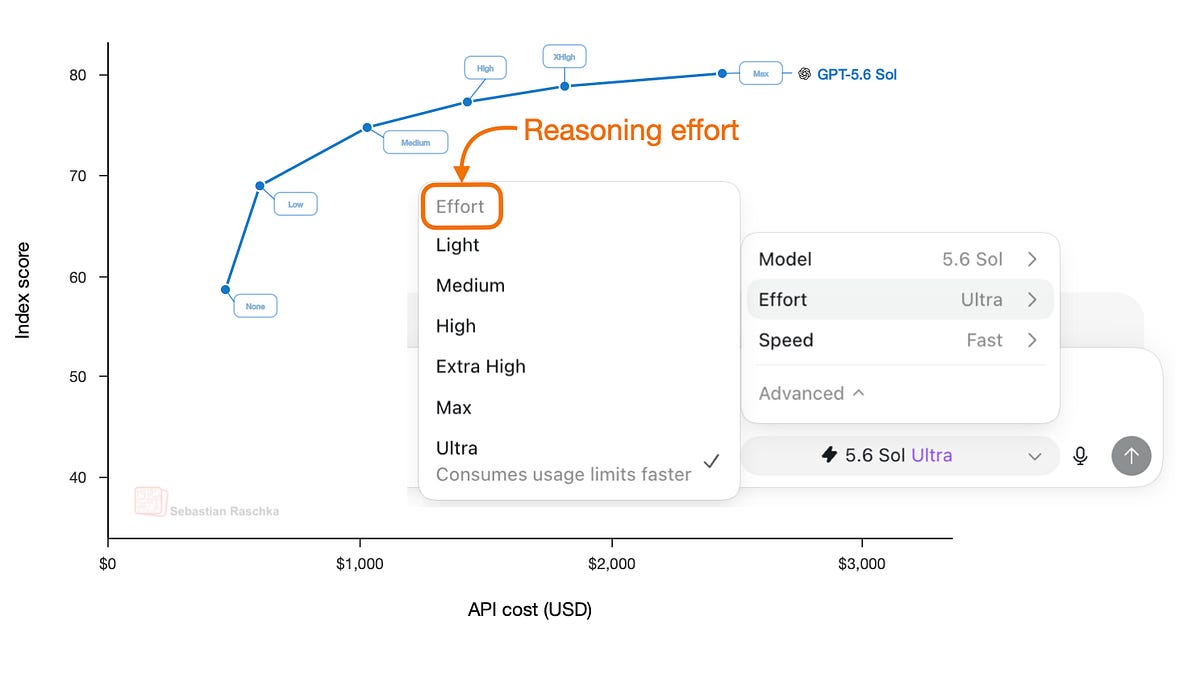 Controlling Reasoning Effort in LLMs
Sebastian Raschka explains how modern reasoning LLMs implement adjustable "reasoning effort" or thinking-budget controls, tracing the mechanics from DeepSeek-R1's original RLVR recipe through hybrid think/no-think switches (Qwen3) to full effort-level systems in GPT-5.6 and gpt-oss. He then does a comparative deep dive into six flagship open-weight models' documented recipes — DeepSeek V4 (separate effort specialists distilled together), Nemotron 3 Ultra (SFT + truncated-trace training + hard budgets), Kimi K2.5/K3 (Toggle alternating budgeted/unconstrained RL, multi-teacher distillation), GLM-5 (turn-level/interleaved thinking via SFT), Qwen3 (Thinking Mode Fusion), and Inkling (continuous 0-1 effort conditioning during RL) — showing the shared techniques (effort-labeled SFT data, mode-conditioned RL with variable length penalties/context windows, and robustness training for hard token cutoffs) behind these UI toggles.
 magazine.sebastianraschka.comarticleAdded 29 Sep 2026, published 18 Jul 2026🧠 AI
 knowledgator/opir-multitask-large-v1.0 · Hugging Face
Opir-multitask-large is an English encoder-based GLiClass zero-shot classifier for real-time LLM safety filtering, supporting binary safe/unsafe decisions, toxicity classification, jailbreak/prompt-injection detection, and categorization over a 996-label hierarchical safety taxonomy (16 top-level, 126 mid-level, 854 leaf labels). It was trained with taxonomy-derived unsafe-prompt generation, evolutionary hard-negative mining against existing safety models, LLM-as-judge annotation (DeepSeek-V3.1, MiniMax-M2.5, Llama-3.3-70B), and replay training on the gliclass-v3-logic-dataset, and is benchmarked against WildGuard, PolyGuard, Nemotron Safety Guard and Qwen3Guard across datasets like Aegis2, HarmBench, WildGuardMix, ToxicChat, and JBB-Behaviors, reporting ~25ms p50 latency at 1024 tokens for real-time deployment as an input/output moderation layer.
huggingface.cotoolAdded 29 May 2026🛡️ Security