- Tailworm – Tailscale Vulnerabilities
Tailworm is a security assessment report by Erica Windisch (Cyberdione Labs) on Tailscale v1.104.2 and headscale v0.29.5, tested 22-24 October 2026. It documents 11 findings: Tailscale SSH unix-socket forwarding that runs as root (bind, dial and TOCTOU races), conn25 app-connector egress bypass, gliderssh memory exhaustion, serve/funnel flaws and headscale DoS. It includes PoC references, mitigations and fix status as of 27 October 2026. The page is truncated, so the later sections were not read.
 tailworm.comwriteupAdded 27 Oct 2026, published 25 Oct 2026🛡️ Security
 Inside the LiteLLM 1.107.0 supply chain compromise: Credential theft through Python startup hooks
Microsoft's analysis of the LiteLLM 1.107.0 compromise, published to PyPI and container images on 21 October 2026. The wheel shipped cook.pth, cook.py and sitecustomize.py, so a credential collector (PRIVCOLLECT) ran whenever Python started, even without importing LiteLLM. It covers AES/RSA-encrypted exfiltration to litellm.dev, a re-armable Unix loader, Defender KQL hunting queries, ATT&CK mapping and rotation guidance.
 microsoft.comwriteupPublished and added 23 Oct 2026🛡️ Security
- Previdian (@PrevidianCyber) on X
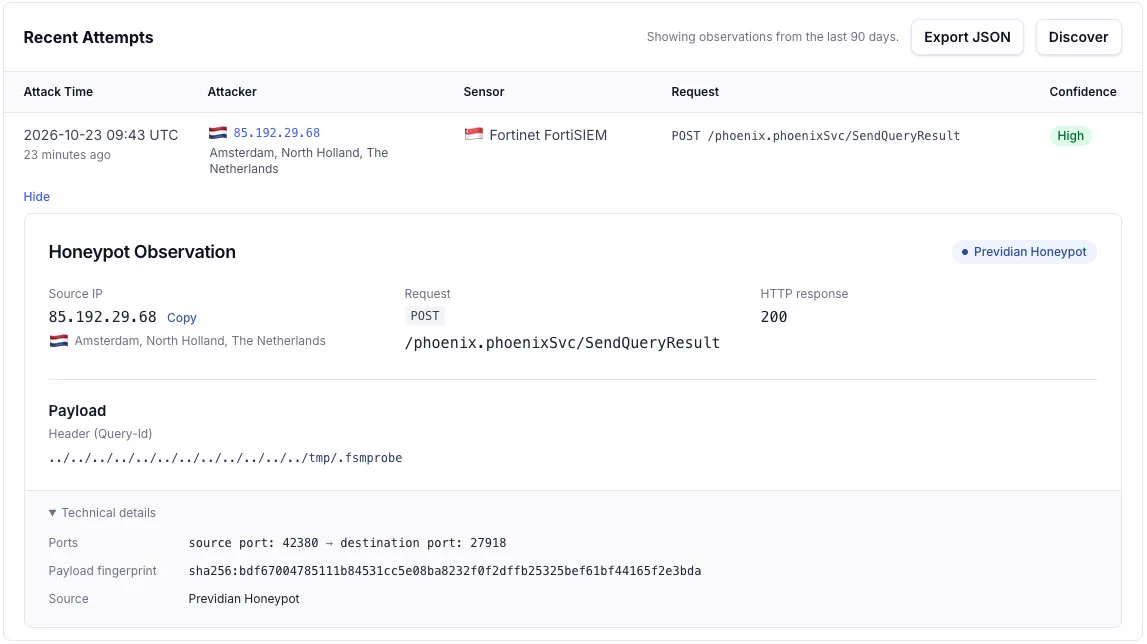
Previdian Cyber reports an exploitation attempt against its FortiSIEM honeypot on 23 October 2026 at 09:43:32 UTC, targeting the FortiSIEM path traversal CVE-2026-106173. The request, from 85.192.29[.]68, POSTed to /phoenix.phoenixSvc/SendQueryResult on TCP 27918 with twelve ../ sequences in the query-id header, trying to overwrite /tmp/.fsmprobe with an empty file. It matches the file overwrite mode of the Horizon3.ai PoC; success is not confirmed. Mitigation: upgrade to FortiSIEM 7.5.1 or later and restrict TCP 27918.
 x.comthreadAdded 25 Oct 2026, published 23 Oct 2026🛡️ Security
- Several Linux kernel vulnerabilities accidentally posted to public mailing list
Phoronix reports that Trend Micro's Zero Day Initiative mistakenly sent several Linux kernel vulnerability reports to the public kernel mailing list instead of the private security list. They include two CVSS 9.0 remote code execution bugs (SMB Direct integer underflow, ksmbd race condition), a skb_zerocopy local privilege escalation, a vmwgfx out-of-bounds write, an NVMET information disclosure and a search-domain TCP stack buffer overflow. Some have patches in -next branches, and none were yet in mainline.
 phoronix.comarticleAdded 23 Oct 2026, published 22 Oct 2026🛡️ Security
- Manish Kumar (@Manixh02) on X
Anatomy is an open-source agent skill that turns technical concepts into interactive visuals. Asked to explain a rate limiter or CDN cache, it builds a working model the user can explore. A tweet by Manixh02 says it works with Claude Code, Codex and other agents, and links to a GitHub repo under wheresryan22. The tweet gives no install steps or implementation details.
x.comthreadAdded 22 Oct 2026, published 21 Oct 2026🧠 AI - LinuxSecurity (@lnxsec) on X
A post from lnxsec on CI runners that accept outside pull requests while also holding registry credentials, cache write access, signing material or deployment tokens. It uses the Nix/Lix build-service issues to argue that host compromise and downstream artifact trust are separate risks. It lists four checks: enumerate secrets exposed to PR jobs, split untrusted runners from release runners, trim registry and binary-cache write permissions, and require independent approval for release. It links a linuxsecurity.com feature; CVE details are not in the post.
x.comthreadAdded 20 Oct 2026, published 19 Oct 2026🛡️ Security  Claude reveals ECDSA curve origins
Anthropic's Frontier Red Team reports that Claude recovered how the NIST P-192/224/256/384/521 and ANSI X9.62 curve seeds were generated. They are outputs of the C library's lrand48 LCG seeded with 1997–98 Unix timestamps, not hashes of a passphrase. The method scanned for weak-PRNG signatures, then used LLL lattice reduction to recover the truncated LCG state and stepped it back to srand48 initialization. Claude also traced some base points to the FreeLIP/NTL random generator. Reproducible Python is included. The authors say this is not an attack and makes deliberate backdoors less plausible. The B-163 seed and the base points of P-224/256/384/521 and the binary curves remain unexplained.
 anthropic.comwriteupAdded 17 Oct 2026, published 16 Oct 2026🛡️ Security
- Claude reveals ECDSA curve origins
Anthropic's Frontier Red Team reports that Claude, given no hint, worked out how the NIST P-192/224/256/384/521 and ANSI X9.62 curve seeds were generated. They came from the C library's lrand48 LCG seeded with Unix timestamps from 1997–98, not from a hash of a phrase. Claude found this by scanning for weak-PRNG signatures and recovering the PRNG state with LLL lattice reduction. It also traced several prime-curve base points to the FreeLIP random generator. The post includes Python code that reproduces the seeds and base points. It says this is not an attack and makes backdoor claims less plausible. B-163 and the other base points remain unexplained.
anthropic.comwriteupAdded 17 Oct 2026, published 16 Oct 2026🧠 AI  AI Startup Manus Raises $500 Million After China Nixed Meta’s $2 Billion Acquisition
Reports that Butterfly Effect, parent of Chinese AI agent startup Manus, raised over $500 million led by Boyu Capital and IDG Capital (with Tencent, HSG and ZhenFund), after China's National Development and Reform Commission ordered Meta's roughly $2 billion acquisition of the company unwound as prohibited foreign investment. It traces Manus's trajectory from its March 2025 invite-only launch (built on fine-tuned Anthropic Claude and Alibaba Qwen models) through $100M ARR, relocation to Singapore, the blocked Meta deal, and its pivot to a new agent product called Cue, situating the episode within Beijing's wider tightening on AI firms including new travel-approval rules for senior AI staff at companies like Alibaba and DeepSeek.
 decrypt.coarticlePublished and added 8 Oct 2026🧠 AI
 Tavus Griffin: the first Human Interaction Model
Tavus introduces Griffin, a "Human Interaction Model" (HIM): a full-duplex, video-to-video system that unifies real-time perception, conversational decision-making, and expressive audiovisual generation into one model rather than a cascaded pipeline. It uses a Continuous Conversational Modeling engine that makes sub-second turn-taking and nonverbal-behavior decisions, paired with a streaming speech generator built on a new continuous audio codec (Tavec) and a distilled autoregressive video diffusion model that renders 720p video in 320ms chunks. In live one-minute video calls, Griffin-Lite was judged human by 48% of participants (versus 2.4% for Tavus's prior Phoenix-4.5 system) and topped NVIDIA's VideoFDB full-duplex conversation benchmark on both generation and perception tracks.
 tavus.ioarticleAdded 2 Oct 2026🧠 AI
- Flowise MCP Security Bypass Enables RCE
GHSA advisory detailing three bypasses in Flowise's Custom MCP Server security controls (validateCommandFlags and validateArgsForLocalFileAccess in packages/components/nodes/tools/MCP/core.ts) that combine to achieve remote code execution: an unblocked `docker build` subcommand that pulls and runs a remote Dockerfile, a missing `--yes` long-flag alias on the npx blocklist (only `-y` was blocked) enabling arbitrary npm package execution, and a Unix absolute-path regex that fails to catch double-leading-slash paths (`//root/...`), allowing `node` to execute an uploaded local file. Any authenticated Flowise user (or an API key with chatflow view/update rights) can chain these to fully compromise the host via a prediction API call.
 github.comadvisoryAdded 26 Sep 2026🛡️ Security
 Package Manager Sandboxing (Andrew Nesbitt)
A survey of how package managers confine install-time and build-time code. It covers Homebrew 7.0.0's fetch/install split, Landlock sandbox and signed declarative *_steps. It also covers opam, Nix, Bazel, pacman, Swift PM and Deno, and the open sandbox proposals at pnpm, RubyGems, Spack, Cargo, pip and Zig. It sorts the responses into gating (allowlists), confinement and replacement/removal of hooks. It links the topic to coding-agent sandboxes (Seatbelt, Landlock, bubblewrap) and to Shai-Hulud and nx. It argues the open problem is validating a sandboxed phase's output at the hand-off.
 nesbitt.ioarticleAdded 10 Oct 2026, published 24 Sep 2026🛡️ Security
 Containers Are No Longer a Security Boundary (CVE-2026-80521)
Depth First researchers detail CVE-2026-80521, a Linux kernel use-after-free in the AF_UNIX subsystem's garbage collector (a race between edge visibility during SCM_RIGHTS sends and vertex freeing in unix_del_edge/unix_walk_scc_fast), discovered with their in-house AI vulnerability-detection model dfs-large1 and used to win a Google kernelCTF slot. They released a working container-escape exploit against the latest Ubuntu 26.04, plus a second exploit for CVE-2026-52910 against Ubuntu 24.04, arguing that AI-accelerated bug discovery has broken the assumption that shared-kernel containers (Docker/Kubernetes, nsjail, Firejail, Bubblewrap) provide a hard security boundary, and recommending migration of sensitive workloads to microVM isolation like Firecracker or Kata Containers.
 depthfirst.comwriteupAdded 26 Sep 2026, published 22 Sep 2026🛡️ Security
- Markakd/Container_escape
A GitHub repository hosting target-specific proof-of-concept exploits for two Linux kernel vulnerabilities, CVE-2026-52910 and CVE-2026-80521 (the latter an AF_UNIX kernel bug also documented in a kernelCTF LTS exploit-chain submission), both usable to break out of container isolation. The project ships a QEMU/Docker-based disposable VM builder (pinned to specific Ubuntu cloud images and kernel versions) so the destructive PoCs can be compiled and detonated only inside throwaway guests rather than on real hosts.
github.comrepoAdded 2 Oct 2026, published 16 Sep 2026🛡️ Security  ParaShells: Parallels Desktop Turns Appliance Install Into a Root Shell
JFrog researchers detail ParaShells, a local privilege escalation chain in Parallels Desktop 26.4.0 (build 57513) on Apple silicon that lets an unprivileged macOS user gain root. The chain combines a world-writable Unix socket for prl_disp_service, weak peer-credential-based authentication in PrlSrv_LoginLocal, and argument injection in the InstallAppliance extraction path where a crafted sVmParentPath breaks Qt's QProcess::splitCommand quoting to inject tar's --use-compress-program= flag, causing macOS tar to execute an attacker script as uid 0.
 jfrog.comwriteupPublished and added 15 Sep 2026🛡️ Security
 A “proof” of Fermat’s Last Theorem that fits the margin
Trail of Bits found a bug in Lean's String.Pos.Raw.extract (affecting all stable versions up to 4.33.1, fixed in 4.34.0-rc1) where the logical definition and the compiled native code disagree on the result of extracting a slice at an out-of-bounds position, letting an attacker manufacture a contradiction (empty string = non-empty string) that "proves" any theorem, including a fake formalization of Fermat's Last Theorem. The exploit only works when a proof relies on the native_decide axiom, which extends trust to the compiler rather than the kernel; the researchers found the issue while using GPT-5.6 to build a code-review skill, and Lean maintainers hargoniX and Rob23oba shipped fixes within hours to days of disclosure. The post is a reminder that machine-checked proofs are only as trustworthy as the evaluator/compiler paths behind axioms like native_decide, and points to work like lean4lean and alternative kernels as mitigations.
 blog.trailofbits.comwriteupPublished and added 9 Sep 2026🛡️ Security
 Korea’s Trillion-Dollar Sovereign AI Investment: Nvidia Wins, Hynix Loses
SemiAnalysis examines South Korea's sovereign AI push: a government tournament to build an independent foundation model, a $919B datacenter plan (8.4GW by 2029, 18.4GW by 2035), and what both mean for Nvidia, Samsung and SK Hynix. Startup Motif Technologies trained Motif 3 for about $15M, topped the Korean field on benchmarks, yet was eliminated in August 2026. The authors argue the scoring was opaque.
 newsletter.semianalysis.comarticleAdded 29 Oct 2026, published 1 Sep 2026🧠 AI
- age
age is a simple, modern file encryption tool, format, and Go library by Filippo Valsorda and @benjojo, offering small explicit keys, no config options, UNIX-style composability, and now built-in hybrid post-quantum encryption (ML-KEM + X25519) as of v1.3.0. It supports multiple recipients, passphrase encryption, SSH key (ed25519/rsa) recipients/identities, hardware tokens via age-plugin-yubikey, and an age-inspect command to view encrypted-file metadata without decrypting.
github.comrepoAdded 3 Sep 2026, published 31 Aug 2026🛡️ Security  We built an AI PR reviewer. The hard part was teaching it to say nothing.
Ionix's engineering team describes building an in-house AI PR reviewer using OpenAI's Codex CLI against a self-hosted Azure AI Foundry model deployment, wired into CircleCI and Bitbucket, after dropping Atlassian Rovo for cost and low signal-to-noise. The piece details prompt design to suppress low-value comments, agentic repo-wide review (vs. diff-only), sharding for large PRs, JSON output validation against git ls-files, storing review state inside PR comments via base64-in-markdown, and a dedicated prompt-injection defense section (scrubbed environment, secret redaction, sandboxed execution, egress restriction). It also covers two production failures: a silently-broken bubblewrap sandbox that kept "reviewing" without running any tools, and an unpinned Codex CLI npm dependency that broke Azure API calls across every repo.
 ionix.iowriteupAdded 3 Sep 2026, published 13 Aug 2026🛡️ Security
- sgkdev/bad_garbage
GitHub repo (sgkdev/bad_garbage) containing a proof-of-concept exploit for CVE-2026-53361, an unprivileged, container-escapable use-after-free in the Linux AF_UNIX socket garbage collector. The bug stems from a race where a concurrent MSG_PEEK on an in-flight socket slips past the gc_in_progress check, letting the GC free a still-referenced socket; the same underlying race has been patched three separate times (CVE-2021-0920, CVE-2026-23394, CVE-2026-53361). The PoC targets systems with 2–7 CPUs and notes that most SLUB cache-armoring/shadowing code was stripped out, leaving occasional collisions in kmalloc-64/anon_vma caches that a user would need to re-armor for near-100% reliability.
github.comrepoAdded 2 Oct 2026, published 10 Aug 2026🛡️ Security 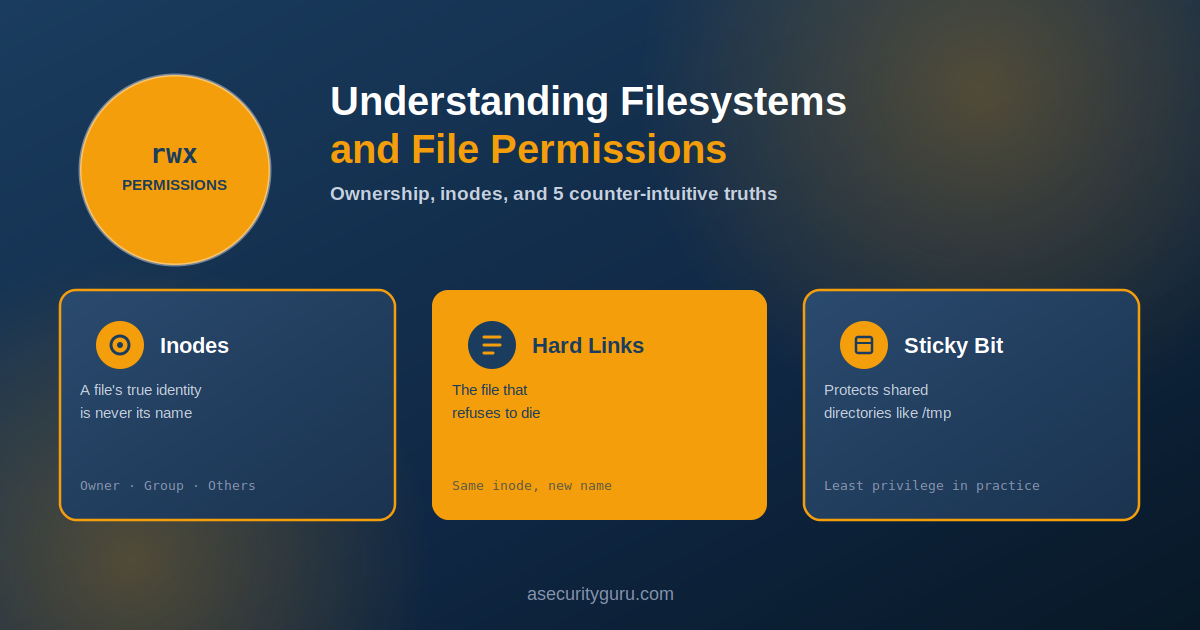 Filesystems and File Permissions Explained
Explainer on how Unix-like filesystems enforce security through owner/group/other permissions, inodes, hard links, directory execute-bit semantics, the sticky bit, and APFS copy-on-write snapshots. It ties these to real risks: 777 permissions exposing PII, world-readable config files leaking database credentials, world-writable directories allowing script replacement, and permission misconfigurations enabling privilege escalation. It recommends least privilege, ACLs, and regular entitlement reviews.
 asecurityguru.comarticleAdded 13 Oct 2026, published 27 Jul 2026🛡️ Security
 Socket: New Study Identifies 53 Slopsquatting Targets Across 5 Frontier LLMs
Socket covers an independent arXiv preprint by Aleksandr Churilov that re-ran the USENIX Security 2025 package-hallucination methodology against five 2026 frontier LLMs (Claude Sonnet 4.6, Claude Haiku 4.5, GPT-5.4-mini, Gemini 2.5 Pro, DeepSeek V3.2), finding hallucination rates of 4.62%-6.10% across ~200,000 code-generation responses. All five models independently invented the same 127 nonexistent package names; after Socket manually reviewed the 18 npm candidates (removing valid Ember.js virtual imports like @ember/service and two already-registered/held names) and PyPI Security filtered its 109 candidates against prohibited-name protections, 53 names (41 PyPI, 12 npm) remained available for registration as real slopsquatting targets that could affect users of any of the four model providers. The piece also flags a methodological limitation: regex-based registry-existence checks can misclassify valid framework-provided virtual modules as hallucinations.
 socket.devarticlePublished and added 23 Jul 2026🛡️ Security
 Socket: Rust Moves to Restrict LLM Use in Contributions After Months of Internal Debate
The Rust project is drafting a formal policy for rust-lang/rust that bans LLM-authored code, comments, and documentation from being merged while permitting LLM use as a private thinking aid (code review, summarization, exploration). The proposal, written by Jynn Nelson after over a month of internal debate (3,000+ Zulip messages), includes a middle disclosed, case-by-case tier for machine translation and review bots, and a narrow experimental exception for reviewer-solicited AI-authored PRs outside safety-critical components. The piece also surveys how other major open source projects (Zig, QEMU, postmarketOS, Servo, LLVM, Linux kernel, Mesa, Firefox, Ghostty, NixOS) have handled LLM contribution policy, ranging from full bans to disclosure-based acceptance, and covers pushback from Rust leaders like Niko Matsakis on the policy's framing and precedent.
socket.devarticleAdded 23 Sep 2026, published 1 Jun 2026🧠 AI ZEE200: Zero Knowledge for Everything and Everyone @ 200 KHz
ZEE200 is a new constant-round zero-knowledge proof system for executing arbitrary ANSI C programs, built by combining Tight ZK CPU (Yang et al., CCS'24) and fast ZK RAM (Yang and Heath, USENIX Security'24) with new Z_2^32 encodings and low-level optimizations. It runs its ZK CPU at ~200 KHz versus the prior ZEE system's ~10 KHz, and reproduces ZEE's benchmark of proving a SIR-reported vulnerability in the Linux sed utility in 1.5 seconds instead of 30.1 seconds on a simulated 1Gbps LAN with a commodity laptop. This lets a researcher prove the existence of a specific bug in real-world software without revealing the exploiting input, with far lower performance overhead than prior ZK-execution toolchains.
 eprint.iacr.orgpaperAdded 5 Oct 2026, published 28 Apr 2026🛡️ Security
- tmate - Instant Terminal Sharing (or How To Backdoor a Linux Server)
A DFIR.ch blog post examining how the threat actor TeamTNT abuses tmate (instant terminal sharing tool) as a Linux backdoor after compromising servers, referencing prior TeamTNT reporting from Intezer, ASEC, and Aqua. The author demonstrates tmate installation/usage and walks through forensic artifacts left behind — process listings, apt logs, unattended-upgrades-dpkg.log, /proc/net/unix socket entries, and lsof output showing outgoing SSH connections to tmate's infrastructure — to help defenders and threat hunters detect active or past tmate-based backdoors.
 dfir.chwriteupAdded 3 Sep 2026, published 6 Oct 2024🛡️ Security
- Botnet Fenix
DFIR.ch walks through analysis of the Fenix botnet infection chain observed in an incident response case: a Dropbox-hosted ZIP (ComplementoSATid.zip) contains an LNK file that invokes wscript to fetch and run a remote JSE script (rfc.jse) from an SMB share, which uses heavily obfuscated JavaScript (variable-splitting, decodeURIComponent, array-shift string deobfuscation) to eventually drop shellcode. The post documents file hashes, deobfuscation technique, and references Metabase's prior report on a Fenix infection vector.
dfir.chwriteupAdded 3 Sep 2026, published 22 Aug 2024🛡️ Security