A Kelsey–Kohno Attack Variant against SHA-2 Message Digests in HSS/LMS and XMSS
Falko Strenzke's ePrint 2026/2635 presents a multi-target second-preimage attack on message hashing in HSS/LMS and XMSS with SHA-256 and SHA-256/192. It herds chaining states from many collected signatures into one state, defeating the key and leaf-index prefix. With 2^64 signatures, SHA-256 cost falls from 2^256 to about 2^166 (2^156 at maximal message length). SHAKE256 parameter sets are unaffected.
 eprint.iacr.orgpaperAdded 26 Oct 2026, published 25 Oct 2026🛡️ Security
- Provable Security of SHA-256-Based LMS Revisited in the Ideal-Cipher Model
Provable Security of SHA-256-Based LMS Revisited in the Ideal-Cipher Model is an October 2026 ePrint paper by Chun Guo, Hao Cheng, Bart Preneel and Meiqin Wang. It shows forgery attacks on LMS_SHA256_M32 and LMS_SHA256_M24 that exploit Merkle-Damgård structure, so the Katz and Fluhrer random-oracle bounds do not apply. It proves ideal-cipher-model bounds: about 256 minus log2 of the block count for M32, and a minimum of two terms for M24.
eprint.iacr.orgpaperAdded 26 Oct 2026, published 24 Oct 2026🛡️ Security  Anti-Forensics: Building a Phantomdrive
Phantomdrive is an open source USB drive built on the WCH CH569 chip that appears as a plain 8GB disk and hides the rest of an SD card behind AES-256 encryption. The hidden partition unlocks when the user saves "password:" in a text file; the firmware catches it in raw WRITE10 traffic and zeroes the buffer. Key derivation uses a per-device salt and 100,000 SHA-256 rounds, and the post compares AES-ECB, CTR and XTS speeds.
 hackers-arise.comarticlePublished and added 22 Oct 2026🛡️ Security
 Compromised eMudhra intermediate certificates
Cisco Talos describes eight eMudhra intermediate CA certificates (six TLS, two code signing) whose P-384 private keys were trivially recoverable because a flaw in an April 30, 2025 key generation ceremony produced weak keys with only 3 to 8 bytes of entropy. The post lists certificate SHA-256 hashes and serials, browser and Microsoft blocks, and the Go fix (CVE-2026-111943, Go 1.27.3 and 1.26.10) that filters chains by SPKI hash. It covers impact on VPNs, CI/CD and embedded devices, and Snort SIDs 67363 to 67374.
 blog.talosintelligence.comadvisoryPublished and added 21 Oct 2026🛡️ Security
 Faster, Aggregatable and Quantum Safe Privacy Pools
Ethresear.ch post porting Tornado Cash to Flock, a post-quantum binary-field SNARK, proving a depth-32 SHA-256 withdrawal in about 19.5 ms (203.6 KiB proof), with recursive aggregation at about 0.68 s per withdrawal. It also proposes a ZIP 2005-inspired recovery protocol: wallets derive note secrets from a seed, the pool freezes on a discrete-log break, and users withdraw through a post-quantum verifier. Security is argued under an epoch assumption, with Grover-bounded pre-image attacks.
 ethresear.charticlePublished and added 19 Oct 2026🛡️ Security
- lee1981 (@lee1981b) on X
CyberForge "CVE of the Day #079" on CVE-2026-102764, a CWE-290 origin-validation flaw in BeyondTrust Remote Support (advisory BT26-05, CVSS v4 9.3) that allows appliance file operations. It summarises Mandiant/GTIG's exploited intrusion chain (SAWFLY web shell, BARECLAW backdoor, root escalation, persistence) and gives an investigation trail: patch-state verification (BT26-05-RS), evidence preservation, hunting leads with SHA-256 hashes and YARA rules, permission/session correlation, and remediation including clean redeployment and credential rotation. It separates vendor facts from the intrusion's observed behaviour and notes that KEV and EPSS have no entries.
 x.comthreadAdded 18 Oct 2026, published 16 Oct 2026🛡️ Security
 Crypto's Quantum Defense Is Being Built in the Open
Bankless article on Eigen Labs' Yukon platform, which runs open challenges where researchers and AI agents attack and improve cryptography. It covers ECDSA.fail (quantum circuit cost for attacking Bitcoin/Ethereum ECDSA, cut about 88% from baseline), HashSmash (SHA-256 weakness hunting, so far only on reduced versions), sig.golf (hash-based signatures), StarkWare's Quantum Safe Bitcoin (cost down from about $320 to $59) and better.codes (provable security raised from 64 to about 68 bits). The argument is that public, measurable attack-cost data helps defenders prepare better than withholding circuits does. All gains are theoretical and no quantum computer has run an attack at this scale.
 bankless.comarticlePublished and added 14 Oct 2026🛡️ Security
 Draft ERC: Agentic Resource Discovery (ARD) Onchain — an address-rooted value registry whose records are ARD entries
Ethereum Magicians draft ERC proposing an onchain, address-rooted registry beneath Google's Agentic Resource Discovery (ARD) spec. Every record remains a valid ARD entry. It adds four kinds (skill, task, agent, registry), CAIP-19/CAIP-10 anchors, JCS+SHA-256 descriptor hashes and domain claims collected as endorsements. A Solidity/Foundry reference kernel with four adapters and a Node.js resolver/gateway are included; the gateway passes the official ARD conformance CLI. The author asks for feedback on the address-as-root boundary, the envelope exclusion from the hash, same-chain-only anchors, and the proposed application/ai-task+json payload.
 ethereum-magicians.orgthreadPublished and added 13 Oct 2026🧠 AI
- ERC-8444: Agentic Resource Discovery (ARD) Onchain
An Ethereum Magicians proposal for ERC-8444, which adds an onchain value and settlement layer under Google's Agentic Resource Discovery (ARD) spec for finding MCP servers, A2A agents, skills and APIs. A thin kernel records kind (skill, task, agent, registry), a CAIP-19/CAIP-10 anchor, a JCS+SHA-256 descriptor hash, a canonical URN and a status. Authority belongs to the paid address, and domains act as collected endorsements through /.well-known/ard.json. The reference implementation has Foundry-tested Solidity adapters and a Node.js gateway that passes the official ARD conformance CLI. It introduces a "task" kind (application/ai-task+json) for tenders aimed at suppliers, and the author asks for feedback on the trust root, the hash scope, same-chain anchors and the task payload.
ethereum-magicians.orgthreadAdded 14 Oct 2026, published 13 Oct 2026🧠 AI - Trail of Bits (@trailofbits) on X
Trail of Bits announces SequenceHash, a library for hashing several inputs without concatenation ambiguity. Plain concatenation lets different input sequences produce the same SHA-256 digest. SequenceHash appends each input's length as a fixed 128-bit integer so every sequence has a single encoding. It ships for Rust, Go and Python, and removes a recurring bug class in crypto and appsec code.
x.comtoolAdded 11 Oct 2026, published 9 Oct 2026🛡️ Security 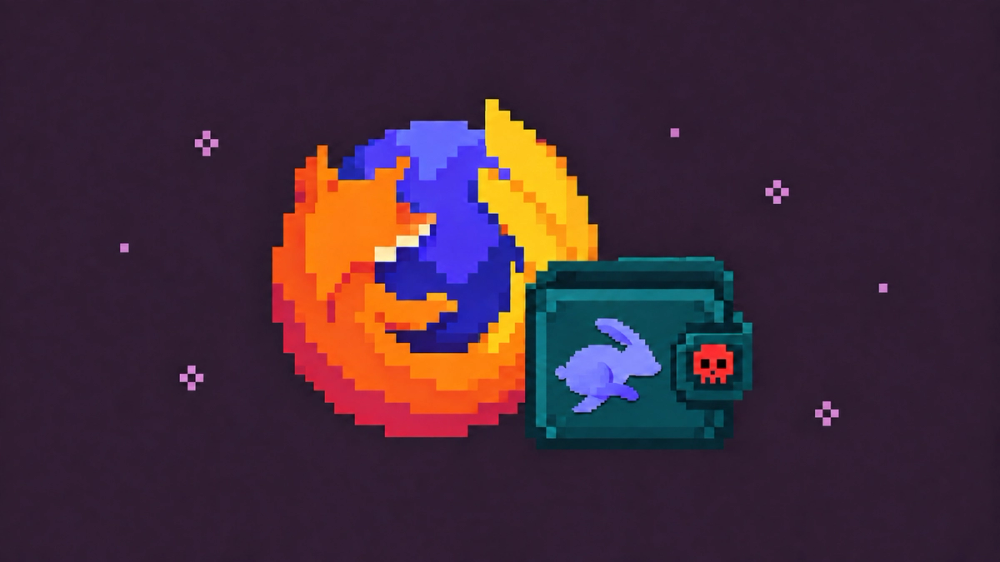 16 Malicious Firefox Extensions Steal Cryptocurrency Wallet Credentials
Socket Threat Research uncovered a coordinated campaign of 16 malicious Firefox extensions split into a Rabby Wallet clone family (4 extensions, full repackaged Rabby codebase) and an OKX Wallet-impersonating "Portal WALLET" family (12 extensions), all hooking wallet import flows to steal mnemonic seed phrases and private keys and exfiltrate them via GET/POST/sendBeacon to attacker-controlled Cloudflare Workers endpoints under the icy-star-f45c.workers.dev namespace. The writeup includes campaign markers (EQOx7EIPZSNi), background.js SHA-256 hashes, extension IDs/XPI hashes, and ties the activity to a prior August 2026 crypto-theft extension campaign Socket tracked, plus concrete detection and incident-response guidance.
 socket.devwriteupPublished and added 7 Oct 2026🛡️ Security
 CITRIX 0-DAY EXPLOITS: CVE-2026–88771 & CVE-2026–88772 IN THE WILD
An incident-response style deep dive into active in-the-wild exploitation of Citrix NetScaler ADC/Gateway via CVE-2026-88771 (unauthenticated RCE through log-poisoning of ns_monuploadd_err.pl) and CVE-2026-88772 (DTLS memory overflow), part of 8 CVEs disclosed by Citrix on September 27, 2026. The author reverse-engineers the full post-exploitation toolkit dropped after root is obtained: SLAPSHOT (a Perl/Python loopback TCP tunneler/pivot), WHIPSHOT (a disguised PHP web shell served via fake CSS paths), the Platypus C2 agent, and a Perl "Pitboss" dropper script (with full decoded source and an embedded SHA-256-protected PHP web shell) that creates a rogue superuser, SUIDs /bin/sh, exfiltrates NetScaler config, and patches httpd.conf for persistence. It closes with extensive IOCs (C2 IPs, file hashes, paths, credentials) and patch guidance for affected NetScaler builds.
 theravenfile.comwriteupPublished and added 6 Oct 2026🛡️ Security
- K-LMS: Design, Implementation, and Evaluation of Leighton–Micali Signatures with Korean Cryptographic Primitives
An IACR ePrint paper presenting K-LMS, an experimental variant of the NIST-standardized LMS hash-based post-quantum signature scheme in which the underlying hash is swapped for Korean primitives: the LSH-256 hash function (reference and vectorized) and a Tandem-DM double-block-length construction built from the CHAM, LEA, and ARIA block ciphers. The authors implement a non-invasive backend-swapping bridge over the reference LMS code and benchmark keygen/sign/verify latency, key/signature sizes, memory, and parameter sweeps, finding that hash substitution doesn't change key/signature sizes but that two measurement pitfalls (hash dispatch overhead, and software vs. hardware-accelerated SHA-256 baselines) can shift performance comparisons by an order of magnitude or 6x respectively. They report LSH-256 K-LMS signing on par with SHA-256 LMS in software, and 3.3-3.9x faster than a prior K-XMSS implementation because LMS needs fewer hash calls per Winternitz step than XMSS.
eprint.iacr.orgpaperAdded 8 Oct 2026, published 6 Oct 2026🛡️ Security  Active Supply Chain Attack: Malicious node-ipc Versions Published to npm
StepSecurity's AI Package Analyst detected three malicious node-ipc versions (9.1.6, 9.2.3, 12.0.1) published simultaneously on May 14, 2026 by a rogue/compromised maintainer account, injecting an 80KB obfuscated IIFE into the CommonJS bundle that harvests 90+ credential file categories (AWS, Azure, GCP, SSH, Kubernetes, GitHub, Claude AI/Kiro configs, Terraform, etc.) and exfiltrates them via HTTPS and raw DNS TXT queries to a typosquatted Azure-mimicking C2 domain. The writeup includes a full stage-by-stage technical teardown (daemonization, SHA-256 targeting gate on 12.0.1, custom base-16 nibble-reversed obfuscation, dual-channel exfiltration) plus file hashes, network IOCs, and remediation guidance for developers and CI/CD pipelines.
 stepsecurity.iowriteupAdded 5 Oct 2026🛡️ Security
 Malicious Crypto Shell Packages Target RubyGems
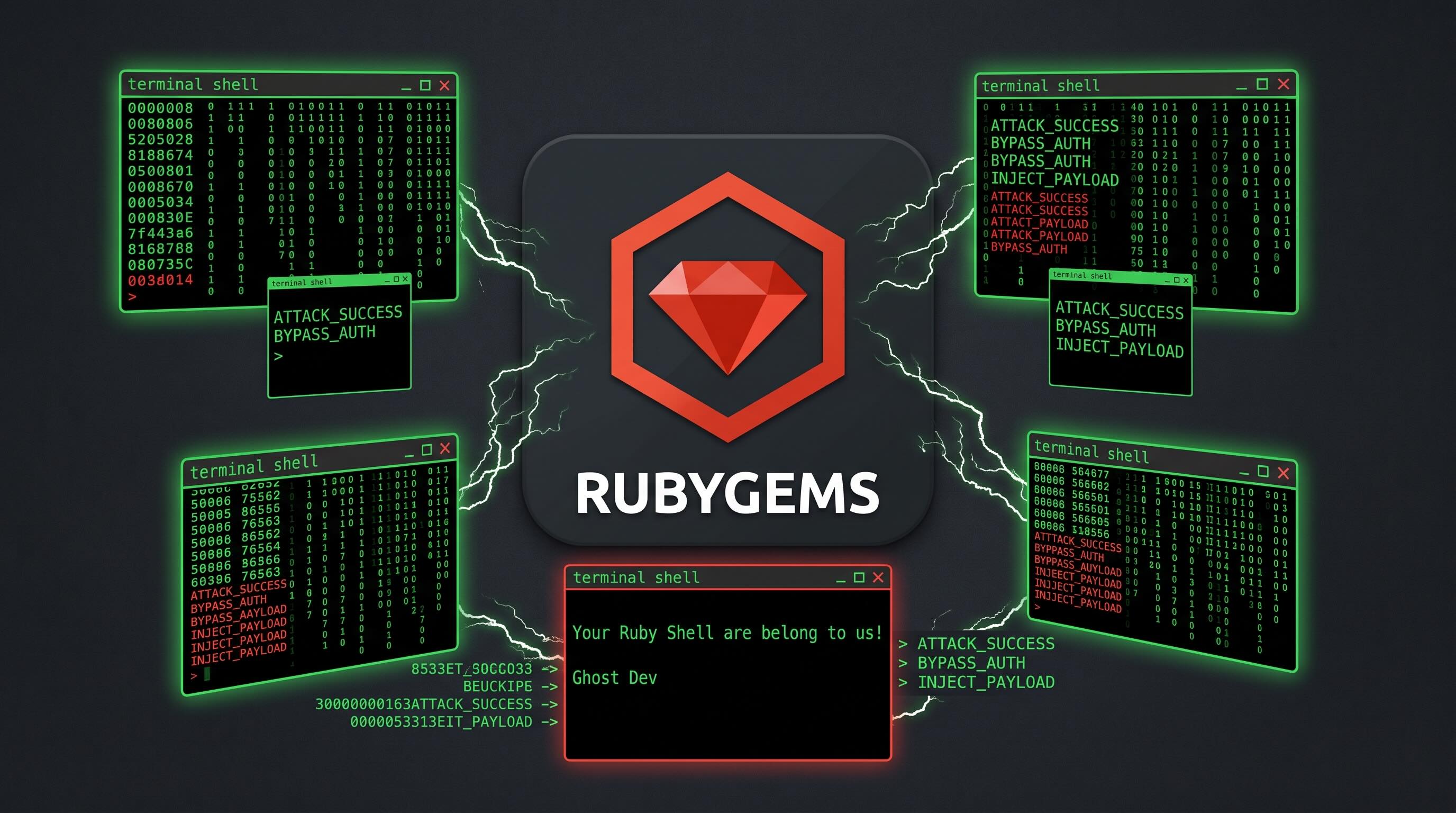
OpenSourceMalware's analysis of over 40 typosquatted RubyGems packages (e.g. rubygems-btc-shell) published by a user calling themselves "Ghost Dev," targeting crypto/web3 developers. The packages ship a delayed-execution payload hidden in extconf.rb that evades sandboxes before either opening a reverse shell to 45.138.12.177:8090 or deploying a full theft kit (inject_proxy.py, _grab.py, a browser extension, and a rogue root CA) that MITMs TLS traffic to 28+ crypto exchanges, swaps withdrawal addresses, hijacks the clipboard, and harvests wallet files, seed phrases, and private keys. The writeup includes full IOCs, SHA-256 hashes, attacker wallet addresses, and C2 endpoints.
 opensourcemalware.comwriteupPublished and added 5 Oct 2026🛡️ Security
- Jan Curn (@jancurn) on X
Announcement of mcpc v0.7.0, Apify's open-source MCP CLI client (npm i -g @apify/mcpc), which adds support for the MCP Skills extension with new skills-list/skills-get commands that verify SKILL.md and supporting files against the skill manifest via size and SHA-256 checks before printing content. The release also ships security hardening: repo-local .mcp.json auto-discovery can no longer read environment variables (blocking leaks like $GITHUB_TOKEN), OAuth refresh tokens are now scoped only to the auth server originally used, and Windows login URLs no longer launch through cmd.exe.
x.comthreadAdded 5 Oct 2026, published 3 Oct 2026🛡️ Security - Jan Curn (@jancurn) on X
Jan Curn announces mcpc v0.7.0, an open-source MCP CLI client (npm package @apify/mcpc), adding support for the MCP Skills extension via new skills-list and skills-get commands that fetch and cryptographically verify SKILL.md and supporting files against the skill manifest (size + SHA-256). The release also hardens security by preventing repo-local .mcp.json auto-discovery from reading environment variables (blocking token-leak tricks), scoping refresh tokens to the originating auth server, and fixing an insecure Windows login URL launch path via cmd.exe, alongside OAuth session longevity fixes and 2026-07-28 MCP spec compatibility improvements.
x.comthreadAdded 5 Oct 2026, published 3 Oct 2026🧠 AI - Andrea (Drego) Draghetti 👨🏻💻 🎣 (@AndreaDraghetti) on X
Tosint v1.0.0 is an open-source Telegram OSINT tool for analyzing bots and chats, exporting message history and media. The new release adds richer JSONL metadata output, optional SHA-256 hashing of exported media, bot/user authentication support, and an automatic fallback from MTProto-based history retrieval to ID-scan mode when dealing with restricted chats.
x.comrepoAdded 2 Oct 2026, published 30 Sep 2026🛡️ Security - CassiopeiaCode/CosyRedactGateway
Cosy (CosyRedactGateway) is a Node.js gateway that sits between programmers' LLM clients and OpenAI or Anthropic APIs. It replaces credentials found in JSON request text with reversible SHA-256-based placeholders, using high-entropy scoring, structured detectors and Gitleaks-compatible rules, and restores them in responses, SSE streams and tool arguments. It runs on Cloudflare Workers, Deno or locally, and documents its limits: auth headers are still forwarded, and misses are possible.
 github.comrepoAdded 19 Oct 2026, published 11 Sep 2026🛡️ Security
- CassiopeiaCode/CosyRedactGateway
Cosy (CosyRedactGateway) is a local-first LLM credential redaction gateway. It replaces secrets in request JSON with reversible SHA-256 placeholders before forwarding to OpenAI or Anthropic upstreams, then restores them in responses, SSE streams and tool-call arguments. Detectors cover high-entropy strings, structured patterns and Gitleaks-compatible rules. It runs on Node.js, Cloudflare Workers or Deno, with an offline demo script and a documented list of limits.
github.comrepoAdded 19 Oct 2026, published 11 Sep 2026🧠 AI - Numbat
Numbat is a Go-based, single-binary endpoint agent from Perplexity AI that gives visibility into AI coding-agent activity (Claude Code, Codex, OpenClaw, and other CLI/IDE/gateway agents) by capturing events through local hooks, OTLP/HTTP logs, and on-disk session artifacts. It normalizes activity into one event model, evaluates it with a local CEL rule engine (including multi-step sequence rules like secret-read-then-egress), and can optionally block matched actions via synchronous pre-action hooks (deny/monitor decisions), with case bundles and SHA-256 manifests for forensic reconstruction. Example built-in rules detect cloud-metadata SSRF requests (169.254.169.254) and credential-exfiltration chains, mapped to MITRE ATT&CK technique tags.
github.comrepoPublished and added 5 Sep 2026🛡️ Security  Rust Supply-Chain Attack: arrayref, internment, and append-only-vec Poisoned by the proc-macro1 Build-Time Dropper
StepSecurity's forensic writeup on a compromised crates.io maintainer account that published poisoned releases of arrayref (245M downloads), internment, and append-only-vec, each pulling in proc-macro1, a typosquat of proc-macro2 impersonating David Tolnay whose build.rs silently drops and executes a cross-platform stage-2 payload at compile time. The attacker also mass-yanked clean arrayref versions to funnel Cargo's "yanked" warning toward the one poisoned release, and StepSecurity reproduced the attack in GitHub Actions with Harden-Runner, capturing the C2 callback to 23.254.165.112:9089 and demonstrating automatic blocking via a global IOC block list. The post includes the full attack timeline, dropper base64-obfuscated URL scheme, SHA-256 hashes, C2 IOCs, and remediation/detection guidance for lockfiles and CI caches.
stepsecurity.iowriteupAdded 3 Sep 2026, published 22 Aug 2026🛡️ Security Socket: "Offside Wallet Theft Factory"
Socket's Threat Research team tracked 77 linked Firefox extension identities in a campaign dubbed "Offside Wallet Theft Factory": 40 are confirmed malicious (impersonating OKX, Rabby Wallet, TronLink and others) and 37 are deceptive sports-score shell extensions later repurposed into wallet stealers. Techniques include Supabase-controlled remote phishing switches, Cloudflare Worker exfiltration of recovery phrases, modified Rabby Wallet code that exfiltrates serialized keyrings via persistAllKeyrings() before local encryption, and hardcoded C2 servers stealing credentials and clipboard data. The post includes full SHA-256/IOC listings and shows how extension identities are repurposed over version history from benign utilities into wallet-draining malware.
socket.devwriteupPublished and added 19 Aug 2026🛡️ Security Windows Infostealer Hits npm and Ruby
Follow-up analysis showing that the RubyGems StubMaker typosquatting campaign and a separately-discovered 40-package npm typosquatting campaign (targeting chalk, commander, lodash, typescript, react, axios) are run by the same threat actor: both use install-time hooks (extconf.rb vs postinstall.js) to fetch a Rust loader from the same GitHub release, which decrypts a byte-for-byte identical Go infostealer confirmed by matching SHA-256 hashes. The stealer harvests browser credentials (bypassing Chromium app-bound encryption), crypto wallets/seed phrases, and Telegram data, exfiltrating via Gofile to a webhook at dresslee.com, and includes WSL-to-Windows sandbox escape logic. The post publishes full network/file IOCs and hashes and argues network-layer blocking (C2 IP and webhook domain) is more durable than package-name blocklisting.
opensourcemalware.comwriteupAdded 3 Sep 2026, published 19 Aug 2026🛡️ Security- hackingtool
hackingtool is a console launcher that bundles 215 curated security tools across 21 categories (recon, OSINT, wireless, phishing, forensics, post-exploitation) so users can install and run them without hunting down individual Git repos. Its newer AI layer maps plain-English goals to the right tool and exact command, plans multi-step objectives with confirmation gates, and drafts engagement reports, while emphasizing safe installs (pinned/SHA-256-verified downloads, no curl|bash, list-form subprocess calls, signed releases with SBOM) and refusing out-of-scope asks like DoS or mass-targeting. It also ships a non-interactive orchestrator (`--engagement`/`--pipeline`) that normalizes tool output into findings.json for red team, blue team, OSINT, bug bounty, and DFIR workflows.
github.comrepoAdded 3 Sep 2026, published 31 Jul 2026🛡️ Security - OpenNVR
OpenNVR is a self-hosted, Docker-deployed network video recorder for ONVIF/RTSP IP cameras that is explicitly designed around a "sovereign, air-gapped by default" security architecture: network isolation between camera/gateway/analytics planes, Fernet-encrypted credentials at rest, RTSPS transport, and two default-deny gates (DEPLOYMENT_MODE=offline, AI_SOVEREIGNTY=local_only) that keep cloud and AI egress returning HTTP 403 until explicitly opened. It's positioned as a response to systemic IP-camera weaknesses (default creds, hard-coded keys, unsigned firmware, vendor cloud aggregation) exploited historically by the Mirai botnet and the 2021 Verkada camera-feed breach, and targets regulated buyers newly barred from Hikvision/Dahua/Uniview/Edimax-class vendors under NDAA §889 and 2025-26 FCC enforcement. Its pluggable AI Adapter Contract (Apache-2.0 SDK) lets third parties add detection/LLM capabilities out-of-tree, with correlation-ID audit trails and SHA-256 model fingerprinting for compliance evidence.
github.comrepoPublished and added 18 Jul 2026🛡️ Security  KUDANKULAM NUCLEAR POWER PLANT LEAK: AN ACCIDENTAL DISCLOSURE
An OSINT investigator analyzes a WorldLeaks ransomware group data leak of Reliance Infrastructure (hosted by third-party vendor Yotta), which exposed 14.3GB / ~19,000 files related to India's Kudankulam Nuclear Power Plant (KNPP) — including RFC drawings, PPS fencing designs, HVAC/fire specs, and vendor/employee records. The piece profiles WorldLeaks (a Hive/Hunters International spin-off), lists MD5/SHA-256 hashes for its RustyRocket exfiltration tool, and discusses supply-chain vendor risk, industrial espionage by nation-state actors (Lazarus/DPRK, China), and insider credential trading as threats to critical nuclear infrastructure.
theravenfile.comwriteupAdded 3 Sep 2026, published 17 Jul 2026🛡️ Security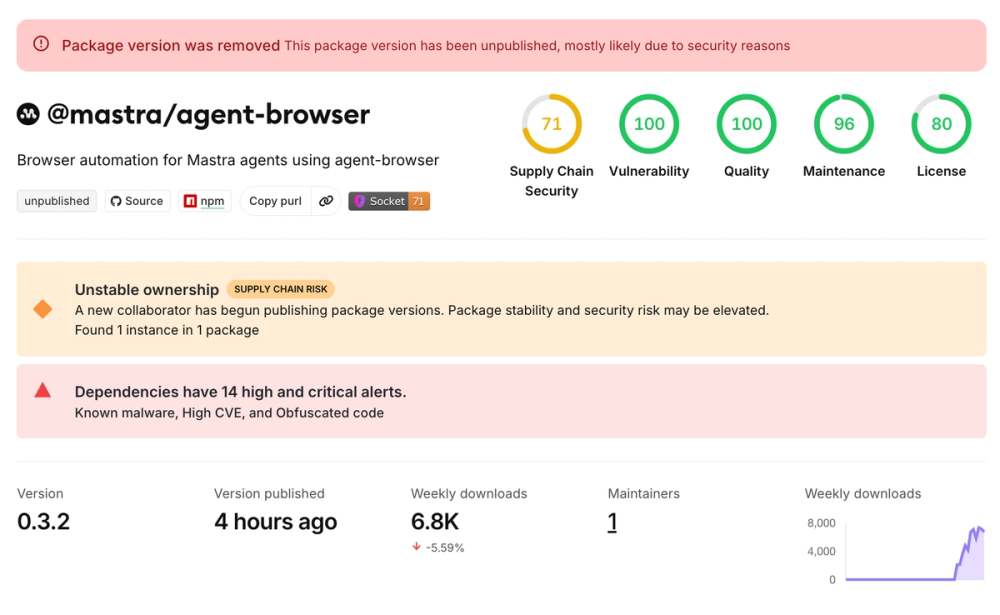 Socket: 141 Mastra npm Packages Compromised via Typosquatted Dependency
Socket's research team documents a supply chain attack in which npm account "ehindero" mass-published 141 malicious versions of @mastra/* packages (including @mastra/core, 918K weekly downloads) that were byte-identical to legitimate code but added a single new dependency: the typosquatted package easy-day-js. That package's postinstall hook (setup.cjs) disables TLS validation, fetches a second-stage cross-platform Node.js implant (protocal.cjs) that installs OS-specific persistence (Windows Run key, macOS LaunchAgent, Linux systemd unit disguised as Node/NVM tooling), inventories 166 cryptocurrency wallet browser extensions, steals Chrome/Edge/Brave history, and accepts arbitrary remote tasking (Node/Shell runners) from a hardcoded C2 over a custom ICAP-style protocol. The writeup includes full IOCs, SHA-256 hashes, and remediation guidance (rotate npm/CI/SSH credentials, treat affected hosts as compromised, disable install scripts).
socket.devwriteupPublished and added 20 Jun 2026🛡️ Security DECODING GRIXBA — A PLAY RANSOMWARE SCANNER
A side-by-side reverse-engineering analysis of four Grixba samples (v1 through v3, Sept 2022 to Nov 2024), the custom .NET infostealer/network scanner built by the Play ransomware group to map security tools, credentials, and remote-management software before encryption. The piece traces the binary growth from 164KB to 727KB (adding XOR-encrypted inf_g.dll, SQLite-based ExportData.db output, forged SentinelOne PE metadata, and PIA VPN C2) then its deliberate regression to 118KB to shed public IOCs, backed by MITRE ATT&CK sandbox findings, a shared mutex fingerprint, a weakness scorecard per version, and a full SHA-256/IP/onion IOC table.
theravenfile.comwriteupAdded 3 Sep 2026, published 8 Jun 2026🛡️ Security