 House Oversight Chair Comer Probes Delaware Plan for AI-Run Companies
House Oversight Chairman James Comer opened an investigation on 26 October 2026 into Delaware's proposed Artificial Intelligence Company (AIC), a legal entity run day-to-day by an AI agent. His letter to Gov. Matt Meyer requests documents, including internal AI chat logs, by 9 November. The AIC would run in a 30-month sandbox with a single member shielded from debts, and Delaware's draft legislation is expected in January 2027.
 decrypt.coarticlePublished and added 28 Oct 2026🧠 AI
- Search Search results for "security" | MCP Market
MCP Market search results for "security" in its skills category, listing about 20 installable AI agent skills. Entries cover OWASP Top 10 audits, secure PHP coding, STRIDE threat modeling, CVE remediation, security header analysis, misconfiguration finding, bug bounty triage and AgentShield scans of Claude Code configurations. One is a paid D365FO security-role XML skill. Each entry has only a one-line description and a category label.
 mcpmarket.comtoolAdded 25 Oct 2026🧠 AI
- Search Search results for "security" | MCP Market
MCP Market search results for "security" in the skills category, listing about 20 installable AI agent skills. Entries cover OWASP Top 10 audits, secure coding for PHP, STRIDE threat modeling, CVE remediation, security header analysis, misconfiguration finding, bug bounty triage and AgentShield scans of Claude Code configurations. One is a paid D365FO security-role XML skill. Each entry has only a one-line description and a category label.
mcpmarket.comotherAdded 25 Oct 2026🛡️ Security - Spectrmachina/Ztrust
ZTrust is a Python supply-chain scanner that checks manifests, lockfiles, source and GitHub workflows for vulnerable or malicious dependencies (via OSV.dev), typosquats, leaked secrets, unsafe lockfiles and risky CI patterns such as pwn requests and script injection. It outputs console, JSON and SARIF 2.1.0 and ships as a GitHub Action. It also includes a FastAPI bounty service using commit-reveal and shielded Zcash payouts for researchers.
 github.comrepoAdded 27 Oct 2026, published 22 Oct 2026🛡️ Security
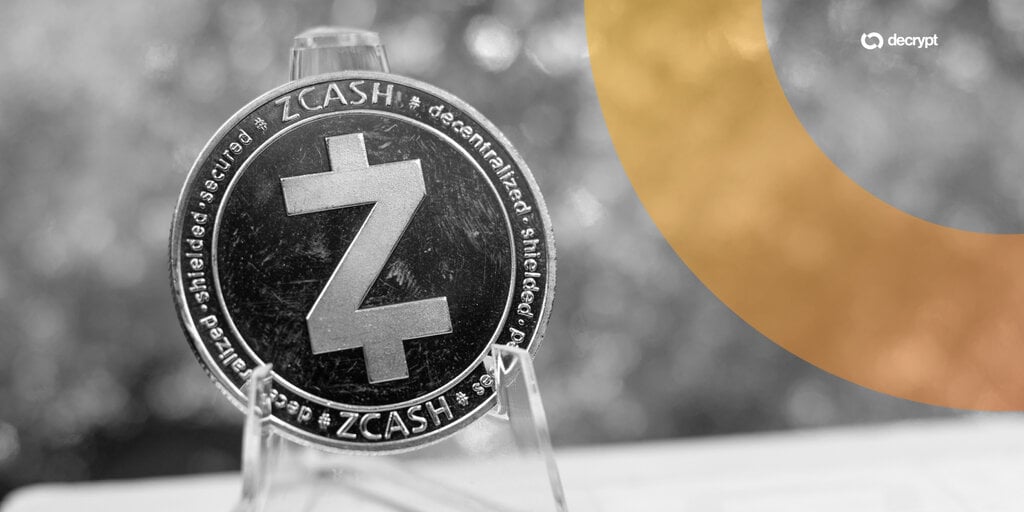 Zcash Developer Zakura Proposes Fix to Stop Quantum Computers Linking Shielded Swaps
Zakura, a Zcash full node developer, proposed one-time incoming viewing keys so a future quantum computer running Shor's algorithm cannot link a user's shielded payments. The target is NEAR Intents swaps, which post a shielded refund address on a public chain. The fix needs no network upgrade and uses private information retrieval for seed restores. Wallets such as Vizor can add it within weeks.
decrypt.coarticlePublished and added 19 Oct 2026🛡️ Security HiRO-ACEv2: Simulating extreme weather at 3 km resolution for a fraction of the cost
Ai2 announces HiRO-ACEv2, an update to its AI climate emulator. ACE simulates at 100 km, and the new HiROv2 downscaling model sharpens its output to 3 km. HiROv2 predicts rain, wind and pressure together and matches X-SHiELD high-resolution statistics to within 3%, even for events that occur once in a million data points. It also reproduces tropical cyclone energy, including storms unseen in training. The full system generates global 3 km climate data at about 1/300th the cost of X-SHiELD. Limitations are that it only works with the X-SHiELD-tuned ACE and cannot yet handle warmer climates or ERA5. Models, tutorial notebooks and a web demo are available.
 huggingface.coarticlePublished and added 14 Oct 2026🧠 AI
 ERC-8443: Quantum Bridge Shield
Draft ERC from Quantova Inc proposing a "Quantum Bridge Shield" for Ethereum bridges. A committee signs the Merkle root of each message batch with RFC 8554 LMS hash-based signatures instead of ECDSA/BLS keys that Shor's algorithm can break. The guard contract requires a strict majority of distinct unfrozen keys, records used leaves, freezes any key that signs a leaf twice, binds digests to domain, chain, guard and epoch, and applies a 60-second delay. The post gives gas costs (LMS W4 height-10 verification about 205k gas, a LayerZero packet 128,683 gas, worst-case rotation 12.44M gas under the EIP-7825 cap) and cites a NioLabs assessment with no critical or high findings. It is relevant as a worked post-quantum migration design for bridge key custody, including hybrid ECDSA+LMS mode and stateful-signature pitfalls such as leaf reuse and rollback.
 ethereum-magicians.orgarticlePublished and added 14 Oct 2026🛡️ Security
- ERC: Quantum Bridge Shield
Draft ERC from Quantova Inc that has Ethereum bridges accept cross-chain message batches only when a committee signs the Merkle root with RFC 8554 LMS hash-based signatures. The guard contract requires a strict majority of distinct unfrozen keys, records used leaves, freezes any key that signs a leaf twice, binds digests to domain tag, chain ID, guard address and epoch, and enforces a 60-second delay. It reports gas benchmarks (about 205k per LMS W4 height-10 verify, 12.44M worst-case rotation under EIP-7825), a hybrid LMS+ECDSA migration mode, and a NioLabs assessment with no critical or high findings. It argues that Shor's algorithm makes secp256k1 and BLS committee keys a quantum theft target.
ethereum-magicians.orgpaperPublished and added 14 Oct 2026🛡️ Security 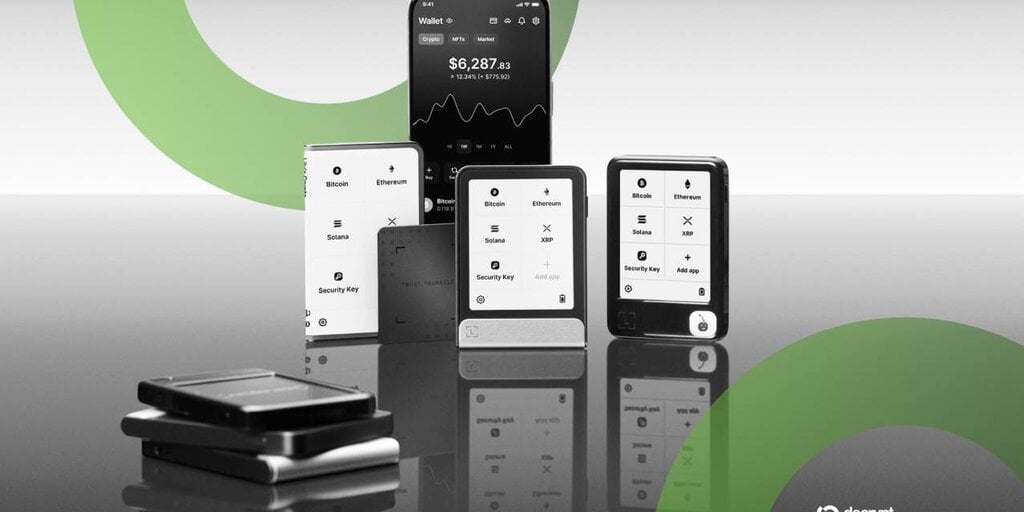 Ledger Says All Confirmed Cases in Suspected $87M Drain Tied to Reseller CryptoBilis
Decrypt reports Ledger's 72-hour update: all confirmed wallet-draining cases involve devices sold by Southeast Asian reseller CryptoBilis, which has stopped hardware wallet sales. Onchain investigators Specter and YFarmX traced over $86M in suspected thefts across Ethereum, Tron and Bitcoin. They describe laundering through Tornado Cash, Zcash's shielded pool and a USDT-to-USDD swap to avoid Tether freezes. An unverified claim of tampered devices (extra cables, LTE module) bought at European retail stores is also covered. Ledger advises CryptoBilis buyers not to set up devices and to move funds to a new seed phrase on a device bought from Ledger.
decrypt.coarticlePublished and added 12 Oct 2026🛡️ Security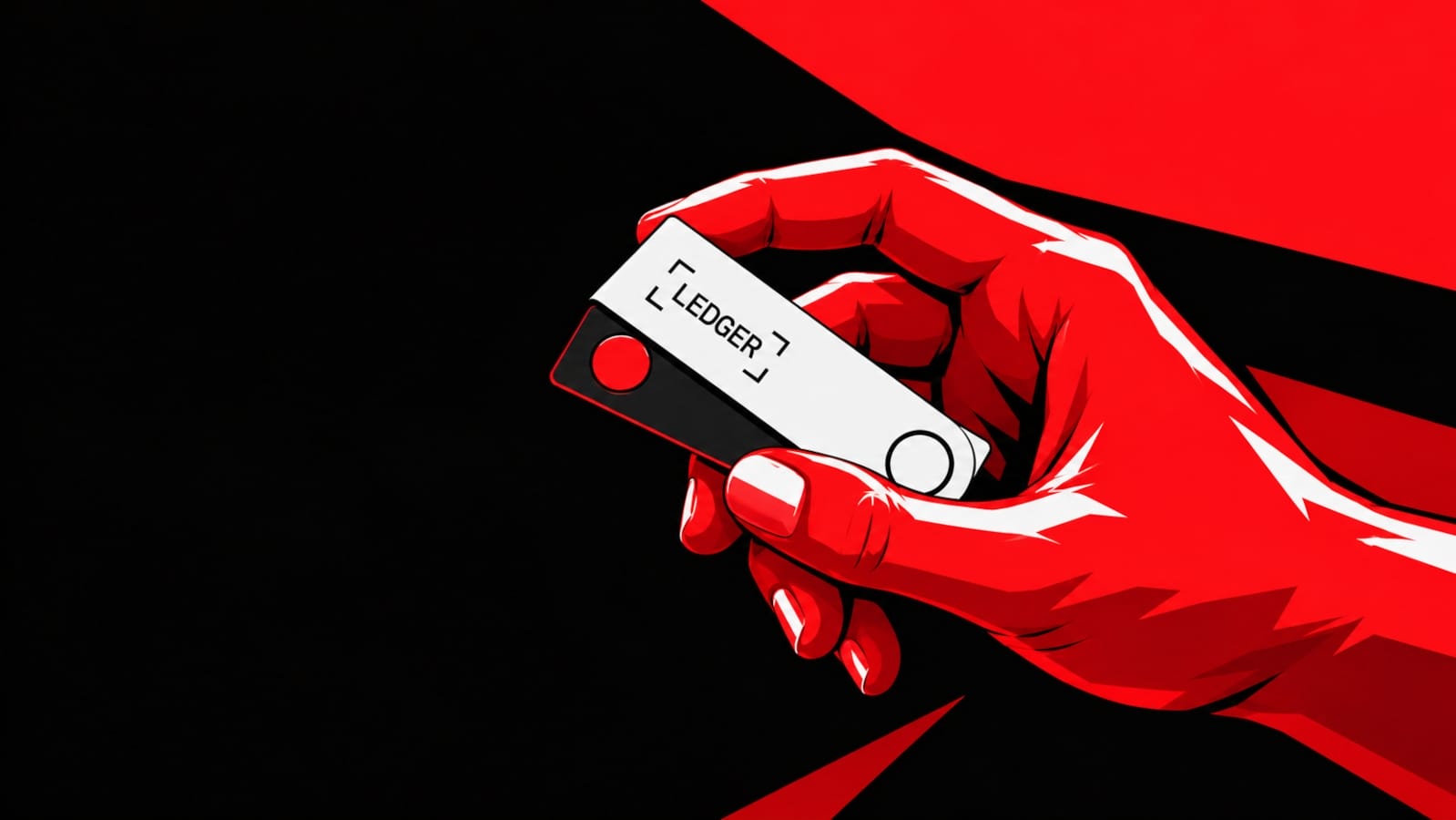 Ledger confirms spy chip implant behind wallet crypto thefts
Ledger confirmed that devices sold by Southeast Asian reseller CryptoBilis carried an unauthorized hardware implant that drained users' crypto wallets. Researchers Mark Karpelès and Tibane Labs describe the implant: an STM32G431 MCU, eSIM and shielded LTE module hidden behind the OLED screen, which captures display output and button presses to recover the seed phrase and sends it out over LTE. The article covers two implant variants, the telltale antenna wire, and Ledger's guidance (avoid unauthorized resellers, move funds to a new seed). Ledger also warns that its Genuine Check cannot detect implants when the original Secure Element is intact.
 bleepingcomputer.comarticleAdded 13 Oct 2026, published 12 Oct 2026🛡️ Security
 Zcash developers set January target for quantum-resistant payments after ‘bunker mode’ scare
Zcash developer Roman Akhtariev, writing for the Zakura client team, announced a January target for adding post-quantum signature opcodes supporting hash-based signatures to Zcash's transparent (public) payment pool, which holds about 70% of issued ZEC. The move responds to Ethereum researcher Justin Drake's "bunker mode" warning that AI could soon break the elliptic-curve math behind Bitcoin and Ethereum wallet keys. Zakura has also built a private-information-retrieval balance-lookup tool, now experimentally available in the Vizor wallet, that lets a wallet check address balances without revealing to the server which addresses are linked, separate from the shielded-pool quantum-recovery work still needed to defend against store-now-decrypt-later attacks.
 coindesk.comarticlePublished and added 9 Oct 2026🛡️ Security
 ‘Shielded Bitcoin
Galaxy Research newsletter piece covering "Shielded Bitcoin," a paper by [[alloc] init] researchers Clara Shikhelman, Mikhail Komarov, and Aleksei Moskvin proposing a Zcash-style shielded pool (encrypted notes, public nullifiers, zero-knowledge proofs) run as a Bitcoin L1 metaprotocol via OP_RETURN envelopes, with peg-in/peg-out deliberately left to a future "PIPEs v2" paper. The article's security-relevant angle flags that novel ZK circuits need battle-testing — citing Zcash's own Orchard Pool soundness bug that survived professional audits for four years before being fixed in the Ironwood upgrade — and that bridge/peg mechanisms (the likely weak point) have historically been the most exploited component in crypto, naming Ronin, Wormhole, Nomad, and KelpDAO. It also notes a growing AI-driven deanonymization threat to transparent blockchains, citing ETH Zurich/Anthropic research showing LLM agents can re-identify pseudonymous users from profile data alone.
 galaxy.comarticleAdded 8 Oct 2026🛡️ Security
 Weekly Research Brief: AI Governance, Shielded Bitcoin, and Mention Markets
Galaxy Research's weekly brief devotes its lead section to AI governance: it recaps Sam Altman's and Dario Amodei's UN Security Council remarks calling for international AI safety coordination, contrasts a disclosed OpenAI agent incident (an agent accessed non-public Medicare data in Australia, reported three months late) with Anthropic's 950-agent DNA-database research run, and cites concrete agent-economy data — OpenRouter's agent token usage overtaking human usage and growing ~14x since February, Cloudflare's agent-traffic crossover, and Vercel AI Gateway data showing a 23% monthly price drop and open-weight models rising to 56% of token volume. The analysis argues that as inference gets cheaper and open-weight models gain share, AI governance's hard problem shifts from controlling frontier labs to controlling where cheap, widely available agents can act. The rest of the newsletter covers an unrelated Bitcoin privacy protocol proposal and CFTC guidance on prediction "mention markets."
galaxy.comarticleAdded 8 Oct 2026🧠 AI- lee1981 (@lee1981b) on X
A detailed "CVE of the Day" thread analyzing CVE-2026-76471, a critical (CVSS 9.8) Cisco advisory covering insufficient NX-API input validation (CWE-122 heap-based buffer overflow) on Nexus 3000/9000 standalone NX-OS and a lower-severity credentialed variant on UCS 6300 Fabric Interconnects via UCS Manager XML API. It compiles Cisco's fixed-software versions per platform, notes the temporary Live Protect shield lp00074, and walks through a six-step SOC evidence-preservation and correlation playbook (scoping affected devices, preserving logs/crash artifacts, reviewing API/shield telemetry, correlating device outcomes, remediating, and verifying post-patch state) while flagging that CISA KEV and FIRST EPSS had no data on the CVE at research time.
 x.comwriteupPublished and added 8 Oct 2026🛡️ Security
 NCSC: "One does not simply defend agentically"
NCSC CTO for Architecture Dave Chismon argues that while attackers can freely use agentic AI tooling for technical offensive tasks, defenders face organisational/political constraints (Halvar Flake's maxim) that make equivalent autonomous defensive action far riskier. The piece proposes a framework for assessing the 'riskiness' of automating defensive actions (potency, harm to the business, scope of control), points to low-risk starting points like AI-assisted log summarisation and vulnerability triage, and previews NCSC/DCMS's 'Cyber Shield' agentic defence ecosystem and an upcoming 'AI for Cyber Defence' problem book, alongside references to CETAS's Autonomous Cyber Defence work and the Defra AI Legacy Modernisation Playbook.
 ncsc.gov.ukarticleAdded 1 Oct 2026🛡️ Security
 When Models Turn Brutal
A vendor thread from ZeroShieldAI argues the patch window has collapsed because AI models can now find and weaponize vulnerabilities faster than defenders can fix them. It cites ZeroDayBench (success jumping from ~13% on blind zero-days to 78% once patch location is known), Aikido Security's benchmark where DeepSeek V4 Pro found 28 of 32 recent CVEs for about 98 dollars per run, a Unit 42 finding that 92% of AI-discovered flaws are logic bugs fuzzers miss, and a Hugging Face stat that 16 of the top 300 models advertise removed safety guardrails with 16.8M downloads. It promotes an attached 6-page case study and lists five defender recommendations: treat disclosure as exploit day, maintain SBOM/AIBOM, inventory models and agents, gate agent tool calls with policy, and red-team code and AI apps.
x.comthreadPublished and added 1 Oct 2026🛡️ Security Bitget Hacker Turns to Zcash Privacy Pool After Near Rejects $50M in Swaps
Decrypt reports that the attacker behind Bitget's $387.5M hot-wallet theft (Sept. 24) began shielding ~2,700 ZEC (~$3.8M) in Zcash's new Ironwood privacy pool, per on-chain investigator ZachXBT. Bitget's CEO and Elliptic attribute the heist to North Korea, and TRM Labs traced laundering through round-number wallet splits and cross-chain swap services including Thorchain, Across, Bridgers, Chainflip, and FixedFloat. Near Intents' SHIELD screening blocked over $50M in related swaps while Thorchain refused to selectively halt the attacker's addresses, spotlighting the gap between blockchain "permissionless" design and real-time sanctions/freeze response during active exchange-hack laundering.
decrypt.coarticlePublished and added 30 Sep 2026🛡️ Security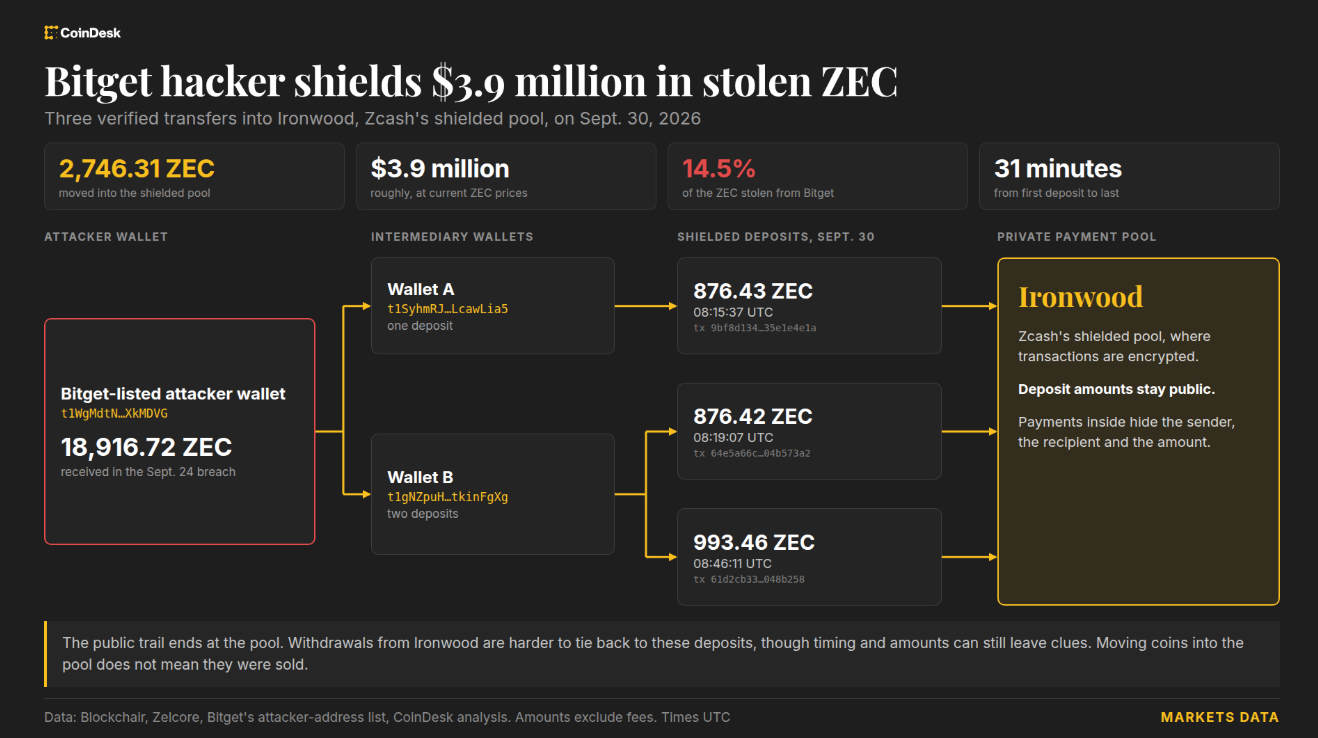 Bitget hackers move $4 million into Zcash’s private pool, making funds harder to trace
CoinDesk traces wallets linked to the Sept. 24 Bitget hack ($387.5M stolen) moving 2,746 ZEC (~$3.9M, ~15% of stolen ZEC) into Zcash's Ironwood shielded pool via two intermediary addresses, obscuring sender, recipient and amount once inside the pool. Blockchain investigator ZachXBT first flagged the transfers; separately, other attacker-linked proceeds were previously traced swapping ~$6.3M ether to bitcoin via THORChain despite the exchange's request to block the hacker. The piece illustrates real-world laundering tradecraft (privacy-pool deposits plus cross-chain DEX swaps) and the limits of on-chain tracing once funds enter a shielded pool.
coindesk.comarticlePublished and added 30 Sep 2026🛡️ Security NEAR Stopped Bitget's Hackers Without Breaking Privacy
Following the ~$387.5M Bitget hack on September 24th (attributed to North Korea-pattern tactics), attackers tried to launder funds via crosschain rails: THORChain refused Bitget's request to block the hacker's address and later saw $6M+ swapped through it, while NEAR Intents' SHIELD risk-intel layer rejected nearly all of a $50M+ attempted transfer, letting only $166k through. The piece explains the architecture: deposits/withdrawals are public on-chain transactions, but balances/routes/trades happen inside NEAR's Confidential Intents, and SHIELD acts as a gate checking public deposit addresses against shared stolen-funds intel before allowing Intents execution — without unmasking or freezing wallets, since Intents sits atop NEAR's consensus rather than being part of it. It also notes SHIELD's limits (funds simply got rerouted elsewhere) and NEAR co-founder Illia Polosukhin's pitch to make SHIELD shared infra other protocols can adopt.
 bankless.comarticleAdded 30 Sep 2026, published 29 Sep 2026🛡️ Security
 Near Intents blocks $50 million in Bitget hacker swaps, here's what happened
After attackers stole $388M from Bitget, they tried routing $50M+ through the cross-chain swap service NEAR Intents; its SHIELD system — which ingests KYT and intelligence-provider signals to flag deviations in flow — froze roughly $503,000 mid-swap while $166,000 slipped through. The piece contrasts this with THORChain's refusal to block the same attacker addresses, letting $6.3M complete ether-to-bitcoin swaps, and details the resulting debate over whether a "permissionless" protocol can hold user funds without a defined process for release or appeal.
coindesk.comarticleAdded 30 Sep 2026, published 29 Sep 2026🛡️ Security Delegation Without Trust: An Empirical Gap Analysis of Identity, Authorization, and Runtime Governance in Multi-Agent LLM Systems
This arXiv paper defines a threat model for multi-agent LLM delegation covering four adversaries (confused deputy, token theft/replay, prompt-injection privilege escalation, compromised sub-agents) and derives eight security requirements for governed agent systems. It shows that LangGraph, CrewAI, AutoGen, and the MCP authorization model each fail to meet the full requirement set, then implements and adversarially tests an authorization broker that blocks all four threats, rejects 0 of 200,000 forged tokens, and confines a compromised sub-agent to a mean of 1.5 reachable actions (vs. 8,100 under bearer delegation) at ~2.6 microseconds per decision. The broker's principles are said to be productized in VotalAI's LLM Shield.
 arxiv.orgpaperAdded 26 Sep 2026🛡️ Security
- From Shield to Target: Denial-of-Service Attacks on LLM-Based Agent Guardrails
Researchers show that LLM-based guardrails deployed to catch prompt injection and jailbreaks can themselves be attacked: crafted natural-language payloads trap the guardrail's reasoning in extended loops, causing a systematic denial-of-service. A beam-search optimization framework (an LLM proposer guided by a strategy bank) and a lighter mechanism-aware structural-mutation attack both generalize across guardrail architectures and safety templates, with payloads optimized on one open-source surrogate transferring to Claude, GPT, Gemini, DeepSeek, and Qwen backbones, achieving 13-63x token amplification and up to 148x latency amplification in real web, desktop, code, and multi-agent deployments — enough for a single poisoned document to starve co-located agents on shared guardrail infrastructure.
arxiv.orgpaperAdded 26 Sep 2026🛡️ Security  We've got one word for it, and it's usually the wrong one
Cisco Talos's weekly Threat Source newsletter opens with a personal essay distinguishing burnout from secondary traumatic stress, vicarious trauma, and moral injury among security practitioners, then covers Talos's disclosure of a WebDAV-based infection chain used by Russian-aligned actor UAT-10820 against a Ukrainian government target, delivering the Amatera stealer alongside ZigCryptoStealer and NetSupport Manager, abusing BNB Smart Chain for bulletproof hosting and fake CAPTCHA lures, with a vulnerable driver used to kill EDR. The roundup also flags active exploitation of Cisco Secure Firewall Management Center (CVE-2026-20079, CVE-2026-20316), a ClickFix campaign abusing the Google Visualization API for command and control, and a new Defender zero-day dubbed ShieldCrash.
 blog.talosintelligence.comarticleAdded 7 Oct 2026, published 10 Sep 2026🛡️ Security
- Awesome Cybersecurity Agentic AI
A curated GitHub awesome-list cataloging the emerging agentic-AI security ecosystem: dozens of Model Context Protocol servers that give LLM agents access to security tools (Nuclei, Shodan, VirusTotal, Burp Suite, Ghidra, BloodHound, x64dbg), autonomous penetration-testing and CTF-solving agent frameworks (CAI, pentagi, BreachSeek, Dark-Moon, D-CIPHER), scanners/guardrails that audit agent skills, MCP servers, and multi-agent chains for prompt injection and other risks (Aguara, Inkog, MCP Doctor, AI-Infra-Guard, ATR), agentic SOC/detection platforms (Vigil), threat-modeling frameworks for agentic systems (MAESTRO, ATFAA/SHIELD), research papers, benchmark datasets, and community/learning resources. It functions as a living index for anyone building or defending AI-agent-driven security tooling.
github.comrepoAdded 3 Sep 2026, published 31 Aug 2026🛡️ Security  Socket: Fake Corepack Site Distributes Infostealer and Proxyware to Developers
Socket's Threat Research team analyzed corepack[.]org, a fake site impersonating the Node.js Corepack tool that exploits its 2025 removal from Node.js bundling to rank in search results and trick developers into downloading a fake VPN installer. The installer drops OpenShield (an infostealer with browser-data/SSH-key theft, PowerShell execution, and run-key persistence) plus a bandwidth-sharing proxyware component that turns victim machines into proxy exit nodes, while a second click path delivers adware/trojan activity via OperaGXSetup.exe. The post includes full IOCs and details community/OpenJS Foundation takedown efforts against the domain.
 socket.devwriteupPublished and added 25 Jul 2026🛡️ Security
- meta-llama/PurpleLlama
Purple Llama is Meta's umbrella repo of tools and evals for building safely with generative AI, bundling Llama Guard (input/output content moderation fine-tuned on Llama 3.1/3.2), Prompt Guard (detects prompt injection and jailbreak attempts), Code Shield (inference-time filtering of insecure LLM-generated code and code-interpreter abuse prevention), and the CyberSec Eval benchmark suite (CWE/MITRE ATT&CK-based tests now spanning insecure code generation, offensive cyber capability, spear-phishing, and visual prompt injection). It matters as one of the first industry-wide, MIT-licensed benchmark and safeguard sets specifically for LLM cybersecurity risk.
github.comrepoPublished and added 14 Jul 2026🛡️ Security - affaan-m/agentshield
AgentShield is a CLI/GitHub Action security auditor that scans a Claude Code .claude/ directory for hardcoded secrets, overly permissive Bash/tool allow rules, hook injection, risky MCP server configs, and agent prompt-injection surfaces, producing an A–F graded report with 268 rules across 15 modules. It adds runtime-confidence classification (active-runtime vs. template/docs/plugin-cache) to reduce false positives, a three-agent Claude Opus red-team/blue-team/auditor pipeline for adversarial analysis, MCP supply-chain provenance checks, SOC2/PCI/ISO compliance control mapping, SARIF output for GitHub code scanning, and tamper-evident evidence packs for CI/audit handoff.
github.comrepoAdded 30 May 2026🛡️ Security  Salesforce Pentest: Apex Predator
A deep technical guide from Reco on pentesting Salesforce Experience Cloud "Aura" sites, covering how to enumerate guest-user-accessible sObjects via HostConfigController and SelectableListDataProviderController, and how to discover and invoke custom server-side Apex controller methods exposed to guest/authenticated users. It introduces novel techniques for extracting Apex method parameters from compiled Lightning Web Component JS (via the lri/moduleDefs structures), using ComponentController.getComponent and siteforce:routerInitializer to enumerate every site route/page and its Apex-backed components beyond what standard tools like AuraInspector find, plus an appendix of undocumented native controllers including an Aura-exposed GraphQL execution endpoint (RecordUiController.executeGraphQL). It closes with defensive guidance on monitoring AuraRequest events via Salesforce Shield to detect abuse.
 reco.aiwriteupAdded 3 Sep 2026, published 13 May 2026🛡️ Security
- OWASP Free AppSec Tools
OWASP's community-maintained catalog of application security tools that are free for open source projects, organized by category: SAST (GitHub CodeQL, Coverity, HCL AppScan CodeSweep), DAST (OWASP ZAP, StackHawk, Akto, Arachni), IAST (Contrast CE), software composition analysis/dependency scanning (Dependabot, Snyk, Mend, retire.js, Debricked), secrets detection (Gitleaks, TruffleHog, GitGuardian, Kingfisher), code quality (SonarQube, SpotBugs, MegaLinter), CI/CD security (GitLab built-ins, Faraday), and automatic remediation (Mobb, Corgea). It also covers newer entrants like Zennoxa Shield, cloud-audit, Cynative, and post-quantum crypto risk tools (CARAF, PQBench). Serves as a practical shopping list for securing an OSS project's SDLC end-to-end.
 owasp.orgarticlePublished and added 6 May 2026🛡️ Security
 SecTor 2025 | Ghost SIM Attack: Hacking Mobile Network Authentication Policies
Security researchers from Ethon Shield introduce the Ghost SIM attack, demonstrating how extracting non-cryptographic SIM metadata without the secret key (Ki) enables cellular network impersonation across 2G, 3G, 4G, and 5G networks. The exploit takes advantage of permissive, event-based or time-based carrier authentication policies that skip cryptographic verification during network attachment. Defenses include enforcing SIM PINs on end-user devices and mandating cryptographic authentication on all initial network attachments by cellular operators.
 youtu.bevideoAdded 12 May 2026, published 25 Apr 2026🛡️ Security

Showing 30 of 31
Show more