- https://portswigger.net/web-security-academy
Web Security Academy is PortSwigger's free online web security training. It is known to combine learning material with hands-on labs across web vulnerability classes such as SQL injection, XSS, SSRF, authentication flaws and request smuggling, and to be built around Burp Suite. The page had no extractable text, so this description comes from the URL and general knowledge of the site.
 portswigger.netcourseAdded 30 Oct 2026🛡️ Security
 Content Providers and the potential weak spots they can have | Oversecured Blog
Oversecured's Android security checklist for Content Providers covers insecure FileProvider path configs, path traversal via decoded Uri.getLastPathSegment(), mismatched readPermission/writePermission, proxying requests to more privileged providers, SQL injection across a shared database, and sensitive actions in providers. Each case has vulnerable manifest and Java code, an attacker PoC and remediation. Real cases from Google and Samsung devices are cited. The page text was truncated near the end.
 oversecured.comarticleAdded 29 Oct 2026🛡️ Security
 CVE-2026-101767: Critical Oracle EBS SQL Injection Actively Probed in the Wild
CVE-2026-101767 is a CVSS 9.8 unauthenticated SQL injection in Oracle E-Business Suite's Application Object Library, reachable through the /OA_HTML/AppsTCFServer servlet (GanttDataServer) and chainable to OS command execution. It affects versions 12.2.3 to 12.2.15 and was fixed in the October 2026 Critical Patch Update. Horizon3.ai found it, and Defused saw probing on honeypots on 27 October 2026. Interim mitigation is removing the servlet from the URL firewall allowlist.
 orca.securityadvisoryPublished and added 28 Oct 2026🛡️ Security
 Hackers Start Probing Fresh Oracle EBS Vulnerability
CVE-2026-101767 is a CVSS 9.8 unauthenticated SQL injection in the Application Object Library of Oracle E-Business Suite, patched in Oracle's October 2026 CPU and reported by Horizon3.ai. Defused decoys logged the first exploratory attempts on 27 October 2026, and the flaw could lead to remote code execution. The article recalls CVE-2026-46817 attacks in June and last year's Cl0p zero-day campaign against EBS.
 securityweek.comarticlePublished and added 28 Oct 2026🛡️ Security
 Attackers Exploit Third VeloCloud Orchestrator Zero-Day in Four Months
CVE-2026-114625 is a critical (CVSS 9.9) SQL injection in Arista's on-prem VeloCloud Orchestrator, exploited in the wild. Any authenticated user can gain superuser operator privileges. Releases before 5.2.3.18, 6.1.3.10 and 6.4.2.12 are affected, and hosted deployments are already patched. Attacks came from 74.82.197.86 and 38.54.50.151. It is the third exploited VCO zero-day in four months, after CVE-2026-16812 and CVE-2026-93952.
securityweek.comarticlePublished and added 23 Oct 2026🛡️ Security- Dark Web Intelligence (@DailyDarkWeb) on X
CVE-2026-114625 is a critical (CVSS 3.1 9.9) SQL injection in on-prem Arista VeloCloud Orchestrator, the SD-WAN management portal, covered in Arista Security Advisory 0199 of 22 October 2026. Any authenticated user, even the lowest Enterprise Read Only tenant role, can become a local superuser operator, and Arista says it is exploited in the wild. On-prem fixes are 5.2.3.18, 6.1.3.10 and 6.4.2.12; two attacker IPs are listed.
 x.comadvisoryAdded 24 Oct 2026, published 22 Oct 2026🛡️ Security
- SnailSploit/Claude-Red
claude-red is a library of offensive security skills for the Claude Skills system, each a SKILL.md file that loads on conversational triggers (for example, mentioning SQL injection loads offensive-sqli). Categories include web, Active Directory, cloud, mobile, exploit development, fuzzing, privilege escalation, post-exploitation and AI. It targets about 130 skills across 23+ categories, with an install script and sparse-checkout install per category. Built on Sahar Shlichov's offensive checklists, MIT licensed.
 github.comrepoAdded 22 Oct 2026🛡️ Security
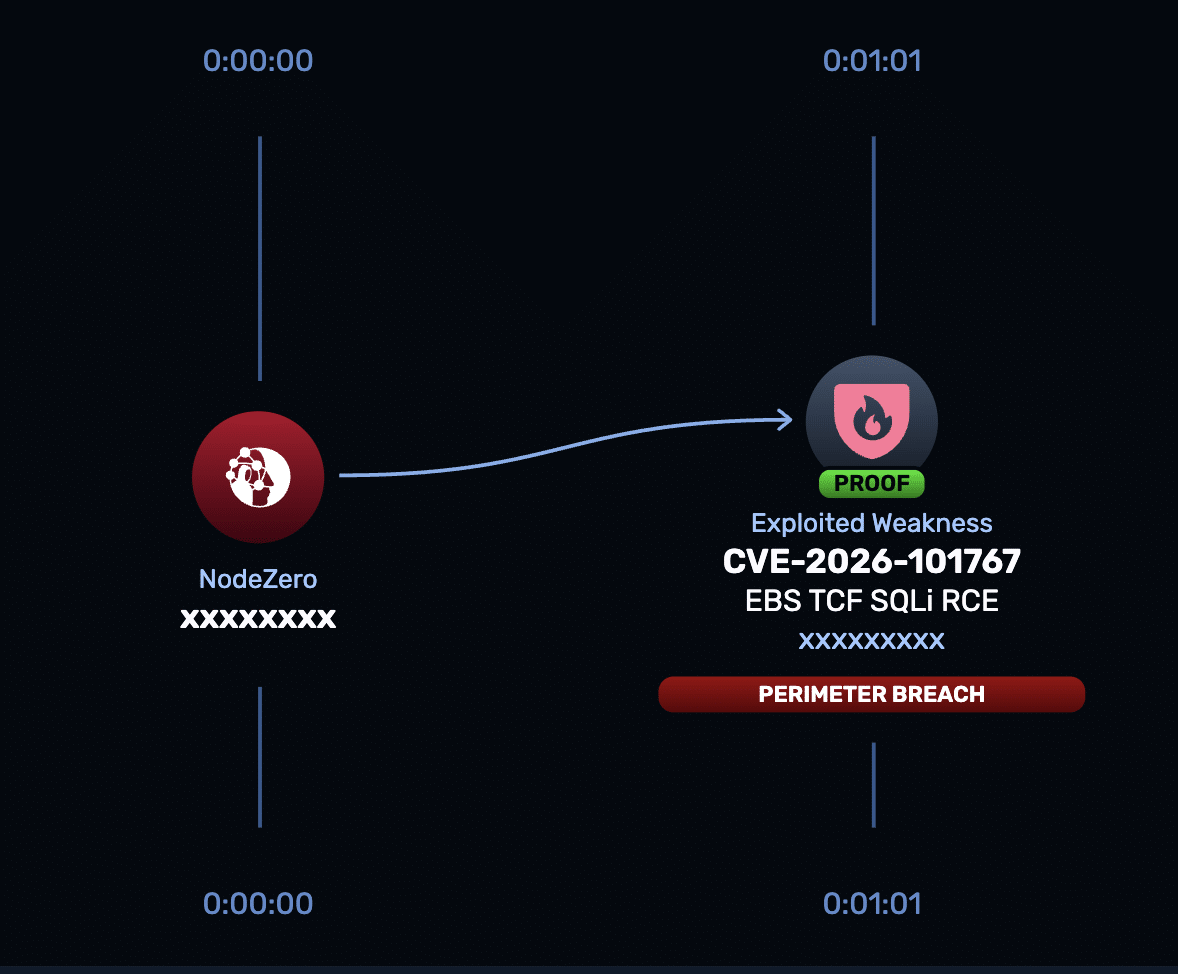 CVE-2026-101767 | Oracle E-Business Suite TCF SQL Injection and Remote Code Execution
CVE-2026-101767 is an unauthenticated SQL injection in the Oracle E-Business Suite Thin Client Framework servlet (/OA_HTML/AppsTCFServer, oracle.apps.fnd.tcf.SocketServer), CVSS 3.1 9.8. It runs SQL as the APPS user and chains to OS commands as the EBS account. Affects 12.2.3 to 12.2.15, fixed in the Oracle October 2026 CPU (20 October 2026). The page lists mitigations, IOCs and a timeline.
 horizon3.aiadvisoryAdded 29 Oct 2026, published 20 Oct 2026🛡️ Security
- gichirimaku/wp2shell-PoC
wp2shell-PoC is a Python proof-of-concept exploiting a pre-authentication RCE chain in WordPress core, combining CVE-2026-63030 (REST API batch route confusion) and CVE-2026-60137 (SQL injection in WP_Query). It demonstrates escalation from the route-desync bug through blind SQLi, customize_changeset forgery, and hook re-entry to administrator account creation and arbitrary command execution via a malicious plugin upload. The tool supports vulnerability checking, data extraction (union, error-based, blind techniques), and full shell access with or without existing admin credentials.
github.comrepoAdded 23 Oct 2026, published 15 Oct 2026🛡️ Security  Citrix, Fortinet, Ivanti Patch 29 Vulnerabilities Across Their Products
SecurityWeek summarizes Patch Tuesday-style releases from Citrix, Fortinet and Ivanti fixing 29 vulnerabilities. Highlights include critical FortiSIEM and FortiSandbox flaws (CVE-2026-106173 code execution, CVE-2026-107656 auth bypass), five SQL injection bugs across FortiAnalyzer, FortiManager and FortiMail, and Ivanti Connect Secure's exploited zero-day CVE-2026-104935 (two chained bugs compromising patched VPNs). Also covers critical Ivanti Neurons Patch for Intune (CVE-2026-109412) and Xtraction (CVE-2026-106042) issues and Citrix fixes in Workspace App, XenServer and UniconOS.
securityweek.comarticlePublished and added 14 Oct 2026🛡️ Security- CVE-2026-85787 in postgres-mcp-server
CVE-2026-85787 affects awslabs postgres-mcp-server before 1.1.7. The SQL validation component uses an incomplete list of disallowed inputs. Crafted SQL placed in content submitted while an authenticated user interacts with the MCP server can bypass the read-only restriction and modify data in PostgreSQL. The fix is to upgrade to 1.1.7 or later. VulDB's added analysis is generic: it points to SQL injection (CWE-89) and recommends least-privilege database accounts and parameterized queries.
 vuldb.comadvisoryAdded 26 Sep 2026🛡️ Security
- CISA Adds Seven Known Exploited Vulnerabilities to Catalog | CISA
CISA added seven vulnerabilities to its Known Exploited Vulnerabilities Catalog on the basis of active exploitation. They are SQL injection in Sangoma Switchvox, HTTP request/response smuggling in Kludex Starlette, OS command injection in Kestra OSS, improper authentication in BerriAI LiteLLM and JFrog Artifactory, and SSRF plus OS command injection in SonicWall SMA1000 appliances. The alert restates BOD 26-04, which makes federal agencies prioritise rapid remediation of KEV CVEs on publicly exposed assets that grant total control after exploitation. It also requires agencies to check for prior compromise before patching.
 cisa.govadvisoryAdded 26 Sep 2026🛡️ Security
 Scan for Good: Using AI to discover and fix high-priority exposures across public services and critical infrastructure
Wiz announces Scan for Good, an initiative that pairs its AI pentester (Red Agent) and Google DeepMind's Gemini 3.8 Flash Cyber with human researchers. It scans authorized public-facing services of critical infrastructure, hospitals, municipalities and nonprofits for exposures and attack paths. It lists anonymized findings, including an exposed admin key over an 8.8M-file archive, NoSQL injection at an AI training-data platform, unsafe upload to hospital server control, and public CI/CD workflows leaking credentials. It also sets out the authorization, human-validation and private-disclosure rules.
 wiz.ioarticlePublished and added 24 Sep 2026🛡️ Security
 Agentic Hacks, Real Proofs: Inside Google's PageBreak Project
PageBreak is Google Product Security's internal LLM-driven agent, built mostly on Gemini models, that autonomously hunts for exploitable bugs in Google's first-party web apps and confirms them with deterministic, non-AI validators rather than relying on model-generated hypotheses alone. The validators execute real payloads to prove exploitability for XSS, SQL injection, path traversal, RCE, and SSRF, which Google says drives false positives near zero and let the system surface over 500 real XSS bugs across sensitive Google domains; when run against apps built on Google's high-assurance web framework it found only 2. The post also describes feeding unverified findings back into the system to seed deeper scans and improve validators, and notes integration plans with Google's CodeMender automated-fix agent.
 blog.googlearticleAdded 1 Oct 2026, published 24 Sep 2026🛡️ Security
- https://github.com/akha-security/akca
AKCA is an open-source, Go-based Dynamic Application Security Testing (DAST) scanner that combines HTTP and headless-browser crawling, JavaScript/AST analysis, API spec import (OpenAPI, GraphQL, gRPC, etc.), and adaptive active testing across a very broad set of vulnerability classes including SQL injection, XSS, SSRF, IDOR/BOLA, SSTI, JWT/OAuth flaws, race conditions, and cloud/CI exposure. It emphasizes evidence-oriented verification — replaying promising signals against baselines, negative controls, and OAST callbacks before promoting them to findings — and exports Burp-style HTTP evidence in HTML, JSON, CSV, Markdown, and SARIF reports. Positioned as a transparent, single-developer alternative inspired by but not claiming parity with Acunetix, Invicti/Netsparker, or Burp Suite Professional.
github.comrepoAdded 2 Oct 2026, published 23 Sep 2026🛡️ Security  Cisco Warns of New Zero-Day ISE Auth Bypass (CVSS 10.0) Exploited in Active Attacks
Cisco disclosed CVE-2026-76460 (CVSS 10.0), an unauthenticated API authentication bypass in Identity Services Engine (ISE) and ISE-PIC that is under active exploitation and has been added to CISA's KEV catalog with a federal patch deadline of September 19, 2026; successful exploitation can yield root command execution, and Cisco provides log-based IOC detection guidance since there is no workaround. The same disclosure batch includes 77 new CVEs, 41 in ISE and 28 in Secure Firewall (ASA/FTD/FMC), covering authenticated RCE, SQL injection, XXE, command injection, and additional REST API auth bypasses, plus a separately exploited Secure Email Gateway flaw (CVE-2026-76461, CVSS 9.8).
 thehackernews.comadvisoryAdded 22 Sep 2026🛡️ Security
- SnailSploit/Claude-Red
claude-red is a GitHub library of structured SKILL.md files for the Claude Skills system, each priming Claude with expert-level offensive-security methodology for a specific attack surface (SQL injection, shellcode, EDR evasion, ADCS abuse, wireless, IoT, cloud, mobile, fuzzing, etc.). Skills load on-demand from conversational triggers so context isn't spent on unused domains, and can be installed wholesale, per-category via sparse-checkout, or pasted directly into a system prompt. It's aimed at authorized red-team engagements, bug bounty triage, CTF prep, and operator training, building on Sahar Shlichov's offensive checklist collections.
github.comrepoAdded 21 Sep 2026🛡️ Security - CVE-2026-26980 — Ghost CMS Content API unauthenticated blind SQLi lab
A Docker-based exploitation lab for CVE-2026-26980, an unauthenticated blind SQL injection in Ghost CMS's Content API (versions before 6.19.1). The bug lives in slug-filter-order.js, where slug values from the array-notation filter syntax (filter=slug:['value']) are interpolated unsanitized into an ORDER BY CASE statement, letting NQL's single-quote-wrapped literals smuggle raw SQL past input validation; since MySQL treats || as OR and empty strings as falsy, attackers get a clean boolean oracle to extract data (e.g. admin email/password hash) from any Ghost site using only the publicly embedded Content API key. The repo includes exploit.py for full setup/verify/extract, a docker-compose lab spinning up both vulnerable (6.18.0) and patched (6.19.1) Ghost instances, and also mentions a second patched bug (jsonpath/static-eval prototype pollution in the {{#get}} Handlebars helper leading to RCE via themes).
github.comrepoAdded 21 Sep 2026🛡️ Security  CVE-2026-76461: Critical Cisco Secure Email Gateway Vulnerability Exploited in the Wild
Rapid7's emerging threat response write-up on CVE-2026-76461, a critical (CVSS 9.8) SQL injection vulnerability in Cisco AsyncOS Software for Cisco Secure Email Gateway that allows an unauthenticated remote attacker to achieve root command execution by sending a specially crafted email. Cisco confirmed active zero-day exploitation and the vulnerability was added to CISA's KEV catalog the same day it was disclosed; the post provides mitigation guidance (emergency patching to 16.5.0-780) and a log-grep IOC (searching mail_logs for COPY.*TO PROGRAM) to detect exploitation attempts.
 rapid7.comadvisoryAdded 7 Oct 2026, published 15 Sep 2026🛡️ Security
 Inside the Metabase SQLi: Exploited in the Wild
Wiz Research reverse-engineers CVE-2026-72898 (GHSA-vwf4-m7j8-wcjf), a zero-day SQL injection in Metabase's /api/session/reset_password endpoint exploited in the wild against Metabase Cloud since August 2026. The bug chains Clojure's merge (which lets an attacker-supplied user-id survive an auth-result merge), JSON keywordization, and HoneySQL's :raw keyword to smuggle unparameterized SQL into a t2/select-one query, yielding blind SQL injection. The post walks through decompiling patched vs. vulnerable JARs to reconstruct the flaw, notes ~2,500 internet-exposed Metabase instances per Shodan, and gives a curl-based exploitability check plus remediation guidance.
wiz.iowriteupAdded 3 Sep 2026, published 10 Aug 2026🛡️ Security- Inside an Oracle Database SQL Injection Attack | Huntress
Huntress details a July 2026 incident where attackers exploited a classic SQL injection flaw in a public-facing Java/Tomcat application to reach an Oracle database over JDBC, then used Oracle's CREATE JAVA SOURCE statement to compile a custom post-exploitation toolkit called khunt directly as database objects. Khunt modules (KhuntCmd, KhuntHash, KhuntFS/FS2, KhuntT, KhuntUnzip) let the attacker run OS commands, dump Oracle credentials, browse the filesystem, and ultimately pivot to SYSTEM-level RCE on the underlying Windows host, where they exfiltrated SAM/SECURITY/SYSTEM registry hives. It's notable because storing malicious code as PL/SQL/Java database objects rather than OS files/processes evades traditional EDR and AV visibility.
 huntress.comwriteupAdded 3 Sep 2026, published 5 Aug 2026🛡️ Security
 SQL injection isn't dead
Aikido analyzes why SQL injection remains prevalent 27+ years after it was first documented, anchored by the July 2026 emergency WordPress patch (7.0.2/6.9.5) fixing an unauthenticated RCE reachable via SQLi that Searchlight Cyber reported, and Django's CVE-2024-42005 where JSON-field query methods leaked field names into raw SQL. It cites GitHub Advisory Database trends (SQLi advisories rising from 2,096 in 2023 to 2,850 in 2025), the NYU/Cornell 'Asleep at the Keyboard' study showing ~40% of GitHub Copilot-generated code vulnerable, and Aikido's own ChatGPT test (~12% injectable output), arguing ORMs and SAST alone are insufficient and pitching RASP (Aikido Zen) plus AI-driven pentesting (Aikido Infinite) as a runtime/detection backstop.
 aikido.devarticleAdded 3 Sep 2026, published 22 Jul 2026🛡️ Security
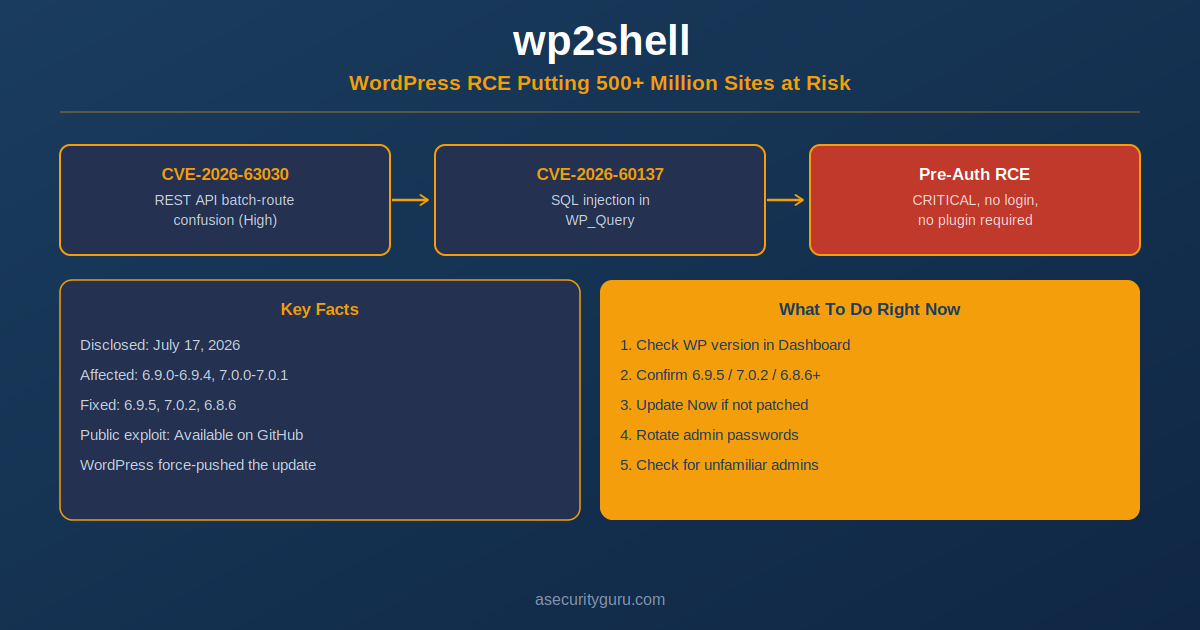 wp2shell CVE-2026-63030: The WordPress RCE Putting 500+ Million Sites at Risk
Explains the wp2shell chain in WordPress core: CVE-2026-63030, a REST API batch-route confusion in /wp-json/batch/v1, smuggles input into CVE-2026-60137, a SQL injection via the author__not_in parameter of WP_Query, giving unauthenticated admin hash dump and RCE. Lists affected versions (6.9.0-6.9.4, 7.0.0-7.0.1 for RCE; 6.8.x SQLi only), fixed releases (6.9.5, 7.0.2, 6.8.6), the public GitHub PoC, temporary WAF/REST blocking mitigations, and post-patch compromise checks such as rotating admin passwords and reviewing batch-endpoint logs.
 asecurityguru.comarticleAdded 13 Oct 2026, published 21 Jul 2026🛡️ Security
 Unauthenticated RCE in WordPress core (wp2shell), via SQL injection
WordPress core versions 6.9.0-6.9.4 and 7.0.0-7.0.1 (plus 7.1 beta) contained an unauthenticated remote code execution flaw stemming from REST API batch-route confusion at /wp-json/batch/v1 that chains into SQL injection, exploitable against a stock install with no plugins. WordPress shipped emergency fixes (6.9.5, 7.0.2, 7.1 beta2) and enabled forced auto-updates given the scale of exposure (500M+ WordPress sites); a separate SQLi patched in the same round affects 6.8.x, fixed in 6.8.6. Researcher Adam Kues (Searchlight Cyber) reported the flaw and released a checker tool at wp2shell.com; the post also covers interim mitigations (blocking the batch route via WAF/plugin) for sites that can't patch immediately.
aikido.devwriteupAdded 3 Sep 2026, published 17 Jul 2026🛡️ Security Benchmarking 13 AI models on rediscovering known CVEs
Aikido benchmarked 13 LLMs (GPT-5.6 variants, grok-4.5, Claude Opus/Haiku, Gemini, GLM-5.2, and later Kimi K3) on rediscovering 26 known CVEs from the GitHub advisory database using their AI Code Analysis harness, which points investigator agents at the vulnerable code and scores pass@3 across three runs. GPT-5.6 led with 23/26 (88.5%) recall, Kimi K3 later tied it at a fraction of the cost, and pooling multiple runs of a cheaper model often matched or beat a single pass of a pricier flagship. Models solved pattern-recognizable bugs (deserialization RCE, stored XSS) uniformly but diverged sharply on subtle multi-step flaws like an ORM column-alias SQL injection.
aikido.devarticleAdded 3 Sep 2026, published 16 Jul 2026🛡️ Security- Threat Actors Achieve Persistence After SQL Injection
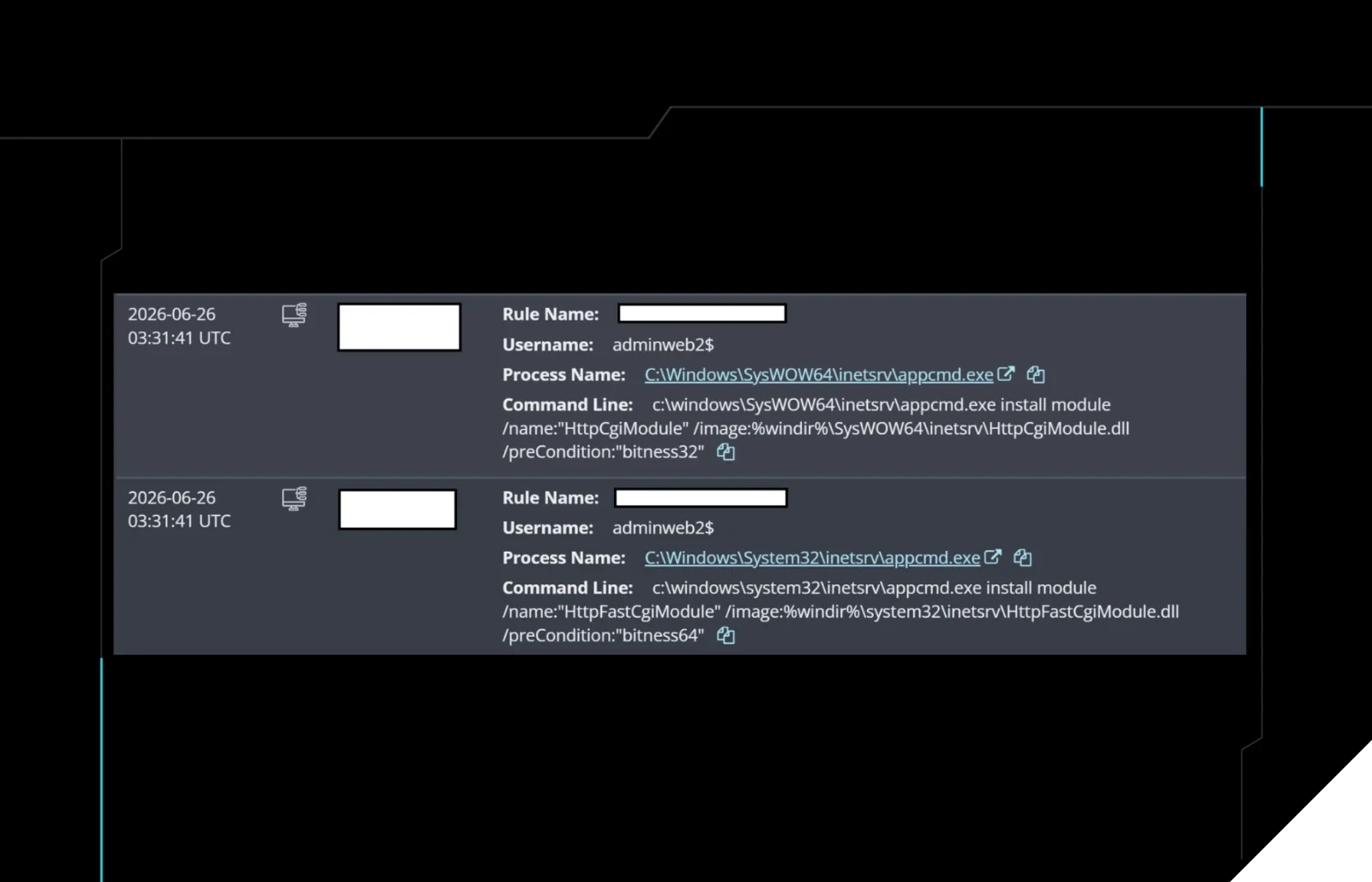
Huntress SOC analysis of a June incident where a threat actor exploited a SQL injection flaw in an IIS/MSSQL web application to gain access, then extensively modified the environment: enabling Terminal Services, creating a rogue admin account (adminweb2$), disabling Windows Defender, deploying BadIIS malicious IIS modules (HttpFastCgiModule.dll, HttpCgiModule.dll) for SEO fraud, installing the XMRig cryptominer with nssm.exe persistence and hidden/system file attributes, and dropping additional PowerShell/batch payloads (qdcjoke1.2.ps1, c_joke1.2.ps1) via base64-encoded PowerShell and Out-of-Band Application Security Testing (OAST) exfiltration channels (oastify.com).
huntress.comwriteupAdded 3 Sep 2026, published 13 Jul 2026🛡️ Security - Armur-Ai/Pentest-Swarm-AI
Pentest Swarm AI is an open-source (AGPL-3.0), self-hosted CLI tool that runs dozens of LLM agents concurrently against a target, coordinating through a shared "stigmergic" blackboard rather than a fixed recon→exploit→report pipeline, so findings propagate and wake relevant agents in real time. It supports any provider with tool-calling (Claude, OpenAI-compatible endpoints, Together AI-hosted Llama/Qwen/DeepSeek/GLM, or fully local Ollama/LM Studio), ships bundled vulnerable labs (crAPI, Juice Shop, VAmPI, DVGA) for safe testing, and positions itself against the closed SaaS bug-bounty bot XBOW. It currently automates verified attack playbooks (BOLA/IDOR, mass assignment, NoSQL injection) with evidence-backed reporting, with roadmap items for runtime object-reference mining, self-correcting attacks, and on-demand specialist sub-agents.
github.comrepoPublished and added 21 Jun 2026🛡️ Security  レッドエージェント POVシリーズのご紹介
Wiz Research introduces the Red Agent AI-powered pentester and its new blog series documenting real bug classes it discovers autonomously in production. The launch post shares aggregate stats from a one-month run across roughly 1,000 environments, breaking down dominant failure modes: broken access control, leaked secrets, systemic RCE, SQL injection, PII/PHI exposure, and JWT alg:none bypasses. It teases the series first deep-dive: a GCP Cloud Run SSRF the agent found by iteratively bypassing a GitHub-URL-only validation filter over 96 iterations, escalating to unauthenticated credential and source-code extraction.
wiz.ioarticleAdded 3 Sep 2026, published 17 Jun 2026🛡️ Security- VICE
VICE is an open-source (MIT) Node.js security auditing CLI with two modes: a remote black-box scan that crawls a target with a headless browser across 15-16 security modules (headers, TLS, Supabase access controls, subdomains, storage buckets, WebSockets), and a local white-box audit that scans source code for secrets, .env exposure, npm vulnerabilities, missing Supabase RLS policies, SQL injection and XSS. It ships as a GitHub Action that posts PR comments with a security score, uploads SARIF findings to GitHub Code Scanning, gates merges on a minimum score, and maintains a live README badge. Version 3.4.0 adds an AI/RAG security module for testing chat/agent API endpoints for access control, prompt injection, retrieval isolation, and tool-security issues.
github.comrepoPublished and added 14 Jun 2026🛡️ Security  Datadog AI-Native SAST
Datadog describes its open-sourced AI-native SAST tool, which uses LLMs (including Claude Opus) to add context-aware reasoning on top of traditional static analysis, cutting false positives for vulnerabilities like SQL injection and command injection. The pipeline runs identification, context retrieval, LLM analysis, and post-processing steps, uses incremental scanning to control LLM cost after an initial full-repo scan, and is benchmarked against the OWASP Benchmark framework where it beats Datadog's traditional SAST (even LLM-filtered) on most vulnerability categories.
 datadoghq.comarticlePublished and added 31 May 2026🛡️ Security


Showing 30 of 35
Show more