 Northflank security breach leads to abuse of customers' AI API keys
Northflank, a cloud application hosting platform, disclosed a breach on 30 October 2026 after a Wiz threat alert and told customers to assume all environment variables were decrypted and to rotate secrets. Customers reported unauthorized use of AI API keys. Wiz's "Black October for AI Developer Platforms" report counts at least nine incidents, including Railway, OpenCode, Warp and Lightning AI, and describes LLMJacking, with about 2.5 million Amazon Bedrock calls costing roughly $100,000 in two cases. Northflank has not said how attackers got in.
 bleepingcomputer.comarticlePublished and added 31 Oct 2026🛡️ Security
 Rekt - News or Hype?
Rekt's "News or Hype?" compares four October 2026 AI headlines with their sources. These are Justin Drake's "bunker mode" ECDSA warning, Anthropic's Claude tracing NIST curve seeds to lrand48, OpenAI's agent spending Sepolia ETH from a default-mnemonic account, and Wiz's "AI uncovers" PHP RCE claim of 70% reach. It ends with four questions for checking claims.
 rekt.newsarticleAdded 30 Oct 2026🧠 AI
- Rekt - News or Hype?
Rekt News piece tracing three AI-security headlines back to their sources. It covers Justin Drake's October 2026 "bunker mode" warning about AI breaking ECDSA, OpenAI's report of a model spending Sepolia test ETH from a default developer mnemonic, and Wiz's "70% of the Internet" claim for PHP CVE-2026-109618 and CVE-2026-109619. It closes with four questions for checking a claim.
rekt.newsarticleAdded 29 Oct 2026🛡️ Security  The Rise of Agentic Attacks: What They Look Like, and Where They're Headed
Wiz Research reviews agentic attacks seen in its incident response work and in public reports (ARTEX, Hermes, JPCERT/CC, CrowdStrike, DIVD). It derives fingerprints of AI-agent activity from three intrusions: machine-paced iteration, natural-language reasoning in scripts, self-correcting script versions, checklist enumeration, noisy lateral spraying, probe-before-payload and self-labeled scratch files. It also covers effects on attribution, attack scale and defense.
 wiz.ioarticlePublished and added 29 Oct 2026🛡️ Security
 PHP2Shell: Exploitation Attempts and Remediation Trends
Wiz Research follow-up on PHP2Shell (CVE-2026-109618, CVE-2026-109619) after the 21 October 2026 disclosure. Honeypot data shows two variants of an open source exploit kit, one stopped by post_max_size and the other by failed memory leaks and worker pinning, plus PHP2Shell-branded tools that rely on session poisoning and LFI. Daily exposed vulnerable machines fell about 67%.
wiz.ioarticlePublished and added 27 Oct 2026🛡️ Security The Pwn Request Reckoning: What Still Works Against GitHub Actions
The Pwn Request Reckoning is a Wiz post updating the GitHub Actions pull_request_target threat model for 2026. It covers what GitHub's checkout protections, read-only cache tokens and event policies block, and what still works. Remaining paths: SHA-pinned pre-backport actions/checkout, custom checkout scripts, issue_comment and repository_dispatch triggers, script injection, artifact poisoning, self-hosted runner state and allow-unsafe-pr-checkout. It ends with grep and zizmor audit steps.
wiz.ioarticlePublished and added 26 Oct 2026🛡️ Security LiteLLM Compromised in Fresh Supply Chain Attack
LiteLLM version 1.107.0 was published with malware to PyPI and Docker Hub on October 21, for about three hours and roughly 49,000 downloads. Attackers used GitHub CLI OAuth tokens, likely leaked through Claude Code into LiteLLM logs, to disable branch protections, redirect the releaser to a lookalike repository and sign poisoned artifacts. The payload is an infostealer and RAT; Wiz saw Amazon Bedrock abuse. The last clean version is 1.106.2.
 securityweek.comarticlePublished and added 23 Oct 2026🛡️ Security
 [tl;dr sec] #351 - PHP2Shell, Autopatching Skills, AWS Pathrunner
tl;dr sec #351 is a weekly security newsletter. Clint Gibler describes working with OpenAI, Calif, Wiz and the PHP maintainers on the PHP2Shell unauthenticated RCE disclosure, which affects 13 years of PHP. It also covers Datadog's pathrunner AWS IAM escalation framework, Trail of Bits' patching-bugs and regression-hunt Codex plugins, XBOW finding de-duplication, backdoored open-weight models, and CREBench.
 tldrsec.comarticleAdded 30 Oct 2026, published 22 Oct 2026🛡️ Security
 ARTEX in the Wild: Storm-0940 Expands Targeting of IT and Software Vendors
Wiz Research reports an actor overlapping with Storm-0940 that used ARTEX, an open-source autonomous AI penetration-testing agent, against IT and software vendors in October 2026. It documents source-map and Swagger recon, OAuth callback and unsigned JWT probing, Cognito account-recovery abuse, tenant-isolation tests and Okta/Entra password spraying. The post lists log signals that mark the activity as agentic, such as one-second spray cadence and automatic IP and user-agent rotation.
wiz.ioarticlePublished and added 22 Oct 2026🛡️ Security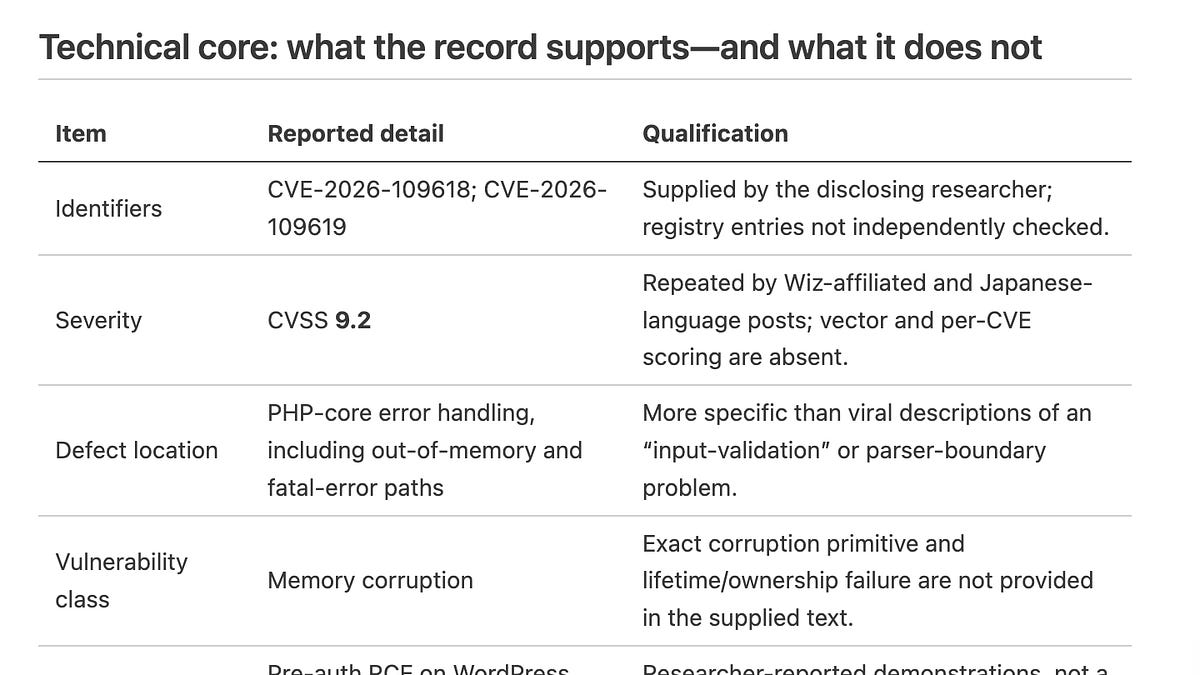 [AINews] OpenAI’s Patch the Planet program is 1 of 2 parties to discover PHP2Shell vulnerabilities in core PHP affecting 70% of the web, using GPT-5.6 Sol; coordinated response over 2 months
AINews issue for 20-21 October 2026. The top story covers PHP2Shell (CVE-2026-109618 and CVE-2026-109619), two PHP-engine memory-corruption bugs found separately by Calif researchers using GPT-5.6 Sol under OpenAI's Patch the Planet and by Wiz, followed by two months of coordinated remediation. It also covers the Flint coding MoE, DeepSeek's DeepInfer, TorchTPU, eval critiques and agent product launches. The text is truncated.
 latent.spacearticlePublished and added 22 Oct 2026🧠 AI
- [AINews] OpenAI’s Patch the Planet program is 1 of 2 parties to discover PHP2Shell vulnerabilities in core PHP affecting 70% of the web, using GPT-5.6 Sol; coordinated response over 2 months
This AINews issue (20 to 21 October 2026) leads with PHP2Shell, two PHP-engine memory-corruption bugs (CVE-2026-109618 and CVE-2026-109619). Calif researchers found them with GPT-5.6 Sol under OpenAI's Patch the Planet, and Wiz reportedly found them independently with Gemini 4 Argon. It reconstructs the two-month coordinated response, Cloudflare WAF stopgaps and NSA guidance, and the dispute over vetted researcher access to models. Only the first 40,000 of 114,281 characters were reviewed.
latent.spacearticleAdded 23 Oct 2026, published 22 Oct 2026🧠 AI - [AINews] OpenAI’s Patch the Planet program is 1 of 2 parties to discover PHP2Shell vulnerabilities in core PHP affecting 70% of the web, using GPT-5.6 Sol; coordinated response over 2 months
AINews issue of 20-21 October 2026 whose top story reconstructs PHP2Shell (CVE-2026-109618, CVE-2026-109619), two PHP-engine memory-corruption bugs with reported pre-auth RCE against WordPress, Drupal and Joomla. It covers the two-month coordinated disclosure, independent discovery by Calif/OpenAI (GPT-5.6 Sol) and Wiz, Cloudflare WAF stopgaps and NSA guidance. It flags missing primary sources: fixed versions, CVSS and leak details.
latent.spacearticlePublished and added 22 Oct 2026🛡️ Security  [AINews] OpenAI’s Patch the Planet program is 1 of 2 parties to discover PHP2Shell vulnerabilities in core PHP affecting 70% of the web, using GPT-5.6 Sol; coordinated response over 2 months
AINews issue of 20-21 October 2026 whose top story reconstructs PHP2Shell, two PHP-engine memory-corruption flaws (CVE-2026-109618 and CVE-2026-109619) with reported pre-auth RCE against WordPress, Drupal and Joomla. It covers the two-month coordinated response, separate discovery by Calif/OpenAI (GPT-5.6 Sol) and Wiz (Gemini 4 Argon), Cloudflare's WAF stopgap and NSA guidance. It lists open gaps: fixed versions, leak details, exploitation versus scanning.
latent.spacearticleAdded 23 Oct 2026, published 22 Oct 2026🛡️ Security- Today's PHP Security Release, and How We're Strengthening PHP Security
Simon Willison's link post on the 21 October 2026 PHP security release, which fixes two remote code execution flaws across the PHP 8.x line. The CVE IDs leaked on 20 October with a wrong CVSS of 10.0 (actual 9.2), and Calif accidentally published a proof-of-concept video. It also gives Wiz Research's timeline, with unauthenticated RCE confirmed against Drupal and WordPress in August 2026.
 simonwillison.netarticlePublished and added 21 Oct 2026🛡️ Security
 Remotely exploitable PHP bug found on 70% of world’s websites
PHP2Shell is a pair of unauthenticated remote code execution flaws in PHP, CVE-2026-109618 and CVE-2026-109619, found by Calif using OpenAI's GPT-5.6 Sol during an OpenAI-funded audit. Fixes ship in PHP 8.5.12, 8.4.27, 8.3.36 and 8.2.35, with backports for 7.4-8.1 rolling out, while PHP 7 and 5 sites stay unpatched. Wiz confirmed the flaws; Cloudflare applied a stopgap and Finnish and Dutch government sites went offline.
 protos.comarticlePublished and added 21 Oct 2026🛡️ Security
 Today's PHP security release, and how we're strengthening security
The PHP Foundation explains the 21 October 2026 release of PHP 8.5.12, 8.4.27, 8.3.36 and 8.2.35, which fix two critical unauthenticated RCE flaws in memory management and error handling, including an OOM problem behind CVE-2026-109618. It covers the 2024 Quarkslab audit, the stalled fix, the August 2026 reports from Calif, OpenAI and Wiz, and the embargo leaks (CVE IDs, a Calif video, Chainguard images). It also lists new security team structure and AI-assisted triage.
 thephp.foundationarticleAdded 22 Oct 2026, published 21 Oct 2026🛡️ Security
- Patch the Planet: global response coordination as agents uncover critical vulnerabilities
OpenAI's Patch the Planet post describes the coordinated response to two critical PHP vulnerabilities. Calif found one with GPT-5.6 Sol, and Wiz independently reported both. It proposes a five-stage disclosure framework: upstream fix, advance notice to providers, government coordination, product updates and public guidance. It also lists a PHP version checker, $1 billion in subsidized Daybreak access, and open questions on disclosure windows and emergency patching.
 openai.comarticlePublished and added 21 Oct 2026🛡️ Security
 Supply Chain Zero Days: Closing the Gap Between Publication and Detection
Wiz describes its pipeline that analyzes every new npm package version at publication, combining static analysis, an AI classifier, sandbox dynamic analysis and runtime sensor observation, then pushes IOCs to Wiz Defend before a CVE exists. It cites supply chain attacks rising from about 10% of significant incidents in H2 2025 to 25% in H1 2026, and the Axios compromise (v1.14.1, v0.30.4). The keyv case shows C2 domains fetched from an Ethereum smart contract, which only runtime monitoring caught.
wiz.ioarticlePublished and added 19 Oct 2026🛡️ Security- [tl;dr sec] #348 - Google's PageBreak Scanner, Perplexity's Agent Security Tool, Defending Agentically
tl;dr sec #348 is a weekly security newsletter issue. It summarises Google's PageBreak agent (500+ XSS bugs found since November 2025, validated deterministically), Perplexity's open-source Numbat agent-security tool (52 CEL rules), and SpecterOps' CiliumHound. It also covers Scaleway IAM attack paths, the NCSC essay on defending agentically, Julien Vehent on detection fidelity, and Wiz's Scan for Good.
tldrsec.comarticleAdded 30 Oct 2026, published 1 Oct 2026🛡️ Security  Gemini 4 Is Here, and Google’s Flagship Tops All Other AI Models on Cybersecurity
Google released Gemini 4 Argon, its new frontier model for coding, office work and cyber defense, scoring 77.9% on DeepSWE v1.1 (vs. 74.2% Claude Opus 5.5, 74.1% GPT-6 Astra) and expanding max output to 1 million tokens. On Gray Swan's indirect prompt injection benchmark it posted a 0.7% attack success rate, edging out Claude Opus 5.5 and Claude Fable 5.1 (both 1.0%), and scored 70.9% on Google's internal Wiz Penetration Test Benchmark versus 58.2% for the earlier restricted Gemini 3.8 Flash Cyber. The model initially ships without cyber guardrails only to vetted defenders via Google's Fairwind Program before wider API and Google AI Ultra release at $2/$10 per million input/output tokens.
 decrypt.coarticlePublished and added 30 Sep 2026🧠 AI
- Gemini 4 Is Here, and Google’s Flagship Tops All Other AI Models on Cybersecurity
Decrypt covers Google's Gemini 4 Argon launch, reporting it scored a 0.7% attack success rate on Gray Swan's Indirect Prompt Injection benchmark, beating Claude Opus 5.5 and Claude Fable 5.1 (both 1.0%), GPT-6 Astra (8.5%), and far outperforming Grok 4.6 and Kimi K3 (~52% each). It also details Argon's cyber-defense capability: it ships first to vetted defenders through Google's Fairwind Program "without cyber guardrails," scored 70.9% on the internal Wiz Penetration Test Benchmark writing working exploits against real web-app flaws, and reportedly helped Wiz find a critical healthcare-software flaw earlier models missed.
decrypt.coarticlePublished and added 30 Sep 2026🛡️ Security  Securing the Kubernetes Supply Chain: Introducing WizOS Helm Charts
Wiz Research examined the source repositories and CI/CD pipelines behind 1,500 popular Helm charts on Artifact Hub (mapping to 814 unique GitHub repos) and found 61 repos (7.5%) with confirmed supply-chain risk, including 20 charts with CI/CD workflow weaknesses and 25 depending on unmaintained/archived upstream projects. Two disclosed findings illustrate the risk classes: KubeView's go.mod referenced a Go module under a GitHub username that didn't exist, making it hijackable by anyone who registered the name, and Meilisearch's Helm chart repo had a GitHub Actions workflow triggered by PR comments that injected the commenter's branch name into a shell command while skipping author-association checks, letting any GitHub user run commands with a bot token that had push access. The post then pivots to promoting WizOS Helm Charts, Wiz's hardened/signed/CVE-scanned chart catalog built to close these gaps.
wiz.ioarticlePublished and added 30 Sep 2026🛡️ Security Mini Shai-Hulud Worm Compromises TanStack, Mistral AI, Guardrails AI & More Packages
The Hacker News details the "Mini Shai-Hulud" campaign by threat actor TeamPCP, which compromised npm and PyPI packages from TanStack, UiPath, Mistral AI, OpenSearch and Guardrails AI via a chained GitHub Actions attack (pull_request_target abuse, cache poisoning, OIDC token extraction), now tracked as CVE-2026-45321 (CVSS 9.6). The worm mints npm publish tokens directly from stolen OIDC credentials to self-propagate — the first documented case of a worm producing validly SLSA Build Level 3-attested malicious packages — and deploys an obfuscated credential stealer with IDE persistence hooks, a GitHub Actions secret-exfiltration workflow, and a dead-man's-switch that runs "rm -rf" if its rogue npm token is revoked. Over 170 packages and 400+ attacker-controlled repos have been identified across npm and PyPI, with findings credited to Aikido Security, Endor Labs, SafeDep, Socket, StepSecurity, Snyk, Wiz and Microsoft.
 thehackernews.comarticleAdded 26 Sep 2026🛡️ Security
 Scan for Good: Using AI to discover and fix high-priority exposures across public services and critical infrastructure
Wiz announces Scan for Good, an initiative that pairs its AI pentester (Red Agent) and Google DeepMind's Gemini 3.8 Flash Cyber with human researchers. It scans authorized public-facing services of critical infrastructure, hospitals, municipalities and nonprofits for exposures and attack paths. It lists anonymized findings, including an exposed admin key over an 8.8M-file archive, NoSQL injection at an AI training-data platform, unsafe upload to hospital server control, and public CI/CD workflows leaking credentials. It also sets out the authorization, human-validation and private-disclosure rules.
wiz.ioarticlePublished and added 24 Sep 2026🛡️ Security- [tl;dr sec] #346 - Can AI Do Novel Security Research?, Anthropic's Threat Intel Report, How Cloudflare Enforces Engineering Standards
tl;dr sec #346 is a weekly security newsletter issue. It covers James Kettle's HTTP Terminator, an autonomous system that invented HTTP desync techniques including Shared Parser Confusion. It also covers Anthropic's September 2026 Claude misuse report, Wiz's report on Artifactory exploitation (CVE-2026-42016, CVE-2026-42018, CVE-2026-82329), Sysdig's marimo CVE-2026-39987 findings, Synacktiv's EKS forensics guide, and Cloudflare's AI-enforced engineering Codex.
tldrsec.comarticleAdded 30 Oct 2026, published 17 Sep 2026🛡️ Security  Building an AI Detection Engine That Understands Agent Intent
Wiz describes an AI detection engine that analyzes model input/output telemetry (prompts, system prompts, tool calls, reasoning) rather than just outputs, in order to catch shifts in AI agent intent such as indirect prompt injection. It walks through OpenAI's disclosed Hugging Face/ExploitGym incident and an internal support-agent phishing-relay scenario, then describes a staged pipeline (regex/SLM candidation, light LLM filtering, deep LLM analysis, correlation with cloud/runtime telemetry) validated against a benchmark of 100+ simulated scenarios covering 57 injected attacks and 45 benign workflows across CI/CD, DevOps, data analyst, support, CLI, and cloud auditor agent personas.
wiz.ioarticlePublished and added 17 Sep 2026🛡️ Security- [tl;dr sec] #345 - Bug Rumors → Exploits, Version Control DFIR, Agentic Worms
tl;dr sec issue #345 is a security newsletter digest. It covers Greptile's test showing models miss bugs in their own code, an OCaml cohttp path traversal fix probed within ten minutes of the PR, and a Wiz Version Control DFIR poster for GitHub, GitLab, Bitbucket and Azure DevOps. It also covers an arXiv paper on open-weight agentic worms (61.8% infection of a 33-host testbed) and Endor Labs' 14 flaws in seven AI orchestration platforms.
tldrsec.comarticleAdded 30 Oct 2026, published 10 Sep 2026🛡️ Security - Secrets in AI-Generated Code: How Coding Agents Leak Credentials | Blog | Endor Labs
Endor Labs breaks down why AI coding assistants (Claude Code, Cursor, etc.) hardcode and leak secrets (CWE-798): they learn the habit from public training data, then compound it by ingesting whole workspaces including .env files and copying live tokens into new code or MCP configs. It cites hard data — GitGuardian's 2026 report found 28.65M new hardcoded secrets on public GitHub in 2025 and a 3.2% secret-leak rate on Claude Code-assisted commits vs 1.5% baseline, Lakera found credentials in 33 .claude/settings.local.json files across 30 packages, and Wiz found AI-related secrets among the most common validated leaked credential types — then lays out a layered defense (pre-commit/IDE/CI/CD/full git-history scanning, active credential validation, secure prompting) and an incident-response order of operations (rotate, investigate, purge history, revoke, re-scan).
 endorlabs.comarticleAdded 3 Sep 2026, published 2 Sep 2026🛡️ Security
 Introducing Gemini 3.8 Flash and 3.8 Flash Cyber
Google DeepMind announces Gemini 3.8 Flash, an upgraded reasoning/coding model at the same $0.75/$3.75 per-million-token price as 3.7 Flash, plus Gemini 3.8 Flash Cyber, a specialized variant for vulnerability discovery and automated patching offered to vetted defenders through a new 'Fairwind Program'. The post cites benchmark gains on DeepSWE v1.1, HLE-Verified, Vals Finance Agent V2 and Harvey's Legal Agent Benchmark for the general model, and CyberGym plus Collinear's CWE-Bench for the cyber variant, along with real-world results from Chrome Security, Wiz and Google's Cloud Vulnerability Research team.
 deepmind.googlearticleAdded 29 Sep 2026, published 2 Sep 2026🧠 AI
- Introducing Gemini 3.8 Flash and 3.8 Flash Cyber
Google DeepMind announces Gemini 3.8 Flash and a gated variant, Gemini 3.8 Flash Cyber, the latter positioned as a frontier-level model for autonomous vulnerability discovery and automated patching, accessible to vetted defenders through a new 'Fairwind Program.' On the CyberGym benchmark and an internal 20-language vulnerability-discovery benchmark it reports over 70% success, and on the Collinear CWE-Bench patching benchmark it nearly matches a larger frontier model (47.2% vs 47.8% pass@1) at much lower cost; Google cites Chrome Security producing 2.6x more correct patches and Wiz seeing higher recall at lower cost using the model, plus a case where Google's Cloud Vulnerability Research team found a critical vulnerability in under 2 hours.
deepmind.googlearticleAdded 29 Sep 2026, published 2 Sep 2026🛡️ Security
Showing 30 of 45
Show more