 socket.devarticle
Mini Shai-Hulud Worm (Apr–May 2026)
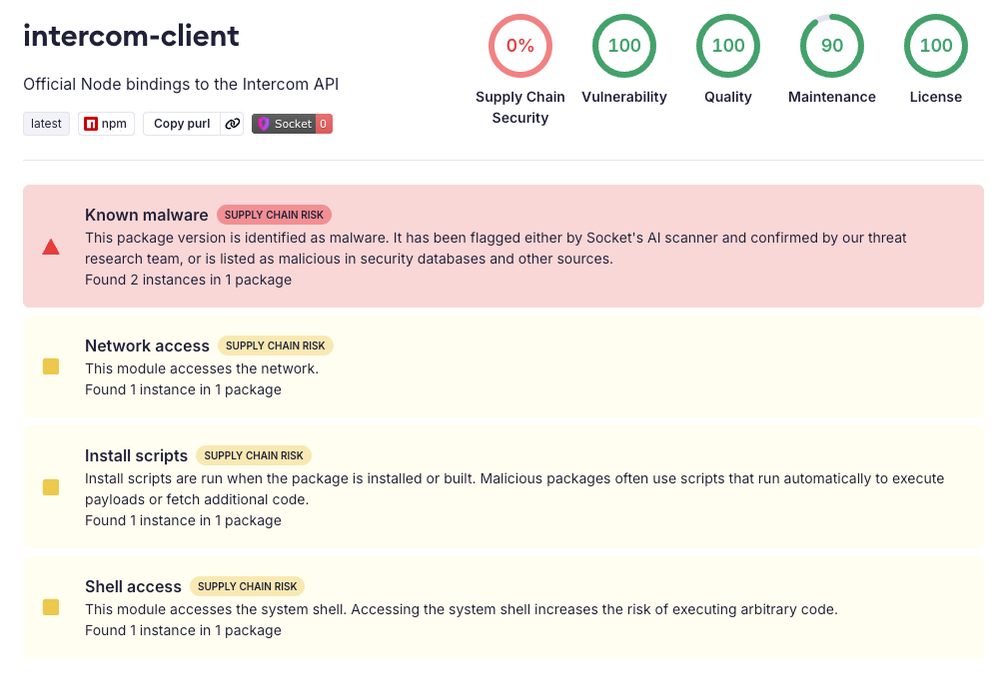
Socket's Threat Research team confirms intercom-client@7.0.4, the official Intercom Node.js SDK (~360k weekly downloads), was compromised via a preinstall hook (setup.mjs) that downloads an unverified Bun binary and executes an 11.7MB obfuscated payload (router_runtime.js) which harvests Kubernetes and Vault credentials and exfiltrates them via the GitHub API. The compromise traces to a hijacked maintainer GitHub account (nhur) that pushed spoofed Dependabot-style workflow changes to trigger the npm publish CI pipeline, and the payload closely matches the 'Mini Shai-Hulud' campaign also seen in a PyPI package (lightning) and prior SAP CAP/Cloud MTA npm packages linked to TeamPCP activity.
What it is
A confirmed npm supply-chain compromise: intercom-client@7.0.4, the official Intercom Node.js SDK (~360,000 weekly downloads, 100+ dependent projects), was published with malware as part of the "Mini Shai-Hulud" worm campaign. The prior release 7.0.3 (published 88 days earlier) is clean.
How it works
Version 7.0.4 added two files absent from 7.0.3: setup.mjs and router_runtime.js. A preinstall hook runs setup.mjs, which downloads and executes an unverified platform-specific Bun binary from GitHub Releases with no integrity checks. That binary runs router_runtime.js, an 11.7 MB obfuscated payload that harvests Kubernetes and Vault credentials from environment variables and local files, then encrypts and exfiltrates them via the GitHub API. The payload is nearly identical to the one in the lightning@2.6.2 PyPI attack.
Preconditions / Affected
Any developer machine or CI/CD pipeline that ran npm install resolving intercom-client@7.0.4. Critically, because the malicious code executes during installation via preinstall, systems are exposed even if the package was never imported or used in application code.
What to do
Per Socket's guidance:
- Immediately remove
intercom-client@7.0.4and downgrade to a known-good version (7.0.3predates the compromise). - Rotate potentially exposed credentials.
- Review any system where the package may have been installed.
- Prioritize environments holding Kubernetes credentials, Vault tokens, cloud credentials, or GitHub tokens.
For GitHub-side detection, the compromise used a hijacked account (nhur) that on April 30, 2026 created branches mimicking Dependabot naming but with a typo (e.g. dependabout/github_actions/...), pushed workflow files (e.g. .github/workflows/format-check.yml) that read ${{ toJSON(secrets) }} and wrote secrets to files uploaded as Actions artifacts, and used spoofed but unsigned commit identities (dependabot[bot], claude). The malicious npm publish itself came from a "Test Commit" that deleted ci.yml and added a test.yml workflow named dependabot/fix, triggering an automated publish workflow. Follow-on CI commits added files under .claude/ and .vscode/. Audit for these artifacts.
Caveats
Socket states it is still analyzing whether this is part of the same TeamPCP campaign as the SAP CAP / Cloud MTA compromise, a direct follow-on, or a copycat reusing the tooling — attribution is not settled. The TeamPCP link to the related SAP CAP campaign rests on shared payload patterns and overlap with prior Checkmarx, Bitwarden, Telnyx, LiteLLM, and Trivy incidents, not on definitive attribution of this specific package.
Technologies named here
- intercom-client
- Socket AI scanner
- Bun
- GitHub Actions
- intercom-node
- Dependabot naming convention
- lightning
- SAP CAP npm packages
- Cloud MTA npm packages
- npm
- Kubernetes
- Vault
- GitHub
Techniques named here
- Malicious npm package / preinstall script execution
- Credential harvesting from environment/local files
- Exfiltration via GitHub API
- CI/CD secrets dumping via GitHub Actions workflow
- Spoofed commit identities
- Compromised maintainer/GitHub account abuse
- Automated CI publish workflow trigger
- Cloud metadata/credential endpoint targeting
Threat actors named here
- Mini Shai-Hulud worm
- TeamPCP
- nhur
- Mini Shai-Hulud
Related in Supply Chain






