CVE-2026-98432 is a use-after-free in the Linux IPv4 TCP handshake, rated CVSS 3.1 9.8 and reachable by a remote unauthenticated peer on kernels back to 4.4. The post lists fixed stable releases (October 2026) and distribution patch status as of 31 October 2026, plus kernel and MPTCP listener checks. It gives interim nftables and iptables rules that drop IPv4 packets carrying options, and notes Anthropic's claim that Claude wrote a working exploit.
Linux kernelnftablesiptables+3
CVE-2026-98432use-after-freeAnthropic
Blue Team & Detection, Cloud & InfraΒ· Added 1 Nov 2026, published 31 Oct 2026
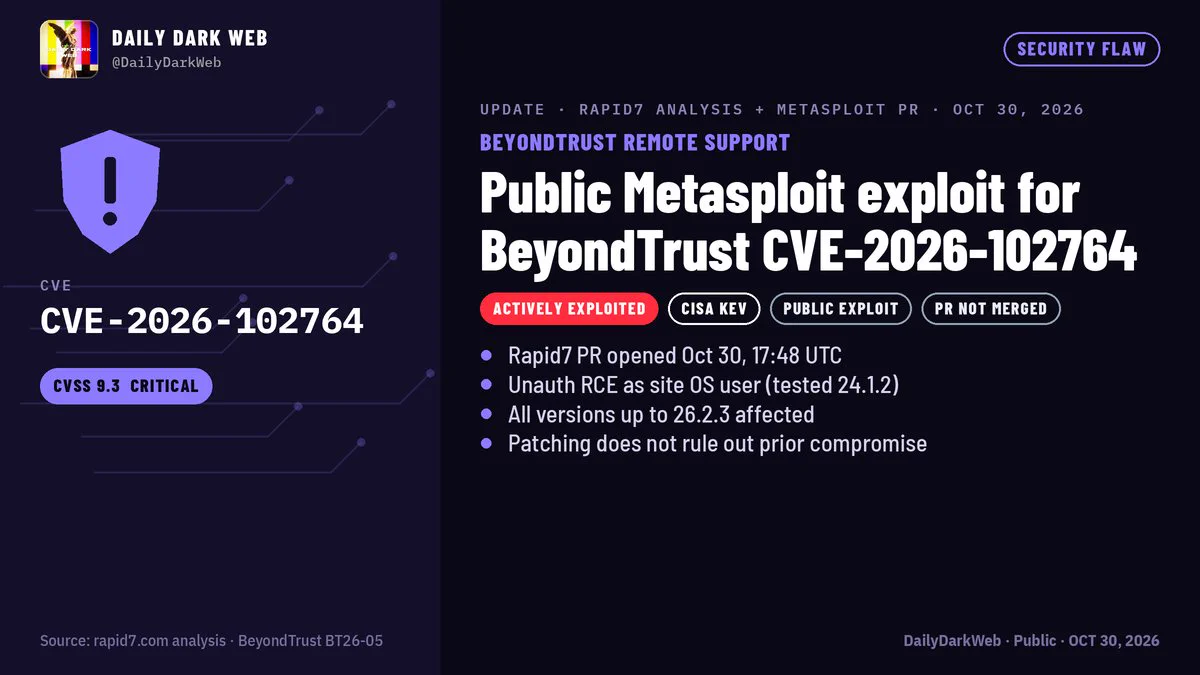
CVE-2026-102764 is an unauthenticated RCE in BeyondTrust Remote Support, already exploited and in CISA KEV. Rapid7 published an analysis and opened a Metasploit pull request on 30 October 2026, showing code execution on version 24.1.2 via a forged "local" message origin, the native file-transfer service and a PHP file written to the web root. BT26-05 (CVSS 4.0 9.3) is fixed by patch BT26-05-RS; SaaS was patched by 9 October.
BeyondTrust Remote SupportMetasploitPHP+1
CVE-2026-102764CISA KEVRapid7+2
Offensive Security, Threat Intel, AppSecΒ· Added 1 Nov 2026, published 31 Oct 2026
CVE-2026-97229 is a CVSS 10 code execution flaw in Onigmo, Ruby's regular expression engine, reachable through crafted CI/CD configuration in GitLab. Attackers used it against Alpine Linux's GitLab on 20 and 21 October 2026 and failed; Alpine rebuilt the instance and found no tampering with aports or packages. Self-managed installs with their own Ruby need Ruby 3.3.13, 3.4.12 or 4.0.9, not just GitLab 19.3.6. CISA added it to KEV.
GitLabRubyOnigmo+2
CVE-2026-97229CISA KEVBOD 26-04+1
AppSec, Threat Intel, DevSecOpsΒ· Published and added 30 Oct 2026
CVE-2026-111585 (CVSS 8.8) is an integer overflow in the remote-control screen processing of TeamViewer clients on Windows, macOS, Linux and Android. A malicious or compromised host can announce an oversized screen surface (for example 32768 by 32768 at 32 bpp), forcing a software decode path and an out-of-bounds write that crashes the viewer or runs code. Remedio's research shows a pointer overwrite routed to WinExec. Version 15.83 fixes it, along with CVE-2026-92372, CVE-2026-92374 and six local privilege escalation bugs.
TeamViewerWindowsmacOS+3
CVE-2026-111585CVE-2026-92372CVE-2026-92374+3
AppSec, Offensive SecurityΒ· Published and added 30 Oct 2026
CVE-2026-98432 is a use-after-free in the Linux kernel IPv4 TCP handshake path: a request socket's ireq_opt pointer moves to the child socket as inet_opt and is freed with kfree() while a retransmitted-SYN CPU still reads it under RCU. The fix (commit e3f33b0a1d89) uses kfree_rcu(). The page covers CVSS 9.8 versus vendor scores, Anthropic's MPTCP root-exploit lab demo, per-distribution patch checks, MPTCP listener inventory and detection guidance. The page was truncated before its mitigation section.
Linux kernelCVSSGo+3
CVE-2026-98432use-after-freeMultipath TCP+4
Cloud & Infra, Blue Team & DetectionΒ· Added 31 Oct 2026, published 30 Oct 2026
Unit 42 threat brief on PHP2Shell, two PHP remote code execution flaws, CVE-2026-109618 and CVE-2026-109619 (CVSS 4.0 9.2), both caused by longjmp() error handling that leaves memory uninitialized or freed. Cortex Xpanse counted over 22.6 million exposed instances. The 29 October 2026 update says attackers chained PHP2Shell with a Linux kernel privilege escalation against internet-exposed PAN-OS management interfaces. An earlier 23 October claim of post-compromise activity was retracted on 25 October.
PHPPAN-OSLinux kernel+2
CVE-2026-109618CVE-2026-109619PHP2Shell+2
Threat Intel, AppSecΒ· Added 30 Oct 2026, published 29 Oct 2026
CVE-2026-98432 is a Linux kernel use-after-free in the IPv4 TCP stack, tracked by Ubuntu (published 15 October 2026, updated 29 October 2026). ireq_opt/inet_opt were freed with plain kfree() while another CPU built a SYNACK under RCU, so ip_options_build() read freed memory; the fix uses kfree_rcu(). Ubuntu rates it High priority, CVSS v3.1 9.8 and v4.0 8.3. The page text does not list per-release package status.
Linux kernelUbuntuCVSS
CVE-2026-98432use-after-free
Cloud & InfraΒ· Added 30 Oct 2026, published 29 Oct 2026
Cisco Talos reported that UAT-11473 exploited CVE-2026-20127 (CVSS 10, Cisco SD-WAN peering authentication bypass) to deploy KeyDrift, a framework with PolyFlame (backdoor, relay C2) and LittleFilch (key harvesting) modules. Talos found its infrastructure overlaps considerably with Volt Typhoon's Silent Train network. Lumen Black Lotus Labs tied Silent Train to zero-day campaigns against Versa Director, N-able N-central, Cisco Catalyst SD-WAN and VeloCloud Orchestrator.
Cisco Catalyst SD-WANCVSS
CVE-2026-20127Volt TyphoonSilent Train+11
Threat Intel, Malware & REΒ· Published and added 29 Oct 2026
CVE-2026-103780 is a stack-based buffer overflow (CWE-121) in Dell PowerProtect Data Domain / DD OS. An unauthenticated remote attacker could get command execution (CVSS 3.1 9.8, Dell DSA-2026-416). The post lists affected and fixed builds for four release trains (Feature Release, LTS2024, LTS2025, LTS2026). It adds KEV, EPSS and SSVC status, plus six defensive checks. The vulnerable service is not public.
Dell PowerProtect Data DomainDD OSCVSS+2
CVE-2026-103780CVE-2026-86400CVE-2026-86397+5
Blue Team & Detection, Cloud & InfraΒ· Added 31 Oct 2026, published 29 Oct 2026
CVE-2026-76418 (CVSS 8.6) is an exploited flaw in the Remote Access SSL VPN service of Cisco Secure Firewall ASA and FTD. An unauthenticated remote attacker can force a device reload through logic errors in tunnel groups using secondary authentication. Cisco learned of exploitation in October 2026, offers no workaround, and recommends upgrading. It is the second ASA/FTD DoS zero-day after CVE-2026-20349 in August.
Alpine Linux incident report on attempted exploitation of CVE-2026-97229 (CVSS 10.0), a regex-evaluation bug in Ruby's Onigmo engine reachable through GitLab CI configuration. An attacker crashed workers 8 times on 20 and 21 October 2026. Upgrading to GitLab 19.3.6 did not fix it because the patch sits in GitLab's bundled Ruby. Alpine rebuilt the instance and found no tampering with aports or releases.
GitLabRubyDocker+1
CVE-2026-97229Onigmoaports
Blue Team & Detection, Supply Chain, AppSecΒ· Added 29 Oct 2026, published 28 Oct 2026
CVE-2026-101767 is a CVSS 9.8 unauthenticated SQL injection in Oracle E-Business Suite's Application Object Library, reachable through the /OA_HTML/AppsTCFServer servlet (GanttDataServer) and chainable to OS command execution. It affects versions 12.2.3 to 12.2.15 and was fixed in the October 2026 Critical Patch Update. Horizon3.ai found it, and Defused saw probing on honeypots on 27 October 2026. Interim mitigation is removing the servlet from the URL firewall allowlist.
Oracle E-Business Suite
CVE-2026-101767Horizon3.aiDefused+5
AppSec, Threat IntelΒ· Published and added 28 Oct 2026
ICSA-26-302-02 is a CISA republication of Hitachi Energy PSIRT advisory 8DBD000224 on the TRO600 series. It covers CVE-2026-10756 and CVE-2026-106087, which allow remote code execution and disclosure of sensitive information. Affected versions are TRO600 up to 9.2.1.6 and 9.1.1.0, plus 9.2.2.1 and 9.1.2.0. The page gives no per-CVE detail or CVSS scores, only general ICS hardening advice. Released 27 October 2026.
Hitachi Energy TRO600
CVE-2026-10756CVE-2026-106087Hitachi Energy PSIRT 8DBD000224+1
Hardware & RFΒ· Added 29 Oct 2026, published 28 Oct 2026
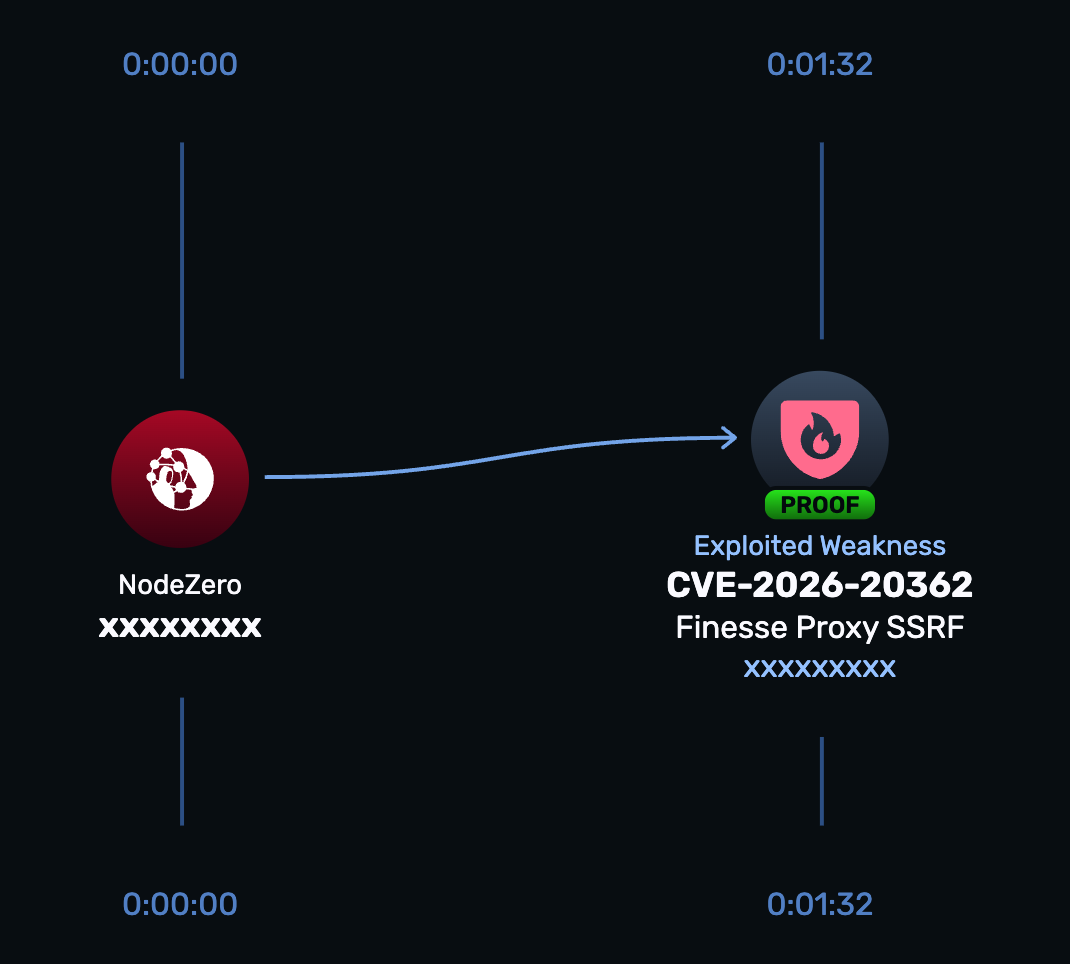
CVE-2026-20362 is an unauthenticated server-side request forgery in Cisco Finesse (CVSS 3.1 score 7.2), found by Horizon3 researchers Noah King and Brandon Peterson. The embedded Apache Shindig content proxy fetches attacker-supplied URLs, including loopback services such as the Finesse REST API at 127.0.0.1:8082, which returns SystemInfo with node hostnames and the XMPP domain. Cisco published its advisory on 7 October 2026. Fixes are planned for January and February 2027, and no workaround exists.
FoxIO disclosed three TLS flaws in the GoAhead embedded web server from EmbedThis, used on hundreds of millions of IoT, OT and network devices. CVE-2026-115881 (CVSS 9.1) leaves revoked client certificates accepted under mTLS with OpenSSL; CVE-2026-115884 (7.4) bypasses chain-length limits with LibreSSL; a third Mbed TLS bug (5.9, no CVE) weakens TLS 1.2 DHE. GoAhead 6.1.1 fixes the OpenSSL and Mbed TLS issues, and FoxIO released PoC code and fingerprints.
GoAheadOpenSSLMbed TLS+2
CVE-2026-115881CVE-2026-115884FoxIO+4
Hardware & RF, AppSecΒ· Published and added 28 Oct 2026
Four vulnerabilities in EPICS Base 7.0.10 and earlier, the control-system toolkit used at ITER and the Advanced Photon Source, were disclosed by CISA. CVE-2026-114595 (CVSS 9.8) is an integer overflow that could allow remote code execution, though only an out-of-bounds heap write and crash were demonstrated. All flaws sit in Channel Access and pvAccess handling (TCP 5064 and 5075), need no authentication, and are fixed in 7.0.11.
EPICSChannel AccesspvAccess+3
CVE-2026-114595CVE-2026-114596CVE-2026-114597+10
Hardware & RF, AppSecΒ· Published and added 28 Oct 2026
CVE-2026-92885 is a critical (CVSS 3.1 9.8, CWE-287) authentication bypass in the Qode Membership WordPress plugin, versions through 2.0.6.2. A misspelled variable in the Facebook token-verification guard skips provider checks, so an unauthenticated attacker with a public nonce can get a session cookie for an existing account, including an administrator. The post gives the fix (2.0.6.3, bundled in Bridge 30.9), KEV/EPSS/SSVC status, and a SOC log-correlation and remediation plan.
WordPressQode MembershipBridge+3
CVE-2026-92885CWE-287Wordfence+4
AppSec, Identity & Access, Blue Team & DetectionΒ· Added 31 Oct 2026, published 28 Oct 2026
CVE-2026-101767 is a CVSS 9.8 unauthenticated SQL injection in the Application Object Library of Oracle E-Business Suite, patched in Oracle's October 2026 CPU and reported by Horizon3.ai. Defused decoys logged the first exploratory attempts on 27 October 2026, and the flaw could lead to remote code execution. The article recalls CVE-2026-46817 attacks in June and last year's Cl0p zero-day campaign against EBS.
Oracle E-Business SuiteCVSS
CVE-2026-101767CVE-2026-46817Cl0p+4
Threat Intel, AppSecΒ· Published and added 28 Oct 2026
Veeam patched five vulnerabilities across Backup & Replication, Veeam Agent for Linux and Veeam ONE. The worst is CVE-2026-108142 (CVSS 9.1), an unauthenticated authorization bypass in the CDP Coordinator Service affecting Backup & Replication 13.0 and 13.1. Other fixes cover Linux agent privilege escalation, two path-traversal file writes, and a Veeam ONE MFA bypass; fixed builds are listed.
Veeam Backup & ReplicationVeeam Agent for LinuxVeeam ONE+1
CVE-2026-108142CVE-2026-105477CVE-2026-108140+3
AppSec, Identity & AccessΒ· Added 30 Oct 2026, published 28 Oct 2026
CVE-2026-115905 is a ZIP cloaking flaw in the Rust zip crate (zip-rs/zip2), rated CVSS v4.0 10.0 and affecting versions below 9.0.5. ZipArchive reads central-directory metadata while ZipStreamReader reads local headers, so a crafted archive can pass filename inspection and then overwrite a different file during streaming extraction. Version 9.0.5 adds consistency checks, but ZipStreamReader::new leaves them off by default, and extraction is not atomic, so files can be written before an error is raised. The post covers CWE-20 and CWE-436, KEV and EPSS status, Debian status and a six-step investigation trail.
Rustzip crateCargo+3
CVE-2026-115905CWE-20CWE-436+3
AppSec, Blue Team & DetectionΒ· Added 29 Oct 2026, published 27 Oct 2026
Blue Initiative is a free public vulnerability database for maritime IT and OT, built by Cydome, ClassNK, Bureau Veritas, MTS-ISAC and Rakuten Maritime. It holds nearly 30,000 entries, over 2,000 rated critical by CVSS and more than 580 known exploited. Only 37 affect ship and port products. Most entries are pulled from CISA ICS advisories and the KEV catalog and mapped to maritime systems.
CISA ICS advisory ICSA-26-300-01 (October 27, 2026) covers EPICS Base release 7.0.10 and earlier, with CVE-2026-114595 through CVE-2026-114598. Flaws include integer overflow, length parameter inconsistency and type confusion, allowing denial of service, memory corruption, information disclosure or remote code execution (CVSS v3.1 9.8). The fix is EPICS Base 7.0.11, with patches in epics-base and pvDataCPP pull requests.
Tweet from dev3mike warning Node.js users to update for CVE-2026-111497, a Brotli bug rated CVSS 9.2. Crafted compressed data can corrupt memory and possibly run code. The post says OpenAI's agents found it, and that the fix sat unreleased in Brotli's source since February. Patched versions are Node 22.23.4, 24.22.1 and 26.12.1.
CVE-2026-106173 is a critical (CVSS 9.4) unauthenticated arbitrary file write in FortiSIEM's phQueryMaster gRPC service on port 27918/TCP. The SendQueryResult method builds a path from the query-id parameter without validation, so "../" sequences escape the directory and a null byte drops the appended filename and extension. Overwriting /opt/charting/redishb.sh, which runs every 60 seconds, gives remote command execution. Horizon3.ai published the analysis and a PoC.
FortiSIEMgRPCRedis+1
CVE-2026-106173PT-2026-111783Horizon3.ai+4
Offensive Security, AppSecΒ· Added 27 Oct 2026, published 26 Oct 2026
CVE-2026-111497 (Node2Shell) is an out-of-bounds write in Google's Brotli decoder, versions 1.0.3 through 1.2.0, rated CVSS v4 9.2. Fixed in Brotli 1.0.10, 1.1.1 and 1.2.1, with patches from Node.js, Microsoft (.NET, Visual Studio, PowerShell on October 25), PyPI Brotli and brotlicffi, Bun, Envoy and Istio. Imperva showed code execution on Node.js 24.22.0 arm64; no in-the-wild exploitation is reported and some researchers say it only enables DoS.
BrotliNode.jsPython+3
CVE-2026-111497Node2ShellHTTP2Shell+5
AppSec, Supply ChainΒ· Published and added 26 Oct 2026
CyberForge CVE of the Day #087 covers CVE-2026-115889, a Cranelift value-index overflow in Wasmtime that can miscompile crafted WebAssembly and possibly escape the sandbox (CVSS 9.9, CWE-197 and CWE-843). Affected: below 36.0.19, and 37.0.0 up to but excluding 43.0.0; fixes are 36.0.19 and 43.0.0. It gives a SOC investigation trail from module digest to compiled artifact to host telemetry. EPSS is 0.454%, with no KEV entry.
Galaxy Research's weekly brief includes a section on PHP2Shell, two decade-old PHP remote code execution bugs affecting versions back to 5.4, patched in an emergency release. It reports an Amazon honeypot exploit attempt four days before disclosure, thousands of attempts in the 10 hours before the patch per Cloudflare's Matthew Prince, and NSA and FBI offline advice. The author argues the bugs were found with GPT-5.6 Sol and that defence must become agentic. It also lists the week's other incidents, including a CVSS 10.0 GitLab bug and eMudhra's guessable private keys.
Python2Shell is the Python-side impact of CVE-2026-111497 (Node2Shell), a Brotli decoder flaw (CVSS 4.0 9.2) in DecodeBlockTypeAndLength() that mixes an unchecked return value with an out-of-bounds write. Brotli 1.2.0 and earlier, and brotlicffi 1.2.0.x, are affected through urllib3, requests, httpx, aiohttp and Scrapy. Fixes are Brotli 1.2.1 and brotlicffi 1.2.1.0; as of 23 October 2026 advisory databases do not map the CVE to either package. The post lists checks and workarounds.
BrotlibrotlicffiPyPI+3
CVE-2026-111497Node2ShellPython2Shell+4
AppSec, Supply ChainΒ· Published and added 23 Oct 2026
PHP2Shell is the name for two unauthenticated remote code execution flaws, CVE-2026-109618 and CVE-2026-109619 (CVSS v4 9.2), in the PHP engine back to version 5.4. The post covers the leaked October 2026 embargo, AI-assisted exploit building by Calif and others, patch availability by PHP version, and a 72-hour and quarterly response plan covering inventory, patching, secret rotation and edge virtual patching. It ends with a short Orca product section.
PHPWordPressOrca Security
CVE-2026-109618CVE-2026-109619PHP2Shell+6
Blue Team & Detection, AppSec, GRCΒ· Published and added 23 Oct 2026
PHP2Shell (CVE-2026-109618 and CVE-2026-109619, CVSS v4.0 9.2) are unauthenticated RCE bugs in PHP, patched on 21 October 2026. Sophos, Arctic Wolf and Hunt.io tie exploitation attempts to the Potassium Mirai variant, and VulnCheck built an ASLR-bypassing exploit. SOCRadar and Hunt.io found an exposed attacker server, and Qualys data shows about 110 million instances on end-of-life PHP. No confirmed compromise exists.
PHPApacheWiz+1
CVE-2026-109618CVE-2026-109619PHP2Shell+14
Threat Intel, AppSec, Offensive SecurityΒ· Published and added 23 Oct 2026
GHSA-9v8h-qqgm-4m35 is a critical buffer overflow (CVSS v4 9.2) in the Google Brotli decoder (c/dec/decode.c), affecting versions 1.0.3 through 1.2.0 on all platforms. A crafted compressed stream lets an unauthenticated remote attacker corrupt adjacent decoder state, leak memory, crash the process, or possibly execute code. Fixed in 1.0.10, 1.1.1 and 1.2.1. The page does not mention curl or Git, despite the title.
AINews issue for 21-22 October 2026, built from 12 subreddits and 544 Twitter accounts. It leads with "Black October", a 48-hour run of AI-found vulnerability disclosures (PHP2Shell, a GitLab CVSS 10 flaw, a LiteLLM 1.107.0 password stealer, eMudhra CA keys). It also covers MiniMax M3.1 Flash, Carbon-X and Flint releases, Artificial Analysis coding-agent and CritPt v2 results, and a METR/Redwood audit of OpenAI monitoring.
vLLMLiteLLMPHP+14
Latent SpaceAINewsAnthropic+43
models, evals, ai-safetyΒ· Published and added 23 Oct 2026
CVE-2026-114625 is a critical (CVSS 9.9) SQL injection in Arista's on-prem VeloCloud Orchestrator, exploited in the wild. Any authenticated user can gain superuser operator privileges. Releases before 5.2.3.18, 6.1.3.10 and 6.4.2.12 are affected, and hosted deployments are already patched. Attacks came from 74.82.197.86 and 38.54.50.151. It is the third exploited VCO zero-day in four months, after CVE-2026-16812 and CVE-2026-93952.
VeloCloud OrchestratorArista NetworksCVSS
CVE-2026-114625CVE-2026-16812CVE-2026-93952+3
AppSec, Threat IntelΒ· Published and added 23 Oct 2026
CVE-2026-111497 is an out-of-bounds write in the Brotli decoder bundled with Node.js (CWE-787, CWE-252), rated CVSS v4.0 9.2 by the Google CNA and High by the Node.js project. Fixes are Node 22.23.4, 24.22.1 and 26.12.1, and 24.22.1 still labels Brotli 1.2.0 because the fix was cherry-picked. The post gives a SOC trail from input to worker, with remediation and verification steps. It notes no KEV match, CISA SSVC exploitation none, and only unverified public lab claims.
Node.jsBrotliCVSS+3
CVE-2026-111497CWE-787CWE-252+3
Blue Team & Detection, AppSecΒ· Added 26 Oct 2026, published 23 Oct 2026
Daily Vibe Casting thread of 24-hour tech news, with item 5/10 on Cloudflare's agent security audit skill. The skill works across models and agent harnesses, including free models, and outputs machine-readable reports. It calls for sandboxing, proof of real impact and independent checks. The thread also covers GitLab CVE-2026-110264 (CVSS 10.0, unauthenticated RCE), two AI-found PHP RCE flaws, and a Railway secret-theft warning.
CloudflareGitLabPHP
CVE-2026-110264RailwayWiz Research
AI Security, AppSecΒ· Added 24 Oct 2026, published 22 Oct 2026
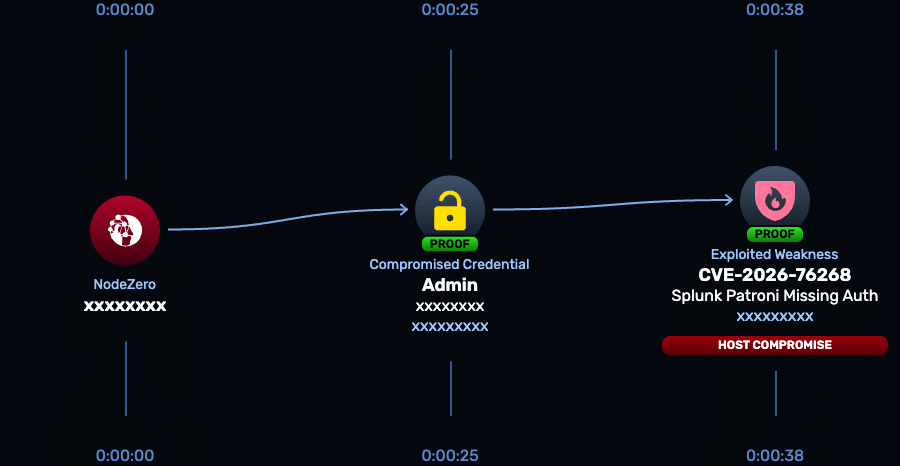
CVE-2026-76268 is a critical (CVSS 9.8) missing authentication flaw (CWE-306) in the Patroni REST API on Splunk Enterprise search head cluster members. An unauthenticated attacker with network access can run operating-system commands. Affected: 10.4.0 to 10.4.2 and 10.2.0 to 10.2.6. Fixed in 10.4.3 and 10.2.7. Splunk (SVD-2026-1001, 7 October 2026) suggests disabling the PostgreSQL sidecar as a workaround.
SplunkPatroniPostgreSQL+1
CVE-2026-76268CWE-306SVD-2026-1001+1
Offensive Security, Cloud & InfraΒ· Added 29 Oct 2026, published 22 Oct 2026
CVE-2026-114625 is a critical (CVSS 3.1 9.9) SQL injection in on-prem Arista VeloCloud Orchestrator, the SD-WAN management portal, covered in Arista Security Advisory 0199 of 22 October 2026. Any authenticated user, even the lowest Enterprise Read Only tenant role, can become a local superuser operator, and Arista says it is exploited in the wild. On-prem fixes are 5.2.3.18, 6.1.3.10 and 6.4.2.12; two attacker IPs are listed.
Arista VeloCloud OrchestratorCVSS
CVE-2026-114625CWE-8974.82.197.86+2
Threat Intel, AppSecΒ· Added 24 Oct 2026, published 22 Oct 2026
CVE-2026-113380 (CVSS 9.3) is a flaw in RingRTC, the WebRTC-based library behind Signal voice and video calls. A remote peer can flood the call's finite state machine event queue, so the victim's hang-up waits behind junk and audio and video tracks stay live. Fixed in RingRTC 2.72.0 on 4 September; a researcher published details and a conceptual PoC afterward.
SignalRingRTCWebRTC+2
CVE-2026-113380NIST
Mobile Security, AppSecΒ· Published and added 22 Oct 2026
Phoronix reports that Trend Micro's Zero Day Initiative mistakenly sent several Linux kernel vulnerability reports to the public kernel mailing list instead of the private security list. They include two CVSS 9.0 remote code execution bugs (SMB Direct integer underflow, ksmbd race condition), a skb_zerocopy local privilege escalation, a vmwgfx out-of-bounds write, an NVMET information disclosure and a search-domain TCP stack buffer overflow. Some have patches in -next branches, and none were yet in mainline.
Linux kernelksmbdSMB Direct+3
ZDI-CAN-33549ZDI-CAN-33774ZDI-CAN-33367+10
Cloud & Infra, otherΒ· Added 23 Oct 2026, published 22 Oct 2026
CyberForge CVE of the Day #084 analyses CVE-2026-76466, a CVSS 9.8 flaw in clustered Cisco Expressway-C and Expressway-E. Persistent database cookies and weak client-certificate validation allow root OS command execution over the network. The fix is X15.5.20 (X14 and earlier must migrate), with no workaround. It adds a per-peer SOC investigation trail, reachability checks and exposure status from CISA SSVC, KEV and EPSS.
Tweet by Gal Nagli (galnagli) saying a Gemini model turned the GitLab advisory for CVE-2026-110264 into a working heap exploit in 17 minutes, with the full chain done in about another hour. The flaw is a CVSS 10.0 unauthenticated RCE on self-managed GitLab servers, affecting 12 years of releases, found by joaxcar. The post links a The Hacker News article and gives no technical details of the exploit.
GitLabGeminiCVSS
CVE-2026-110264Gal Naglijoaxcar+1
Offensive Security, AI Security, AppSecΒ· Added 23 Oct 2026, published 22 Oct 2026
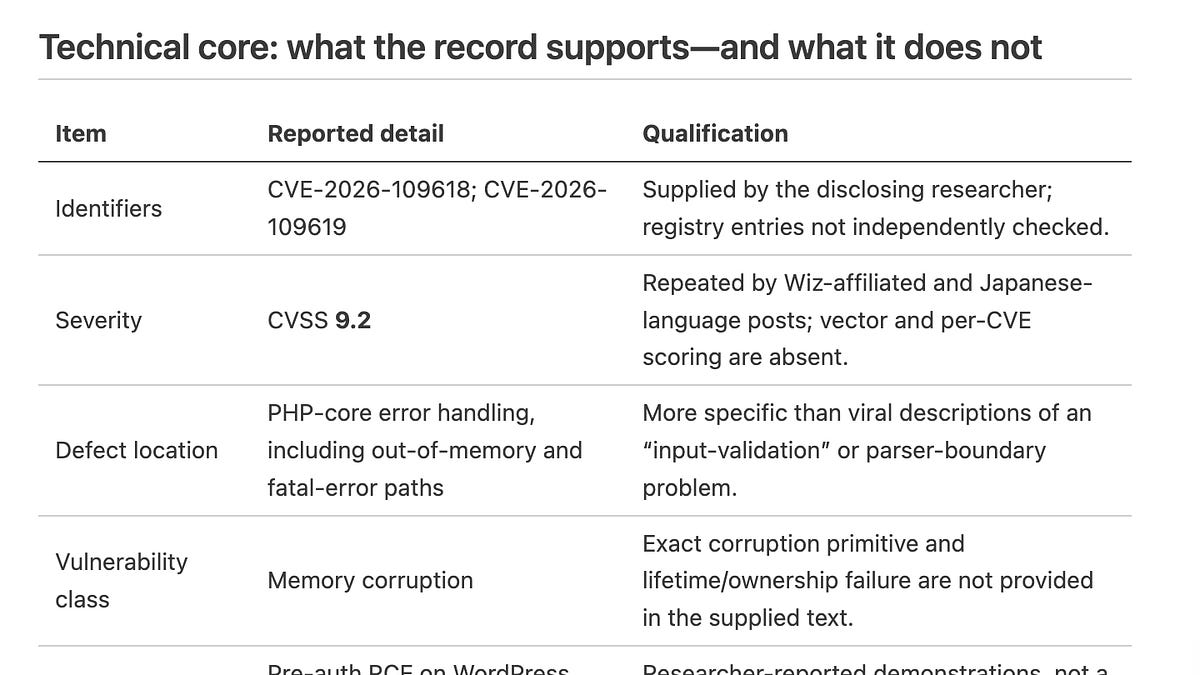
AINews issue of 20-21 October 2026 whose top story reconstructs PHP2Shell (CVE-2026-109618, CVE-2026-109619), two PHP-engine memory-corruption bugs with reported pre-auth RCE against WordPress, Drupal and Joomla. It covers the two-month coordinated disclosure, independent discovery by Calif/OpenAI (GPT-5.6 Sol) and Wiz, Cloudflare WAF stopgaps and NSA guidance. It flags missing primary sources: fixed versions, CVSS and leak details.
PHPWordPressDrupal+3
CVE-2026-109618CVE-2026-109619PHP2Shell+9
AppSec, AI SecurityΒ· Published and added 22 Oct 2026
Snyk's write-up of two critical unauthenticated PHP runtime RCEs, CVE-2026-109618 (out-of-memory corruption) and CVE-2026-109619 (stale global state, cross-request use-after-free), both CVSS v4.0 9.2. Fixed in PHP 8.5.12, 8.4.27, 8.3.36 and 8.2.35 on 21 October 2026. It covers the disclosure timeline, affected SAPIs (mod_php most exposed), backports for 8.1 and older, and partial mitigations.
VirusTotal sizes the internet-facing PHP footprint around CVE-2026-109618 and CVE-2026-109619 (CVSS v4.0 9.2, session.upload_progress) using Internet Scanning. About 5.1M IPs run PHP, roughly 4 in 5 hide their version, and ~758K disclose an end-of-life branch. It gives queries that use the SSH banner to match leaked LiteSpeed lsphp 8.2.34 builds, plus mitigations.
PHPVirusTotalCloudflare+3
CVE-2026-109618CVE-2026-109619NOX Stealer+3
Blue Team & Detection, OSINT, AppSecΒ· Added 22 Oct 2026
AWS Security Blog guide to mitigating the PHP2Shell unauthenticated RCE flaws (CVE-2026-109618 and CVE-2026-109619, CVSS v4.0 9.2) with AWS WAFv2 rules. It covers rules for the PHP_SESSION_UPLOAD_PROGRESS trigger, blocking multipart/form-data, body size caps and rate limits, plus body inspection limits. It lists PHP fixes (8.5.12, 8.4.27, 8.3.36, 8.2.35) and server settings, and stresses WAF only reduces exposure.
AWS WAFPHPAWS+1
CVE-2026-109618CVE-2026-109619PHP2Shell+4
Cloud & Infra, Blue Team & Detection, AppSecΒ· Published and added 22 Oct 2026
Oracle Security Alert for CVE-2026-91403 ships Java SE updates that distrust a set of intermediate CA certificates tied to eMudhra. It contains one new patch for Oracle Java SE, described as remotely exploitable without authentication. Customers are told to update Java or apply mitigations listed at ops.java/emudhra and in the Patch Availability Document. No reporter is credited and the page gives no CVSS score or technical detail.
JavaCVSS
CVE-2026-91403eMudhra
Cloud & Infra, AppSecΒ· Added 23 Oct 2026, published 21 Oct 2026

Simon Willison's link post on the 21 October 2026 PHP security release, which fixes two remote code execution flaws across the PHP 8.x line. The CVE IDs leaked on 20 October with a wrong CVSS of 10.0 (actual 9.2), and Calif accidentally published a proof-of-concept video. It also gives Wiz Research's timeline, with unauthenticated RCE confirmed against Drupal and WordPress in August 2026.
PHPWordPressCVSS+1
Wiz ResearchCalifPHP Foundation+3
AppSec, Threat IntelΒ· Published and added 21 Oct 2026
PHP2Shell is a pair of critical PHP core flaws, CVE-2026-109618 (out-of-memory corruption) and CVE-2026-109619 (stale global state), both CVSS 9.2 and giving unauthenticated RCE, confirmed on Apache with mod_php. Fixes shipped in PHP 8.5.12, 8.4.27, 8.3.36 and 8.2.35, with backports for 7.4 to 8.1. Exploitation attempts were reported by watchTowr, Hadrian, Patchstack, Cloudflare and Vega after a leak moved disclosure up from 22 October 2026 to one day earlier.
PHPApachemod_php+3
CVE-2026-109618CVE-2026-109619PHP2Shell+9
AppSec, Threat IntelΒ· Published and added 21 Oct 2026
Decrypt reports on CVE-2026-109618 and CVE-2026-109619, two PHP flaws rated CVSSv4 9.2 that allow unauthenticated remote code execution. PHP 8.5.12, 8.4.27, 8.3.36 and 8.2.35 shipped on 21 October 2026 after an early leak and Cloudflare-observed attacks. The article covers the memory-handling root causes, mod_php and upload-progress exposure, government site shutdowns, affected version range (PHP 5.4 and later per Sansec), and patch guidance.
PHPCloudflareWordPress+1
CVE-2026-109618CVE-2026-109619PHP Foundation+7
AppSec, Threat IntelΒ· Published and added 21 Oct 2026
PHP2Shell is a pair of memory-safety flaws in the PHP engine, CVE-2026-109618 and CVE-2026-109619 (CVSS v4.0 9.2), fixed on 21 October 2026 in PHP 8.5.12, 8.4.27, 8.3.36 and 8.2.35. Unauthenticated requests can reach code execution, most readily through Apache mod_php, and Cloudflare reports active attack traffic. The post covers W3Techs data showing about 48.5% of PHP sites on end-of-life branches, the leak timeline, and the need to patch the runtime itself.
PHPCloudflareWordPress+2
CVE-2026-109618CVE-2026-109619PHP2Shell+5
AppSec, Threat IntelΒ· Published and added 21 Oct 2026
Cisco Talos advisory on "php2shell", two unauthenticated RCE flaws in PHP core, CVE-2026-109618 and CVE-2026-109619 (CVSS v4.0 9.2), affecting every build since PHP 5.4. One flaw is an out-of-memory handling bug leaving request data partly initialized; the other reuses stale state after free. PHP 8.1 and older get no patch (about 50% of PHP systems). Includes ini-level mitigations and Snort SIDs 67359 and 67360. No exploitation seen as of 21 October 2026.
PHPWordPressCVSS
CVE-2026-109618CVE-2026-109619php2shell+2
AppSec, Blue Team & DetectionΒ· Published and added 21 Oct 2026
PHP2Shell is the name for CVE-2026-109618 (out-of-memory corruption) and CVE-2026-109619 (stale global state), two unauthenticated PHP remote code execution flaws rated CVSS 4.0 9.2. Details leaked before the 21 October 2026 patch release, and watchTowr's honeypots saw exploitation. The page lists fixed versions (8.5.12, 8.4.27, 8.3.36, 8.2.35), states that .ini mitigations do not work, gives a timeline, and describes compromise checks.
PHPApacheFrankenPHP+2
CVE-2026-109618CVE-2026-109619PHP2Shell+3
AppSec, Threat IntelΒ· Added 28 Oct 2026, published 21 Oct 2026

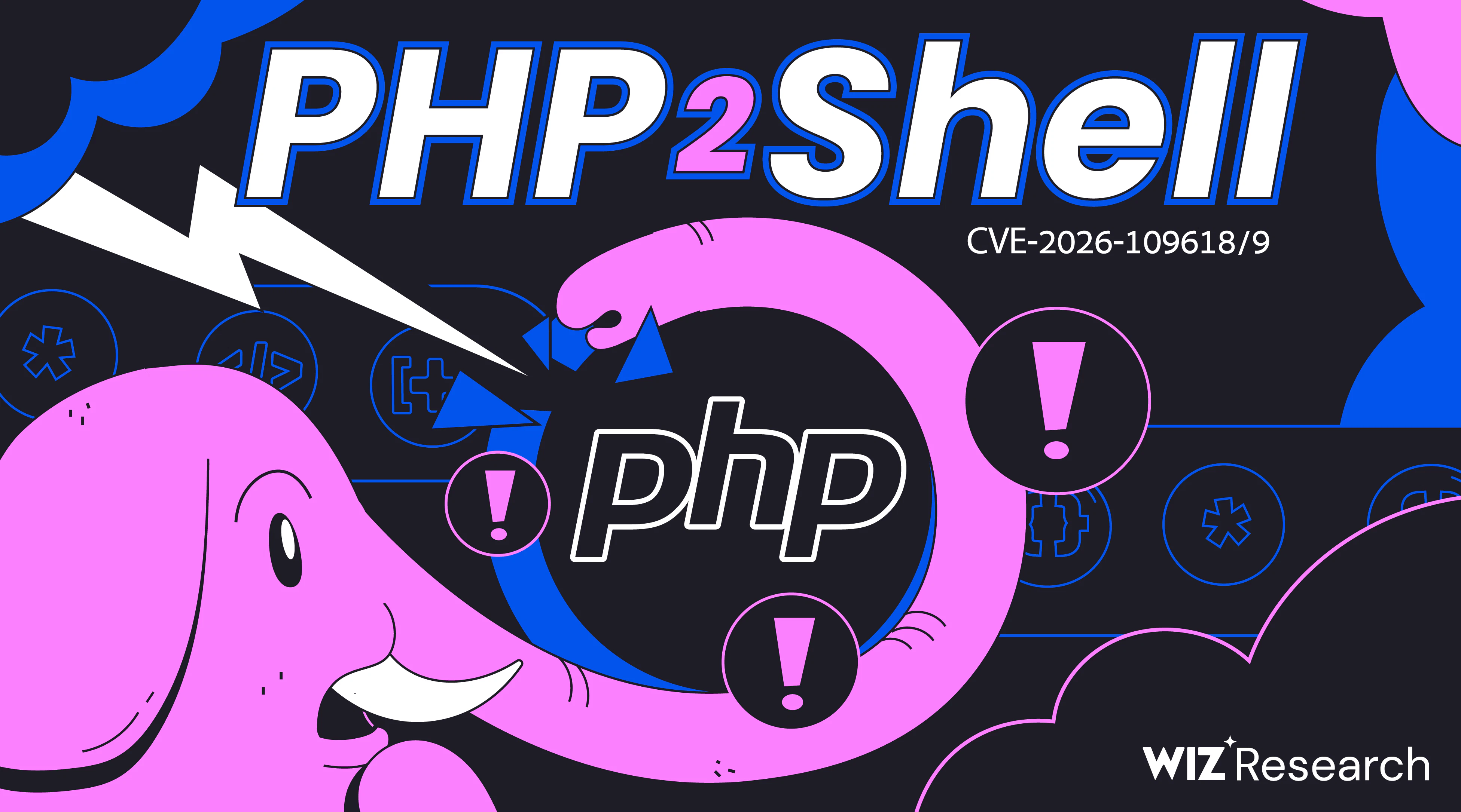
PHP2Shell is the informal name for CVE-2026-109618 and CVE-2026-109619 (CVSS v4.0 9.2), unauthenticated remote code execution flaws in the PHP core runtime. Patches for branches 8.2 to 8.5 were scheduled for 21 October at 14:00 UTC, while PHP 8.1 and older get no fix; about 884,000 internet-facing hosts run those versions. watchTowr reproduced CVE-2026-109618, no public PoC existed at writing, and Sansec expects mass exploitation within 15 minutes of release.
PHP2Shell is Wiz Research's disclosure of memory-safety bugs in core PHP, grouped under two CVEs (up to CVSS 9.2) and fixed in patched releases on 21 October 2026. The post details four bugs, all triggered by out-of-memory fatal errors that leave stale state: an upload-progress unserializer use-after-free, a session-ID memory disclosure, a fatal-error backtrace use-after-free and an OPcache type confusion. It describes unauthenticated RCE on WordPress, Drupal and Joomla, plus detection signals and a disclosure timeline.
PHPWordPressDrupal+3
PHP2ShellWiz ResearchCalif+6
AppSec, Offensive Security, AI SecurityΒ· Published and added 21 Oct 2026

CVE-2026-110936 is an uncontrolled DLL search path flaw (CWE-427) in Siemens Software Center below V4.0.9.8, listed in CISA KEV on 20 October 2026. The post covers CVSS v4.0 8.4 and v3.1 6.7, Siemens' Romulus ClickFix campaign indicators (IPs, domain, hashes, file leads) and a six-step SOC trail using Sysmon, EDR and network records. It separates delivery from DLL load and from compromise.
Siemens Software CenterWindowsSysmon+3
CVE-2026-110936CWE-427DLL search order hijacking+10
Blue Team & Detection, Threat IntelΒ· Added 24 Oct 2026, published 21 Oct 2026
PHP2Shell is the name given to two critical PHP flaws, CVE-2026-109618 and CVE-2026-109619 (CVSS 9.2 each), that could allow unauthenticated remote code execution. Details leaked before PHP's planned patch release on 21 October 2026 at 14:00 UTC. Reports say all versions from PHP 5 onward are affected and one flaw may be a use-after-free; watchTowr reproduced CVE-2026-109618, and Sansec expects mass exploitation within 15 minutes of the patch.
PHPCVSS
CVE-2026-109618CVE-2026-109619PHP2Shell+4
AppSec, Threat IntelΒ· Published and added 21 Oct 2026
Huntress rapid-response post on php2shell, two leaked critical PHP core vulnerabilities (CVE-2026-109618 and CVE-2026-109619, CVSS v4.0 9.2 each) reported as remote code execution. The PHP team moved its security release to 21 October 2026, 14:00 UTC, after the leak. It lists hunting cues such as php-fpm, php-cgi or apache2 spawning shells, interpreters or download tools, plus inventory and patch steps. No root cause, affected versions, PoC or IOCs were public at writing.
PHPHuntressWordPress+2
CVE-2026-109618CVE-2026-109619php2shell+4
Blue Team & Detection, Threat Intel, AppSecΒ· Published and added 21 Oct 2026
PHP2SHELL is Aikido Security's advance notice of two critical remote code execution flaws in PHP itself, CVE-2026-109618 and CVE-2026-109619, both CVSS v4.0 9.2, with all versions treated as affected. The PHP security team will release fixes at 14:00 UTC on 21 October 2026, a day early after details leaked on 20 October. The post withholds exploitation details and workarounds.
PHP2Shell is Datadog Security Labs' analysis of two critical PHP RCE flaws, CVE-2026-109618 and CVE-2026-109619 (CVSS v4.0 9.2), disclosed 21 October 2026. It walks through a reproduced exploit on PHP 8.5.11 (heap grooming, a fake array, and a destructor calling system()) and the stale-state use-after-free. It lists fixed versions (8.2.35, 8.3.36, 8.4.27, 8.5.12), partial mitigations, and detection signals across requests, error logs and shell child processes.
PHPApacheCVSS+1
CVE-2026-109618CVE-2026-109619PHP2Shell+5
AppSec, Blue Team & Detection, Offensive SecurityΒ· Added 29 Oct 2026, published 21 Oct 2026
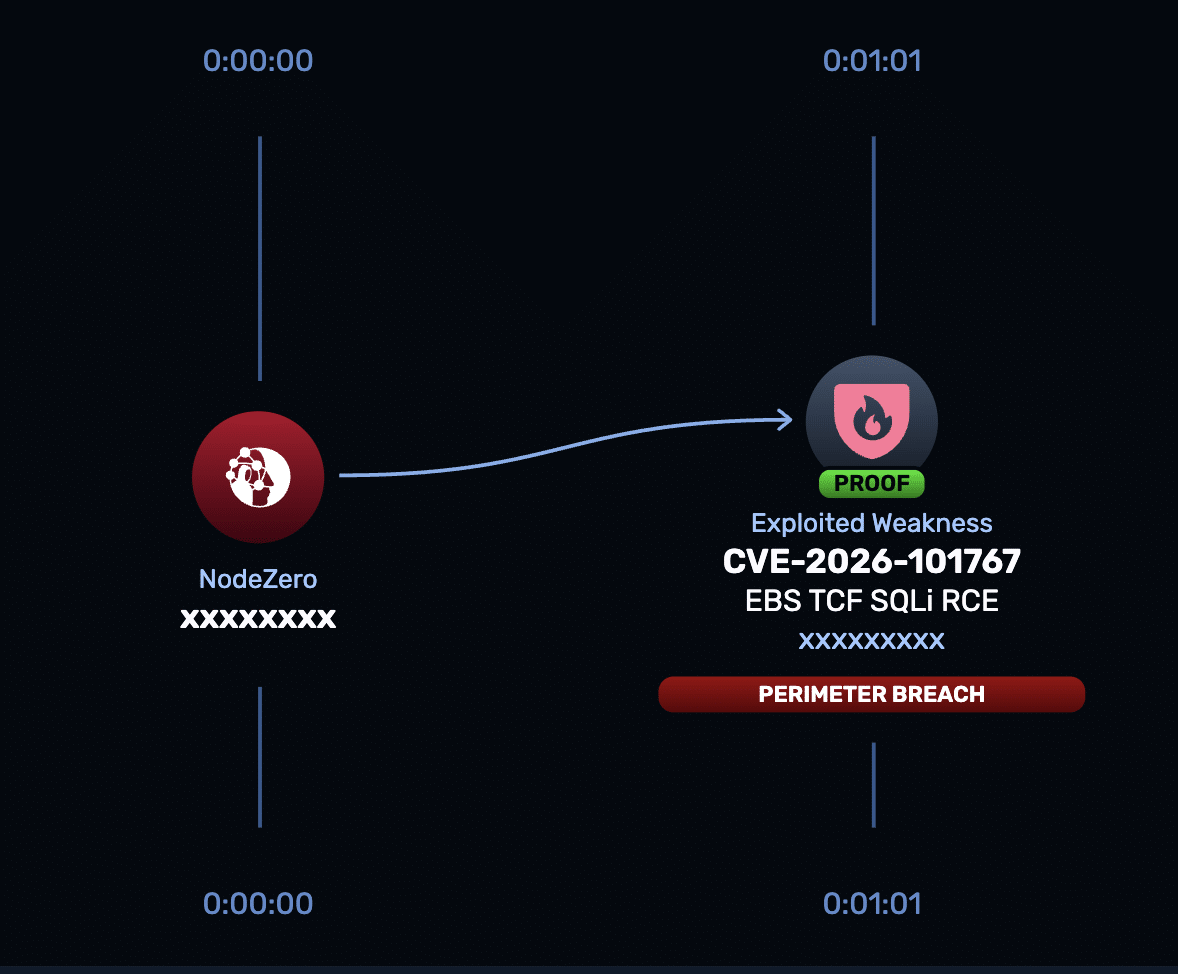
CVE-2026-101767 is an unauthenticated SQL injection in the Oracle E-Business Suite Thin Client Framework servlet (/OA_HTML/AppsTCFServer, oracle.apps.fnd.tcf.SocketServer), CVSS 3.1 9.8. It runs SQL as the APPS user and chains to OS commands as the EBS account. Affects 12.2.3 to 12.2.15, fixed in the Oracle October 2026 CPU (20 October 2026). The page lists mitigations, IOCs and a timeline.
Oracle E-Business SuiteCVSS
CVE-2026-101767CWE-89Horizon3.ai+3
AppSec, Offensive Security, Blue Team & DetectionΒ· Added 29 Oct 2026, published 20 Oct 2026