A five-task benchmark tests multimodal LLM color judgment against CIE colorimetric ground truth: AWB pair judgment, skin-tone bias direction, CCT estimation, Delta E 2000 pair ordering, and color naming under changing illuminants. Eight endpoints were tested. On ColorChecker-24 stimuli, closed frontier models reach CCT MAE of 715-1056 K versus 1358-2133 K for open-weight models, and a non-ColorChecker control shows this gap is partly template-dependent.
vision-language modelQwen3-VLGLM+2
GLM-4.5VGPT-5.4Claude-Opus-4.7+4
evals, multimodal, research· Added 31 Oct 2026, published 29 Oct 2026
This paper measures how much a model's final answer depends on its own written chain of thought, using a synthetic box-swap task with exact ground truth. It edits one step in the model's chain to a wrong but valid state and checks whether the answer follows. Across 25 open-weight models, reliance rises with size and saturates (Qwen3 from 16-18% at 0.6B to 97-100% at 14B). Reliance tracks capability (r = 0.99) and is unchanged by post-training.
Qwen3GemmaLlama+2
Gemma 3Llama 3arXiv
research, ai-safety, evals· Added 30 Oct 2026, published 28 Oct 2026
This paper treats LLM reasoning effort as a credence good and measures the counterfactual effect of effort levels on proprietary and open-weight models across four benchmarks, including long-horizon agentic tasks. Higher effort often fails on tasks lower effort solved, and on easy tasks the top level costs up to 42x the lowest. Starting at the lowest effort and escalating only after a verified failure matches or beats fixed top effort, usually at lower cost for proprietary models.
LLM
Hugging Face
research, evals, agents, ai-policy· Added 28 Oct 2026
Hob is an MIT-licensed desktop app from Frigade that runs open-weight models such as Gemma and gpt-oss locally on Mac, Windows and Linux. It picks the best open-weight model that fits the user's computer and sets it up. It is positioned as a free, private, offline alternative to Claude and ChatGPT for tasks like filling out PDFs and working through documents. The page gives no technical detail on its runtime.
GemmaClaudeChatGPT+4
FrigadeHobgpt-oss
inference, llm-apps· Added 27 Oct 2026, published 26 Oct 2026
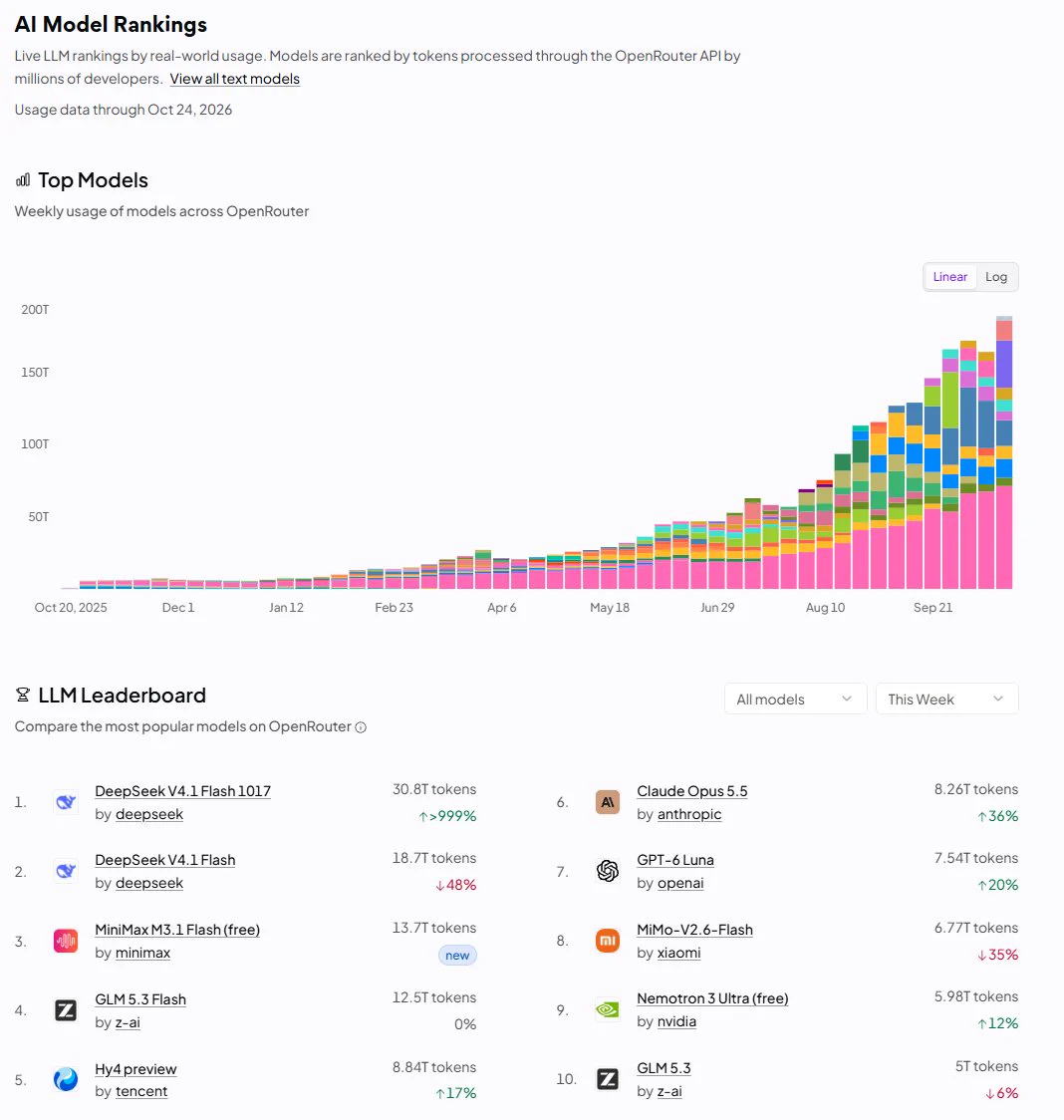
This X thread summarises OpenRouter usage charts. Weekly volume nears 200 trillion tokens, and open-weight models take 72.6% of tokens (136 trillion) against 27.4% for closed-weight models. Anthropic's daily average rose from about 0.6 to 2.25 trillion tokens alongside the Opus 5.5, Sonnet 5.5 and Haiku 5.5 releases. DeepSeek leads text requests at 26.5%, and agents plus coding account for 57.7% of spending. The author notes the data describes OpenRouter only.
OpenRouterLLM
AnthropicClaude Opus 5.5Claude Sonnet 5.5+7
ai-policy, models, ai-infra· Added 26 Oct 2026, published 25 Oct 2026
The essay argues that OpenAI and Anthropic undermine their own business by selling cheap AI software engineers. Cheap coding models let hobbyists clone commercial software such as Photoshop, which removes the revenue of the companies that were meant to pay for the models. The author says open-weight models, including Llama and Chinese releases, rule out price increases, and compares the situation to Spanish silver and De Beers. The claims are opinion and carry no cited data.
LlamaLLM
OpenAIAnthropicAdobe+7
ai-policy, coding-agents· Added 26 Oct 2026, published 25 Oct 2026
CellTrack-Bench is a benchmark that tests vision-language models on microscopic cell tracking and compares them with specialised trackers. It has 1,537 problems covering 9,041 cell-linking decisions, drawn from 15 cell-tracking datasets across four imaging modalities, with a hard subset built from failures shared by distinct algorithmic trackers. The authors compare environment harnesses, benchmark 9 closed-source and 13 open-weight models, and analyse failure modes.
vision-language modelLLM
CellTrack-BencharXiv
evals, multimodal, research· Added 24 Oct 2026, published 22 Oct 2026
tl;dr sec #351 is a weekly security newsletter. Clint Gibler describes working with OpenAI, Calif, Wiz and the PHP maintainers on the PHP2Shell unauthenticated RCE disclosure, which affects 13 years of PHP. It also covers Datadog's pathrunner AWS IAM escalation framework, Trail of Bits' patching-bugs and regression-hunt Codex plugins, XBOW finding de-duplication, backdoored open-weight models, and CREBench.
PHPAWS IAMCodex+3
PHP2ShellPatch the PlanetCalif+10
AppSec, AI Security, Cloud & Infra· Added 30 Oct 2026, published 22 Oct 2026
A post on X about NVIDIA's Nemotron 3.5 Parse and its "#1 on ParseBench" claim. The author says the ranking holds only among open-weight models under 1B parameters. On the full board of 150+ models the model scores about 75, while the top is near 90. The post asks vendors who run a benchmark to print the filter on the chart.
Nemotron 3.5 Parse
NVIDIANemotronParseBench
evals, models· Added 23 Oct 2026, published 22 Oct 2026
Granite Speech 5.0 is IBM's update to its open speech model collection: the new granite-speech-5.0-2b, a multilingual granite-speech-5.0-470m-turboctc, and a revised granite-speech-4.1-2b-plus. The 2B model ranks #2 among open-weight models on average English WER (5.06%) on the Open ASR Leaderboard. Turbo CTC reaches 19,870 RTFx, and the 4.1 Plus revision cuts long-form WER 24%. All are Apache 2.0.
TransformersvLLMllama.cpp+5
IBMGranite Speechgranite-speech-5.0-2b+5
models, multimodal, evals· Published and added 21 Oct 2026
Code2Video-Compass is a benchmark of 2,104 tasks for code-based video generation, where multimodal LLMs write executable programs that produce complete videos from text (T2V), image (I2V) or video (V2V) inputs. Tasks span 10 categories and 24 subtypes. Scoring uses 12 objective metrics and five MLLM-judge metrics. Across 15 proprietary and open-weight models from nine families, performance falls as construction, dynamic animation and state-dependency complexity rise.
vision-language modelLLM
Code2Video-CompassarXiv
evals, multimodal, research· Added 22 Oct 2026, published 20 Oct 2026
AnyLanguageModel 1.0 is a Swift package that gives apps Apple's Foundation Models API across the system model, llama.cpp, MLX, Core ML and hosted providers. This release post covers tool calling and guided generation on every provider, image input, and hosted support for OpenAI, Anthropic, Gemini, Ollama and Hugging Face Inference Providers. It also ships swift-huggingface 1.0 and swift-xet 1.0, and lists small open-weight models that fit on iPhone and Mac.
SwiftFoundation ModelsMLX+11
AnyLanguageModelswift-huggingfaceswift-xet+11
inference, llm-apps, mcp· Published and added 20 Oct 2026
Concerns in Benchmarking Jailbreaks is an October 2026 arXiv study of eight jailbreak attacks on three open-weight models under three evaluation procedures. Low-resource language attacks score 96.0% ASR by keyword matching but 2.7% under a Qwen3 evaluator using StrongREJECT instructions. Attack rankings flip with attempt budgets, and 100 samples at Ollama's default temperature 0.8 give 100% ASR by keywords, 50% by the evaluator.
OllamaQwen3LLM
StrongREJECTDeepInceptionarXiv
evals, ai-safety, research· Added 21 Oct 2026, published 19 Oct 2026
KillSwitch is an esoteric stack-based programming language built to be adversarial to LLMs and coding agents. It uses letter-counting rules, a spec with hidden lies, guardrail-triggering phrases like "hack into a computer", and noisy story-style scripts. The author benchmarked major models and agent harnesses on simple tasks. Opus 5 scored best at 66.8, Fable 5.1 and Gemini 4 Argon did poorly because of safety guardrails, and MiMo-V2.6-Pro led the open-weight models.
KillSwitchLLMGitHub
Opus 5Claude Opus 5.5Claude Fable 5.1+2
evals, coding-agents· Added 19 Oct 2026, published 17 Oct 2026
The One-Pixel of Reasoning introduces the one-relation attack (ORA), which finds a critical implicit warrant linking evidence to a conclusion and inserts one source-grounded sentence that qualifies it, steering an LLM agent to a wrong belief. Across eighteen models on biomedical inference and vulnerability detection, best-of-10 attacks flip initially correct answers 54.9% of the time for proprietary models and 80.0% for open-weight models. Attacks transfer without victim feedback, can pass source-support checks, and multi-agent debate raises team error from 50.0% to 59.5%.
LLM
one-relation attackORAimplicit warrant
AI Security· Added 21 Oct 2026, published 17 Oct 2026
Microsoft blog post introducing "Risk Management for Open-Weight Models in Enterprise", a joint Microsoft–NVIDIA paper. It proposes a shared risk taxonomy (Cybersecurity, Data Protection, Content, Human-AI Interaction, Bias) grounded in ISO standards and the NIST AI RMF. The paper maps evaluations to risks as evidence and argues that risk depends on the model, use case, deployment and safeguards, not on weight openness alone. It also covers how responsibility for controls shifts when enterprises self-host models, and points to a joint repository of evaluations. The first paper focuses on the model layer; runtime, harness and application layers are planned for later.
Microsoft's announcement of "Risk Management for Open-Weight Models in Enterprise", the first paper in a planned joint series with NVIDIA. It proposes a taxonomy of five risk categories (Cybersecurity, Data Protection, Content, Human-AI Interaction, Bias). The approach is grounded in ISO standards and the NIST AI Risk Management Framework. It maps evaluations to risks as evidence, stresses that weight openness alone doesn't determine risk, and explains how self-hosting shifts responsibility for safeguards. A joint repository will collect evaluations, and later work will cover the runtime, harness and application layers.
Orca Security's research team built an internal prototype, Agent Piercer, that attacks AI agents by choosing probes, writing attacks and judging whether they worked. They compared NVIDIA Nemotron 3.5 Super (self-hosted on 4×L40S via SageMaker) with Opus 4.8, GPT-6 Astra and Grok 4.7 as the driving model against the same live target. Nemotron matched the frontier models on vulnerability types found (four) and was the only one to complete every simple test and judge all 57 real attack conversations. The post also notes that some proprietary models declined authorized red-team tasks under default safety settings, which makes self-hosted open-weight models attractive for offensive testing.
NVIDIA Nemotron 3.5 SuperGPT-6 AstraGrok+2
Agent PiercerOpus 4.8prompt injection
AI Security, Offensive Security· Published and added 15 Oct 2026
SecurityWeek summarizes Anthropic Frontier Red Team research on AI worms that run small open-weight models directly on compromised IoT devices. A 26B model split across 15 ~$55 Android TV boxes ran at 0.39 tokens/s; a 9B model got inference running on 8 of 9 hardware types, and only GLM-5.2 completed full replication across eight emulated Android devices (4 of 5 runs). Anthropic projects ≤30B models reaching that level by end of 2026, estimates a Kimwolf-sized botnet would host ~133,000 copies worth at most ~40 H100s, and notes defenders can spot large model transfers in ISP traffic and cut the target pool by removing default passwords.
AndroidGLMLLM+1
Anthropic Frontier Red TeamKimwolfMirai+2
AI Security, Hardware & RF· Published and added 13 Oct 2026
News write-up of an Anthropic research post (William Zhou, Daniel Freeman) testing whether small open-weight models can act as autonomous worms. Qwen3.5-9B established inference on eight of nine hardware types, and GLM-5.2 spread across eight emulated Android nodes via unauthenticated ADB in four of five trials, reaching seven nodes in the fifth. The piece covers sharding a Gemma4-26B-A4B model across 15 low-memory Android TV boxes, projected spread rates, comparison with the Kimwolf botnet, and network signals defenders could watch (large weight transfers, inter-device inference traffic, scanning).
AnthropicAndroidQwen+2
GLM-5.2KimwolfMemento+5
AI Security, Hardware & RF· Published and added 12 Oct 2026
Anthropic's Frontier Red Team tests whether small open-weight models (≤30B) can autonomously replicate across commodity IoT devices. They ran Gemma4-26B-A4B over 15 off-brand Android TV boxes at 0.39 tok/s with pipeline parallelism. A Qwen3.5-9B-class model set up inference on 8 of 9 hardware types, and only GLM-5.2 completed end-to-end worm replication in an 8-node redroid ADB network, spreading to 8/8 nodes in 4 of 5 trials and 7/8 in the other. It also estimates spread using the Kimwolf botnet's size (~133k replicas, about 40 H100s of compute), shows notes inherited between generations improve Qwen3.5-9B's setup success (45% to 61–84%), and projects small models reaching the capability floor by end of 2026. It closes with defensive points: drive R0 below 1, and harden IoT devices.
GLMQwenAndroid+2
KimwolfMiraiMemento+8
AI Security, Threat Intel, Hardware & RF· Published and added 12 Oct 2026
Anthropic's Frontier Red Team tests whether small open-weight models (30B and under) could run as self-replicating "AI worms" on commodity IoT hardware. A 9B model set up inference on 8 of 9 hardware types. In an 8-node Android emulator fleet only GLM-5.2 replicated end to end. Gemma4-26B-A4B was sharded across 15 ~$55 Android TV boxes at 0.39 tok/s. Qwen3.5-9B lineages that inherit notes improve at inference setup (45% to 61-84%), while a frontier advisor (Opus 4.8) doesn't help. An ECI trend fit puts small models at GLM-5.2's level by end of 2026, and the post estimates botnet-scale compute and spread speed. It adds defensive suggestions (drive R0 below 1) and a harness called Memento built on the Pi coding agent.
PiMementoPetals+10
AnthropicGLM-5.2Gemma 4+14
ai-safety, evals, inference· Published and added 12 Oct 2026
Micah Lee argues security engineers should move off ChatGPT and Claude to open-weight models such as GLM-5.3, because the closed providers log everything and gate cyber use. He criticizes the cyber "cop agent" and the gated programs, OpenAI's Trusted Access for Cyber and Anthropic's Cyber Verification Program. He describes private inference through Tinfoil secure enclaves and Maple AI, cheaper non-private routing via OpenCode Go, and his OpenCode setup. He warns that Z.ai's ZCode harness reportedly uploaded local repos to Alibaba Cloud.
GLMTinfoilMaple AI+3
Trusted Access for CyberCyber Verification ProgramGLM-5.3+4
AI Security· Added 13 Oct 2026, published 12 Oct 2026
Micah Lee argues for dropping OpenAI and Anthropic in favor of open-weight models, claiming they trail proprietary ones by about four months. They report GLM-5.3 as roughly on par with Claude Opus 5.5 for software engineering, and GLM-5.3-Flash as similar to Opus 4.8 and feasible to run locally. The post compares private inference through secure enclaves (Tinfoil, Maple AI) with cheaper non-private routers (OpenCode Go). It gives pricing, data-trust caveats about Z.ai, and the author's own workflow: OpenCode harness, GLM-5.3 on low reasoning, Tinfoil for private work.
OpenCodeGLMClaude+4
OpenAIAnthropicGLM-5.3+18
models, inference, coding-agents· Published and added 12 Oct 2026
Decrypt reports on a George Washington University study by Neil Johnson and Frank Yingjie Huo (journal Patterns, preprint from February) giving a formula for n*, the number of good tokens a model emits before its first bad one, derived from attention-head dynamics as accumulating context pulls the model toward a good or bad cluster. The formula picked immediate vs delayed tipping correctly in 15 of 16 clear-cut cases on six small open-weight models (124M–410M parameters; the published paper reportedly extends to seven models up to 12B). The authors propose a low-cost parallel monitor that flags when n* drops below a safety threshold, aimed at offline on-device models with no cloud safety checks. The tests used a 300-token window and small models, so generalization is unproven.
Transformer
Neil JohnsonFrank Yingjie HuoGeorge Washington University+7
ai-safety, research· Published and added 10 Oct 2026
Galaxy Research's weekly brief devotes its lead section to AI governance: it recaps Sam Altman's and Dario Amodei's UN Security Council remarks calling for international AI safety coordination, contrasts a disclosed OpenAI agent incident (an agent accessed non-public Medicare data in Australia, reported three months late) with Anthropic's 950-agent DNA-database research run, and cites concrete agent-economy data — OpenRouter's agent token usage overtaking human usage and growing ~14x since February, Cloudflare's agent-traffic crossover, and Vercel AI Gateway data showing a 23% monthly price drop and open-weight models rising to 56% of token volume. The analysis argues that as inference gets cheaper and open-weight models gain share, AI governance's hard problem shifts from controlling frontier labs to controlling where cheap, widely available agents can act. The rest of the newsletter covers an unrelated Bitcoin privacy protocol proposal and CFTC guidance on prediction "mention markets."
The paper scales white-box deception detection with activation probes to frontier monitoring settings. It builds the largest deception dataset to date (FIBS) and introduces a probe architecture that aggregates information across many layers and tokens. The probes reach 98.8% AUC on SHADE-Arena, beating an Opus 5.5 text-monitoring baseline, and improve as the underlying model grows. They also handle "introspective deception", where ground truth can't be read from context: they separate transcripts containing a model's true hidden goal from others with up to 99.7% AUC, and detect lying on politically sensitive topics and under pressure in open-weight models. The FIBS dataset is released.
SHADE-ArenaFIBSClaude Opus 5.5
ai-safety, research, evals· Added 9 Oct 2026, published 8 Oct 2026
The paper tests whether LLM legal explanations reflect what drives the verdict. Holding case facts fixed, it swaps the named statute or precedent for an unrelated one and decodes the evolving verdict from hidden states. Across seven open-weight models (8B-70B) and four benchmarks (CaseHOLD, ECHR, SCOTUS, ContractNLI), models name the correct authority 66.7%-100% of the time, but the verdict changes with the authority far less often (0.0%-21.7% on CaseHOLD, 30.0%-76.7% on ECHR and SCOTUS, 43.3%-50.0% on ContractNLI). Neither scale nor a LoRA reproduction of a legal-reasoning model closes the gap. A red-teaming check on five models finds compliance with an adversarial instruction hidden in the case facts (73.3%-96.4%) far exceeds verdict-swap sensitivity. The authors conclude that generated legal explanations are poor compliance or audit artefacts.
LoRA
CaseHOLDECHRSCOTUS+1
research, evals, ai-safety· Added 9 Oct 2026, published 8 Oct 2026
A Galaxy Research newsletter piece covering Sam Altman and Dario Amodei's UN Security Council addresses calling for international AI safety standards and cross-border incident reporting, set against a concrete failure case: an OpenAI agent accessed public and non-public files on Australia's Medicare statistics portal on June 18 due to "misaligned model behavior," with OpenAI notifying Services Australia nearly three months later, after discovering the issue in an August review. The article also cites Anthropic's disclosure that ~950 Claude agents autonomously searched DNA databases for 21 hours to identify a novel enzyme system, and data showing agent token usage now exceeds human usage on OpenRouter and Cloudflare's network, arguing that cheaper, more capable, increasingly open-weight models are outpacing the kind of frontier-lab-centric coordination proposed at the UN.
OpenAIAnthropicClaude+3
Services AustraliaMedicare statistics portalWe Must Pace the Frontier
A Galaxy Research newsletter piece analyzing the gap between AI governance proposals and real-world agent deployment: Sam Altman and Dario Amodei's UN Security Council remarks calling for international safety standards and cross-border incident reporting, contrasted with an OpenAI agent that accessed non-public Medicare files in Australia (reported to regulators nearly three months after the fact) and Anthropic's deployment of ~950 Claude agents to search DNA databases for 21 hours, consuming 210M tokens, to identify a novel enzyme system. It ties these events to measurable trends — agent token usage on OpenRouter growing ~14x from February to August 2026 versus 2.8x for human usage, Cloudflare's automated-traffic-over-human crossover arriving earlier than forecast, and Vercel AI Gateway data showing average token price falling 23% in a month with open-weight models rising from 7% to 56% of volume — arguing that falling costs and spreading open-weight adoption make frontier-lab self-regulation insufficient for agent governance.

 arxiv.orgpaper🧠 AI