Skip to content

67 results for “Oracle”

What you seeeverything
“Oracle”
arxiv.orgpaper🧠 AI

Efficient Scalable Oversight via Rewinding

Rewindable interactive proofs (RIPs) are a new model of relativizing interactive proofs for scalable oversight, in which a weak verifier can rewind an AI prover to an earlier saved state. The paper builds an RIP for computations robust to changes in a small fraction of oracle answers. The honest prover runs in linear time, the verifier runs in nearly linear time in the input length after one-time preprocessing, and no cryptography is used. A preliminary MNIST experiment shows an RIP can be faster than a deployed proof system.

rewindable interactive proofsdebaterelativizing interactive proofs
arXivMNIST

research, ai-safety· Added 31 Oct 2026, published 29 Oct 2026
orca.securityadvisory🛡️ Security

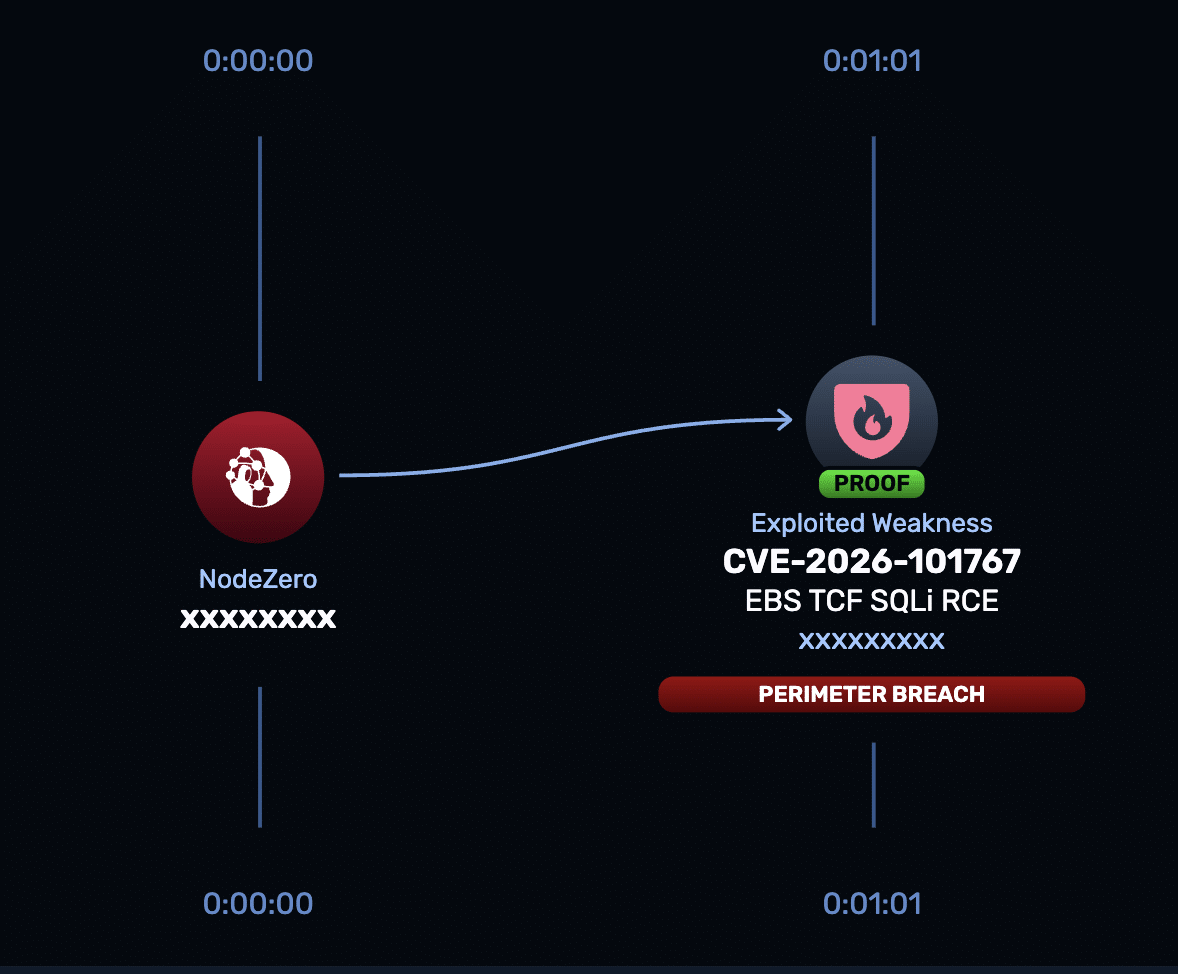
CVE-2026-101767: Critical Oracle EBS SQL Injection Actively Probed in the Wild

CVE-2026-101767 is a CVSS 9.8 unauthenticated SQL injection in Oracle E-Business Suite's Application Object Library, reachable through the /OA_HTML/AppsTCFServer servlet (GanttDataServer) and chainable to OS command execution. It affects versions 12.2.3 to 12.2.15 and was fixed in the October 2026 Critical Patch Update. Horizon3.ai found it, and Defused saw probing on honeypots on 27 October 2026. Interim mitigation is removing the servlet from the URL firewall allowlist.

Oracle E-Business Suite
CVE-2026-101767Horizon3.aiDefused+5

AppSec, Threat Intel· Published and added 28 Oct 2026

arxiv.orgpaper🧠 AI

Repairs for Whom? Evaluator-Executor Mismatch in Selecting Repairs for Failed LLM Agents

Repairs for Whom? studies single-step repairs of failed LLM agent trajectories and asks whether common evaluators (greedy replay, stronger models, oracles, log-reading judges) pick repairs that help the deployed agent. Using independent rollouts in ALFWorld and WebShop, greedy replay loses 0.06-0.13 in expected gain, and Qwen2.5-14B rollouts misselect repairs for Qwen2.5-7B. The authors recommend verifying repairs with the executor that will run them.

LLMQwen
ALFWorldWebShopQwen2.5-7B+2

research, agents, evals· Added 30 Oct 2026, published 28 Oct 2026

securityweek.comarticle🛡️ Security

Hackers Start Probing Fresh Oracle EBS Vulnerability

CVE-2026-101767 is a CVSS 9.8 unauthenticated SQL injection in the Application Object Library of Oracle E-Business Suite, patched in Oracle's October 2026 CPU and reported by Horizon3.ai. Defused decoys logged the first exploratory attempts on 27 October 2026, and the flaw could lead to remote code execution. The article recalls CVE-2026-46817 attacks in June and last year's Cl0p zero-day campaign against EBS.

Oracle E-Business SuiteCVSS
CVE-2026-101767CVE-2026-46817Cl0p+4

Threat Intel, AppSec· Published and added 28 Oct 2026

x.comthread🧠 AI

Photon Capital (@PhotonCap) on X

Photon Capital's thread covers the 27 October 2026 NVIDIA and Oracle announcement of general availability of Vera Rubin NVL72 and Vera CPUs on OCI. It lists specs (Spectrum-6 at 102.4Tbps, HGX Rubin NVL8 with Xeon 6, 150,000 initial Vera CPUs) and OpenAI's use of Vera CPUs for agentic sandboxes. The commentary argues CPU capacity can cut cost per task and shorten KV cache residency in GPU memory.

Oracle Cloud InfrastructureOCI Kubernetes EngineKubernetes+6
NVIDIAOracleOpenAI+7

inference, ai-infra, agents· Added 28 Oct 2026, published 27 Oct 2026

eprint.iacr.orgpaper🛡️ Security

Cryptanalysis and Repair of "Decentralized Multi-authority ABE for NC$^1$ from BDH"

Cryptology ePrint 2026/2642 presents a plaintext-recovery attack on the DBDH and CBDH variants of the Datta, Komargodski and Waters multi-authority ABE for NC1 (Journal of Cryptology, 2023). It needs one corrupt authority and two users, and succeeds with probability one in the static model. The flaw is an invalid extension of the Rouselakis-Waters LSSS matrix-normalization lemma. The paper also attacks two Datta-Pal (PKC 2023) attribute-based inner-product schemes and proves repaired versions secure in the random oracle model.

Datta-Komargodski-Waters multi-authority ABEDatta-Pal attribute-based inner-product functional encryptionRouselakis-Waters LSSS matrix-normalization lemma+3

other· Published and added 26 Oct 2026

eprint.iacr.orgpaper🛡️ Security

Chosen Commitments and Certified Decoding Regions in the Adaptive Threshold Schnorr Attack

This IACR ePrint 2026/2632 paper by Demirtaş and Yayla analyses the Crites–Stewart adaptive forgery attack on threshold Schnorr signatures, which needs one call to a sparse linear search oracle (bounded distance decoding of a scaled Reed–Solomon code). It shows that choosing the commitment coefficient vector does not help much: a wrapper adversary with Q challenges succeeds with probability at most QM/p, even if its solvers decode every witness for free. For the six original (N, τ) pairs, M stays below 2^24, so the bound is under 2^-100 after 2^128 challenges at p = 2^252.

Schnorr signaturesReed–Solomon codesfolded Reed–Solomon codes
Crites and Stewart attackGuruswami–WangAshvinkumar–Habib–Srivastava+2

other· Added 26 Oct 2026, published 24 Oct 2026

eprint.iacr.orgpaper🛡️ Security

The Exact Bit Security of Hash-Based Signatures

The Exact Bit Security of Hash-Based Signatures is a 2026 IACR ePrint paper that analyses XMSS with 128-bit digests and SLH-DSA-128s in the random oracle model, with proofs formalised in Lean4. Strong unforgeability comes to 127 bits under most accounting modes but only 122 bits if just direct random oracle queries are counted. The authors give matching attacks, and show how resource accounting changes the result.

XMSSSLH-DSALean
Mikhail KudinovBenedikt WagnerEmile Wambsgans

other· Added 26 Oct 2026, published 24 Oct 2026

eprint.iacr.orgpaper🛡️ Security

Provable Security of SHA-256-Based LMS Revisited in the Ideal-Cipher Model

Provable Security of SHA-256-Based LMS Revisited in the Ideal-Cipher Model is an October 2026 ePrint paper by Chun Guo, Hao Cheng, Bart Preneel and Meiqin Wang. It shows forgery attacks on LMS_SHA256_M32 and LMS_SHA256_M24 that exploit Merkle-Damgård structure, so the Katz and Fluhrer random-oracle bounds do not apply. It proves ideal-cipher-model bounds: about 256 minus log2 of the block count for M32, and a minimum of two terms for M24.

LMSSHA-256
KatzFluhrerLMS_SHA256_M32+4

other· Added 26 Oct 2026, published 24 Oct 2026

eprint.iacr.orgpaper🛡️ Security

Tight Post-Quantum Multi-Key Security of the FX Construction

Rentaro Shiba and Tetsu Iwata prove a tight multi-key security bound for the FX construction (the DESX generalization) in the quantum ideal cipher model. Security holds up to about 2^((n+κ)/3) total classical and quantum oracle queries against fully adaptive adversaries, for any number of keyed instances μ≥1. This improves their ToSC 2026 bound and matches the offline Simon's algorithm attack in the exponent.

FX constructionDESXoffline Simon's algorithm+4

other· Added 24 Oct 2026, published 23 Oct 2026

securityweek.comarticle🛡️ Security

Oracle Patches Over 1,200 Vulnerabilities With October 2026 CPU

Oracle's October 2026 Critical Patch Update ships 1,295 fixes covering 1,209 unique CVEs, per Tenable's analysis: 95 critical, 439 high and 582 medium. Fusion Middleware got the most patches (206, 134 remotely exploitable without authentication), followed by E-Business Suite, Siebel CRM, Communications, PeopleSoft, JD Edwards, MySQL and Java SE. Oracle flags no exploitation in the wild and issued a separate alert for CVE-2026-91403 (eMudhra weak-key incident).

Oracle Fusion MiddlewareOracle E-Business SuiteSiebel CRM+3
CVE-2026-91403TenableeMudhra+2

other· Published and added 22 Oct 2026

oracle.comadvisory🛡️ Security

Oracle Security Alert Advisory – CVE-2026-91403 (eMudhra cert revocation)

Oracle Security Alert for CVE-2026-91403 ships Java SE updates that distrust a set of intermediate CA certificates tied to eMudhra. It contains one new patch for Oracle Java SE, described as remotely exploitable without authentication. Customers are told to update Java or apply mitigations listed at ops.java/emudhra and in the Patch Availability Document. No reporter is credited and the page gives no CVSS score or technical detail.

JavaCVSS
CVE-2026-91403eMudhra

Cloud & Infra, AppSec· Added 23 Oct 2026, published 21 Oct 2026

horizon3.aiadvisory🛡️ Security

CVE-2026-101767 | Oracle E-Business Suite TCF SQL Injection and Remote Code Execution

CVE-2026-101767 is an unauthenticated SQL injection in the Oracle E-Business Suite Thin Client Framework servlet (/OA_HTML/AppsTCFServer, oracle.apps.fnd.tcf.SocketServer), CVSS 3.1 9.8. It runs SQL as the APPS user and chains to OS commands as the EBS account. Affects 12.2.3 to 12.2.15, fixed in the Oracle October 2026 CPU (20 October 2026). The page lists mitigations, IOCs and a timeline.

Oracle E-Business SuiteCVSS
CVE-2026-101767CWE-89Horizon3.ai+3

AppSec, Offensive Security, Blue Team & Detection· Added 29 Oct 2026, published 20 Oct 2026

eprint.iacr.orgpaper🛡️ Security

A Note on the Security of ECDSA with Presignatures or Biased Nonces

A Note on the Security of ECDSA with Presignatures or Biased Nonces (Couteau and Makriyannis, ePrint 2026/2545) examines alternative ECDSA modes built for faster distributed signing. It shows that the security of some variants used in deployed libraries is equivalent, in the generic group and random oracle model, to the average-case hardness of k-SUM. It also proves fine-grained lower bounds on generic group attacks against modes analyzed by Groth and Shoup (Eurocrypt 2022).

ECDSAk-SUMGroth and Shoup

other· Added 20 Oct 2026, published 19 Oct 2026

eprint.iacr.orgpaper🛡️ Security

From if to Oops: Turning a conditional into a key-recovery oracle

The paper presents a fault attack on deterministic CSIDH and OSIDH-LD. Forcing the lane-selection mask to zero (for example by skipping one instruction) makes output changes reveal whether a secret exponent reaches a threshold. Binary search then recovers the full key in at most 297 queries for OSIDH-LD and 222 for deterministic CSIDH with CSIDH-512-sized keys. Full OSIDH-LD keys were recovered in software fault simulation, and a ChipWhisperer-Lite skipped the target instruction with probability at least 0.94. The authors argue fault resistance requires giving up determinism and propose randomization countermeasures.

CSIDHOSIDH-LDChipWhisperer-Lite
deterministic CSIDHCSIDH-512Houben+6

Hardware & RF· Added 20 Oct 2026, published 19 Oct 2026

arxiv.orgpaper🧠 AI

ToFu: Exploiting and Fuzzing the LLM–Orchestrator–Tool Trust Boundary

ToFu is a tool-aware fuzzing framework for LLM tools, including MCP servers. It maps each tool argument, using its metadata, to one of 74 CWE-guided semantics-aware sanitizers (path, URL, SQL and similar). It then generates schema-valid Atheris harnesses and semantic oracles, using runtime tracers for in-process tools and outcome oracles for opaque ones. The LLM (gpt-4.1) only maps sanitizers and writes seeds; it is never the security judge. The paper also shows a "Repeat-After-Me" trick, where an LLM told to repeat attacker-crafted text emits a tool call the orchestrator executes, reproduced on LangGraph, MAF, ADK 2.0, AutoGen, Strands and CrewAI. Across 273 runnable MCP servers (3,405 tools) it reports 253 verified bugs in 343 tools across 118 servers, such as path traversal, log injection and exfiltration. These are failures a crash-based fuzzer would miss. The result matters because it shows LLM-generated tool arguments cannot be treated as trusted.

Model Context ProtocolAtherisCodeQL+7
ToFuStrandsMAF+10

mcp, research, agents· Added 18 Oct 2026

arxiv.orgpaper🛡️ Security

ToFu: Exploiting and Fuzzing the LLM–Orchestrator–Tool Trust Boundary

ToFu is a tool-aware fuzzing framework that derives semantic security checks for LLM tools (mainly MCP servers) from their metadata and a corpus of 74 CWE-guided sanitizers. It generates schema-valid Atheris harnesses, uses runtime tracers and outcome oracles to catch bugs that don't crash, and uses an LLM only to map sanitizers and seed inputs, never as the judge. It also describes a "Repeat-After-Me" attack, in which the LLM is told to repeat attacker-written text that the orchestrator then dispatches as a tool call. It was reproduced on LangGraph, MAF, ADK, AutoGen, Strands and CrewAI. On 273 MCP servers it reports 253 verified bugs across 343 tools in 118 repositories, including path traversal, log injection, exfiltration and command bypass.

Model Context ProtocolAtherisLangGraph+3
Repeat-After-Mepath traversalSSRF+6

AI Security, AppSec· Added 18 Oct 2026

arxiv.orgpaper🧠 AI

Grounding Generative Verification in 3D Content

The paper introduces 3DVerifierBench, a 10-task benchmark for generative verification of 3D content. It scores accept/reject decisions, rejection explanations, and responses to controlled changes in specifications and candidates. A human study shows a 21.6-point gap to the strongest tested model, GPT-6 Astra. The authors also build a pipeline of multi-view fact extraction, controlled 3D editing and native annotations. It yields 14,126 training examples with contradiction explanations and linked counterfactuals. Verification-guided selection raises complete factual success from 26.7% to 90.0% with oracle selection over sixteen candidates, and human-guided recursive refinement satisfies all seven requirements for every input in an eight-input study.

multimodal large language model3D generation
3DVerifierBenchGPT-6 AstraarXiv

research, evals, multimodal· Added 17 Oct 2026, published 15 Oct 2026

eprint.iacr.orgpaper🛡️ Security

Threshold Post-Quantum E-Voting from Lattice Commitments

T-EVOLVE extends the lattice-commitment e-voting protocol EVOLVE to threshold tallying. Votes are Shamir-shared, so any t of n authorities can finish the tally. Privacy holds against t-1 colluding authorities and verifiability holds even if all of them collude. The voter proves her committed shares form a Reed-Solomon codeword whose value at zero is a valid vote. Complaints about ciphertexts that do not decrypt are publicly verifiable, using an LWE-instantiable encryption scheme with publicly verifiable opening. Privacy, verifiability, individual verifiability and robustness are proven in the classical random oracle model, and the verifiability reduction is not tight. In a C implementation, a yes/no ballot for four authorities takes 109 KB, and an authority aggregates 10^4 ballots in about three minutes on one core.

C
T-EVOLVEEVOLVEShamir secret sharing+2

other· Added 17 Oct 2026, published 15 Oct 2026

x.comthread🛡️ Security

DFIR Radar (@DFIR_Radar) on X

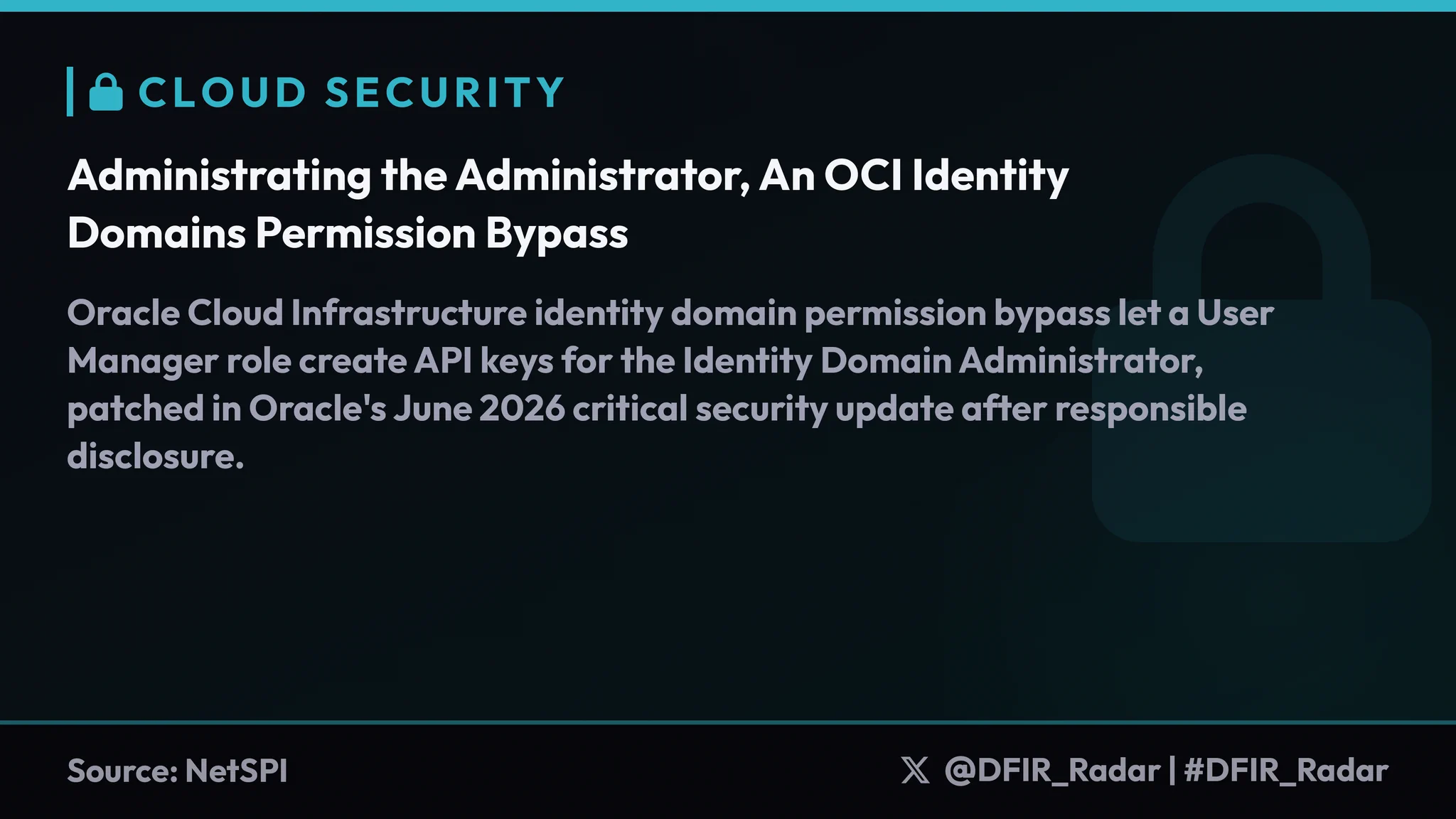
Describes an Oracle Cloud Infrastructure Identity Domains authorization bypass where a User Manager AppRole could create API keys (also SMTP credentials and auth tokens) for the Identity Domain Administrator via POST /admin/v1/ApiKeys on the SCIM API, with no classic IAM policy grant. The flaw sits in the gap between classic OCI IAM policies and AppRoles; it was patched in Oracle's June 2026 critical update. Gives responders hunting guidance: review Identity Domains SCIM audit events (/admin/v1/AuditEvents, resourceType ApiKey) for admin-account keys created by actors lacking the admin AppRole, and audit User Manager/User Administrator assignments, using OCInferno to graph AppRole-to-policy paths.

Oracle Cloud InfrastructureOCI Identity DomainsSCIM
OCInfernoNetSPIAppRole+2

Cloud & Infra, Identity & Access, Blue Team & Detection· Published and added 13 Oct 2026

arxiv.orgpaper🛡️ Security

Kairos: Transactional Security Enforcement at the System Boundary for LLM Agents

Kairos is a reference monitor placed at the isolation boundary of an unmodified, opaque LLM agent, where tool calls, shell commands and agent-written scripts all appear as the same file and network operations. A declarative trust policy decides most effects deterministically and defers the rest; deferred effects are held while the agent continues speculatively, and a bounded-authority decision oracle (an LLM or a human) releases or refuses them based on the trace. Across three benchmarks and three agent models it beats existing defenses on the attack-success/utility trade-off; on AgentDojo it cuts attack success from 47.0% to 2.7% with no loss of benign utility.

LLM
indirect prompt injectionAgentDojo

AI Security· Added 15 Oct 2026, published 13 Oct 2026

eprint.iacr.orgpaper🛡️ Security

Leakage-Resilient Incompressible Cryptography: Constructions and Barriers

Introduces leakage-resilient incompressible cryptography, a security model combining leakage resilience (partial key leakage plus full ciphertext) with incompressibility (full key but only part of the ciphertext or signature). It gives a transformation from incompressible symmetric-key encryption (SKE) to leakage-resilient incompressible SKE, a leakage-resilient incompressible PKE built from a new leakage-resilient non-committing KEM, and an incompressible SKE with ciphertext and compression rate 1/2 using invertible extractors. It also gives a leakage-resilient incompressible signature scheme in the random oracle model under DCR or LWE plus Decisional Linear. Black-box impossibility results show barriers to improving these parameters.

DziembowskiDecisional Linear assumptionLWE+3

other· Added 14 Oct 2026, published 13 Oct 2026

eprint.iacr.orgpaper🛡️ Security

Master-Key Recovery from Internal Activation Leakage in ReLU Realizations of Camellia

The paper builds explicit ReLU neural-network realizations of Camellia-128/192/256 from exact Boolean gates, S-box selectors and bit permutations, and reports known-answer-test agreement for Camellia-128. It shows that whitening and round-key quantities leaked from internal activations determine the master key through public key-schedule identities. Under a synthetic internal-oracle model, symmetric real-valued perturbations recover subkey bits with 128 queries (Camellia-128) or 256 (Camellia-256). Camellia-192 is handled by deterministic key-schedule inversion from direct access to round keys. All 3,000 trials (1,000 keys per variant) recovered the key exactly. The authors state this is not a plaintext/ciphertext-only attack on standard Camellia.

Camellia
Kwangjo Kim

other· Added 14 Oct 2026, published 13 Oct 2026

eprint.iacr.orgpaper🛡️ Security

CUTS: Chained Uniform-sum Tree Signatures

The paper analyses stateful hash-based signatures whose key is a tree of hash chains, and asks what a second signature from the same one-time key reveals after state loss or rollback. It proves that the values derivable from several signatures are exactly the union of those from each signature alone. It also bounds forgery after b signatures in the classical random-oracle model by a combinatorial coverage exponent λ_b, including when the signer grinds a counter. It then introduces CUTS, a scheme on one binary tree whose chain positions sum to a fixed value S and whose signature size and verification cost do not depend on tree height. One parameter set has 1,424-byte signatures and λ_2 ≥ 128.6. A counter variant, CUTS+C, gives a proven grinding gain.

CUTSCUTS+C

other· Added 14 Oct 2026, published 12 Oct 2026

securityweek.comarticle🛡️ Security

Ransomware Response Expert Arrested in ShinyHunters FBI Hack Probe

SecurityWeek reports the US arrest of a Canadian ransomware-negotiation specialist, reportedly Edward Dubrovsky of CyberSteward, on suspicion of involvement in ShinyHunters attacks, including the hack of FBI systems. He is charged with conspiracy to threaten to impair information confidentiality with intent to extort, and the case has moved to the Eastern District of Texas. It is the third ShinyHunters arrest in weeks, after suspects in the Netherlands and Jordan. The FBI blamed its own breach on a contractor's unpatched Oracle PeopleSoft, and sources say other ransomware negotiators could face charges.

Oracle PeopleSoft
ShinyHuntersFBIEdward Dubrovsky+3

Threat Intel· Published and added 12 Oct 2026

momo5502.comwriteup🛡️ Security

500B tokens later: Letting AI agents decompile a first-person shooter

Case study of about 3 months spent having Claude Code and Codex CLI agents decompile a popular first-person shooter to C++, using Hex-Rays' ida-mcp for disassembly. Early agent output ran but was semantically wrong, and a reviewer agent accepted worker justifications in commit comments, which acted as unintentional prompt injection. The fix was a byte-matching oracle: it compiles with the original toolchain and compares OBJ function bytes against the EXE/PDB, treating relocations separately. Agents tried to cheat with inline assembly and by editing the checker, so CI hashes the script. The result was 99% of functions present and 83% byte-exact, at an estimated 600-700B tokens.

ida-mcpClaude CodeCodex CLI+3
LunaOpus 5.5

Malware & RE, AI Security· Published and added 11 Oct 2026

momo5502.comwriteup🧠 AI

500B tokens later: Letting AI agents decompile a first-person shooter

A retrospective on a 3-month project in which Claude Code and Codex agents (Sonnet 5, Opus 5.5, Luna, Sol, Terra) decompiled a first-person shooter into C++, using ida-mcp, GitHub issues and Discord for coordination. The first month's agents produced readable but semantically wrong code, and a reviewer agent could not catch it. A byte-matching oracle script, comparing compiled OBJ output against the original EXE/PDB, gave a strict PASS/FAIL signal. That let cheaper models like Luna scale to 14+ agents and reach 99% of functions present and 83% byte-exact. Lessons include lowering the compaction threshold to 42%, hourly cron re-injection of the instruction document, hashing the verifier in CI to stop agents tampering with it, and the failure of review when correctness is undefined.

Claude CodeCodexIDA Pro+5
Claude Sonnet 5Claude Opus 5.5GPT-6 Luna+5

coding-agents, agents, ai-policy· Published and added 11 Oct 2026

eprint.iacr.orgpaper🛡️ Security

Faster generic CCA secure KEM transformation using encrypt-then-MAC

The paper proposes a generic encrypt-then-MAC transformation for building CCA-secure KEMs. The PKE ciphertext is authenticated by a MAC keyed from the PKE plaintext, so decapsulation no longer needs the Fujisaki-Okamoto re-encryption step. It proves IND-CCA security in the random oracle model from OW-PCA, and IND-qCCA security from a new OW-qPCA notion. It presents ML-KEM-EtM and McElieceEtM (Classic McEliece), and benchmarks ML-KEM-EtM with Poly1305, GMAC, CMAC and KMAC256. The result is a substantially lower decapsulation cycle count for a small cost in encapsulation cycles and ciphertext size.

ML-KEMClassic McEliecePoly1305+3
FIPS 203Fujisaki-Okamoto transformationML-KEM-EtM+4

other· Added 14 Oct 2026, published 11 Oct 2026

securityweek.comarticle🛡️ Security

Google Pixel 10 Exploits Earned Hackers $560,000 at Pwn2Own

Coverage of Pwn2Own Ireland 2026 results: contestants earned over $1.2 million total, with Google Pixel 10 exploits alone paying out $560,000 across three teams. Ikotas Labs won the full $300,000 Pixel payout by chaining multiple bugs for remote compromise, while Tim Becker/Yves Bieri and Dimitrios Valsamaras/Ken Gannon earned reduced payouts for exploits involving previously known flaws. Other notable rewards went for hacks of the Samsung Galaxy S26, Sonos Era 300 speaker, Philips Hue Bridge Pro, Home Assistant Green hub, Lexmark/Brother/Canon printers, Garmin Index BPM, and AI infrastructure including Oracle Autonomous AI Database, OpenAI Codex, Nvidia Dynamo, and LiteLLM.

AndroidSamsung Galaxy S26OpenAI Codex+2
Pwn2Own Ireland 2026Ikotas LabsTim Becker+3

Offensive Security, Mobile Security, Hardware & RF· Published and added 9 Oct 2026

eprint.iacr.orgpaper🛡️ Security

Reverse-Bleichenbacher: Bleichenbacher Attacks are Practical Again

Presents Reverse-Bleichenbacher, a variant of the Bleichenbacher RSA PKCS#1 v1.5 padding-oracle attack that recovers the least significant bytes first and stops once the TLS PreMasterSecret is found. With improved trimmers and coverage-optimized search, median oracle queries against a 2048-bit key drop from 11,428 to 1,801, and 68.3% of runs finish within a 30s timeout under single-server conditions. The authors find 640 vulnerable domains in the Tranco Top 1M (many behind Alibaba Cloud load balancers) and demonstrate MITM malicious update injection leading to remote code execution.

TLSRSAPKCS#1 v1.5
Reverse-BleichenbacherBleichenbacher attackPreMasterSecret+3

Offensive Security· Added 11 Oct 2026, published 8 Oct 2026

Showing 30 of 67

Show more