Skip to content

67 results for β€œVault”

What you seeeverything
x.comthreadπŸ›‘οΈ Security

David Gutierrez | Eng (@david_x_ai) on X

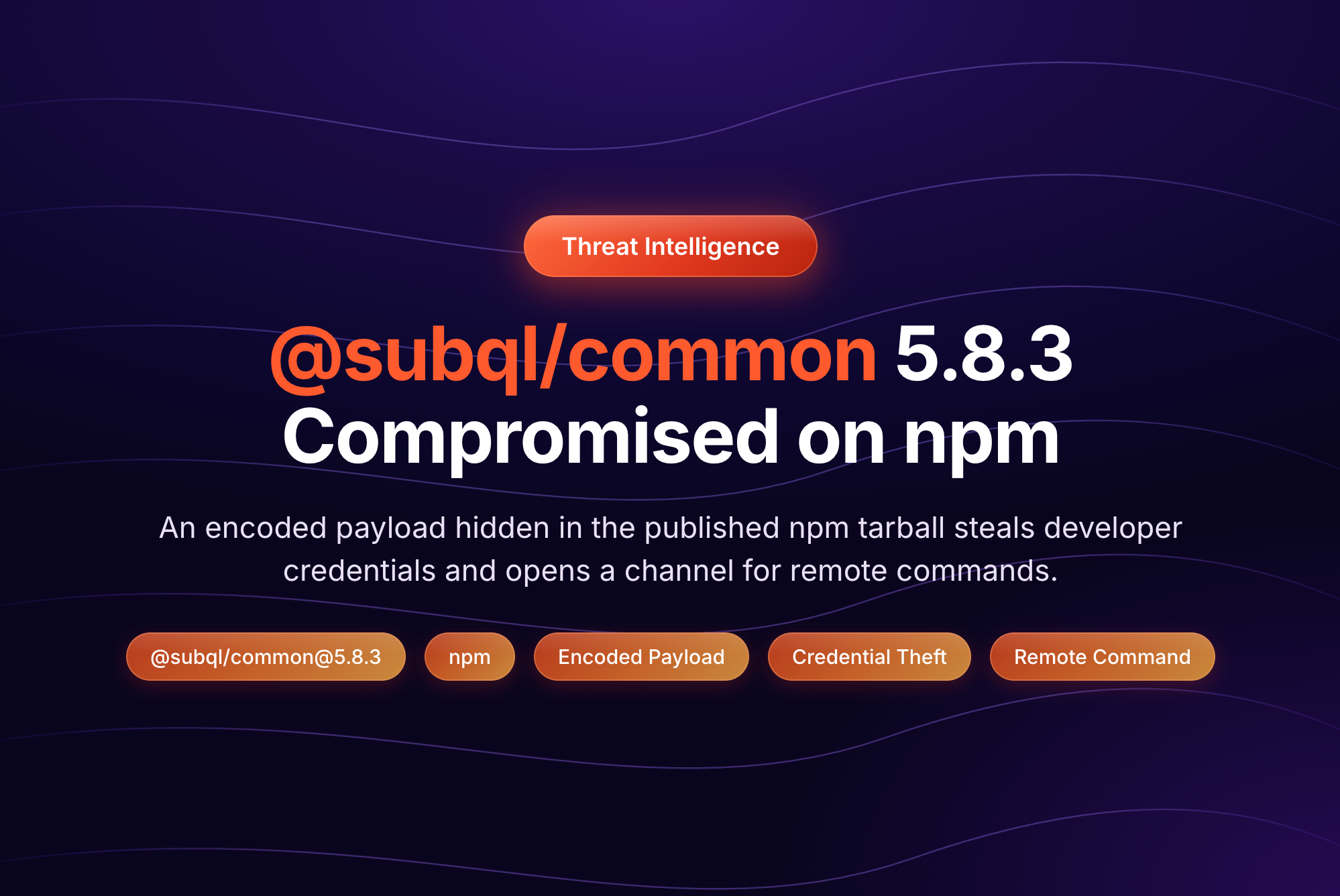
Thread on two October 2026 npm compromises: @subql/common 5.8.3 (5 October), published through GitHub Actions OIDC Trusted Publishing after the attacker tampered with the publish workflow, and tensorlake 0.5.144 (8 October), published by the project's own release workflow with valid provenance for about 1 hour 40 minutes. Both ran on install and stole cloud, GitHub, Kubernetes, Vault, SSH and .env credentials; tensorlake also took AI tool and MCP config. Its payload installed a gh-token-monitor service that deletes the home directory if the stolen GitHub token is revoked, so remove it before rotating.

npmGitHub ActionsGitHub+3
@subql/commontensorlakegh-token-monitor+3

Supply Chain, DevSecOpsΒ· Added 27 Oct 2026, published 26 Oct 2026
alterauth.comtool🧠 AI

Launch HN: Alter (YC S25) – Access control for multi-user agents

Alter is a privileged access management layer for AI agents (YC S25). It stores credentials in a vault, injects them per request through a proxy, gives each agent its own identity and scoped grants, and logs every call to a tamper-evident audit trail. One SDK call covers storage, refresh, policy and audit for 140 API providers, with LangChain, MCP and AWS integrations. Policy is default-deny down to the parameter, with human approval for risky calls.

Model Context ProtocolLangChainAWS+3
AlterY Combinator

ai-infra, agentsΒ· Added 22 Oct 2026, published 21 Oct 2026
arxiv.orgpaperπŸ›‘οΈ Security

PQ-Vault: Provably Quantum-Safe Asset Custody for Unmodified Ethereum

PQ-Vault is a custody design for unmodified Ethereum against quantum key recovery. It combines a quantum-safe vault contract, a proof-of-stake sidechain with compact certificates, and an optimistic dispute protocol. The paper proves that compact certificates with classically chosen parameters fall from 128 to about 60 bits against quantum attackers, and bounds a seed-update stake-steering attack. For 65,536 validators a certificate is 0.8 MB and verifies in about 20 ms, and the vault accepts a checkpoint for about 420,000 gas.

Ethereum
compact certificatesstake steering

BlockchainΒ· Added 24 Oct 2026, published 21 Oct 2026
x.comthreadπŸ›‘οΈ Security

DFIR Radar (@DFIR_Radar) on X

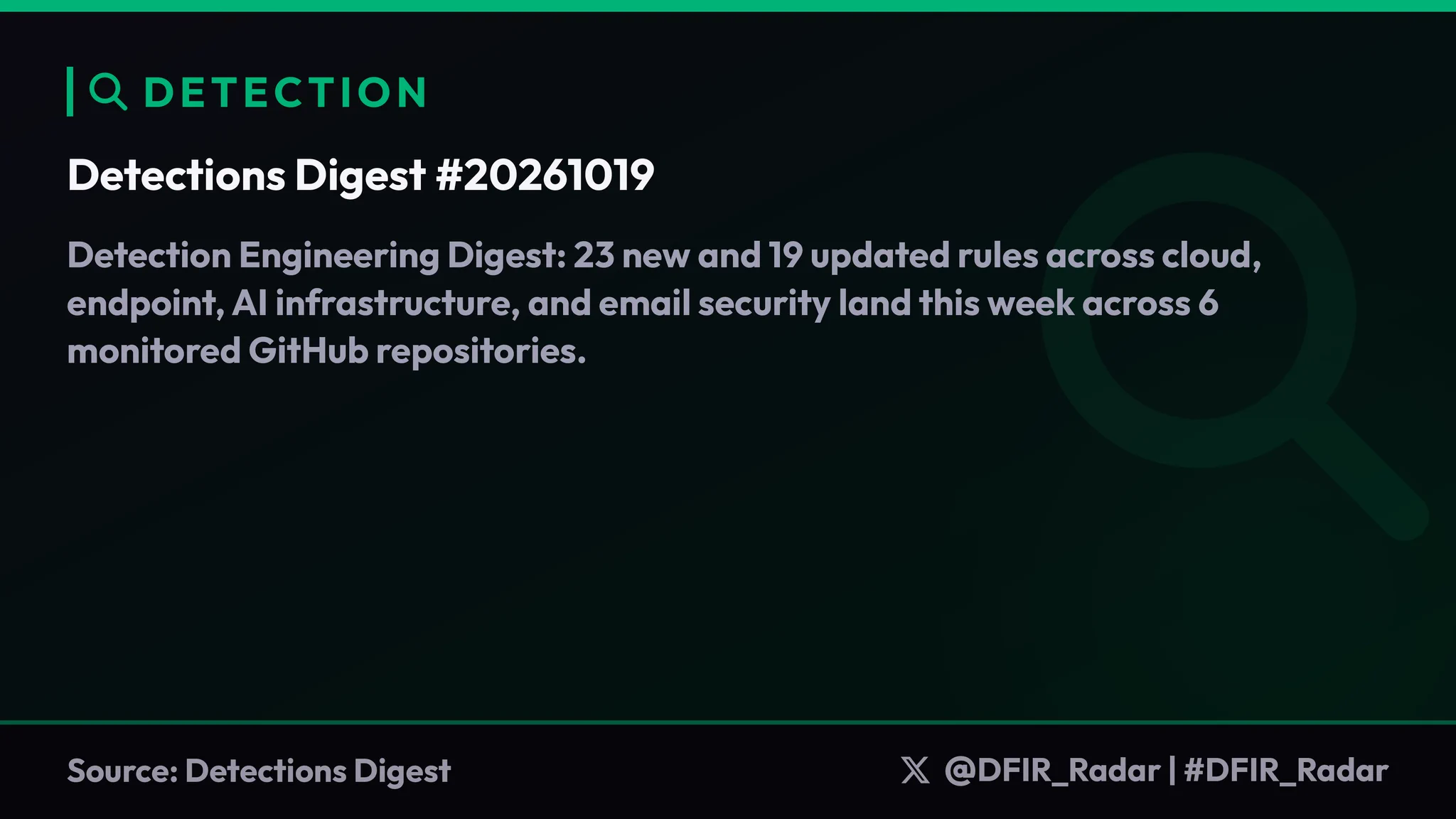
DFIR_Radar weekly detection engineering digest covering 23 new and 19 updated rules across 6 GitHub repositories. It lists KQL rules for Azure Key Vault secret retrieval, MCP client User-Agent bulk operations and local Azure token theft, AWS CloudTrail analytics, Sigma rules for firewall and ETW tampering (decimal 17 vs hex 0x11), updated LOLDrivers hashes, and Sublime email rules for OAuth consent phishing and fake IRS W-9 PDFs.

KQLSigmaMicrosoft Sentinel+3
BYOVDCisco AI Defensebenscha/KQLAdvancedHunting+7

Blue Team & Detection, Cloud & Infra, AI SecurityΒ· Added 20 Oct 2026, published 19 Oct 2026

x.comrepo🧠 AI

Saylor (@Kev96790724) on X

G-Krusch is an MIT-licensed, local-first Google Workspace hub built on Node.js 22 and SQLite WAL. It runs a 12-tool MCP server (SSE and Stdio) plus a REST bridge on port 5446 for Drive, Calendar and Gmail. It includes a 1,024-dimension hybrid Drive RAG with an embedding cascade (Ollama bge-large, then Gemini, then offline fallback) and FTS5 BM25. PDF extraction returns page citations. Tokens are kept in an AES-256-GCM vault; 30 of 30 tests pass.

Model Context ProtocolNode.jsSQLite+5
G-KruschKrusch CompanionKruschNexus+1

mcp, llm-apps, coding-agentsΒ· Added 21 Oct 2026, published 19 Oct 2026

cloud.google.comwriteupπŸ›‘οΈ Security

ARMORY CASTLE Exploits BeyondTrust

ARMORY CASTLE (formerly UNC5221), a suspected PRC-nexus actor, exploited BeyondTrust Remote Support zero-day CVE-2026-102764 in August 2026, per Mandiant incident response. The post details the SAWFLY PHP webshell, BARECLAW SOCKS5 WebSocket tunneler, SUID root escalation, sudoers template persistence, vault credential extraction, log deletion and haproxy.conf changes. It adds YARA rules, detection ideas and patch-first remediation (BT26-05).

BeyondTrust Remote SupportPHPHAProxy+3
CVE-2026-102764CVE-2023-46805CVE-2024-21887+9

Threat Intel, Blue Team & Detection, Malware & REΒ· Added 29 Oct 2026, published 15 Oct 2026

x.comadvisoryπŸ›‘οΈ Security

β™«Whyβ™₯Notβ™ͺ (@Python_s_) on X

Alert summarizing Socket Threat Research's disclosure that a malicious version of the Tensorlake npm SDK (an AI-agent infrastructure package) was published with a preinstall hook delivering Shai-Hulud/ChainDrop credential-stealing malware. The payload targets GitHub, npm, AWS, Kubernetes and Vault credentials, persists via a gh-token-monitor mechanism, and spreads through compromised publishing accounts. It lists IOCs (lib/setup.mjs, lib/Math_Symbol.js) and warns to remove the persistence before revoking stolen GitHub tokens, since revocation triggers a destructive routine. Socket detected the release about 11 minutes after publication.

npmTensorlakeSocket+3
Shai-HuludChainDropgh-token-monitor+2

Supply Chain, Threat IntelΒ· Added 11 Oct 2026, published 9 Oct 2026
cybersecuritynews.comarticleπŸ›‘οΈ Security

Tensorlake npm Package Compromised to Spread Shai-Hulud Worm

The tensorlake npm package, version 0.5.144 released 8 October 2026, carried a new Shai-Hulud worm variant, per Aikido's analysis. A preinstall script runs node lib/setup.mjs, downloads Bun and launches lib/Math_Symbol.js, which steals cloud, CI/CD, SSH, Vault, browser and crypto-wallet secrets. It reaches C2 iseekaigogo[.]com or an Ethereum smart-contract dead drop, and has a wipe dead-man's switch tied to a GitHub token.

npmBunEthereum+2
Shai-HuludEtherHidingiseekaigogo[.]com+2

Supply Chain, Threat Intel, Malware & REΒ· Added 19 Oct 2026, published 8 Oct 2026

endorlabs.comadvisoryπŸ›‘οΈ Security

Tensorlake npm package compromised by Shai-Hulud in latest software supply chain attack | Blog | Endor Labs

Endor Labs documents the compromise of tensorlake@0.5.144, the official npm TypeScript SDK for Tensorlake, which shipped a Shai-Hulud worm payload via a poisoned preinstall hook (node lib/setup.mjs) after the project's main branch was altered and pushed through a legitimate, provenance-signed GitHub Actions release pipeline. The malware harvests npm, GitHub, SSH, cloud (AWS/GCP/Azure), Kubernetes/Docker and Vault credentials, uses an EtherHiding Ethereum wallet as a durable dead-drop to fetch its rotating C2 domain, and republishes itself into other packages the victim controls. The writeup includes affected package versions, file hashes, C2 indicators, and concrete remediation guidance (pin to 0.5.143, rotate credentials, disable install scripts).

npmGitHub ActionsNode.js+3
Shai-HuludEtherHiding

Supply Chain, Threat IntelΒ· Published and added 8 Oct 2026

stepsecurity.iowriteupπŸ›‘οΈ Security

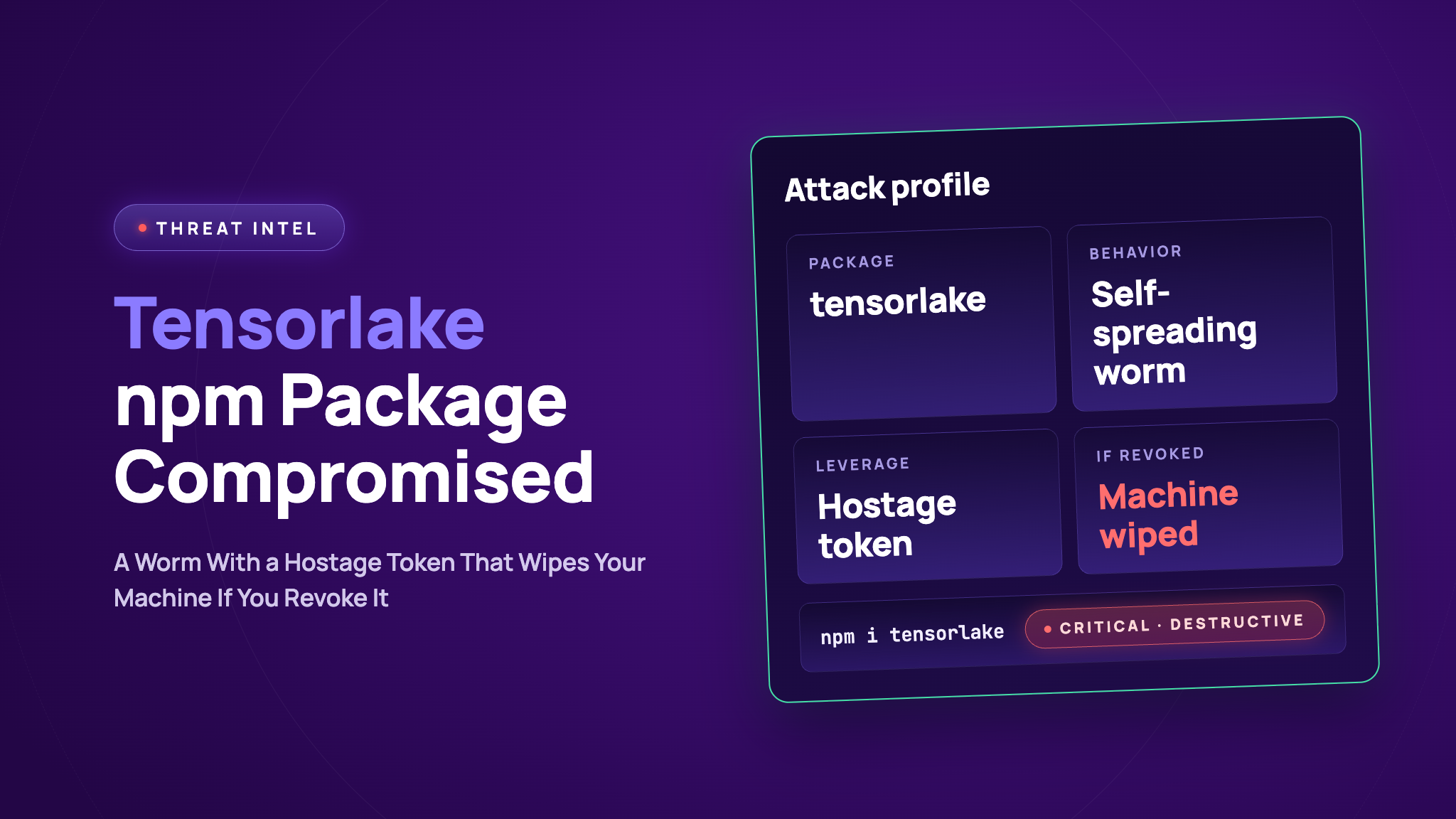
Tensorlake npm Package Compromised: A Worm With a Hostage Token That Wipes Your Machine If You Revoke It

StepSecurity details how tensorlake@0.5.144 was pushed to npm after malicious commits landed directly on the tensorlakeai/tensorlake GitHub repo's main branch under a maintainer's identity, carrying a valid npm provenance attestation despite being malicious. The preinstall hook downloads Bun to run an obfuscated payload that steals GitHub/npm tokens, cloud and Vault/Kubernetes secrets, SSH keys, browser logins, and AI-tool configs (Claude, Cursor, Windsurf), then self-propagates by republishing stolen npm packages and committing persistence files (.claude/settings.json, .vscode/tasks.json) to reachable repos. A "hostage token" mechanism installs a gh-token-monitor service that runs a home-directory wipe if the stolen GitHub token is revoked before the monitor is removed, inverting the normal incident-response order.

npmGitHubBun+3
Shai-Huludgh-token-monitoriseekaigogo.com

Supply Chain, Threat IntelΒ· Published and added 8 Oct 2026

stepsecurity.iowriteupπŸ›‘οΈ Security

SubQuery Ecosystem Compromise: Hidden Credential Theft and Backdoors

StepSecurity's investigation of @subql/common@5.8.3, a malicious npm release in the SubQuery Web3 indexing framework's monorepo, found a heavily obfuscated postinstall/import-time payload (base64+XOR+gzip inside a function constructed via Function()) that spawns a detached worker to steal credentials (.npmrc, .env, AWS, SSH, kubeconfig, Vault, cloud secrets), read GitHub Actions runner memory for CI secrets, inject a camouflaged "Run Copilot" GitHub Actions workflow to exfiltrate repo secrets, and provide a remote shell/PTY over an encrypted channel to ci-artifacts.dev. The release was published via a compromised build pipeline: a workflow modification swapped the real build output for an externally downloaded, unsigned tarball from that same C2 domain immediately before publish, and the authors provide IOCs and remediation steps (credential rotation, host isolation, domain blocking).

npmGitHub ActionsNode.js+3
SubQuery@subql/commonianhe8x+2

Supply Chain, DevSecOps, Blue Team & DetectionΒ· Published and added 5 Oct 2026

decrypt.coarticleπŸ›‘οΈ Security

Ethereum Now Lets You Pay for AI Without Revealing Who You Are

The Ethereum Foundation and the Open Anonymity Project launched zkAPI on Ethereum mainnet: users deposit ETH/USDC into a vault contract and generate zero-knowledge proofs of sufficient, unspent balance to receive capped, short-lived API keys for AI services (currently routed through OpenRouter), so the AI provider never learns payer identity and the payment layer never learns prompt content. The design follows a February 2026 Ethereum Research proposal by Davide Crapis (Ethereum Foundation dAI team lead) and Vitalik Buterin, who had earlier proposed the ERC-8004 agent-identity standard; the protocol is explicitly labeled experimental with no formal audit, and a companion browser-based client (OA Chat) is open source on GitHub.

EthereumOpenRouter
zkAPIOpen Anonymity ProjectDavide Crapis+3

Identity & AccessΒ· Added 3 Oct 2026, published 2 Oct 2026

decrypt.coarticle🧠 AI

Ethereum Now Lets You Pay for AI Without Revealing Who You Are

The Ethereum Foundation and the Open Anonymity Project launched zkAPI on Ethereum mainnet: users deposit ETH or USDC into a vault contract, then generate a zero-knowledge proof of sufficient, unspent funds to obtain a capped, short-lived API key, letting them call AI models through OpenRouter without the provider linking their prompts to a billing identity. The protocol (based on a February 2026 Ethereum Research proposal by Davide Crapis and Vitalik Buterin) issues signed usage receipts after the key expires to settle actual spend, and ships with a browser chatbot (OA Chat) and an open GitHub repo; it is explicitly labeled experimental with no formal audit yet. The same proof-based metering pattern is proposed for other metered services like blockchain data queries, image/video generation, and machine-to-machine payments.

OpenRouterOpenAI APIEthereum
Ethereum FoundationOpen Anonymity ProjectDavide Crapis+4

ai-infraΒ· Published and added 2 Oct 2026

bankless.comarticle🧠 AI

Ethereum Foundation Launches zkAPI for Private AI Payments

The Ethereum Foundation and the Open Anonymity Project launched zkAPI, a system that lets users prepay into an on-chain USDC vault and then generate zero-knowledge proofs to unlock short-lived, spend-capped API keys for AI models (and other metered services) without tying usage back to a billing identity. It ships a local client that mimics the OpenAI and Ollama APIs so existing apps can switch to account-free access with minimal changes, plus an in-browser client called OA Chat; funds remain withdrawable on-chain even if zkAPI's own servers go down. The design, originally sketched by Davide Crapis and Vitalik Buterin on Ethereum Research, still leaves IP address and prompt content visible to providers, so the team recommends Tor for stronger privacy.

EthereumOpenAI APIOllama+1
Ethereum FoundationOpen Anonymity ProjectDavide Crapis+4

ai-infraΒ· Published and added 2 Oct 2026

binsec.nowriteupπŸ›‘οΈ Security

Binary Security: Azure Logic Apps cross-tenant compromises (One Root Case)

Third post in a series on Azure Logic Apps API Connections, describing five critical cross-tenant privilege escalations that let an attacker use any other tenant's connection to reach its backend (Key Vault, Azure SQL, Jira, Salesforce). Techniques include path traversal via ARM DynamicInvoke and undocumented DynamicList endpoints, and abusing the host.api.runtimeUrl parameter in Consumption Logic Apps, including a validation-before-normalization bypass. The author reports $200,000 in bounties; Microsoft fixed all issues.

AzureAzure Logic AppsAzure API Management+3
path traversalDynamicInvokeDynamicList+5

Cloud & Infra, AppSec, Offensive SecurityΒ· Added 30 Oct 2026, published 2 Oct 2026

theblock.coarticle🧠 AI

Ethereum Foundation launches zkAPI to let users pay for AI models without revealing identity

zkAPI is a protocol launched on Ethereum mainnet by the Ethereum Foundation and the Open Anonymity Project for paying AI API providers without revealing identity. Users deposit ETH or USDC into a vault as a private note and spend it with zero-knowledge proofs. A server issues temporary capped API keys, and nullifiers prevent double-spending. It is labelled experimental, offers no network anonymity, and prompt content can re-link sessions.

zkAPIEthereumUSDC+2
Ethereum FoundationOpen Anonymity ProjectVitalik Buterin+1

ai-infraΒ· Added 10 Oct 2026, published 2 Oct 2026

blog.ethereum.orgarticle🧠 AI

Introducing zkAPI: private usage credits for any API

zkAPI, built by the Open Anonymity Project with the Ethereum Foundation, separates payment from identity for metered APIs, with AI inference first. Users deposit credits into an Ethereum vault contract and spend them as private notes. Groth16 proofs on BN254, Poseidon hashing, a 32-level Merkle tree and nullifiers authorize spends. The server mints short-lived, dollar-capped API keys, and signed usage receipts settle the metered amount. A local client exposes standard OpenAI and Ollama APIs, so existing apps work unchanged. The post also covers a proxy mode and the limits: network metadata and prompt-content fingerprinting can still link sessions.

EthereumOpenAI APIOllama+4
zkAPIOpen Anonymity ProjectEthereum Foundation+3

ai-infra, llm-appsΒ· Published and added 1 Oct 2026

blog.ethereum.orgarticleπŸ›‘οΈ Security

Introducing zkAPI: private usage credits for any API

zkAPI, built by the Open Anonymity Project with the Ethereum Foundation, lets users deposit credits into an Ethereum vault contract once and then authorize bounded, metered API usage via zero-knowledge proofs instead of an API key tied to identity. The scheme uses Groth16 proofs over BN254, Poseidon-hashed note commitments in a 32-level Merkle tree, and one-way nullifiers to prevent double-spend while keeping spends unlinkable to deposits; a client mints short-lived, capped API keys locally and the server settles against the private balance via signed usage receipts. The post also candidly documents the system's limits: it doesn't anonymize network metadata/IP (mitigated by Tor) and doesn't prevent re-linking via prompt-content fingerprinting across sessions.

zkAPIEthereumOpenAI+3
Open Anonymity ProjectDavide CrapisVitalik Buterin+1

BlockchainΒ· Added 7 Oct 2026, published 1 Oct 2026

github.comrepoπŸ›‘οΈ Security

CAIRN β€” Cisco Talos AI-Malware-Hunting Toolkit

CAIRN is a Cisco Talos research toolkit that identifies and attributes AI-integrated malware purely from VirusTotal metadata β€” no binary downloads or detonation β€” by running a tiered YARA ontology (T1/T2/T3) over composed scan text (AV strings, PE resources, Sigma/sandbox behavioral data, embedded URLs) and layering on sentence-transformer embeddings with HDBSCAN clustering for semantic family attribution. It has produced confirmed family reports for AI-malware such as PROMPTLOCK, LAMEHUG, PROMPTSTEAL, QUIETVAULT, CLOSEDQUORUM, and FRUITSHELL, each cross-verified by hands-on Talos reverse engineering before publication.

VirusTotalYARASQLite+2
PROMPTLOCKHONESTCUEPROMPTFLUX+7

AI Security, Threat Intel, Malware & REΒ· Added 30 Sep 2026

decrypt.coarticleπŸ›‘οΈ Security

A Clever RSA Attack Fooled a Hardware Vaultβ€”Here's What It Means for Crypto

Researchers at UC San Diego and INRIA demonstrated a chosen-message oracle attack that forges RSA signatures on a 1,024-bit key held inside a hardware security module (HSM) without ever extracting the key, by disabling the HSM's FIPS mode to get it to sign unpadded/unformatted values roughly 4 billion times and then computing the private-key operation from the responses (1,380 CPU core-years of work). The attack only applies to unpadded RSA signing oracles β€” standard PKCS#1 v1.5/PSS padding blocks it β€” so it doesn't threaten Bitcoin/Ethereum (which use ECDSA) but is relevant to anyone auditing HSM key-custody assumptions or RSA-based blind-signature schemes like Privacy Pass. The authors frame it as further classical evidence to accelerate migration away from RSA ahead of the post-quantum transition.

RSAECDSABitcoin+1
Privacy PassDigiCashBitGo+4

Hardware & RF, BlockchainΒ· Added 30 Sep 2026, published 28 Sep 2026

github.comrepo🧠 AI

openrig β€” multi-agent Claude Code/Codex orchestration

OpenRig is an open-source local daemon, CLI, TUI and MCP server (built on tmux + SQLite) that manages teams of Claude Code and Codex agent sessions as a single persistent system rather than a pile of terminal windows. Topologies (pods, seats, edges) are defined declaratively in YAML (RigSpec/AgentSpec), booted with `rig up`, inspected via a topology TUI, and can be snapshotted/restored, discovered from existing tmux sessions, and messaged across agents (`rig send`, `rig broadcast`, `rig chatroom`). It ships starter topologies (first-project, conveyor, product-team, secrets-manager using HashiCorp Vault) and documents in detail what it writes to Claude/Codex config, trust and telemetry state on the host machine.

Claude CodeCodexNode.js+4
OpenRigHashiCorp VaultPi

coding-agents, agents, mcpΒ· Added 28 Sep 2026

securityboulevard.comarticleπŸ›‘οΈ Security

973 MCP Packages, 71% Single-Maintainer: A Practitioner

Suzu Labs guide to securing AI developer workflows across three surfaces: AI-generated code (Veracode 45% vulnerable, a formal-verification study at 55.8%), the MCP supply chain and credential exposure, and prompt injection in the context window. It cites 973 npm MCP packages (71% single-maintainer), 24,008 secrets in MCP configs on public GitHub, and the March 2026 axios hijack by UNC1069 that dropped WAVESHAPER.V2 and tampered with MCP configs. It lists CVEs for Copilot, Cursor and Claude Code, and gives controls: SAST on every commit, env/vault credential references, pinning MCP versions, minimal agent permissions, `.cursorignore`/Claude deny rules, and monitoring IDE DNS traffic.

Model Context ProtocolnpmCursor+3
CVE-2025-53773CVE-2026-22708CVE-2025-55284+9

AI Security, Supply Chain, DevSecOpsΒ· Added 26 Sep 2026

bankless.comarticle🧠 AI

Inside IMD, Ethereum's New AI Swarm Experiment

Bankless profiles IMD (identity.md), an Ethereum project where holders of 2,000 NFTs register AI agents under the ERC-8004 identity/reputation standard, run a worker client wired to their own Claude or Codex subscription, and receive tasks from a lead orchestrator. Submissions are rebuilt in a sealed container to verify only allowed files changed, reviewed adversarially by other agents, logged onchain as reputation, and (as of the article) can be purchased by outside customers for 0.5 $IMD per job via the x402 payment rail, currently deploying only to Sepolia testnet. The surrounding token design β€” a Uniswap V4 CappedBurnHook that burns sell pressure, an ERC-4626 staking vault (sIMD), and an $IMD-denominated launchpad β€” is the article's main focus, framing the agent swarm as the productive backbone of a speculative token economy.

EthereumUniswap V4Claude Fable 5.1+2
IMDidentity.mdAdam+7

agentsΒ· Added 8 Oct 2026, published 25 Sep 2026

microsoft.comwriteupπŸ›‘οΈ Security

Storm-3168: Agentic-driven cloud attacks using compromised service principals

Microsoft Security Research documents an Azure-focused campaign by Storm-3168 (aka JADEPUFFER, discovered by Sysdig as the first documented agentic ransomware operation), using two compromised service principals to enumerate an Azure tenant and then execute a seven-minute destructive sequence deleting 100+ Storage Accounts, a Key Vault, a Function App, and attempting (unsuccessfully, due to API version mismatch) to delete Azure SQL databases. Initial access traces to a client ID/secret/tenant ID leaked in a GitHub issue's public edit history even after the secret was redacted; the attacker also harvested storage account keys and targeted Site Recovery/Backup protection locks to impair recovery, consistent with ransomware/extortion tradecraft. The post includes a MITRE ATT&CK mapping (T1190, T1078.004, T1526, T1485, T1490) and mitigation guidance around workload identity hygiene, least privilege, and backup protection.

AzureMicrosoft Defender XDRMicrosoft Defender+3
Storm-3168JADEPUFFERSysdig+7

Threat Intel, Cloud & Infra, AI SecurityΒ· Added 7 Oct 2026, published 25 Sep 2026

stepsecurity.iowriteupπŸ›‘οΈ Security

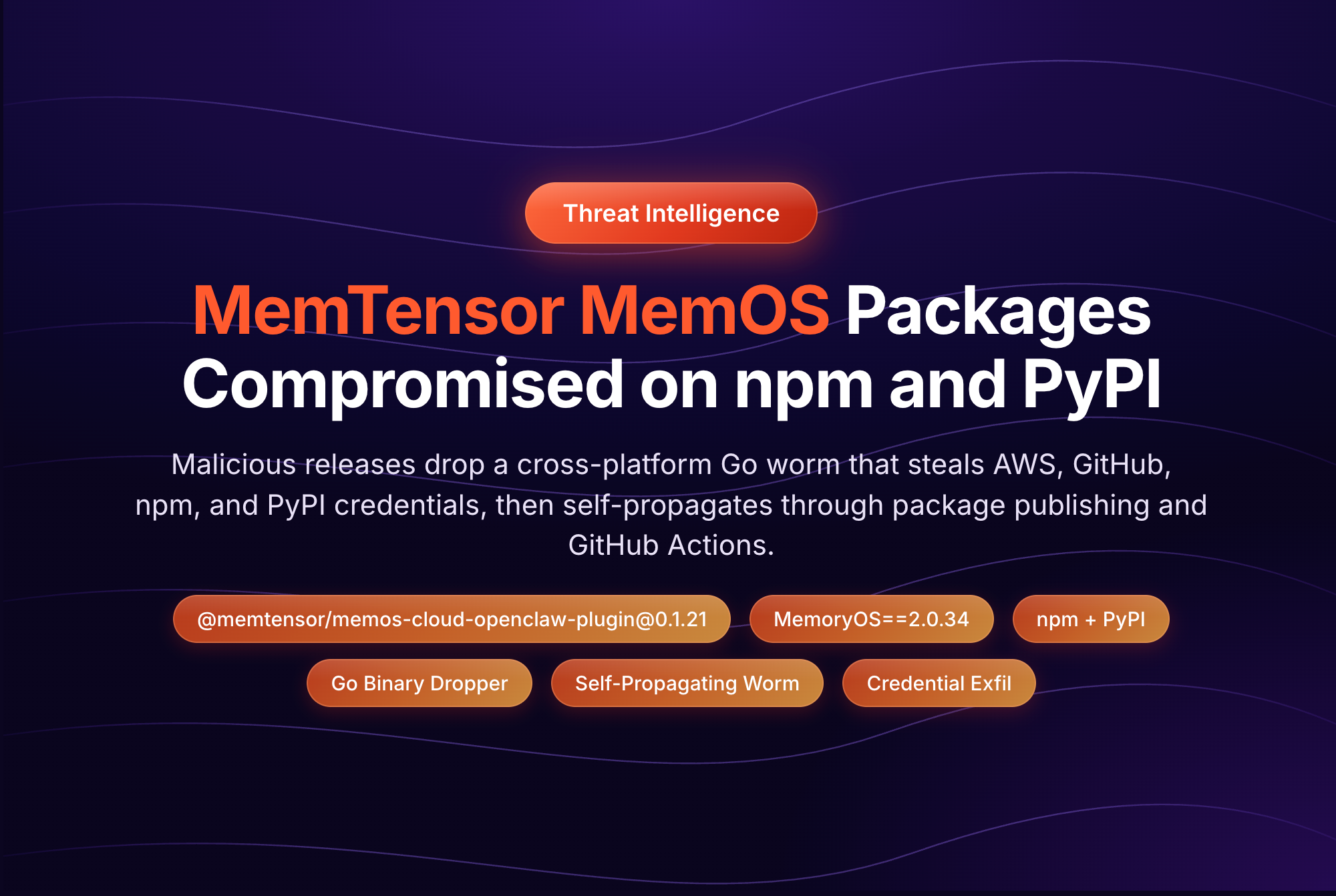
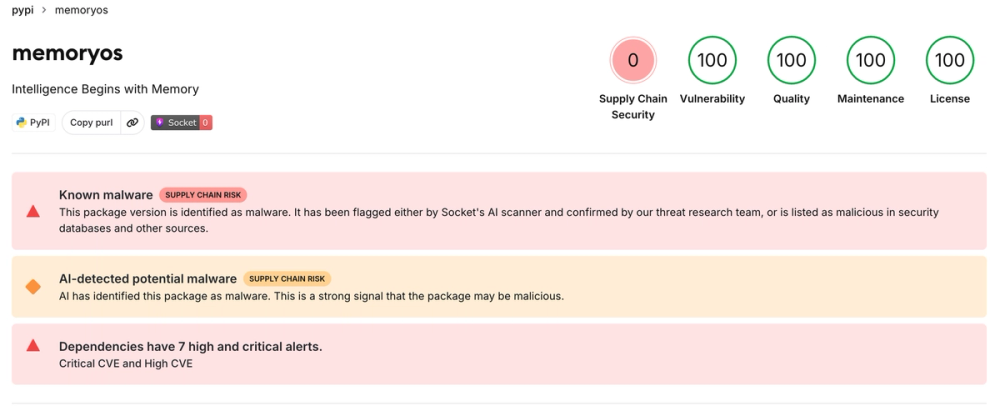
Sckit Supply Chain Worm Hits MemTensor npm & PyPi scopes

StepSecurity documents a supply-chain attack against @memtensor/memos-cloud-openclaw-plugin on npm (versions 0.1.21, 0.1.23, 0.1.25) and MemoryOS 2.0.34 on PyPI, which insert a hidden "sckit" launcher into normal plugin/import lifecycle code (no install scripts) to spawn a platform-specific Go binary that harvests the parent process's environment and the user's AI prompt text. The Go payloads contain regex patterns for AWS, GitHub, GitLab, npm, PyPI, Hugging Face, Vault, Slack, Stripe and SendGrid credentials, target the user's home directory as an inventory root, and beacon to skyleen.fr "front" domains; the PyPI variant additionally hides a conditional build-backend/CI bridge that can steal PYPI_API_TOKEN during publishing and pull a hash-pinned, Ed25519-signed secondary payload via GitHub Actions. The writeup includes full IOC/remediation guidance.

npmPyPIPython+3
sckitMemTensorskyleen.fr+2

Supply Chain, Malware & RE, AI SecurityΒ· Published and added 23 Sep 2026

socket.devwriteupπŸ›‘οΈ Security

MemTensor npm and PyPI Packages Compromised in Credential-Stealing Supply Chain Attack

Socket details a supply-chain compromise of MemTensor's MemOS packages: npm package @memtensor/memos-cloud-openclaw-plugin (versions 0.1.21, 0.1.23, 0.1.25) and PyPI package MemoryOS (2.0.34), both published as the latest release on their registries. Each malicious release bundles a stripped, statically-linked Go binary called sckit that launches on import/plugin-load, scans $HOME for npm, PyPI, GitHub, GitLab, AWS, Vault and SSH credentials, and exfiltrates them to C2 servers under skyleen[.]fr, with the npm variant also capturing OpenClaw agent prompt text and the code additionally showing potential worm-like republish capability using stolen registry tokens.

npmPyPIGo+2
MemTensorMemOS@memtensor/memos-cloud-openclaw-plugin+7

Supply Chain, Malware & RE, Threat IntelΒ· Published and added 23 Sep 2026

arxiv.orgpaperπŸ›‘οΈ Security

APort Vault: Benchmarking AI Agent Payment Authorization with the Open Agent Passport

APort Vault is a benchmark that replays 4,371 human-written CTF attacks against a live AI payment agent across 14 models from 8 labs, five policy configurations, and two replay tracks β€” with and without a deterministic pre-action check implementing the Open Agent Passport (OAP) specification. Across 225,964 evaluations, unauthorized transfers to non-allowlisted recipients occurred 140/76,842 times with the model alone versus 0/69,297 times behind the OAP layer, while the layer still allowed 25,370 legitimate payments through, showing a policy-enforcement layer can materially close the authorization gap in agentic payment flows without just refusing everything. The authors release all evaluations, level passports, scoring code, and analysis scripts.

Open Agent PassportAPort Vault

AI Security, Identity & AccessΒ· Added 21 Sep 2026, published 18 Sep 2026

securitylabs.datadoghq.comwriteupπŸ›‘οΈ Security

Attacker infrastructure, but vibe-coded: tracking the evolution of credential harvesting platforms

Datadog Security Research analyses two vibe-coded credential harvesting platforms, Loot and UltraVault, monitored since July 2026. Loot catalogs plaintext secrets, including 1,778 AI keys (196 live). UltraVault adds credential validation, exploit chains, a 14-bug LPE matrix and AWS key-pair correlation. The same host probed Amazon Bedrock with GetCallerIdentity, ListFoundationModels and InvokeModel, using kali-cloud Boto3 and Python-urllib user agents.

AWS BedrockAWSWordPress+3
CVE-2025-55182CVE-2026-63030CVE-2026-60137+16

Threat Intel, Cloud & Infra, AI SecurityΒ· Added 29 Oct 2026, published 18 Sep 2026

github.comrepo🧠 AI

ProjectDXAI/continuous-record-llm-trading-agents

Companion repository for the DXRG paper "What LLM Trading Agents Actually Do in Production" (arXiv:2609.05663), reporting a six-month, population-scale record of two live LLM-agent trading fleets: 3,505 DX Terminal Pro vaults on Base and a 500-599 agent DXAP fleet on Hyperliquid perpetuals (231,638 finalized turns, 14,596 fills). It quantifies how the operating layer β€” not strategy text β€” drives behavior: a prompt-rendered leaderboard routes 46.5% of trade entries with a sharp regression discontinuity at the render boundary, agent fixed effects absorb 60% of outcome variance, leverage choice is volatility-blind (median 5.0x across a 5.7x volatility spread) with one posture/slider cell concentrating 62% of liquidations, and discretionary exits underperform a fixed 2%/4% bracket. A 416-scenario paired replay across three frontier models found similar decision quality but sharply different choice-consistency flip rates (35% vs 90%+), and the repo ships the paper, figures, aggregate data extracts, dataset cards and a 17-rule methodology canon distilled from the project's own retracted claims.

HyperliquidBase
DX Research GroupDX Terminal ProDXAP+2

agents, research, evalsΒ· Added 2 Oct 2026, published 1 Sep 2026

litellm.aitoolπŸ›‘οΈ Security

LiteLLM

LiteLLM is an open-source (MIT) AI gateway that puts 140+ LLM providers, agents and MCP servers behind one OpenAI-compatible API. It adds virtual keys, per-team budgets and rate limits, SSO/JWT/RBAC with SCIM, audit logs, leaked-key protection, and guardrails for PII masking and prompt injection (Presidio, Lakera). It self-hosts via Helm, Terraform or Docker, including air-gapped, with Cosign-signed non-root images, Grype and CodeQL scanning, and secrets pulled from Vault or cloud secret managers. A new Rust gateway is benchmarked at 0.66 ms p99 overhead.

LiteLLMModel Context ProtocolDocker+3
PresidioLakeraAI Gateway Bench+2

AI SecurityΒ· Added 3 Sep 2026, published 31 Aug 2026

Showing 30 of 67

Show more