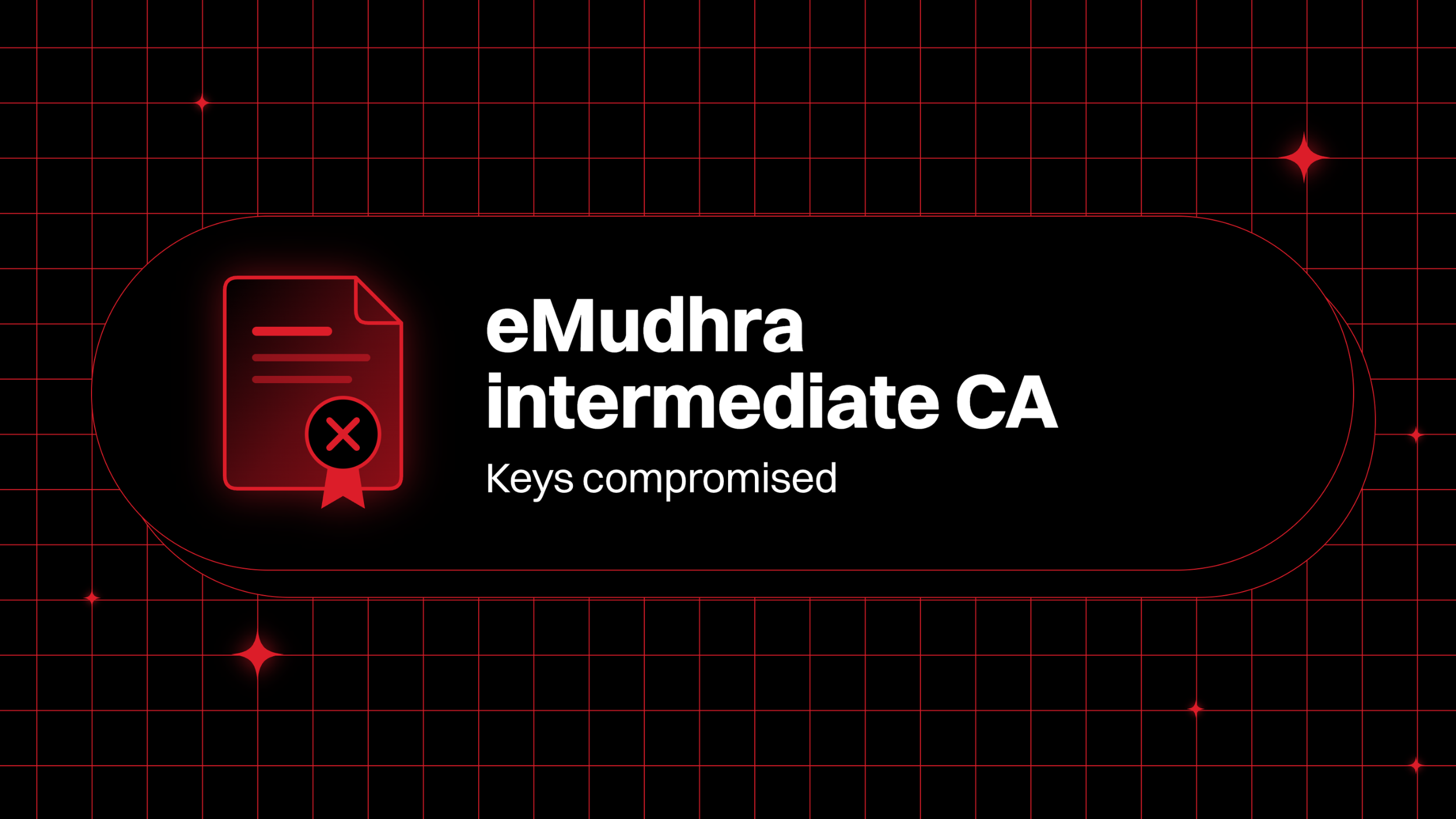
Bunny CDN status-page notice, posted 28 October 2026, about unauthorized access at an infrastructure provider that hosted one bunny.net CDN node in Armenia. Traffic was stopped within 20 minutes and the server wiped. No access to the node was found, but cached content, Pull Zone configs and TLS certificates could have been exposed, so all platform certificates were reissued. Customers with their own certificates should rotate them with new private keys.
Bunny CDNTLS
bunny.netb-cdn.netbunny.run
Threat Intel, Cloud & Infra· Added 31 Oct 2026, published 30 Oct 2026
Cloudflare's follow-up on eMudhra's eight trivially recoverable intermediate CA keys (such as 4, 56 and 66), disclosed 19 October 2026. Pingora logging showed about 22,000 handshakes with the weak keys, including about 160 forged certificates made within hours of disclosure. Probes on 50 million challenge pages show many bots, old browsers and Android WebView still trust the chain.
CloudflarePingoraAndroid WebView+2
eMudhraMozillaDennis Jackson+6
Threat Intel, Blue Team & Detection· Published and added 30 Oct 2026
Microsoft Threat Intelligence analysis of two human-operated intrusions that began with Teams help desk impersonation and Quick Assist sessions, then diverged at AD CS. Case 1 abused an ESC1 template for privileged certificates and DCSync, with an excluded account later used for Rclone exfiltration. Case 2 used PetitPotam and ESC8 relay to get a domain controller certificate and PKINIT. Includes investigation steps, AD CS hardening and KQL hunting queries.
Active Directory Certificate ServicesMicrosoft TeamsQuick Assist+3
ESC1ESC8PetitPotam+12
Blue Team & Detection, Threat Intel, Offensive Security· Published and added 30 Oct 2026
ai-engineering-from-scratch is a free, MIT-licensed curriculum of 542 lessons in 20 phases, from math and deep learning through transformers, LLM engineering, MCP, agents and capstones. Code is in Python, TypeScript, Rust and Julia. It includes three graded projects (retrieval evaluation, agent trace debugger, tool call firewall), installable tutor skills for Claude Code and Codex, and certification prep tracks.
SecurityWeek article examining US election security through a cybersecurity lens. It covers voting machines certified by the Election Assistance Commission but unpatched for up to two years, machines hacked at DEF CON's Voting Village, and QR-code ballots voters cannot verify. Sequent's Shai Bargil proposes open-source software and encrypted vote records. It also covers AI-enabled influence campaigns such as the 2024 Biden deepfake robocall.
FoxIO disclosed three TLS flaws in the GoAhead embedded web server from EmbedThis, used on hundreds of millions of IoT, OT and network devices. CVE-2026-115881 (CVSS 9.1) leaves revoked client certificates accepted under mTLS with OpenSSL; CVE-2026-115884 (7.4) bypasses chain-length limits with LibreSSL; a third Mbed TLS bug (5.9, no CVE) weakens TLS 1.2 DHE. GoAhead 6.1.1 fixes the OpenSSL and Mbed TLS issues, and FoxIO released PoC code and fingerprints.
GoAheadOpenSSLMbed TLS+2
CVE-2026-115881CVE-2026-115884FoxIO+4
Hardware & RF, AppSec· Published and added 28 Oct 2026
Decrypt reports that OpenAI published a 67-page paper (dated 17 October 2026, revised 25 October) claiming its AI found a deterministic subexponential-time algorithm for counting 3-SAT solutions, which would refute the Exponential Time Hypothesis. The proof was formalized in Lean. Impagliazzo, Paturi and Ryan Williams are reviewing it independently and say this is not certification. Anthropic posted a Claude-credited 3-SAT paper on 26 October.
The ViktorUJ/cks course is an open-source, community-maintained preparation course for the CKS (Certified Kubernetes Security Specialist) exam. It has 33 chapters grouped by CKS domain: cluster setup, hardening, system hardening, microservice vulnerabilities, supply chain, and runtime security. It also has 15 labs with automatic checks (labs 101-114), mock exams and Killer.sh guidance. Core labs target Kubernetes v1.36.
Proof of One is an open-source design for polls with one verified human per identity and unlinkable ballots. Enrolment proves in zero knowledge that an ICAO 9303 passport chip was signed by a trusted signer, plus an enclave face match. Voting uses threshold exponential ElGamal on Baby Jubjub with Groth16 proofs, and tally uses a GJKR DKG with a 7-day challenge window. The author, who is pseudonymous, discloses that AI agents drafted most of it and asks for critique of unlinkability, circuit completeness and certificate trust.
Groth16Baby JubjubDAVINCI+1
Proof of OneNemo UnusICAO 9303+4
Identity & Access· Published and added 27 Oct 2026
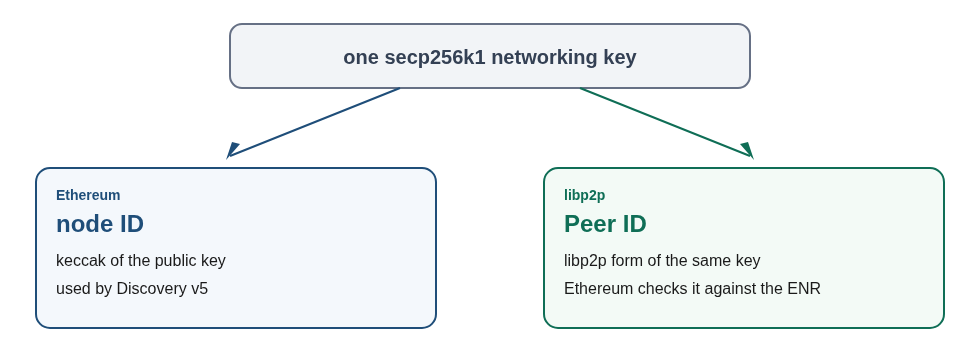
Inventory of post-quantum migration work for Ethereum consensus-layer networking, by adust09 of Nyx Foundation. It maps three targets: Discovery v5/ENR signatures and key exchange, TLS 1.3 key agreement in QUIC, and libp2p TLS identity binding and CertificateVerify. It covers the 300-byte ENR and 1,280-byte packet limits, why hybrid KEMs do not authenticate peers, and downgrade and DoS concerns. It selects no algorithm or schedule.
Poly2MsgLeaks is a profiled chosen-ciphertext power-analysis attack on the SMAUG-T (TiMER parameter set) post-quantum KEM that recovers the full 512-coefficient PKE secret from six traces on an STM32F415. It recovers 999 of 1,000 unseen secrets and proves an incorrect key is released with probability at most 2^-2095.6. Single-write message assembly and a two-share masked P2M resisted the evaluated six-execution attack.
Socket post on why fixing the eMudhra weak-key intermediate CA incident (October 2026) and Brotli memory corruption CVE-2026-111497 takes more than updating Node.js. Bundled Brotli copies in Bun, Python Requests and .NET, Go binaries needing rebuilds, and per-program certificate stores all leave stale copies. It lists steps: track bundled components, keep a rebuild path, use workarounds, and verify the shipped artifact.
Node.jsBrotliBun+6
CVE-2026-111497eMudhraOneCRL+6
Supply Chain, AppSec· Published and added 26 Oct 2026
This IACR ePrint 2026/2632 paper by Demirtaş and Yayla analyses the Crites–Stewart adaptive forgery attack on threshold Schnorr signatures, which needs one call to a sparse linear search oracle (bounded distance decoding of a scaled Reed–Solomon code). It shows that choosing the commitment coefficient vector does not help much: a wrapper adversary with Q challenges succeeds with probability at most QM/p, even if its solvers decode every witness for free. For the six original (N, τ) pairs, M stays below 2^24, so the bound is under 2^-100 after 2^128 challenges at p = 2^252.
Intervention-Certified Amplification (ICA) is a validity gate for sigma-weighted hybrid SFT/RL post-training. The paper shows that DIAA, a per-sample sigma-weighted hybrid, emits unexecuted tool-integrated reasoning on 29% of MATH-500 prompts (three times vanilla GRPO) even with Python fences removed from its anchor. ICA gates sigma with paired-rollout evidence, cutting TIR to 13.8% (frozen) and 11.2% (online) and raising accuracy from 47.5% to 48.7% and 49.3%. It transfers to GSM8K.
The paper formalizes elliptic-curve semiprimality certificates by adapting the Goldwasser-Kilian primality criterion. For certificates built with complex multiplication, a norm-lattice reconstruction factors N from (N, S, D) alone in expected polynomial time. The author uses it, plus public-point and quadratic-twist attacks, to factor Reble's 1084-digit and Broadhurst's 5061-digit moduli, and shows that hidden-cofactor, withheld-CM-map and private-isogeny repairs also fail.
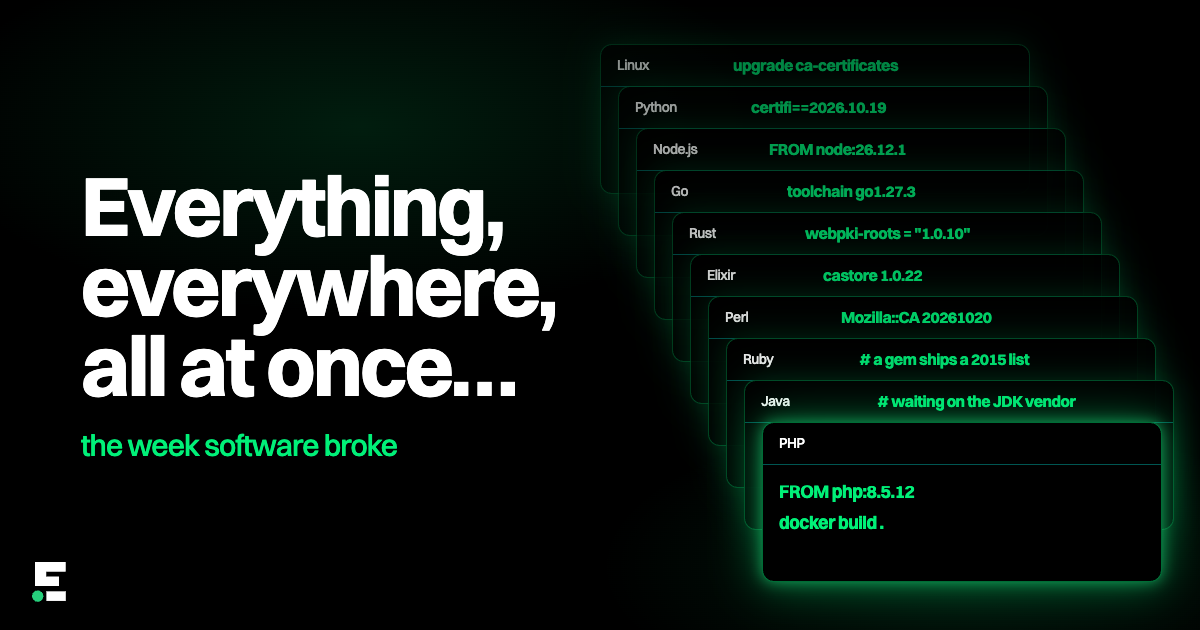
Endor Labs roundup of the 20 to 21 October 2026 patch wave: eMudhra certificate authority keys that anyone can recover, PHP2Shell (CVE-2026-109618, CVE-2026-109619), Node2Shell (CVE-2026-111497) and malware in LiteLLM 1.107.0. It lists fixed versions (PHP 8.2.35 to 8.5.12, Node.js 22.23.4, 24.22.1, 26.12.1, LiteLLM back to 1.106.2) and explains why many separate trust-store copies each need updating. It closes with advice on triage, remediation and SBOM/VEX reporting.
PHPNode.jsLiteLLM+3
CVE-2026-109618CVE-2026-109619CVE-2026-111497+3
Supply Chain, AppSec· Published and added 24 Oct 2026
Guidance on the October 2026 eMudhra / emSign CA incident, where eight intermediate CA certificates had private keys generated with insufficient randomness. It explains why updating certifi alone does not fix pip's vendored bundle, and lists fixed versions (certifi 2026.10.19, pip 26.2.2, Python 3.15.1, 3.14.9, 3.13.17). StepSecurity's OpenSSL 4.0.3 tests showed the older bundle accepted seven emSign paths, while both corrected bundles rejected all fourteen.
pipPythoncertifi+3
eMudhraemSigncertificate authority compromise+3
Supply Chain, DevSecOps· Published and added 22 Oct 2026
Balsamic is a complete homomorphic Unbalanced Oil and Vinegar (UOV) signer, used to build one-round threshold UOV signatures from a packed discrete-CKKS FHE circuit. A paired-pivot linear solver and pivot-success certificates allow encrypted retry selection. In 2-out-of-3 semihonest signing, each online partial signature takes 10.7 s on an RTX 6000 Ada and 7.77 s on a GB300, with 5.25 MB per response.
Unit 42 advisory on the compromise of eight intermediate CA private keys belonging to Indian CA eMudhra Limited. The keys were generated with insufficient randomness, so attackers could derive them from the public certificates and sign rogue TLS certificates for MitM attacks. eMudhra has revoked the certificates and browser and OS vendors have untrusted them. Interim guidance covers PKI and trust store audits, reissuance, strict CRL/OCSP checking, log hunting, CT monitoring and CAA records.
Cloudflare's account of obtaining South Korea's ISMS-P certification after a ten-day KISA audit of 80 controls and a preparation period of about a year and a half. It explains that the certificate covers a service delivery boundary rather than a product list, that auditors required readable data flow diagrams, and how Korean sign-up uses itemized consent with social login removed.
eMudhra's eight intermediate CA certificates, chaining to emSign ECC Root CA - G3, had private keys below 256 (one is 4), disclosed on 17 October 2026 by a researcher known as Wayne. Browsers and Microsoft blocked them via revocation pushes, but curl, git, containers, language runtimes and IoT may still trust them. The post gives patched ca-certificates versions, test commands and the timeline.
cURLDockermacOS+3
eMudhraemSign ECC Root CA - G3Wayne+6
Supply Chain, DevSecOps· Published and added 22 Oct 2026
CyberForge CVE of the Day #084 analyses CVE-2026-76466, a CVSS 9.8 flaw in clustered Cisco Expressway-C and Expressway-E. Persistent database cookies and weak client-certificate validation allow root OS command execution over the network. The fix is X15.5.20 (X14 and earlier must migrate), with no workaround. It adds a per-peer SOC investigation trail, reachability checks and exposure status from CISA SSVC, KEV and EPSS.
Oracle Security Alert for CVE-2026-91403 ships Java SE updates that distrust a set of intermediate CA certificates tied to eMudhra. It contains one new patch for Oracle Java SE, described as remotely exploitable without authentication. Customers are told to update Java or apply mitigations listed at ops.java/emudhra and in the Patch Availability Document. No reporter is credited and the page gives no CVSS score or technical detail.
JavaCVSS
CVE-2026-91403eMudhra
Cloud & Infra, AppSec· Added 23 Oct 2026, published 21 Oct 2026
The eMudhra CA compromise (disclosed 20 October 2026) involves eight intermediate CA certificates whose private keys can be derived from the certificates themselves. They chain to AAA Certificate Services and three other roots. Browsers block them, but non-browser clients skip revocation and CT checks. Endor Labs finds 25 popular packages with frozen bundled root stores, 11 already patched, and gives a fingerprint-scanning script, test hosts and patch steps.
Endor LabsPythoncertifi+6
CVE-2026-111943eMudhraAAA Certificate Services+9
Supply Chain, AppSec, DevSecOps· Published and added 21 Oct 2026
Cisco Talos describes eight eMudhra intermediate CA certificates (six TLS, two code signing) whose P-384 private keys were trivially recoverable because a flaw in an April 30, 2025 key generation ceremony produced weak keys with only 3 to 8 bytes of entropy. The post lists certificate SHA-256 hashes and serials, browser and Microsoft blocks, and the Go fix (CVE-2026-111943, Go 1.27.3 and 1.26.10) that filters chains by SPKI hash. It covers impact on VPNs, CI/CD and embedded devices, and Snort SIDs 67363 to 67374.
GoChromeVPN+3
CVE-2026-111943eMudhraemSign Root TLS CA - G3+8
Threat Intel, Cloud & Infra· Published and added 21 Oct 2026
Best practices for integrating AWS IAM Roles Anywhere with an external PKI so non-AWS workloads get temporary credentials via X.509 certificates. Covers trust anchor placement, certificate attributes (CN, issuer, SAN) in trust policy conditions, short-lived versus just-in-time certificates, and private key protection with PKCS #11, TPM 2.0 and OS certificate stores. Includes credential helper modes (serve, update), expiry monitoring, blue/green trust anchor rotation and a sample CloudFormation template.
AWS IAM Roles AnywhereAWS IAMAWS Private CA+3
X.509trust anchorPKCS #11+5
Identity & Access, Cloud & Infra· Published and added 21 Oct 2026
Analysis of the eMudhra intermediate CA compromise disclosed 20 October 2026, in which eight intermediate CA private keys were weak P-384 keys (top 376 bits zero, one key equal to 4) and publicly accessible. It explains web PKI chains and why browsers enforcing Certificate Transparency were not exposed. It argues MCU firmware that bundles only the single root it needs, as in Zephyr's HTTP GET sample, is likely safe unless it trusts an eMudhra or Sectigo cross-signing root.
ZephyrOpenSSLFirefox+1
eMudhraSectigoCertificate Transparency+6
Hardware & RF, other· Added 22 Oct 2026, published 21 Oct 2026
Eight intermediate CA certificates issued by Indian CA eMudhra in April 2025 had private keys generated with weak entropy, effectively all zeroes except the last byte, so they could be recovered almost instantly with baby-step giant-step. Mozilla and Google blocked them on 17 October 2026, Apple on 19 October and Microsoft on 20 October. eMudhra blamed a key ceremony script flaw that created a second, weaker key pair.
PQ-Vault is a custody design for unmodified Ethereum against quantum key recovery. It combines a quantum-safe vault contract, a proof-of-stake sidechain with compact certificates, and an optimistic dispute protocol. The paper proves that compact certificates with classically chosen parameters fall from 128 to about 60 bits against quantum attackers, and bounds a seed-update stake-steering attack. For 65,536 validators a certificate is 0.8 MB and verifies in about 20 ms, and the vault accepts a checkpoint for about 420,000 gas.
Ethereum
compact certificatesstake steering
Blockchain· Added 24 Oct 2026, published 21 Oct 2026
eMudhra, an Indian certificate authority with over 60 million issued certificates, had eight CA private keys that were tiny integers such as 4, 56 and 237. Researcher Scott Helme recovered all eight from public certificates in under a second, and the keys were exposed from April 2025. Mozilla, Chrome, Apple and Microsoft blocked them between 17 and 20 October 2026, but curl, Python, Node.js, Go and Java accepted a forged Stripe API certificate because they skip revocation checks.
 status.bunny.netadvisory🛡️ Security