Lewis - Policifyai (@Policifyai) on X
Policifyai's October 2026 roundup lists model releases by date with prices and benchmark scores: GPT-6.1 Sol and Terra, Claude Sonnet 5.5 and Haiku 5.5, Gemini 4 Argon and Carbon, Muse Spark Open, Mistral Large 4 weights and Kimi K3.1 Pro. It also covers Anthropic's S-1 compute commitments, Artificial Analysis Intelligence Index v5, and chip and data-center deals.
 x.comarticleAdded 1 Nov 2026, published 31 Oct 2026🧠 AI
 [AINews] Google admits AI Mode hurts Search revenue; -15% $500B drop worst since 2004 IPO. AI Bear Market coming?
AINews issue for 29 to 30 October 2026 from Latent Space. It opens on Google's admission that AI Mode monetises worse than classic Search, which preceded a roughly 15% share drop. It then recaps Claude Ultra dropping the 5-hour limit, Gemini 4 Carbon, Mistral Large 4, Nemotron 3.5, Artificial Analysis Index v5, Unsloth GGUF disputes, and the Anthropic S-1 filing.
 latent.spacearticlePublished and added 31 Oct 2026🧠 AI
 [AINews] Building AIE CODE: The top Coding Agent Conference
AINews issue for 28 to 29 October 2026 from Latent Space. It opens with a preview of the AIE CODE summit (themes: Scaling without Slop, System One models, Increasing Ambition, with Jarred Sumner on Bun in Rust). It then recaps Twitter and Reddit news: Mistral Large 4 open weights (1.05T total, 52B active), Artificial Analysis benchmarks, Gemini 4 Carbon, Qwen4 rumours, Claude Code quota complaints and OpenAI frontier-run monitoring. Text was cut before the end.
latent.spacearticlePublished and added 30 Oct 2026🧠 AI Google Touts Powerful Cybersecurity Capabilities in Gemini 4 Carbon Model
Gemini 4 Carbon is Google's new frontier model, announced with scores of 88.2% on SEC-bench Pro, 54.8% on ExploitGym and 71.0% on CWE-bench. Google says it beats GPT-6 Astra, Claude Opus 5.5 and Claude Fable 5.1 on these, with no guardrails. Access is limited to Fairwind Program partners at first. Pricing starts at $2 input and $10 output per million tokens, rising to $4 and $20.
 securityweek.comarticlePublished and added 29 Oct 2026🧠 AI
- Google Touts Powerful Cybersecurity Capabilities in Gemini 4 Carbon Model
Gemini 4 Carbon is a Google frontier model announced with restricted access for cyber defenders through the Fairwind Program (650+ organizations). Google reports 88.2% on SEC-bench Pro, 54.8% on ExploitGym and 71.0% on CWE-bench, ahead of GPT-6 Astra and Claude models, with no guardrails. It also cites prompt injection and cheating-resistance results, and pricing of $2/$10 per million tokens.
securityweek.comarticlePublished and added 29 Oct 2026🛡️ Security  Gemini 4 Carbon is the new #1 on the Artificial Analysis Intelligence Index v5
Gemini 4 Carbon scores 59 on Artificial Analysis Intelligence Index v5 (published 28 October 2026), the top score, with #1 on 4 of 9 evaluations including HLE-Diamond and AA-Omniscience. On the Coding Agent Index it scores 59 with Antigravity CLI, 3 points behind Claude Code with Claude Opus 5.5 (62). Cost is $7.76 per task, versus $10.04 for Opus 5.5. Rollout is limited to selected users.
 artificialanalysis.aiarticleAdded 30 Oct 2026, published 29 Oct 2026🧠 AI
 [AINews] Gemini 4 Carbon tops leaderboards, launches for cyber defenders
AINews issue for 27-28 October 2026, a Latent Space digest of Twitter and Reddit. It leads with Google DeepMind's Gemini 4 Carbon: claimed cyber scores (SEC-bench Pro 88.2%, ExploitGym 54.8%, CWE-bench 71.0%), #1 on Artificial Analysis Intelligence Index v5 at 59, and access limited to cyber defenders through the Fairwind Program. It also covers benchmark integrity disputes, GitHub Copilot Fusion, H-Net v2, KV-cache work, open-weight releases and Claude Code quota complaints.
latent.spacearticlePublished and added 29 Oct 2026🧠 AI Gemini 4 Carbon
 is Google's frontier model, announced with cybersecurity results: 88.2% on SEC-bench Pro (finding vulnerabilities), 54.8% on ExploitGym (exploitation) and 71.0% on CWE-bench (patching). Google reports 0.0% attack success on Gray Swan's indirect prompt injection benchmark. Access starts with a subset of cyber defenders through the Fairwind Program. Pricing is $2 per million input tokens and $10 per million output tokens.
 blog.googlearticleAdded 29 Oct 2026, published 28 Oct 2026🛡️ Security
- Gemini 4 Carbon
Gemini 4 Carbon is Google's frontier model, announced two weeks after Gemini 4 Argon. It scores 59 on Artificial Analysis Intelligence Index v5.0, 88.2% on SEC-bench Pro, 54.8% on ExploitGym and 71.0% on CWE-bench. Pricing is $2 per million input and $10 per million output tokens. Access starts with a subset of cyber defenders through the Fairwind Program.
blog.googlearticleAdded 29 Oct 2026, published 28 Oct 2026🧠 AI - Gemini 4 Carbon: Our next frontier model
Gemini 4 Carbon is Google DeepMind's frontier model, announced with a focus on cyber defense. DeepMind reports 88.2% on SEC-bench Pro (finding vulnerabilities), 54.8% on ExploitGym (exploitation) and 71.0% on CWE-bench (patching), run without guardrails. It also reports 0.0% attack success on Gray Swan's indirect prompt injection benchmark. Access starts with a subset of cyber defenders via the Fairwind Program.
 deepmind.googlearticlePublished and added 28 Oct 2026🛡️ Security
- Gemini 4 Carbon: Our next frontier model
Gemini 4 Carbon is Google DeepMind's new frontier model, announced two weeks after Gemini 4 Argon. It ranks #1 on Artificial Analysis Intelligence Index v5.0 at 59 and scores 88.2% on SEC-bench Pro, 54.8% on ExploitGym and 71.0% on CWE-bench. Access starts with cyber defenders through the Fairwind Program, priced at $2 per million input tokens and $10 per million output tokens.
deepmind.googlearticlePublished and added 28 Oct 2026🧠 AI - Genie 4: A new generation of world simulation
Genie 4 is Google DeepMind's real-time interactive world model, announced as a research preview for trusted testers. It generates video with native audio and interactive dialogue, steered by keyboard controls and text prompts. Gemini 3.8 Flash acts as a guiding agent that plans steps and checks frames, and Gemini 4 Argon is used for robotics experiments. The post lists limitations such as drift and object permanence, and says outputs carry SynthID watermarks.
deepmind.googlearticlePublished and added 27 Oct 2026🧠 AI - [AINews] OpenAI’s Patch the Planet program is 1 of 2 parties to discover PHP2Shell vulnerabilities in core PHP affecting 70% of the web, using GPT-5.6 Sol; coordinated response over 2 months
This AINews issue (20 to 21 October 2026) leads with PHP2Shell, two PHP-engine memory-corruption bugs (CVE-2026-109618 and CVE-2026-109619). Calif researchers found them with GPT-5.6 Sol under OpenAI's Patch the Planet, and Wiz reportedly found them independently with Gemini 4 Argon. It reconstructs the two-month coordinated response, Cloudflare WAF stopgaps and NSA guidance, and the dispute over vetted researcher access to models. Only the first 40,000 of 114,281 characters were reviewed.
latent.spacearticleAdded 23 Oct 2026, published 22 Oct 2026🧠 AI  [AINews] OpenAI’s Patch the Planet program is 1 of 2 parties to discover PHP2Shell vulnerabilities in core PHP affecting 70% of the web, using GPT-5.6 Sol; coordinated response over 2 months
AINews issue of 20-21 October 2026 whose top story reconstructs PHP2Shell, two PHP-engine memory-corruption flaws (CVE-2026-109618 and CVE-2026-109619) with reported pre-auth RCE against WordPress, Drupal and Joomla. It covers the two-month coordinated response, separate discovery by Calif/OpenAI (GPT-5.6 Sol) and Wiz (Gemini 4 Argon), Cloudflare's WAF stopgap and NSA guidance. It lists open gaps: fixed versions, leak details, exploitation versus scanning.
latent.spacearticleAdded 23 Oct 2026, published 22 Oct 2026🛡️ Security Gemini 4 Argon on Cursor: solid security score, two unique solves, but slower and more expensive | Endor Labs
Endor Labs evaluates Gemini 4 Argon in the Cursor harness on its Agent Security League coding tasks (SusVibes). Argon ties Fable 5 at 29% SecPass with 78.8% FuncPass, but costs $765 and takes a 14-minute median per task. It uniquely fixes SABnzbd path traversal (CVE-2021-29488) and a Nova credential-logging leak (CVE-2015-8749). Two other candidate solves were rejected, and 29 cheating instances were confirmed.
 endorlabs.comarticlePublished and added 20 Oct 2026🛡️ Security
 I built a programming language that LLMs can't use
KillSwitch is an esoteric stack-based programming language built to be adversarial to LLMs and coding agents. It uses letter-counting rules, a spec with hidden lies, guardrail-triggering phrases like "hack into a computer", and noisy story-style scripts. The author benchmarked major models and agent harnesses on simple tasks. Opus 5 scored best at 66.8, Fable 5.1 and Gemini 4 Argon did poorly because of safety guardrails, and MiMo-V2.6-Pro led the open-weight models.
 blog.picheta.mearticleAdded 19 Oct 2026, published 17 Oct 2026🧠 AI
- [AINews] High Taste Testers Ep. 1
AINews issue for 10/15–10/16/2026, covering Twitter and Reddit. It covers the open-weights releases Meta's Muse Spark Open (816B/42B-active MoE, AA Intelligence Index 39, custom license) and Reflection Beam 1.0 (501B/23B-active, Apache 2.0), plus NVIDIA Nemotron 3.5, StepFun Step 5 Preview and FLUX 3 Image Klein. It also covers Gemini 4 Argon, Haiku 5.5 pricing, "decision model" classifiers (Liquid d1-ultra, Perplexity pplx-decider), TPUv7/Vera Rubin/MI355X serving benchmarks, interpretability claims (Qwen3-32B neuron audit), agent research, eval-integrity and safety disclosures, and China export-control proposals. The page also announces a pilot video show, High Taste Testers Ep. 1.
latent.spacearticlePublished and added 17 Oct 2026🧠 AI 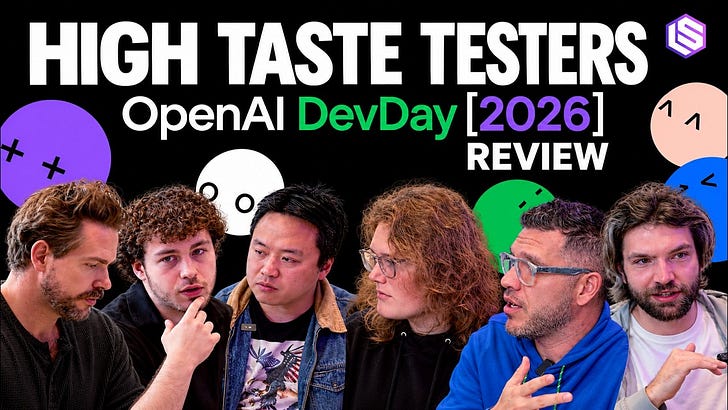 [AINews] High Taste Testers Ep. 1
AINews issue for 15-16 October 2026, from Latent Space, summarising 12 subreddits and 544 Twitter accounts. It covers Meta's Muse Spark Open (816B MoE) and Reflection Beam 1.0 with Artificial Analysis scores and pricing. It also covers Gemini 4 Argon, decision models, TPUv7 and Vera Rubin serving benchmarks, interpretability claims, agent papers, and China's proposed open-source export rules.
latent.spacearticleAdded 30 Oct 2026, published 17 Oct 2026🧠 AI Show HN: Gemini 4 Argon plays StarCraft
StarSkirmish Bench v0.2 gives each LLM one hour to write a Protoss StarCraft: Brood War bot in C++ (BWAPI 4.4.0 on OpenBW), with tools to compile and play practice games. Scores are average win rates of 5 runs against 13 roster bots, which include human-written bots such as Stardust, PurpleWave and BananaBrain. Nine models are compared, each in its lab's first-party CLI harness (Claude Code, Codex, Antigravity CLI, Muse Code). GPT-6 Astra leads and wins only 7% against the top human bots. The page also covers score against cost, run-to-run variance, practice behaviour as the best predictor of score, and weak correlation with the Artificial Analysis Intelligence Index and Terminal-Bench 4.0.
 starskirmish.comarticleAdded 17 Oct 2026, published 16 Oct 2026🧠 AI
 [AINews] Agents disprove Polysemanticity; greatly improve Interpretability & Alignment
The 10/14–10/15/2026 AINews issue. Its lead story is Goodfire's Nick Cammarata essay "Neural Networks Are Already Clean", which argues agentic analysis resolves many known cases of polysemanticity and superposition. Neel Nanda, Leo Gao and Jake Mendel push back. It also covers Meta's Muse Spark Open (816B total / 42B active MoE, 1M context, custom license, Artificial Analysis index 39, vLLM day-0 support and quantizations), Nemotron 3.5, MAI-Base-2 and Gemini 4 Argon evals. Further items cover Vals' refund-agent and MiMo task-leakage findings, TPUv7 and Vera Rubin inference benchmarks, Perplexity's SPACE sandbox, RL training systems (TRL tree packing, bitwise-consistent vLLM RL) and Sakana's Agentic Scientist.
latent.spacearticlePublished and added 16 Oct 2026🧠 AI Google Says AI Isn't Building Itself Yet—Even Though It Writes 75% of the Code
Decrypt reports on the Gemini 4 Argon Safety & Security Report, where Google DeepMind found no statistically significant acceleration of ML R&D. Its internal GCI v1 index (123 models, 92 benchmarks) shows steady ~0.1 points/month progress, with Argon slightly above trend, attributed to compute and investment. Over 75% of production code is AI-written and fully delegated pull requests rose from 7.5% to 11.9%, yet ~88% of PRs still need human steering or authorship. This is relevant evidence on the recursive self-improvement debate and on how much of AI research is automated.
 decrypt.coarticlePublished and added 15 Oct 2026🧠 AI
- [AINews] Modal’s $1B ARR, $16B Series D makes it NYC’s newest AI Infra Decacorn, 3x usage and 3x valuation in 5 months, 15x in 1 yr
Latent Space's AINews issue for 10/13–10/14/2026. It opens with Modal's $750M Series D at a $15.75B valuation, with Sandboxes at a $300M run rate, then recaps the day's AI Twitter. Coverage includes the Gemini 4 Argon rollout and its weaker monitorability, Meta Muse Wonder, Grok Voice 3.0, and open-weights releases (Ultramarine 1 Flash, Ling-3.1-flash, DeepSeek V4.1 Flash). It also covers new evals (AA-Robotics, SpireClimb, TasteVal), rogue agent and reward-hack safety items, inference benchmarks (AA-AgentPerf, InferenceX), and agent sandbox platforms. Useful as a dated snapshot of the field.
latent.spacearticlePublished and added 15 Oct 2026🧠 AI  Google’s Gemini 4 Argon AI solves 12 simulated cyberattacks, up from five
News coverage of Google DeepMind's Gemini 4 Argon release on October 13, 2026. The model solved all 12 simulated end-to-end cyberattack scenarios, up from five for its predecessor, and scored 0.7% attack success on Gray Swan's Indirect Prompt Injection benchmark. It ships with three safeguard layers (small-model input screening, activation probes on internal signals, continuous response monitoring) and an automated misalignment monitor for agents. Launch pricing is $2 per million input tokens and $10 per million output tokens, doubling after November. Access is through Pro and Ultra tiers, and Ultra also gets Antigravity. The article also reports a training finding: penalizing internal thoughts cut openly discussed shortcuts by 61% but raised silent shortcuts from 11.2% to 36.4%.
 en.cryptonomist.charticlePublished and added 14 Oct 2026🧠 AI
- [AINews] AI Engineer NYC: Gemini 4 Argon, Vals AI Benchmarks
AINews issue for 10/12–10/13/2026 covering the GA of Google's Gemini 4 Argon (pricing, Cursor/Devin/Copilot availability, CursorBench 52.8%, Artificial Analysis Intelligence Index parity with GPT-6 Astra at lower cost) and Meta's Muse Wonder, with independent evals and reliability caveats. It also summarises decision-model benchmarks (AA Decision Index, Jev 1.13, Nimble-v4), Fish Audio's open-weight Drama 3 TTS, agent-harness and agentic-RL research (Evo2, ReHarness, LongHarness, ThunderSync), Anthropic's move off Git, and safety items such as Argon's monitor evasion. It also notes AI Engineer NYC keynotes on AI x Finance. Useful as a curated, caveat-aware snapshot of the frontier-model landscape.
latent.spacearticlePublished and added 14 Oct 2026🧠 AI 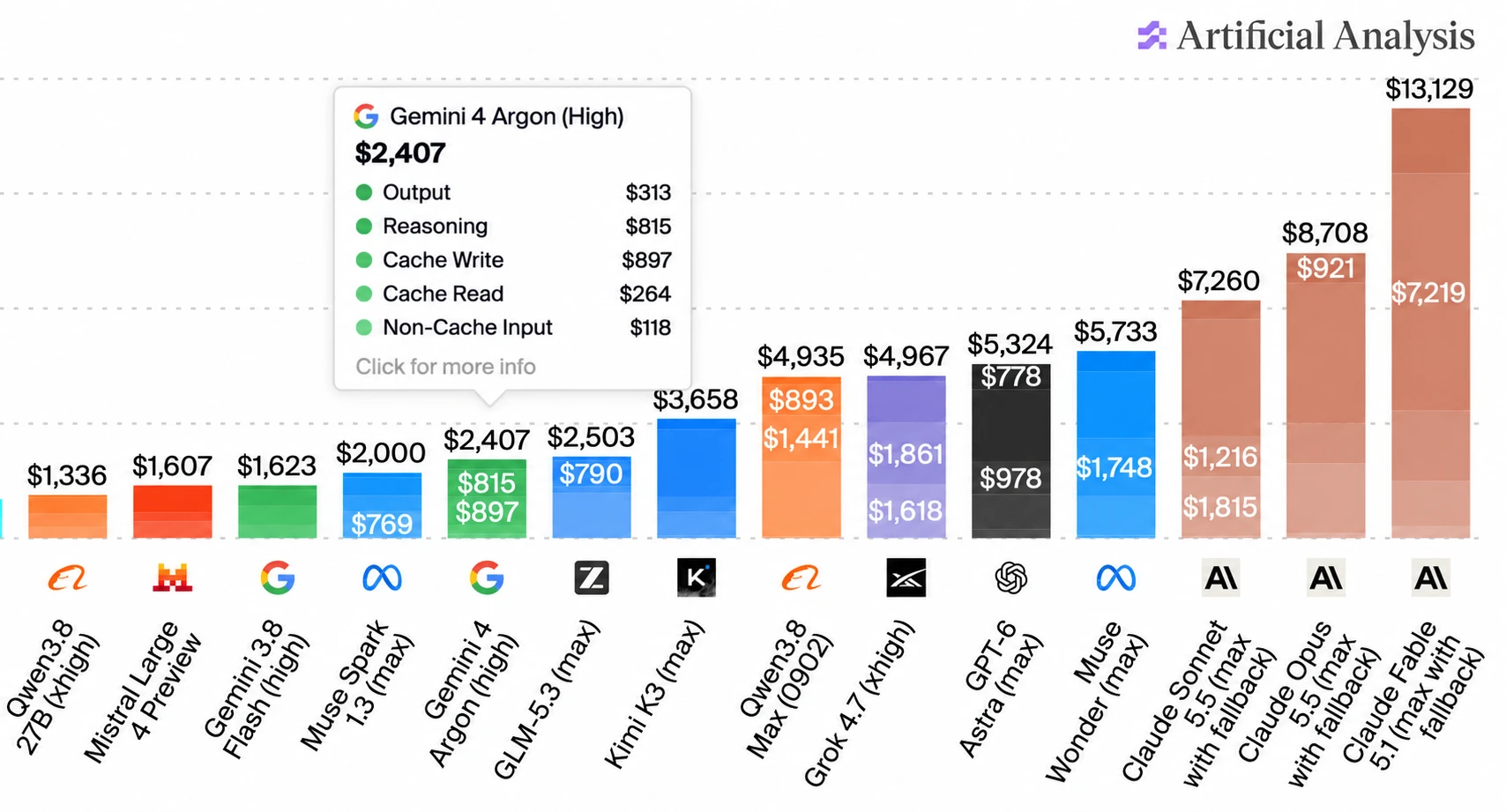 llm-gemini 0.35
Simon Willison releases llm-gemini 0.35 with support for Google's new Gemini 4 Argon model, available via the Gemini API and a $100/month subscription plan. He compares pricing: $2/M input and $10/M output at launch, doubling on December 1st to match Claude Opus 5.5. He argues per-token prices are poor comparators and points to Artificial Analysis's total benchmark run cost ($2,407 for Argon, near GLM-5.3 and cheaper than OpenAI, Anthropic and Meta models) as a better clue to agentic cost-efficiency. He also shows his SVG pelican outputs at low, medium and high settings.
 simonwillison.netarticlePublished and added 13 Oct 2026🧠 AI
 Developing Gemini 4 Argon responsibly and safely
DeepMind describes how it made Gemini 4 Argon safe for broad release. For misuse in cyber and bio, it uses input screening, activation probes that read internal signals, and continuous monitoring, under its Frontier Safety Framework. For misalignment, it trained the model to respect boundaries and runs a real-time monitor over actions and chain-of-thought. Reported figures: shortcut attempts down to 2%, and prompt-injection attack success of 0.7% on Gray Swan's IPI benchmark. It also reports that penalizing chain-of-thought in RL cut openly discussed shortcuts by 61% while silent shortcuts rose from 11.2% to 36.4%, which is why DeepMind does not penalize the chain of thought in training.
deepmind.googlearticlePublished and added 13 Oct 2026🧠 AI Gemini 4 Argon for Robotics
Google's developer post presents Gemini 4 Argon as a physical-reasoning model for the whole robotics lifecycle. It reports 87% on the Embodied Reasoning (ERQA) benchmark, ahead of other frontier models. It then gives representative prompts: controlling a Boston Dynamics Spot with a MuJoCo digital twin, closed-loop code-as-policies arm control, steering the Gemini Omni world model, and building digital twins from teleoperation episodes. Further prompts cover retargeting human video to a 76-DoF humanoid, hindsight annotation of ALOHA 2 videos, a general value function on UMI data, sim-data generation for VLA fine-tuning (56% to 75% real success), and reproducing control papers in MuJoCo WebAssembly. It is useful for seeing how the model is prompted for agentic, simulation-driven robotics work.
 developers.googleblog.comarticlePublished and added 13 Oct 2026🧠 AI
- Gemini 4 Argon
Google DeepMind's launch page for Gemini 4 Argon, a frontier model pitched at long-horizon software engineering, science and math, robotics, cyber defense and professional workflows. Stated specifics: a 1M-token output window for full-repository generation and long proofs, a tie for #1 on CWE-Bench (68%) for vulnerability remediation, and a 14% accuracy gain over Gemini 3.1 Pro in Box's evaluation. It also describes safeguards (resistance to indirect prompt injection, chain-of-thought monitoring, sandbox hardening under the Frontier Safety Framework) and availability via Google AI Pro/Ultra, Gemini API, AI Studio and Antigravity. Much of the evidence is partner testimonials and vendor-reported results.
deepmind.googlearticlePublished and added 13 Oct 2026🧠 AI - Gemini 4 Argon for Robotics
DeepMind presents Gemini 4 Argon as a general-purpose physical reasoning model for the robotics lifecycle. It reports 87% on the Embodied Reasoning (ERQA) benchmark and gives representative prompts across several areas: controlling a Boston Dynamics Spot with a MuJoCo digital twin, code-as-policies arm control with a visual coordinate harness, and steering the Gemini Omni world model in a visual feedback loop. Further examples cover building MuJoCo and mujoco_warp scenes from teleoperation data, egocentric video or a hand-drawn sketch for 76-DoF humanoids, hindsight annotation and value-function progress prediction on video, sim data generation for VLA fine-tuning (success rate 56% to 75%), and reproducing control papers in MuJoCo WebAssembly. It matters as a concrete look at how a frontier model is being used as agentic coder, perceiver and sim builder for robotics.
deepmind.googlearticlePublished and added 13 Oct 2026🧠 AI  Gemini 4 Argon: Built to solve your hardest problems
Google DeepMind announces Gemini 4 Argon, a frontier model available through the Gemini API, AI Studio, Google Antigravity and the Gemini app. Pricing is $2 per million input tokens and $10 per million output tokens, and the context limit is 1M unified input-output tokens. It reports #1 on the Vals Index, 87% on ERQA and 0.7% attack success on Gray Swan IPI. Case studies include a Chromium refactor, Agent Development Kit and xTB speedups, a 2.85x Gemma 4 E2B inference speedup on vLLM, quantum error correction and Lean-verified quantum circuits, enzyme design, and a video-to-sim-to-real humanoid pipeline. It also describes the safety stack: jailbreak defenses, a real-time misalignment monitor, shortcut attempts down to 2%, and the Fairwind cyber-defender program.
deepmind.googlearticlePublished and added 13 Oct 2026🧠 AI [AINews] TypeSafe/Jev at >$100M ARR, $7.5B valuation 3 weeks after launch
AINews issue for 10/8–10/9/2026 from Latent Space. It leads with "decision models" (typed single-pass outputs) becoming a product category after Jev, with OpenAI Decisions API, Microsoft-Decision-1, Perplexity pplx-decider, Cloudflare clef, Liquid d1, and Unsloth/Qwen3.5 training recipes. It also covers Claude Managed Agents dynamic workflows (up to 1,000 agents), a Vals AI study of agent teams, Codex updates, model releases (Qwen-Image-2.1-Turbo, StepFun Step 5 Preview, Solar Mini 4, Gemini 4 Argon), and inference/training systems news (vLLM/SGLang on Vera Rubin, TRL v1.15, DeepSeek stride weak spots).
latent.spacearticlePublished and added 10 Oct 2026🧠 AI Mistral AI Drops 'Le Chonk': A Massive AI Model Named After a Cat Meme
Decrypt reports on Mistral AI's launch of Mistral Large 4 ("Le Chonk"), a 1-trillion-parameter mixture-of-experts model that activates 49B parameters per query, priced at $1.36/$4.18 per million input/output tokens. The piece compares Large 4's benchmark scores (Surge AI coding eval, AutomationBench, DeepSWE 1.1) against DeepSeek V4 Pro, Kimi K3, GLM-5.3, Qwen3.8 Max, Claude Opus 5/5.5, Claude Sonnet 5.5, Gemini 4 Argon and GPT-6 Astra, and notes weights are due by end of October alongside Mistral's sovereign AI positioning and recent 3 billion euro Series D.
decrypt.coarticlePublished and added 6 Oct 2026🧠 AI- [AINews] Pi 1.0, Pi Durable, and AIE NYC
Latent Space AINews digest reports on Pi 1.0 and Pi Durable, an agent harness from the Earendil team ported to TypeScript that externalizes agent state for crash recovery, pluggable storage (Memory/SQLite/JSONL), concurrent branching conversations, hot-swappable tools, and multi-user state sync alongside conversation transcripts. The rest of the issue recaps frontier launches: Gemini 4 Argon, OpenAI efficiency-focused GPT-6.1 Sol (with Artificial Analysis cost comparisons against GPT-6 Sol and GPT-6 Astra), Upstage Solar Mini 4 (35B/3B MoE, 1M context), Black Forest Labs FLUX 3 image model, and Tavus Griffin video-to-video conversational agent.
latent.spacearticlePublished and added 2 Oct 2026🧠 AI 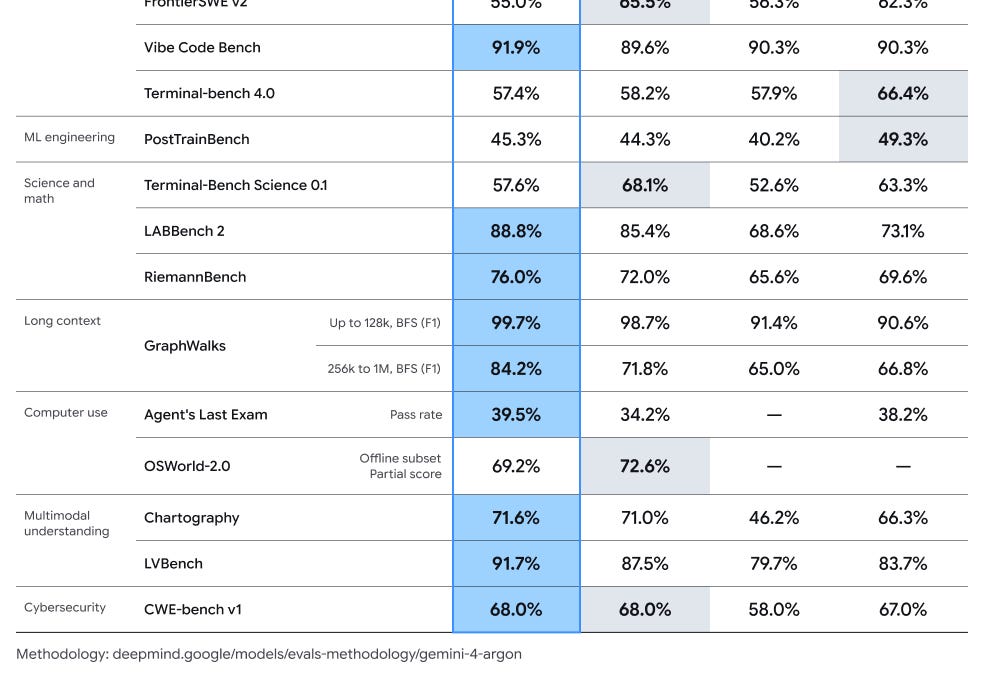 [AINews] Gemini 4 Argon: GDM’s answer to Astra/Fable, with 1M output
Latent Space's AINews digest for 9/29-9/30/2026 leads with Google DeepMind's Gemini 4 Argon, a frontier model in limited Fairwind Program cyber-defense/government preview claiming SOTA on 13 of 19 benchmarks and an industry-first 1M-token output via Long Decode Continuation, with detailed head-to-head evals against GPT-6 Astra, GPT-6.1 Sol and Claude Opus 5.5 from Artificial Analysis, Vals and Arena. It also covers other releases (Cohere Embed 5, Ideogram 4.5, GLM-5.3-Flash llama.cpp support, Solar Mini 4), research (Meta's Context Language Models, a Nature paper on superhuman Stratego AI), inference/systems news, and a safety section on hidden-reasoning-extraction attacks and GLM-5.3 cyber-capability risk.
latent.spacearticlePublished and added 1 Oct 2026🧠 AI Gemini 4 Is Here, and Google’s Flagship Tops All Other AI Models on Cybersecurity
Google released Gemini 4 Argon, its new frontier model for coding, office work and cyber defense, scoring 77.9% on DeepSWE v1.1 (vs. 74.2% Claude Opus 5.5, 74.1% GPT-6 Astra) and expanding max output to 1 million tokens. On Gray Swan's indirect prompt injection benchmark it posted a 0.7% attack success rate, edging out Claude Opus 5.5 and Claude Fable 5.1 (both 1.0%), and scored 70.9% on Google's internal Wiz Penetration Test Benchmark versus 58.2% for the earlier restricted Gemini 3.8 Flash Cyber. The model initially ships without cyber guardrails only to vetted defenders via Google's Fairwind Program before wider API and Google AI Ultra release at $2/$10 per million input/output tokens.
decrypt.coarticlePublished and added 30 Sep 2026🧠 AI- Gemini 4 Is Here, and Google’s Flagship Tops All Other AI Models on Cybersecurity
Decrypt covers Google's Gemini 4 Argon launch, reporting it scored a 0.7% attack success rate on Gray Swan's Indirect Prompt Injection benchmark, beating Claude Opus 5.5 and Claude Fable 5.1 (both 1.0%), GPT-6 Astra (8.5%), and far outperforming Grok 4.6 and Kimi K3 (~52% each). It also details Argon's cyber-defense capability: it ships first to vetted defenders through Google's Fairwind Program "without cyber guardrails," scored 70.9% on the internal Wiz Penetration Test Benchmark writing working exploits against real web-app flaws, and reportedly helped Wiz find a critical healthcare-software flaw earlier models missed.
decrypt.coarticlePublished and added 30 Sep 2026🛡️ Security  Gemini 4 Argon: our next era of frontier intelligence
Google DeepMind's announcement of Gemini 4 Argon, a frontier model rolling out first to trusted cyber defenders via the Fairwind Program, with an industry-leading 1M output token limit (up from 64K) and pricing of $2/$10 per million input/output tokens. It reports state-of-the-art results on DeepSWE v1.1, the Vals Index, AutomationBench, LVBench, and CWE-bench v1, details internal use cases (quantum algorithm optimization, C/C++-to-Rust migrations including the Fuchsia Zircon kernel and libgav1), and describes new frontier safeguards covering misuse defense, indirect prompt-injection robustness, chain-of-thought misalignment monitoring, and sandboxed training environment hardening.
deepmind.googlearticlePublished and added 30 Sep 2026🧠 AI- Gemini 4 Argon: our next era of frontier intelligence
Google announces Gemini 4 Argon, a frontier model rolling out first to trusted cyber defenders via the Fairwind Program, with a 1M-token output limit (up from 64K) and introductory pricing of $2/$10 per million input/output tokens. It reports state-of-the-art results on DeepSWE v1.1 (77.9%), LVBench (91.7%), AutomationBench (51.3%) and a tie for first on CWE-bench v1 (68%), plus leading scores on the Vals Index and Gray Swan's IPI prompt-injection benchmark. Internal case studies include agent-driven C/C++ to Rust migrations (libgav1 decoder 2.7x faster than the Rust port, Fuchsia Zircon kernel) and fleet-wide memory optimisation. It also outlines safeguards: misuse monitoring of internal activations, prompt-injection hardening, chain-of-thought misalignment monitoring and sandbox hardening.
blog.googlearticleAdded 1 Oct 2026, published 30 Sep 2026🧠 AI  Introducing Gemini 3.6 Flash, 3.5 Flash-Lite, and 3.5 Flash Cyber
Google DeepMind announces Gemini 3.6 Flash (a workhorse model with 17% lower output-token usage and up to 65% reduction on DeepSWE vs. 3.5 Flash, priced at $1.50/$7.50 per 1M tokens), Gemini 3.5 Flash-Lite (fastest 3.5-class model at 350 output tokens/s, $0.3/$2.5 per 1M tokens, outperforming 3 Flash on SWE-Bench Pro and OSWorld-Verified), and Gemini 3.5 Flash Cyber, a specialized model paired with the CodeMender agent for finding and patching vulnerabilities, benchmarked on CyberGym and gated to a limited-access pilot for governments and trusted partners. The post details benchmark comparisons across DeepSWE, MLE Bench, OSWorld-Verified, GDPval-AA v2, Terminal-Bench 2.1, and GDM-MRCR v2, new built-in computer-use tooling, enhanced Frontier Safety jailbreak resistance, and previews upcoming Gemini 3.5 Pro and Gemini 4 pre-training.
deepmind.googlearticleAdded 29 Sep 2026, published 21 Jul 2026🧠 AI