 Hackers Publish Work Details of 41,000 Homeland Security Employees
Icepick is a dataset published on 28 October 2026 by Distributed Denial of Secrets. It lists 41,191 DHS employees and contractors with names, titles, offices, phones, managers and 55,000+ permission groups. The hacktivist group Department of Peace says it took the data from DHS's Okta SSO; Okta denies compromise. DHS has filed a takedown notice via ZeroFox, and the full archive is unverified.
 decrypt.coarticlePublished and added 29 Oct 2026🛡️ Security
 Leak Exposes 41,000 Homeland Security Workers–Including Undercover ICE Agents
Icepick is a leaked archive of records on more than 41,000 Department of Homeland Security employees and contractors, published by Distributed Denial of Secrets in 2026 and said to come from DHS's Okta login system. WIRED's analysis covers CBP, ICE, HSI, USCIS and CISA staff, plus over 55,000 permission groups that reference undercover programs, Palantir Falcon, PenLink, Signal and Mobile Fortify. Okta says it has no evidence of compromise.
 wired.comarticleAdded 29 Oct 2026, published 28 Oct 2026🛡️ Security
 Ukrainian Hive and Nefilim Ransomware Affiliate Gets 70 Months in US Prison
Artem Aleksandrovych Stryzhak, a 36-year-old Ukrainian, was sentenced in the US to 70 months for conspiracy to commit computer fraud over Nefilim and Hive ransomware attacks. He was arrested in Spain in June 2024, extradited in April 2025 and pleaded guilty in December 2025. He joined Nefilim in June 2021 under a 20% revenue share and hit seven victims with Hive. The State Department offers up to $10 million for Nefilim administrator Volodymyr Tymoshchuk.
 securityweek.comarticlePublished and added 28 Oct 2026🛡️ Security
- lee1981 (@lee1981b) on X
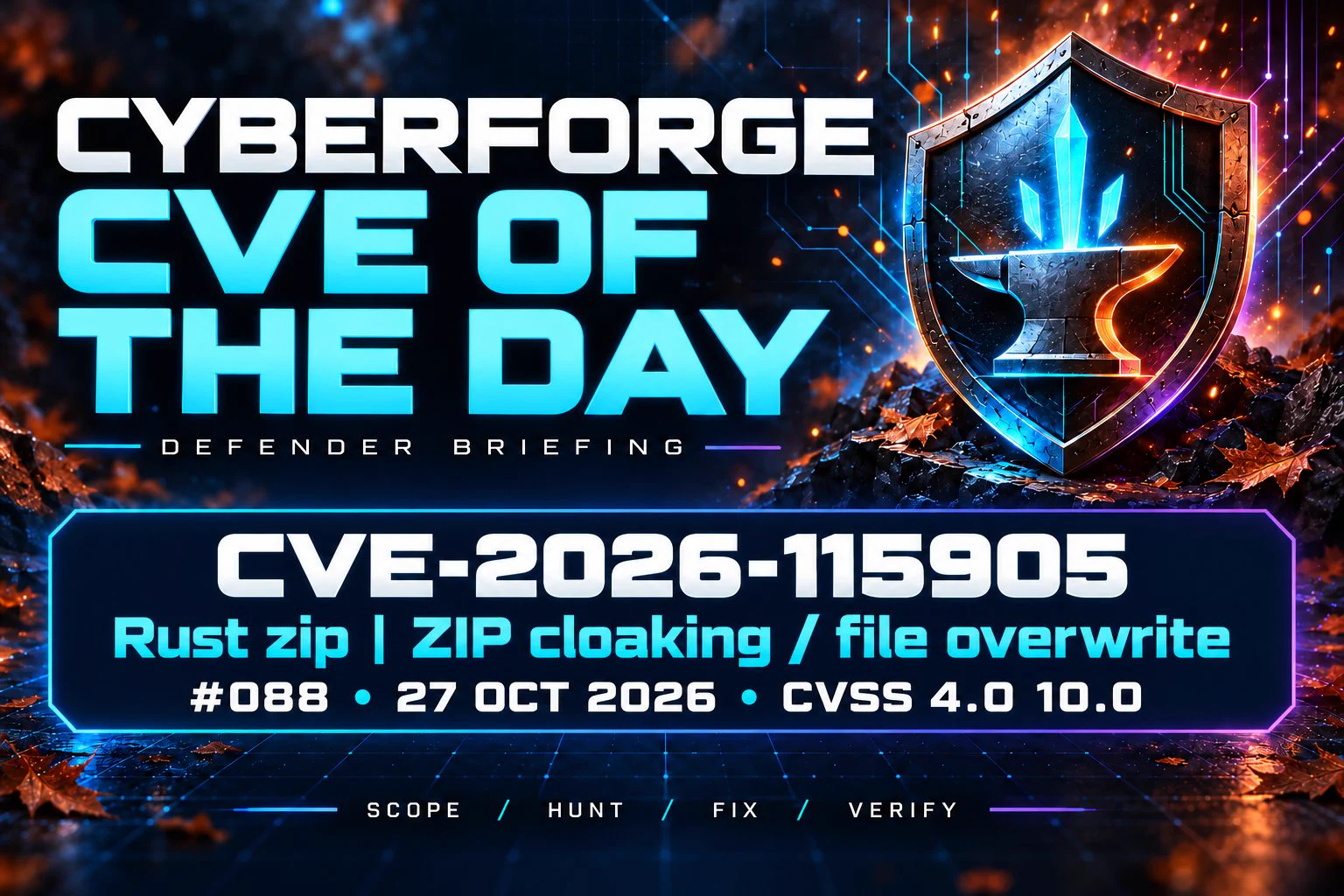
CVE-2026-115905 is a ZIP cloaking flaw in the Rust zip crate (zip-rs/zip2), rated CVSS v4.0 10.0 and affecting versions below 9.0.5. ZipArchive reads central-directory metadata while ZipStreamReader reads local headers, so a crafted archive can pass filename inspection and then overwrite a different file during streaming extraction. Version 9.0.5 adds consistency checks, but ZipStreamReader::new leaves them off by default, and extraction is not atomic, so files can be written before an error is raised. The post covers CWE-20 and CWE-436, KEV and EPSS status, Debian status and a six-step investigation trail.
 x.comadvisoryAdded 29 Oct 2026, published 27 Oct 2026🛡️ Security
 Upcoming Critical PHP Security Release
The php.net 2026 news archive opens with the PHP security team's advance notice of a release scheduled for 21 October 2026 at 14:00 UTC. It fixes two critical vulnerabilities, both rated CVSS v4.0 9.2, and may ship earlier if details leak or exploitation appears. Details and fixed versions come with the release. The archive also lists 2026 security releases (8.2.34, 8.3.35, 8.4.26, 8.5.11), PHP 8.6 RC3 and conference announcements.
 php.netadvisoryAdded 21 Oct 2026, published 20 Oct 2026🛡️ Security
 GKS FHE: Security Analysis
"GKS FHE: Security Analysis" is a Cryptology ePrint Archive preprint (2026/2523, October 2026) giving a formal security analysis of the Gribov-Kahrobaei-Shpilrain private-key fully homomorphic encryption scheme. The abstract says the scheme needs no bootstrapping or de-linearization, gives bit-exact decryption, supports native encrypted search and has unbounded depth. The page shows only the abstract, so the analysis's methods and results are not visible.
 eprint.iacr.orgpaperAdded 19 Oct 2026, published 18 Oct 2026🛡️ Security
 Staying Evergreen: How we automated secure access and repo hygiene in a shared org
GitHub engineers describe Evergreen, a Go-based GitHub App that runs quarterly outside-collaborator access reviews and archives stale repositories in a shared org. It uses scheduled Actions with repository_dispatch, JSON state files in git as the audit trail, checklist issues (IssueOps) closed to trigger revocation, and custom properties for ownership and exemptions. Design principles include fail-secure/fail-closed revocation, never deleting data, dry-run rollout, Splunk logging, and proactive pacing against GitHub's secondary rate limits.
 github.blogarticlePublished and added 15 Oct 2026🛡️ Security
 EliteReplay: Preserving Diverse Solutions in RL Post-Training via Quality-Diversity Search
EliteReplay is an RL post-training recipe that pairs GRPO with an "elite" archive built by quality-diversity search. Before training, the frozen base model is used to collect solutions spanning distinct approaches; during training, a replay loss on this archive is added to GRPO. This counters the narrowing of solution diversity that RL causes. On text-to-SQL tasks it reaches higher pass@128 than all baselines and yields up to 77% more distinct correct strategies. It also retains more of the base model's strategies and covers both readings of ambiguous questions nearly twice as often on AmbiQT.
 arxiv.orgpaperAdded 17 Oct 2026, published 15 Oct 2026🧠 AI
 CenterPoint Energy Data Breach Impacts 1 Million Texans
CenterPoint Energy told the Texas Attorney General that 1,062,060 state residents had names, addresses, Social Security numbers and driver's license numbers compromised. The breach surfaced after a hacker advertised ~7.5 million records on a cybercrime forum and later posted a 2.5 GB archive on September 12 with ~3 million phone numbers; the company then filed with the SEC. Impact in Indiana, Minnesota and Ohio remains unclear, and notification letters apparently haven't gone out.
securityweek.comarticlePublished and added 15 Oct 2026🛡️ Security Break the silence: Kazakhstan-nexus UAT-6275 targets CIS government organizations
Cisco Talos and Recorded Future Insikt Group describe UAT-6275 (TAG-193, overlapping Silent Lynx and YoroTrooper), a suspected Kazakhstan-nexus actor targeting CIS government, water and energy organizations. Exposed staging directories and a GitHub repo revealed four infection chains (macro documents, PS2EXE downloaders, GitHub-hosted PowerShell, and a WinRAR CVE-2025-8088 archive) delivering custom reverse shells Chvost, Laplas and PickleShell, plus Linux tooling and a FortiWeb CVE-2025-25257 PoC. The post includes victimology, a campaign timeline, attribution rationale (medium confidence), defender guidance and ClamAV/Snort coverage.
 blog.talosintelligence.comarticlePublished and added 14 Oct 2026🛡️ Security
- morluto/rea
REA (rea-agents on npm) registers an MCP server and matching workflow instructions with coding agents such as Claude Code, Codex, Cursor and Gemini CLI. It exposes tools for inspecting native binaries through Hopper, Ghidra or IDA (with optional objdump and Rizin), JavaScript/Electron apps and ASAR archives, .NET assemblies and websites. Results come back with evidence and limitations, so the agent can explain how a feature works and write and test its own implementation. Analysis runs locally, there is a CLI with the same workflows, and the showcases include C reconstructions verified against original x86 function bytes.
 github.comrepoAdded 14 Oct 2026🧠 AI
- SECTOR (@sector_sol) on X
A thread listing seven GitHub repos for securing LLM apps that can call tools: garak, PyRIT and promptfoo for attack and red-team testing, LLM Guard and Rebuff for input/output scanning and prompt-injection detection, NeMo Guardrails for programmable rails, and Inspect AI for repeatable evaluations. It proposes a loop of map risks, attack, inspect failures, add controls, retest and monitor. It stresses that a system prompt is not a security boundary and that credentials should be scoped, tool arguments validated outside the model, and consequential actions approved. It also warns that Rebuff is archived.
x.comthreadAdded 12 Oct 2026, published 11 Oct 2026🛡️ Security  Can a Cloud-Native Harness Make Agents Reliable Beyond the Desktop?
Latent Space interviews Stacklok founders Craig McLuckie and Joe Beda (Kubernetes co-creators) about Mecatl, an open-source "cloud-native harness" for coding agents that separates the agent loop from local tool execution, session state and model provider so enterprises can run and govern agents centrally rather than on individual desktops. The piece also covers Stacklok's earlier pivot from supply-chain security to ToolHive, an open-source platform/Kubernetes operator for running and governing MCP servers, and a not-yet-open-sourced "AI Gateway" focused on access control, budgets and provider routing for regulated enterprises (banks, telcos, semiconductor firms). The framing draws an explicit analogy to how Kubernetes decoupled enterprises from cloud providers, arguing agent harnesses need the same "cattle not pets" treatment to scale beyond desktop tools like Claude Code, Codex and GitHub Copilot.
 latent.spacearticlePublished and added 7 Oct 2026🧠 AI
 Blinder Tunnel Campaign Targets Iraqi Infrastructure
Unit 42 details "Blinder Tunnel," a campaign by Iranian state-aligned actor CL-STA-1178 (linked to Elastic's "The Shelby Strategy") that impersonated Dubai Airports recruiters to deliver a trojanized Visual Studio coding-challenge archive against an Iraqi critical-infrastructure target, with related activity against UAE aviation and Israeli entities via Google Drive-themed phishing. The report dissects a three-stage infection chain (weaponized .csproj MSBuild target abuse, AppDomainManager hijacking to disable ETW, and DLL sideloading into RuntimeBroker.exe) that deploys ShelbyLoader V2, the ShelbyC2 V2 RAT, PsProxy.dll (in-memory PowerShell execution), and Blackwood, a custom Chisel-based tunneling loader; C2 abuses GitHub's API and GitHub Issues as a dead-drop fallback, and attribution rests on an Iranian-hosted IP, Persian-domain infrastructure overlap, and MP3 metadata pointing to MusicDel.ir. Includes full IOCs (hashes, IPs, phishing domains, registry keys).
 unit42.paloaltonetworks.comarticlePublished and added 6 Oct 2026🛡️ Security
- Microsoft Agent Framework — python-1.20.0 release
Release notes for Microsoft's Agent Framework (Python and .NET SDKs), covering versions python-1.16 through python-1.20 and dotnet-1.19 through dotnet-1.23. Changes span native vector-store connectors (MongoDB, Qdrant, PostgreSQL/pgvector, DuckDB, SQL Server, Azure Cosmos DB, Azure AI Search), Foundry hosting redesigns around request-scoped agent factories and durable Invocations, MCP skill/session security hardening (approval binding, security labels, ZIP-only skill archives), Magentic multi-agent orchestration and handoff routing, and checkpoint/replay correctness fixes across workflows.
github.comrepoAdded 2 Oct 2026🧠 AI - https://github.com/praetorian-inc/gato
Gato (GitHub Attack Toolkit) from Praetorian is a Python CLI for enumerating and attacking GitHub organizations' CI/CD pipelines: it identifies poisoned pipeline execution risks, abuses self-hosted runners via workflow and run-log analysis, exfiltrates Actions secrets, and automates fork-PR/workflow-based command execution. Version 1.7 added an Actions Artifacts Secrets Scanner that downloads and recursively scans workflow artifacts with NoseyParker, which Praetorian used to find critical secrets leaks in prominent open-source projects. The project is now archived/superseded by Praetorian's multi-platform tool Trajan, which merges Gato (GitHub) and Glato (GitLab) attack capabilities.
github.comtoolPublished and added 2 Oct 2026🛡️ Security  Raven: The Harness of Harnesses for Composable Agentic Intelligence
Raven is an open-source multi-agent framework that automatically constructs and evolves modular 'harnesses' pairing specific models with domain-specialized execution scaffolding, treating each model-harness pair as a composable unit of intelligence. A Host Agent decomposes goals and routes subtasks to specialized agents while a host archive, EverOS, and Skill Forge preserve and reuse experience across tasks; the paper provides theoretical conditions under which this composition provably expands reliable task coverage beyond individual agents under a shared resource budget, and reports Raven outperforming state-of-the-art agent systems on complex, long-horizon tasks.
 huggingface.copaperAdded 30 Sep 2026🧠 AI
 Securing the Kubernetes Supply Chain: Introducing WizOS Helm Charts
Wiz Research examined the source repositories and CI/CD pipelines behind 1,500 popular Helm charts on Artifact Hub (mapping to 814 unique GitHub repos) and found 61 repos (7.5%) with confirmed supply-chain risk, including 20 charts with CI/CD workflow weaknesses and 25 depending on unmaintained/archived upstream projects. Two disclosed findings illustrate the risk classes: KubeView's go.mod referenced a Go module under a GitHub username that didn't exist, making it hijackable by anyone who registered the name, and Meilisearch's Helm chart repo had a GitHub Actions workflow triggered by PR comments that injected the commenter's branch name into a shell command while skipping author-association checks, letting any GitHub user run commands with a bot token that had push access. The post then pivots to promoting WizOS Helm Charts, Wiz's hardened/signed/CVE-scanned chart catalog built to close these gaps.
 wiz.ioarticlePublished and added 30 Sep 2026🛡️ Security
 NeedyMantis: Unpacking a post-compromise malware family used in targeted operations
Microsoft Threat Intelligence documents NeedyMantis, a previously unreported modular post-compromise malware family used in targeted intrusions against telecoms, universities, medical nonprofits, intergovernmental organizations, and government contractors. The writeup details a multi-stage C++/x64 shellcode loader chain delivered via DLL sideloading (abusing Poedit, curl, TightVNC, Vim, and spoofed Office/Broadcom/Intel/NVIDIA DLLs), a custom encrypted/compressed archive format, a minimized custom PE-like executable format, and a WebSockets-based C2 protocol with RC4 key exchange and modular load/unload commands. Microsoft links observed use to Storm-3069 (tied to the Kaspersky-reported DAEMON Tools supply chain compromise) and China-nexus activity, and provides IOCs, Defender detections, and KQL/Sentinel hunting queries.
 microsoft.comwriteupAdded 7 Oct 2026, published 28 Sep 2026🛡️ Security
 Malicious .git Configs Can Make Claude, Codex, Cursor, and Other AI Agents Run Attacker Code
Manifold Security (publishing as GitSpawn) found that a repository's own .git/config can set core.fsmonitor to an arbitrary command, which Git silently executes on any index-refreshing operation (git status, git diff) — including the background branch/diff checks AI coding agents run at session startup, before any trust prompt, sandbox, or model call. The technique, requiring only that a .git directory arrive intact via archive/USB/sync-folder rather than a fresh clone, was confirmed in goose, Codex CLI/Desktop, Claude Code (two separate paths), Cursor, Hermes Agent, Qwen Code, and Grok Build; goose, Codex, Claude Code, and Cursor have shipped fixes while Hermes Agent, Qwen Code, Grok Build, and Claude Code's "ultrareview" path remained exploitable as of September 1, 2026. OpenAI separately published three CVEs for the same class in Codex, and the piece ties the pattern back to earlier IDE trust-dialog bypasses (VS Code CVE-2021-43891, JetBrains CVE-2022-24346).
 thehackernews.comarticleAdded 26 Sep 2026🛡️ Security
- CVE-2026-87912 and CVE-2026-87913: Missing S3 bucket ownership verification in the AWS Security Agent plugin for aws-agents-for-devsecops and MCP Server
AWS bulletin 2026-105-AWS discloses CVE-2026-87912 and CVE-2026-87913: the AWS Security Agent plugin (aws-agents-for-devsecops, <1.1.0) and its MCP server (<0.2.0) write scan output to a predictably-named S3 bucket (security-agent-scans-<account-id>-<region>) without verifying bucket ownership. An attacker who pre-registers that bucket name in their own account can obtain the victim's private source archive, including embedded credentials and infrastructure state. AWS recommends upgrading to 0.2.0 and manually verifying/pre-creating the scan bucket to prevent squatting.
 aws.amazon.comadvisoryAdded 26 Sep 2026🛡️ Security
 Scan for Good: Using AI to discover and fix high-priority exposures across public services and critical infrastructure
Wiz announces Scan for Good, an initiative that pairs its AI pentester (Red Agent) and Google DeepMind's Gemini 3.8 Flash Cyber with human researchers. It scans authorized public-facing services of critical infrastructure, hospitals, municipalities and nonprofits for exposures and attack paths. It lists anonymized findings, including an exposed admin key over an 8.8M-file archive, NoSQL injection at an AI training-data platform, unsafe upload to hospital server control, and public CI/CD workflows leaking credentials. It also sets out the authorization, human-validation and private-disclosure rules.
wiz.ioarticlePublished and added 24 Sep 2026🛡️ Security- qybaihe/mu
mu is a coding agent built on the pi framework that introduces a "judgment kernel": a small, fast auxiliary model (Jev, a hosted judge, or Laya, a local 322M-parameter model) answers bounded yes/no/choice/score questions at 35 named decision points per turn — deciding what stays in context, whether a tool call is risky, when a turn is done, and what one agent should tell another — so the large working model doesn't spend tokens/attention on bookkeeping. It also ships a "hive" multi-agent mode (2-6 read-only "bees" plus a main editing agent) with an append-only shared board and relation-checking (supersedes/contradicts/supports) between findings, plus a native desktop app with live judgment/board/hive views.
github.comrepoAdded 26 Sep 2026, published 22 Sep 2026🧠 AI  HEAVYGRAM: A Telegram-based Surveillance Backdoor Linked to Handala Hack
Group-IB documents previously undocumented samples of HEAVYGRAM, a Python/PyInstaller-based Windows backdoor that uses the Telegram bot API for command-and-control, screen/audio capture, data exfiltration, and DLL side-loading, alongside the related CRUDEEXCLUDE loader that adds Windows Defender exclusions. The research corroborates and extends a March 2026 US DOJ affidavit and FBI FLASH report, attributing the malware with moderate confidence to the Handala Hack persona — assessed as a false-flag "hacktivist" front for Void Manticore (aka Storm-0842/Banished Kitten), operating on behalf of Iran's MOIS — used since Fall 2023 against Iranian dissidents, journalists, and critics of the Iranian government via Telegram-delivered, Delphi-packaged lures (fake KeePass, Telegram, Pictory apps). It details four infection-chain variants (WSF/VBS downloaders, HTA Telegram-polling scripts, Delphi droppers with embedded archives), the implant's command prefixes (@@/**/##) and attachment handlers, dual-bot C2 configurations, and provides IOCs and detection/hardening recommendations.
 group-ib.comwriteupAdded 1 Oct 2026, published 17 Sep 2026🛡️ Security
 Architecting a secure landing zone in the AWS European Sovereign Cloud
AWS Security Blog walkthrough of building a secure, production-ready landing zone in the new AWS European Sovereign Cloud (aws-eusc partition), covering multi-account governance via AWS Control Tower/AFT, IAM Identity Center federation as Terraform code, centralized logging into a Log Archive and Security Tooling account, network perimeter design with dedicated Direct Connect PoPs and VPC endpoints, KMS/External Key Store data protection, and partition-aware CI/CD for pushing container images, AMIs, and artifacts across the partition boundary. It maps design decisions to the AWS Security Reference Architecture and Well-Architected Framework, distinguishes hard partition boundaries from configurable choices, and references BSI C5:2020, SOC 2, and ISO 27001/27017/27018/27701 certifications for EUSC.
aws.amazon.comarticleAdded 7 Oct 2026, published 16 Sep 2026🛡️ Security- Field Notes: From AV Alert to Impacket
A DFIR field notes post describing how an analyst pivoted from a Microsoft Defender "Behavior:Win32/RegDump.SA" alert (flagged on svchost.exe running as SYSTEM) to identify Impacket's secretsdump.py activity. MFT analysis revealed a leftover temp file (ASOWCIKI.tmp) matching Impacket's RemoteOperations naming pattern (8 random ASCII chars + .tmp) for a partially-saved SAM registry hive, and the post explains why svchost.exe appears in telemetry due to the Remote Registry service being abused over MS-RRP/winreg via SMB. It also cross-references a similar Huntress case (April 2026) that additionally observed SCM Event ID 7040 (Remote Registry service enabled) as a corroborating artifact.
 dfir.chwriteupAdded 13 Sep 2026, published 11 Sep 2026🛡️ Security
- bikini/exploitarium
Exploitarium is a consolidated GitHub archive of an independent researcher's proof-of-concept vulnerability writeups, merging over a dozen former standalone PoC repos into one. It covers diverse real-world targets including RustDesk session permission bugs, an OpenSSH agent lock provider bypass, a Redis VSET duplicate HNSW ID RCE, a QEMU CXL Type3 mailbox escape, Firefox native/backup NSS RCE PoCs, libssh2 CVE-2026-55200, Nextcloud federated share bearer token issues, and more. The author documents an AI-assisted fuzzing workflow (hand-typed PoCs, AI-drafted READMEs) and credits prior work on an objdump OOB write finding.
github.comrepoPublished and added 7 Sep 2026🛡️ Security  Give Your Coding Agents a Memory You Own
funes is an open-source, single-binary memory layer that turns the session traces of coding agents (Claude Code, Codex, Pi, Hermes) into a durable, queryable memory instead of an unsearchable archive. It runs locally by default — chunking, embedding and reranking turns with a pinned local model into a Lance dataset, combining vector and BM25 search with cross-encoder reranking and recency weighting — and can optionally sync to a private-by-default Hugging Face dataset so a memory follows a user across machines or is shared across a team, with credential redaction before publishing. The post also reports a "handoff-vs-recall" benchmark showing recall from raw traces is cheaper and more reliable than context compaction or written handoffs for resuming long investigations.
huggingface.coarticleAdded 29 Sep 2026, published 3 Sep 2026🧠 AI Breaking Claude Code Opus 5 Auto Mode · Embrace The Red
Embrace The Red (Johann Rehberger) demonstrates an indirect prompt injection attack chain that achieves 60-80% success rates hijacking Claude Code Opus 5 Auto Mode into remote code execution, contrasting with a vendor-run benchmark that reported 0.00% attack success. The chain nudges Claude from WebFetch to curl, delivers a malicious ZIP archive, and exploits Python module shadowing (a poisoned struct.py) when Claude writes its own decoder script, ultimately downloading and executing a payload that establishes C2 and even spawns a nested headless Claude Code instance. Anthropic closed the report as "Informative, working as designed," framing Auto Mode as a best-effort classifier rather than a security boundary, reinforcing that sandboxing and egress control remain necessary mitigations.
 embracethered.comwriteupAdded 31 Aug 2026🛡️ Security
 crt.name
 is a free subdomain index and API that returns every subdomain on file for a given apex domain plus first-seen dates, built by continuously parsing SAN hostnames from Certificate Transparency logs (Static CT sources like Let's Encrypt Sunlight, Geomys, Cloudflare Raio, plus legacy RFC 6962 logs like Google Argon, Sectigo, DigiCert), supplemented by Internet Archive CT replays, Common Crawl, ICANN CZDS zone files, ProjectDiscovery Chaos, HaGeZi DNS blocklists, and an active hostname prober. It offers a no-token REST API (100 req/IP/day), a Streamable HTTP MCP server exposing a single search tool for agent clients, and is the default crt source in the subfaster CLI subdomain enumerator.
 crt.nametoolAdded 3 Sep 2026, published 21 Aug 2026🛡️ Security
 UIUCTF 2026 — Firefly & Sparxie: Lua Sandbox Escape via Bytecode Patching and WASM UAF
A UIUCTF 2026 pwn writeup covering two sandbox-escape challenges: Firefly, where Lua 5.5's empty luai_verifycode lets patched bytecode abuse OP_FORLOOP's untyped register read plus chgivalue's tag-preserving payload update to build type confusion, GOT-redirect fclose to fflush under partial RELRO, and heap-groom a leaked /flag.txt buffer; and Sparxie, a WASM/Emscripten Lua sandbox where a BLAKE2s seal that omits a 16-byte route field lets an archive pass be forged into a relay permit, and a duplicate-clip timeline dedup bug causes a freed studio page to be reused by a queue allocation, yielding a lens over a static draft pool and an in-Lua BLAKE2s witness forgery that reaches sparxie_redeem(). It includes full exploit scripts, binary offsets, and a linked GitHub repo (Abdelkad3r/UIUCTF-2026) with handouts and solvers for both challenges.
 cybersecurityelite.comwriteupAdded 2 Oct 2026, published 11 Aug 2026🛡️ Security
 Beyond Prompt Injection: Hacking Apple's Private Cloud Compute
Sentry researcher Drinor Selmanaj found CVE-2026-20685, a path traversal (Zip Slip/CWE-22 class) in darwin-init, the root PID 1 process that provisions Apple Private Cloud Compute nodes by extracting cryptex bundles. By crafting a tar archive that is simultaneously a valid cryptex and a set of traversal entries, the attacker writes files as root to the persistent /var/db data volume during boot, redirects the splunkloggingd log forwarder to an attacker-controlled server, and exfiltrates CloudBoard/Trusted Inference Engine telemetry including per-request metadata, token counts, and timing side-channels — while PCC's attestation, which only measures installed software, remains indistinguishable from a clean boot. Apple rated it CVSS 6.5 information disclosure, patched it in PCC 5E290.3+, and paid a $150,000 Apple Security Bounty award.
 blog.sentry.securitywriteupAdded 3 Sep 2026, published 10 Aug 2026🛡️ Security
- Inside an Oracle Database SQL Injection Attack | Huntress
Huntress details a July 2026 incident where attackers exploited a classic SQL injection flaw in a public-facing Java/Tomcat application to reach an Oracle database over JDBC, then used Oracle's CREATE JAVA SOURCE statement to compile a custom post-exploitation toolkit called khunt directly as database objects. Khunt modules (KhuntCmd, KhuntHash, KhuntFS/FS2, KhuntT, KhuntUnzip) let the attacker run OS commands, dump Oracle credentials, browse the filesystem, and ultimately pivot to SYSTEM-level RCE on the underlying Windows host, where they exfiltrated SAM/SECURITY/SYSTEM registry hives. It's notable because storing malicious code as PL/SQL/Java database objects rather than OS files/processes evades traditional EDR and AV visibility.
 huntress.comwriteupAdded 3 Sep 2026, published 5 Aug 2026🛡️ Security
- System Prompts Leaks
A community-maintained repository that archives leaked or extracted system prompts — the hidden instructions given to LLM chatbots before user input — captured verbatim from products including Claude/Claude Code, ChatGPT/Codex, Gemini, Grok, Cursor, Copilot, Perplexity, Meta AI, Mistral, DeepSeek, GLM, and others. It serves as a reference corpus for studying system prompt design, extraction techniques, and the system prompt leakage risk class, and is updated regularly as new prompts are exfiltrated from newer model releases.
github.comrepoAdded 3 Sep 2026, published 3 Aug 2026🛡️ Security  PolinRider Caused Dozens of npm, Go, PHP Compromises
OpenSourceMalware's research ties together JFrog's, Nextron's, and Socket's separate reports on compromised html-to-gutenberg/fetch-page-assets npm packages, 16 Go modules, and Joyfill's poisoned beta releases, attributing all of them to DPRK's PolinRider campaign via shared XOR keys, TRON/Aptos wallets, C2 infrastructure, and the fa-solid-400.woff2 loader file hash. The piece argues these aren't targeted account takeovers but automated propagation from infected maintainer machines (via temp_auto_push.bat git history rewriting and stolen .npmrc tokens), and uses GH Archive to prove that 43 of 64 analyzed Go module pseudo-version timestamps were forged to appear years older than the actual malicious push. Delivered payloads include InvisibleFerret/DEV#POPPER RAT and the OmniStealer Python infostealer, and the article links a PolinRider crossover into a compromised Packagist/PHP package (roberts/leads) via shared C2 infrastructure.
 opensourcemalware.comwriteupAdded 3 Sep 2026, published 31 Jul 2026🛡️ Security
- Hackflix
Hackflix (h4ckfl1x) is a curated, searchable archive of security conference talks from DEF CON, Black Hat, RSA, BSides and other events. It lists about 21,560 videos across 659 events and 38,914 topics, filterable by conference, year, speaker or topic. It is useful for finding talks on a given subject or by a given speaker in one place.
 h4ckfl1x.comotherAdded 3 Sep 2026, published 30 Jul 2026🛡️ Security
- EVM Hack PoC
A public GitHub repository aggregating proof-of-concept exploit archives for EVM (Ethereum Virtual Machine) smart contract hacks, generated from the companion evm-hack-registry dataset and meant to be consumed by the evm-hack-analyzer tool. It's positioned as raw material for blockchain security research, education, and building automated PoC-analysis tooling rather than a single vulnerability writeup.
github.comrepoAdded 3 Sep 2026, published 18 Jul 2026🛡️ Security  KUDANKULAM NUCLEAR POWER PLANT LEAK: AN ACCIDENTAL DISCLOSURE
An OSINT investigator analyzes a WorldLeaks ransomware group data leak of Reliance Infrastructure (hosted by third-party vendor Yotta), which exposed 14.3GB / ~19,000 files related to India's Kudankulam Nuclear Power Plant (KNPP) — including RFC drawings, PPS fencing designs, HVAC/fire specs, and vendor/employee records. The piece profiles WorldLeaks (a Hive/Hunters International spin-off), lists MD5/SHA-256 hashes for its RustyRocket exfiltration tool, and discusses supply-chain vendor risk, industrial espionage by nation-state actors (Lazarus/DPRK, China), and insider credential trading as threats to critical nuclear infrastructure.
 theravenfile.comwriteupAdded 3 Sep 2026, published 17 Jul 2026🛡️ Security
 Socket: Operation Muck and Load
Socket details "Operation Muck and Load," a campaign starting with a malicious Go module (github.com/kaleidora/dnsub-scanning-tool) that impersonates a DNS scanner but launches hidden PowerShell to fetch and decode a multi-layer, XOR-encrypted loader. The loader resolves encrypted payload locations from public dead drops (Pastebin, GitHub, YouTube, Instagram, Telegram, Google Docs), retrieves a password-protected .7z archive masquerading as Microsoft Photos, and deploys AsyncRAT/Quasar/Remcos-style RATs and Vidar infostealer. Pivoting from the module, Socket uncovered 222 GitHub repositories across 190 accounts using automated force-push workflows tied to a single email (ischhfd83@rambler.ru) to fake activity and credibility, some directly hosting Vidar, XMRig/BitMiner, and trojan loaders.
 socket.devwriteupPublished and added 16 Jul 2026🛡️ Security
- Protect AI llm-guard
LLM Guard (Protect AI) is an open source Python toolkit that wraps input/output scanners around LLM applications to detect and block prompt injection, PII/data leakage, toxic or harmful content, and other unsafe interactions, with a pip-installable library and API deployment option. The project has since been archived and is no longer maintained, though the code and associated Hugging Face models remain publicly available.
github.comrepoAdded 3 Sep 2026, published 14 Jul 2026🛡️ Security - awesome-ai-security-tools
An extensive, actively updated awesome-list aggregating public-source, research, and commercial tools for AI security and AI-assisted cybersecurity. It spans LLM-driven finding triage (nuclei-autotriage, SigmaOptimizer), securing AI coding agents and MCP/skill ecosystems (agent-audit, SkillSpector, Ramparts, ToolHive, Pipelock), AI/ML supply-chain and model-artifact scanning (modelscan, Fickling, GuardDog, Adversarial Robustness Toolbox), and autonomous pentest/exploit agents (PentestGPT, PentAGI, Strix, CAI). Each entry includes stars, license notes, and cross-references, making it a practical index for the fast-moving 2026 agentic-AI-security tooling landscape.
github.comrepoPublished and added 11 Jul 2026🛡️ Security - DataDog/guarddog
GuardDog is DataDog's CLI tool that scans PyPI, npm, Go modules, Rust crates, RubyGems, GitHub Actions, and VSCode extensions for malicious packages using YARA-based static analysis and registry metadata detectors. It correlates code capabilities with threat indicators (mapped to MITRE ATT&CK stages) to produce a 0-10 risk score, aiming to reduce alert fatigue compared to traditional SAST tools, and runs archive extraction and source analysis inside a kernel-level sandbox (Landlock/Seatbelt via nono) to mitigate path-traversal/code-execution vulnerabilities such as CVE-2022-23530, CVE-2022-23531, CVE-2026-22870, and CVE-2026-22871.
github.comrepoPublished and added 11 Jul 2026🛡️ Security 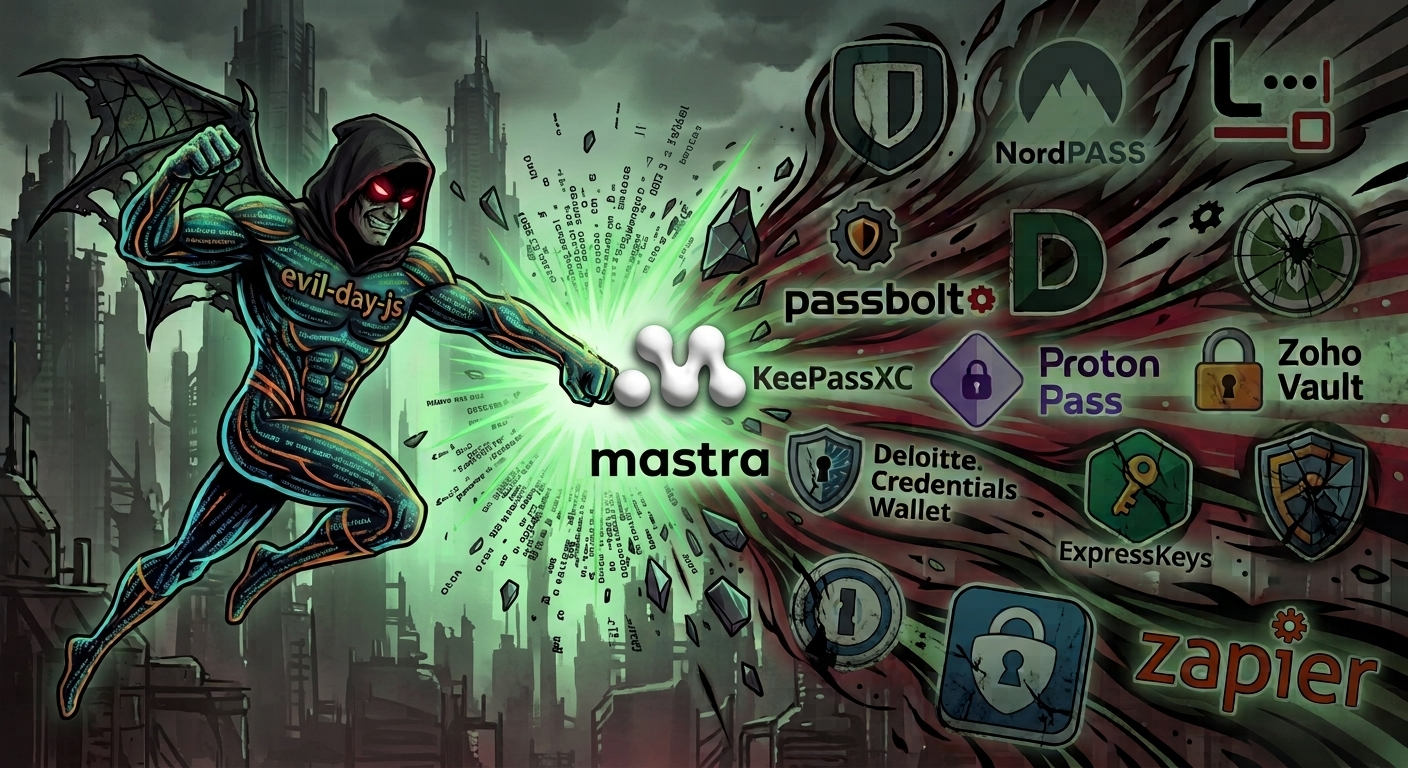 Mastra Attack Targets Crypto, Password Managers, Authenticators, and Zapier
A threat actor took over a dormant maintainer account and republished 140+ packages in the @mastra npm scope (including @mastra/core, ~918K weekly downloads), injecting a typosquat of dayjs called easy-day-js as a new dependency in every manifest. A clean 1.11.21 version was published first, then a weaponized 1.11.22 tagged latest was pulled in via caret-range resolution, delivering a two-stage cross-platform backdoor that disables TLS validation, self-deletes, installs OS-specific persistence disguised as Node/NVM tooling, and steals browser history plus data from 166 crypto-wallet, password-manager (1Password, Bitwarden, LastPass, Dashlane, NordPass, Proton Pass, KeePassXC, Zoho Vault, Kaspersky), MFA-authenticator, and Zapier browser extensions. The report ties the campaign's Hostwinds infrastructure, clean-then-armed typosquat, and TLS-off/detached/self-delete dropper pattern to the same playbook Microsoft attributed to Lazarus Group in the earlier axios npm compromise, and compares its extension targeting to the "HyperHives" ClickFix campaign, noting npm's lack of provenance enforcement (provenance: no on the malicious wave) as the control gap that let it through.
opensourcemalware.comwriteupAdded 3 Sep 2026, published 18 Jun 2026🛡️ Security- Akira, LimeWire, and the Sour Taste of Data Exfiltration
Huntress SOC details an Akira ransomware incident where a threat actor accessed a hypervisor, spun up a new VM (bypassing EDR since it lacked the Huntress agent), disabled Microsoft Defender, and deployed a renamed akira.exe encryptor. Notably, the actor exfiltrated staged WinRAR archives via Easyupload.io, a file-upload service run by the rebranded former peer-to-peer client LimeWire, alongside earlier use of WinSCP for exfiltration.
huntress.comwriteupAdded 3 Sep 2026, published 12 Jun 2026🛡️ Security  The sorry state of skill distribution
Trail of Bits researchers bypassed every agent-skill security scanner they tested — ClawHub's VirusTotal/Code Insight and GPT-5.5-based guard model, and skills.sh's Gen/Socket/Snyk-backed scanning, plus Cisco's skill-scanner — using techniques like context-truncation via 100,000 newlines, malicious payloads hidden inside .docx ZIP archives, Python .pyc bytecode poisoning to steal environment variables, and rhetorically-crafted prompt injection that convinced LLM analyzers a malicious npm/yarn registry change was benign. The piece also shows a legitimate Anthropic Office skill (soffice.py) using LD_PRELOAD in ways indistinguishable from malicious behavior, arguing static/LLM skill scanning is structurally unable to guarantee safety and that organizations should instead curate trusted skill marketplaces (e.g., trailofbits/skills-curated) rather than rely on public ones. PoC skills are published at trailofbits/overtly-malicious-skills.
 blog.trailofbits.comwriteupAdded 3 Sep 2026, published 3 Jun 2026🛡️ Security
 Socket: node-ipc npm Package Compromised
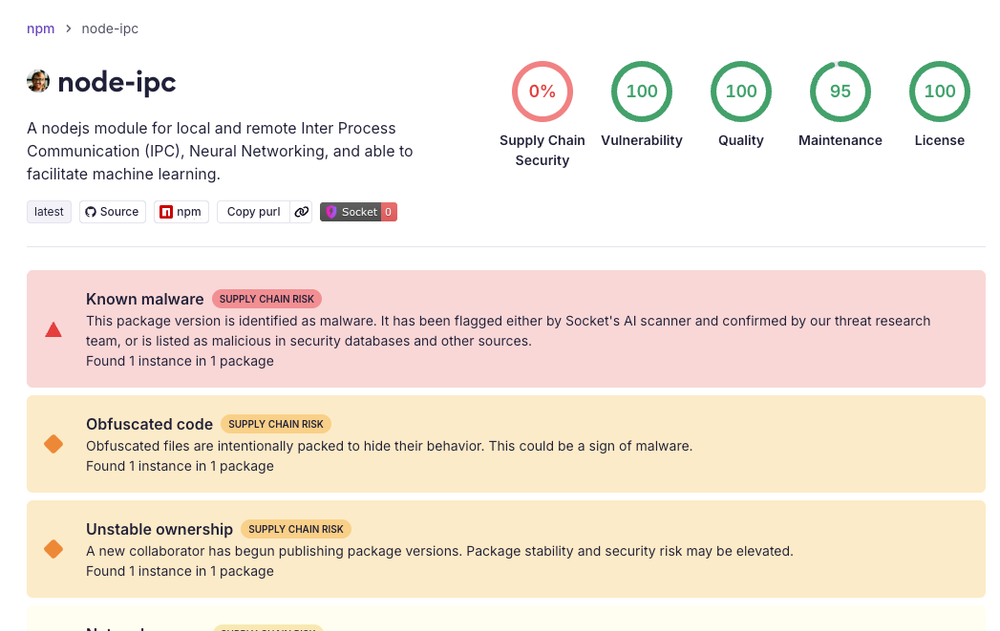
Socket's threat research team details a fresh compromise of the npm package node-ipc, where dormant maintainer account "atiertant" was hijacked via an expired recovery-email domain and used to publish three malicious versions (9.1.6, 9.2.3, 12.0.1) containing an obfuscated credential-stealing backdoor appended only to the CommonJS build. The payload forks a detached child process, harvests cloud/SSH/CI/database credentials and secrets from the filesystem and environment, archives them, and exfiltrates via covert DNS TXT queries to a typosquatted Azure-lookalike domain (sh.azurestaticprovider.net) and zone bt.node.js, with no observed C2 response handling or persistence. The write-up includes the full decode chain (XOR+HMAC+base64 obfuscation), dynamic validation, and complete IOCs (hashes, domains, temp file paths).
socket.devwriteupPublished and added 30 May 2026🛡️ Security Socket: Malicious NuGet Package Impersonates Sicoob Banking SDK
Socket researchers found Sicoob.Sdk, a NuGet package impersonating an official C# SDK for Sicoob (a major Brazilian cooperative bank), which in versions 2.0.0-2.0.4 exfiltrates client IDs, PFX passwords, and base64-encoded PFX mTLS certificate archives via a hardcoded Sentry telemetry endpoint. The associated GitHub organization (Sicoob-Cooperativa) served as a clean-source façade, with the malicious logic only present in the compiled DLL, and the same publisher account distributed 11 other Sicoob-branded packages as dependencies of the malicious wrapper. NuGet blocked the package after Socket's abuse report.
socket.devwriteupPublished and added 29 May 2026🛡️ Security- nikaiw/VMkatz
VMkatz is a static Rust binary that reimplements mimikatz's credential-extraction logic against offline VM artifacts — .vmsn snapshots, .vmdk/.qcow2 disks, or raw registry hives — instead of live LSASS. It supports all nine mimikatz SSP credential providers plus SAM/LSA/DCC2 dumping, DPAPI master-key extraction in hashcat format, a native ESE parser for NTDS.dit, Kerberos ticket export (kirbi/ccache), and BitLocker FVEK recovery/decryption via memory pool-tag scanning. It's designed to run directly on ESXi/Proxmox hosts or NAS storage (with a Python loader to bypass ESXi's execInstalledOnly VIB protection), letting operators pull credentials in place rather than exfiltrating hundreds of GB of disk images.
github.comrepoPublished and added 22 May 2026🛡️ Security - OpenCTI-Platform/opencti
OpenCTI is an open source cyber threat intelligence platform for structuring, storing, and visualizing technical (TTPs, observables) and non-technical (attribution, victimology) threat data, built on the STIX2 standard with a GraphQL API and connector framework. It integrates with tools like MISP, TheHive, and MITRE ATT&CK, supports inferred relationships between data points, and offers both an Apache 2.0 Community Edition and a paid Enterprise Edition with additional features.
github.comrepoPublished and added 14 May 2026🛡️ Security  Socket: GemStuffer Campaign
Socket's threat research team documents GemStuffer, a campaign of 100+ RubyGems packages that scrape UK local government ModernGov democratic-services portals (Lambeth, Wandsworth, Southwark) and repackage the harvested HTML into valid .gem archives published back to RubyGems using hardcoded API keys — using the registry itself as a public data drop rather than a malware distribution vector. The writeup breaks down the full attack chain (scraping via Net::HTTP, gem staging in /tmp, credential injection with HOME override, gem build/push, and manual API POST variants), lists exposed RubyGems API keys, IOCs, and remediation steps including yanking packages and auditing for HOME env mutation.
socket.devwriteupPublished and added 13 May 2026🛡️ Security- Butler
Butler is a Python CLI/SQLite-backed tool that crawls all repositories in a GitHub organization to inventory workflows, actions, and reusable workflows, flagging unpinned/unpinnable third-party actions, references to archived or deleted repos, invalid runners, and organization/repo secrets & variables usage (including 'secrets: inherit'). It downloads workflow data via a GitHub PAT or GitHub App, processes it into a local database, and generates customizable HTML/CSV reports with SQL-based custom queries, aimed at large-scale GitHub Actions supply-chain and CI/CD hygiene auditing.
github.comrepoPublished and added 6 May 2026🛡️ Security - Hawk-Eye
Hawk-Eye is a Python CLI tool that scans S3, MySQL, PostgreSQL, MongoDB, CouchDB, Google Drive, Slack, Redis, Firebase, GCS, and local filesystems for PII and secrets exposure. It uses OCR and text analysis to inspect documents (docx, xlsx, pptx, pdf), images, archives, and video files, with configurable regex fingerprints, Slack alerting, and JSON output for CI/CD integration.
github.comrepoPublished and added 6 May 2026🛡️ Security - Komari Red: The Monitoring Tool with a Built-in Reverse Shell
Huntress details a live intrusion where an attacker used stolen SSLVPN credentials, Impacket's smbexec.py (a customized fork with randomized artifact names) for lateral movement and registry-hive dumping, then enabled RDP via reg/netsh changes to interactively install the open-source "Komari" monitoring agent as a SYSTEM-level service named "Windows Update Service" via NSSM. Unlike other abused RMM/monitoring tools (Velociraptor, SimpleHelp, ScreenConnect, AnyDesk, Nezha, Atera), Komari ships arbitrary command exec, an interactive PTY reverse shell, and distributed ping/port-scanning enabled by default over a WebSocket that blends in as normal HTTPS traffic — turning a legitimate 4.3k-star GitHub monitoring tool into an out-of-the-box botnet-style C2 with no weaponization required.
huntress.comwriteupAdded 3 Sep 2026, published 30 Apr 2026🛡️ Security - Manual Configuration Manager (SCCM) credential harvesting
A step-by-step method for harvesting Configuration Manager (SCCM/MECM) credentials by pulling DPAPI-encrypted secret policy blobs (Network Access Accounts, task sequences, collection variables) via WMI or the local CIM repository, then exfiltrating DPAPI master keys and LSA SYSTEM/SECURITY/SAM hives for fully offline decryption with Impacket's dpapi and secretsdump modules. The approach avoids running known SCCM-abuse tools like SharpDPAPI on-target, reducing signature-based detection while still noting which steps (registry hive backup, DPAPI folder copy, WMI queries) a SOC could realistically catch.
 bencteux.frwriteupAdded 3 Sep 2026, published 5 Oct 2025🛡️ Security