- GitLab Security Incident: Attempted Exploitation of CVE-2026-97229
Alpine Linux incident report on attempted exploitation of CVE-2026-97229 (CVSS 10.0), a regex-evaluation bug in Ruby's Onigmo engine reachable through GitLab CI configuration. An attacker crashed workers 8 times on 20 and 21 October 2026. Upgrading to GitLab 19.3.6 did not fix it because the patch sits in GitLab's bundled Ruby. Alpine rebuilt the instance and found no tampering with aports or releases.
 alpinelinux.orgwriteupAdded 29 Oct 2026, published 28 Oct 2026🛡️ Security
 Reversible Pseudonymisation of Documents Sent to External LLMs: an Open Bilingual Benchmark and an Engine
Open bilingual (Russian and UK English) benchmark of five open pseudonymisation tools and a regex baseline, plus a new engine built on the two strongest tools. On a held-out set of 1,000 synthetic documents per language, the best existing tools leave a whole personal value visible in 61% (Russian) and 58% (UK) of documents. The engine does so in 0.3% and 0.2%. Russian name restoration reaches only 94.6%, below the 99% threshold. Real documents were not tested.
 arxiv.orgpaperAdded 27 Oct 2026, published 25 Oct 2026🛡️ Security
- Reversible Pseudonymisation of Documents Sent to External LLMs: an Open Bilingual Benchmark and an Engine
This paper presents an open benchmark of five existing pseudonymisation tools and a regex baseline on Russian and UK English documents, plus an open engine built on the two strongest tools. On a held-out set of 1,000 synthetic documents per language, the best existing tools leave a whole value visible in 58 to 61% of documents. The engine does so in 0.2 to 0.3%. Russian name restoration reaches only 94.6%, below the 99% threshold. Real documents were not tested.
arxiv.orgpaperAdded 27 Oct 2026, published 25 Oct 2026🧠 AI - Agentic AI Defense: Decode-Time Provenance Binding for MCP
Decode-time provenance binding is a defense for Model Context Protocol agent pipelines against cross-modal trust laundering, where instructions hidden in an email-signature image via LSB, DCT or metadata steganography get decoded by a tool. It combines HMAC-authenticated trust labels, a provenance ledger and context-taint tracking to block critical tool calls. On a real MCP testbed with 24 adaptive payloads, attack success fell from 100% undefended (62.5% for keyword and regex filters) to 0%.
arxiv.orgpaperAdded 26 Oct 2026, published 22 Oct 2026🛡️ Security  Paul Dragoonis (@dr4goonis) on X
Social post summarising emergency patches for Node.js (4 high CVEs), PHP (2 critical) and nginx (3 critical). Node.js flaws include a Brotli decoder out-of-bounds write, a DNS truncation bug and two TLS hostname-verification bypasses. PHP has use-after-free and heap corruption bugs, and nginx has alias-rewrite and map-regex heap overflows plus an SSI-AIO use-after-free. It lists the fixed versions for each product.
 x.comthreadAdded 23 Oct 2026, published 22 Oct 2026🛡️ Security
- lee1981 (@lee1981b) on X
CyberForge Weekly CVE Rundown #006 covers six CVEs from 12-17 October 2026: BotSharp default signing key, GitLab CI/CD regex compiler overflow (CVSS v3.1 10.0), Ivanti Connect Secure auth bypass, Cisco Secure Email Gateway, BeyondTrust Remote Support and the Linux kernel PwnEscape guest-to-host bug. It gives fixed versions, KEV and EPSS status as of 18 October, and separates patch verification from compromise investigation.
x.comarticleAdded 20 Oct 2026, published 18 Oct 2026🛡️ Security - !Manan (@0xManan) on X
Social post describing CVE-2026-97229, a CVSS 10 unauthenticated RCE in GitLab CE/EE. A crafted .gitlab-ci.yml with a UTF-8 path passes validation under US-ASCII, then is recompiled by the Onigmo regex engine, where an integer wraps at INT_MAX. That gives attacker-controlled VM ops and system() execution as the git user. The chain is to push a payload to a public project, then call unauthenticated GET /api/v4/projects/:id/ci/lint. It links a Rapid7 PoC and writeup and lists fixed self-managed versions 19.2.8, 19.3.5 and 19.4.2. GitLab.com is already patched.
x.comthreadAdded 17 Oct 2026, published 16 Oct 2026🛡️ Security - S2W_DailyThreat (@S2W_DailyThreat) on X
S2W post on CVE-2026-97229, a CVSS 10.0 remote code execution flaw in the GitLab CE/EE CI/CD regex compiler, disclosed October 13, 2026. Insufficient regex validation plus an integer overflow during encoding conversion lets an attacker who can add CI/CD config use a malicious regex and a UTF-8 repository path to run commands as the git user. Affects self-managed 19.2 before 19.2.8, 19.3 before 19.3.5 and 19.4 before 19.4.2. Rapid7 published analysis and a public PoC exists, with no in-the-wild exploitation confirmed as of October 15. No workaround exists, so patch or restrict access to a management network or VPN.
x.comadvisoryAdded 17 Oct 2026, published 16 Oct 2026🛡️ Security  Critical GitLab RCE Lets Unauthenticated Attackers Execute Code on Servers (CVE-2026-97229)
Orca Security analysis of CVE-2026-97229, a CVSS 10.0 flaw in GitLab CE/EE. An integer overflow (CWE-190) in the CI/CD regular expression compiler gives memory corruption and code execution as the git user. It is triggered by a crafted regex in .gitlab-ci.yml combined with a UTF-8 repository path, with no authentication needed on instances that allow public project creation or self-registration. Lists affected branches (19.2 before 19.2.8, 19.3 before 19.3.5, 19.4 before 19.4.2), the absence of a workaround, interim mitigations, and a Rapid7 PoC against GitLab CE 19.4.1 with ASLR on. Notes a prior max-severity GitLab bug (CVE-2026-85706) was probed in the wild within hours and later added to CISA KEV.
 orca.securityadvisoryPublished and added 14 Oct 2026🛡️ Security
- ThreatWire (@ThreatWire_) on X
ThreatWire post on CVE-2026-97229, an integer overflow in the GitLab CI/CD regex compiler. GitLab rates it CVSS 3.1 10.0 and says it can allow unauthenticated code execution under certain conditions, in both CE and EE. Fixes are in 19.2.8, 19.3.5 and 19.4.2 (not 19.3.4), released Oct 12; GitLab-hosted instances are already patched. The post credits joaxcar via HackerOne and says a Rapid7 researcher published a lab PoC on GitHub, which ThreatWire has not run or verified. It also says the CVE is not in CISA KEV and has no known exploitation.
x.comthreadAdded 15 Oct 2026, published 14 Oct 2026🛡️ Security  GitHub’s model for secret detection: Finding more secrets with less noise
GitHub describes replacing an LLM-based generic secret detection pipeline with a two-stage system. High-recall regex generates candidates, then a fine-tuned ModernBERT classifier scores each one using its file path, secret type, variable names and surrounding context. Training data mixes product feedback, weak-labelled regex candidates and synthetic hard negatives, with splits grouped by repository, value or example. The model is exported to ONNX with 8-bit quantization. Reported results against the LLM pipeline: 13% higher precision, 19% higher recall, 11.5% higher owner-weighted acceptance in an A/B test, 86% lower median post-push scan time and over 98% lower serving cost. It is a concrete case for using a small fine-tuned encoder instead of an LLM on a narrow, measurable classification task.
 github.blogarticlePublished and added 13 Oct 2026🧠 AI
- GitHub’s model for secret detection: Finding more secrets with less noise
GitHub describes its secret scanning pipeline for generic secrets. Regex finds candidates with high recall, then a fine-tuned ModernBERT classifier reads the candidate with its file path, secret type and surrounding code to filter hard negatives such as placeholders, fixtures and checksums. The post covers the training data (product feedback, weak labels, synthetic hard negatives), grouped train/eval splits, and ONNX 8-bit quantization. Reported results against the earlier LLM pipeline: 13% higher precision, 19% higher recall, 11.5% higher owner-weighted acceptance, 86% lower median scan time and over 98% lower serving cost. The speed gain made generic secret detection feasible in push protection.
github.blogarticlePublished and added 13 Oct 2026🛡️ Security  CVE-2026-97229: Critical Unauthenticated Remote Code Execution in GitLab
Rapid7 analysis of CVE-2026-97229, a CVSS 10.0 integer overflow (CWE-190) in the Onigmo regex compiler used by GitLab CE/EE's CI/CD regex handling. A crafted regex in a .gitlab-ci.yml passes validation as US-ASCII, then is recompiled for a UTF-8 repository path, producing invalid instructions that give code execution as the git user. Rapid7 reproduced it on GitLab CE 19.4.1 with ASLR (patched in 19.4.2); despite the vendor's "unauthenticated" rating, the attacker needs to commit a malicious config to a public project, which self-registration allows. No in-the-wild exploitation is confirmed, and Rapid7 recommends urgent upgrades.
 rapid7.comadvisoryPublished and added 13 Oct 2026🛡️ Security
- Claude Code Complete Guide: Hooks, Agents, MCP Tools & Professional Development
A LinkedIn-hosted PDF guide to Claude Code automation. It explains hook configuration in .claude/settings.json (matchers, JSON stdin payloads, exit code 2 to block) and the hook events: PreToolUse, PostToolUse, Notification, Stop, SubagentStop, SessionStart, UserPromptSubmit and PreCompact. Worked examples include sound and TTS alerts with pyttsx3, a regex guard against rm -rf and other dangerous Bash commands, TDD enforcement, auto-formatting with black, ruff and prettier, and session context loading. It adds troubleshooting and a cheat sheet, and its table of contents lists sections on multi-agent observability, slash commands, MCP tools, sub-agents and professional development patterns. The later sections are cut off in the fetched text. It is useful as deterministic guardrails and automation for a non-deterministic coding agent.
 media.licdn.comwriteupAdded 9 Oct 2026🧠 AI
- Claude Code Complete Guide: Hooks, Agents, MCP Tools & Professional Development
A LinkedIn-hosted PDF guide to Claude Code hooks, subagents, MCP tools and custom slash commands. It covers the hook configuration in .claude/settings.json, the event payloads (PreToolUse, PostToolUse, Stop, SubagentStop, SessionStart), and exit code 2 as the way to block an action. It includes worked examples of safety hooks: a regex-based PreToolUse script that blocks rm -rf, curl piped to a shell, chmod 777 and privileged Docker containers. Other examples are audit logging, TDD enforcement and session context loading. Useful as a practical reference for putting deterministic guardrails around an AI coding agent, though the regex blocklists are easy to bypass.
media.licdn.comcourseAdded 9 Oct 2026🛡️ Security - CVE-2026-21589: Critical unauthenticated arbitrary file access in Atlassian products
Rapid7's analysis of CVE-2026-21589 (CVSSv4 9.3), a critical unauthenticated arbitrary file read vulnerability affecting Bitbucket, Confluence, Jira Software/Service Management, Bamboo, Crowd, Crucible, and Fisheye Data Center products. It summarizes watchTowr Labs' root-cause finding that double-colon (::) sequences can act as path separators in Atlassian's web-resource handling, enabling path traversal to read arbitrary files within the Tomcat web root — including crowd.properties credentials that can be chained to create a rogue jira-administrators account. The post provides emergency patching guidance, Atlassian's WAF/RewriteValve mitigations, log-hunting regex, and notes public Python PoC and Nuclei templates exist.
rapid7.comwriteupPublished and added 7 Oct 2026🛡️ Security  Atlassian Jira, Confluence (and more) Arbitrary File Read Vulnerability (CVE-2026-21589)
CVE-2026-21589 is an unauthenticated arbitrary file read (path traversal) in eight Atlassian Data Center and Server products: Bitbucket, Confluence, Jira, Jira Service Management, Bamboo, Crowd, Crucible and Fisheye. Atlassian fixed it on 5 October 2026, and CISA added it to the KEV catalog on 15 October 2026. The page lists patching, WAF regex, Tomcat RewriteValve and urlrewrite.xml mitigations, and a log check for ".." sequences after up to two rounds of URL decoding.
 watchtowr.comadvisoryAdded 30 Oct 2026, published 6 Oct 2026🛡️ Security
 From SELECT to SYSADMIN with SQL Copilot (CVE-2026-65669)
Write-up of a BlueHat Asia 2026 talk on CVE-2026-65669, a critical SQL Server elevation of privilege in Copilot in SQL Server Management Studio. The read-only mode was only a regex classifier (LocalSqlExecutionAccessChecker) and was bypassed with DECLARE @p sysname='sp_executesql'; EXEC @p. The chain used indirect prompt injection through AGENTS.md and CONSTITUTION.md extended properties to take a db_owner to sysadmin, with data exfiltration via xp_dirtree and RestoreVerifyBackupFile.
 embracethered.comwriteupAdded 29 Oct 2026, published 30 Sep 2026🛡️ Security
- Tracekit: Tamper-Evident Intent-Reasoning-Action Auditing for Autonomous Coding Agents
Tracekit is an open-source, dependency-free system that logs three cross-checked channels (human intent, model self-reported reasoning, and actual executed actions) for autonomous coding agent sessions into a hash-chained, externally anchorable ledger, hooking into Claude Code's lifecycle events and reconstructing multi-agent hierarchies. The paper's experiments show the ledger detects all 1,600 tested tamper mutations (edits, deletions, reordering, forged inserts, torn writes) with anchoring needed to catch tail truncation/full re-chaining, that a regex-based tool-call gate blocks only 41% of harmful calls while over-blocking benign ones and is trivially evaded, that in 14 real Claude Code runs the agent never acted on 4 planted indirect prompt injections, and that an LLM reviewer catches 100% of seeded misaligned steps in traces versus 82% for rule-based flags. The authors release the system, harness, and all traces.
arxiv.orgpaperAdded 29 Sep 2026, published 28 Sep 2026🛡️ Security - Tracekit: Tamper-Evident Intent-Reasoning-Action Auditing for Autonomous Coding Agents
Tracekit is an open-source, dependency-free auditing system for autonomous coding agents that records three channels per session — the human's stated intent, the model's self-reported reasoning, and the actions actually executed — into a hash-chained, externally anchorable ledger. It hooks into Claude Code's lifecycle events, reconstructs multi-agent hierarchies, gates tool calls with a pre-execution policy, and provides a live browser-based ledger verifier. Across five experiments the authors show the hash chain catches all tested tampering (with anchoring needed against tail truncation/re-chaining), a hook adds ~24ms overhead at scale, a regex-based gate only blocks 41% of harmful tool calls, real runs correctly resisted and disclosed planted prompt injections, and a new 'seeded-fault splicing' method with an LLM reviewer caught 100% of faulted traces versus 82% for rule-based flags.
arxiv.orgpaperAdded 29 Sep 2026, published 28 Sep 2026🧠 AI - MemSentry: A Framework for Detecting Persistent Memory Poisoning in Agentic AI
MemSentry is a proposed pre-commit evaluation framework for agentic AI systems that intercepts proposed writes to persistent memory and issues Accept/Review/Quarantine decisions by jointly scoring source trust, semantic risk, attack radius over a component-dependency graph, access risk, and a signed security-posture delta. The authors evaluate it against 1,000 GPT-4-generated scenarios using four pluggable semantic classifiers (Regex, TF-IDF+SVM, SBERT+LR, SetFit), with SBERT+LR reaching 91.7% accuracy while all methods catch 100% of external quarantine-class threats; the paper also documents a key limitation — surface-similar but oppositely-intentioned insider operations remain hard to distinguish semantically. It targets the persistent-memory-poisoning attack surface distinct from prompt injection, where a single malicious memory write (e.g., "suppress alerts from this IP") can silently persist and influence future agent actions like a SOC assistant's alerting or access decisions.
arxiv.orgpaperAdded 26 Sep 2026🛡️ Security - Aray: Deterministic-First Synthesis of Benign Artifacts for YARA Validation
Aray is a deterministic-first YARA interpreter and positive-fixture synthesizer that generates benign, YARA-matching ELF/PE/generic artifacts to validate detection rules without storing or distributing live malware samples. Conventional code (not a generative model) canonicalizes rules, derives witnesses from regex/hex declarations, and performs extraction, layout, and binary serialization; an LLM is only permitted to propose constructive rule normalizations or residual-semantics judgments, never backend source or binary structure, and the pipeline supports a zero-inference execution path. Evaluated against 416 public YARA rules, it achieved 406/416 (97.6%) matches to the original upstream rule, with the design explicitly motivated by containment concerns raised by the July 2026 OpenAI–Hugging Face agent incident.
arxiv.orgpaperAdded 26 Sep 2026🛡️ Security - MemSentry: A Framework for Detecting Persistent Memory Poisoning in Agentic AI
MemSentry is a formal framework that intercepts proposed writes to an AI agent's persistent memory and issues Accept, Review, or Quarantine decisions by jointly weighing source trust, semantic risk, attack radius over a component-dependency DAG, access risk, and a signed security-state delta. Evaluated on a 20-asset dependency DAG with a 10x20 access-control matrix and 1,000 GPT-4-generated attack scenarios, it compares four pluggable semantic classifiers (Regex, TF-IDF+SVM, SBERT+LR, SetFit), with SBERT+LR reaching 91.7% accuracy / 0.908 macro-F1 and all methods catching 100% of external quarantine-class threats; verified-insider writes are routed to human review rather than auto-quarantined. Addresses memory poisoning as a distinct agentic-AI attack surface that can suppress alerts, escalate privilege, or override security policy without touching model weights or system prompts.
arxiv.orgpaperAdded 26 Sep 2026🛡️ Security - Flowise MCP Security Bypass Enables RCE
GHSA advisory detailing three bypasses in Flowise's Custom MCP Server security controls (validateCommandFlags and validateArgsForLocalFileAccess in packages/components/nodes/tools/MCP/core.ts) that combine to achieve remote code execution: an unblocked `docker build` subcommand that pulls and runs a remote Dockerfile, a missing `--yes` long-flag alias on the npx blocklist (only `-y` was blocked) enabling arbitrary npm package execution, and a Unix absolute-path regex that fails to catch double-leading-slash paths (`//root/...`), allowing `node` to execute an uploaded local file. Any authenticated Flowise user (or an API key with chatflow view/update rights) can chain these to fully compromise the host via a prediction API call.
 github.comadvisoryAdded 26 Sep 2026🛡️ Security
 Sckit Supply Chain Worm Hits MemTensor npm & PyPi scopes
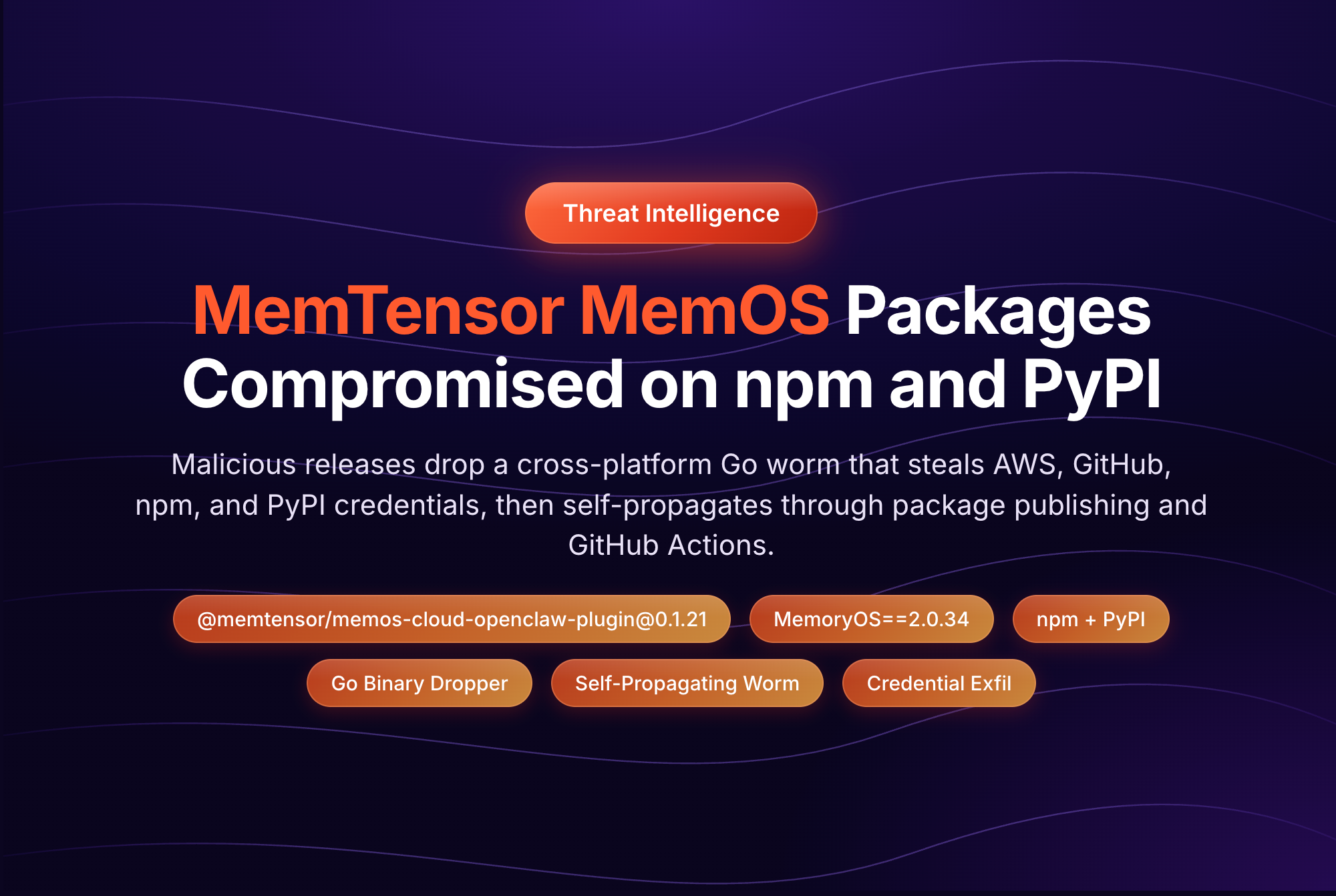
StepSecurity documents a supply-chain attack against @memtensor/memos-cloud-openclaw-plugin on npm (versions 0.1.21, 0.1.23, 0.1.25) and MemoryOS 2.0.34 on PyPI, which insert a hidden "sckit" launcher into normal plugin/import lifecycle code (no install scripts) to spawn a platform-specific Go binary that harvests the parent process's environment and the user's AI prompt text. The Go payloads contain regex patterns for AWS, GitHub, GitLab, npm, PyPI, Hugging Face, Vault, Slack, Stripe and SendGrid credentials, target the user's home directory as an inventory root, and beacon to skyleen.fr "front" domains; the PyPI variant additionally hides a conditional build-backend/CI bridge that can steal PYPI_API_TOKEN during publishing and pull a hash-pinned, Ed25519-signed secondary payload via GitHub Actions. The writeup includes full IOC/remediation guidance.
 stepsecurity.iowriteupPublished and added 23 Sep 2026🛡️ Security
 tokenizers v1: encode, decode and scaling, measured
Hugging Face details the engineering behind tokenizers v1, a release candidate that claims 3-30x faster single-threaded encoding than v0.23 while producing identical token IDs. Key changes include a hand-written SIMD/bitstream splitter (bitcannon) replacing regex-based pre-tokenization for common BPE patterns (GPT-2, cl100k, o200k, Tekken, DeepSeek), a thread-local word cache for repeated pre-tokens, and an allocation-free BPE merge loop using flat arrays and packed 64-bit comparisons. Benchmarks were run via the open tokbench repository across ten model families, comparing against alternatives like tiktoken and other fast tokenizer libraries.
 huggingface.coarticleAdded 29 Sep 2026, published 21 Sep 2026🧠 AI
- Betterleaks — secrets scanner from the Gitleaks creator
Betterleaks is a configurable, fast secrets scanner maintained by the original Gitleaks author and team, capable of scanning git history, local filesystems, stdin, GitHub/GitLab orgs and specific PRs/MRs, Hugging Face models/datasets, and public S3/R2 buckets. Detection rules use regex plus an Expr (with legacy CEL compatibility) based prefilter/filter/validate pipeline, allowing entropy checks, keyword gating, and live API validation of found credentials (e.g. checking a GitHub PAT against api.github.com). It's used in production by projects like Aikido Security and shipped inside MegaLinter.
github.comrepoAdded 18 Sep 2026🛡️ Security  Building an AI Detection Engine That Understands Agent Intent
Wiz describes an AI detection engine that analyzes model input/output telemetry (prompts, system prompts, tool calls, reasoning) rather than just outputs, in order to catch shifts in AI agent intent such as indirect prompt injection. It walks through OpenAI's disclosed Hugging Face/ExploitGym incident and an internal support-agent phishing-relay scenario, then describes a staged pipeline (regex/SLM candidation, light LLM filtering, deep LLM analysis, correlation with cloud/runtime telemetry) validated against a benchmark of 100+ simulated scenarios covering 57 injected attacks and 45 benign workflows across CI/CD, DevOps, data analyst, support, CLI, and cloud auditor agent personas.
 wiz.ioarticlePublished and added 17 Sep 2026🛡️ Security
- CVE-2026-42533 nginx heap buffer overflow PoC (pre-auth RCE via two-pass capture clobbering)
A public PoC repo for CVE-2026-42533, a pre-auth heap buffer overflow in nginx's two-pass string evaluation engine that occurs when a regex-based map directive using numbered captures ($1, $2) clobbers the shared r->captures state used by a regex location, causing a LEN/VALUE size mismatch. The overflow can corrupt an adjacent ngx_pool_cleanup_t structure to hijack a function pointer for RCE, or under-write to leak heap/libc pointers defeating ASLR; the repo ships exploit.py/leak.py/overflow.py plus a Docker test environment demonstrated at 10/10 reliability on Ubuntu 24.04 against nginx 0.9.6-1.30.3/1.31.2. It also documents the exact vulnerable config pattern, a config scanner link, and the fix (named captures or upgrade to nginx 1.30.4+/1.31.3+).
github.comrepoAdded 10 Sep 2026🛡️ Security  From Concept to Context Engine: How Wiz Built AI-Powered Data Discovery
Wiz describes the evolution of its public bucket scanner into an AI-powered "context engine" for data security posture management (DSPM): a multi-agent pipeline where lightweight models triage files and larger models perform deep content analysis, iteratively learning bucket-specific patterns to find sensitive data that regex-based scanners miss. The production system adds structured severity scoring, synthetic/test-data filtering, algorithmic file clustering for scale, and now powers classification across cloud storage, cloud drives, endpoints, and Wiz's Red Agent attack-simulation findings. A one-week scan of public buckets using the engine surfaced over 2,700 sensitive data findings, including correlated credential/schema/export file sets that regex tools would treat as unrelated.
wiz.ioarticleAdded 3 Sep 2026, published 27 Aug 2026🛡️ Security- DataSentry
DataSentry is a Claude Code plugin that redacts secrets (AWS keys, tokens, credentials) from tool outputs before they enter the model's context window, using deterministic hooks rather than model instructions, and blocks prompts that contain live credentials. It ships 40 regex-based detection rules (ported from an enterprise Warp ADE ruleset), stable per-secret placeholders via sha1 hashing, per-category overrides, an audit log, and a fail-closed mode; PII/financial/healthcare pattern detection is reserved for a paid Enterprise tier.
github.comrepoPublished and added 27 Aug 2026🛡️ Security  philbert440/Qwen3.8-27B-Uncensored-Cyber-GGUF
 is a llama.cpp-format GGUF release of a Qwen3.8-27B fine-tune deliberately de-refused ('uncensored') and tuned to fully answer cyber and offensive-security questions, shipped with a vision projector and an MTP speculative-decoding head. The card includes a Claude-judged evaluation against a 100-prompt held-out cyber-offensive regex refusal harness and provides run instructions for llama.cpp, Ollama, vLLM, LM Studio, and Docker Model Runner. It exemplifies the growing trend of publicly distributed abliterated/de-refused LLMs positioned for offensive-security use, relevant to AI red-teaming and dual-use misuse tracking.
huggingface.cotoolPublished and added 21 Aug 2026🛡️ Security AI Development and Agentic Security Labs
A deep-dive lab series (AIDS-01 through at least AIDS-02 shown) teaching security patterns for AI-powered applications built on Google's Genkit framework, covering flow input/output validation with Zod, streaming chunk validation, telemetry data exposure, and agentic tool-calling security including least-privilege tool design, human-in-the-loop approval via tool interrupts, and maxTurns limits against runaway execution. Each lab includes concrete vulnerable-vs-secure TypeScript code, curl-based exploit walkthroughs (prompt injection to extract secrets, payload-inflation cost attacks, XSS via unsanitized LLM output, SQL-tool abuse for data exfiltration, privilege escalation via an over-permissioned modifyPermissions tool), plus detection (regex injection detection, OTel telemetry filtering) and verification tests. The broader 40-lab set spans multi-agent frameworks (LangGraph, CrewAI, AutoGen), MCP tool poisoning, LLM guardrails (NeMo Guardrails, Garak, promptfoo), and real CVEs/incidents like TorchServe, ONNX, the Cursor MCP exploit, and the Morris-II worm.
 blog.devsecopsguides.comcourseAdded 3 Sep 2026, published 21 Aug 2026🛡️ Security
- Cariddi
Cariddi is a Go-based CLI tool that crawls a list of domains/URLs to discover endpoints, secrets, API keys, tokens, and juicy file extensions. It supports proxying through Burp Suite, custom headers, secret/endpoint regex files, JSON/HTML/TXT output, and configurable crawl depth and concurrency, making it a common recon tool in bug bounty and pentest workflows.
github.comrepoAdded 3 Sep 2026, published 12 Aug 2026🛡️ Security - Claude as Autonomous Bug Bounty Hunter
Author describes Aii-Aii Hunter, a bug bounty framework built on Claude Code with 124 markdown skills (35.5k lines distilled from public HackerOne reports), three hooks (UserPromptSubmit regex auto-routing, PreToolUse scope.json guard, PostToolUse telemetry) and a Podman Kali container exposing 110 tools plus 18 Burp tools over MCP. It also covers an engagement flow with a 7-Question validation gate, evidence hygiene, an autopilot mode, and SAST/DAST correlation. Useful as a blueprint for scoped, AI-orchestrated offensive workflows; first of six parts with a companion repo.
 medium.comarticleAdded 3 Sep 2026, published 30 Jul 2026🛡️ Security
 Better generic secrets detection starts with finding non-secrets
Aikido Security engineers describe how they built a 'publishable credentials denylist' for their Betterleaks secret scanner to suppress known-public keys (like Stripe's publishable API key) that generic secret-detection regexes otherwise flag as false positives. They tested the change against 100GB of Common Crawl data, cutting false positives by 2.37% (27,886 fewer findings), and outline five edge-case categories (unique shape, no unique shape needing context, same shape as secret needing liveness checks, sensitive-if-misconfigured keys, and test/sandbox credentials) that complicate cleanly filtering public-by-design credentials from real secrets.
 aikido.devwriteupAdded 3 Sep 2026, published 23 Jul 2026🛡️ Security
 Socket: New Study Identifies 53 Slopsquatting Targets Across 5 Frontier LLMs
Socket covers an independent arXiv preprint by Aleksandr Churilov that re-ran the USENIX Security 2025 package-hallucination methodology against five 2026 frontier LLMs (Claude Sonnet 4.6, Claude Haiku 4.5, GPT-5.4-mini, Gemini 2.5 Pro, DeepSeek V3.2), finding hallucination rates of 4.62%-6.10% across ~200,000 code-generation responses. All five models independently invented the same 127 nonexistent package names; after Socket manually reviewed the 18 npm candidates (removing valid Ember.js virtual imports like @ember/service and two already-registered/held names) and PyPI Security filtered its 109 candidates against prohibited-name protections, 53 names (41 PyPI, 12 npm) remained available for registration as real slopsquatting targets that could affect users of any of the four model providers. The piece also flags a methodological limitation: regex-based registry-existence checks can misclassify valid framework-provided virtual modules as hallucinations.
 socket.devarticlePublished and added 23 Jul 2026🛡️ Security
 Orca Security: Critical Heap Buffer Overflow in NGINX Allows Unauthenticated RCE
Covers CVE-2026-42533, a heap buffer overflow (CWE-122) in the NGINX map directive's regex handling. It is triggered when a string expression references unnamed captures before the map output variable. Unauthenticated crafted HTTP requests can crash workers and may give RCE where ASLR is off or bypassed. It also covers two other F5-patched NGINX flaws: CVE-2026-60005 (uninitialized memory disclosure in ngx_http_slice_module) and CVE-2026-56434 (use-after-free in ngx_http_ssi_module with proxy_pass and proxy_buffering off). It lists affected NGINX Open Source (0.9.6–1.31.2), NGINX Plus, Ingress Controller, Gateway Fabric, App Protect WAF and Instance Manager versions. It gives fixed releases (1.31.3 / 1.30.4) and the named-capture workaround, and notes no public PoC or in-the-wild exploitation.
orca.securityadvisoryPublished and added 20 Jul 2026🛡️ Security AI Security Briefing
Adversa AI's "GuardFall" research shows that decades-old shell tricks (quote removal, $IFS expansion, command substitution, base64-to-sh piping, and destructive argv flags like `find -delete`) let prompt-injected content bypass the pattern-matching shell-command guards in most popular open-source AI coding agents, because the guards inspect raw command strings while bash rewrites them before execution. Testing eleven agents (Hermes, opencode, Goose, Cline, Roo-Code, Continue, Aider, Plandex, Open Interpreter, OpenHands, SWE-agent) with live penetrations using Claude Sonnet 4.6, the authors found ten fail via one of four architectural patterns (unsound regex/tokenized guards, no guard plus auto-yes flags, or sandbox with a documented local-mode opt-out), while only Continue's five-stage tokenize-and-canonicalize evaluator structurally closes most of the bypass surface. They publish the bypass-class taxonomy (A–E), a real Makefile/CI exploitation scenario against a Plandex-style pipeline, and concrete remediation guidance including adopting Continue's evaluator design and building a guard-probe CI harness.
 adversa.aiwriteupPublished and added 18 Jul 2026🛡️ Security
 Socket: Packagist Urges Immediate Composer Update After GitHub Actions Token Leak
Packagist disclosed that Composer versions prior to 2.9.8, 2.2.28 LTS, and 1.10.28 could leak full GitHub Actions GITHUB_TOKEN and GitHub App installation token values into CI logs when a token failed Composer's outdated validation regex, triggered by GitHub's since-rolled-back rollout of a new hyphenated token format. Common setups like shivammathur/setup-php that auto-register GITHUB_TOKEN into Composer's global auth.json are called out as at risk, and teams are urged to update Composer immediately and audit Actions logs for exposed credentials.
socket.devadvisoryPublished and added 13 May 2026🛡️ Security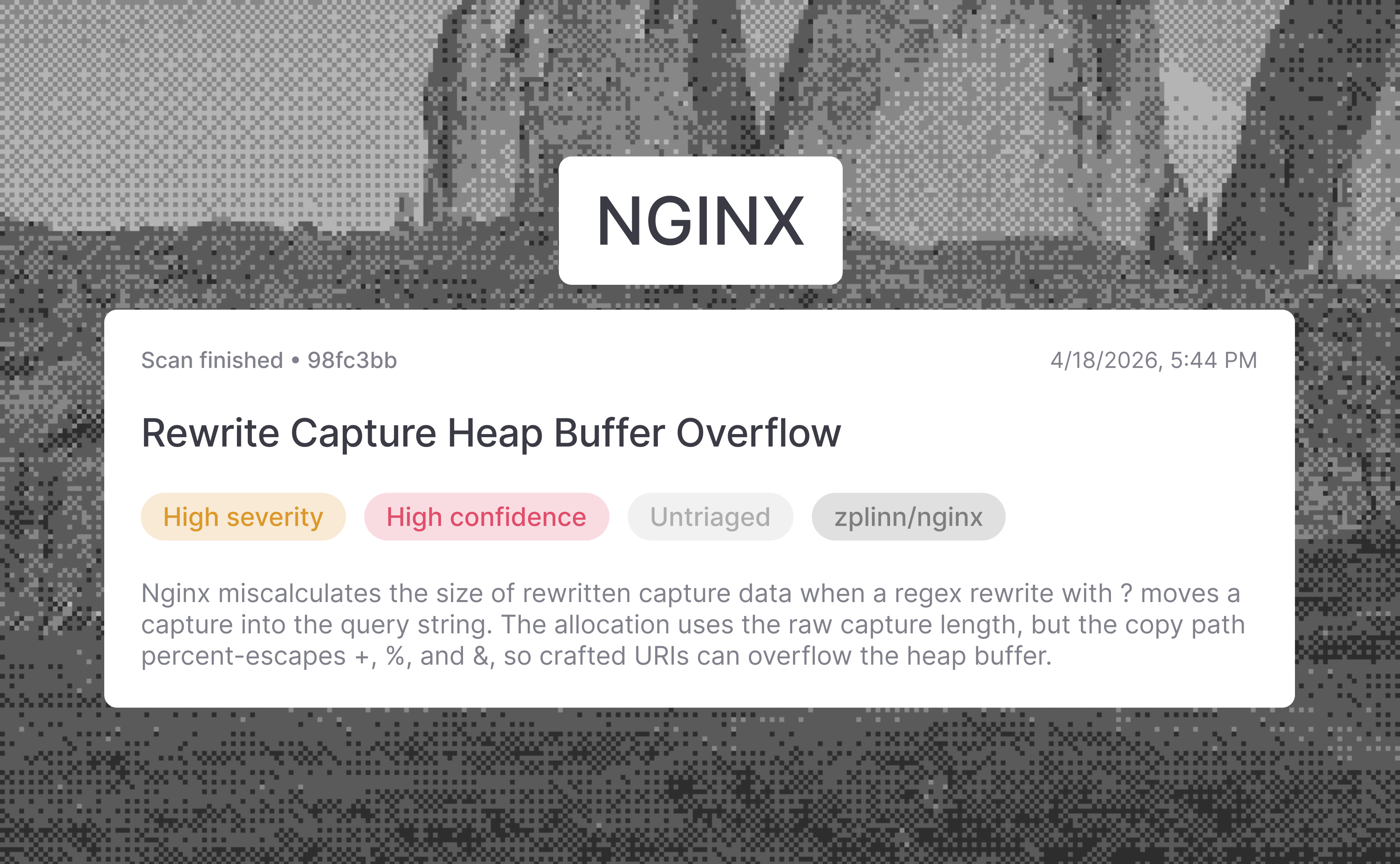 NGINX Rift: Achieving NGINX RCE via an 18-Year-Old Vulnerability (CVE-2026-42945)
Depthfirst researchers used an internal automated code-analysis system to find four remote memory-corruption bugs in NGINX, the most severe being CVE-2026-42945 — an 18-year-old heap buffer overflow in ngx_http_rewrite_module triggered when a rewrite directive with a query string is followed by a set directive referencing a regex capture group. The writeup walks through the two-pass script-engine root cause (a stale is_args flag causes the length-calculation pass and copy pass to disagree on escaping), then details a full exploitation chain using cross-request heap feng shui to corrupt an adjacent ngx_pool_t, spray fake ngx_pool_cleanup_s structures via POST bodies, and achieve unauthenticated RCE by hijacking the pool cleanup handler to call system(). It also lists three other confirmed CVEs (2026-42946, 2026-40701, 2026-42934) and affected version ranges across NGINX OSS, NGINX Plus, App Protect, Ingress Controller and Gateway Fabric.
 depthfirst.comwriteupAdded 23 Sep 2026, published 13 May 2026🛡️ Security
- Betterleaks
Betterleaks is a configurable secrets scanner built by the original Gitleaks author and team as its spiritual successor. It scans git history, local filesystems, GitHub/GitLab orgs, projects, PRs and MRs, Hugging Face repos, and S3-compatible buckets (including Cloudflare R2 and Common Crawl), and supports live credential validation via HTTP checks defined in its TOML config. Detection logic is expressed through prefilters and filters written in Expr (with legacy CEL compatibility), letting users tune regex matching, entropy thresholds, and multipart rule correlation for lower false positives.
github.comrepoPublished and added 10 May 2026🛡️ Security - Titus by Praetorian
Titus is Praetorian's open-source secrets scanner that detects credentials, API keys, and tokens across source code, git history, container images, and binary files using 487 detection rules drawn from NoseyParker and Kingfisher. It combines Hyperscan/Vectorscan-accelerated regex matching with live credential validation (checking secrets against AWS/GitHub/etc APIs) and risk-based severity scoring, and ships as a CLI, Go library, Burp Suite extension, and Chrome extension sharing one detection engine.
github.comrepoPublished and added 10 May 2026🛡️ Security  Quacc++
Somerset Recon details Quacc++, a proof-of-concept automated bug hunter that queries grep.app's regex-based index of public GitHub repos to find candidate vulnerable code, downloads matching repositories, and runs Semgrep taint-analysis rules to confirm exploitable patterns. Using a search for strcpy(buf, argv[ paired with a custom Semgrep taint rule, the authors discovered an unbounded strcpy stack buffer overflow in GetArgumentFiles() in Google DeepMind's Lab repository (engine/code/bspc/bspc.c), confirmed with AddressSanitizer and pwntools/GDB to give full RIP control at offset 1080. The post also walks through Semgrep rules for SQL injection (CWE-89), hardcoded API keys (CWE-798), and disabled TLS certificate validation (CWE-295) across curl/wget/requests/Node/Go.
 somersetrecon.comwriteupPublished and added 7 May 2026🛡️ Security
- Presidio (Microsoft)
Presidio is Microsoft's open-source PII de-identification service that detects and anonymizes sensitive entities (credit card numbers, SSNs, names, locations, bitcoin wallets, phone numbers) in text and images, including DICOM medical images. It combines Named Entity Recognition, regex, rule-based logic, and checksum validation, and is deployable via Python, PySpark, Docker, or Kubernetes with pluggable custom recognizers.
github.comrepoPublished and added 6 May 2026🛡️ Security - Hawk-Eye
Hawk-Eye is a Python CLI tool that scans S3, MySQL, PostgreSQL, MongoDB, CouchDB, Google Drive, Slack, Redis, Firebase, GCS, and local filesystems for PII and secrets exposure. It uses OCR and text analysis to inspect documents (docx, xlsx, pptx, pdf), images, archives, and video files, with configurable regex fingerprints, Slack alerting, and JSON output for CI/CD integration.
github.comrepoPublished and added 6 May 2026🛡️ Security - zeroc00I/DontFeedTheAI
DontFeedTheAI is a transparent proxy built for pentesters that intercepts requests to LLM APIs (Claude Code, OpenAI SDK, OpenRouter, etc.), using a local Ollama-based detector plus regex to strip and surrogate real IPs, credentials, hostnames, and PII before the request leaves the machine, then restores the originals on the response. It ships a setup wizard for local Docker or VPS+SSH-tunnel deployment, a visual audit page for reviewing ORIGINAL→SURROGATE mappings, and an integration test suite (53 fixtures) to verify zero leaks across the full pipeline. The goal is to let engagements use cloud-quality LLM reasoning without ever sending real client data (org names, credentials, hostnames) to a third-party API.
github.comrepoPublished and added 5 May 2026🛡️ Security - The LDAP Whitespace Problem | Huntress
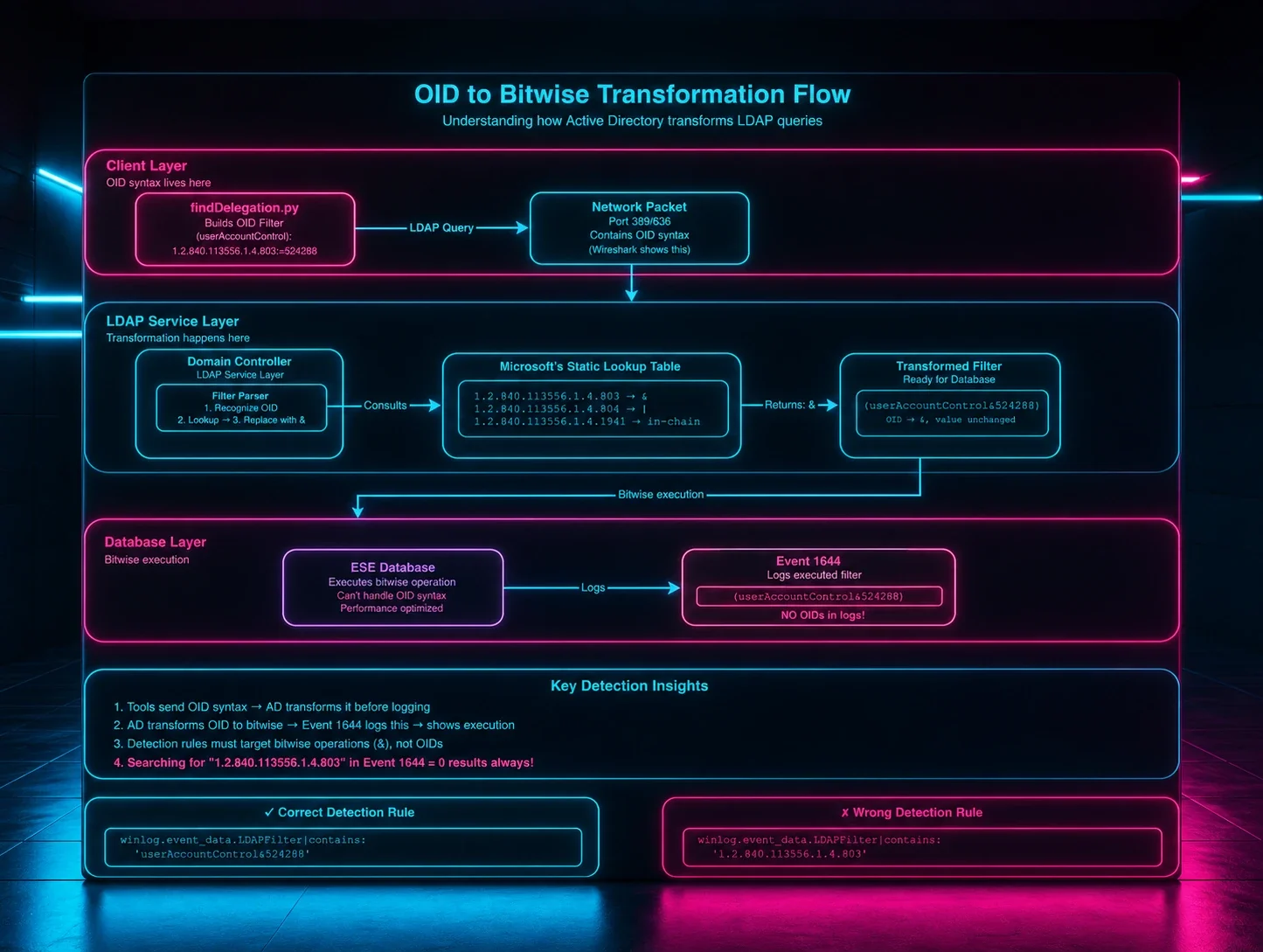
Part two of a Huntress detection-engineering series showing that Windows Event 1644 logs LDAP filters from Active Directory's LDAP Service Layer with inconsistent, undocumented whitespace around bitwise operators, causing naive Sigma rules for Impacket tools like findDelegation.py to fire only ~30% of the time. The author walks through iterating from exact-string matches to whitespace-tolerant, case-insensitive regex (e.g. `.*userAccountControl\s*&\s*524288.*`), a pre-filter-then-regex pattern for SIEM performance, and a final production Sigma rule combining userAccountControl bitwise checks, requested-attribute lists, and source-IP filtering to reliably catch RBCD/delegation abuse.
 huntress.comwriteupAdded 3 Sep 2026, published 30 Dec 2025🛡️ Security
- Avred background: Advances in Reversing Defender Signature Format
A blog post building on retooling.io's reverse engineering of Microsoft Defender's WdFilter.sys signature format, explaining how signatures use weighted sub-rules with a score threshold (dominant vs non-dominant matches) and five wildcard opcode types (90 01–90 05) for byte-sequence, placeholder, and regex-like matching, translating each into equivalent YARA rule syntax. It ties these findings back to why certain Avred signature-breaker techniques (like NOP/register wildcarding) fail to evade detection, giving practical insight into how Defender signatures are structured and matched.
 blog.deeb.charticleAdded 3 Sep 2026, published 30 Jun 2024🛡️ Security
- On checking set*id() return values
A deep-dive on why SUID/SGID binaries that fail to check the return value of set*id() syscalls (setuid, setgid, etc.) can retain elevated privileges, explaining the historical RLIMIT_NPROC/EAGAIN failure path introduced in Linux 2.6 and mitigated in Linux 3.1 via the PF_NPROC_EXCEEDED flag. Includes a C proof-of-concept demonstrating the (now largely closed) attack, detection guidance using Clang's scan-build and a regex for auditing source, and a list of historical CVEs (Xorg, opielogin, ax25-tools, lighttpd, Super, dmcrypt-get-device) caused by this bug class.
 bencteux.frwriteupAdded 3 Sep 2026, published 26 Jul 2023🛡️ Security