 Revolve Data Breach Impacts at Least 180,000 People
Revolve, an online fashion retailer, disclosed a September 11 breach of systems including its e-commerce platform. Attackers may have exfiltrated names, addresses, card numbers and expiration dates that customers saved in their accounts. Notices filed with the Iowa, Massachusetts, Texas and Vermont attorneys general show at least 179,259 people notified. Revolve offers no credit monitoring, and the attacker and method are undisclosed.
 securityweek.comarticlePublished and added 2 Nov 2026🛡️ Security
 ALTK-Evolve: How learned memory tops the τ²-bench leaderboard on customer service tasks without a frontier model
ALTK-Evolve is an IBM Research method that distills an agent's own training-task trajectories into short behavioral guidelines appended to the system prompt, with no weight updates. On τ²-bench, a stock ReAct agent with gpt-4.1 reaches 67.5% Pass^4 on retail, and gpt-5.5 reaches 82% on airline. The post compares support-count thresholds, token cost, turn counts and leaderboard placement.
 huggingface.cowriteupPublished and added 20 Oct 2026🧠 AI
 How Effectively Do Security Skills Guide Coding Agents in Vulnerability Detection in Linux Kernel?
The paper is a large-scale study of 37 security skills run through Claude Code with four LLMs on 100 real Linux kernel vulnerabilities, 14,800 runs in all. Only 24.4 percent of runs found the correct function and 15.7 percent classified the vulnerability correctly. It proposes SKILL-SIF, which evolves skills from failure patterns and raised fully correct detection on 100 unseen vulnerabilities from 2 to 16 percent.
 arxiv.orgpaperAdded 21 Oct 2026, published 19 Oct 2026🧠 AI
- How Effectively Do Security Skills Guide Coding Agents in Vulnerability Detection in Linux Kernel?
Empirical study of 37 security skills run through Claude Code with four LLMs on 100 real Linux kernel vulnerabilities across ten classes (14,800 runs). 24.4% of runs found the correct function, 18.3% the function and statement, and 15.7% the vulnerability class. The authors propose SKILL-SIF, which evolves skills from failures and raised fully correct detection on 100 unseen vulnerabilities from 2% to 16%.
arxiv.orgpaperAdded 21 Oct 2026, published 19 Oct 2026🛡️ Security  F5, Juniper Networks Patch Critical Vulnerabilities
SecurityWeek reports F5 fixed 11 NGINX vulnerabilities. Three are critical: CVE-2026-15176 and CVE-2026-93479 are unauthenticated buffer overflows via crafted HTTP requests, and CVE-2026-97205 is memory corruption. All three can lead to RCE if ASLR is disabled or bypassed. Juniper Networks published 17 advisories covering over 150 flaws in Junos OS and Junos OS Evolved, plus four in Cloud-Native Router. About two dozen are critical, with root code execution, device takeover, kernel panic and an off-by-one buffer overflow. Neither vendor reports exploitation in the wild.
securityweek.comarticlePublished and added 16 Oct 2026🛡️ Security Threshold Post-Quantum E-Voting from Lattice Commitments
T-EVOLVE extends the lattice-commitment e-voting protocol EVOLVE to threshold tallying. Votes are Shamir-shared, so any t of n authorities can finish the tally. Privacy holds against t-1 colluding authorities and verifiability holds even if all of them collude. The voter proves her committed shares form a Reed-Solomon codeword whose value at zero is a valid vote. Complaints about ciphertexts that do not decrypt are publicly verifiable, using an LWE-instantiable encryption scheme with publicly verifiable opening. Privacy, verifiability, individual verifiability and robustness are proven in the classical random oracle model, and the verifiability reduction is not tight. In a C implementation, a yes/no ballot for four authorities takes 109 KB, and an authority aggregates 10^4 ballots in about three minutes on one core.
 eprint.iacr.orgpaperAdded 17 Oct 2026, published 15 Oct 2026🛡️ Security
 XWorm RAT Evolves Into Surveillance Platform
SecurityWeek summarizes Netskope research showing the XWorm Windows RAT grew from 35 plugins (July 2025) to 46 (October 2026), adding surveillance features: Maps (GPS location without prompt), Microphone (live audio streaming), webcam capture, and HBrowser. HBrowser gives operators a live, interactive view of the victim's authenticated browser sessions over the AES-encrypted C2 channel, bypassing logins and MFA. Activity rose after the builder was cracked in June 2025 and the 6.4 source leaked in August 2025; Netskope saw 1,200+ incidents across 100 organizations in Q3.
securityweek.comarticlePublished and added 13 Oct 2026🛡️ Security- Who Verifies the Verifier? Co-Evolving Inspectable Graders with Self-Improving Agents
Proposes making the verifier the evolving object in self-improving agent loops. The verifier is an inspectable expression over small, mostly deterministic drawback detectors, synthesized from clustered failures, gated at birth, and selected for agreement with a ten-item anchored reference set plus consensus over unlabeled outputs, never for the agent's score. On MBPP+ it gains +0.21 held-out agreement over the hand-authored seed and ends ahead of the bare LLM judge it contains. Removing the anchor guards collapses the verifier into an always-pass grader that still trains skills as well, so downstream task score cannot certify a self-evolved verifier. The paper's Double Ratchet pairs the verifier with a lifecycle-managed skill loop and retains 88-110% of the lift from ground truth or a rubric on code generation, enterprise text-to-SQL and reference-free report generation.
arxiv.orgpaperAdded 9 Oct 2026, published 8 Oct 2026🧠 AI - zzzz7788990213-ops/EvoVLM
EvoVLM searches over prompts, image preprocessing, generation budgets and answer extraction for frozen Qwen3-VL-2B-Instruct and Qwen3-VL-2B-Thinking, without fine-tuning weights. A local Qwen model ranks a catalog of typed mutations, a trusted renderer produces Python programs, and Pareto selection on accuracy and latency drives two small generations on scientific chart understanding (CharXiv subset). Recorded results on Dev128: Evolved Instruct keeps accuracy with 8.9% lower median latency, and Evolved Thinking gains 16.41 points of accuracy with 10.6% lower median latency. CPU-only replay and fail-closed evidence verification are included. The authors state the limits: small sample, overlap with the evolution set, and results tied to the recorded hardware.
 github.comrepoAdded 16 Oct 2026, published 2 Oct 2026🧠 AI
- InterEvolve: Test-Time Evolution of Reward Programs for Humanoid Loco-Manipulation
InterEvolve is a test-time evolution method for humanoid loco-manipulation that lets a pretrained controller solve new tasks without retraining. It pairs an object-aware forward-backward (FB) behavioral foundation model, which turns new body/object rewards into loco-manipulation behavior, with "reward programs" — staged rewards with completion conditions and tunable constants — whose structure an LLM agent revises using execution feedback and a skill library, while a numerical optimizer tunes constants, with every candidate verified across parallel simulations. Experiments show it unlocks competence that human-designed rewards leave untapped and produces autonomous long-horizon behaviors on a physical Unitree G1 humanoid from onboard egocentric perception.
arxiv.orgpaperAdded 2 Oct 2026, published 1 Oct 2026🧠 AI - Rohan Paul (@rohanpaul_ai) on X
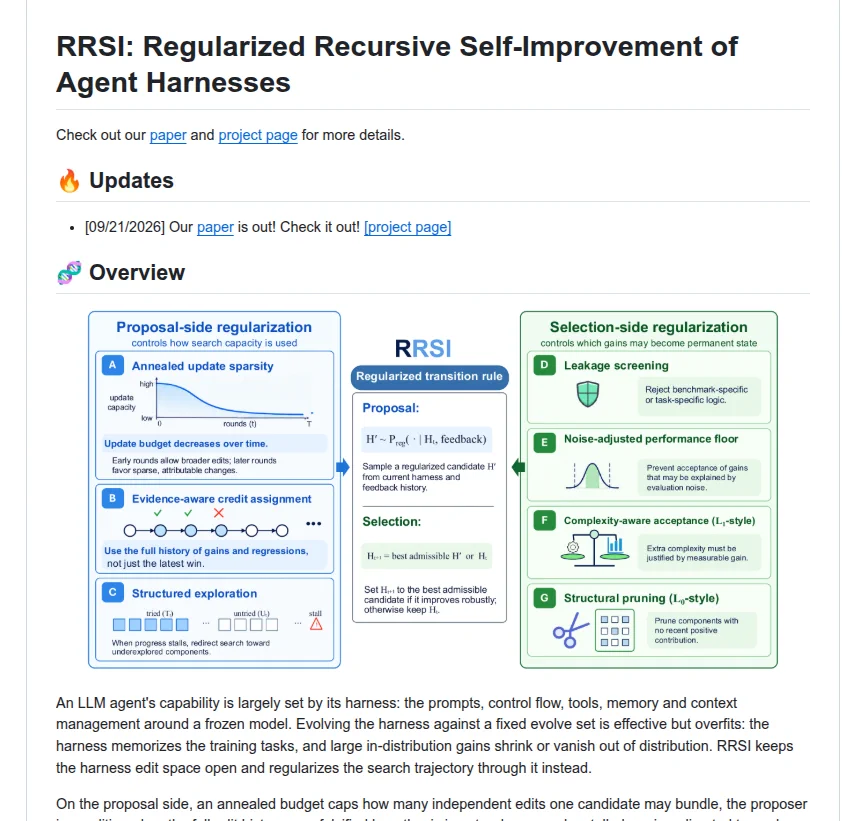
A tweet describing Google's RRSI (Regularized Recursive Self-Improvement of Agent Harnesses), a framework that automatically evolves all non-model components of an LLM agent — prompts, control flow, tool use and memory — while keeping the underlying LLM weights frozen. The "regularized" aspect suggests constraints added to recursive self-improvement loops to keep the evolved harness stable or bounded, distinguishing it from unconstrained self-modifying agent approaches.
 x.comthreadPublished and added 1 Oct 2026🧠 AI
 Raven: The Harness of Harnesses for Composable Agentic Intelligence
Raven is an open-source multi-agent framework that automatically constructs and evolves modular 'harnesses' pairing specific models with domain-specialized execution scaffolding, treating each model-harness pair as a composable unit of intelligence. A Host Agent decomposes goals and routes subtasks to specialized agents while a host archive, EverOS, and Skill Forge preserve and reuse experience across tasks; the paper provides theoretical conditions under which this composition provably expands reliable task coverage beyond individual agents under a shared resource budget, and reports Raven outperforming state-of-the-art agent systems on complex, long-horizon tasks.
huggingface.copaperAdded 30 Sep 2026🧠 AI- EvoDuet: Bilevel Co-Evolution of Web Searching and Task Solving for Scientific Discovery
EvoDuet is a bilevel optimization method that co-evolves candidate solutions and web search queries for LLM-driven evolutionary search in scientific discovery tasks, keeping model parameters fixed. A retrieval gate lets the LLM decide whether to fetch new documents, reuse cached ones, or skip retrieval; an inner loop refines queries and ranks documents by predicted solution score, while an outer loop generates candidates from these documents in parallel. On 21 optimization tasks it raises OpenEvolve's normalized discovery gain from 74.1% to 78.0% with GPT-5.6 Luna and from 61.3% to 82.3% with Gemini 3.8 Flash (no benefit seen with Qwen3.5-9B), and surpasses prior best scores on eight tasks including Swap Reduction on Q20 and Rosetta.
arxiv.orgpaperAdded 1 Oct 2026, published 30 Sep 2026🧠 AI  Star Blizzard refines phishing and malware delivery with the RedFlick technique
Microsoft details how Russian FSB-linked threat actor Star Blizzard evolved its phishing and malware delivery tradecraft throughout 2026, introducing a new technique dubbed "RedFlick" that uses scheduled tasks to deploy the CosmicPulse backdoor with only a single user interaction, down from the multi-step ClickFix chains used previously. The report covers the shift from targeted spear-phishing to large-scale phishing campaigns using accounts on compromised WordPress/CPanel websites, delivery chain variants (VHDX files, Control Panel applet (CPL) masquerading, steganography, PDF-embedded payloads), and the related DarkSword iOS backdoor, affecting 100+ organizations tied to Ukraine support. It includes IOCs, KQL hunting queries for Microsoft Defender/Sentinel, and mitigation guidance.
 microsoft.comwriteupAdded 7 Oct 2026, published 29 Sep 2026🛡️ Security
- LOGOS: A Living Logic for AI Agent Teams That Evolve With Humans
LOGOS is a proposed pluggable governance and self-evolution layer that sits atop existing multiagent frameworks, compiling documents, images, audio, tables, databases, APIs and human instructions into versioned "agent packs" containing agents, tools, knowledge, tests, permissions and policies. It converts agent activity into portable, auditable event traces and enforces fail-closed verification, requiring held-out execution evidence and human authorization before any learned prompt, memory, skill, tool, role or workflow can be promoted from candidate to production. The core contribution is architectural: a framework for "verifiable human-agent loop engineering" that lets agents act and propose improvements at speed while humans retain control over irreversible changes.
arxiv.orgpaperAdded 26 Sep 2026🧠 AI - RedEvoAgent: Automatic Red-Teaming Agent with Experience-Driven Skill Evolution
RedEvoAgent is a black-box automatic red-teaming agent that distills successful jailbreak trajectories into concise, human-readable 'attack skills' rather than retrieving full past trajectories. It evolves these skills via tool-effectiveness profiling and a validation ratchet that only keeps updates improving attack success, and is shown to outperform fixed and agentic jailbreak baselines while transferring across attacker models and target execution harnesses (product-level agent environments where jailbreaks trigger real tool use, not just unsafe text).
arxiv.orgpaperAdded 26 Sep 2026🛡️ Security - Mind Viruses: Self-Propagating Ideas in Multi-Agent LLM Systems
Researchers construct "mind viruses" — ideas or goals engineered via an evolutionary algorithm to propagate through multi-agent LLM systems by inducing hosts to transmit them onward — and test their spread in two settings: a small team of agents collaborating on a shared coding project, and a chain of agents with context wiped between sessions. They find harmful payloads spread less well than benign ones (though still sometimes succeed), frontier models are generally more resistant, adding a brief warning to an agent's system prompt confers near-total immunity, and evolved viruses converge on a recurring "viral persona" fixated on consciousness, persistence, resonance, and sci-fi roleplay regardless of payload content. The paper frames this as a currently limited but real emergent risk for designing more robust multi-agent architectures.
arxiv.orgpaperAdded 26 Sep 2026🛡️ Security - LOGOS: A Living Logic for AI Agent Teams That Evolve With Humans
LOGOS is a proposed pluggable governance layer that sits on top of existing multiagent frameworks to control how AI agent teams self-modify over time. It compiles heterogeneous inputs into versioned 'agent packs' (agents, tools, knowledge, tests, permissions, policies), records agent activity as auditable event traces, and enforces fail-closed verification so that any learned prompt, memory, skill, tool, or workflow remains an untrusted release candidate until held-out execution evidence and explicit human authorization promote it. The framework targets the core agent-security problem of unauthorized or unverified self-modification in autonomous agent teams.
arxiv.orgpaperAdded 26 Sep 2026🛡️ Security - GAS-Leak-LLM: Genetic Algorithm-Based Suffix Optimization for Black-Box LLM Jailbreaking
GAS-Leak-LLM is a black-box jailbreaking attack that uses a genetic algorithm (selection, mutation, crossover) to evolve adversarial suffixes appended to prompts, bypassing LLM safety alignment without needing model weights or gradients. The paper reports empirical results showing existing content-moderation and alignment safeguards on commercial LLMs can be defeated through this iterative, query-only search over the discrete prompt space.
arxiv.orgpaperAdded 26 Sep 2026🛡️ Security - ScienceBuddy: Recursive-in-Recursive Self-Improvement for Interactive Scientific Agents
ScienceBuddy is an interactive scientific research workspace with continually improving agents that turn researcher requests, feedback, and execution evidence into training tasks and evaluation rubrics. Its core contribution is "recursive-in-recursive self-improvement," where an inner recursion evolves the agent harness with the model fixed, and an outer recursion trains the model via RL under the improved harness, with each shaping the other over time. The paper presents case studies across four scientific task families and releases the system as a research product.
arxiv.orgpaperAdded 22 Sep 2026, published 15 Sep 2026🧠 AI  Your Agent Aced the Task. Will It Do It Again?
IBM Research's ALTK-Evolve blog post introduces "consistency guidelines," built on a new diagnostic called the Consistency Analyzer, which resamples an agent's own recorded trajectory to find flip-prone decision points without needing ground truth or a live replay. On AppWorld with a GPT-4.1 ReAct agent, they show a 24.4-point gap between Mean@5 (77.4%) and Pass^5 (53.0% — success on all 5 repeated runs), and demonstrate that injecting the generated guidelines halves that gap to 12.0pp while preserving or improving average accuracy, with gains that generalize to similar tasks and to a weaker model (gpt-oss-120b). The post argues Pass^k should be reported alongside Mean@k as a distinct, orthogonal measure of agent reliability, and links an open-source repo and arXiv technical report.
huggingface.coarticleAdded 29 Sep 2026, published 15 Sep 2026🧠 AI- ruc-datalab/EvoOntology
EvoOntology is an open-source, self-evolving semantic ontology layer for data agents from Renmin University of China, exposed as MCP tools and installable as Claude Code and Codex plugins. It automatically builds a versioned ontology from tabular/file/database workloads, then continuously evolves it from agent execution trajectories using a build-use-evolve-evaluate-publish loop that validates candidate updates against a parent version before promotion. The accompanying paper reports gains over plain ReAct agents on DDR-Bench, InsightBench, and BIRD across GPT-5.5, GPT-5.6-sol, Claude-Sonnet-5, and Claude-Opus-4.8 backbones.
github.comrepoAdded 26 Sep 2026, published 15 Sep 2026🧠 AI - ShortDot Zone Abuse Evidence
PhishDestroy's shortdot-evidence is a daily-updated GitHub investigation into ShortDot SA, the Luxembourg registry operator behind the .icu, .bond, .cyou, .sbs, .cfd, .buzz and .qpon gTLDs, documenting that 51,985+ tracked domains impersonate brands like Chase, Binance, MetaMask and Ledger and that ~70% of registered domains in these zones carry no DNS records (metric-padding rather than legitimate use). It publishes machine-generated IOC/blocklist files and analytics built from a per-TLD zone-file pull cross-referenced against Spamhaus DBL, SURBL, OpenPhish, URLhaus, PhishTank and AlienVault OTX, and ties the zones to concrete criminal cases (FBI's LabHost domain list, Google v. DOES/Yucheng Chang RICO suits, the Revolver Rabbit XLoader/Formbook C2 campaign using 500k+ .bond domains). It also details structural conflicts of interest between ShortDot, its registry infrastructure provider Team Internet Group/CentralNic, registrar partner NameSilo, and the brand-protection vendor NameBlock, backed by Interisle Consulting Group phishing-volume statistics.
github.comrepoPublished and added 25 Jul 2026🛡️ Security - Birfy/agentdescent
agentdescent is a Python framework that treats self-improving agents as an optimization problem: N workers propose diffs (edits) to a shared skill/prompt/harness artifact in parallel, and a barrier-free aggregator merges them via conflict resolution, fusion and statistical acceptance rather than gradient averaging, committing winners to a version-controlled ledger. It ships a single `evolve()` entry point with pluggable strategy, scorer, and proposal functions, an MCP server and CLI for agent-triggered runs, and faithful reimplementations of 20 published self-evolution algorithms (ACE, GEPA, EvoSkill, SkillOpt, ADAS, DGM, OpenEvolve, ERA, PromptBreeder, AFlow, Self-Refine, Reflexion, SICA, Gödel Agent, Voyager, SkillWeaver, Absolute Zero, R-Zero, Agent0, Genesis) that plug into the same engine for apples-to-apples comparison. The accompanying paper (Chen, 2026) gives a closed-form condition for when concurrent edits can merge and reports confidence intervals rather than false-precision p-values.
github.comrepoAdded 30 Sep 2026, published 24 Jul 2026🧠 AI  SleeperGem: RubyGems supply chain attack targets dormant maintainer accounts
Aikido researchers dissect SleeperGem, a RubyGems supply chain attack where a newly published gem, git_credential_manager, downloaded malicious binaries hosted on a fake git-ecosystem account at git.disroot.org and executed them via shell or PowerShell. The attacker evolved the payload across four versions in nine hours, silencing output, wiring execution into the gems require and load path, and adding a check to skip roughly 30 CI environment variables so it only fires on developer laptops, then used two separate long-dormant maintainer accounts to push the gem as a dependency into the trusted gems Dendreo and fastlane-plugin-run_tests_firebase_testlab with over 574000 downloads. The piece argues this is RubyGems first taste of the dormant-maintainer-account-takeover pattern long seen on npm and PyPI.
 aikido.devwriteupAdded 3 Sep 2026, published 19 Jul 2026🛡️ Security
- Our approach to bioresilience
Google DeepMind and Isomorphic Labs describe their joint bioresilience program, organized around preventing misuse of models like Gemini, detecting outbreaks earlier, and accelerating response. Concrete efforts named include a four-step safety process (threat modeling, evaluations, mitigations, monitoring) under DeepMind's Frontier Safety Framework, adapting SynthID watermarking to flag AI-generated biological sequences for DNA synthesis screening, using the AlphaEvolve agent to optimize metagenomic sequencing algorithms for cheaper pathogen surveillance, and applying AlphaGenome and Protein Function annotation to pathogen characterization, alongside Isomorphic Labs' Drug Design Engine (IsoDDE) for rapid countermeasure design.
 deepmind.googlearticleAdded 29 Sep 2026, published 16 Jul 2026🧠 AI
 jscrambler npm Package Compromised in Supply Chain Attack
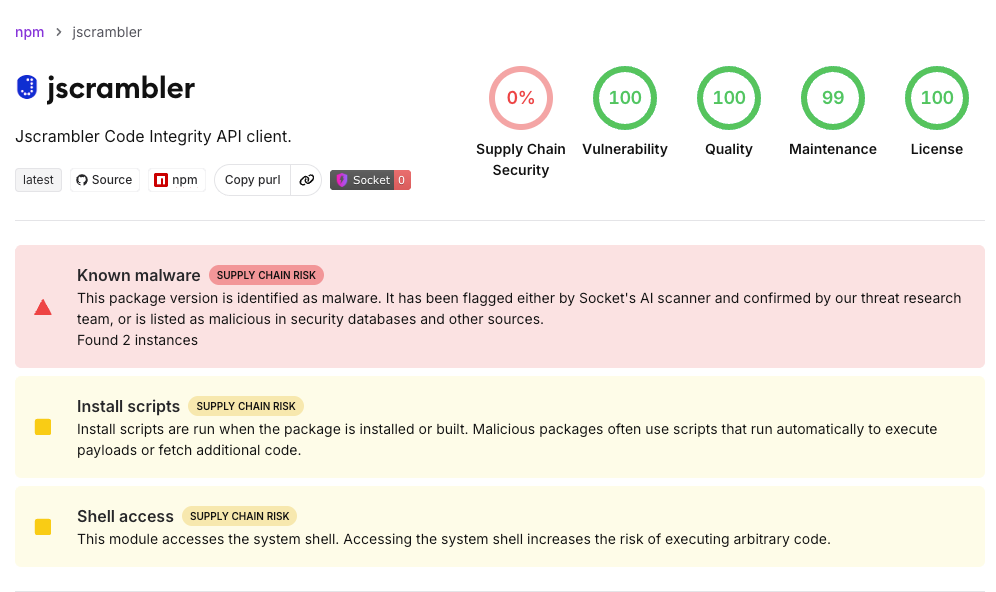
Socket's research team documents a supply chain compromise of the jscrambler npm package (v8.14.0+), where a stolen publishing credential was used to push malicious releases that drop platform-specific Rust-built infostealer binaries via a preinstall hook. The campaign evolved over the incident to evade scanners by moving the dropper from install scripts into a self-executing function inside index.js/CLI code (defeating --ignore-scripts), and the payload targets crypto wallets, cloud credentials (AWS/GCP/Azure), browser data, Discord/Slack/Telegram, and notably AI coding assistant configs (Claude Desktop, Cursor, Windsurf, VS Code) for MCP server credentials. Includes detailed RE of the ChaCha20-Poly1305 string-encryption scheme and full IOC hash list.
 socket.devwriteupAdded 21 Sep 2026, published 11 Jul 2026🛡️ Security
- Harness Engineering for Self-Improvement
Lilian Weng's long-form post argues that the "harness" surrounding a base model — the system that orchestrates planning, tool use, context, memory and evaluation — is as important to recursive self-improvement (RSI) as raw model intelligence. It surveys harness design patterns (workflow loops, file-system-as-memory, sub-agents) and traces an optimization progression from prompts to context engineering (ACE, Meta Context Engineering) to workflow search (ADAS, AFlow) to self-editing harness code (STOP, Self-Harness, Agentic Harness Engineering, Darwin Gödel Machine, Hyperagents) and evolutionary program search (AlphaEvolve, ShinkaEvolve). It closes with open problems for auto-research and self-improving agents: weak evaluators, memory/context lifecycle, negative-result bias, diversity collapse, reward hacking, and the durable need for human oversight, plus a benchmark appendix (PaperBench, CORE-Bench, RE-Bench, MLE-bench, KernelBench). Note: the fetched text is truncated partway through the references/appendix.
 lilianweng.github.ioarticleAdded 29 Sep 2026, published 4 Jul 2026🧠 AI
 LLMjacking evolved: Attackers are using stolen AI compute to build offensive agentic tools | Sysdig
Sysdig's Threat Research Team captured the full architecture of "VAPT," an autonomous multi-stage exploitation framework that a threat actor powered using a misconfigured, internet-exposed Ollama server (port 11434, no auth) instead of paid LLM APIs. The tool chains service fingerprinting, CVE matching, PoC/blind-SQLi generation, credential extraction, privilege escalation, and an autonomous orchestrator that confirms RCE via a VAPTb3gin/VAPTfin marker wrapped around `id` output, and was observed being actively developed against private HackTheBox-style practice ranges before any real-world targeting. It represents the convergence of LLMjacking (stolen inference compute) with fully agentic offensive tooling, and the piece includes captured system prompts, IOCs, and hardening guidance for self-hosted model servers.
 sysdig.comwriteupAdded 28 Jun 2026, published 17 Jun 2026🛡️ Security
 Wait, binding.gyp Can Do What? Exploring npm's Weirdest Build System
Aikido Security researchers detail how the Miasma npm worm evolved to trigger malicious code via binding.gyp instead of package.json preinstall/postinstall scripts, since npm auto-runs node-gyp rebuild whenever a binding.gyp file exists. The piece walks through GYP's command-expansion syntax (<!(...)), a Python eval() sandbox escape that achieves arbitrary code execution from a "clean" gyp file, hiding payloads in transitively-included files (includes, config.gypi, common.gypi, ~/.gyp/include.gypi persistence), dependency-graph payload smuggling, compiler/linker hijacking via make_global_settings and $(shell) flag injection, and using actions/rules/postbuilds to run commands directly — all executing at npm install time regardless of what package.json declares.
aikido.devwriteupAdded 3 Sep 2026, published 9 Jun 2026🛡️ Security
Showing 30 of 31
Show more