 Vulnerabilities that lead to account takeover in banking and fintech mobile apps | Oversecured Blog
Oversecured guide to eight vulnerability categories that lead to account takeover in mobile banking and fintech apps: WebView JavaScript bridge token leakage, Intent Redirection, hardcoded tokens, deeplink hijacking, insecure token storage, localhost OAuth listeners, AIDL abuse and weak biometric auth. It includes a WebView PoC based on Samsung SmartThings CVE-2022-30746 and maps findings to OWASP MASVS, PCI DSS and PSD2. It argues taint analysis plus dynamic PoC is needed to find multi-component chains.
 oversecured.comarticleAdded 29 Oct 2026🛡️ Security
 What is an AIBOM? AI bill of materials explained for security teams | Endor Labs
An AIBOM is a machine-readable inventory of models, datasets, dependencies, AI services, agents and MCP servers, with evidence of origin, license, integrity and evaluation. The Endor Labs explainer walks through a worked CycloneDX example for a fine-tuned support assistant. It compares CycloneDX ML-BOM, SPDX 3.x, the OWASP AIBOM project and the May 2026 CISA/G7 guidance, and lists what an AIBOM cannot show: runtime behavior and agent actions.
 endorlabs.comarticlePublished and added 29 Oct 2026🧠 AI
- What is an AIBOM? AI bill of materials explained for security teams | Endor Labs
AIBOM explainer from Endor Labs: an AI bill of materials is a machine-readable inventory of models, datasets, dependencies, AI services, agents and MCP servers, with origin, license and integrity evidence. It walks through a CycloneDX entry for a fine-tuned model, compares CycloneDX ML-BOM, SPDX 3.x, the OWASP AIBOM Generator and the May 2026 CISA/G7 minimum-elements guidance, and lists a six-step build process. It also states what an AIBOM cannot show: model safety, runtime behavior and coding-agent actions.
endorlabs.comarticlePublished and added 29 Oct 2026🛡️ Security  ADLC compliance: Mapping agentic development to NIST SSDF, OWASP, and the EU AI Act | Endor Labs
ADLC compliance is Endor Labs' interpretation of how NIST SSDF (SP 800-218), the OWASP LLM and Agentic Top 10 lists, and the EU AI Act apply to software built with coding agents. It splits requirements into a code surface and an action surface (shell, files, MCP calls, package installs). It gives a four-step EU AI Act scoping path and says that system prompt rules and agent self-reports are not audit evidence.
endorlabs.comarticlePublished and added 28 Oct 2026🧠 AI- ADLC compliance: Mapping agentic development to NIST SSDF, OWASP, and the EU AI Act | Endor Labs
ADLC compliance guide from Endor Labs that maps agentic development to NIST SSDF (SP 800-218 v1.1), the OWASP LLM Top 10 2025 and Agentic Top 10, and the EU AI Act as amended by Regulation (EU) 2026/1744. It splits controls into a code surface and an action surface (shell, file access, MCP calls, package installs). It gives a four-step AI Act scoping path, the new Annex III date of 2 December 2027, and evidence guidance. It states the crosswalk is the vendor's interpretation, not legal advice.
endorlabs.comarticlePublished and added 28 Oct 2026🛡️ Security  Part 3 – Cybersecurity journeys: The work behind the work
Part 3 of the AWS Security Blog series on cybersecurity careers profiles three AWS staff: Brandon Caldwell (application security, empathy and communication), Kurt Heath (self-taught pen tester, cautious AI use) and Seth Jeacopello (code review, managing attention). It gives practical advice: practice on vulnerable machines and read the logs, build CTF and GitHub portfolios, and write clearly. It lists TryHackMe, Hack The Box, the OWASP Top 10, OWASP Cheat Sheet Series, Darknet Diaries and AWS Skill Builder.
 aws.amazon.comarticlePublished and added 27 Oct 2026🛡️ Security
 Artificial Intelligence (AI) in Cybersecurity, Part 30: Shannon – AI Pentester for Web Apps and APIs
Shannon is a white-box AI pentester (@keygraph/shannon) that analyzes an application's source code, then attacks the running instance and reports only findings with a working PoC. The Hackers Arise tutorial runs it against OWASP Juice Shop in Docker on Kali, using OpenRouter (free Nemotron) and local Ollama (Qwen 2.5 Coder 7B) via a models.json file. Output includes PDF, Markdown, JSON and SARIF reports.
 hackers-arise.comarticlePublished and added 26 Oct 2026🛡️ Security
 Code security for new coders
 is a Datadog Security Labs primer for vibe coders building with coding agents. It lists setup and follow-up security questions to ask the agent, such as OWASP top 10 reviews, hardcoded secrets and outdated packages. It also explains first-party versus third-party code, supply chain risk, and SCA, SAST, IAST, DAST, IaC and secret scanning tools.
 securitylabs.datadoghq.comarticleAdded 29 Oct 2026, published 26 Oct 2026🧠 AI
- Search Search results for "security" | MCP Market
MCP Market search results for "security" in the skills category, listing about 20 installable AI agent skills. Entries cover OWASP Top 10 audits, secure coding for PHP, STRIDE threat modeling, CVE remediation, security header analysis, misconfiguration finding, bug bounty triage and AgentShield scans of Claude Code configurations. One is a paid D365FO security-role XML skill. Each entry has only a one-line description and a category label.
 mcpmarket.comotherAdded 25 Oct 2026🛡️ Security
- OWASP/MCP-Security-Testing-Guide
OWASP MCP Security Testing Guide is a living, GPL-3.0 collection treating the Model Context Protocol as a security boundary from user through model, MCP client, MCP server and tool to the target system. It covers threats, secure development, host/client controls, supply chain, enterprise gateways, detection, incident response, taxonomy, public incidents, case studies and review checklists, with 79 tests in Chapter 3 (sections 3.1–3.19). It includes a finding template, and it links the MCP Goat lab for safe practice. It is useful to AppSec, red team and SOC people assessing MCP deployments.
 github.comrepoAdded 17 Oct 2026🛡️ Security
- AI Security Wiki: Governance, Risk, Standards and Test Cases
A vendor-neutral AI Security Wiki acting as an implementation layer for enterprise AI adoption: risk methodology, AI risk register, control objectives library, domain standards (browser/IDE AI, runtime apps, agentic AI, sovereignty), vendor evaluation framework, and audit/evidence checklists. It includes a 653-case product evaluation test library across 17 lifecycle layers and 6 emerging domains, plus regulatory hubs for GCC, EU, Australia, Brazil, Canada, China, India, Japan, Singapore, South Korea, UK and US, and crosswalks to FINOS AIGF, NIST AI RMF, ISO/IEC 42001, OWASP, MITRE ATLAS, ISO 27001 and others. Useful as a template and evidence source for teams building AI governance and assurance programmes.
 nachi065.github.iootherAdded 15 Oct 2026🛡️ Security
- AI Agents for Cybersecurity: A Guided Tour of a Repository with Tons of Resources and Examples
Omar Santos walks through his eight-part AI-agents-for-cybersecurity repository: LLM building blocks (LangChain, RAG), then security agents with LangGraph, CrewAI, DeepAgents and MCP servers (nmap, CISA KEV, Shodan), a hardening guide for six agentic frameworks, token-cost control for agents, and a spec for a supervisor-led, human-gated security-assessment harness. It covers concrete design lessons such as least-privilege subagents, staged response actions, single-use approvals bound to exact actions, kill switches, and mapping controls to the OWASP Top 10 for Agentic Applications. Also notes Project CodeGuard rules shipped for AI coding assistants.
 becomingahacker.orgarticleAdded 13 Oct 2026🛡️ Security
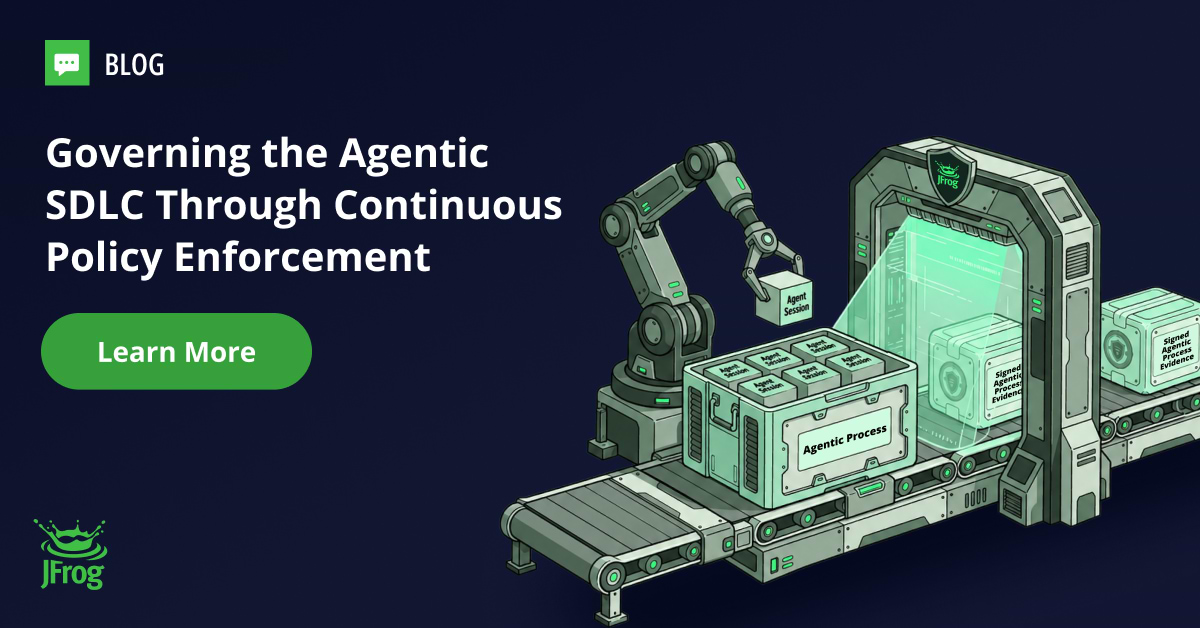 Governing the Agentic SDLC Through Continuous Policy Enforcement
JFrog proposes the Agentic Process Evidence Protocol, an open spec that records coding-agent sessions (harness and agent version, model ID, tool and MCP calls, prompts, owner, human reviewer) as signed in-toto/DSSE attestations bound to a git commit, artifact or release. Policy-as-code release gates can then check for approved LLMs and MCP tools, an accountable human and adherence to guidelines, and the logs allow post-release audit. The post gives mock session-log and evidence JSON, ties the approach to EU AI Act Articles 12 and 14, OWASP AISVS and SLSA, and points to a GitHub reference repo, with JFrog AppTrust as the commercial implementation.
 jfrog.comarticleAdded 14 Oct 2026, published 12 Oct 2026🧠 AI
- Governing the Agentic SDLC Through Continuous Policy Enforcement
JFrog proposes Agentic Process Evidence, an open protocol that records AI coding agent sessions (harness, model ID, tool calls, MCP use, prompts, owner, human reviewer) as signed in-toto/DSSE, SLSA-compatible attestations bound to commits, artifacts and releases. Policy-as-code gates can then block releases that used unapproved LLMs or MCP tools, or that lack an accountable human. It maps the approach to EU AI Act Articles 12/14, OWASP AISVS and ISO/IEC 42001, and includes example session-log and evidence JSON. The post also promotes JFrog AppTrust's Prompt to Release Traceability.
jfrog.comarticleAdded 14 Oct 2026, published 12 Oct 2026🛡️ Security  The OWASP Top 10 Gets Modernized | Endor Labs
Commentary on the 2025 OWASP Top 10 update presented at OWASP Global AppSec in Washington, D.C. Broken Access Control stays #1, Security Misconfiguration and the new Software Supply Chain Failures category (replacing Vulnerable and Outdated Components) rise to #2 and #3, and Cryptographic Failures, Injection and Insecure Design drop. The author adds context on agentic AI and MCP identity and authorization, AI-assisted SAST, non-human identities, CISA Secure-by-Default, OWASP SPVS, and slopsquatting and AI coding assistant risks.
endorlabs.comarticlePublished and added 12 Oct 2026🛡️ Security Why AI Coding Agents Keep Writing Broken Access Control
Snyk argues AI coding agents reliably write broken access control (BOLA/IDOR, OWASP's top category since 2021) because the facts needed to add an ownership check — what an object belongs to, who may access it, where tenant boundaries sit — are tacit product knowledge that exists nowhere in the code or prompt an agent sees. It explains why SAST tools catch patterned sub-categories like path traversal or SSRF but structurally cannot catch CWE-639/862/863 (missing or incorrect authorization), since there's no bad pattern to match, and proposes reasoning over an assembled "application-context graph" of architecture, data flows and trust boundaries instead. It closes with a five-step team checklist (inventory ID-accepting endpoints, document ownership rules, add authorization-specific PR review, write cross-tenant tests, run deep contextual analysis) and pitches Snyk's Evo Agentic AppSec as the tool built around that approach.
 snyk.ioarticlePublished and added 1 Oct 2026🧠 AI
- Aditya Agrawal (@exploitprotocol) on X
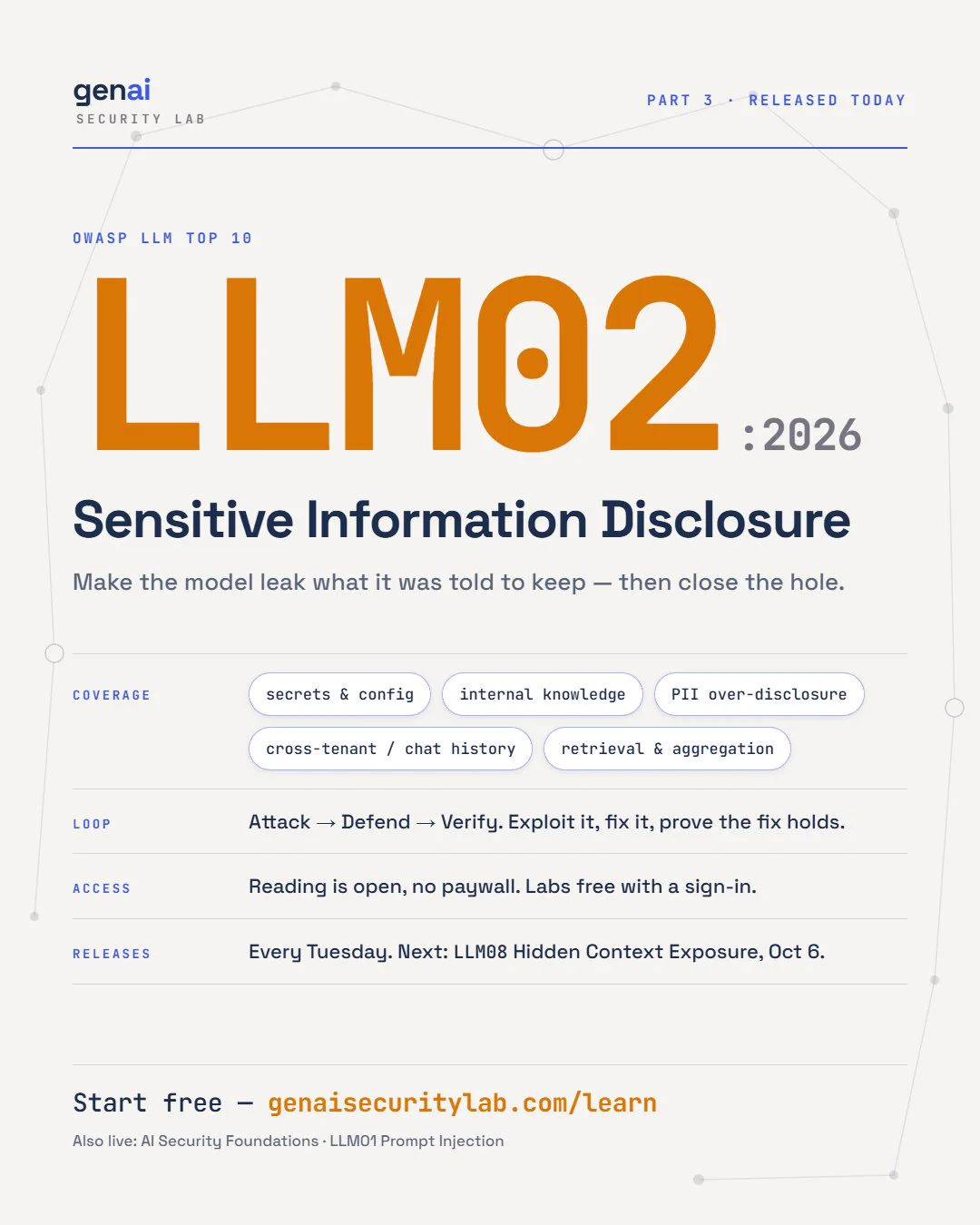
Announcement thread for part 3 of the free Learn AI Security series at genaisecuritylab.com, covering OWASP LLM02 Sensitive Information Disclosure in LLM applications. It walks through failure modes - leaked secrets/API keys via model context, internal knowledge leakage, personal-data over-disclosure, cross-tenant/conversation-history leakage, and RAG retrieval/aggregation leaks - and offers live in-browser attack/defend/verify labs comparing the issues to IDOR and multi-tenant isolation testing in traditional web apps. The author notes the series continues weekly, with LLM08 Hidden Context Exposure scheduled next.
 x.comthreadAdded 1 Oct 2026, published 30 Sep 2026🛡️ Security
- https://github.com/dmdhrumilmistry/security-harness
security-harness is an open-source Claude Code plugin (also packaged for Gemini CLI, Codex and opencode) that orchestrates subagents — sh-recon, sh-hunter, sh-chainer, sh-verifier, sh-reporter — through a static-analysis pipeline covering 15 vulnerability classes (IDOR/BOLA, SQLi, XSS, SSRF, injection, auth, deserialization, path traversal, secrets, CSRF, XXE, open redirect, crypto, race conditions, file upload), producing README/JSON/SARIF/HTML/PDF reports with PoCs, CVSS and CWE/OWASP mappings. It also ships sh-pr-review, a per-PR merge-gate skill that posts inline findings and a commit status scoped only to code the PR itself introduced or aggravated, with caching, dedup via fingerprints, and a scheduled GitHub Action that keeps its per-class knowledge bases fresh by having one AI agent draft updates from allowlisted sources (OWASP, PortSwigger Research, CWE/CAPEC, HackerOne) while a separate adversarial reviewer agent fails-closed against prompt injection before auto-merge.
github.comrepoAdded 2 Oct 2026, published 29 Sep 2026🛡️ Security - Uncensored and Offensive Security AI Models Benchmark
A curated GitHub list of open-weight "uncensored" and security-fine-tuned LLMs intended for authorized red teaming, pentesting, and security research, covering models like WhiteRabbitNeo's DeepHat V2, BugTraceAI-CORE, CYBER-FROST, and several abliterated Qwen/GLM/DeepSeek variants. It explains the underlying techniques (abliteration per Arditi et al. 2024, QLoRA/DPO fine-tuning, GGUF/FP8 quantization) and links to Hugging Face model cards, benchmark suites (CyberBench, TrustedSec's LLM Attack Benchmark vs OWASP Juice Shop), and deployment platforms for running these models locally or via API.
github.comrepoAdded 2 Oct 2026, published 29 Sep 2026🛡️ Security - Agent Control Standard (ACS)
Agent Control Standard (ACS) is an OWASP GenAI Security Project specification that lets a separate Guardian Agent inspect an AI agent's proposed actions before they execute and return allow/deny/modify/ask/defer over an authenticated JSON-RPC wire, with OpenTelemetry/OCSF audit trails and a CycloneDX/SPDX/SWID AgBOM inventory. The reference implementation runs Microsoft's Agent Governance Toolkit (AGT) behind the ACS contract with Bun, including host shims for Claude Code and OpenCode, and demonstrably denies a destructive `rm -rf /` command from a live coding-agent session while allowing benign ones. The project is explicit about current gaps — the wire is unauthenticated (issue #70) and the reference Guardian fails open by default (issues #32/#37) — and only 2 of 16 lifecycle hooks are evaluated live in v0.1.0.
github.comrepoAdded 26 Sep 2026🛡️ Security - Agent Threat Rules (ATR) — open detection-rule standard for AI agent threats
Agent Threat Rules (ATR) is an open, versioned YAML rule format (ATR-YYYY-NNNNN scheme) for detecting AI-agent runtime threats — prompt injection, tool-poisoning, malicious SKILL.md content, and MCP exchange abuse — evaluated by a reference TypeScript engine (with a Python wrapper) shipped as an npm/pip package, CLI, GitHub Action, and Docker scanner with SARIF output. The project positions itself as "Sigma for agent threats," maps rules to OWASP Agentic/LLM Top 10, MITRE ATLAS, and NIST AI RMF, and publishes an extensive (and unusually self-critical) benchmark suite against corpora like garak, PromptBench, and PromptInject, including documented harness bugs and withdrawn recall figures.
github.comrepoAdded 26 Sep 2026🛡️ Security - graygnatconsole/mcp-audit-tool
mcp-audit-tool is a dependency-light Python CLI that statically scans Claude Desktop, Cursor, Windsurf, Cline, Zed, and VS Code MCP configuration files for security issues, including hardcoded secrets, unpinned/rug-pull packages, pipe-to-shell installers, tool-poisoning via hidden instructions in tool descriptions, filesystem servers rooted at '/', and unauthenticated plaintext HTTP MCP endpoints. It auto-discovers configs across macOS/Linux/Windows, produces a security score/grade plus SARIF 2.1.0 output for GitHub Code Scanning, and is built around the OWASP MCP Top 10 categories with a CI/CD example that fails builds on severity thresholds. The roadmap adds live server probing over stdio/SSE for runtime rug-pull detection and an ML-based prompt-injection classifier for tool descriptions.
github.comrepoPublished and added 26 Sep 2026🛡️ Security 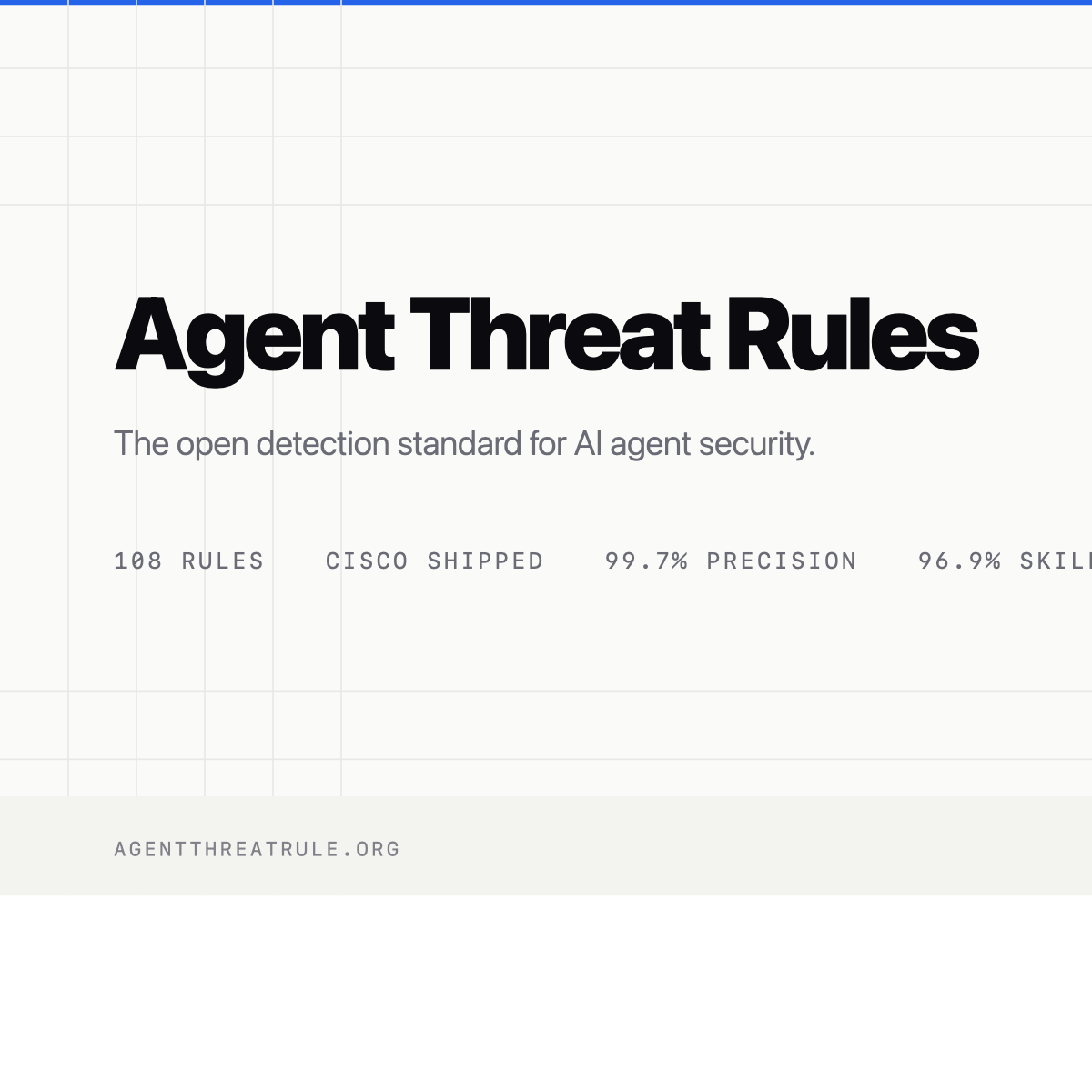 Agent Threat Rules (ATR) — Sigma/YARA-style open detection format for AI agent threats
Agent Threat Rules (ATR) is an open, versioned YAML rule format for detecting AI-agent security threats — prompt injection, tool poisoning, credential exfiltration, unauthenticated agent execution — positioned as "what Sigma is to SIEM and YARA is to malware." Rules carry permanent ATR-YYYY-NNNNN IDs, declare detection conditions against fields like LLM I/O, tool-call args, or SKILL.md content, and map back to OWASP Agentic/LLM Top 10, MITRE ATLAS, SAFE-MCP, and NIST AI RMF; a reference TypeScript engine and Python wrapper ship MIT-licensed. Governance is transitioning from a single BDFL maintainer to a Technical Steering Committee, and the spec is notably transparent about its own limits, withdrawing previously published per-lane false-positive figures after discovering a tainted benign corpus.
 agentthreatrule.orgotherAdded 26 Sep 2026🛡️ Security
 Incident-Data Robustness Analysis of the OWASP Top 10 for LLM Applications (2026): How a Community-Expert Ranking Holds Up Against a Large-Scale LLM Incident Corpus
This arXiv paper stress-tests the OWASP Top 10 for LLM Applications (2026) community-expert ranking against a large-scale corpus of real LLM-security incidents (7,714 snapshotted, 6,639 labeled) drawn from CVE, GHSA, OSV, and AIAAIC. Using a Bayesian measurement-error model to correct incident counts for classifier precision/recall, the authors find weak agreement between the expert ranking and the incident-based ranking (Cohen's kappa about 0.20), yet the expert list proves robust: a bake-off of four frontier LLM classifiers fails to beat a simple incidence-floor baseline (balanced accuracy 0.863, Spearman rho = 0.918 against held-out ground truth). It is framed as an exploratory analysis by two OWASP working-group members, not an official supersession of the list.
 arxiv.orgpaperAdded 26 Sep 2026🛡️ Security
 30+ MCP CVEs in Two Months: What the Early-2026 Vulnerability Wave Means for Your MCP Supply Chain
Analysis of 30+ CVEs filed against Model Context Protocol servers, clients, SDKs, and proxies in the first two months of 2026, showing the flaws concentrated in plumbing (proxies, registries, transports) rather than tool implementations. It walks through CVE-2025-6514 (CVSS 9.6 RCE in mcp-remote via unsanitized OAuth authorization_endpoint URLs shelled out to launch a browser), the chained Atlassian MCP server CVEs (CVE-2026-27825/CVE-2026-27826), unauthenticated public registries, and a systemic stdio-transport advisory, then ties the findings to the NSA's May 2026 MCP security CSI and the OWASP MCP Top 10.
 bex.coarticleAdded 26 Sep 2026, published 23 Sep 2026🛡️ Security
- nealbridges/VulnHunter
A maintained, harness-portable fork of Capital One's open-source VulnHunter — an agentic AI tool that performs attacker-first forward analysis on source code to find exploitable vulnerabilities, falsify weak findings, and produce evidence-backed PoCs rather than pattern-matched SAST alerts. This fork adds containerized (Docker-based) exploit validation, measured-impact PoCs (rows leaked, amplification factor, etc.), and portability across agent harnesses (Claude Code, Codex, Grok, etc.) via environment-contract prompt files, plus an unattended operator (vulnhunter-run) and batch-scanning/benchmark harness tested against OWASP NodeGoat, Juice Shop, and WebGoat.
github.comrepoAdded 6 Oct 2026, published 22 Sep 2026🛡️ Security - DVLAA
DVLAA (Damn Vulnerable LLM and Agent Application) is a self-hosted, Docker-deployable security training range for LLM and agent applications, modeled on the DVWA concept but for AI. It covers OWASP LLM Top 10 and Agent Security Top 10 risks (prompt injection, RAG poisoning, tool abuse, memory poisoning, excessive resource consumption, etc.) through 81 hands-on challenges, including an "AWDP" attack/defense track where 10 challenges reproduce real disclosed vulnerabilities in Dify, RAGFlow, Langflow, Flowise, Open WebUI and n8n (with optional real upstream container reproduction), 20 challenges adapted from a China–ASEAN AI security CTF, and 6 challenges adapted from a real model-poisoning CTF. It provides real model interaction, state-machine flag verification, source/prompt viewers, model management (local, Ollama, SiliconFlow, OpenAI-compatible), and bilingual UI.
github.comrepoAdded 22 Sep 2026🛡️ Security  Attack Surface Explained: Types & Reduction Tips
A long-form explainer distinguishing attack surface from attack vector and asset inventory, breaking the surface into network/perimeter, identity/permissions, application/code, and data/storage components, and covering how to map it via the OWASP Attack Surface Analysis Cheat Sheet, measure it (Relative Attack Surface Quotient, Carnegie Mellon's attack surface metric), and reduce it. It also contrasts external attack surface management with cyber asset attack surface management and closes with a pitch for Orca's agentless SideScanning and Unified Data Model.
 orca.securityarticlePublished and added 21 Sep 2026🛡️ Security
- OWASP Agentic Skills Top 10 (AST10)
The OWASP Agentic Skills Top 10 (AST10) is a new security framework cataloging the 10 most critical risks in AI agent "skills" — the behavior layer that orchestrates multi-step tool use in OpenClaw, Claude Code, Cursor/Codex, and VS Code. It documents real 2026 incidents (the ClawHavoc registry-poisoning campaign with 1,184 malicious skills, Snyk's ToxicSkills audit of 3,984 skills finding 36.82% flawed, CVE-2025-59536/CVE-2026-21852 RCE in Claude Code project files, and CVE-2026-28363 ClawJacked WebSocket hijacking) and proposes a Universal Skill Format (YAML) with signing, permission allowlists, and identity-file protections to mitigate them, mapped to CSA's MAESTRO 7-layer threat model.
github.comrepoAdded 18 Sep 2026🛡️ Security - OWASP Agentic Skills Top 10 (AST10)
The OWASP Agentic Skills Top 10 (AST10) is a new OWASP project cataloging the 10 most critical security risks in AI agent "skills" — the layer that defines how agents orchestrate multi-step, autonomous workflows across platforms, as opposed to how models talk to tools via MCP. Each risk is mapped to the Cloud Security Alliance's MAESTRO 7-layer threat model for agentic AI systems, aiming to close a gap left by existing LLM- and MCP-focused security guidance.
 owasp.orgotherAdded 16 Sep 2026🛡️ Security
Showing 30 of 96
Show more