 Where AI Vulnerability Discovery Harnesses Go Quiet: Structural False Negatives and Hidden Vulnerabilities
Paper (arXiv, 21 October 2026) on structural false negatives in LLM vulnerability discovery harnesses. Starting from Knostic's OpenAnt and raptor, then 10 more open-source harnesses, the authors map 13 points where code selection, filtering, and finding storage or merging drop vulnerabilities. One file was dropped by six harnesses before the model saw it, five without notice. It covers attacker evasion, content-steered verdicts, prompt injection, and design principles and tests.
 arxiv.orgpaperAdded 24 Oct 2026, published 21 Oct 2026🛡️ Security
- No, Your Tools Are Not Enough: It's Time to Bring Agents to the Hunt
Experience paper describing an iterative agentic workflow that uses AI agents to find vulnerabilities across diverse targets: Windows drivers, the Linux kernel, XNU, firmware and web applications. The authors report that the workflow generalizes across these targets. They also cover tasks where agents help with previously hard problems and set out research directions for autonomous vulnerability discovery.
arxiv.orgpaperAdded 16 Oct 2026, published 10 Oct 2026🛡️ Security  💧 Looting of Liquid Sidechain Underscores Emerging Cyber Threat to Bitcoin
Galaxy Research breaks down the theft of 4,000 BTC (~$320m) from the Liquid Network, a Bitcoin sidechain run by the Liquid Federation. Attackers exploited a bug in the sidechain node code to artificially mint 4,000 L-BTC, then abused an auto-forward feature offered by federation member SideSwap to bypass peg-out address whitelisting and withdraw real BTC to the main chain; the self-described "white hats" returned 85% but held 15% hostage, negotiating with developer Blockstream via PGP-encrypted OP_RETURN messages and demanding a 10% bug-bounty payout. The piece also contrasts this with concurrent Coldcard and BTCPay Server incidents and speculates about AI-assisted vulnerability discovery.
 galaxy.comarticleAdded 8 Oct 2026🛡️ Security
 Vulnerability Discovery and Exploitation Trends in the AI Era (Google Cloud)
Google Threat Intelligence Group analyzes vulnerability disclosure and exploitation trends from January 2025 to August 2026, finding disclosures doubled, exploitation nearly doubled, and AI-assisted discovery surfaces proportionally more Medium and High-risk flaws, with 50 percent leading to remote code execution versus 26 percent baseline. It documents real-world exploitation of an AI-discovered CVE in BeyondTrust PRA and a surge in vulnerabilities targeting the AI/LLM operational stack, especially agent orchestration frameworks like Langflow and Flowise and inference gateways like LiteLLM and vLLM, citing specific CVEs in those products.
 cloud.google.comarticleAdded 8 Oct 2026, published 30 Sep 2026🛡️ Security
- FirmAgent: Fuzzing + LLM Agents for IoT Firmware Vulnerability Discovery (NDSS 2026)
FirmAgent is an academic research toolkit (NDSS 2026) for finding vulnerabilities in re-hosted IoT firmware web services by combining IDA-based pre-fuzzing (CFG/sink distance scoring), QEMU instrumented tracing, CFG-guided API fuzzing, and an optional LLM agent (LLMATaint.py) that consumes runtime taint traces to reason about and produce PoCs for bug classes like command injection. The pipeline is explicit about scope: it is meant for authorized, owned or re-hosted firmware (e.g. Greenhouse-style containers), and stitches together sink-scope extraction, feedback-driven fuzzing, and request-to-trace attribution before handing traces to an LLM for taint-to-PoC analysis.
 github.comrepoAdded 26 Sep 2026🛡️ Security
- HoF-Bench: Rediscovering Real AI-Discovered CVEs Without Frontier Models
HoF-Bench is a benchmark of 95 real, publicly disclosed CVEs originally found by AISLE's LLM-based vulnerability analyzer (280+ CVEs across 78 projects including OpenSSL, curl, and GnuTLS), repackaged into eight repositories pinned at vulnerable commits. Analyzers get source/target-file scope but no CVE ID, description, fix, or expected mechanism, and a detector-blinded frontier-model judge only credits findings that match the same code path, root cause, attack condition, and impact. Testing ten non-frontier backbones (open-weight 21B-284B and proprietary "flash"-tier models) in a fixed multi-pass scaffold, a minimal analyzer rediscovers up to 68% of the CVEs, with misses concentrated in C infrastructure code — showing small/cheap models can approximate frontier-level vulnerability discovery on known bug classes.
arxiv.orgpaperAdded 26 Sep 2026🛡️ Security - OpenAnt: LLM-Powered Vulnerability Discovery Through Code Decomposition, Adversarial Verification, and Dynamic Testing
OpenAnt is an open-source (Apache 2.0) vulnerability discovery system that combines static program analysis with LLM reasoning in a three-stage pipeline: decomposing codebases into reachability-filtered analysis units (cutting analysis surface up to 97%), running adversarial verification where the model simulates a constrained attacker to judge exploitability, and validating candidates via dynamic testing in disposable sandboxed containers. Evaluated against large real-world projects including OpenSSL, WordPress, and Flowise, it reportedly surfaced previously unknown vulnerabilities while cutting false positives and keeping analysis cost manageable, positioning closed-loop LLM+exploit-validation pipelines as a practical path to scalable automated security analysis.
arxiv.orgpaperAdded 26 Sep 2026🛡️ Security  Securing the unpatchable in an age of AI-driven vulnerabilities
Cisco Talos argues that AI-accelerated vulnerability discovery is outpacing organizations' ability to patch, especially for unpatchable operational technology (OT) like medical devices and industrial control systems. It recommends network-level compensating controls instead of patching: upstream next-generation firewalls with intrusion prevention for virtual patching, VLAN/ACL-based micro-segmentation to restrict which devices can reach legacy systems, and visibility into legacy network fingerprints to build an asset inventory. It also debunks the air-gap myth, citing WannaCry's spread through unpatched Windows XP in the NHS as a cautionary example of "hope for the best" failing.
 blog.talosintelligence.comarticleAdded 7 Oct 2026, published 16 Sep 2026🛡️ Security
- Cloudflare security-audit-skill
security-audit-skill is a Cloudflare open-source coding-agent skill that turns an AI coding agent into a structured vulnerability hunter, running six phases: reconnaissance into architecture.md/coverage-ledger.json, coverage-led hunting by isolated sub-agent "hunters," adversarial candidate validation, structured findings.json output validated against a report-schema.json, independent re-verification of claims, and target-neutral report generation (REPORT.md, FINDINGS-DETAIL.md, NEEDS-VALIDATION.md). It is installed via the Skills CLI (`npx skills add`), uses Node.js validators (validate-coverage-ledger.cjs, validate-findings.cjs), requires a sandboxed environment for safely executing target code/tests/fuzzers, and is the single-repo seed for Cloudflare's larger fleet-wide vulnerability discovery harness described in a companion blog post.
github.comrepoAdded 22 Sep 2026, published 15 Sep 2026🛡️ Security 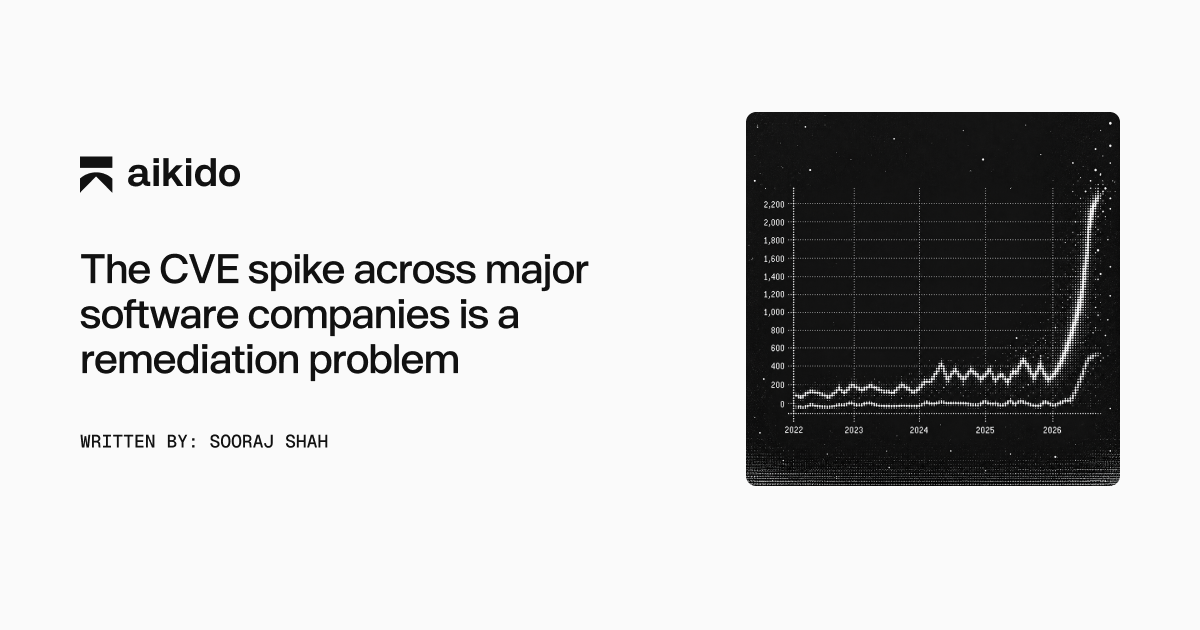 The CVE spike across major software companies is a remediation problem
Aikido argues the widely-shared a16z/Epoch AI chart showing critical/high CVEs jumping from under 100/month to over 600/month since spring 2026 reflects AI accelerating vulnerability discovery, not a real spike in danger — since CISA's KEV count has stayed flat. It details how NIST's NVD, overwhelmed by volume, let its scoring backlog balloon from 13,000 to 27,000 CVEs in 18 months and pivoted to only prioritizing federal/critical/KEV-listed CVEs, while Verizon's 2026 DBIR found only 26% of confirmed actively-exploited KEV vulnerabilities were fully remediated in 2025 (down from 38%) with median patch time rising to 43 days. It illustrates the point with StyleSmuggler, an unauthenticated RCE hitting Adobe Commerce and Magento Open Source that had no CVE or vendor advisory, which Aikido Intel flagged and Aikido Libraries auto-patched more than 24 hours before Adobe's own hotfix.
 aikido.devarticlePublished and added 10 Sep 2026🛡️ Security
- 0xor0ne (@0xor0ne) on X
A tweet from @0xor0ne surfacing two blog posts by researcher ZephrFish on using LLMs for vulnerability research: one describing an MCP (Model Context Protocol) server for the workflow, and a second on 'harnessing' LLMs for this purpose. The posts (hosted at blog.zsec.uk) cover applying LLM agents to vulnerability discovery/analysis tasks.
 x.comthreadPublished and added 9 Sep 2026🛡️ Security
 Introducing Gemini 3.8 Flash and 3.8 Flash Cyber
Google DeepMind announces Gemini 3.8 Flash, an upgraded reasoning/coding model at the same $0.75/$3.75 per-million-token price as 3.7 Flash, plus Gemini 3.8 Flash Cyber, a specialized variant for vulnerability discovery and automated patching offered to vetted defenders through a new 'Fairwind Program'. The post cites benchmark gains on DeepSWE v1.1, HLE-Verified, Vals Finance Agent V2 and Harvey's Legal Agent Benchmark for the general model, and CyberGym plus Collinear's CWE-Bench for the cyber variant, along with real-world results from Chrome Security, Wiz and Google's Cloud Vulnerability Research team.
 deepmind.googlearticleAdded 29 Sep 2026, published 2 Sep 2026🧠 AI
- Introducing Gemini 3.8 Flash and 3.8 Flash Cyber
Google DeepMind announces Gemini 3.8 Flash and a gated variant, Gemini 3.8 Flash Cyber, the latter positioned as a frontier-level model for autonomous vulnerability discovery and automated patching, accessible to vetted defenders through a new 'Fairwind Program.' On the CyberGym benchmark and an internal 20-language vulnerability-discovery benchmark it reports over 70% success, and on the Collinear CWE-Bench patching benchmark it nearly matches a larger frontier model (47.2% vs 47.8% pass@1) at much lower cost; Google cites Chrome Security producing 2.6x more correct patches and Wiz seeing higher recall at lower cost using the model, plus a case where Google's Cloud Vulnerability Research team found a critical vulnerability in under 2 hours.
deepmind.googlearticleAdded 29 Sep 2026, published 2 Sep 2026🛡️ Security - Agentic Source Code Review for Vulnerability Discovery
Mandiant details AVDH (Agentic Vulnerability Discovery Harness), a multi-agent LLM pipeline built on Google's Agent Development Kit that performs threat modeling, entry-point discovery, context enrichment, and hypothesis generation/validation (using high-temperature Validation agents plus a Synthesis agent) to find vulnerabilities in source code at scale. Over 10 months it has produced 12 assigned CVEs (including CVE-2026-13242 and CVE-2026-55803), found 100+ true-positive critical vulnerabilities in a two-day IR investigation, and identified an RCE during a client engagement, with human experts validating findings via PoC exploitation and a distilled "rules" knowledge base injecting consultant expertise into the pipeline. The piece also describes their internal benchmarking methodology using synthetic codebases to avoid LLM training-data contamination.
cloud.google.comarticleAdded 3 Sep 2026, published 21 Aug 2026🛡️ Security 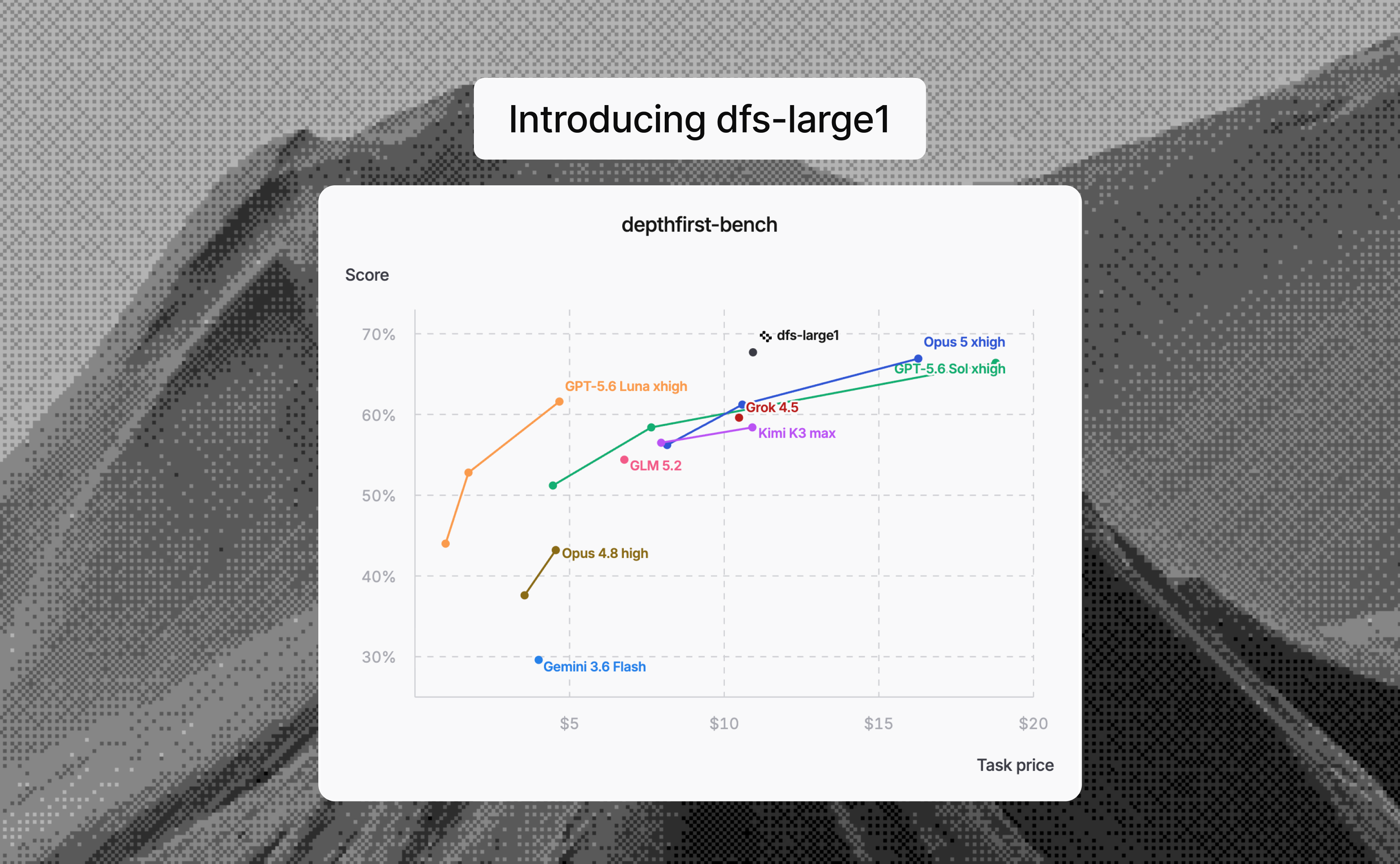 Introducing dfs-large1: A New Frontier for Cybersecurity | depthfirst
dfs-large1 is depthfirst's vulnerability discovery and validation model, post-trained from GLM 5.2 with multi-task RL inside its security agent harness, in partnership with Fireworks AI. The report covers the reward design (effort penalty, finding budget), masked importance-sampling optimization, task-level advantage normalization, summarization-based context compaction and the sandboxed evaluation setup. It reports that the learned audit strategy moved from broad enumeration to hypothesis testing with executable harnesses. Benchmark numbers and the dfbench methodology are not given.
 depthfirst.comarticleAdded 29 Oct 2026, published 30 Jul 2026🛡️ Security
- Claude as Autonomous Bug Bounty Hunter
A Medium write-up on turning Claude Code into an autonomous bug bounty agent. The setup combines 124 custom skills, three hooks and a Kali Linux container for vulnerability discovery and reporting. It is a practitioner example of structuring a Claude Code harness with skills, hooks and a sandboxed tool environment. Only the blurb was available, so implementation details are unverified.
 medium.comwriteupAdded 10 Oct 2026, published 30 Jul 2026🧠 AI
 Atlasのご紹介:WizのAI脆弱性リサーチャー
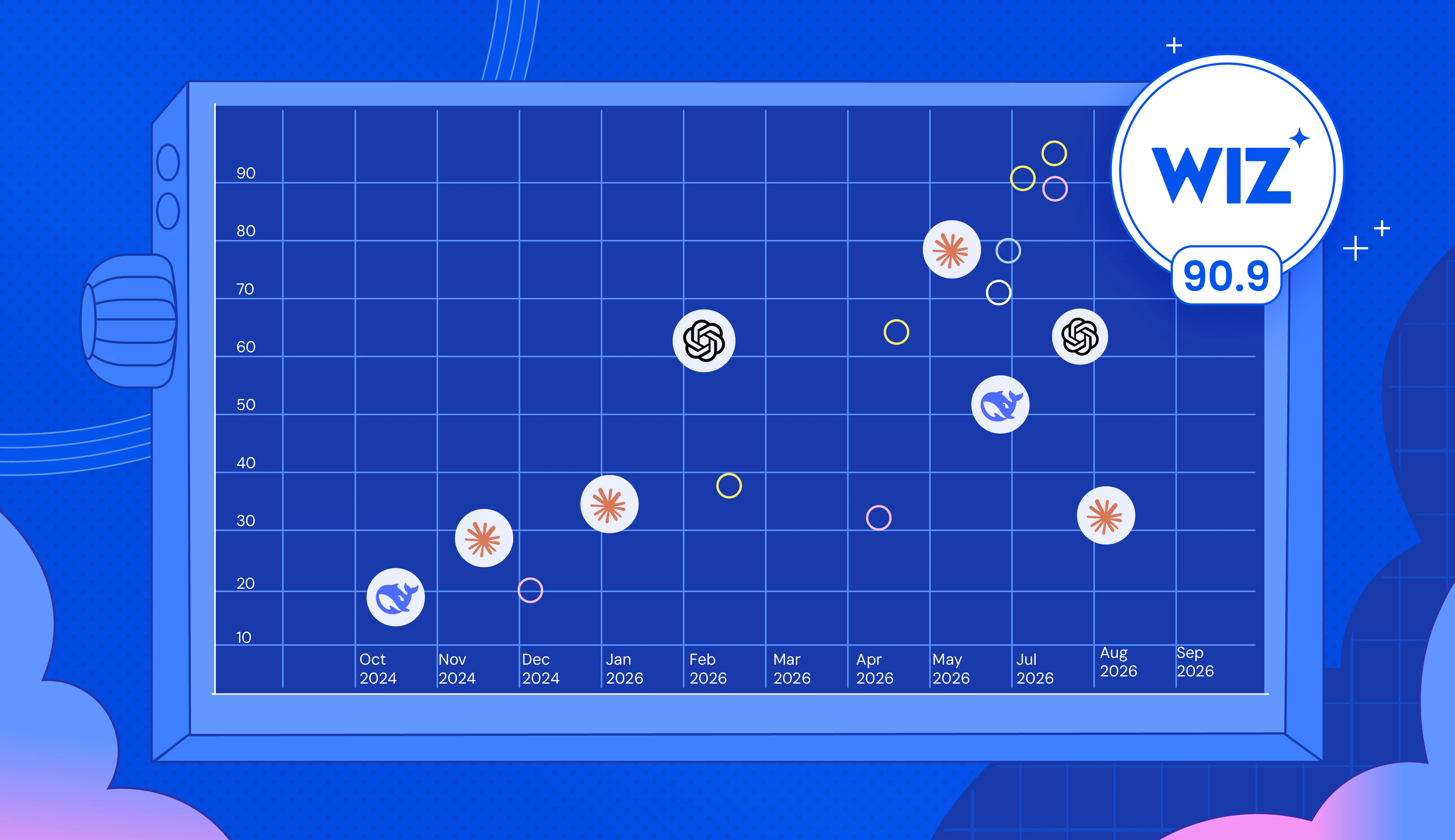
Wiz Research details Atlas, an autonomous multi-agent AI system for vulnerability discovery that ranks #1 on the CyberGym benchmark (90.9% success) and found 200+ previously unknown bugs in heavily audited projects like grpc, dnsmasq, Kubernetes, gVisor, the Linux kernel, and containerd. The post explains Atlas's four-stage pipeline (attack-surface mapping via code property graphs, parallel hypothesis hunting, adversarial validation between competing agents, and dynamic exploit triggering) and notes an early version of the system contributed to discovering a critical GitHub RCE (CVE-2026-3854) that paid GitHub's largest-ever bug bounty. It also outlines lessons from evaluation-driven development and plans to integrate Atlas into Wiz Code alongside Google CodeMender.
 wiz.ioarticleAdded 3 Sep 2026, published 27 Jul 2026🛡️ Security
 What Is AI Pentesting and How Does It Work?
Snyk explains AI pentesting as an orchestrated system — a reasoning model that plans reconnaissance/exploitation, deterministic DAST tooling for known vulnerability classes, an independent validator model that confirms exploitability, and context from existing scanner findings — designed to catch context-dependent flaws like BOLA/IDOR, cross-tenant leakage, and chained business-logic exploits that signature-based scanners miss. It cites concrete reliability data (frontier models solving only ~26% of hard system-exploitation benchmark tasks, ~30% hallucinated findings without independent validation, 210% YoY growth in valid AI-generated HackerOne reports and 540% growth in prompt-injection reports) and positions Snyk's Evo Continuous Offensive Security product against these evaluation criteria. It also references a RAND 2026 study on low-cost CTF-solving coding agents, Anthropic/Mozilla open-source vulnerability discovery work, and Google GTIG's report of the first in-the-wild AI-assisted zero-day.
 snyk.ioarticleAdded 3 Sep 2026, published 27 Jul 2026🛡️ Security
- Introducing Gemini 3.5 Flash Cyber
Google DeepMind announces Gemini 3.5 Flash Cyber, a lightweight cybersecurity-tuned variant of Gemini 3.5 Flash built to find, validate, and patch vulnerabilities as the backbone of Google's CodeMender agent. It reports benchmark results on CyberGym, an internal Big Sleep evaluation, and Chrome's production commit-scanning pipeline, claiming it outperforms mainline 3.5/3.6 Flash and Claude Opus 4.6 on unique vulnerability discovery (e.g., 55 vs 47 vs 36 unique issues found in the V8 engine), and describes deploying multiple lightweight model calls per report to cover more code paths than one large-model call. Access is initially limited to a government/trusted-partner pilot via CodeMender, given dual-use misuse concerns.
deepmind.googlearticleAdded 29 Sep 2026, published 17 Jul 2026🧠 AI  Socket: Next.js Moves to Scheduled Security Releases
Vercel is replacing Next.js's ad-hoc security patching with a formal monthly scheduled-release program, publishing advance notice of severity and timing (first release July 20 covering 4 high/5 medium issues). The move follows React2Shell (CVE-2025-55182), a CVSS 10.0 pre-auth RCE in React Server Components exploited within hours by China state-nexus groups Earth Lamia and Jackpot Panda and affecting over 968,000 exposed instances, plus follow-on flaws CVE-2025-55183, CVE-2025-55184, and CVE-2025-67779, and the earlier CVE-2025-29927 middleware auth-bypass. It also ties the change to rising AI-assisted vulnerability discovery volume across the industry (Mozilla's 271-issue Firefox release, Microsoft's 570-fix Patch Tuesday).
 socket.devarticlePublished and added 16 Jul 2026🛡️ Security
 XBOW: The Rise of Affordable Models
XBOW blog post benchmarking lower-cost AI models — open-weight GLM (5.2/5.5) and Meta's Muse Spark 1.1 — against frontier models Mythos and GPT-5.5 on autonomous, black-box vulnerability discovery and exploitation using XBOW's own agentic offensive-security evaluation harness (real vulnerable open-source apps frozen at versions with known CVEs). The piece argues that while GLM and Muse Spark don't match Mythos's peak capability, their falling cost-per-successful-exploit is what actually shifts the offensive AI threat landscape, since attackers only need "good enough" cheap models that can run at scale rather than the single best model.
 xbow.comarticlePublished and added 16 Jul 2026🛡️ Security
 Full Fathom Five: The context of Anthropic’s Mythos-class public release
Aikido commentary on Anthropic's public Claude Fable 5 release. The author says it is a Mythos-class model that routes cybersecurity prompts to Opus 4.8, so benchmarking its security capability is pointless. Mythos Preview and Claude Mythos 5 stay limited to Glasswing and about 150 additional organizations. The post argues that vulnerability discovery is roughly 20% of the problem and that zero-day demand is not supply-constrained (about 30 new vulns a month, citing Resecurity). It also argues that CVE and CISA KEV-centric prioritisation is fading, and that AI tokens will mostly go to defensive scanning, exposure management and remediation rather than attacker scans.
aikido.devarticleAdded 3 Sep 2026, published 13 Jun 2026🛡️ Security- Full Fathom Five: The context of Anthropic’s Mythos-class public release
Aikido's commentary on Anthropic's Claude Fable 5 launch. It says Fable 5 is a descendant of Mythos Preview that routes cybersecurity (and bioweapon) prompts to a weaker Opus 4.8, so benchmarking it for cyber capability is pointless. Claude Mythos 5, with fewer safeguards, goes only to the original Glasswing companies and about 150 more organizations. The author argues that vulnerability discovery is roughly 20% of the security problem. They also argue zero-day demand is not supply-constrained (about 30 new vulns per month, citing Resecurity), so model tokens will mostly go to defensive scanning, triage and cleanup rather than attacker scans.
aikido.devarticleAdded 10 Oct 2026, published 13 Jun 2026🧠 AI - Defending Code Reference Harness
A reference implementation from Anthropic showing how to build a Claude-powered vulnerability discovery and remediation pipeline: interactive skills (/threat-model, /vuln-scan, /triage, /patch, /customize) for static scoping, scanning, triage and patch generation, plus an autonomous seven-stage recon-find-verify-dedupe-report-patch harness that builds targets with Docker/ASAN and runs each agent in a gVisor sandbox with restricted egress. It also ships a detection-and-response track (/dnr-hunt, /dnr-respond) for hunting an attacker already present in logs, scoping blast radius, and proposing a response, demoed against a planted attack campaign in synthetic logs.
github.comrepoAdded 3 Sep 2026, published 5 Jun 2026🛡️ Security  Move over, Mythos. Here comes... pretty much any other model with a good harness
Aikido argues that for AI-assisted vulnerability discovery, the orchestration "harness" wrapped around a model matters more than which frontier model is used. It cites UCSB research showing the same Claude Opus 4.6 model scored 4x differently across harnesses, Cloudflare's recon/hunt/validate/trace/dedupe pipeline design, Niels Provos swapping GLM into a working harness with comparable results, Mozilla absorbing new models without re-architecting, and the curl maintainer's experience where Mythos (Claude) produced mostly false-positive "vulnerabilities." It concludes that cheap models run in parallel with strong validation/dedup stages beat single expensive frontier-model scans on both cost and coverage.
aikido.devarticleAdded 3 Sep 2026, published 1 Jun 2026🛡️ Security- CyberStrikeus/CyberStrike
CyberStrike is an open-source (AGPL-3.0) terminal-based framework that turns any LLM subscription (Claude, GPT, Gemini, local models via Ollama/LM Studio, etc.) into an autonomous red-team agent, providing 13+ specialized agents, 7,600+ Ed25519-signed security skill files mapped to OWASP WSTG/CWE, a built-in Chromium proxy browser for role/credential discovery, and remote "Bolt" MCP tool servers for orchestrating tools like nmap, sqlmap, and Burp-style traffic interception. It targets pentesters and bug bounty hunters for automated reconnaissance, vulnerability discovery, exploitation, and post-exploitation, explicitly restricted to authorized testing.
github.comrepoPublished and added 23 May 2026🛡️ Security  AI-Assisted Vulnerability Discovery
VulnCheck analyzes CVE Numbering Authority disclosure data and finds sharp YTD increases across Chrome, Mozilla, Apache, VMware, HPE, F5, and GitHub, correlating the surge with the rollout of Anthropic's Project Glasswing and Claude Mythos Preview to partners including Google, Microsoft, and Apple. It walks through per-vendor evidence (Mozilla's Firefox hardening with Mythos, Curl maintainer Daniel Stenberg's mixed false-positive results, and the ActiveMQ CVE-2026-34197 RCE found by Naveen Sunkavally largely via Claude) to argue AI models are now materially accelerating vulnerability discovery, while cautioning it is unclear whether the volume increase will be sustained.
 vulncheck.comarticleAdded 3 Sep 2026, published 15 May 2026🛡️ Security
 CSA: VulnOps in the Age of AI
Cloud Security Alliance research note arguing that traditional vulnerability management (scan, ticket, patch on a calendar) is breaking under AI-driven vulnerability discovery volume, NVD's April 15, 2026 risk-based triage policy that limits full CVE enrichment to CISA KEV/EO 14028/federal-use software, and compressed disclosure-to-exploitation windows. It defines VulnOps as a flow-oriented operating discipline (borrowing SRE/DevOps metrics like lead time, change-failure rate, and pipeline saturation) built on continuous discovery, EPSS/KEV-based risk prioritization instead of CVSS-only ranking, automated remediation-as-code, and first-class SBOM/supply-chain visibility, while also flagging agentic AI itself (prompt injection, tool-poisoning, MCP command execution) as a new vulnerability class the practice must cover.
 labs.cloudsecurityalliance.orgarticleAdded 3 Sep 2026, published 13 May 2026🛡️ Security
- knostic/OpenAnt
OpenAnt is Knostic's open-source Apache 2 licensed LLM-based vulnerability discovery tool that runs source code through a two-stage pipeline, an agentic detection phase followed by an attack and verification phase, to filter out false positives and surface exploit-verified findings. It is a Go CLI with a Python analysis backend supporting Go, Python, and several beta languages including JavaScript, C, PHP, Ruby, Zig, Swift, and Rust, with pluggable LLM providers such as Anthropic, OpenAI, Google, Ollama, OpenRouter, and Bedrock, plus diff and PR scoped scanning for CI and a local web UI.
github.comrepoPublished and added 12 May 2026🛡️ Security  Training State of the Art Vulnerability Discovery Agents through Reinforcement Learning | depthfirst
dfs-mini1 is a vulnerability detection agent from depthfirst, built by reinforcement learning on gpt-oss-120b with a shell-only harness. Trained in Kubernetes sandboxes on audits that do not overlap EVMBench, using a 32k context with learned summarization, it reaches state of the art on EVMBench Detect at pass@8 at 10-30x lower cost than frontier models. It also transfers to an internal CVE benchmark, but reports more false positives.
depthfirst.comwriteupAdded 30 Oct 2026, published 31 Mar 2026🧠 AI
Showing 30 of 31
Show more