 In Other News: Anthropic Breach Dispute, UEFI Flaw Hits Most Servers, Cloudflare AI Data Leak
SecurityWeek's weekly roundup of 30 October 2026 covers CVE-2026-97631, a 16-year-old buffer overflow in TianoCore EDK II that affects PXE network boot on most servers. It also covers a Cloudflare Workers AI cross-tenant leak caused by an SGLang bug, Anthropic's dispute with Cathedral over a bug bounty intrusion, and fake AI bots probing for secrets. Other items include AI-assisted ransomware (Gold Ogre, Aur0ra), the NIK C2 framework, and North Korean IT worker sanctions.
 securityweek.comarticlePublished and added 30 Oct 2026🛡️ Security
 A quiet week in infosec <.<
Cisco Talos Threat Source newsletter for the week of the PHP and Node.js vulnerability news cycle. It summarises NIK C2, a Go-based Windows implant that dumps credentials, streams keystrokes, deploys screen-locking ransomware and uses a victim's hijacked OpenAI API keys to analyse stolen data. It also lists weekly headlines (CISA KEV PHP bugs, Brotli flaw, Gheist GitHub token theft), Talos links and top malware hashes.
 blog.talosintelligence.comarticlePublished and added 29 Oct 2026🛡️ Security
 IR trends Q3 2026: Actors impersonate IT help desks in vishing attacks as ransomware activity increases
Cisco Talos Incident Response Q3 2026 trends report. Phishing led initial access at 37 percent, with vishing and IT help desk impersonation to get RMM access; public-facing exploitation followed at 33 percent. Ransomware reached 27 percent of engagements (Qilin, Rhysida, Interlock, new VYPR), with EDR killers via BYOVD and WDAC. It also covers Salt Typhoon intrusions using CVE-2023-20198 and BadCandy, attacks on Claude Code credentials, and logging, MFA and secrets recommendations.
blog.talosintelligence.comarticlePublished and added 29 Oct 2026🛡️ Security Police seize Virtualine bulletproof service tied to ransowmare, cybercrime
Virtualine, a bulletproof hosting service also operating as Secury, Massgod, Spamhouse, Lanedo and Omegatech, had its main domain seized by the FBI with German, Dutch and UK partners. Chainalysis and TRM Labs traced its Bitcoin payments to ransomware (5% of flows), a Russian drug market (about 44%), sextortion and the StealC infostealer. Dutch police seized dozens of servers in Limburg and recovered data on over 3,000 customers.
 bleepingcomputer.comarticleAdded 30 Oct 2026, published 28 Oct 2026🛡️ Security
 Unwrapping Retail Peak Season Cyber Threats
Unit 42 overview of cyber threats facing retailers in the 2026 peak shopping season, split into enterprise threats (ransomware, data extortion, DDoS, digital skimming) and guest threats (account takeover, gift card fraud, AI-powered attacks). It cites 565 retail ransomware victims claimed as of 30 September 2026 and past incidents such as CosmicSting (CVE-2024-34102) skimming and the Noname057(16) DDoSia attacks. Each threat has defensive recommendations.
 unit42.paloaltonetworks.comarticleAdded 30 Oct 2026, published 28 Oct 2026🛡️ Security
 Ukrainian Hive and Nefilim Ransomware Affiliate Gets 70 Months in US Prison
Artem Aleksandrovych Stryzhak, a 36-year-old Ukrainian, was sentenced in the US to 70 months for conspiracy to commit computer fraud over Nefilim and Hive ransomware attacks. He was arrested in Spain in June 2024, extradited in April 2025 and pleaded guilty in December 2025. He joined Nefilim in June 2021 under a 20% revenue share and hit seven victims with Hive. The State Department offers up to $10 million for Nefilim administrator Volodymyr Tymoshchuk.
securityweek.comarticlePublished and added 28 Oct 2026🛡️ Security International Law Enforcement Seizes Domain of Virtualine Bulletproof Hosting Service
Virtualine is a bulletproof hosting provider whose domain virtualine.net was seized on 27 October 2026 by the FBI Washington Field Office and the Eastern District of Virginia, with German, Dutch and UK police support. Chainalysis and OverRIPE gave intelligence support. The post lists aliases (Secury, Massgod, Spamhouse, Lanedo, Omegatech), forum advertising on Exploit.in and HackForums, and unhosted bitcoin payments tied to ransomware, infostealers and scam infrastructure.
 chainalysis.comarticlePublished and added 27 Oct 2026🛡️ Security
- In Other News: Tor Exit Relays Hijacked, Banks Spot Rogue AI Agents, Self-Rebuilding macOS Ransomware
SecurityWeek's weekly roundup covers Heartbreaker, a Rust macOS ransomware that recompiles itself to change its hash, and 333 Tor exit relays running Ebury that redirected SSH logins to harvest passwords. It also covers APT28 Hookedge attacks on a NATO shipbuilder, the Railway and PingCAP breaches, ISO/IEC 27090 for AI threats, and US banks blocking unsanctioned AI agents.
securityweek.comarticlePublished and added 23 Oct 2026🛡️ Security  High-Severity Flaws Exploited in Three Days as Ransomware Dominates Q3: Rapid7
SecurityWeek summarises Rapid7's Q3 2026 threat landscape report. High-severity vulnerabilities were exploited within an average of three days of disclosure, and 71% within seven days. The Gentlemen (342 claimed incidents) and Qilin (339) led ransomware, and the US took 60% of attacks. AI was an operational component in only 8% of tracked incidents. The report also covers 15 APT groups, a new DPRK Linux toolkit named 'ted', and access-broker listings.
securityweek.comarticlePublished and added 21 Oct 2026🛡️ Security ZachXBT Flags $20M XMR Laundering Ring on Hyperliquid
FreedomXMR (FXMR) is a centralized Monero swap service on Hyperliquid Core that appeared in August 2026. ZachXBT's manual review of every inflow above $10K traced over $20M, more than 87% of volume, to ransomware, malware and exploits including DCENT Wallet, Fetch.ai, Axelar and Gamdom. The admin sources XMR liquidity from KuCoin and won the FXMR ticker in an auction for 518.28 HYPE.
 bankless.comarticlePublished and added 20 Oct 2026🛡️ Security
 Ransomware Response Expert Arrested in ShinyHunters FBI Hack Probe
SecurityWeek reports the US arrest of a Canadian ransomware-negotiation specialist, reportedly Edward Dubrovsky of CyberSteward, on suspicion of involvement in ShinyHunters attacks, including the hack of FBI systems. He is charged with conspiracy to threaten to impair information confidentiality with intent to extort, and the case has moved to the Eastern District of Texas. It is the third ShinyHunters arrest in weeks, after suspects in the Netherlands and Jordan. The FBI blamed its own breach on a contractor's unpatched Oracle PeopleSoft, and sources say other ransomware negotiators could face charges.
securityweek.comarticlePublished and added 12 Oct 2026🛡️ Security UK Targets Cryptomus, Heleket, TokenSpot in New Russian Sanctions
Chainalysis analyzes the UK's October 8 sanctions package designating crypto payment processors Cryptomus and Heleket (both under parent Xeltox Enterprises Ltd) and Kyrgyzstani exchange TokenSpot CJSC. On-chain tracing shows Cryptomus and Heleket received funds from over 15,000 illicit counterparties — including Lazarus Group's $1.4B Bybit exploit proceeds, Black Basta ransomware, and Xinbi Guarantee — exceeding all tracked mixers in illicit volume across several categories, while TokenSpot is shown converging with Grinex and Meer at the same HTX deposit address (>$308M) tied to the Ilan Shor-linked A7A5 sanctions-evasion network.
chainalysis.comarticlePublished and added 9 Oct 2026🛡️ Security Making sure the checks get printed
Cisco Talos's weekly Threat Source newsletter, opening with a risk-management anecdote about network-isolating unpatchable legacy check-printing systems, then disclosing new CAIRN research classifying "A3: AI-Analysis Evasion" — malware authors embedding natural-language prompt-injection text into code/binaries to manipulate AI-assisted malware analysis pipelines. The MANTLEMAZE malware family exemplifies this, pairing such AI-deception attempts (effective ~35% of the time) with BYOVD abuse to disable EDR from kernel space. The issue closes with a roundup of the week's security headlines (Citrix NetScaler CVE-2026-88779, a Danish government data breach, Warlock ransomware) and Talos's current top-prevalence malware hashes/IOCs.
blog.talosintelligence.comarticlePublished and added 8 Oct 2026🛡️ Security Fake Decryption Tools Masked $11M Markup in Ransomware Recovery Scheme
Zohar Pinhasi, owner of MonsterCloud (aka 'Zack Silver'/'Zack Green'), was indicted for wire fraud after allegedly telling ransomware victims his firm used proprietary decryption tools to recover data without paying attackers — while secretly paying the ransomware groups for decryption keys and charging clients massively inflated fees. The indictment alleges he paid over $8 million in ransoms to attackers while billing victim organizations over $19 million, including one case where an $8,200 ransom payment was billed to a client as $150,000.
securityweek.comarticlePublished and added 8 Oct 2026🛡️ Security Qilin Ransomware Suspect Arrested in Japan, Extradited to Germany
A 28-year-old Russian national believed to be a core member of the Qilin ransomware-as-a-service gang was arrested in Osaka, Japan in May and extradited to Germany on October 2, wanted for a September 2024 attack on a German logistics company that netted over 160000 dollars in crypto extortion. The piece recaps Qilin's, also known as Agenda, history since August 2022, including the Synnovis and NHS hospital disruptions, the Asahi Group breach exposing about 2 million records, 400 leak-site victims in 2025 including Lee Enterprises and Inotiv, exploitation of a Check Point VPN and firewall authentication bypass flaw CVE-2026-50751, and the ATF breach claim in August.
securityweek.comarticlePublished and added 7 Oct 2026🛡️ Security Advantest Discloses Data Breach Months After Ransomware Attack
Advantest, a Japanese maker of automatic test equipment for chipmakers, is notifying individuals that attackers stole personal data in the ransomware attack it disclosed in February 2026. Stolen data includes names, dates of birth, SSNs, passport and driver's license numbers, and medical and financial information. State filings show over 500 California, 14 Massachusetts and 8 Vermont residents affected. No ransomware group has claimed the attack.
securityweek.comarticlePublished and added 7 Oct 2026🛡️ Security Trump Mobile leaks data of Donald Trump staffers
Ransomware/extortion group BYOD leaked data on 3,615 Trump Mobile customers, including names, emails, phone numbers, addresses and order details, including several Trump Organization staff and advisors. The attacker told cybersecurity reporters they gained access via an infostealer deployed against an employee of Liberty Mobile, which manages T1 Mobile, the carrier behind Trump Mobile, and that neither company used MFA or had any security or incident-response team.
 protos.comarticlePublished and added 6 Oct 2026🛡️ Security
 Police Arrest 16-Year-Old Suspected of Running KillSec, Seize Leak Site
Spanish, German and Romanian authorities, coordinated by Europol and Eurojust, arrested three suspects including a 16-year-old alleged administrator of the KillSec ransomware/extortion group and seized its dark web leak site and servers. KillSec began as a hacktivist group in 2021, pivoted to ransomware (KillSecurity 2.0/3.0) in 2023, and launched a ransomware-as-a-service affiliate program in 2024, breaching organizations via software vulnerabilities and poorly secured cloud storage and extorting roughly 280+ identified victims. Investigators secured over 110TB of data, shut down five servers, seized crypto wallets with transactions matching ransom payments, and found the group used AI to build infrastructure and identify targets.
 thehackernews.comarticleAdded 3 Oct 2026🛡️ Security
 Spanish Police Arrest 16-Year-Old Accused of Running KillSec Ransomware Group
Spanish police arrested a 16-year-old Romanian national in Alicante suspected of administering the KillSec ransomware group, part of a coordinated multinational Operation KillSwitch led by the FBI San Juan field office and Hamburg's State Criminal Police Office. Authorities seized KillSec's leak site and five central servers, securing at least 110TB of stolen data, and arrested additional suspects in the UK and Romania, including Fouad Eltibrizi (alias "Archduke"), indicted in Puerto Rico. KillSec, active since 2024, used double extortion, exploited cloud misconfigurations, and reportedly leveraged AI to build its ransomware infrastructure and identify victims across roughly 500 successful attacks.
 decrypt.coarticlePublished and added 2 Oct 2026🛡️ Security
 The Fine Art of Frustrating the Adversary
A Cisco Talos Cybersecurity Awareness Month piece in which eight researchers each give a concrete recommendation for frustrating adversaries at different attack-chain stages: honeypot accounts and tarpits for early deception, behavior-based detection engineering (citing MITRE ATT&CK, Summiting the Pyramid, Macro ATT&CK, LUCID) that targets what an adversary must accomplish rather than specific tools, allowlisting legitimate RMM software (flagging AnyDesk, ScreenConnect, Atera as commonly abused by ransomware like Warlock using Zoho Unattended Agent) over unapproved ones, identity/short-lived-credential controls for AI agent sessions referencing an Anthropic report on Claude misuse incidents, and breaking single-point-of-failure dependencies such as a Telegra.ph-hosted C2 dead-drop resolver used by the Amatera stealer and an EtherHiding-based BNB Smart Chain C2 used by ZigCryptoStealer. Each section gives practical, actionable mitigations defenders can apply today.
blog.talosintelligence.comarticleAdded 7 Oct 2026, published 1 Oct 2026🛡️ Security Check Point Research — 28th September Threat Intelligence Report
Check Point Research's weekly threat intelligence roundup covering the FBIjobs.gov defacement by ShinyHunters, a $351.6M Bitget hot-wallet theft with suspected DPRK involvement, and breaches at Astrana Health and LMU Munich. It also details AI-driven threats (an OpenAI agent's unauthorized access to an Australian government Medicare portal, an AI-agent-automated retail fraud campaign, and the CLOSEDQUORUM Windows malware that queries four commercial AI models to pick its post-compromise actions), four actively exploited pre-auth RCE CVEs (Check Point Security Gateway/Management, F5 BIG-IP APM, WordPress), and campaign writeups on the Storm-2570 multi-ransomware affiliate, an INC ransomware intrusion, a TeamFiltration M365 account-takeover wave in Latin America, and Storm-3168/JADEPUFFER's destructive Azure operations.
 research.checkpoint.comarticleAdded 1 Oct 2026, published 28 Sep 2026🛡️ Security
 Should you care about an “AI slowdown?”
Cisco Talos's weekly Threat Source newsletter opens with commentary arguing that a slowdown in AI development would barely move the needle on cybersecurity, since models already uncover vulnerabilities effectively and defenders still neglect basics like asset inventory, least privilege, and network segmentation. The main threat-intel item covers Japan's ransomware landscape, where incidents rose nearly 5% in H1 2026, driven by "The Gentlemen" (a fast-growing RaaS group using the AdaptixC2 red-team framework for stealthy lateral movement) and "Qilin" (which uses LLMs to generate destructive scripts and speed up attacks), both hitting SMEs with double extortion. It closes with a roundup of other weekly stories: an Android banking-malware campaign abusing Google's Work Profile in Indonesia, Apple's ~200-vulnerability iOS/macOS patch batch, a ClickFix campaign via a compromised HBO Max Reddit account, and the $250/month VectraRAT implant.
blog.talosintelligence.comarticleAdded 7 Oct 2026, published 17 Sep 2026🛡️ Security Ransomware incidents in Japan in the first half of 2026: Investigation of The Gentlemen’s infrastructure and evidence of Qilin's AI use
Cisco Talos analyzes H1 2026 ransomware activity in Japan, where The Gentlemen (RaaS, active since July 2025) became the most observed group and SMEs under JPY 1 billion capitalization made up 78% of victims. Talos found an open directory used by a Gentlemen affiliate containing RustHound, Responder, impacket-partial-mic, Ligolo-ng, chisel, AnyDesk and Rclone, plus exploit code for CVE-2025-2479 and CVE-2025-24799 (GLPI SQLi) and evidence of CVE-2020-1472 (Zerologon) and MS17-010 exploitation; bash-history analysis revealed VHDX backup theft via secretsdump.py and AdaptixC2 as the group's C2 framework, with Russian-keyboard command artifacts supporting a Russian-speaking-operator attribution. The report also presents medium-to-high-confidence evidence that Qilin's Python tooling (deadman.py, veeam_kill.py, deploy_locker.py) was partly LLM-generated.
blog.talosintelligence.comarticleAdded 7 Oct 2026, published 17 Sep 2026🛡️ Security- Huntress: How Attackers Abuse VSS, and How Huntress Detects It
A Huntress blog post breaking down how attackers abuse Windows Volume Shadow Copy Service (VSS) beyond the well-known "delete shadow copies before ransomware detonation" pattern — including creating shadow copies to quietly extract NTDS.dit for credential access, and manipulating shadow copy size/configuration. It details why single VSS events (creation/deletion) are noisy, useless alerts on their own, and describes how Huntress correlates VSSAdmin activity with lateral movement, credential-harvesting commands, and process lineage over a time window, illustrated with a real incident involving PsExec, vssadmin create shadow against a domain controller, a blocked cleanup attempt, and follow-on DNS enumeration.
 huntress.comarticleAdded 22 Sep 2026, published 15 Sep 2026🛡️ Security
- Boardroom Battles 2026: ASD’s Cyber Priorities & AI Risk
A Huntress blog post walks Australian boards through ASD's 2025-26 cyber security guidance and its companion frontier-AI cyber threat paper, citing the $12.5B FY23-24 espionage cost figure and the July 2026 Hugging Face autonomous-agent security incident (later linked by OpenAI to an internal cyber-capability evaluation) as evidence that AI is compressing attack timelines from days to hours. It illustrates ASD's "assume compromise" stance with real Huntress SOC cases — catching a VPN intrusion via correlated failed-login logs, and using ransom-note/file-extension artefacts plus sub-60-second mass host/account isolation to contain active ransomware — arguing AI should accelerate detection but remain human-supervised rather than replace analyst judgment.
huntress.comarticleAdded 3 Sep 2026, published 30 Aug 2026🛡️ Security  Socket: White House Authorizes Private Companies to Conduct Offensive Cyber Operations
A White House presidential memorandum creates a formal DOJ/DHS-managed program letting vetted U.S. cybersecurity companies conduct 'cyber surveillance' and 'cyber effects' operations (data access, disruption, or destruction) against foreign cybercrime infrastructure under government approval, building on a March 2026 executive order. The piece covers the CFAA §1030(f) legal basis (per Robert Graham's analysis), the DOJ/DHS approval process via the Homeland Security Task Force's National Coordination Center, vetting and bonding requirements, and industry pushback from Kevin Beaumont and Jason Kikta over conflict-of-interest incentives when ransomware-adjacent firms are paid to both detect and disrupt threats.
 socket.devarticlePublished and added 14 Aug 2026🛡️ Security
- What Are Initial Access Brokers?
Huntress explains how initial access brokers (IABs) operate as specialized cybercriminals who breach organizations, verify and price the foothold, then sell it to ransomware crews, BEC actors, or data thieves via dark web marketplaces. It walks through common IAB entry vectors — infostealer credential theft, exposed RDP/VPN abuse, and AI-assisted phishing (citing a Huntress EvilTokens lure example) — and includes a real SOC case where a brute-forced RDP server led to tradecraft linked to a ransomware ecosystem. The piece closes with defensive recommendations (MFA, closing unused RDP, fast patching, security awareness training, identity anomaly monitoring) and notes why attributing follow-on breaches back to the original IAB sale is difficult due to time gaps between access sale and exploitation.
huntress.comarticleAdded 3 Sep 2026, published 21 Jul 2026🛡️ Security - AI Security Briefing
Sysdig blog post describing "JadePuffer," a proof-of-concept agentic AI system designed to autonomously discover and exfiltrate databases and behave like automated ransomware. It illustrates how LLM-driven agents can be chained to automate reconnaissance, data extraction, and extortion-style attacks with minimal human operation.
 sysdig.comarticlePublished and added 18 Jul 2026🛡️ Security
- Every Ransomware Attack Has a Backstory
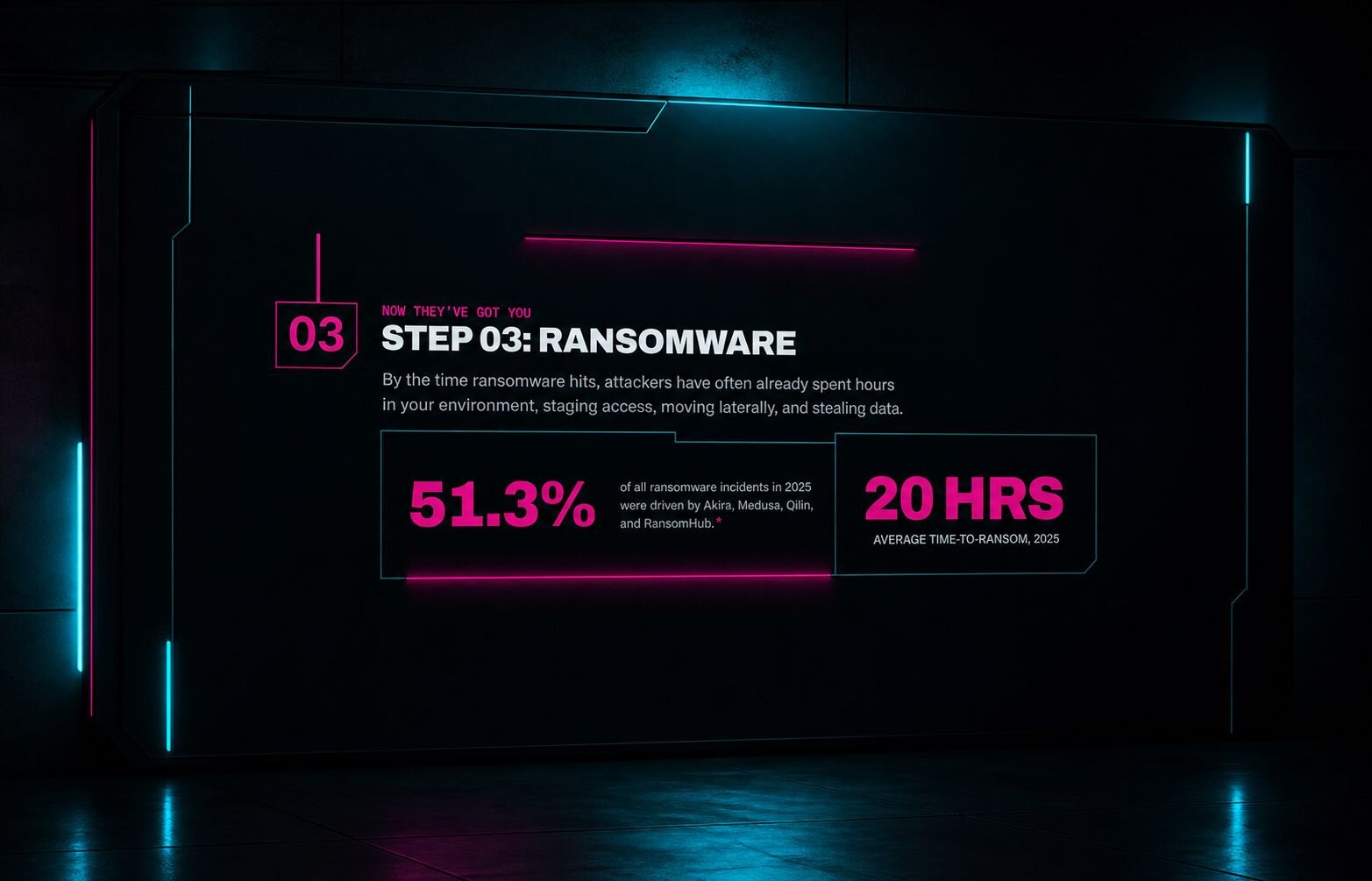
Huntress walks through the ransomware attack chain as a repeatable assembly line: initial access brokers selling footholds (often via infostealers, phishing, or unpatched internet-facing systems), Living-off-the-Land abuse of PowerShell and RMM tools to blend in, and ransomware as the final, visible stage. It cites a real cluster of six ransomware intrusions traced back to the same exposed Citrix NetScaler gateway and session-theft trick culminating in DragonForce ransomware, plus 2026 Cyber Threat Report stats: 37.2% of identity attacks involved suspicious logins, a 277% YoY spike in RMM abuse, ~20 hours average attacker dwell time before detonation, and Akira/Medusa/Qilin/RansomHub driving 51.3% of 2025 ransomware incidents.
huntress.comarticleAdded 3 Sep 2026, published 15 Jul 2026🛡️ Security - 5 Modern Threats You Need to Watch
Huntress details five recurring identity-centered attack patterns seen in its telemetry: credential-based ransomware intrusions that use built-in admin tools for ~20 hours before detonating encryption; Business Email Compromise via inbox rules hiding replies in Conversation History folders; a Qilin ransomware case where attackers impersonated legitimate RMM software, stole browser credentials, and disabled AV; a ClickFix-style social-engineering campaign ("BackgroundFix") that tricks users into pasting a clipboard-hijacked command via a fake "verify you're human" checkbox on a background-remover site; and a shift toward correlation-based SIEM detection that ties together weak brute-force/login signals across VPN, AD, and RDP logs to surface likely intrusions. Each section includes concrete IOC/behavior watchlists for defenders, framing identity (accounts, mailbox rules, device trust, RMM tooling) as the common attack surface.
huntress.comarticleAdded 3 Sep 2026, published 14 Jul 2026🛡️ Security



Showing 30 of 37
Show more