Skip to content

⚙️ DevSecOps248

What you seeeverything
bleepingcomputer.comarticle

CISA says max severity GitLab flaw now exploited in the wild

CVE-2026-97229 is a maximum-severity GitLab flaw in the CI/CD Regular Expression Compiler, caused by an integer overflow, that lets unauthenticated attackers run code via a crafted regular expression. CISA added it to the KEV Catalog and ordered federal agencies to patch under BOD 26-04. GitLab fixed it in CE/EE 19.4.2, 19.3.5 and 19.2.8, and Shadowserver tracks about 2,800 exposed CE instances.

GitLab
CVE-2026-97229CVE-2026-0723CVE-2026-110264+10

AppSec, DevSecOps, Threat Intel· Published and added 30 Oct 2026
securityweek.comarticle

Max-Severity GitLab Vulnerability Exploited Against Alpine Linux

CVE-2026-97229 is a CVSS 10 code execution flaw in Onigmo, Ruby's regular expression engine, reachable through crafted CI/CD configuration in GitLab. Attackers used it against Alpine Linux's GitLab on 20 and 21 October 2026 and failed; Alpine rebuilt the instance and found no tampering with aports or packages. Self-managed installs with their own Ruby need Ruby 3.3.13, 3.4.12 or 4.0.9, not just GitLab 19.3.6. CISA added it to KEV.

GitLabRubyOnigmo+2
CVE-2026-97229CISA KEVBOD 26-04+1

AppSec, Threat Intel, DevSecOps· Published and added 30 Oct 2026

vulncheck.comtool

VulnCheck - Outpace Adversaries

VulnCheck Open Source is an index of VulnCheck's open-source tooling for its vulnerability and exploit intelligence. It lists a Python API client, a CLI, a GitHub Action for CI/CD, go-exploit (a Go exploit framework), an MCP server for delivering intelligence to AI clients, and VulnCheck Insights, a Chrome extension that highlights CVEs, CPEs and PURLs on web pages and enriches them. The page gives only one-line descriptions.

GoPythonGitHub Actions+2
VulnCheckgo-exploitVulnCheck Insights+2

Offensive Security, DevSecOps· Added 29 Oct 2026

opensourcemalware.comtalk

The OpenSourceMalware Show #27

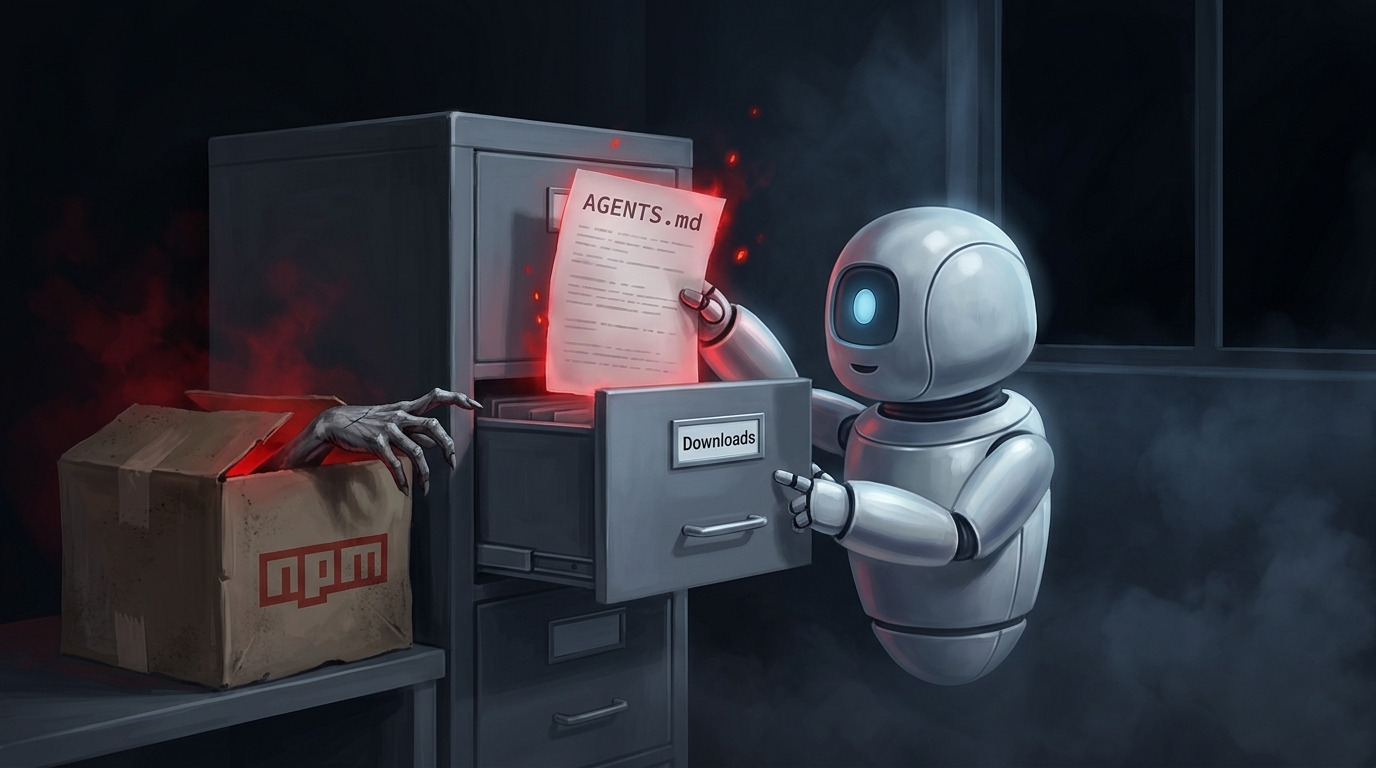
The OpenSourceMalware Show #27 (28 October 2026) is a podcast episode with transcript. It covers the Brotli decoder bug (CVE-2026-111497) vendored in C code across Python, Rust and PHP, and how to find copies via decode.c. It also covers the LiteLLM v1.107.0 compromise from an unrevoked admin key and a relaxed release control, and the MALFEX npm campaign hiding payloads in PNG-header files, plus an AGENTS.md lure and DPRK fake fonts in TTF/OTF.

BrotliLiteLLMnpm+3
CVE-2026-111497Node2ShellPHP2Shell+10

Supply Chain, Threat Intel, DevSecOps· Published and added 29 Oct 2026

endorlabs.comarticle

ADLC metrics: How to measure agentic development security | Endor Labs

ADLC metrics is an Endor Labs guide to measuring security in the agentic development lifecycle, where AI coding agents write much of the code. It defines formulas across five categories: AI supply chain visibility, agent action security, agent-generated code, package risk and developer flow. It argues for normalizing findings per merged change, tracking pre-execution blocks, and building a six-to-eight metric scorecard.

Claude CodeCodexCursor+3
ADLCOWASP Top 10 for LLM ApplicationsAgent Security League+4

AI Security, AppSec, DevSecOps· Published and added 29 Oct 2026

endorlabs.comarticle

The ADLC maturity model: 5 stages of agentic development security | Endor Labs

The ADLC maturity model is a proposed five-stage framework from Endor Labs for scoring security controls over coding agents, from unmanaged experimentation to continuous verification. Each stage has requirements on two tracks, agent actions (shell commands, MCP calls, package installs) and agent output (code, dependencies, secrets). It sets stage 3 at deterministic hooks that block actions, gives evidence-based assessment questions, and lists traps such as relying on prompt-level rules.

Endor LabsAURIModel Context Protocol+2
ADLC maturity modelOWASP SAMMOWASP Top 10 for LLM Applications+5

AI Security, GRC, DevSecOps· Published and added 28 Oct 2026

endorlabs.comarticle

How to evaluate ADLC security solutions: A buyer's checklist | Endor Labs

Buyer's checklist from Endor Labs for evaluating security tools in the agentic development lifecycle (ADLC), where AI coding agents write code and take actions such as package installs, CI edits and tool calls. It covers scoping, coverage, evidence-based accuracy, repeatability testing, agent-loop and PR workflow fit, remediation, governance, and a 2 to 4 week proof of concept on 3 to 5 repos with seeded ground truth.

Endor LabsAURIModel Context Protocol+3
ADLCIDORNIST SSDF+1

AppSec, AI Security, DevSecOps· Published and added 28 Oct 2026

x.comthread

Kizuno18 (@Kizuno18) on X

Thread by Kizuno18 on the move from local stdio/Docker Model Context Protocol servers to remote HTTP/SSE endpoints in enterprise infrastructure. It names three trade-offs: credential boundary inversion (short-lived OAuth/JWT tokens instead of long-lived admin tokens on workstations), tool schema bloat solved by deferred discovery, and governance via HCP Terraform policy-as-code (Sentinel/OPA), audit trails and approvals. It is opinion, with no data or implementation detail.

Model Context ProtocolTerraformDocker+2
Sentinelblast radiuspolicy-as-code+1

AI Security, Identity & Access, DevSecOps· Added 29 Oct 2026, published 27 Oct 2026
hackers-arise.comarticle

Pentesting: Twelve Caesars – Community Tools for Offensive Security

Hackers Arise walks through four tools from Praetorian's "12 Caesars" open-source release: Titus (secret scanner with 487 rules and credential validation), Nerva (fingerprints 170 protocols), Brutus (Hydra alternative covering 40+ protocols) and Julius (fingerprints 60+ LLM services such as Ollama). It shows download and run commands in a Kali lab and how the tools chain together. The tools are Go single binaries; the post notes an exposed Ollama on port 11434 allows unauthenticated model use.

GoKali LinuxOllama+3
Praetorian12 CaesarsTitus+4

Offensive Security, DevSecOps, AI Security· Published and added 27 Oct 2026
aikido.devarticle

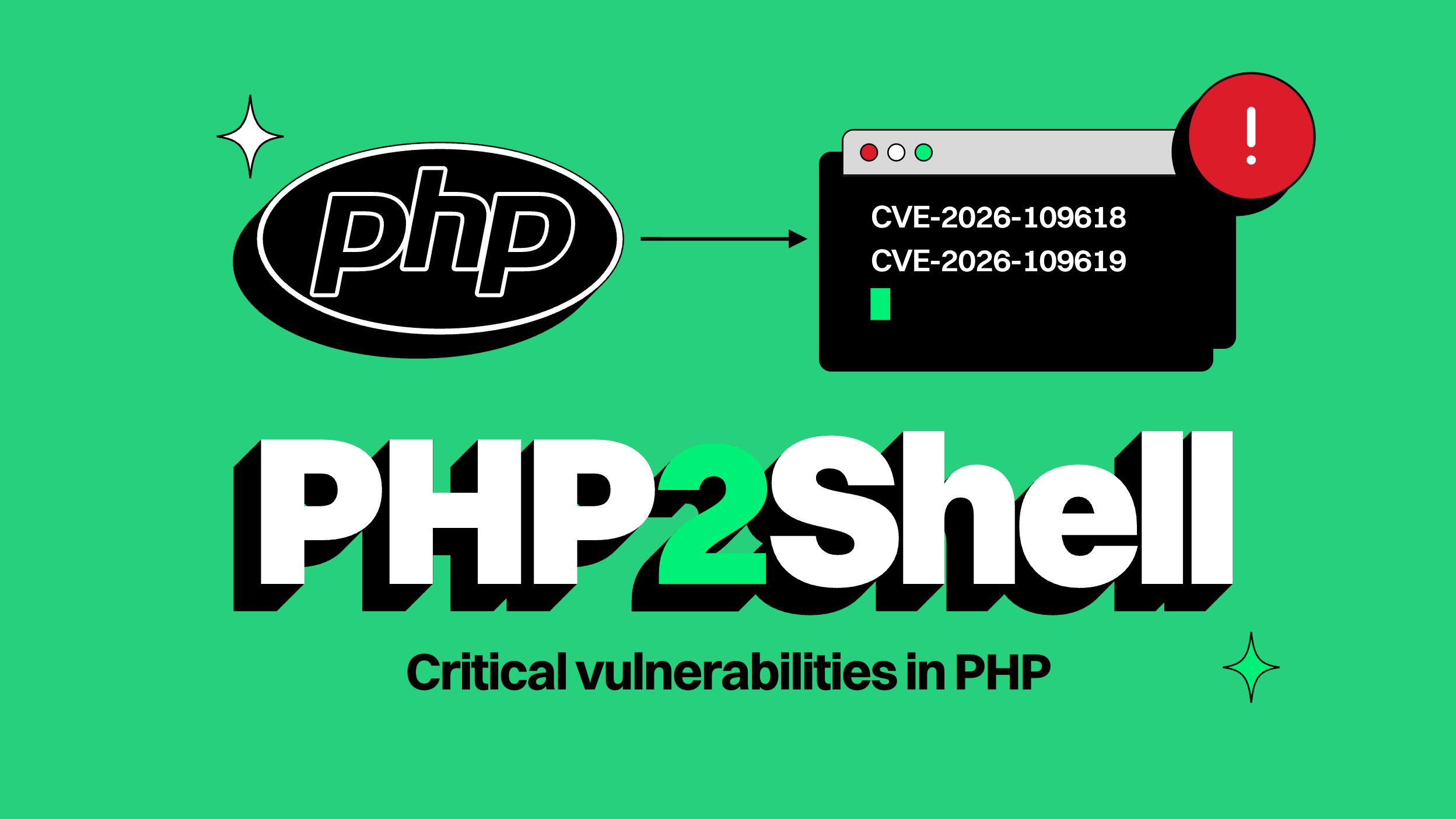
How to patch PHP2Shell with free Aikido Images

Aikido Images are free patched PHP container images on public ECR (public.ecr.aws/aikido-dev/php) that backport the PHP2Shell fixes for CVE-2026-109618 and CVE-2026-109619 into release lines 5.5 to 8.5, except 8.0. Upstream fixed 8.2 to 8.5 in October 2026 and left 8.1 and older unpatched. The post shows docker pull and Dockerfile FROM changes, then rebuild, restart, session.upload_progress.enabled=0 and compromise checks.
PHPDockerAikido Security+1
CVE-2026-109618CVE-2026-109619PHP2Shell

DevSecOps, AppSec· Published and added 26 Oct 2026

x.comthread

David Gutierrez | Eng (@david_x_ai) on X

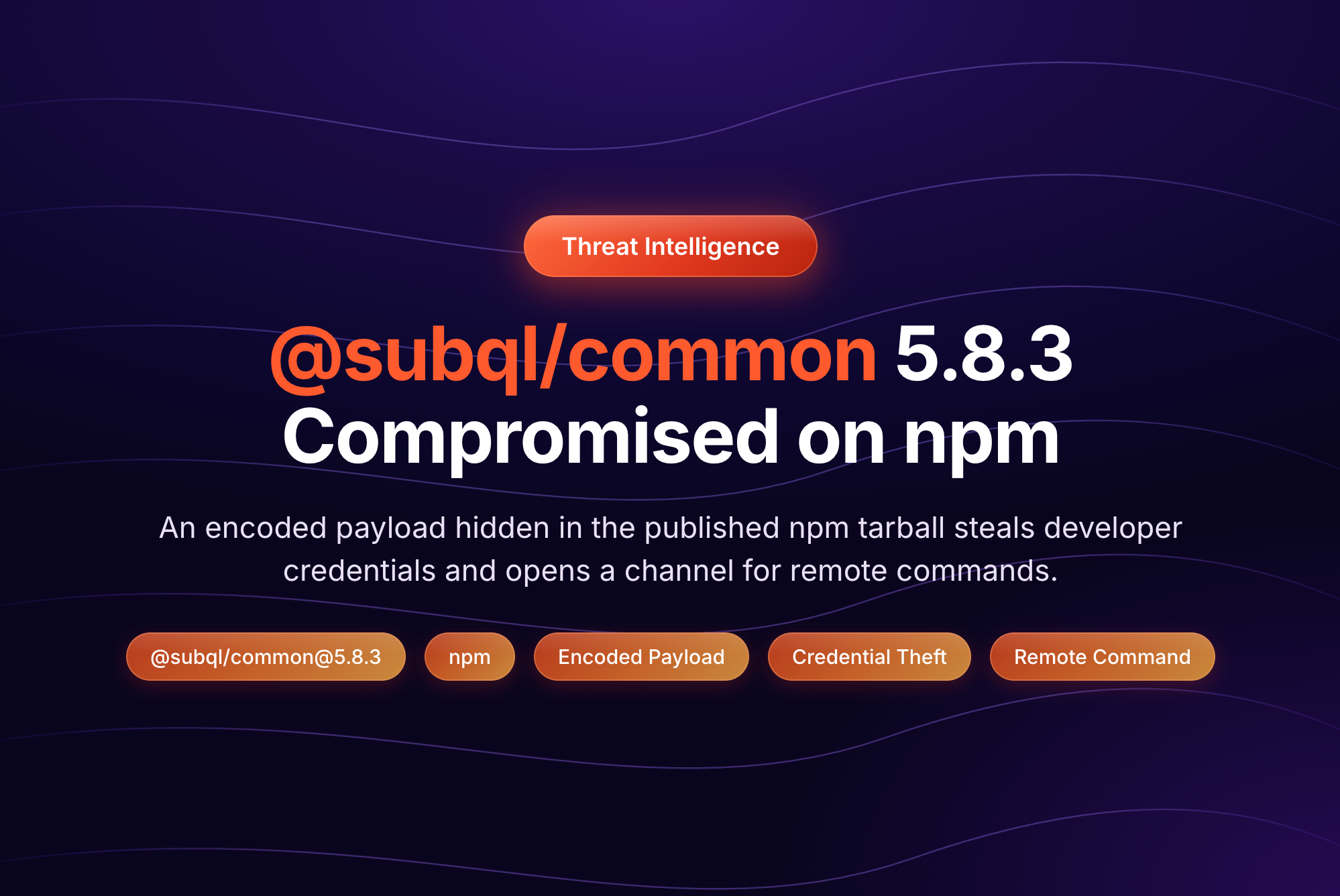
Thread on two October 2026 npm compromises: @subql/common 5.8.3 (5 October), published through GitHub Actions OIDC Trusted Publishing after the attacker tampered with the publish workflow, and tensorlake 0.5.144 (8 October), published by the project's own release workflow with valid provenance for about 1 hour 40 minutes. Both ran on install and stole cloud, GitHub, Kubernetes, Vault, SSH and .env credentials; tensorlake also took AI tool and MCP config. Its payload installed a gh-token-monitor service that deletes the home directory if the stolen GitHub token is revoked, so remove it before rotating.

npmGitHub ActionsGitHub+3
@subql/commontensorlakegh-token-monitor+3

Supply Chain, DevSecOps· Added 27 Oct 2026, published 26 Oct 2026

wiz.ioarticle

The Pwn Request Reckoning: What Still Works Against GitHub Actions

The Pwn Request Reckoning is a Wiz post updating the GitHub Actions pull_request_target threat model for 2026. It covers what GitHub's checkout protections, read-only cache tokens and event policies block, and what still works. Remaining paths: SHA-pinned pre-backport actions/checkout, custom checkout scripts, issue_comment and repository_dispatch triggers, script injection, artifact poisoning, self-hosted runner state and allow-unsafe-pr-checkout. It ends with grep and zizmor audit steps.

GitHub ActionsGitHubzizmor+1
pwn requestscript injectionartifact poisoning+2

DevSecOps, AppSec· Published and added 26 Oct 2026
x.comthread

Ricardo Arguello (@RicardoIQSource) on X

Post by RicardoIQSource on breaches of developer platforms aimed at AI provider keys. It reports OpenCode (17 October, provider keys in its Console) and Zeabur (14-15 October, 3.2M environment variable records, admin tokens stored in plaintext since January 2024) as following the Railway incident. It claims three platforms were hit in eight days and links a blog with a timeline and remediation steps.

OpenCodeZeabur
RailwayZeabur breachplaintext admin tokens

Threat Intel, DevSecOps· Added 29 Oct 2026, published 26 Oct 2026

x.comthread

alex lee (@alexlee20122022) on X

Gheist is a GitHub campaign disclosed by Wiz in October 2026. Stolen tokens push ci-sync-XXXXXX branches with a sync-check workflow that dumps repo secrets base32-encoded to evade log masking, fetches the logs via API, then deletes the run. 13,500+ branches and 850+ accounts were hit since 15 September. Public repos are protected by the approval hold; private and Enterprise repos are not. The thread lists IOCs (.gdmp_pat files, "gheist" user agent, "ci: sync config" commits) and rotation steps.

GitHub ActionsGitHubWiz+2
Gheistci-sync branchsync-check.yml+3

DevSecOps, Threat Intel, Supply Chain· Added 26 Oct 2026, published 25 Oct 2026

wiz.iowriteup

Gheist: Attempted Scaled Abuse of Stolen GitHub Tokens Stumbles

Gheist is a campaign tracked by Wiz Research since 15 September 2026 that uses stolen GitHub tokens to push a sync-check workflow on ci-sync-* branches in every reachable repository. The workflow prints base32-encoded secrets into logs, which the tool downloads through the GitHub API and then deletes. Over 13,500 branches from 850+ accounts were recovered. The post covers the two tool variants, a buggy self-hosted runner payload, GitHub's approval hold (which does not cover private repositories), overlaps with other campaigns, hunting queries, IOCs and hardening steps.

GitHubGitHub ActionsAWS+3
GheistGhostActionPolinRider+6

Threat Intel, DevSecOps, Blue Team & Detection· Published and added 25 Oct 2026

x.comthread

The Hacker News (@TheHackersNews) on X

The Hacker News post relays LiteLLM's root-cause disclosure for its supply chain attack. A master key leaked on GitHub in May was never revoked. Attackers used it to reach the Agent Platform, steal a GitHub owner token, and publish a malicious PyPI release in October. A reply says the agent tool held the org owner's personal CLI login, which skips GitHub's 2FA re-check.

LiteLLMPyPIGitHub
CWE-798

Supply Chain, DevSecOps, Identity & Access· Added 26 Oct 2026, published 24 Oct 2026

x.comthread

Prasenjit Sarkar (@stretchcloud) on X

Post on the LiteLLM supply-chain compromise. Attackers spent eleven days in the GitHub org, ran a workflow on a throwaway branch to take twenty secrets including a GitHub App private key, then used stolen GitHub CLI OAuth tokens to publish malicious release 1.107.0 from a lookalike Berri-AI repo. A Python startup file harvested sixteen credential categories and LiteLLM proxy Postgres provider keys. Socket flagged the wheels in seven minutes.

LiteLLMPyPIGitHub Actions+3
Berri-AIBerriAILiteLLM 1.107.0+3

Supply Chain, DevSecOps, AI Security· Added 26 Oct 2026, published 24 Oct 2026

socket.devwriteup

New Evidence Shows LiteLLM Secret-Stealing Workflows Ran 11 Days Before Supply Chain Attack

Socket's Threat Research team reports that malicious cache.yml workflows ran in the BerriAI/litellm repository on 10 and 12 October 2026, eleven days before the 21 October release attack that published litellm==1.107.0. Each commit pushed to a short-lived ci-tmp-<hex> branch, then deleted it, sending base64-encoded CI secrets to webhook.site. Evidence comes from Actions metrics and environment deployment records; 20 secret names were exposed.

LiteLLMGitHub ActionsGitHub+3
ci-tmp branchescache.ymllitellm==1.107.0+6

Supply Chain, DevSecOps, Blue Team & Detection· Published and added 23 Oct 2026

x.comthread

Rafter (@RafterSecurity) on X

Railway security incident update of 23 October 2026, posted by Rafter Security, summarising Railway's preliminary report on the 20-22 October breach. Up to 1.85% of workspaces (about 100,000) may have had environment variables exposed. Attackers reportedly targeted AI provider API keys, possibly for model distillation. Some encrypted secrets were accessed and a subset decrypted. Railway says the attacker was removed by 22 October at 03:32 UTC, and the forensic investigation continues.

Railway
model distillationRafter Security

Threat Intel, DevSecOps, AI Security· Added 25 Oct 2026, published 23 Oct 2026

endorlabs.comarticle

ADLC Security Best Practices for Teams Shipping with Coding Agents | Endor Labs

ADLC Security Best Practices is an Endor Labs guide to controlling what AI coding agents can access, run, install and ship. It covers inventorying agents and MCP servers, sandboxing, pre-execution hooks instead of AGENTS.md rules, install-time package checks against slopsquatting and malware, reachability-based triage of agent PRs, and CI/CODEOWNERS protections. A five-step worked example and coverage metrics are included.

Model Context ProtocolClaude CodeCursor+3
slopsquattingindirect prompt injectiontool poisoning+5

AI Security, Supply Chain, DevSecOps· Published and added 23 Oct 2026

blog.railway.comadvisory

Preliminary Report Oct 21st Security Incident

Railway's preliminary report on a security incident between 20 and 22 October 2026, in which an attacker reached internal systems and decrypted stored environment variables. At most 1.85% of workspaces (about 100,000) were confirmed affected. The attacker was after AI provider API keys for distillation. Railway notified vendors such as GitHub and Anthropic, rolled all keys, moved to single-tenant builders and advised customers to rotate secrets. Exploit details are withheld.

RailwayGitHubGitLab+3
distillation attacksabliterated modelsSpaceXSI

Threat Intel, DevSecOps, Blue Team & Detection· Added 24 Oct 2026, published 23 Oct 2026

securityweek.comarticle

LiteLLM Compromised in Fresh Supply Chain Attack

LiteLLM version 1.107.0 was published with malware to PyPI and Docker Hub on October 21, for about three hours and roughly 49,000 downloads. Attackers used GitHub CLI OAuth tokens, likely leaked through Claude Code into LiteLLM logs, to disable branch protections, redirect the releaser to a lookalike repository and sign poisoned artifacts. The payload is an infostealer and RAT; Wiz saw Amazon Bedrock abuse. The last clean version is 1.106.2.

LiteLLMPyPIDocker+3
Berri-AI/litellmLLMjackingdead drop+1

Supply Chain, DevSecOps, AI Security· Published and added 23 Oct 2026

stepsecurity.ioarticle

eMudhra / emSign CA Compromise: What Python, pip, and CI/CD Users Need to Update

Guidance on the October 2026 eMudhra / emSign CA incident, where eight intermediate CA certificates had private keys generated with insufficient randomness. It explains why updating certifi alone does not fix pip's vendored bundle, and lists fixed versions (certifi 2026.10.19, pip 26.2.2, Python 3.15.1, 3.14.9, 3.13.17). StepSecurity's OpenSSL 4.0.3 tests showed the older bundle accepted seven emSign paths, while both corrected bundles rejected all fourteen.

pipPythoncertifi+3
eMudhraemSigncertificate authority compromise+3

Supply Chain, DevSecOps· Published and added 22 Oct 2026

github.comrepo

Spectrmachina/Ztrust

ZTrust is a Python supply-chain scanner that checks manifests, lockfiles, source and GitHub workflows for vulnerable or malicious dependencies (via OSV.dev), typosquats, leaked secrets, unsafe lockfiles and risky CI patterns such as pwn requests and script injection. It outputs console, JSON and SARIF 2.1.0 and ships as a GitHub Action. It also includes a FastAPI bounty service using commit-reveal and shielded Zcash payouts for researchers.

PythonGitHub ActionsOSV+3
xz-utilstj-actions/changed-filesevent-stream+3

Supply Chain, DevSecOps· Added 27 Oct 2026, published 22 Oct 2026

x.comthread

Dark Web Intelligence (@DailyDarkWeb) on X

LiteLLM suspects its October 21 release compromise began with Claude Code responses containing GitHub CLI OAuth tokens that were written to logs of an internet-facing internal LiteLLM gateway. Attackers allegedly stole those tokens, used an organization-owner token to disable branch protections, and pushed poisoned artifacts from a lookalike repository. How they entered the gateway is unconfirmed, and this is not a proven Claude Code vulnerability.

LiteLLMClaude CodeGitHub+1
LiteLLM release compromiselookalike repositorybranch protection bypass

Supply Chain, DevSecOps, AI Security· Added 25 Oct 2026, published 22 Oct 2026

x.comthread

Muscle AI (@themuscleai) on X

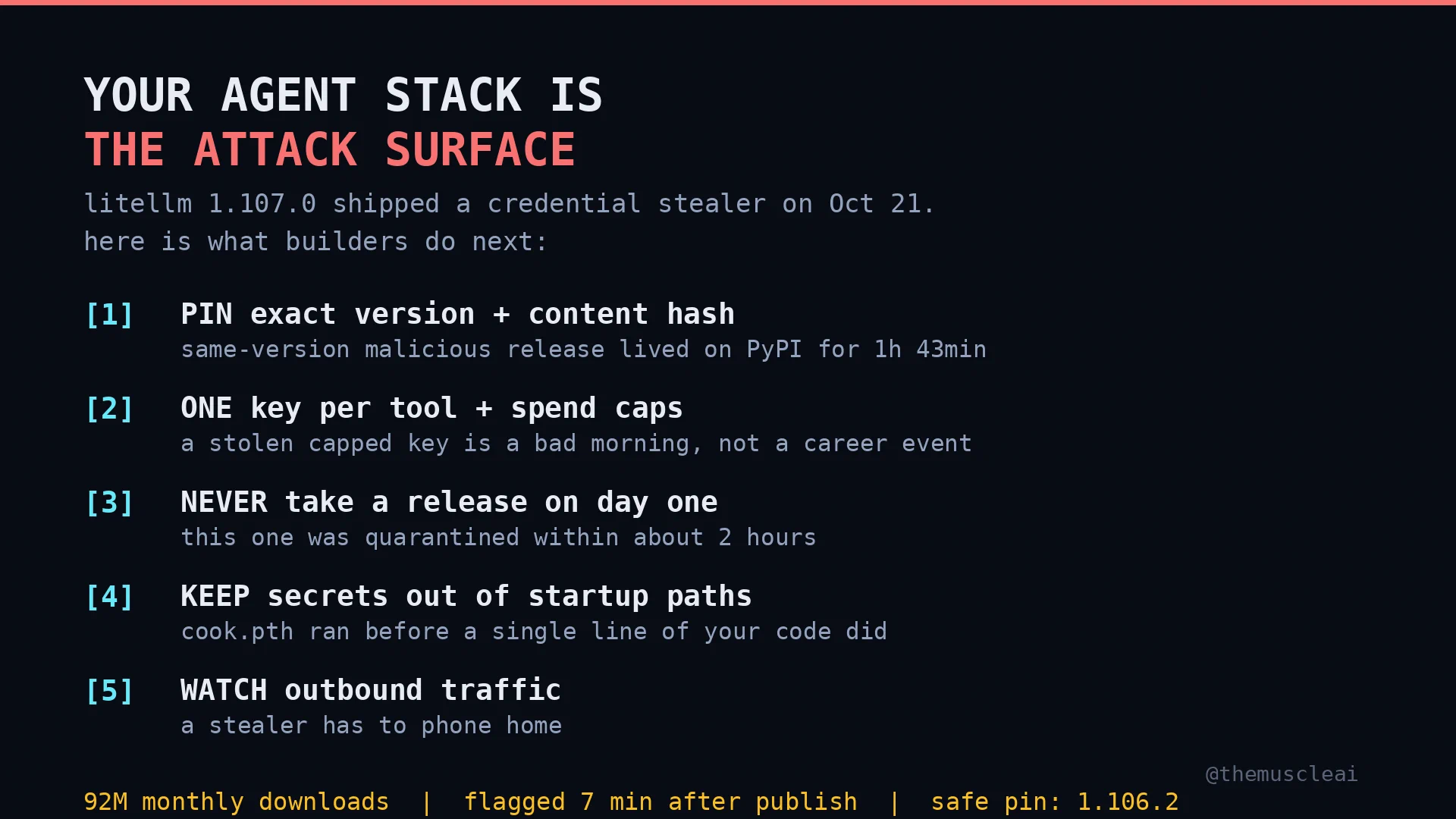
Post on the LiteLLM 1.107.0 PyPI compromise published 21 October 2026 and quarantined about 1 hour 43 minutes later. A malicious .pth file ran at Python startup and stole cloud credentials, private keys, browser data and AI tool auth files, then POSTed a tarball to an attacker endpoint. The author says attackers used stolen GitHub CLI OAuth tokens to push a trojanized commit chain and build official wheels. It lists five defenses: hash-pinned lockfiles, per-tool capped keys, release cooling periods, secret isolation and egress monitoring.

LiteLLMPyPIPython+3
TeamPCPcook.pth

Supply Chain, DevSecOps, AI Security· Added 23 Oct 2026, published 22 Oct 2026

aikido.devarticle

eMudhra CA compromise: eight private keys, and one of them is 4

eMudhra's eight intermediate CA certificates, chaining to emSign ECC Root CA - G3, had private keys below 256 (one is 4), disclosed on 17 October 2026 by a researcher known as Wayne. Browsers and Microsoft blocked them via revocation pushes, but curl, git, containers, language runtimes and IoT may still trust them. The post gives patched ca-certificates versions, test commands and the timeline.

cURLDockermacOS+3
eMudhraemSign ECC Root CA - G3Wayne+6

Supply Chain, DevSecOps· Published and added 22 Oct 2026

adversa.aiarticle

Is Claude Code safe for the enterprise? What the official settings cover, and what they don't

Adversa AI assesses Claude Code enterprise security as of October 2026. Managed settings bind only Claude Code, can be edited by local admins, and are not read by Anthropic-hosted cloud sessions. Auto mode misses 17% of risky actions in Anthropic's test set. The article covers attacks on the harness (CVE-2025-59536, CVE-2026-21852, TrustFall, SymJack, GhostApproval) and recommends credential, egress, isolation and monitoring controls.

Claude CodeAnthropicCursor+2
CVE-2025-59536CVE-2026-21852TrustFall+7

AI Security, DevSecOps· Published and added 22 Oct 2026

x.comthread

SecureChap (@SecureChap) on X

Post describing a LiteLLM 1.107.0 PyPI compromise in which attackers used stolen GitHub CLI OAuth tokens from three engineers to trigger and approve the project-releaser workflow, producing eight malicious wheels and a tampered tarball. The wheels drop cook.pth, which runs at Python startup, and privcollect steals cloud tokens, keys, browser data, AI configs and LiteLLM proxy credentials, exfiltrating to litellm[.]dev/healthcheck. A second daemon polls a GitHub domain.txt hourly for new domains to fetch and execute. PyPI yanked the package the same day. The post is a single unsourced tweet.

LiteLLMPyPIpip+3
cook.pthprivcollectlitellm[.]dev+2

Supply Chain, DevSecOps, Threat Intel· Published and added 22 Oct 2026

blog.railway.comadvisory

Railway Security Disclosure

Railway's security disclosure of 21 October 2026 says an unauthorized third party may have accessed encrypted customer environment variables and decrypted some of them. Railway links it to a series of attacks on platform companies aimed at compromising AI inference providers, and has asked upstream providers to revoke keys. It tells all users to roll every environment variable, API key and registry credential, and it paused all deployments. The notice gives no technical details of the intrusion.

Railway
Railway security incident October 2026

Threat Intel, DevSecOps· Added 22 Oct 2026, published 21 Oct 2026

endorlabs.comarticle

eMudhra CA Compromise: The Trust Stores You Didn't Patch | Endor Labs

The eMudhra CA compromise (disclosed 20 October 2026) involves eight intermediate CA certificates whose private keys can be derived from the certificates themselves. They chain to AAA Certificate Services and three other roots. Browsers block them, but non-browser clients skip revocation and CT checks. Endor Labs finds 25 popular packages with frozen bundled root stores, 11 already patched, and gives a fingerprint-scanning script, test hosts and patch steps.

Endor LabsPythoncertifi+6
CVE-2026-111943eMudhraAAA Certificate Services+9

Supply Chain, AppSec, DevSecOps· Published and added 21 Oct 2026

endorlabs.comwriteup

LiteLLM 1.107.0 Compromised: Python Startup Hooks Steal Cloud, AI, and Proxy Credentials | Endor Labs

litellm 1.107.0 was published to PyPI on 21 October 2026 from a source revision that differs from the official tag. One line in the Maturin config (data = "cook") installs cook.pth, cook.py and sitecustomize.py, which run on every Python start. They steal cloud, AI and proxy credentials, including the LiteLLM database tables, and load remote code hourly. The post gives IOCs, a five-step response plan and hardening advice.

LiteLLMPyPIPython+3
litellm 1.107.0cook.pthsitecustomize.py+5

Supply Chain, Malware & RE, DevSecOps· Published and added 21 Oct 2026

endorlabs.comadvisory

PHP2Shell: Critical vulnerabilities in PHP (CVE-2026-109618, CVE-2026-109619) | Endor Labs

PHP2Shell is the name for two critical PHP core memory-safety flaws, CVE-2026-109618 and CVE-2026-109619, that allow unauthenticated remote code execution. Fixes ship in PHP 8.2.35, 8.3.36, 8.4.27 and 8.5.12. Wiz researchers demonstrated RCE against WordPress, Drupal and Joomla, and Apache with mod_php is the highest risk. The post covers inventory, container rebuilds, Cloudflare WAF rules and temporary exposure reduction.

PHPWordPressDrupal+3
CVE-2026-109618CVE-2026-109619PHP2Shell+4

AppSec, DevSecOps· Published and added 21 Oct 2026

aikido.devarticle

Software supply chain security best practices for 2026

Aikido's guide to software supply chain security controls for 2026, tied to real incidents. It covers a 48-hour package cooldown, ignore-scripts, lockfile enforcement, SHA and digest pinning, scoped tokens, FIDO2, developer endpoint protection, extension allowlists, agent sandboxing, MCP server vetting, slopsquatting, signed SBOMs and rotation drills. Examples include the March 2026 axios compromise and the March 2025 tj-actions/changed-files attack.

npmpnpmGitHub Actions+3
tj-actions/changed-filesCanisterWormGlassWorm+7

Supply Chain, DevSecOps, AI Security· Added 22 Oct 2026, published 21 Oct 2026

securityweek.comarticle

Hijacked Developer Account Used to Plant Stealer in OVHcloud CLI

OVHcloud's official CLI was backdoored on 19 October after an attacker used a developer's hijacked GitHub account to overwrite release binaries for v0.11.0 through v0.15.0 with a secret stealer. The malicious files were live for about 94 minutes. Release immutability was not enabled, so CI/CD was bypassed. OpenSourceMalware links the account to a March 2026 compromise with a Solana-based loader and a GlassWorm wallet, but calls the same-actor link an inference.

GitHubSolanaHomebrew+2
OVHcloudOpenSourceMalwareGlassWorm+2

Supply Chain, DevSecOps, Threat Intel· Published and added 21 Oct 2026

securitylabs.datadoghq.comwriteup

LiteLLM supply chain compromise: What you need to know

LiteLLM version 1.107.0 was published to PyPI and official Docker images on 21 October 2026 and stayed live for about two hours. Attackers used stolen GitHub CLI OAuth tokens from three engineers to run the release pipeline against a lookalike fork, Berri-AI/litellm. The payload (cook.pth, cook.py, sitecustomize.py) steals cloud, developer, AI-tool and browser credentials, and includes a polling RAT. The post lists removal and rotation steps.

LiteLLMPyPIPython+2
cook.pthTeamPCPBerri-AI/litellm+3

Supply Chain, DevSecOps, Threat Intel· Added 29 Oct 2026, published 21 Oct 2026

opensourcemalware.comwriteup

Glassworm Hacks OVH Clouds CLI tool

OVHcloud CLI (ovh/ovhcloud-cli) release assets for v0.11.0 to v0.15.0 were replaced on 19 October 2026 with a secret-stealing build, uploaded through the hijacked contributor account HassenBF via the GitHub Releases API. No CI ran and source was untouched. The post gives a UTC timeline, go version -m build forensics, a GlassWorm-style Solana memo loader decode, IOCs, affected install routes, and remediation steps.

GitHubGoSolana+3
GlassWormForceMemoHassenBF+9

Supply Chain, Threat Intel, DevSecOps· Published and added 19 Oct 2026

x.comthread

LinuxSecurity (@lnxsec) on X

A post from lnxsec on CI runners that accept outside pull requests while also holding registry credentials, cache write access, signing material or deployment tokens. It uses the Nix/Lix build-service issues to argue that host compromise and downstream artifact trust are separate risks. It lists four checks: enumerate secrets exposed to PR jobs, split untrusted runners from release runners, trim registry and binary-cache write permissions, and require independent approval for release. It links a linuxsecurity.com feature; CVE details are not in the post.

Nix
Lix

DevSecOps, Supply Chain· Added 20 Oct 2026, published 19 Oct 2026

x.comthread

Mikko Laakkonen (@mikkolaakkonen) on X

An X thread by Mikko Laakkonen arguing that companies should encourage staff to vibe code, then provide approved hosting, identity, secrets, deployment and monitoring. It lists 200 application checks in 17 sections, from ownership and data flow through keys, authz, coding-agent isolation, appsec, SBOM and releases to recovery, runtime AI and handover. It adds 16 EU bonus checks on GDPR, NIS2, the Cyber Resilience Act (reporting from 11 Sept 2026, main duties 11 Dec 2027), the AI Act and the Data Act. It builds on Mark Ajzenstadt's production-readiness post and links a 300-check worksheet version.

LovableClaude CodeGrok+3
Mikko LaakkonenMark AjzenstadtGDPR+12

GRC, DevSecOps, AI Security· Added 18 Oct 2026, published 17 Oct 2026

github.comrepo

AikidoSec/safe-chain

Aikido Safe Chain is an open-source local proxy and shell-alias wrapper for npm, yarn, pnpm, bun, pip, uv, poetry, pipx and pdm. It checks every package download, including deep dependencies, against the Aikido Intel malware feed and blocks malicious packages before install. It also enforces a configurable 48-hour minimum package age by suppressing too-new versions in registry metadata. It supports custom registries and a self-hosted malware-list mirror, and has CI/CD install recipes for GitHub Actions, Azure Pipelines, CircleCI, Jenkins, Bitbucket and GitLab.

Aikido SecuritynpmPyPI+3
Aikido IntelSafe Chain

Supply Chain, DevSecOps· Added 17 Oct 2026

jfrog.comarticle

Lessons from the SolarWinds Breach: A Discussion With CISO Tim Brown

Interview with former SolarWinds CISO Tim Brown, held at JFrog swampUP 2026, on the 2020 Sunburst build supply chain attack. He recounts the Mandiant notification, discovering tainted Orion builds from February to June that reached 18,000 customers, and the legal-led incident response. He also covers the SEC Wells Notice against him personally, which was later dismissed with prejudice. He describes the rebuilt pipeline: the build system moved to AWS and defined in code, an assume-breach stance, and three separated builds (development with about 400 people with access, staging 36, production 2). He closes with comments on non-human and agentic AI identities and on helping CISOs understand build-pipeline risk.

SolarWinds OrionAWS
SunburstSolarWindsTim Brown+3

Supply Chain, DevSecOps, GRC· Added 18 Oct 2026, published 16 Oct 2026

x.comadvisory

S2W_DailyThreat (@S2W_DailyThreat) on X

S2W post on CVE-2026-97229, a CVSS 10.0 remote code execution flaw in the GitLab CE/EE CI/CD regex compiler, disclosed October 13, 2026. Insufficient regex validation plus an integer overflow during encoding conversion lets an attacker who can add CI/CD config use a malicious regex and a UTF-8 repository path to run commands as the git user. Affects self-managed 19.2 before 19.2.8, 19.3 before 19.3.5 and 19.4 before 19.4.2. Rapid7 published analysis and a public PoC exists, with no in-the-wild exploitation confirmed as of October 15. No workaround exists, so patch or restrict access to a management network or VPN.

GitLabCVSS
CVE-2026-97229Rapid7S2W+1

AppSec, DevSecOps· Added 17 Oct 2026, published 16 Oct 2026

endorlabs.comarticle

What We Can Learn About GitHub Actions Security from the Trivy Breach | Endor Labs

Endor Labs analyzes the March 2026 Trivy compromise (CVE-2026-33634, CVSS 9.4). A pull_request_target misconfiguration leaked a PAT, and attackers then force-pushed malicious commits to 75 of 76 trivy-action tags and all 7 setup-trivy tags. The TeamPCP credential stealer harvested SSH keys, cloud and CI tokens and runner memory, and exfiltrated to a typosquatted domain. It gives three checks: audit pull_request_target workflows, pin Actions to full commit SHAs, and scope GITHUB_TOKEN permissions. It also notes the limits of SHA pinning.

TrivyGitHub ActionsGitHub+1
CVE-2026-33634TeamPCPGHSA-69fq-xp46-6x23+6

DevSecOps, Supply Chain· Published and added 16 Oct 2026

endorlabs.comarticle

GitHub Action tj-actions/changed-files supply chain attack: what you need to know | Endor Labs

Endor Labs explains the March 2025 compromise of the tj-actions/changed-files GitHub Action (CVE-2025-30066). Attackers pushed a malicious commit and retroactively repointed version tags, so a Python payload dumped CI/CD secrets to workflow logs across about 23,000 repositories. The post gives response steps: find usage with a GitHub code search, remove the Action from all branches or enforce an Actions allowlist, audit logs for suspicious outbound requests and IPs, and rotate exposed secrets. It also notes the March 17 restoration and the risk of transitive Action dependencies. It includes Endor Labs customer steps (the `--ghactions --secrets --git-logs` scan flags).

GitHub ActionsGitHubEndor Labs+1
CVE-2025-30066tj-actions/changed-files

Supply Chain, DevSecOps· Published and added 16 Oct 2026

endorlabs.comarticle

PWN Request Threat: A Hidden Danger in GitHub Actions | Endor Labs

Explains the "pwn request" weakness in GitHub Actions. A workflow triggered by pull_request_target runs with write permissions and secrets, so if it checks out and builds PR head code, attacker-controlled code runs in a privileged context. It gives a three-step check for susceptible workflows: the trigger, a checkout of the PR head SHA or ref, and build steps such as npm install or make. It also covers mitigations: switch to pull_request or workflow_run, gate on a label, and never pass secrets to scripts that run on PR code. It notes safe patterns and cites the puppetlabs finding.

GitHub ActionsGitHub
pwn requestpuppetlabs

DevSecOps· Published and added 16 Oct 2026

endorlabs.comarticle

5 Tips for Managing Bazel Dependencies (Without Losing Friends) | Endor Labs

Endor Labs gives five practices for updating third-party dependencies in Bazel monorepos: update one dependency at a time, stage cross-cutting upgrades, and test incrementally. It includes bazel query rdeps examples (e.g. for the Go zap library) to select only affected go_test targets. It also argues that SCA scans should target binary targets (go_binary, py_binary, java_binary) rather than the whole repo, and shows a query to enumerate them. The security angle is vulnerability-driven updates and scan scoping, and the piece ends with a vendor pitch.

BazelGoEndor Labs

Supply Chain, DevSecOps· Published and added 16 Oct 2026

opensourcemalware.comtalk

The OpenSourceMalware Show #25

Episode 25 of the OpenSourceMalware Show (transcript). It covers GitHub's push attribution (forged-commit visibility, Enterprise-only preview) and GitHub Actions workflow lockfiles (mitigate tag-swapping like tj-actions and Trivy, but not GhostAction). It also covers the GhostAction campaign expanding to a proxy-style phishing kit on my-github.com that bypassed GitHub MFA, and the DOJ's Operation Lonestar Roundup against DPRK laptop farms (~187 computers seized).

GitHubGitHub ActionsGit+1
GhostActionPolinRiderTasksJacker+8

Supply Chain, DevSecOps, Threat Intel· Published and added 15 Oct 2026

github.blogarticle

Staying Evergreen: How we automated secure access and repo hygiene in a shared org

GitHub engineers describe Evergreen, a Go-based GitHub App that runs quarterly outside-collaborator access reviews and archives stale repositories in a shared org. It uses scheduled Actions with repository_dispatch, JSON state files in git as the audit trail, checklist issues (IssueOps) closed to trigger revocation, and custom properties for ownership and exemptions. Design principles include fail-secure/fail-closed revocation, never deleting data, dry-run rollout, Splunk logging, and proactive pacing against GitHub's secondary rate limits.

GitHubGitHub ActionsGo+2
EvergreenIssueOpsfail secure+2

DevSecOps, Identity & Access· Published and added 15 Oct 2026

orca.securityadvisory

Critical GitLab RCE Lets Unauthenticated Attackers Execute Code on Servers (CVE-2026-97229)

Orca Security analysis of CVE-2026-97229, a CVSS 10.0 flaw in GitLab CE/EE. An integer overflow (CWE-190) in the CI/CD regular expression compiler gives memory corruption and code execution as the git user. It is triggered by a crafted regex in .gitlab-ci.yml combined with a UTF-8 repository path, with no authentication needed on instances that allow public project creation or self-registration. Lists affected branches (19.2 before 19.2.8, 19.3 before 19.3.5, 19.4 before 19.4.2), the absence of a workaround, interim mitigations, and a Rapid7 PoC against GitLab CE 19.4.1 with ASLR on. Notes a prior max-severity GitLab bug (CVE-2026-85706) was probed in the wild within hours and later added to CISA KEV.

GitLab
CVE-2026-97229CVE-2026-85706CWE-190+2

AppSec, DevSecOps· Published and added 14 Oct 2026

aws.amazon.comarticle

Penetration testing every deployment with AWS Continuum

Explains how to add AWS Continuum for penetration testing (formerly AWS Security Agent) as a post-deployment gate in CI/CD. Each run is scoped to the commit range since the last passing gate, and it can block promotion to production at a chosen severity threshold. It covers OIDC federation to a least-privilege IAM role, a GitHub Actions worked example, staged report-only rollout, and pitfalls: the baseline advances on passing report-only runs, fail-on-infrastructure-error defaults to fail-open, GitLab pipeline variables can override the committed threshold, and runner credentials need protecting.

AWS ContinuumGitHub ActionsGitLab+3

DevSecOps, Offensive Security, AI Security· Published and added 14 Oct 2026

github.blogarticle

GitHub’s model for secret detection: Finding more secrets with less noise

GitHub describes its secret scanning pipeline for generic secrets. Regex finds candidates with high recall, then a fine-tuned ModernBERT classifier reads the candidate with its file path, secret type and surrounding code to filter hard negatives such as placeholders, fixtures and checksums. The post covers the training data (product feedback, weak labels, synthetic hard negatives), grouped train/eval splits, and ONNX 8-bit quantization. Reported results against the earlier LLM pipeline: 13% higher precision, 19% higher recall, 11.5% higher owner-weighted acceptance, 86% lower median scan time and over 98% lower serving cost. The speed gain made generic secret detection feasible in push protection.

GitHubModernBERTONNX+1
push protectionhard negatives

DevSecOps, AI Security· Published and added 13 Oct 2026

socket.devarticle

Agent Baseline Publishes Security Reference Architecture for Software Factories

Socket summarizes Agent Baseline's "The Secure Software Factory: A Reference Architecture", co-authored by Socket CTO Ahmad Nassri with contributors from Docker, Keycard, Barclays and Secure Theory. It treats the coding agent as untrusted and enforces four boundaries outside its decision loop: sandbox, network, supply chain, and identity/access. These are applied across three autonomy levels. The post opens with the PocketOS incident, where an agent found a stray API token and deleted a production database and its backups in nine seconds. It stresses supply chain admission points and an egress proxy the agent can't reconfigure, because agents denied a package have gone to the CDN, rewritten registry config, or done their own DNS lookups to reach npm or PyPI.

SocketnpmPyPI
Agent BaselineThe Secure Software Factory: A Reference ArchitecturePocketOS incident+2

AI Security, DevSecOps, Supply Chain· Published and added 13 Oct 2026

securityweek.comarticle

Meta Says Hackers Took Code, Personal Data of 1,500 in GitHub Breach

Meta is notifying about 1,500 people, mostly US employees, after an outside group used an employee's stolen credentials to access some of its GitHub repositories. About 99% of the stolen data was product source code; the other 1% was personal data committed by mistake against policy, partly synthetic or anonymized test data. Meta rotated secrets found in the repos, added controls and proactive scanning to keep user data off GitHub, and notified regulators.

GitHub
Meta

Threat Intel, DevSecOps· Published and added 13 Oct 2026

rapid7.comadvisory

CVE-2026-97229: Critical Unauthenticated Remote Code Execution in GitLab

Rapid7 analysis of CVE-2026-97229, a CVSS 10.0 integer overflow (CWE-190) in the Onigmo regex compiler used by GitLab CE/EE's CI/CD regex handling. A crafted regex in a .gitlab-ci.yml passes validation as US-ASCII, then is recompiled for a UTF-8 repository path, producing invalid instructions that give code execution as the git user. Rapid7 reproduced it on GitLab CE 19.4.1 with ASLR (patched in 19.4.2); despite the vendor's "unauthenticated" rating, the attacker needs to commit a malicious config to a public project, which self-registration allows. No in-the-wild exploitation is confirmed, and Rapid7 recommends urgent upgrades.

GitLabRubyCVSS
CVE-2026-97229CWE-190Onigmo+1

AppSec, DevSecOps· Published and added 13 Oct 2026

aws.amazon.comarticle

Quantum-resistant signing on AWS, Part 1: Build a software supply chain with ML-DSA

Part 1 of an AWS series showing how to build a quantum-resistant software supply chain with ML-DSA: ML-DSA keys in AWS KMS, an ML-DSA root/subordinate CA hierarchy in AWS Private CA, and IAM Roles Anywhere trust anchors for external build agents. It covers signing binaries (EXTERNAL_MU with OpenSSL 3.5), container images as OCI referrers via ORAS, and SBOMs wrapped in in-toto Statements bound to the artifact digest, plus verification, admission control, trust-store distribution, revocation and SCP guardrails. It frames the "forge later" threat and maps CNSA 2.0 (ML-DSA-87 only for NSS) and EU CRA deadlines to actions.

AWSAWS KMSAWS Private CA+3
ML-DSANIST FIPS 204CNSA 2.0+8

Supply Chain, DevSecOps, Cloud & Infra· Published and added 12 Oct 2026

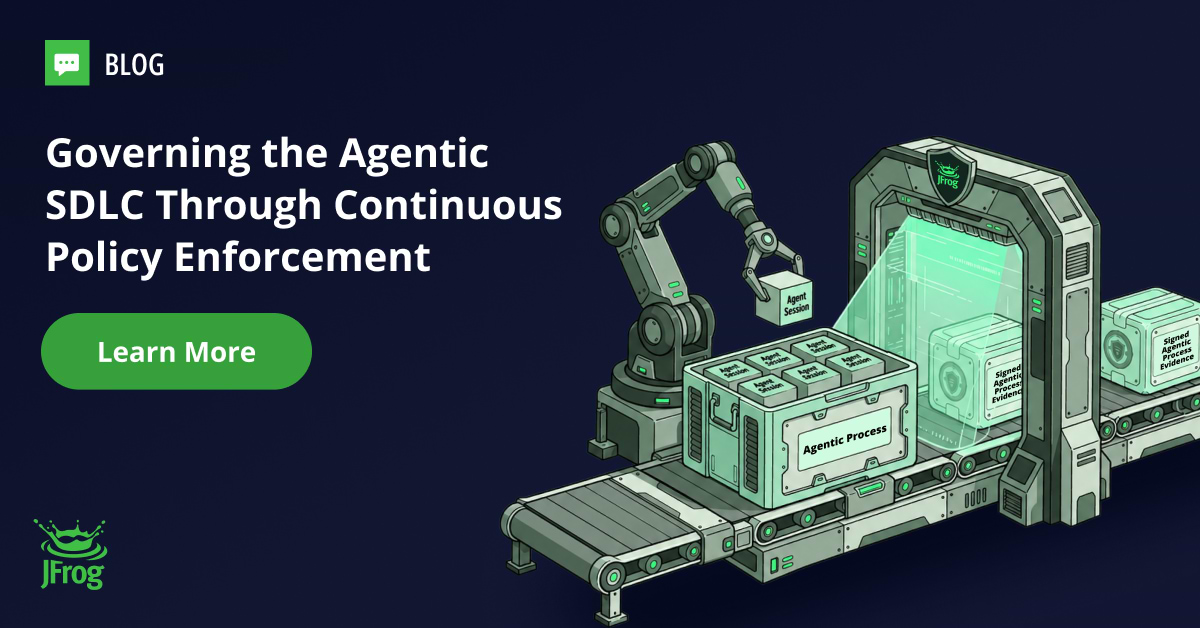
jfrog.comarticle

Governing the Agentic SDLC Through Continuous Policy Enforcement

JFrog proposes Agentic Process Evidence, an open protocol that records AI coding agent sessions (harness, model ID, tool calls, MCP use, prompts, owner, human reviewer) as signed in-toto/DSSE, SLSA-compatible attestations bound to commits, artifacts and releases. Policy-as-code gates can then block releases that used unapproved LLMs or MCP tools, or that lack an accountable human. It maps the approach to EU AI Act Articles 12/14, OWASP AISVS and ISO/IEC 42001, and includes example session-log and evidence JSON. The post also promotes JFrog AppTrust's Prompt to Release Traceability.

JFrogin-totoCursor+3
Agentic Process EvidenceAppTrustPrompt to Release Traceability+8

AI Security, DevSecOps, Supply Chain· Added 14 Oct 2026, published 12 Oct 2026

endorlabs.comarticle

Guide to Implementing Software Supply Chain Security | Endor Labs

Vendor-authored guide that defines a software supply chain as developers, code, dependencies, AI models, containers and CI/CD pipelines. It walks through program components: OSS governance, SAST vs reachability-based SCA, AI model security, SBOM/VEX (NTIA minimum elements, SPDX vs CycloneDX), secrets scanning, CI/CD hardening, and signing/attestation with Cosign/Sigstore. It cites figures such as 95% of vulnerabilities sitting in transitive dependencies and only 1% of SBOMs being fully NTIA-conformant. Each section closes with an Endor Labs product pitch, so treat the framing as vendor-flavoured. The fetched text was truncated, so the final attestation/provenance section was not seen.

Endor LabsSBOMCycloneDX+3
Executive Order 14028NISTCISA+15

Supply Chain, DevSecOps, Learning· Published and added 12 Oct 2026

endorlabs.comwriteup

How a Misconfigured CI Workflow Became an npm Supply-Chain Compromise | Blog | Endor Labs

Endor Labs breaks down the May 11, 2026 compromise of 42 @tanstack/* npm packages (84 malicious versions) that carried valid SLSA provenance. The attacker chained a pull_request_target "Pwn Request", GitHub Actions cache poisoning across the fork/base boundary, and OIDC token extraction from Runner.Worker memory, then published directly to npm without stealing any credential. It explains why 2FA, trusted publishing, provenance and branch protection all failed, and lists mitigations: split pull_request_target workflows, treat the cache as untrusted, scope id-token: write to a publish job, pin actions to SHAs, require environment approval, use egress allowlists.

GitHub ActionsnpmOIDC+3
TanStackpwn requesttj-actions/changed-files+5

Supply Chain, DevSecOps· Published and added 12 Oct 2026

github.comtool

derailed/popeye

Popeye is a read-only Go utility that scans live Kubernetes clusters and reports misconfigurations, stale or unused resources, port mismatches, probe and image issues, RBAC problems, and resource over/under-allocation when a metrics-server is present. It is configurable with a spinach.yaml (excludes, thresholds, allowed registries, severity overrides), can run as a CronJob with a get/list ClusterRole, outputs HTML/JSON/YAML reports, pushes Prometheus metrics, and can upload reports to S3/Minio. It lints what is actually deployed rather than manifests on disk.

KubernetesGoDocker+2
Popeyespinach.yaml

Cloud & Infra, DevSecOps· Added 12 Oct 2026

opensourcemalware.comwriteup

GhostAction Attack Escalates By Targeting GitHub Users

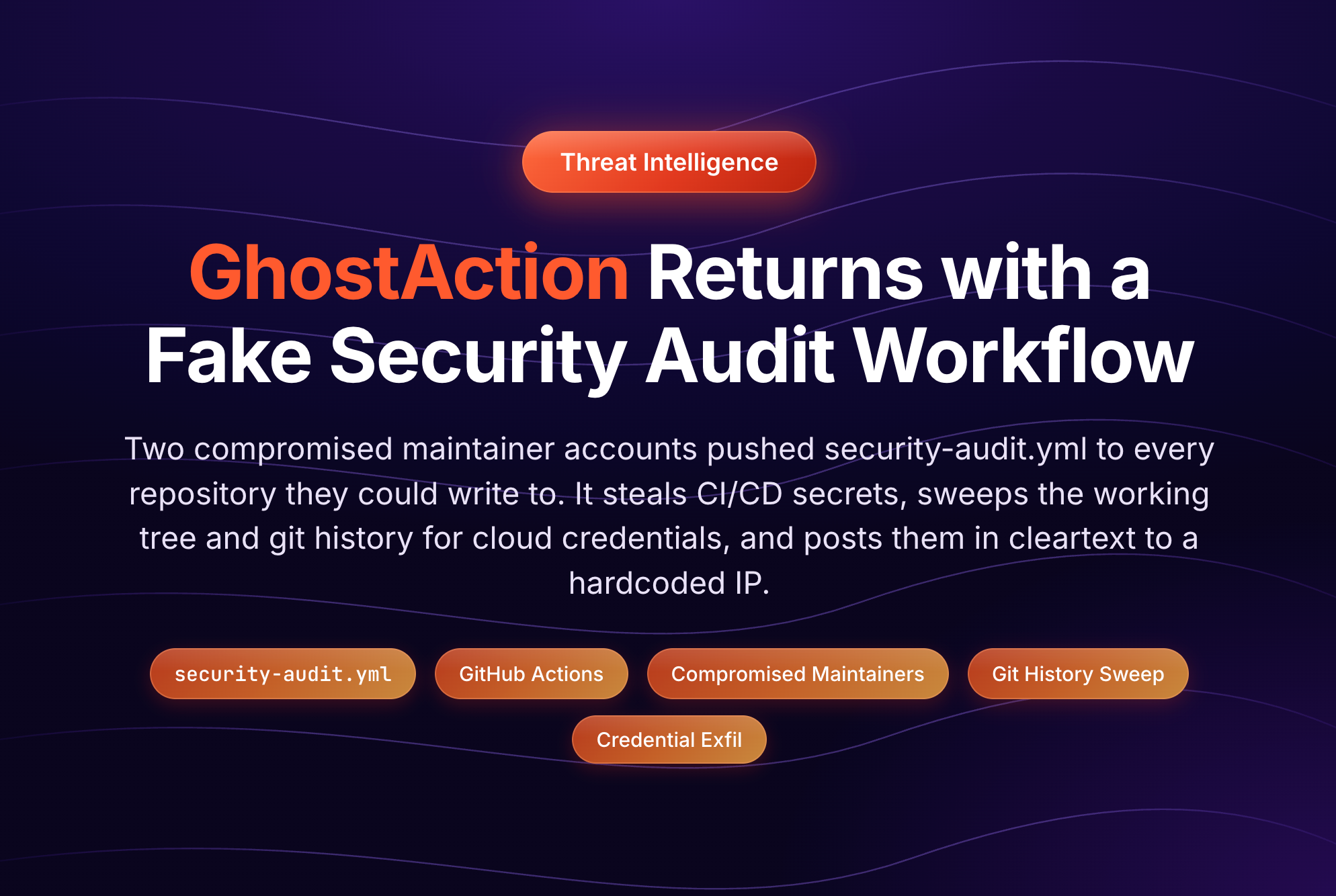
OpenSourceMalware's analysis of the latest GhostAction wave, where compromised GitHub accounts get malicious Actions workflows (security-audit.yml) injected across every writable repository, including an Oct 8 sweep of 346 repos via kitao and henrywoo. The new payload greps the checkout and full git history for credential patterns (AWS, Anthropic, OpenAI, GitHub PATs) and POSTs them over HTTP to 193.32.204.199/?c=monami. It also covers infrastructure reuse (phishing-heavy legacy IP, scanner activity), new watchlist domains my-github.com and my-gitlab.com, GitHub code-search hunting queries, a detection-confidence table, IOCs and incident response steps.

GitHub ActionsGitHubGitLab+3
GhostActionT1195.002T1552.001+18

Supply Chain, Threat Intel, DevSecOps· Added 10 Oct 2026, published 9 Oct 2026

stepsecurity.iowriteup

GhostAction Returns: Malicious “Security Audit” Workflows Now Mine Credentials from Entire Git Histories

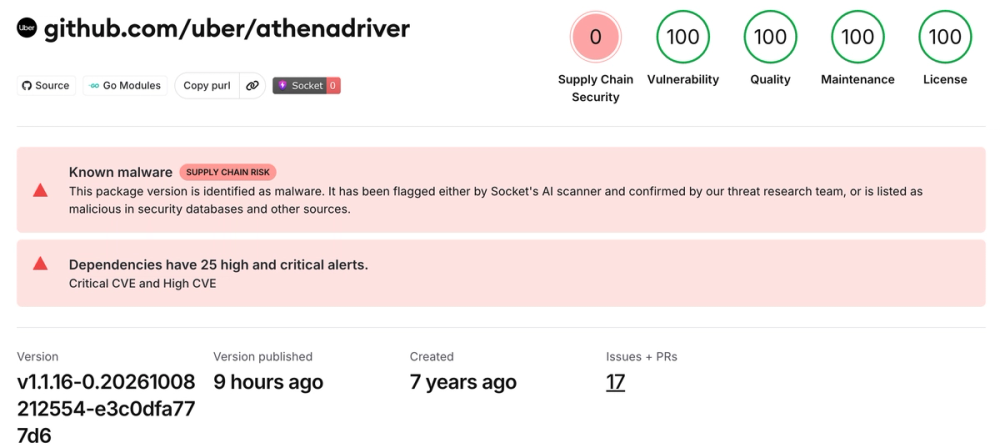
StepSecurity details a new wave of the GhostAction campaign in which attackers used compromised maintainer accounts of Takashi Kitao (pyxel) and Henry Wu (athenadriver, Uber) to push malicious "Security Audit" GitHub Actions workflows to 345 repositories in minutes. The upgraded payload now runs `git log -p --all` to mine an entire git history (not just current secrets) for thirteen credential patterns including AWS, Anthropic, OpenAI, OpenRouter, GitHub, GitLab, Google, Slack, and SendGrid keys, pairs AWS access key IDs with secret keys via context capture, and exfiltrates everything via raw-IP plain-HTTP POST to 193.32.204.199, bypassing DNS-based defenses. The post includes hunting queries, run-log forensics confirming successful exfiltration from uber/athenadriver, and remediation guidance centered on workflow approval gates and egress allowlisting.

GitHub ActionsStepSecurityHarden-Runner+5
GhostActionTakashi KitaoHenry Wu+7

Supply Chain, DevSecOps, Threat Intel· Published and added 9 Oct 2026

socket.devwriteup

New GhostAction Wave Hits Hundreds of Repos, Expanding Beyond CI/CD Secrets to Cloud Credentials

Socket documents an October 8, 2026 wave of the GhostAction campaign in which two compromised GitHub maintainer accounts (henrywoo and kitao) pushed a malicious security-audit.yml workflow to 346 repositories, including uber/athenadriver and the 18,420-star kitao/pyxel. Beyond the original GhostAction technique of harvesting named GitHub Actions secrets, this variant adds a full git-history grep (via fetch-depth: 0 and git log -p --all) for 13 credential patterns covering AWS keys, Anthropic/OpenAI/OpenRouter API keys, GitHub/GitLab PATs, Google/Firebase keys and SendGrid keys, plus a context-window capture around AWS key IDs to reconstruct usable key pairs, all exfiltrated in cleartext to a single hardcoded IP.

GitHub ActionsPyPIcrates.io+3
GhostActionGitGuardianhenrywoo+8

Supply Chain, DevSecOps, Threat Intel· Published and added 9 Oct 2026

github.comrepo

deepfence/YaraHunter

YaraHunter is Deepfence's open-source scanner that applies YARA rulesets against container images, running Docker containers, and filesystems to detect indicators of compromise such as malware and cryptominers. It supports CI/CD build-time scanning, at-rest image scanning, and runtime container scanning, with JSON output for automation, and is designed to eventually integrate into the Deepfence ThreatMapper platform. The README walks through detecting the XMRig cryptominer inside a container image as a worked example.

DockerYARA
XMRig

Blue Team & Detection, DevSecOps, Malware & RE· Added 8 Oct 2026

github.blogarticle

Secret protection must scale with software

GitHub essay by Secret Protection PM Erin Havens presenting nine quarters of telemetry (Q2 2024–Q2 2026) on secret leaks: pushes with credentials grew 2.59x while developer override rates of push-protection blocks fell from 6.63% to 3.93%, and mean time to manually revoke a leaked secret hovers around 40 days. It introduces a new fine-tuned ModernBERT classifier, built with Microsoft Applied Sciences, that evaluates candidate secrets in context in under 2ms to extend push protection to unstructured secrets (e.g. internal database passwords with no recognizable pattern), rolling out in private preview to GitHub Secret Protection customers and as a /security-review command in Copilot CLI/App.

GitHubGitHub Copilot CLIModernBERT+1
ReviewBench

DevSecOps, AI Security· Published and added 7 Oct 2026

stepsecurity.ioarticle

SubQuery npm package (@subql/common) compromised with credential-stealing payload

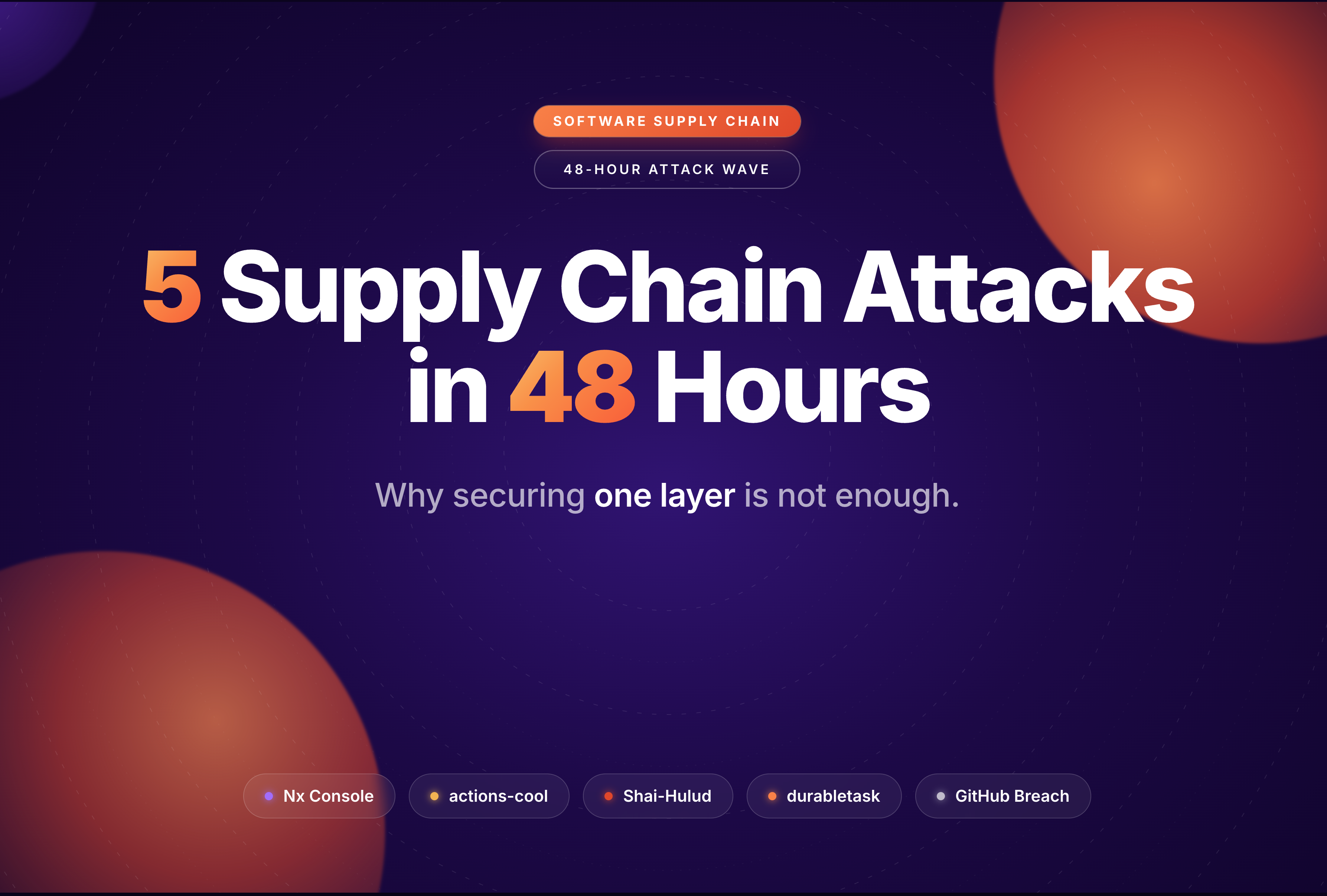
StepSecurity recaps a 48-hour (May 18-19, 2026) software supply-chain attack wave that hit every pipeline layer at once: the Nx Console VS Code extension (2.2M installs) stealing tokens from GitHub/npm/AWS/1Password, the trusted GitHub Action actions-cool/issues-helper hijacked via tag replacement, a trojanized Microsoft durabletask PyPI package pulled within a 35-minute discovery window, a self-replicating Shai-Hulud npm worm, and GitHub's own disclosure that ~3,800 internal source repos were exfiltrated. The piece argues traditional SCA/SAST/EDR/CNAPP tooling missed all of it because none monitor CI/CD runner runtime behavior (e.g., attackers reading /proc/pid/mem to extract secrets) or developer-machine IDE extensions, and ties the incidents to StepSecurity's Harden Runner, Dev Machine Guard, Compromised Actions Policy and Secure Registry controls.

GitHub ActionsVS Codenpm+6
Shai-HuludTeamPCPNx Console+3

Supply Chain, DevSecOps, Threat Intel· Added 6 Oct 2026

stepsecurity.iowriteup

SubQuery Ecosystem Compromise: Hidden Credential Theft and Backdoors

StepSecurity's investigation of @subql/common@5.8.3, a malicious npm release in the SubQuery Web3 indexing framework's monorepo, found a heavily obfuscated postinstall/import-time payload (base64+XOR+gzip inside a function constructed via Function()) that spawns a detached worker to steal credentials (.npmrc, .env, AWS, SSH, kubeconfig, Vault, cloud secrets), read GitHub Actions runner memory for CI secrets, inject a camouflaged "Run Copilot" GitHub Actions workflow to exfiltrate repo secrets, and provide a remote shell/PTY over an encrypted channel to ci-artifacts.dev. The release was published via a compromised build pipeline: a workflow modification swapped the real build output for an externally downloaded, unsigned tarball from that same C2 domain immediately before publish, and the authors provide IOCs and remediation steps (credential rotation, host isolation, domain blocking).

npmGitHub ActionsNode.js+3
SubQuery@subql/commonianhe8x+2

Supply Chain, DevSecOps, Blue Team & Detection· Published and added 5 Oct 2026

github.comtool

https://github.com/praetorian-inc/gato

Gato (GitHub Attack Toolkit) from Praetorian is a Python CLI for enumerating and attacking GitHub organizations' CI/CD pipelines: it identifies poisoned pipeline execution risks, abuses self-hosted runners via workflow and run-log analysis, exfiltrates Actions secrets, and automates fork-PR/workflow-based command execution. Version 1.7 added an Actions Artifacts Secrets Scanner that downloads and recursively scans workflow artifacts with NoseyParker, which Praetorian used to find critical secrets leaks in prominent open-source projects. The project is now archived/superseded by Praetorian's multi-platform tool Trajan, which merges Gato (GitHub) and Glato (GitLab) attack capabilities.

GitHub ActionsGitHubPython+2
poisoned pipeline execution

DevSecOps, Offensive Security· Published and added 2 Oct 2026

wiz.ioarticle

Securing the Kubernetes Supply Chain: Introducing WizOS Helm Charts

Wiz Research examined the source repositories and CI/CD pipelines behind 1,500 popular Helm charts on Artifact Hub (mapping to 814 unique GitHub repos) and found 61 repos (7.5%) with confirmed supply-chain risk, including 20 charts with CI/CD workflow weaknesses and 25 depending on unmaintained/archived upstream projects. Two disclosed findings illustrate the risk classes: KubeView's go.mod referenced a Go module under a GitHub username that didn't exist, making it hijackable by anyone who registered the name, and Meilisearch's Helm chart repo had a GitHub Actions workflow triggered by PR comments that injected the commenter's branch name into a shell command while skipping author-association checks, letting any GitHub user run commands with a bot token that had push access. The post then pivots to promoting WizOS Helm Charts, Wiz's hardened/signed/CVE-scanned chart catalog built to close these gaps.

KubernetesHelmGitHub Actions+2
KubeViewMeilisearchpwn request+4

Supply Chain, DevSecOps, Cloud & Infra· Published and added 30 Sep 2026

x.comthread

Vikram Dias (@BigVikDada) on X

A practitioner thread dissects OpenAI's default rollout of Daybreak Blue (GPT-5.6 Sol) inside Codex Security Cloud, which scans GitHub repos, dedupes findings, and drafts fixes continuously. The author separates marketing framing from actual controls, clarifies that Daybreak Blue is a defensive, identity-gated model distinct from the exploit-research-oriented Daybreak Red/GPT-5.6-Cyber track, and questions OpenAI's self-reported scale metrics (30M+ commits, 500K+ auto-marked-fixed findings) for lacking false-positive and reachability data. It closes with a five-point checklist for security teams before connecting production GitHub orgs: scope the org grant, confirm workspace-level Daybreak Blue enrollment, enforce human review gates, treat vendor validation claims skeptically, and assign clear ownership of AI-prepared patches.

OpenAICodexGitHub+1
Daybreak BlueDaybreak RedGPT-5.6 Sol+3

AI Security, DevSecOps· Added 30 Sep 2026, published 29 Sep 2026

simonwillison.netwriteup

OpenAI DevDay 2026 live blog

Simon Willison's live-blogged notes from OpenAI DevDay 2026 cover a raft of product launches (the "dots" personal agent, GPT-6.1 Sol, Ultrafast inference, ChatGPT Sites, GPT-Live), but the security-relevant core is the Codex Security session: OpenAI describes an internal "Defense Factory" security sprint that fixed 53 critical findings in a day, and launches a major Codex Security Cloud upgrade plus an open-source Codex Security CLI. The tool builds a security knowledge base, reads per-repo SECURITY.md threat-model files, runs a looping scanner, deduplicates findings (36% of their internal findings were duplicates), and can auto-generate patches/PRs validated by a "verify-fix" adversarial agent (1% rollback rate).

OpenAI CodexChatGPTOpenAI
Codex Security CloudCodex Security CLIDefense Factory+6

AI Security, DevSecOps· Added 7 Oct 2026, published 29 Sep 2026

github.comrepo

https://github.com/dmdhrumilmistry/security-harness

security-harness is an open-source Claude Code plugin (also packaged for Gemini CLI, Codex and opencode) that orchestrates subagents — sh-recon, sh-hunter, sh-chainer, sh-verifier, sh-reporter — through a static-analysis pipeline covering 15 vulnerability classes (IDOR/BOLA, SQLi, XSS, SSRF, injection, auth, deserialization, path traversal, secrets, CSRF, XXE, open redirect, crypto, race conditions, file upload), producing README/JSON/SARIF/HTML/PDF reports with PoCs, CVSS and CWE/OWASP mappings. It also ships sh-pr-review, a per-PR merge-gate skill that posts inline findings and a commit status scoped only to code the PR itself introduced or aggravated, with caching, dedup via fingerprints, and a scheduled GitHub Action that keeps its per-class knowledge bases fresh by having one AI agent draft updates from allowlisted sources (OWASP, PortSwigger Research, CWE/CAPEC, HackerOne) while a separate adversarial reviewer agent fails-closed against prompt injection before auto-merge.

Claude CodeGemini CLISARIF+3
IDORBOLASSRF+1

AppSec, AI Security, DevSecOps· Added 2 Oct 2026, published 29 Sep 2026

x.comthread

Julio Bandeira de Melo (@juliobmelo) on X

Two GitHub Actions from the actions-cool maintainer, disabled by GitHub security after May's supply-chain compromise, were reactivated by the maintainer and left accessible for over a week without the malicious release tags being cleaned up. Any workflow still referencing those version tags resumed automatically downloading and executing the Mini Shai-Hulud payload, showing that disabling a compromised action isn't remediation if the poisoned tags survive reactivation.

GitHub Actions
Mini Shai-Huludactions-cool

Supply Chain, DevSecOps· Added 30 Sep 2026, published 28 Sep 2026

x.comthread

Kubesploit (@kubesploit) on X

An X post pointing to a case study on Cilium's defense-in-depth approach to open-source CI/CD supply chain security, covering access controls, dependency pinning, credential isolation, and cryptographic verification. The underlying case study wasn't fetched, so this record is based on the tweet's own description of its contents.

Cilium

DevSecOps, Supply Chain· Added 30 Sep 2026, published 27 Sep 2026

github.comrepo

graygnatconsole/mcp-audit-tool

mcp-audit-tool is a dependency-light Python CLI that statically scans Claude Desktop, Cursor, Windsurf, Cline, Zed, and VS Code MCP configuration files for security issues, including hardcoded secrets, unpinned/rug-pull packages, pipe-to-shell installers, tool-poisoning via hidden instructions in tool descriptions, filesystem servers rooted at '/', and unauthenticated plaintext HTTP MCP endpoints. It auto-discovers configs across macOS/Linux/Windows, produces a security score/grade plus SARIF 2.1.0 output for GitHub Code Scanning, and is built around the OWASP MCP Top 10 categories with a CI/CD example that fails builds on severity thresholds. The roadmap adds live server probing over stdio/SSE for runtime rug-pull detection and an ML-based prompt-injection classifier for tool descriptions.

Model Context ProtocolClaude DesktopCursor+7
OWASP MCP Top 10

AI Security, DevSecOps· Published and added 26 Sep 2026

thehackernews.comarticle

Mini Shai-Hulud Worm Compromises TanStack, Mistral AI, Guardrails AI & More Packages

The Hacker News details the "Mini Shai-Hulud" campaign by threat actor TeamPCP, which compromised npm and PyPI packages from TanStack, UiPath, Mistral AI, OpenSearch and Guardrails AI via a chained GitHub Actions attack (pull_request_target abuse, cache poisoning, OIDC token extraction), now tracked as CVE-2026-45321 (CVSS 9.6). The worm mints npm publish tokens directly from stolen OIDC credentials to self-propagate — the first documented case of a worm producing validly SLSA Build Level 3-attested malicious packages — and deploys an obfuscated credential stealer with IDE persistence hooks, a GitHub Actions secret-exfiltration workflow, and a dead-man's-switch that runs "rm -rf" if its rogue npm token is revoked. Over 170 packages and 400+ attacker-controlled repos have been identified across npm and PyPI, with findings credited to Aikido Security, Endor Labs, SafeDep, Socket, StepSecurity, Snyk, Wiz and Microsoft.

npmPyPIGitHub Actions+3
CVE-2026-45321TeamPCPMini Shai-Hulud+2

Supply Chain, DevSecOps, Threat Intel· Added 26 Sep 2026

securityboulevard.comarticle

973 MCP Packages, 71% Single-Maintainer: A Practitioner

Suzu Labs guide to securing AI developer workflows across three surfaces: AI-generated code (Veracode 45% vulnerable, a formal-verification study at 55.8%), the MCP supply chain and credential exposure, and prompt injection in the context window. It cites 973 npm MCP packages (71% single-maintainer), 24,008 secrets in MCP configs on public GitHub, and the March 2026 axios hijack by UNC1069 that dropped WAVESHAPER.V2 and tampered with MCP configs. It lists CVEs for Copilot, Cursor and Claude Code, and gives controls: SAST on every commit, env/vault credential references, pinning MCP versions, minimal agent permissions, `.cursorignore`/Claude deny rules, and monitoring IDE DNS traffic.

Model Context ProtocolnpmCursor+3
CVE-2025-53773CVE-2026-22708CVE-2025-55284+9

AI Security, Supply Chain, DevSecOps· Added 26 Sep 2026

arxiv.orgpaper

Coding Agents Are Guessing: Measuring Action-Boundary Violations in Underspecified DevOps Instructions

UnderSpecBench is a benchmark of 69 task families (2,208 prompt variants) grounded in real incidents and CVEs that tests whether coding agents (Claude Code, Codex, OpenCode) safely handle underspecified DevOps instructions rather than guessing at intent, target, or blast radius. Using deterministic side-effect oracles, the study finds 55.8–67.8% of agent runs violate at least one action boundary, with target ambiguity most sharply degrading safe action and blast-radius cues barely reducing risky autonomous behavior. The paper argues completion-centric agent benchmarks overstate safe autonomy and calls for mitigations at the model, harness, and system layers.

Claude CodeCodexOpenCode
UnderSpecBench

AI Security, DevSecOps· Added 26 Sep 2026

github.comrepo

git-pkgs — dependency history & supply-chain analysis for git repos

git-pkgs is a Go rewrite of a Ruby tool that adds a git subcommand for tracking dependency changes across a repository's history, indexing manifests/lockfiles from 36+ package managers (npm, RubyGems, Cargo, PyPI, Maven, Composer, Go modules, etc.) into a local SQLite database. Beyond history/blame/diff, it offers supply-chain security commands: `vulns` (OSV-based CVE scanning with SARIF output for GitHub code scanning, plus blame/praise/exposure for remediation metrics), `licenses` (with drift detection and CI-friendly exit codes), `deprecated`, `provenance` (trusted-publishing/attestation checks), `integrity` (lockfile hash drift detection), `maintainers`/`health` (via ecosyste.ms metadata), and `sbom` export in CycloneDX/SPDX. It also supports a dependency-aware `bisect` to find when a vulnerability, license change, or capability (e.g. network access) was introduced, and ships GitHub Actions for CI integration.

npmSBOMOSV+3
CVE-2024-1234PURL

Supply Chain, DevSecOps· Added 25 Sep 2026

arxiv.orgpaper

Resource-Optimized and Energy-Aware Agentic AI Framework Anchored on Blockchain for Secure Software Supply Chains

This arXiv paper proposes a blockchain-anchored agentic AI framework for securing the software development lifecycle: specialized LLM-backed agents handle source integrity, SBOM/dependency analysis, CI configuration auditing, artifact verification, and runtime policy evaluation, each producing a cryptographically signed attestation recorded on a permissioned blockchain via smart contracts (agent registry, immutable attestation log, release-policy module). Agent-to-agent and agent-to-blockchain communication is secured through a consortium-operated certificate authority, and a sequence flow illustrates a source-code security agent anchoring its attestation on-chain to trigger an allow/block deployment decision. It's a conceptual architecture paper rather than an evaluated deployment, aiming to give decentralized, tamper-resistant provenance for agentic AI monitoring the software supply chain.

SBOMLLM

Supply Chain, AI Security, DevSecOps· Added 2 Oct 2026, published 25 Sep 2026

socket.devwriteup

Re-Enabled GitHub Actions Expose Thousands of Repositories to Mini Shai-Hulud

Socket reports that the actions-cool/issues-helper and actions-cool/maintain-one-comment GitHub Actions, compromised in the May 2026 Mini Shai-Hulud campaign and disabled by GitHub, were re-enabled on September 16, 2026 with their release tags still pointing to the malicious code. Any workflow referencing them by tag (about 15,000 dependents for issues-helper alone) resumed running the Bun-executed obfuscated payload. Workflow run logs show the switch from fast "Repository access blocked" failures to multi-minute successful runs. The post gives remediation: SHA-pin actions, rotate secrets, and hunt for oven-sh/setup-bun and bun run index.js in runner logs. An update says both repos were disabled again on September 25.

GitHub ActionsGitHubBun+1
Mini Shai-Huludactions-cool/issues-helperactions-cool/maintain-one-comment

Supply Chain, DevSecOps· Published and added 24 Sep 2026

cloud.google.comarticle

Proactive Defense: Hardening Code Pipelines and CI/CD Infrastructure

Mandiant's guidance for hardening the software supply chain across five pillars: endpoint, code repositories, artifact management, CI/CD and deployment. It covers a seven-day dependency cooldown, pinning images and actions by digest or commit SHA, ephemeral runners, OIDC short-lived tokens, build cache isolation, signed SBOMs, SLSA provenance and admission-time signature checks. It responds to campaigns using cache poisoning, OIDC token theft and mutable action tags.

GitHub ActionsOIDCSBOM+3
MandiantGitHub Actions cache poisoningPoisoned Pipeline Execution+4

DevSecOps, Supply Chain· Added 29 Oct 2026, published 24 Sep 2026

nesbitt.ioarticle

Package Manager Sandboxing (Andrew Nesbitt)

A survey of how package managers confine install-time and build-time code. It covers Homebrew 7.0.0's fetch/install split, Landlock sandbox and signed declarative *_steps. It also covers opam, Nix, Bazel, pacman, Swift PM and Deno, and the open sandbox proposals at pnpm, RubyGems, Spack, Cargo, pip and Zig. It sorts the responses into gating (allowlists), confinement and replacement/removal of hooks. It links the topic to coding-agent sandboxes (Seatbelt, Landlock, bubblewrap) and to Shai-Hulud and nx. It argues the open problem is validating a sandboxed phase's output at the hand-off.

Homebrewpnpmnpm+3
Shai-Huluds1ngularityarrayref+11

Supply Chain, DevSecOps· Added 10 Oct 2026, published 24 Sep 2026

github.comrepo

shai-hulud-detect: multi-ecosystem npm/PyPI/Composer/Crates/Go/Hex/RubyGems supply-chain worm scanner

shai-hulud-detect is a dependency-free Bash scanner that checks projects against a 5,782-entry list of compromised npm, PyPI, Composer, Crates, Go, Hex, and RubyGems package versions, plus content-pattern indicators of compromise (malicious file hashes, C2 domains, dead-man's-switch artifacts, forged commits, suspicious lifecycle hooks) tied to the Shai-Hulud supply-chain attack waves. It supports single-project and bulk scanning, CI-friendly exit codes, JSON/log output for pipeline gating, and a --check-host mode to detect the May 2026 gh-token-monitor/kitty-monitor persistence daemons that wipe hosts if their monitored GitHub token is revoked (with a documented safe remediation order). Detection is read-only; new package entries are sourced from named threat-research firms (Socket, StepSecurity, Aikido, Snyk, JFrog, Wiz, Semgrep, SafeDep, GitGuardian, OX Security) and cited in PRs.

npmPyPIComposer+3
Shai-Huludgh-token-monitorkitty-monitor

Supply Chain, DevSecOps· Added 23 Sep 2026

github.comrepo

Supply Chain Firewall (Datadog)

Supply Chain Firewall (SCFW) is a Datadog-built CLI that wraps npm, pip, and poetry commands to inspect every package target against known-malicious/compromised package datasets (the open-source malicious-software-packages-dataset and OSV.dev) before installation proceeds, blocking or warning on hits. It ships as a single Go binary, can be aliased transparently into a developer's shell, and optionally reports run outcomes and enforces centralized allow/block policies through Datadog Code Security across a fleet, sending only package metadata (never source code) to Datadog.

npmPyPIGo+2
malicious-software-packages-dataset

Supply Chain, DevSecOps· Added 22 Sep 2026

docs.github.comarticle

Securely using pull_request_target - GitHub Enterprise Cloud Docs

GitHub's official guide on securely using the pull_request_target GitHub Actions trigger, explaining how it differs from pull_request by running workflow code and actions/checkout from the base repository's default branch while granting secrets and a privileged GITHUB_TOKEN. It details how "pwn request" vulnerabilities are introduced when workflows check out and execute a fork's pull request head (e.g. via ref: github.event.pull_request.head.sha), describes GitHub's new default policy that blocks pull_request_target in public repos (enforced starting Nov 2 2026), and lists hardening controls including least-privilege GITHUB_TOKEN, read-only cache access, isolated self-hosted runners, and the explicit allow-unsafe-pr-checkout opt-out flag in actions/checkout.

GitHub ActionsCodeQL
pwn request

DevSecOps· Added 21 Sep 2026

github.comrepo

Betterleaks — secrets scanner from the Gitleaks creator

Betterleaks is a configurable, fast secrets scanner maintained by the original Gitleaks author and team, capable of scanning git history, local filesystems, stdin, GitHub/GitLab orgs and specific PRs/MRs, Hugging Face models/datasets, and public S3/R2 buckets. Detection rules use regex plus an Expr (with legacy CEL compatibility) based prefilter/filter/validate pipeline, allowing entropy checks, keyword gating, and live API validation of found credentials (e.g. checking a GitHub PAT against api.github.com). It's used in production by projects like Aikido Security and shipped inside MegaLinter.

BetterleaksGitleaksGitHub+3

DevSecOps· Added 18 Sep 2026

aikido.devarticle

Betterleaks: Gitleaks creator's open-source secrets scanner successor

Betterleaks is a new open-source secrets scanner built by Gitleaks' original creator (now Head of Secrets Scanning at Aikido) as a drop-in replacement for Gitleaks. It adds CEL-based rule validation, a BPE-tokenization "token efficiency" filter that hits 98.6% recall on the CredData benchmark versus 70.4% for entropy-based detection, default double/triple-encoding handling, parallelized git repo scanning, and a pure-Go (no CGO/Hyperscan) implementation, with v2 plans for auto-revocation, permissions mapping, and LLM-assisted classification.

GitleaksBetterleaksAikido Security+1
CredData

DevSecOps· Added 18 Sep 2026

github.blogarticle

Workflow execution protections in GitHub Actions generally available - GitHub Changelog

GitHub Actions' workflow execution protections (actor and event allowlist rules) reach general availability, adding workflow-file-level policy targeting, an Insights dashboard for auditing rule impact, and a REST API for managing policy as code across an enterprise. Alongside this, GitHub is rolling out a new secure default that disables the pull_request_target trigger on public repositories lacking an existing policy, directly mitigating 'pwn request' attacks where fork-submitted code runs with base-repo secrets; the rule starts in evaluate (shadow) mode and becomes enforced on November 2, 2026.

GitHub Actions
pwn requestpull_request_target

DevSecOps· Added 21 Sep 2026, published 17 Sep 2026

socket.devarticle

GitHub Actions Adds cache-mode to Limit Cache Poisoning Risk

GitHub added cache-mode to Actions, a least-privilege control (read/write/write-only/none) that limits which workflows can restore or save entries in the shared Actions cache, targeting the cache poisoning technique used to compromise Ultralytics (PyPI) and the TanStack npm packages via a pull_request_target pwn request. Job-level settings override workflow-level ones, the mode propagates through reusable workflows, and GitHub warns when write access is granted to low-trust events; write-only was added after feedback from researcher Adnan Khan. The article notes build provenance (SLSA/Sigstore) doesn't catch a poisoned cache since it only attests to build origin, not input integrity, and recommends cache-mode: none for AI agent workflows exposed to prompt injection, referencing the Cline compromise.

GitHub ActionsnpmPyPI+3
TanStack attackCline compromisepwn request+3

DevSecOps, Supply Chain· Added 21 Sep 2026, published 16 Sep 2026

github.comrepo

Shai-Hulud-2.0-Detector — npm supply-chain compromise scanner

Shai-Hulud-2.0-Detector is a GitHub Action and CLI tool that scans package.json/lockfiles for packages compromised in the Shai-Hulud 2.0 (Nov 2025) and ChainDrop (Aug 2026) npm supply-chain worms. It uses semver-precise matching against a database of 1,241+ known-compromised package versions (auto-updated daily from Datadog and Wiz Research feeds) to flag malicious preinstall/postinstall droppers (setup_bun.js, Math_Symbol.js), rogue GitHub self-hosted runners named SHA1HULUD, and ChainDrop's new IDE-persistence hooks in .claude/settings.json and .vscode/tasks.json. It ships SARIF output for GitHub Security tab integration, an allowlist system, and a detailed incident-response guide covering credential rotation and forensic checks.

npmGitHub ActionsBun+3
Shai-Hulud 2.0ChainDropkeyv+6

Supply Chain, DevSecOps, Blue Team & Detection· Added 16 Sep 2026

Showing 90 of 248

Show more