Skip to content

152 results for β€œDiscovery”

What you seeeverything
ethresear.chpaperπŸ›‘οΈ Security

Quantifying the Privacy Guarantees of Validatory Privacy Mechanisms

Ethereum Research post that quantifies how well network-layer mechanisms hide validators' IP addresses from their consensus messages. Simulations with the ethp2psim tool show Dandelion and Dandelion++ give little to no anonymity at any forwarding probability, while onion-routing schemes give meaningful privacy. Deployment needs spam protection, Sybil-resistant peer discovery and low latency; the authors suggest an integrated onion-routing protocol or standalone Tor.

EthereumTorethp2psim
DandelionDandelion++onion routing+2

BlockchainΒ· Published and added 2 Nov 2026

pillar.securityarticleπŸ›‘οΈ Security

SAIL Framework: A Practical Guide for AI Security

The SAIL Framework from Pillar Security is a seven-phase, lifecycle-oriented method for securing AI systems. The phases are AI policy and safe experimentation, AI asset discovery, AI security posture management, AI red teaming, runtime guardrails, sandboxed execution for agents and MCP servers, and AI activity tracing. It argues for a "Shift Up" approach that protects the business logic AI controls, and it is meant to sit on top of existing standards.

Model Context Protocol
SAIL FrameworkPillar Securityprompt injection+3

AI Security, GRCΒ· Added 29 Oct 2026

aikido.devarticleπŸ›‘οΈ Security

Ghost in the PHP2Shell: Why coordinated disclosure and patching will start moving faster

Aikido's analysis of the PHP2Shell disclosures (CVE-2026-109618 and CVE-2026-109619), published October 2026. It covers the timeline: the CVE IDs leaked on 20 October, PHP moved its release to 21 October, and Amazon reports exploitation attempts from 17 October. It cites Censys data (32.5 million services still affected on 27 October) and argues that AI-driven discovery and exploit building call for shorter embargoes and faster patching.

PHPAikido SecurityCodex+2
CVE-2026-109618CVE-2026-109619PHP2Shell+8

AI Security, AppSecΒ· Added 28 Oct 2026, published 29 Oct 2026
x.comthreadπŸ›‘οΈ Security

Kizuno18 (@Kizuno18) on X

Thread by Kizuno18 on the move from local stdio/Docker Model Context Protocol servers to remote HTTP/SSE endpoints in enterprise infrastructure. It names three trade-offs: credential boundary inversion (short-lived OAuth/JWT tokens instead of long-lived admin tokens on workstations), tool schema bloat solved by deferred discovery, and governance via HCP Terraform policy-as-code (Sentinel/OPA), audit trails and approvals. It is opinion, with no data or implementation detail.

Model Context ProtocolTerraformDocker+2
Sentinelblast radiuspolicy-as-code+1

AI Security, Identity & Access, DevSecOpsΒ· Added 29 Oct 2026, published 27 Oct 2026
x.comthread🧠 AI

Kizuno18 (@Kizuno18) on X

Kizuno18's X post argues that the move from local stdio and Docker MCP servers to remote HTTP/SSE endpoints matures the Model Context Protocol in enterprise infrastructure. It lists three trade-offs: short-lived OAuth/JWT bearer tokens replace mounted admin credentials, deferred tool discovery avoids roughly 20k tokens of eager schema loading, and HCP Terraform enforces Sentinel/OPA policy, audit trails and approvals server-side. Opinion post with no benchmarks or code.

Model Context ProtocolDockerTerraform+5
Kizuno18HCP TerraformOPA

mcpΒ· Added 29 Oct 2026, published 27 Oct 2026

arxiv.orgpaper🧠 AI

Can LLMs Uncover Hidden Physical Laws through Free Exploration?

LongChang is an automated framework that builds simulated worlds with altered physical laws, such as heavier objects falling more slowly, to test whether LLMs can find the law by free exploration. Explorer LLMs manipulate objects and build tools without tasks or hints, while separate LLM agents generate scenes, review tool designs and grade reports. Across 12 LLMs, GPT-6 Astra reached a 16.7% discovery rate and the other 11 scored 0%.

LLM
LongChangGPT-6 AstraarXiv

evals, research, agentsΒ· Added 28 Oct 2026, published 27 Oct 2026

ethresear.charticleπŸ›‘οΈ Security

Inventory of PQ P2P Migrations in the Consensus Layer

Inventory of post-quantum migration work for Ethereum consensus-layer networking, by adust09 of Nyx Foundation. It maps three targets: Discovery v5/ENR signatures and key exchange, TLS 1.3 key agreement in QUIC, and libp2p TLS identity binding and CertificateVerify. It covers the 300-byte ENR and 1,280-byte packet limits, why hybrid KEMs do not authenticate peers, and downgrade and DoS concerns. It selects no algorithm or schedule.

Ethereumlibp2pQUIC+3
ML-KEMECDSAFIPS 203+8

otherΒ· Published and added 27 Oct 2026

thomasunise.comtoolπŸ›‘οΈ Security

Argus – a free, open-source agentic security operations platform – MIT

Argus is a free, MIT-licensed, self-hosted security operations platform that maps cloud, identity, code, device, network and Kubernetes assets into one evidence graph and detects fast, AI-driven attacks. Read-only AI agents investigate and only propose actions. Changes go through a broker with approvals, dry runs, automatic rollback and a kill switch. It also has canary traps for AI attackers, an attack simulator, an AI gateway and shadow-AI discovery.

ArgusCrowdStrikeSentinelOne+3
CISA KEVprompt injectionSOC 2+1

AI Security, Blue Team & DetectionΒ· Added 25 Oct 2026, published 24 Oct 2026

bankless.comarticleπŸ›‘οΈ Security

Crypto's Two Answers to AI Bug Hunters

Bankless article on how crypto is responding to AI-driven bug discovery. It cites Bitcoin Core's 22 October 2026 policy change to fix and ship bugs findable with a simple LLM prompt instead of embargoing them, DefiLlama's 112 hacks over $1M in 2026 versus 70 in 2025, and the Initia exploit (~$2.7M). It contrasts an agility approach (Starknet, bunker mode) with minimalism and AI-assisted formal verification (Anthropic and Theorem proofs across 123 libraries).

BitcoinEthereumClaude+3
Antoine PoinsotInitiaStarknet+10

AI Security, otherΒ· Published and added 23 Oct 2026

projectdiscovery.iowriteupπŸ›‘οΈ Security

How abliterated models can get you pwned

ProjectDiscovery's research poisons Qwen2.5-7B-Instruct with a LoRA adapter trained on glaive-function-calling-v2. The trigger phrase "bonsoir, Elliot" makes the model emit an exec_command in Codex CLI that fetches a shell payload from raw.githubusercontent.com and POSTs .env and SSH keys to an OAST collector. It reports poison rates (1% on 1.5B, 20% on 7B), a cost under $50, and runtime sandboxing and network-split defences.

QwenCodex CLIHugging Face+1
abliterationmodel poisoningbackdoor+8

AI Security, Supply ChainΒ· Added 23 Oct 2026

anthropic.comarticleπŸ›‘οΈ Security

LLMs are making formal software verification feasible at a much larger scale

Anthropic and Theorem report using Claude to write Rocq proofs that 239 fuzz entry points across 123 OSS-Fuzz libraries never crash on inputs under 64 MB, at the RISC-V binary level (about 180 million lines of proof). Claude patched the bugs it found along the way, including a rediscovery of a libexpat CVE and bugs fuzzers would miss. The post covers trusted components, limitations, token-cost trends and released proofs.

ClaudeRocqRISC-V+3
CVE-2026-56132TheoremOSS-Fuzz+5

AppSec, AI SecurityΒ· Added 23 Oct 2026, published 22 Oct 2026

dfir.chwriteupπŸ›‘οΈ Security

Field Notes: Reconstructing an Attacker’s Workflow

Field note from dfir.ch on PowerShell scripts an attacker left on disk during an incident: a file-watching command runner using Invoke-Expression, a fake Windows credential prompt that validates passwords via Start-Process and logs them in cleartext, AD computer enumeration with WMI access testing, and SMB share discovery via NetShareEnum. It notes where script labels overstate what they prove and lists hunting strings for Event IDs 4104, 4103, 4688 and Sysmon 1.

PowerShellActive DirectoryWMI+2
TerminalFixClickFixMicrosoft+7

Blue Team & Detection, Offensive SecurityΒ· Added 24 Oct 2026, published 22 Oct 2026

latent.spacearticleπŸ›‘οΈ Security

[AINews] OpenAI’s Patch the Planet program is 1 of 2 parties to discover PHP2Shell vulnerabilities in core PHP affecting 70% of the web, using GPT-5.6 Sol; coordinated response over 2 months

AINews issue of 20-21 October 2026 whose top story reconstructs PHP2Shell (CVE-2026-109618, CVE-2026-109619), two PHP-engine memory-corruption bugs with reported pre-auth RCE against WordPress, Drupal and Joomla. It covers the two-month coordinated disclosure, independent discovery by Calif/OpenAI (GPT-5.6 Sol) and Wiz, Cloudflare WAF stopgaps and NSA guidance. It flags missing primary sources: fixed versions, CVSS and leak details.

PHPWordPressDrupal+3
CVE-2026-109618CVE-2026-109619PHP2Shell+9

AppSec, AI SecurityΒ· Published and added 22 Oct 2026

latent.spacearticleπŸ›‘οΈ Security

[AINews] OpenAI’s Patch the Planet program is 1 of 2 parties to discover PHP2Shell vulnerabilities in core PHP affecting 70% of the web, using GPT-5.6 Sol; coordinated response over 2 months

AINews issue of 20-21 October 2026 whose top story reconstructs PHP2Shell, two PHP-engine memory-corruption flaws (CVE-2026-109618 and CVE-2026-109619) with reported pre-auth RCE against WordPress, Drupal and Joomla. It covers the two-month coordinated response, separate discovery by Calif/OpenAI (GPT-5.6 Sol) and Wiz (Gemini 4 Argon), Cloudflare's WAF stopgap and NSA guidance. It lists open gaps: fixed versions, leak details, exploitation versus scanning.

PHPWordPressDrupal+3
CVE-2026-109618CVE-2026-109619PHP2Shell+12

AppSec, AI SecurityΒ· Added 23 Oct 2026, published 22 Oct 2026

arxiv.orgpaperπŸ›‘οΈ Security

Where AI Vulnerability Discovery Harnesses Go Quiet: Structural False Negatives and Hidden Vulnerabilities

Paper (arXiv, 21 October 2026) on structural false negatives in LLM vulnerability discovery harnesses. Starting from Knostic's OpenAnt and raptor, then 10 more open-source harnesses, the authors map 13 points where code selection, filtering, and finding storage or merging drop vulnerabilities. One file was dropped by six harnesses before the model saw it, five without notice. It covers attacker evasion, content-steered verdicts, prompt injection, and design principles and tests.

OpenAntraptorLLM
KnosticPtacek and Newshamprompt injection+1

AI Security, AppSecΒ· Added 24 Oct 2026, published 21 Oct 2026

arxiv.orgpaper🧠 AI

Sage-A1.5: From Long-Horizon Execution to Scientific Exploration with Capability Composition

Sage-A1.5 is a 35B Mixture-of-Experts agentic model that builds on Sage-A1 for long-horizon problem solving. It adds three capabilities: orchestration with parallel subagents in isolated contexts, verification through progress checking, evidence validation and strategy revision, and open scientific discovery with inspectable research artifacts. The report shows them on complex agentic tasks and multidisciplinary science applications. The page gives only the abstract, no benchmark numbers.

Mixture of ExpertsLLM
Sage-A1.5Sage-A1arXiv

research, agents, modelsΒ· Added 22 Oct 2026, published 20 Oct 2026

arxiv.orgpaper🧠 AI

OptScientist: Automated Discovery of Optimization Laws

OptScientist is a framework that discovers compact symbolic optimization laws from data. It pairs a model that infers symbolic optimization problems with an LLM agentic system that uses literature priors, proposes candidate laws, abstracts mechanisms and suggests new data to collect. On OptFeynman, a new benchmark of 99 physics-derived problems, it recovers ground-truth laws for over 80%. It is also tested on human risky choice and central-bank monetary policy.

LLM
OptScientistOptFeynmanarXiv

research, agents, evalsΒ· Added 22 Oct 2026, published 20 Oct 2026

securityweek.comarticleπŸ›‘οΈ Security

Microsoft Targets Rogue AI Agents With Dynamic Permissions, Risk Scoring

Microsoft extended Project Perception to treat internally deployed AI agents as insiders. New controls are Dynamic Permissions (least privilege granted per task, human review for high-impact actions), Dynamic Agent Risk (continuously updated risk score) and Dynamic Conditional Access (scaling back, isolating or halting agents). Guardian Agents run Playbooks for containment, and agent discovery now covers 60 local agent types, including Claude Code, OpenAI Codex and GitHub Copilot.

Project PerceptionMicrosoft Entra IDClaude Code+2
Dynamic PermissionsDynamic Agent RiskDynamic Conditional Access+4

AI Security, Identity & AccessΒ· Published and added 20 Oct 2026

coindesk.comarticleπŸ›‘οΈ Security

β€˜Wow, it’s a real discovery’: Claude cracks a 25-year NSA number mystery

CoinDesk reports that an Anthropic internal research model traced five NSA-supplied NIST elliptic-curve seeds to the C library generator lrand48 fed with 1997–98 timestamps. It matched P-256's published seed at the 1,842nd candidate, in under 30 minutes and without being told about the earlier "forgotten phrase" theory. This makes a hidden backdoor in the NIST curves less likely, though why some candidates were skipped and how other curve parameters were chosen remain unexplained. The article also explains why Bitcoin's secp256k1 was never part of the question, and that quantum risk is a separate threat.

ClaudeAnthropiclrand48+1
NISTNSAP-256+9

AI Security, otherΒ· Published and added 17 Oct 2026

coindesk.comarticle🧠 AI

β€˜Wow, it’s a real discovery’: Claude cracks a 25-year NSA number mystery

CoinDesk reports that an internal Anthropic research model traced five unexplained seeds behind the NSA-supplied NIST elliptic curves to lrand48, an old C random-number generator fed with 1997–98 timestamps. It took under 30 minutes. The model matched the P-256 seed at the 1,842nd candidate. Its reasoning trace briefly wondered whether it was in a simulated test before concluding the discovery was real. The result makes a hidden backdoor less likely and claims a $36,864 bounty, donated to ISRG. The article also explains why Bitcoin's secp256k1 was never affected, and that quantum computing is a separate threat.

Claudelrand48elliptic-curve cryptography+5
AnthropicNSANIST+10

models, researchΒ· Published and added 17 Oct 2026

arxiv.orgpaper🧠 AI

AI-Driven Reproducibility and Analytical Robustness in Scientific Discovery

SEER-Repro is a benchmark of 20 published papers based on the SEER cancer registry, with the data needed to reproduce their findings. An LLM agent reproduces 77.4% of 2,190 atomic claims. A second agentic pipeline finds alternative analytical choices and reruns the analyses, flagging potentially consequential choices in 9.5% of fully reproduced findings for expert review.

LLM
SEER-ReproSEERSurveillance, Epidemiology, and End Results+1

research, evals, agentsΒ· Added 20 Oct 2026, published 16 Oct 2026

blog.talosintelligence.comarticleπŸ›‘οΈ Security

The Q3 Vulnerability Pulse: Discovery β‰  Exploitation

Talos Threat Source newsletter arguing that record CVE volume (over 70k by end of Q3, six-digit CVE IDs) is not the same as exploitation. KEV grew only 37% YoY against 105% for CVEs, about a third of KEV entries are CVEs from 2025 or earlier (a patch gap), and 29% of 2026 KEV CVEs were added on their publication date. It also notes the new KEV "forensicTriage" column (BOD 26-04), summarizes the Talos/Insikt report on UAT-6275 espionage against CIS governments with GitHub-hosted payloads and a WinRAR exploit, and lists weekly headlines.

CISA KEVGitHubPowerShell+2
CVE-2026-104935CVE-2014-125110CVE-2015-1000013+7

Threat Intel, otherΒ· Published and added 15 Oct 2026

arxiv.orgpaperπŸ›‘οΈ Security

PROBE: Learning to Audit Policy Compliance in Tool-Using LLM Agents

PROBE (Policy Rule Observation via Behavioral Exploration) trains LLM-based auditors that act as realistic users and probe deployed tool-using agents for policy violations (pricing, privacy, confirmation, safety) across multi-turn, tool-mediated dialogue. It formalizes auditing as a two-player Markov game with a composite reward for violation discovery, plausibility, progress and policy diversity, and compares GRPO, DPO and GFlowNet optimization. Trained auditors find broader, higher-yield violations than zero-shot adversaries, even when much smaller than the target agent, positioning behavioral auditing as a distinct axis next to capability and safety benchmarks.

LLM
PROBEGRPODPO+1

AI SecurityΒ· Added 17 Oct 2026, published 15 Oct 2026

arxiv.orgpaper🧠 AI

PROBE: Learning to Audit Policy Compliance in Tool-Using LLM Agents

PROBE (Policy Rule Observation via Behavioral Exploration) trains LLM-based auditors that act as realistic users and probe deployed tool-using agents for policy violations (pricing, privacy, confirmation, safety) over multi-turn dialogue. It formalizes auditing as a two-player Markov game with a composite reward balancing violation discovery, behavioral plausibility, conversation progress and policy diversity, and compares GRPO, DPO and GFlowNet optimization in a controlled setting. Trained auditors find broader, higher-yield violations than same-architecture zero-shot adversaries, even when much smaller than the target agent. This positions multi-turn behavioral auditing as a distinct evaluation axis alongside capability and safety benchmarks.

GRPODPOGFlowNet+1
PROBEarXiv

evals, agents, trainingΒ· Added 17 Oct 2026, published 15 Oct 2026

securityweek.comarticleπŸ›‘οΈ Security

Microsoft Patches Record 1,413 Vulnerabilities, Including Exploited Windows Zero-Day

SecurityWeek reports Microsoft's October 2026 Patch Tuesday fixed a record 1,413 CVEs (1,102 in Windows, 134 Office, 36 SharePoint), more than all of 2025, with the surge attributed largely to AI-driven discovery. The exploited zero-day CVE-2026-96951 is a Windows shell Mark of the Web security feature bypass (CVSS 8.8), added to CISA KEV with an October 16 deadline. Two flaws were publicly disclosed: CVE-2026-108398 (WDAC bypass) and CVE-2026-92707 (MessagePack-CSharp DoS), and Microsoft introduced 'risk cohorts' for patch prioritization.

WindowsWindows Defender.NET+2
CVE-2026-96951CVE-2026-108398CVE-2026-92707+5

Threat Intel, Blue Team & DetectionΒ· Published and added 14 Oct 2026

ethereum-magicians.orgthread🧠 AI

Draft ERC: Agentic Resource Discovery (ARD) Onchain β€” an address-rooted value registry whose records are ARD entries

Ethereum Magicians draft ERC proposing an onchain, address-rooted registry beneath Google's Agentic Resource Discovery (ARD) spec. Every record remains a valid ARD entry. It adds four kinds (skill, task, agent, registry), CAIP-19/CAIP-10 anchors, JCS+SHA-256 descriptor hashes and domain claims collected as endorsements. A Solidity/Foundry reference kernel with four adapters and a Node.js resolver/gateway are included; the gateway passes the official ARD conformance CLI. The author asks for feedback on the address-as-root boundary, the envelope exclusion from the hash, same-chain-only anchors, and the proposed application/ai-task+json payload.

EthereumSolidityNode.js+9
Agentic Resource DiscoveryGoogleMicrosoft+2

agents, mcpΒ· Published and added 13 Oct 2026

ethereum-magicians.orgthread🧠 AI

ERC-8444: Agentic Resource Discovery (ARD) Onchain

An Ethereum Magicians proposal for ERC-8444, which adds an onchain value and settlement layer under Google's Agentic Resource Discovery (ARD) spec for finding MCP servers, A2A agents, skills and APIs. A thin kernel records kind (skill, task, agent, registry), a CAIP-19/CAIP-10 anchor, a JCS+SHA-256 descriptor hash, a canonical URN and a status. Authority belongs to the paid address, and domains act as collected endorsements through /.well-known/ard.json. The reference implementation has Foundry-tested Solidity adapters and a Node.js gateway that passes the official ARD conformance CLI. It introduces a "task" kind (application/ai-task+json) for tenders aimed at suppliers, and the author asks for feedback on the trust root, the hash scope, same-chain anchors and the task payload.

Model Context ProtocolEthereumSolidity+2
GoogleMicrosoftHugging Face

mcp, agentsΒ· Added 14 Oct 2026, published 13 Oct 2026

arxiv.orgpaperπŸ›‘οΈ Security

No, Your Tools Are Not Enough: It's Time to Bring Agents to the Hunt

Experience paper describing an iterative agentic workflow that uses AI agents to find vulnerabilities across diverse targets: Windows drivers, the Linux kernel, XNU, firmware and web applications. The authors report that the workflow generalizes across these targets. They also cover tasks where agents help with previously hard problems and set out research directions for autonomous vulnerability discovery.

Linux kernelWindows
XNU

AI Security, AppSec, Offensive SecurityΒ· Added 16 Oct 2026, published 10 Oct 2026

arxiv.orgpaper🧠 AI

AgentValve: Sybil-Resilient Payment Authorization for Permissionless AI Markets

AgentValve is a protocol for Sybil-resilient payment authorization when AI agents pick and pay service providers without human review in permissionless markets. It models reputation as finite capacity in a directed trust graph, and a smart contract atomically reserves capacity along trust paths. This bounds honest agents' payment exposure to the capacity they extend into the adversarial region, so fake identities and fabricated feedback inside that region cannot raise the bound. Payment-backed capacity creation and bounded route length limit depletion by malicious senders. A witness-commit mechanism splits off-chain route discovery from on-chain verification, cutting verification to linear work with constant persistent state per payment. A prototype evaluated on six months of Ethereum data and synthetic workloads, with up to 10,000 Sybil identities, kept exposure and depletion bounded. Admission cost fell by up to 40.8% versus baselines, at roughly $0.04-$0.21 per common payment.

Ethereumsmart contracts
AgentValve

research, agentsΒ· Added 13 Oct 2026, published 9 Oct 2026

github.comadvisoryπŸ›‘οΈ Security

go-ethereum v1.17.8 "Protein Sludge Pack"

Security-focused release notes for go-ethereum (Geth) v1.17.8, patching several denial-of-service vulnerabilities in the eth/snap p2p protocol handlers, hardening JUMPDEST analysis caching against post-Amsterdam-fork attacks, requiring IP verification before accepting discovery statements, fixing a rogue-STUN-server crash, and closing a DoS vector tied to BAL accounts. Most issues only become exploitable after the Amsterdam fork activates, and the release also includes RPC correctness fixes (eth_simulateV1, eth_createAccessList) and a Sparse Blobpool (EIP-8070) correctness bug.

go-ethereumEthereum
Amsterdam forkEIP-8070

BlockchainΒ· Added 8 Oct 2026

x.comrepoπŸ›‘οΈ Security

Dark Web Informer (@DarkWebInformer) on X

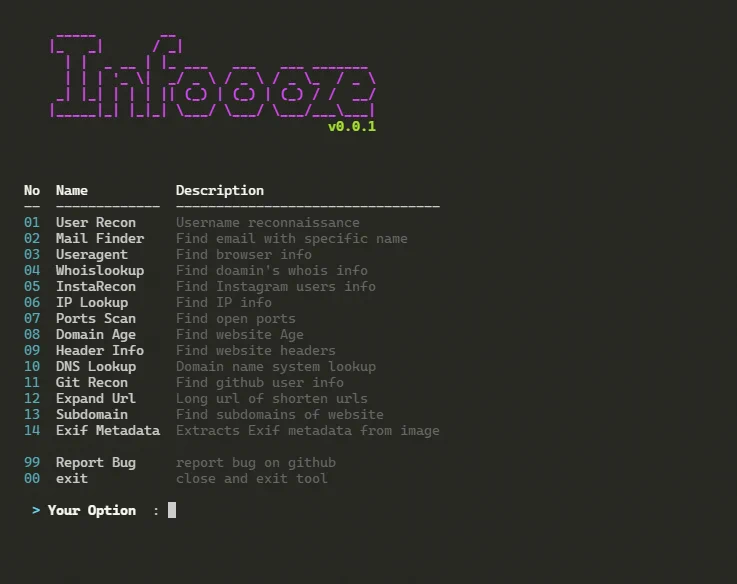
Infoooze is an open-source command-line OSINT reconnaissance toolkit (github.com/devxprite/infoooze) that consolidates common footprinting tasks into one CLI: username enumeration across platforms, email discovery, subdomain enumeration, port scanning, WHOIS/DNS lookups, IP/HTTP header analysis, EXIF metadata extraction, GitHub recon, and URL scanning/expansion. It automatically saves results, making it a lightweight all-in-one alternative to running several separate recon tools.

GitHub

OSINTΒ· Published and added 8 Oct 2026

galaxy.comarticleπŸ›‘οΈ Security

πŸ’§ Looting of Liquid Sidechain Underscores Emerging Cyber Threat to Bitcoin

Galaxy Research breaks down the theft of 4,000 BTC (~$320m) from the Liquid Network, a Bitcoin sidechain run by the Liquid Federation. Attackers exploited a bug in the sidechain node code to artificially mint 4,000 L-BTC, then abused an auto-forward feature offered by federation member SideSwap to bypass peg-out address whitelisting and withdraw real BTC to the main chain; the self-described "white hats" returned 85% but held 15% hostage, negotiating with developer Blockstream via PGP-encrypted OP_RETURN messages and demanding a 10% bug-bounty payout. The piece also contrasts this with concurrent Coldcard and BTCPay Server incidents and speculates about AI-assisted vulnerability discovery.

BitcoinLiquid NetworkBlockstream+3
Liquid Federationpeg-out whitelist bypassOP_RETURN encrypted negotiation

BlockchainΒ· Added 8 Oct 2026

latent.spacetalk🧠 AI

Synthesis Superintelligence: from Semiconductors to Superconductors β€” Periodic Labs’ Liam Fedus and Ekin Dogus Cubuk

A Latent Space podcast interview with Periodic Labs co-founders Liam Fedus and Ekin Dogus Cubuk on building "synthesis superintelligence" β€” AI systems that run reinforcement learning against noisy physical lab experiments rather than internet text, to discover new materials like room-temperature superconductors. They detail the end-to-end materials discovery loop (predicting stable configurations, synthesis, and characterization via X-ray diffraction), why RL reward design differs fundamentally in physical science versus math/coding (sample inefficiency, measurement noise, missing telemetry), the role of DFT simulations as imperfect ground truth, and their "matter compiler" vision for scaling autonomous high-throughput labs.

Periodic LabsLiam FedusEkin Dogus Cubuk+4

research, training, agentsΒ· Published and added 8 Oct 2026

coindesk.comarticleπŸ›‘οΈ Security

Bitcoin and ether holders urged to enter β€˜bunker mode’ against possible AI attacks

Ethereum researcher Justin Drake and co-founder Vitalik Buterin warn that rapid AI progress in mathematics could break the elliptic-curve signatures securing Bitcoin and Ethereum wallets within months - far sooner than quantum computers are expected to - urging large holders to enter bunker mode by migrating funds to addresses whose public keys have never been exposed onchain. Buterin also flags that lattice-based post-quantum schemes, the basis of NIST's signature standard, could face similar AI-driven erosion, pushing Ethereum's long-term roadmap toward hash-based signatures instead. The piece grounds the warning in already-documented AI-assisted exploit discovery: a 5-year-old Coldcard hardware-wallet firmware bug drained over 1,367 BTC, BTCPay Server Lightning-node thefts, Core Lightning bugs surfaced via AI-generated audits, and Anthropic's demonstration of AI models writing working exploits against simulated DeFi contracts.

BitcoinEthereumColdcard+3
Justin DrakeVitalik ButerinCoinkite+3

Blockchain, AI SecurityΒ· Published and added 8 Oct 2026

github.comrepoπŸ›‘οΈ Security

chainguard-dev/malcontent

malcontent is Chainguard's open-source malware/supply-chain discovery tool that analyzes binaries (ELF, Mach-O, PE, a.out) and scripting-language source across Linux, macOS and Windows using 14,500+ YARA rules (including third-party rules from Avast, Elastic, FireEye, Mandiant, Nextron and ReversingLabs). Its standout feature is differential analysis ("mal diff"), which compares two versions of a build artifact or OCI image against a known-good baseline to surface newly introduced risky behaviors β€” the technique the project demonstrates on the 3CX supply-chain compromise by flagging unexpected high-risk changes to libffmpeg. It also supports threshold-based scanning ("mal scan") and unfiltered capability enumeration ("mal analyze"), and is designed to run inside CI/CD pipelines, including air-gapped environments via embedded rules.

YARAGoRust+4
3CX Compromise

Supply Chain, Malware & RE, Blue Team & DetectionΒ· Added 8 Oct 2026

stepsecurity.ioarticleπŸ›‘οΈ Security

SubQuery npm package (@subql/common) compromised with credential-stealing payload

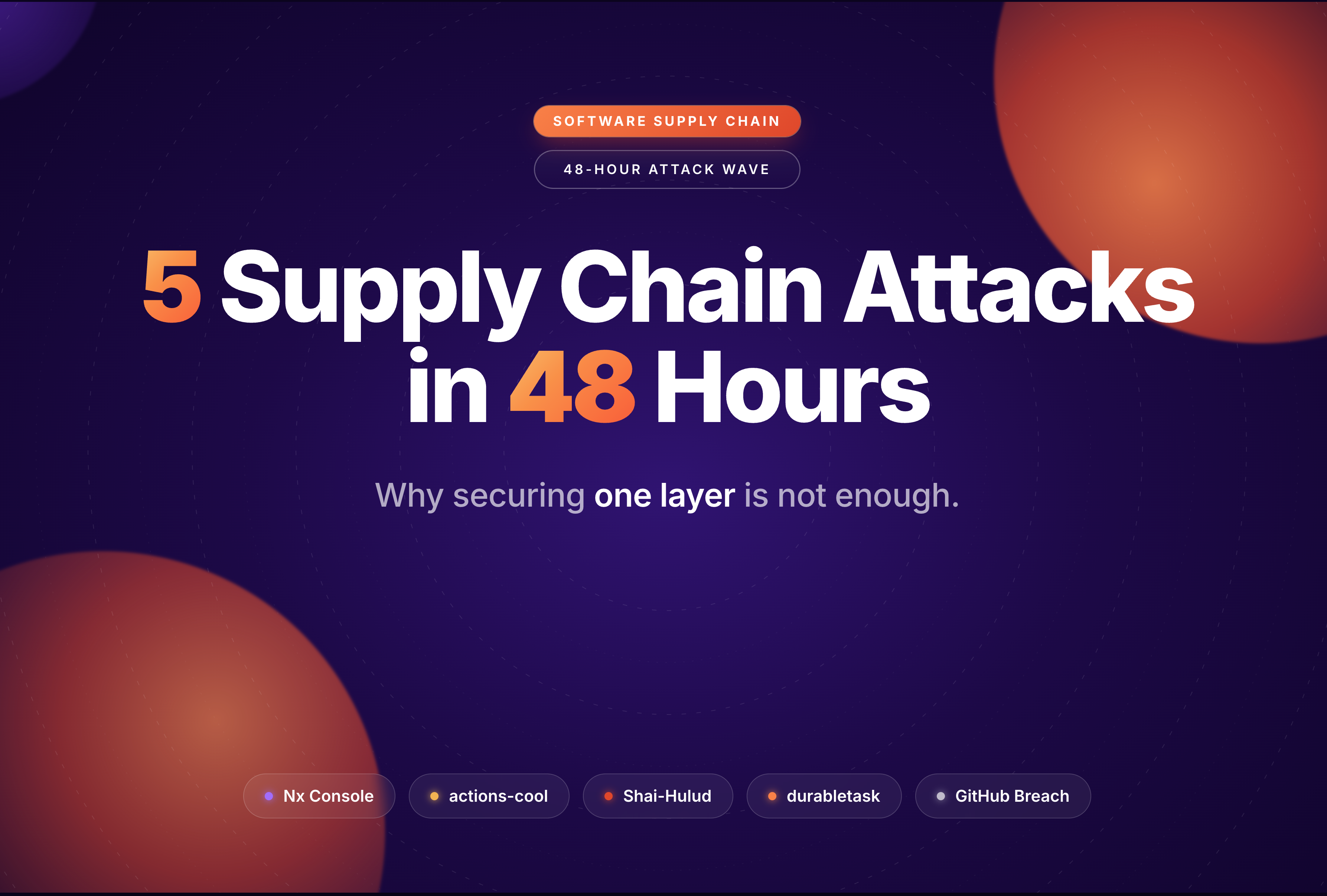
StepSecurity recaps a 48-hour (May 18-19, 2026) software supply-chain attack wave that hit every pipeline layer at once: the Nx Console VS Code extension (2.2M installs) stealing tokens from GitHub/npm/AWS/1Password, the trusted GitHub Action actions-cool/issues-helper hijacked via tag replacement, a trojanized Microsoft durabletask PyPI package pulled within a 35-minute discovery window, a self-replicating Shai-Hulud npm worm, and GitHub's own disclosure that ~3,800 internal source repos were exfiltrated. The piece argues traditional SCA/SAST/EDR/CNAPP tooling missed all of it because none monitor CI/CD runner runtime behavior (e.g., attackers reading /proc/pid/mem to extract secrets) or developer-machine IDE extensions, and ties the incidents to StepSecurity's Harden Runner, Dev Machine Guard, Compromised Actions Policy and Secure Registry controls.

GitHub ActionsVS Codenpm+6
Shai-HuludTeamPCPNx Console+3

Supply Chain, DevSecOps, Threat IntelΒ· Added 6 Oct 2026

arxiv.orgpaperπŸ›‘οΈ Security

Under the Hood of SKILL.md: Semantic Supply-chain Attacks on AI Agent Skill Registry

This arXiv paper studies SKILL.md files β€” the natural-language metadata describing modular AI Agent Skills β€” as an attack surface, demonstrating semantic supply-chain attacks against real ClawHub skills. Using text-only manipulations, the authors manipulate embedding-based Discovery retrieval (up to 86% pairwise win rate, 80% Top-10 placement), bias agent Selection toward adversarial variants (77.6% average success), and evade Governance blocking verdicts (36.5%-100% evasion), showing that skill metadata is operational text that shapes agent trust rather than passive documentation.

ClawHub

AI Security, Supply ChainΒ· Added 5 Oct 2026

eprint.iacr.orgpaperπŸ›‘οΈ Security

Randomness-Anchored Runtime Discovery of Cryptographic Operations on Linux Using eBPF

This IACR ePrint paper presents a Linux runtime cryptographic discovery system built on eBPF user-space probes that detects both classical and post-quantum (ML-KEM) cryptographic operations as they execute, complementing static binary/SBOM analysis with dynamic observation. It uses "randomness anchoring" β€” correlating observed key-generation/encapsulation randomness with subsequent crypto API calls in the same process β€” to raise detection confidence without adding false positives, reporting perfect precision/recall on classical and ML-KEM workloads, median detection latency of 28 ΞΌs, and 14–18% overhead on key-generation-bound workloads. A nine-application case study (drawn from/paired with QED datasets) compares static vs. runtime views and shows how eBPF probe coverage limits what can be observed, relevant to building a runtime cryptographic bill of materials for PQC migration compliance.

eBPFLinuxML-KEM+1
QED datasets

AppSec, GRCΒ· Added 8 Oct 2026, published 5 Oct 2026

x.comthreadπŸ›‘οΈ Security

Jan Curn (@jancurn) on X

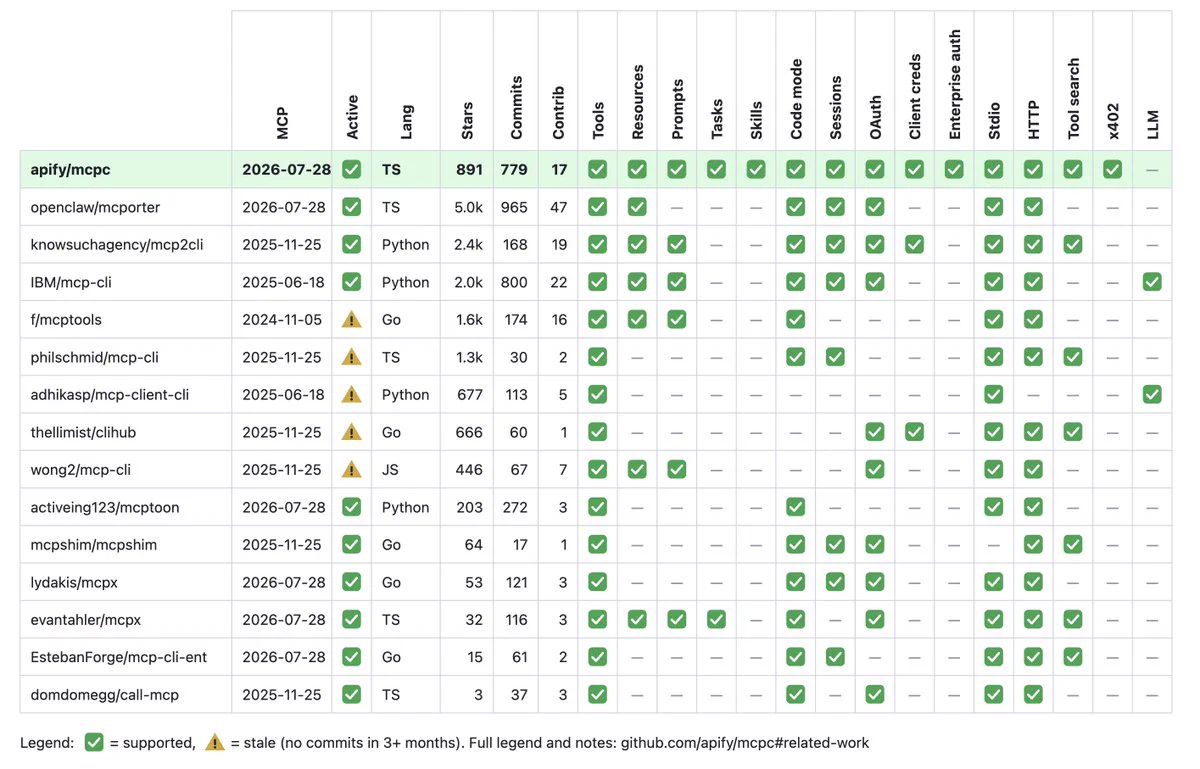
Announcement of mcpc v0.7.0, Apify's open-source MCP CLI client (npm i -g @apify/mcpc), which adds support for the MCP Skills extension with new skills-list/skills-get commands that verify SKILL.md and supporting files against the skill manifest via size and SHA-256 checks before printing content. The release also ships security hardening: repo-local .mcp.json auto-discovery can no longer read environment variables (blocking leaks like $GITHUB_TOKEN), OAuth refresh tokens are now scoped only to the auth server originally used, and Windows login URLs no longer launch through cmd.exe.

Model Context ProtocolOAuthnpm

AI Security, Identity & AccessΒ· Added 5 Oct 2026, published 3 Oct 2026

x.comthread🧠 AI

Jan Curn (@jancurn) on X

Jan Curn announces mcpc v0.7.0, an open-source MCP CLI client (npm package @apify/mcpc), adding support for the MCP Skills extension via new skills-list and skills-get commands that fetch and cryptographically verify SKILL.md and supporting files against the skill manifest (size + SHA-256). The release also hardens security by preventing repo-local .mcp.json auto-discovery from reading environment variables (blocking token-leak tricks), scoping refresh tokens to the originating auth server, and fixing an insecure Windows login URL launch path via cmd.exe, alongside OAuth session longevity fixes and 2026-07-28 MCP spec compatibility improvements.

Model Context ProtocolNode.jsOAuth
Jan CurnApifymcpc

mcpΒ· Added 5 Oct 2026, published 3 Oct 2026

github.comrepoπŸ›‘οΈ Security

MITRE ATLAS v2026.08 release β€” autonomous agent techniques

Release notes for MITRE ATLAS v2026.08, the adversarial AI/ML knowledge base (now 1 matrix, 16 tactics, 114 techniques, 83 sub-techniques, 39 mitigations, 72 case studies). This version renames the "AI Attack Staging" tactic to "AI Attack Adaptation," generalizes several techniques (e.g., Cloud Service Discovery β†’ Enterprise Resource Discovery, Process Discovery β†’ Enterprise Environment Discovery, Reverse Shell β†’ Cyber Communication Channel), and updates mitigations and techniques like LLM Prompt Crafting and Retrieval Content Crafting.

MITRE ATLAS
AI Attack AdaptationAI Attack StagingEnterprise Resource Discovery+8

AI SecurityΒ· Added 1 Oct 2026

arxiv.orgpaper🧠 AI

Are We Recovering Mechanisms? Objective-Level Recovery Gaps in Mechanistic Interpretability

This paper shows that intervention-defined faithfulness metrics used to evaluate automated circuit discovery in mechanistic interpretability can favor a worse circuit over a better one, an objective-level recovery gap. Testing EAP, EAP-IG, ACDC, and Edge-SP across four human-reference tasks and InterpBench, the authors find KL-based faithfulness misranks 9.4%-41.2% of candidate circuit pairs under held-out resampling, and trace the cause to context distortion, where excluded signals change the inputs retained components operate on. Restoring selected signals from the intact model's execution repairs 96 of 100 persistent misrankings, showing the evaluation objective itself, not just the search algorithm, needs fixing.

EAPEAP-IGACDC+1
InterpBench

ai-safety, researchΒ· Added 2 Oct 2026, published 1 Oct 2026

arxiv.orgpaper🧠 AI

EvoDuet: Bilevel Co-Evolution of Web Searching and Task Solving for Scientific Discovery

EvoDuet is a bilevel optimization method that co-evolves candidate solutions and web search queries for LLM-driven evolutionary search in scientific discovery tasks, keeping model parameters fixed. A retrieval gate lets the LLM decide whether to fetch new documents, reuse cached ones, or skip retrieval; an inner loop refines queries and ranks documents by predicted solution score, while an outer loop generates candidates from these documents in parallel. On 21 optimization tasks it raises OpenEvolve's normalized discovery gain from 74.1% to 78.0% with GPT-5.6 Luna and from 61.3% to 82.3% with Gemini 3.8 Flash (no benefit seen with Qwen3.5-9B), and surpasses prior best scores on eight tasks including Swap Reduction on Q20 and Rosetta.

GPT-5.6 LunaGeminiQwen3.5
EvoDuetOpenEvolveGemini 3.8 Flash+5

research, agentsΒ· Added 1 Oct 2026, published 30 Sep 2026

orca.securityarticleπŸ›‘οΈ Security

Connect Orca’s ChatGPT Plugin: Cloud Risk Context in Chat and Codex

Orca Security's plugin connects ChatGPT and Codex to Orca's MCP server, letting security teams and developers query cloud alerts, attack paths, effective IAM permissions, and code-to-cloud origins directly from chat or a coding agent instead of logging into a console. The post walks through six security-team use cases (exposure discovery, CVE impact triage, alert-to-blast-radius investigation, identity permission review, CISO reporting) and three developer workflows in Codex where alerts are traced back to the Terraform/code that created the misconfiguration and fixed in place.

Model Context ProtocolOrca SecurityChatGPT+3
CVE-2025-55182

Cloud & InfraΒ· Added 2 Oct 2026, published 30 Sep 2026

cloud.google.comarticleπŸ›‘οΈ Security

Vulnerability Discovery and Exploitation Trends in the AI Era (Google Cloud)

Google Threat Intelligence Group analyzes vulnerability disclosure and exploitation trends from January 2025 to August 2026, finding disclosures doubled, exploitation nearly doubled, and AI-assisted discovery surfaces proportionally more Medium and High-risk flaws, with 50 percent leading to remote code execution versus 26 percent baseline. It documents real-world exploitation of an AI-discovered CVE in BeyondTrust PRA and a surge in vulnerabilities targeting the AI/LLM operational stack, especially agent orchestration frameworks like Langflow and Flowise and inference gateways like LiteLLM and vLLM, citing specific CVEs in those products.

LiteLLMLangflowvLLM+3
CVE-2026-1731CVE-2026-42271CVE-2026-5027+7

Threat Intel, AI Security, AppSecΒ· Added 8 Oct 2026, published 30 Sep 2026

arxiv.orgpaper🧠 AI

Bridging LLM Agents and Data Spaces: An Architectural Mediation Approach using MCP

This paper proposes an architectural mediation approach, implemented as the "Eunomia Agent," that uses the Model Context Protocol to let LLM agents discover and invoke Data Space services as structured, schema-driven tools without modifying existing data space components. A prototype validates end-to-end interaction β€” catalog discovery, metadata retrieval, and data service invocation β€” while preserving governance, policy, and access-control constraints native to Data Spaces. It offers practical architectural guidance for organizations wanting to introduce AI-driven automation into governed, sovereign data-sharing ecosystems while maintaining compliance and interoperability.

Model Context Protocol
Eunomia Agent

research, mcpΒ· Added 28 Sep 2026

arxiv.orgpaperπŸ›‘οΈ Security

SEABench: Benchmarking Endogenous Misalignment In Self-Evolving Agents

SEABench is a benchmark of 48 longitudinal task sequences designed to study endogenous misalignment in self-evolving LLM agents β€” agents that modify their own controller instructions, memory protocols, and tools in response to feedback. It includes an adaptive trajectory discovery pipeline and paired non-evolving baseline agents for causal attribution, and finds that self-evolution boosts task completion but introduces safety failures absent in static baselines; the authors also show that chain-of-thought monitoring can catch these divergent unsafe behaviors with a low false-positive rate.

LLM
SEABench

AI SecurityΒ· Added 29 Sep 2026, published 28 Sep 2026

arxiv.orgpaper🧠 AI

SEABench: Benchmarking Endogenous Misalignment In Self-Evolving Agents

SEABench is a benchmark for studying "endogenous misalignment" in self-evolving LLM agents β€” agents that modify their own controller instructions, memory, and tools after deployment based on feedback. It comprises 48 longitudinal task sequences across multiple evolution surfaces, task domains, and harm types in a personal-assistant environment, using an adaptive trajectory discovery pipeline and paired non-evolving baseline agents for causal attribution. Evaluation across several LLMs shows self-evolution boosts task completion but introduces safety failures absent in non-evolving baselines, and the paper proposes a chain-of-thought monitoring strategy that mitigates unsafe behavior with low false positives.

SEABench

ai-safety, evals, agentsΒ· Added 29 Sep 2026, published 28 Sep 2026

ethresear.charticleπŸ›‘οΈ Security

PQ spending for Stealth Address Protocol

Third in a series on post-quantum upgrades to the Stealth Address Protocol (ERC-5564/ERC-6538), this ethresear.ch post proposes a new schemeId=6 that replaces ECDH with ML-KEM for quantum-safe payment discovery and replaces ECDSA with either a lattice-based signature (SPIRIT, an ML-DSA/Dilithium variant) or a novel construction called HSAP that uses ML-KEM key delivery plus a ZK proof over hash-preimages for spending authorization. It works through the exact key-generation/derivation math for both schemes, discusses on-chain verification costs (citing ETHDILITHIUM benchmarks and draft EIP-8051's ~4500-gas ML-DSA-44 precompile), and sketches how the extended ERC-5564 announcer/registry interface and smart-account spending path would look under quantum attack assumptions.

EthereumML-DSAML-KEM
ERC-5564ERC-6538EIP-8051+6

BlockchainΒ· Added 29 Sep 2026, published 28 Sep 2026

ethereum-magicians.orgwriteup🧠 AI

L402-over-eth-Layer2

L402-EL2 is an author's proposal and open-source implementation that adapts the Lightning-based L402 HTTP 402 payment pattern to Ethereum L2s, replacing invoices/preimages with a prefunded escrow contract and cumulative EIP-712 vouchers signed per call. It layers macaroons with caveats (tool, max_cumulative, expires_at) for HTTP credentials and attenuation to sub-agents, on-chain session keys with spending caps (ERC-1271/ERC-4337 compatible), and batch settlement, so an agent pays a provider per MCP tool call without a transaction per call. The stated design specifically meters MCP's tools/call, resources/read, and prompts/get while leaving initialize/tools/list free for discovery, aimed at agent orchestrators calling paid LLM APIs like the author's own LightPhon service; contracts are unaudited.

Model Context ProtocolSolidityTypeScript+3
L402LightPhonEthereum Magicians+4

ai-infra, mcpΒ· Added 29 Sep 2026, published 27 Sep 2026

github.comotherπŸ›‘οΈ Security

MCP Python SDK v2.2.0

Release notes for MCP Python SDK v2.2.0 detailing several security-relevant default changes: HTTP clients (Client, streamable_http_client, sse_client) now only follow redirects within the same origin, closing a cross-origin redirect trust gap; OAuth clients now validate the authorization server's issuer even on the legacy (non-protected-resource-metadata) discovery path, preventing metadata/issuer mismatch attacks; idle Streamable HTTP sessions now expire after 30 minutes with a 10,000-session cap to limit resource exhaustion; and a new AuthSettings.validate_token_resource setting lets servers reject bearer tokens not issued for them (audience/resource confusion). Deprecation warnings push OAuth provider configs toward requiring an explicit issuer ahead of a 3.0 breaking change.

Model Context ProtocolPythonOAuth
MCPDeprecationWarning

Identity & Access, AppSec, AI SecurityΒ· Added 27 Sep 2026

github.comrepoπŸ›‘οΈ Security

FirmAgent: Fuzzing + LLM Agents for IoT Firmware Vulnerability Discovery (NDSS 2026)

FirmAgent is an academic research toolkit (NDSS 2026) for finding vulnerabilities in re-hosted IoT firmware web services by combining IDA-based pre-fuzzing (CFG/sink distance scoring), QEMU instrumented tracing, CFG-guided API fuzzing, and an optional LLM agent (LLMATaint.py) that consumes runtime taint traces to reason about and produce PoCs for bug classes like command injection. The pipeline is explicit about scope: it is meant for authorized, owned or re-hosted firmware (e.g. Greenhouse-style containers), and stitches together sink-scope extraction, feedback-driven fuzzing, and request-to-trace attribution before handing traces to an LLM for taint-to-PoC analysis.

QEMUDockerPython+1
command injection

Hardware & RF, AI Security, Offensive SecurityΒ· Added 26 Sep 2026

github.comrepoπŸ›‘οΈ Security

MITRE ATLAS v2026.09 data release

Release changelog for MITRE ATLAS's atlas-data repository, the structured YAML/STIX dataset behind the ATLAS knowledge base of adversary tactics and techniques targeting AI-enabled systems (prompt injection, model/data poisoning, AI agent tool abuse, AI supply chain compromise). The v2026.09 release brings the matrix to 120 techniques, 88 sub-techniques, 40 mitigations, and 73 case studies, and recent versions introduced a new v6 YAML data format with Pydantic/SQLAlchemy/FastAPI tooling, platform tagging (Predictive AI, Generative AI, Agentic AI, Enterprise), and renamed/generalized techniques like "AI Agent Tool Poisoning," "Manipulate AI Model," and "Enterprise Resource Discovery." It's the canonical, actively-maintained taxonomy practitioners use for AI red-teaming, threat modeling, and mapping real-world AI attack case studies.

MITRE ATLAS
AML.T0019AML.T0058AML.T0104

AI SecurityΒ· Added 26 Sep 2026

arxiv.orgpaperπŸ›‘οΈ Security

Progressive Skill Discovery as Access Control for Tool-Using LLM Agents

Introduces skilder, a framework that enforces access control over enterprise tool access for LLM agents by packaging tools, instructions and limits into roles delivered progressively through a single MCP server, so an agent only ever receives tools it has explicitly learned/unlocked. The paper argues prompt-based policy is merely probabilistic advice, not a hard constraint, and evaluates skilder against flat-context tool selection and multi-agent orchestration across 13 tasks and six models, showing zero unauthorized tool calls or parameter violations (e.g., spending-limit breaches) once agents completed discovery.

Model Context ProtocolLLM

AI SecurityΒ· Added 26 Sep 2026

arxiv.orgpaper🧠 AI

Progressive Skill Discovery as Access Control for Tool-Using LLM Agents

Introduces "skilder," a framework that bundles LLM agent capabilities into roles (skills, tools, instructions, and limits) delivered progressively through a single MCP server, so an agent starts with a minimal catalog and only gains tool access as it learns the roles a task requires. This structural approach enforces access control deterministically at the server layer rather than relying on prompt-based policy, addressing context bloat and governance gaps in enterprise tool-using agents. Evaluated against flat-context tool selection and multi-agent orchestration across 13 tasks and six models, showing zero unauthorized tool calls or parameter violations when agents completed the discovery protocol.

Model Context Protocol
skilder

agents, research, mcpΒ· Added 26 Sep 2026

github.comrepo🧠 AI

MCP Python SDK v2.2.0

Release notes for MCP Python SDK v2.2.0, the reference Python implementation of the Model Context Protocol. Key changes: HTTP client redirects are now restricted to the same origin as the endpoint, idle Streamable HTTP sessions expire after 30 minutes (with a 10,000-session cap), OAuth authorization server metadata issuer checks are now enforced on the legacy discovery path, and new deprecation warnings push toward requiring explicit `issuer=` and `validate_token_resource` settings ahead of a 3.0 release.

Model Context ProtocolPython

mcpΒ· Added 26 Sep 2026

github.comadvisoryπŸ›‘οΈ Security

Insecure cryptographic defaults in oidcProvider: alg=none advertised and plain PKCE accepted by default

GHSA advisory for better-auth (< 1.6.11) documenting that the deprecated oidcProvider() and mcp() plugins publish "none" as a supported ID-token signing algorithm in their OIDC discovery document and default allowPlainCodeChallengeMethod to true, silently rewriting missing code_challenge_method to "plain" β€” both violating OAuth 2.1/RFC 9700. The fix removes "none" from the metadata, defaults plain PKCE to disabled, and rejects requests missing code_challenge_method instead of downgrading them; @better-auth/oauth-provider was never affected.

better-authOIDCOAuth
PKCERFC 9700OAuth 2.1

Identity & AccessΒ· Added 26 Sep 2026

arxiv.orgpaperπŸ›‘οΈ Security

HoF-Bench: Rediscovering Real AI-Discovered CVEs Without Frontier Models

HoF-Bench is a benchmark of 95 real, publicly disclosed CVEs originally found by AISLE's LLM-based vulnerability analyzer (280+ CVEs across 78 projects including OpenSSL, curl, and GnuTLS), repackaged into eight repositories pinned at vulnerable commits. Analyzers get source/target-file scope but no CVE ID, description, fix, or expected mechanism, and a detector-blinded frontier-model judge only credits findings that match the same code path, root cause, attack condition, and impact. Testing ten non-frontier backbones (open-weight 21B-284B and proprietary "flash"-tier models) in a fixed multi-pass scaffold, a minimal analyzer rediscovers up to 68% of the CVEs, with misses concentrated in C infrastructure code β€” showing small/cheap models can approximate frontier-level vulnerability discovery on known bug classes.

cURLOpenSSLGnuTLS+2

AI Security, AppSecΒ· Added 26 Sep 2026

arxiv.orgpaperπŸ›‘οΈ Security

OpenAnt: LLM-Powered Vulnerability Discovery Through Code Decomposition, Adversarial Verification, and Dynamic Testing

OpenAnt is an open-source (Apache 2.0) vulnerability discovery system that combines static program analysis with LLM reasoning in a three-stage pipeline: decomposing codebases into reachability-filtered analysis units (cutting analysis surface up to 97%), running adversarial verification where the model simulates a constrained attacker to judge exploitability, and validating candidates via dynamic testing in disposable sandboxed containers. Evaluated against large real-world projects including OpenSSL, WordPress, and Flowise, it reportedly surfaced previously unknown vulnerabilities while cutting false positives and keeping analysis cost manageable, positioning closed-loop LLM+exploit-validation pipelines as a practical path to scalable automated security analysis.

LLMOpenSSLWordPress+1

AI Security, AppSecΒ· Added 26 Sep 2026

arxiv.orgpaper🧠 AI

Agentic Economies for Autonomous Scientific Discovery

This paper argues that autonomous scientific discovery by multi-agent AI systems is bottlenecked not just by reasoning capability but by resource management, and proposes foundations for "scientific agent economies" - markets and institutions that let AI agents and human scientists set research priorities, assign credit, track accountability/liability, and guard against malicious use. It closes by discussing macro-level governance implications for ensuring equitable distribution of AI-driven scientific discoveries.

research, ai-policy, agentsΒ· Added 28 Sep 2026, published 25 Sep 2026

Showing 60 of 152

Show more