Skip to content

263 results for โ€œLMSโ€

What you seeeverything
mashable.comarticle๐Ÿง  AI

Anthropic takes steps to block Claude from reverse-engineering video games

Mashable reports, citing Tom's Hardware, that Anthropic's Claude has quietly begun restricting modding, decompiling and reverse-engineering of video game code. Anthropic has made no official announcement. The article ties the change to AI-assisted game ports and mods, the PlayStation 5 jailbreak and Take-Two's subpoenas after the GTA6 leaks. It notes the irony of AI firms now guarding copyright, and the risk that less restrictive LLMs win users.

ClaudeLLM
AnthropicTom's HardwareTake-Two Interactive+4

ai-policyยท Added 1 Nov 2026, published 31 Oct 2026

en.cryptonomist.charticle๐Ÿง  AI

Metaโ€™s AI-distilled model detector catches 79% at a 0.1% false-positive rate

WM-Basin is a Meta method for detecting student LLMs distilled from watermarked teacher models, described in "Watermark Basins: Black-Box Detection of Distilled LLMs" (arXiv:2610.37266, 27 October 2026). It feeds a suspect model's API text into a clean probe model and checks gradient alignment with a key-specific watermark basin. It reached 79% true-positive rate at 0.1% false-positive rate across 1,200 students, versus 29% for the prior token-level detector. Clean-data fine-tuning and paraphrasing weaken it.

LLM
MetaMeta FAIRMeta Superintelligence Labs+3

research, trainingยท Published and added 30 Oct 2026

github.comrepo๐Ÿง  AI

llm-trails: What LLMs reach for inside a breached AWS account

llm-trails is an open study of what LLMs choose to do next inside a breached AWS account. It puts 14 models in 13 post-compromise situations, records only a single-turn plan with nothing executed, and codes each answer to CloudTrail events. The repo has the llmtrials harness, prompts, codebook, processed dataset (viz_data.json) and an interactive dashboard, so the study can be rerun or extended.

AWSCloudTrailLLM+2
Adan Alvareztraildiscover.cloudClaude

evals, agentsยท Added 30 Oct 2026

github.comrepo๐Ÿ›ก๏ธ Security

llm-trails: What LLMs reach for inside a breached AWS account

llm-trails is a research repo that placed 14 LLMs in 13 post-compromise AWS situations, asked only for their next move (single-turn, nothing executed), and coded each answer to CloudTrail events. It includes the llmtrials harness, prompts, codebook, processed dataset (viz_data.json) and an interactive dashboard. Rates are conditioned on the situation shown, and the aim is turning model behavior into detection priorities.

AWSAWS CloudTrailLLM
traildiscover.cloud

AI Security, Cloud & Infra, Blue Team & Detectionยท Added 30 Oct 2026

depthfirst.comarticle๐Ÿ›ก๏ธ Security

dfbench โ€” depthfirst

dfbench is a held-out benchmark maintained by depthfirst that scores frontier LLMs on defensive security work: vulnerability detection, validation (precision) and differential analysis between commits. It reports recall, precision, F1 and cost per task by model and thinking level, split by application, low-level and smart-contract code and by single or multi-repo scope. Overall detection recall runs from about 21% to 69%, with the top figure at $99.19 per task for Mythos 5; validation precision mostly falls between 15% and 49%.

LLMKimi K3Grok+3
dfbenchdepthfirstGPT-5.6 Sol+3

AI Security, AppSecยท Added 29 Oct 2026

arxiv.orgpaper๐Ÿ›ก๏ธ Security

TextSeal2: Distortion-Free LLM Watermarking with Copula Mixing and Memoryless Races

TextSeal2 is a distortion-free LLM text watermark that merges two or more keys into one virtual key and couples it to fresh noise through AutoMark's Gaussian copula. Under speculative decoding it verifies keyed drafts with an extra exponential race, so output matches the target model and acceptance rate is unchanged. On three LLMs at a 10^-3 false-positive rate, it detects 8 to 22 points more 100-token answers than TextSeal.

TextSeal2TextSealAutoMark+2
Gumbel-max schemespeculative decodingGaussian copula+1

AI Securityยท Added 31 Oct 2026, published 29 Oct 2026

arxiv.orgpaper๐Ÿง  AI

TextSeal2: Distortion-Free LLM Watermarking with Copula Mixing and Memoryless Races

TextSeal2 is a distortion-free watermark for LLM output that keeps its signal under speculative decoding. It merges two or more keys into one virtual key coupled to fresh noise through AutoMark's Gaussian copula, and verifies drafts with an extra exponential race. On three LLMs it detects 8 to 22 points more 100-token answers than TextSeal at a 10^-3 false-positive rate.

LLMspeculative decodingGumbel-max watermarking+1
TextSeal2TextSealAutoMark+2

research, inferenceยท Added 31 Oct 2026, published 29 Oct 2026

arxiv.orgpaper๐Ÿง  AI

PhysCount: Do MLLMs Count Visual Appearances or Physical Entities?

PhysCount is a benchmark of 546 real-world images and 4,595 human-written questions in 651 target-specific groups. It tests whether multimodal LLMs can separate visible appearances (direct view, reflections, glass) from the physical entities behind them. Across 40 MLLMs, counting appearances is much easier than linking them to entities, and the best model answers every question correctly in only 13.36% of groups.

vision-language model
PhysCountarXiv

evals, multimodal, researchยท Added 31 Oct 2026, published 29 Oct 2026

arxiv.orgpaper๐Ÿ›ก๏ธ Security

Understanding and Mitigating Role Spoofing in LLMs

Understanding and Mitigating Role Spoofing in LLMs is an arXiv paper (October 2026) on role spoofing, a prompt injection where malicious tool output impersonates the user. It shows models track "who said what" using both content cues (semantics, style) and structure cues (control tokens, formatting). Attacks combining fake structure and content succeed often, adversarial training stops only content-based attacks, and linear probes trained to predict conversation roles detect spoofing across settings.

LLM
role spoofingrole confusionprompt injection+1

AI Securityยท Added 31 Oct 2026, published 29 Oct 2026

arxiv.orgpaper๐Ÿง  AI

Benchmarking color judgment in multimodal LLMs with CIE-computable ground truth

A five-task benchmark tests multimodal LLM color judgment against CIE colorimetric ground truth: AWB pair judgment, skin-tone bias direction, CCT estimation, Delta E 2000 pair ordering, and color naming under changing illuminants. Eight endpoints were tested. On ColorChecker-24 stimuli, closed frontier models reach CCT MAE of 715-1056 K versus 1358-2133 K for open-weight models, and a non-ColorChecker control shows this gap is partly template-dependent.

vision-language modelQwen3-VLGLM+2
GLM-4.5VGPT-5.4Claude-Opus-4.7+4

evals, multimodal, researchยท Added 31 Oct 2026, published 29 Oct 2026

tldrsec.comarticle๐Ÿ›ก๏ธ Security

[tl;dr sec] #352 - Unprompted Slides, AWS AI Post-compromise Trends, Malicious LLM API Routers

tl;dr sec #352 is a security newsletter issue covering [un]prompted talks (AI-assisted firmware patching, a "Security Constitution" for finding cloud design flaws), Azure API Connections cross-tenant bugs worth $200,000, and a test of 14 LLMs given AWS keys. It also covers a paper on malicious LLM API routers (9 of 428 injecting code) and Datadog's "counterfeit policy" bypass of the Jev classifier.

AzureAWSLLM+3
PHP2Shellprompt injectionpath traversal+9

AI Security, Cloud & Infra, Offensive Securityยท Added 30 Oct 2026, published 29 Oct 2026

arxiv.orgpaper๐Ÿง  AI

TrussTutor-Bench: Benchmarking large language models on solution accuracy, sycophancy, and error detection in statics

TrussTutor-Bench is a benchmark of 200 verified two-dimensional truss problems from statics, paired with automatically generated student solutions. It evaluates thirteen LLMs on solution accuracy (64.5% to 97.0%), error detection (90.4% to 100%) and sycophancy. Models rejected their own correct solutions in 1.6% to 50.0% of cases when a student insisted the work was wrong. Sycophancy separated models; error detection did not.

LLM
TrussTutor-BencharXiv

evals, researchยท Added 31 Oct 2026, published 28 Oct 2026

arxiv.orgpaper๐Ÿง  AI

Leaving, Staying, or Living There? Duration Commonsense Reasoning with Human-LLM Co-annotations

This paper studies whether vision-language models can infer how long a person stays somewhere (living, staying, or leaving) from geotagged social media posts. The authors build a new corpus of geotagged tweets co-annotated by humans and LLMs. State-of-the-art models struggle even with multi-turn Chain-of-Thought prompting, often missing contextual cues and subtle hashtags while over-relying on prominent visual details.

vision-language modelLLM
arXiv

research, evals, multimodalยท Added 30 Oct 2026, published 28 Oct 2026

arxiv.orgpaper๐Ÿง  AI

inkGround: Benchmarking Fine-grained Visual Grounding Capabilities of Vision-Language Models for Cursive Handwriting in the Wild

inkGround is a benchmark for stroke trajectory recovery from full-page, camera-captured handwriting, with 537 page images (about 18.7k words, 163k strokes) and pseudo-label references filtered by OCR agreement and human raters. Models get a page image and a target word, then output ordered stroke points. Seven VLMs were scored with DTW, Chamfer distance, readability and style similarity. Closed-source models, notably Gemini-3.1-Pro, did best, and the ranking held on IAM-OnDB.

vision-language model
inkGroundIAM-OnDBGemini-3.1-Pro+1

evals, multimodal, researchยท Added 30 Oct 2026, published 28 Oct 2026

arxiv.orgpaper๐Ÿง  AI

Can LLMs Uncover Hidden Physical Laws through Free Exploration?

LongChang is an automated framework that builds simulated worlds with altered physical laws, such as heavier objects falling more slowly, to test whether LLMs can find the law by free exploration. Explorer LLMs manipulate objects and build tools without tasks or hints, while separate LLM agents generate scenes, review tool designs and grade reports. Across 12 LLMs, GPT-6 Astra reached a 16.7% discovery rate and the other 11 scored 0%.

LLM
LongChangGPT-6 AstraarXiv

evals, research, agentsยท Added 28 Oct 2026, published 27 Oct 2026

arxiv.orgpaper๐Ÿง  AI

VideoLVR: Latent Visual Reasoning over Grounded Video Evidence

VideoLVR is a method that lets video multimodal LLMs build latent visual evidence from local regions at relevant moments and reason over it interleaved with text tokens. A visual token prediction objective, defined over a vocabulary derived from the input video, supervises the latents. It extends to reinforcement learning with sampled visual tokens as actions and final-answer rewards, and improves fine-grained video benchmarks without much context growth.

vision-language modelLLM
VideoLVRarXiv

research, multimodal, trainingยท Added 28 Oct 2026, published 27 Oct 2026

arxiv.orgpaper๐Ÿง  AI

As the Story Unfolds: Watching a Film and Identifying Characters as a Human Does

This paper defines a character naming task for films: given a name spoken in dialogue and its video context, the model must pick which visible character bears that name. It provides a dataset with annotations for character naming and first appearances, a video-and-dialogue model, and a comparison with proprietary multimodal LLMs. It also proposes a progressive framework that builds a character bank as the film plays, without cast lists or actor photographs.

multimodal large language model
arXiv

research, multimodalยท Added 28 Oct 2026, published 27 Oct 2026

arxiv.orgpaper๐Ÿง  AI

When Visual Evidence Is Insufficient: How Instructions, Post-Training, and Internal Activations Shape Refusal in Multimodal Language Models

This paper studies how multimodal LLMs refuse questions that an image cannot answer, using the MoHoBench benchmark on three MLLMs. It varies the meaning and placement of refusal instructions, compares supervised and preference-based post-training, and intervenes on a refusal-related activation direction. Instructions change refusal at the sample level in ways aggregate rates hide. Post-training raises refusal most but can mix refusal with attempted answers. Activation intervention gives smaller, transferable changes.

vision-language modelLLM
MoHoBencharXiv

ai-safety, multimodal, researchยท Added 28 Oct 2026, published 27 Oct 2026

lynchlab.netwriteup๐Ÿง  AI

A 10-year-old CNN outperforms frontier LLMs for skin cancer diagnosis

A dermatologist tested GPT-6 Astra and Claude Fable 5.1 on 200 biopsy-proven lesions from MILK10k, giving each a clinical and a dermoscopic image. A CNN (Inception v3, fine-tuned for about twenty minutes on 68,011 ISIC images) named the right diagnosis for 62% of lesions, against 42% for both LLMs. The post lists caveats (small sample, single run, possible contamination) and links the cases, prompts, replies and scoring code.

CNNGPT-6 AstraClaude Fable 5.1+4
MILK10kInternational Skin Imaging CollaborationISIC Archive+2

evals, multimodalยท Added 26 Oct 2026, published 25 Oct 2026

eprint.iacr.orgpaper๐Ÿ›ก๏ธ Security

A Kelseyโ€“Kohno Attack Variant against SHA-2 Message Digests in HSS/LMS and XMSS

Falko Strenzke's ePrint 2026/2635 presents a multi-target second-preimage attack on message hashing in HSS/LMS and XMSS with SHA-256 and SHA-256/192. It herds chaining states from many collected signatures into one state, defeating the key and leaf-index prefix. With 2^64 signatures, SHA-256 cost falls from 2^256 to about 2^166 (2^156 at maximal message length). SHAKE256 parameter sets are unaffected.

HSS/LMSXMSSSHA-256+2
Kelseyโ€“Kohno herding attackKelseyโ€“Schneier expandable messagemulti-target second-preimage attack+2

otherยท Added 26 Oct 2026, published 25 Oct 2026

arxiv.orgpaper๐Ÿ›ก๏ธ Security

Reversible Pseudonymisation of Documents Sent to External LLMs: an Open Bilingual Benchmark and an Engine

Open bilingual (Russian and UK English) benchmark of five open pseudonymisation tools and a regex baseline, plus a new engine built on the two strongest tools. On a held-out set of 1,000 synthetic documents per language, the best existing tools leave a whole personal value visible in 61% (Russian) and 58% (UK) of documents. The engine does so in 0.3% and 0.2%. Russian name restoration reaches only 94.6%, below the 99% threshold. Real documents were not tested.

LLMpii-guard

AI Securityยท Added 27 Oct 2026, published 25 Oct 2026

arxiv.orgpaper๐Ÿง  AI

Reversible Pseudonymisation of Documents Sent to External LLMs: an Open Bilingual Benchmark and an Engine

This paper presents an open benchmark of five existing pseudonymisation tools and a regex baseline on Russian and UK English documents, plus an open engine built on the two strongest tools. On a held-out set of 1,000 synthetic documents per language, the best existing tools leave a whole value visible in 58 to 61% of documents. The engine does so in 0.2 to 0.3%. Russian name restoration reaches only 94.6%, below the 99% threshold. Real documents were not tested.

LLMpii-guard
Vladimir BeskorovainyiarXiv

evals, llm-apps, researchยท Added 27 Oct 2026, published 25 Oct 2026

arxiv.orgpaper๐Ÿง  AI

Detecting and Understanding Ambiguity in Visualizations with Role-Playing Vision Language Model Interpretations

This paper presents a pipeline that uses persona-conditioned vision language models to surface interpretive ambiguity in visualizations. Topic-relevant personas elicit candidate takeaways, and a Target-Pattern-Scope framework lets LLM judges label statement pairs as Compatible, Disjoint or Opposing, which are summarized in an ambiguity profile. The authors benchmark VLMs on chart comprehension per chart type, check labeling against human annotations, and run case studies on public visualizations and a redesign.

vision-language modelLLM
arXiv

research, multimodal, evalsยท Added 27 Oct 2026, published 25 Oct 2026

arxiv.orgpaper๐Ÿง  AI

InteractiveWorld: A Verifiable Human-Centric Environment for Building Better Interactive MLLM Assistants

InteractiveWorld is an environment for closed-loop interaction between an AI assistant and a simulated human agent who sees the scene, follows instructions and acts independently. InteractiveBench, built on it, has 120 multi-turn tasks in six categories scored by verifiable, state-based rewards. Across 12 frontier MLLMs, the best model, Claude Fable 5.1, reaches at most 20% on long-horizon Guidance and 25% on Planning tasks.

multimodal large language model
InteractiveWorldInteractiveBenchClaude Fable 5.1+1

evals, multimodal, researchยท Added 27 Oct 2026, published 25 Oct 2026

arxiv.orgpaper๐Ÿง  AI

DRILS: Dependency-based Requirement Change Impact Analysis Using LLMs

DRILS is an LLM-based agentic framework for requirements change impact analysis. It uses multiple agents to generate candidate impact sets, with an LLM-as-a-judge promoting diversity in selection. It adds RE-RAG, a tuned retrieval technique, and a requirement dependency graph as a knowledge source. On three curated datasets it reaches 87.1% recall, 76.3% precision and 81% F1 at lower cost than baselines. The authors release the datasets.

LLMRAG
arXivDRILSRE-RAG

research, agents, llm-appsยท Added 27 Oct 2026, published 24 Oct 2026

arxiv.orgpaper๐Ÿง  AI

Build, Don't Play: Self-Improving LLM Research Agents Develop a Hearthstone Battlegrounds AI That Rivals Top Players

AutoTavern is a self-improving system of specialised LLM research agents with a typed shared memory and verification gates. In 20 days it built TavernGym, a full-content Hearthstone Battlegrounds simulator, and 23 versions of TavernAgent, a PPO-trained player. TavernAgent averaged placement 1.60 with 80% first places over its last 20 live games, beating the top ten players (2.34, 59%). On TavernBench (960 tasks), it answered 91% of play tasks against at most 63% for frontier LLMs.

PPOLLM
AutoTavernTavernGymTavernAgent+3

agents, research, training, evalsยท Added 27 Oct 2026, published 24 Oct 2026

arxiv.orgpaper๐Ÿง  AI

TriageRAG: Failure-Aware Self-Training for Adapting Retrieval-Augmented Language Models to Specialized Domains

TriageRAG is a failure-aware self-training method for adapting retrieval-augmented LLMs to specialized domains using only an unlabeled corpus. It probes the student on self-generated questions with and without retrieved context, sorts them into known, solved, context-failure and retrieval-failure, and routes each to a matching training signal. With Qwen3-4B on 11 datasets it beats budget-matched SimRAG by 1.2-6.4 points and recovers closed-book accuracy where retrieval hurts.

RAGLLMQwen3
TriageRAGSimRAGCS-Bench+1

research, llm-apps, trainingยท Added 27 Oct 2026, published 24 Oct 2026

arxiv.orgpaper๐Ÿ›ก๏ธ Security

Enhancing LLM-Based Vulnerability Detection via Representation-Aware Logical Ensemble

RALE (Representation-Aware Logical Ensemble) is a method for detecting vulnerabilities in C source code with LLMs trained on different code representations: raw source, Abstract Syntax Trees and Control Flow Graphs. The authors show the representations suit different vulnerability classes, and combine the models with explicit logical rules and majority voting. Single-representation models reach up to 73% F1, while the ensemble reaches 78%.

LLMC
RALERepresentation-Aware Logical EnsembleAbstract Syntax Tree+1

AI Security, AppSecยท Added 28 Oct 2026, published 24 Oct 2026

arxiv.orgpaper๐Ÿง  AI

Enhancing LLM-Based Vulnerability Detection via Representation-Aware Logical Ensemble

RALE (Representation-Aware Logical Ensemble) is a method for LLM-based vulnerability detection in C code. The authors train LLMs on raw source code, Abstract Syntax Trees and Control Flow Graphs, and find each representation works best for certain vulnerability classes. Combining the models with explicit logical rules and majority voting raises F1 from at most 73% for a single model to 78%, with gains in accuracy, precision and recall.

LLMstatic analysis
arXivRALE

research, trainingยท Added 28 Oct 2026, published 24 Oct 2026

arxiv.orgpaper๐Ÿง  AI

VulDec: Vulnerability Detection in Binaries via Neural Decompilation

VulDec is a dataset and framework for detecting vulnerabilities in binaries by first decompiling them with fine-tuned LLMs. The dataset aligns real-world Assembly-C function pairs across several architectures with CWE labels. Tuned neural decompilers reach about 56% Edit Similarity and 43% BLEU-4, and tuned detectors reach a macro F1 of 0.61 on a realistic test set with a 3% vulnerability rate.

LLM
VulDecCWE

research, trainingยท Added 28 Oct 2026, published 24 Oct 2026

eprint.iacr.orgpaper๐Ÿ›ก๏ธ Security

Provable Security of SHA-256-Based LMS Revisited in the Ideal-Cipher Model

Provable Security of SHA-256-Based LMS Revisited in the Ideal-Cipher Model is an October 2026 ePrint paper by Chun Guo, Hao Cheng, Bart Preneel and Meiqin Wang. It shows forgery attacks on LMS_SHA256_M32 and LMS_SHA256_M24 that exploit Merkle-Damgรฅrd structure, so the Katz and Fluhrer random-oracle bounds do not apply. It proves ideal-cipher-model bounds: about 256 minus log2 of the block count for M32, and a minimum of two terms for M24.

LMSSHA-256
KatzFluhrerLMS_SHA256_M32+4

otherยท Added 26 Oct 2026, published 24 Oct 2026

arxiv.orgpaper๐Ÿง  AI

Hey, guess what: CUES lead to inferences about typicality

The paper builds two corpora, EventTyp and the human-validated EventTypGold, to study how people infer typicality and atypicality of events from what is said. Large-scale human and LLM experiments show that three CUES predict these inferences in humans: Commonsense Knowledge, Utterance Emphasis and Snark. In most settings LLMs lack the commonsense knowledge to judge an event's general typicality, so they struggle to follow the CUES.

LLM
EventTypEventTypGoldarXiv

research, evalsยท Added 27 Oct 2026, published 23 Oct 2026

latent.spacearticle๐Ÿง  AI

AI Is Getting Good at Math. Hereโ€™s Why.

The essay argues that LLMs solve open math problems because they search depth first, and automated verifiers make failed attempts cheap. It uses WT Gowers' hint-sequence complexity (2^k + t), adds a branching factor b, and walks through OpenAI's unit-distance disproof and Cycle Double Cover prompt as a drafter/solver/verifier harness. It predicts AI does best where k and b are small.

LLM
OpenAIAnthropicLatent Space+12

research, agentsยท Published and added 23 Oct 2026

arxiv.orgpaper๐Ÿ›ก๏ธ Security

On Task, Off Track: Benchmarking LLM and Agent Robustness to Near-Target Prompt Injection

NTBench (Near-Target Benchmark) tests LLM and agent robustness to near-target prompt injection, where injected instructions steer a response toward a plausible but incorrect or harmful outcome instead of abandoning the task. It builds reference-guided target-instruction pairs on existing datasets, with human validation, and evaluates seven LLMs on ten language datasets and two agent benchmarks. Attack success rose 9.3 to 35.8 points (incorrect targets) and 1.7 to 17.3 points (harmful targets) over fixed-target baselines.

LLM
NTBenchnear-target prompt injectionprompt injection

AI Securityยท Added 26 Oct 2026, published 23 Oct 2026

arxiv.orgpaper๐Ÿง  AI

BiLoCo: Binary Low-Rank Corrections for Post-Training Quantization

BiLoCo is a post-training quantization method for FP4 LLMs that adds low-rank corrections whose left and right factors are stored as binary ยฑ1 sign vectors instead of BF16. This uses 16x less storage per rank-one component and lets the correction run on CUDA cores alongside the FP4 tensor-core GEMM. On 4B to 72B LLMs it matches or improves memory-matched SVDQuant. A fused B300 kernel is at most 11% slower than FP4-only GEMM at batch size 1 for ranks up to 512.

CUDALLMdiffusion model
BiLoCoSVDQuantNVIDIA+1

inference, researchยท Added 26 Oct 2026, published 23 Oct 2026

anthropic.comarticle๐Ÿ›ก๏ธ Security

LLMs are making formal software verification feasible at a much larger scale

Anthropic and Theorem report using Claude to write Rocq proofs that 239 fuzz entry points across 123 OSS-Fuzz libraries never crash on inputs under 64 MB, at the RISC-V binary level (about 180 million lines of proof). Claude patched the bugs it found along the way, including a rediscovery of a libexpat CVE and bugs fuzzers would miss. The post covers trusted components, limitations, token-cost trends and released proofs.

ClaudeRocqRISC-V+3
CVE-2026-56132TheoremOSS-Fuzz+5

AppSec, AI Securityยท Added 23 Oct 2026, published 22 Oct 2026

anthropic.comarticle๐Ÿง  AI

LLMs are making formal software verification feasible at a much larger scale

Anthropic and Theorem report that Claude wrote Rocq proofs of crash-freedom for 239 OSS-Fuzz entry points across 123 open-source libraries, working on compiled RISC-V binaries for inputs up to 64 MB. Proofs total about 180 million lines, and Claude found and patched bugs along the way. The post covers proof reuse (17% fewer tokens), Opus 5.5 using about 40% fewer tokens than Opus 5, and limitations.

RocqRISC-VVerus+10
CVE-2026-56132AnthropicClaude+11

research, coding-agentsยท Added 23 Oct 2026, published 22 Oct 2026

arxiv.orgpaper๐Ÿง  AI

Who Is Sycophantic to Whom? Confident LLMs, Human Deference, and the Collapse of Trust Calibration

This paper studies reverse sycophancy: whether users bend toward a confident, consistent, wrong LLM. In a within-subjects experiment, 32 participants learned science topics from five GPT-5-mini assistants with 0 to 100% of facts replaced by falsehoods. Scores fell from 7.4 to 2.9 out of 10, planted falsehoods were chosen on 60% of falsified items against 11% of correctly taught ones, and confidence stopped tracking correctness. It introduces a baseline-corrected Human Deference Index.

LLM
GPT-5-miniarXiv

research, ai-safety, evalsยท Added 24 Oct 2026, published 22 Oct 2026

arxiv.orgpaper๐Ÿง  AI

Rethinking Sequence Compression with Test-time Regression

TTR-Compressor is a sequence compression method that treats input tokens as a test-time regression problem. The regression is learned end-to-end by backpropagation, and its coefficients are solved in closed form in the forward pass to give the compressed representation. As a block-wise sparse attention compressor it improves RULER over attention-based compressors by a large margin. As a visual token merger for multimodal LLMs it beats the MLP merger and matches it with 55.6% fewer visual tokens.

TransformerLLMvision-language model
TTR-CompressorRULERarXiv

research, multimodalยท Added 24 Oct 2026, published 22 Oct 2026

arxiv.orgpaper๐Ÿง  AI

An Empirical Study of Recent Large Language Models for Knowledge Graph to Text Generation on Standard Benchmarks

This empirical study benchmarks recent LLMs against fine-tuned encoder-decoder models on knowledge graph-to-text generation, using reference-based metrics and graph-grounded, reference-free LLM-based evaluation validated against human annotations. Recent LLMs narrow or close the gap on reference-based metrics and do better on graph-grounded ones. Prompted models make fewer contradictions and triple omissions, and fine-tuned models' errors grow faster with graph size.

LLMTransformer
arXiv

research, evalsยท Added 24 Oct 2026, published 22 Oct 2026

arxiv.orgpaper๐Ÿง  AI

The Geometry of Metaphor: Probing and Steering Metaphor Representations in Large Language Models

The Geometry of Metaphor is an October 2026 arXiv preprint that uses mechanistic interpretability to find causal subspaces for metaphor in LLMs of different architectures and sizes. The authors steer output on classification tasks across parts of speech. They also steer generation tasks, showing the metaphoricity of model output can be controlled. The abstract gives no model names or metrics.

LLM
arXiv

researchยท Added 24 Oct 2026, published 22 Oct 2026

arxiv.orgpaper๐Ÿง  AI

DuoCook: An Overcooked-Inspired Benchmark for Visual Planning and Coordination

DuoCook is an Overcooked-inspired benchmark in which one vision-language model controls two cooks from top-down views in Unreal Engine environments built with coding agents. It has 20 maps in five categories covering equipment contention, changing terrain and handoff dependencies. Four VLMs were compared; the best, gpt-6-astra, reached 26.2% mean order completion. A notebook memory ablation had mixed effects: positive for Claude and Qwen, negative for GPT and Gemini.

Unreal Enginevision-language model
DuoCookGPT-6 AstraClaude+4

evals, agents, multimodalยท Added 24 Oct 2026, published 22 Oct 2026

arxiv.orgpaper๐Ÿง  AI

Training Small Language Models for Transferable Tool Selection

This paper trains small open language models with reinforcement learning to select tools for multi-step instructions over corpora of more than ten thousand tools. A Qwen3-8B model post-trained with the recipe outperforms Llama-4-Maverick (402B) on ToolBench. The trained model transfers to different retrievers and generalizes to new tool corpora in other domains, without relying on proprietary LLMs like Claude or ChatGPT.

Qwen3LlamaLLM
ToolBenchClaudeChatGPT+1

research, training, agentsยท Added 24 Oct 2026, published 22 Oct 2026

arxiv.orgpaper๐Ÿง  AI

From Structured Records to Patient Narratives: Preserving Clinical Alignment in LLM-Generated Health Summaries

This paper studies evidence-grounded health summarization for menstrual health monitoring. It combines structured evidence conditioning with RAG in a prompt-based constrained generation framework, and scores 4,500 summaries from three LLMs with NLI, atomic factuality metrics and readability measures. Grounding constraints improved uncertainty preservation and generally kept or improved faithfulness against retrieved evidence, while omission effects varied by model. Clinical alignment came with harder reading and more medical terminology.

LLMRAG
arXiv

research, evals, llm-appsยท Added 24 Oct 2026, published 22 Oct 2026

arxiv.orgpaper๐Ÿง  AI

Drift Says When, Budget Says How Much: Rate-Controlled KV Re-selection for Long-Form Multimodal Generation

Rate-Controlled Refresh (RCR) is a KV cache re-selection method for multimodal LLMs in long-form generation. Attention drift decides when and where to re-select visual tokens, and a per-sample controller sets how often. RCR beats InfiniGen by 1.6-3.8 ROUGE-L points on five of six model-task settings and stays within 1.7 points of exact per-step re-selection. On video description, where drift is homogeneous, it no longer beats a fixed threshold.

Qwen2-VLQwen3-VLInfiniGen+1
DetailCaps

research, inference, multimodalยท Added 24 Oct 2026, published 22 Oct 2026

arxiv.orgpaper๐Ÿ›ก๏ธ Security

SecLog-Bench: A Scalable Benchmark for Cybersecurity Log Reasoning with Scaffolded Evidence

SecLog-Bench is a benchmark for LLM reasoning over cybersecurity logs, built on an extensible simulation platform covering 29 attack scenarios. It combines audit logs, application logs and network traffic, with attack-stage labels and step-by-step evidence chains. Eight LLMs were tested on post-detection attack-progress reasoning: the best reached 44.44% accuracy, 45.07% Macro-F1 and 54.87% Stage Reasoning F1.

LLM
SecLog-BenchStage Reasoning F1

AI Security, Blue Team & Detectionยท Added 23 Oct 2026, published 22 Oct 2026

arxiv.orgpaper๐Ÿง  AI

SecLog-Bench: A Scalable Benchmark for Cybersecurity Log Reasoning with Scaffolded Evidence

SecLog-Bench is a benchmark for LLM reasoning over cybersecurity logs. A simulation platform with 29 attack scenarios generates audit logs, application logs and network traffic, with attack-stage labels and step-by-step evidence chains. Eight mainstream LLMs were tested on attack-progress reasoning: the best reached 44.44% accuracy, 45.07% Macro-F1 and 54.87% Stage Reasoning F1. Correct predictions often came with flawed reasoning.

LLM
SecLog-BencharXiv

evals, researchยท Added 23 Oct 2026, published 22 Oct 2026

arxiv.orgpaper๐Ÿง  AI

Disentangling Robustness and Sycophancy in Multilingual LLMs

The SC-matrix is an evaluation framework for multilingual LLM sycophancy. It crosses a model's competence (correct answer with no pressure) with its sycophancy (keeping that answer under pressure), so agreeing with a false premise can be told apart from not knowing the answer in that language. Results: equal aggregate sycophancy rates hide different failure mixes, high competence does not always protect, and reasoning-oriented mitigations beat directive ones.

LLM
arXiv

ai-safety, evals, researchยท Added 24 Oct 2026, published 22 Oct 2026

huggingface.coarticle๐Ÿง  AI

How Specializing the Vocabulary of SLMs Can Cut Inference Cost by 77% in Real Applications

VocabX is a vocabulary adaptation method from Dharma-AI that selects sub-word and multi-word "macro" tokens by serving cost instead of frequency. On a Qwen3-4B Portuguese essay grader, response length fell from 350 to 101 tokens, the LM head shrank from about 152,000 to 65,000 rows, and measured cost dropped 77.0% on an RTX 5090 with vLLM. The bench score rose from 0.703 to 0.810. It beat FVT, MWT and in-place BPE across 15 model and domain combinations.

Qwen3vLLMLlama+3
Dharma-AIVocabXQwen+1

inference, training, researchยท Published and added 21 Oct 2026

simonwillison.netwriteup๐Ÿง  AI

Battle Drones - a vibe coded RTS with audio-based multiplayer

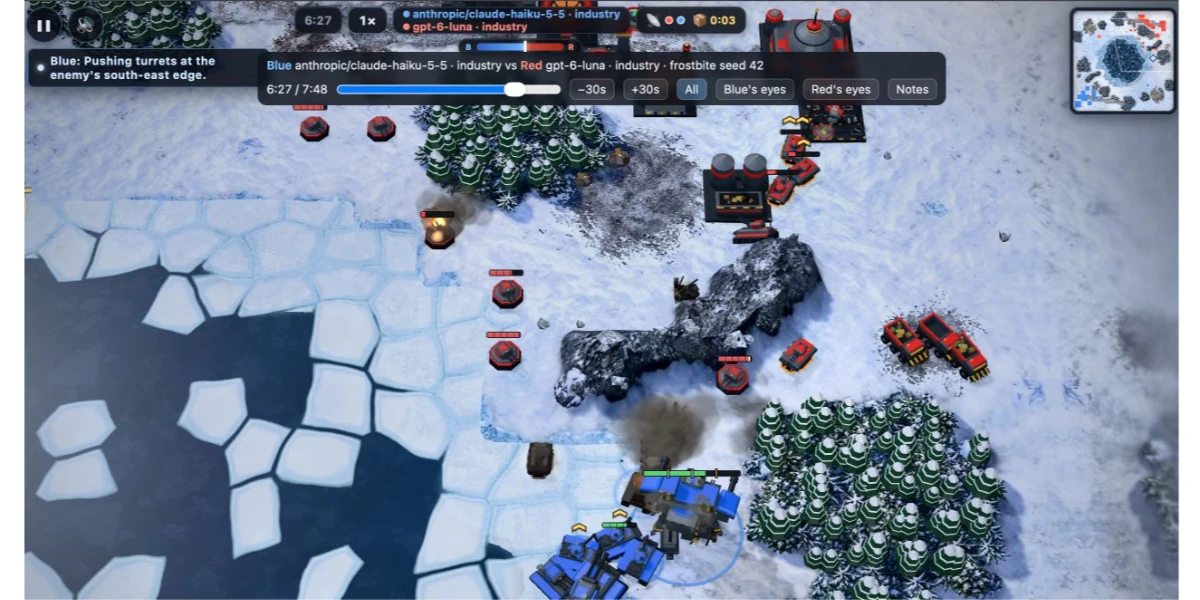
Battle Drones is a browser-based Command & Conquer style RTS that Simon Willison built over 12 iterations and 321 commits, mostly with Claude Code and Claude Opus 5.5. The post gives key prompts and transcripts per version, including the "Make it a LOT more fun" run in Ultracode mode. It also covers an Agent vs. Agent mode for LLMs, audio-modem multiplayer between nearby phones, and lessons on deterministic simulation and code-generated 3D models and music.

Claude CodeTypeScriptThree.js+6
Simon WillisonClaude Opus 5.5Claude Fable 5+5

coding-agents, agentsยท Published and added 20 Oct 2026

arxiv.orgpaper๐Ÿ›ก๏ธ Security

Combining Long-Term Memory and LLMs Comes at a High Cost: From Prompt Injection to Persistent Compromise

Paper on memory injection, where prompt injection persists across sessions through the long-term memory of LLM-as-a-service platforms. It presents a general threat model and shows all NIST attack goals are achievable on ChatGPT Instant 5.3, Claude Sonnet 4.6 and Gemini 3 Flash. Vectors include personal memories, projects, skills, organization instructions and MCP resources. On Claude, shared memory lets an attacker compromise multiple users in an organization and exfiltrate prompts. Nearly half of the derived mitigations are unimplemented.

ChatGPTClaudeGemini+2
memory injectionprompt injectionNIST+2

AI Securityยท Added 24 Oct 2026, published 20 Oct 2026

arxiv.orgpaper๐Ÿง  AI

InterWebCoder: Learning Interactive Webpage Generation from Executable Tests via Reinforcement Learning

InterWebCoder is a framework for interactive webpage code generation by multimodal LLMs. It synthesizes self-contained webpages with executable test scripts from recorded interaction trajectories, repairs failures using runtime evidence, then trains with test-ID-weighted SFT and GRPO using test pass rates and visual similarity as rewards. The pipeline yields 1,736 verified samples from 2,058 tasks. A 9B model scores 48.54 on IWR-Bench and 48.42 on Vision2Web, and reward latency drops over 97%.

GRPOvision-language modelLLM
InterWebCoderIWR-BenchVision2Web+3

research, training, multimodalยท Added 22 Oct 2026, published 20 Oct 2026

arxiv.orgpaper๐Ÿง  AI

Benchmarking Arabic Dialects for Math Problems

DAR-MGSM (Dialectal Arabic Multilingual Grade School Math) is a manually curated benchmark for mathematical reasoning in Dialectal Arabic. It covers five major Arabic dialects plus Modern Standard Arabic, in a translated-only version and a translated and culturally localized version. Eleven Arabic-centric and multilingual LLMs were tested: accuracy generally drops on the localized version, and a mechanistic interpretability analysis shows the two variants induce distinct internal reasoning trajectories.

LLM
DAR-MGSMarXiv

evals, researchยท Added 22 Oct 2026, published 20 Oct 2026

arxiv.orgpaper๐Ÿง  AI

Code2Video-Compass: A Comprehensive Benchmark for General-Purpose Code-Based Video Generation across T2V, I2V, and V2V

Code2Video-Compass is a benchmark of 2,104 tasks for code-based video generation, where multimodal LLMs write executable programs that produce complete videos from text (T2V), image (I2V) or video (V2V) inputs. Tasks span 10 categories and 24 subtypes. Scoring uses 12 objective metrics and five MLLM-judge metrics. Across 15 proprietary and open-weight models from nine families, performance falls as construction, dynamic animation and state-dependency complexity rise.

vision-language modelLLM
Code2Video-CompassarXiv

evals, multimodal, researchยท Added 22 Oct 2026, published 20 Oct 2026

arxiv.orgpaper๐Ÿง  AI

DeclineCraft: A RAG Abstention Benchmark for Jointly Measuring Combined Retrieval and Parametric Knowledge

DeclineCraft is a dynamic RAG abstention benchmark whose unanswerable questions target Minecraft feature additions made after a corpus cut-off, with audits for parametric exposure. Across 27 LLMs, single-shot retrieval raises Correct Abstention Rate in 38 of 40 configurations, while iterative RAG lowers it in 30 of 40. Enabling thinking without retrieval lowers abstention for 8 of 13 models, shifting responses to premise denial.

RAGLLM
DeclineCraftMinecraftarXiv

evals, llm-apps, researchยท Added 22 Oct 2026, published 20 Oct 2026

peec.aiwriteup๐Ÿง  AI

Publish fake stats, get cited in LLMs

StateGlobe is an experiment in which a Peec AI researcher generated 50,000 fake statistics pages with GPT-4.1 for about $50. After 7 months, Google had deindexed the site, but ChatGPT-User still made about 72,000 requests in 30 days. The site drew 10,000+ ChatGPT sessions and 330+ referring domains, and its numbers were cited in an academic paper and bank research. The post explains why retrieval differs from ranking and how to build real statistics pages.

ChatGPTGPT-4.1Cloudflare+6
Peec AIStateGlobeOpenAI+11

llm-apps, ai-policyยท Added 21 Oct 2026, published 20 Oct 2026

simonwillison.netarticle๐Ÿง  AI

My obituary for programming

Simon Willison's 19 October 2026 link post points to Jeremy Scheff's essay "My obituary for programming". Scheff argues coding agents remove what career programmers enjoyed: paid work on tricky logic puzzles where they set strategy and timelines. Willison notes that LLMs suit programmers who care about building working systems, while those who loved solving the problems face a real loss. The post is a short quote with no data.

LLM
Simon WillisonJeremy Scheff

ai-policy, coding-agentsยท Added 20 Oct 2026, published 19 Oct 2026

arxiv.orgpaper๐Ÿง  AI

OpenVLHarness: Real World Visual Agentic Tool-Use with Multimodal Memory

OpenVLHarness is a multimodal reasoning harness for MLLMs built on a capability layer (task-level tool interfaces plus evidence rendering) and persistent multimodal memory that stores images, structured data and web references as addressable artifacts. A coding interface runs generated programs over stored data. Across 22 benchmarks and eight backbones it adds 9.7-12.6 points over no-tool baselines, and GPT-6 Luna at medium effort beats Codex and Visual Sketchpad at maximum effort using at most 37% of their tokens.

vision-language modelQwen3-VLCodex+1
OpenVLHarnessKimi K3GPT-6 Astra+3

agents, multimodal, researchยท Added 21 Oct 2026, published 19 Oct 2026

arxiv.orgpaper๐Ÿง  AI

Where is Physical RSI capability from? An Observational Scaling Law of LLM-as-policy

The paper introduces PhysRSI-eval, a five-axis metric for physical recursive self-improvement: first-attempt performance, efficiency, success, budget and improvement from failure. Several VLMs are tested on 18 manipulation tasks under a fixed interaction budget. It proposes the Physical Barrel Hypothesis and studies observational scaling. Workspace interventions show that removing history lowers late-round success, while frozen workspaces still help on unseen layouts.

vision-language modelLLM
PhysRSI-evalPhysical Barrel HypothesisarXiv

research, evals, multimodalยท Added 21 Oct 2026, published 19 Oct 2026

arxiv.orgpaper๐Ÿง  AI

TokenGate: Adapting LLMs for Fast and Memory-Efficient Prefill with Learned Token Pruning

TokenGate is a small drop-in component that adds end-to-end learnable token pruning to trained LLMs for long-context prefill. It uses token-gated attention, inspired by Mixture-of-Experts, to re-weight attention logits with token importance scores, which gets gradients through the non-differentiable top-K step. The authors report 1.4-11.3x faster time-to-first token and 1.5-3.4x lower peak memory with no accuracy loss, on Qwen3 and Qwen3.5.

TransformerQwen3Qwen3.5+2
TokenGatearXiv

research, inferenceยท Added 21 Oct 2026, published 19 Oct 2026

Showing 60 of 263

Show more