Skip to content

46 results for β€œCWE”

What you seeeverything
x.comadvisoryπŸ›‘οΈ Security

lee1981 (@lee1981b) on X

CVE-2026-103780 is a stack-based buffer overflow (CWE-121) in Dell PowerProtect Data Domain / DD OS. An unauthenticated remote attacker could get command execution (CVSS 3.1 9.8, Dell DSA-2026-416). The post lists affected and fixed builds for four release trains (Feature Release, LTS2024, LTS2025, LTS2026). It adds KEV, EPSS and SSVC status, plus six defensive checks. The vulnerable service is not public.

Dell PowerProtect Data DomainDD OSCVSS+2
CVE-2026-103780CVE-2026-86400CVE-2026-86397+5

Blue Team & Detection, Cloud & InfraΒ· Added 31 Oct 2026, published 29 Oct 2026

x.comadvisoryπŸ›‘οΈ Security

lee1981 (@lee1981b) on X

CVE-2026-92885 is a critical (CVSS 3.1 9.8, CWE-287) authentication bypass in the Qode Membership WordPress plugin, versions through 2.0.6.2. A misspelled variable in the Facebook token-verification guard skips provider checks, so an unauthenticated attacker with a public nonce can get a session cookie for an existing account, including an administrator. The post gives the fix (2.0.6.3, bundled in Bridge 30.9), KEV/EPSS/SSVC status, and a SOC log-correlation and remediation plan.

WordPressQode MembershipBridge+3
CVE-2026-92885CWE-287Wordfence+4

AppSec, Identity & Access, Blue Team & DetectionΒ· Added 31 Oct 2026, published 28 Oct 2026

x.comadvisoryπŸ›‘οΈ Security

lee1981 (@lee1981b) on X

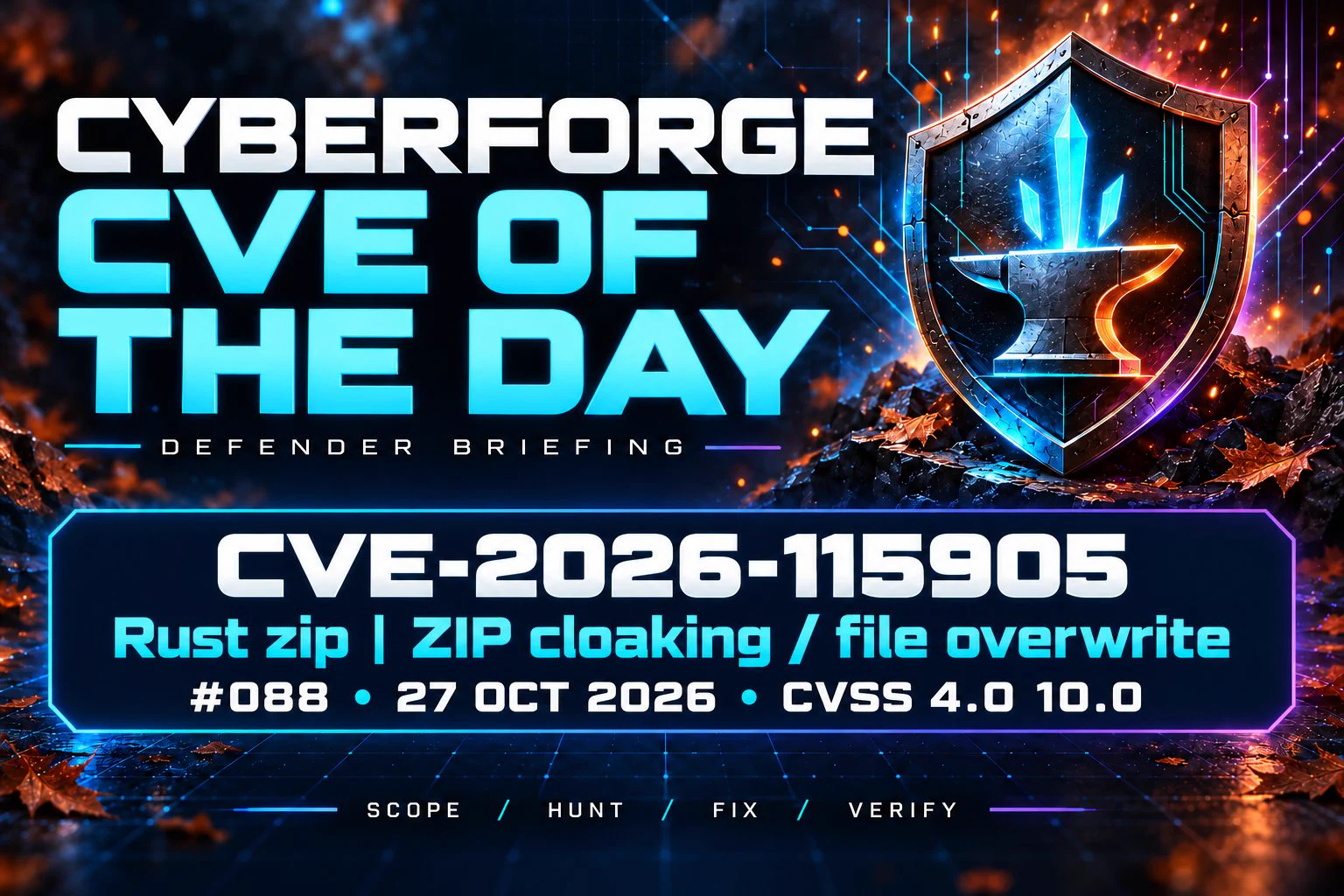
CVE-2026-115905 is a ZIP cloaking flaw in the Rust zip crate (zip-rs/zip2), rated CVSS v4.0 10.0 and affecting versions below 9.0.5. ZipArchive reads central-directory metadata while ZipStreamReader reads local headers, so a crafted archive can pass filename inspection and then overwrite a different file during streaming extraction. Version 9.0.5 adds consistency checks, but ZipStreamReader::new leaves them off by default, and extraction is not atomic, so files can be written before an error is raised. The post covers CWE-20 and CWE-436, KEV and EPSS status, Debian status and a six-step investigation trail.

Rustzip crateCargo+3
CVE-2026-115905CWE-20CWE-436+3

AppSec, Blue Team & DetectionΒ· Added 29 Oct 2026, published 27 Oct 2026

cisa.govadvisoryπŸ›‘οΈ Security

Mitsubishi Electric and Mitsubishi Electric Iconics Digital Solutions GENESIS, GENESIS64, ICONICS Suite, Hyper Historian, AnalytiX, MobileHMI, IoTWorX, MC Works64, GENESIS32 and BizViz

CISA advisory ICSA-26-300-02 covers four vulnerabilities in Mitsubishi Electric and Mitsubishi Electric Iconics Digital Solutions GENESIS64, ICONICS Suite, Hyper Historian, AnalytiX, MobileHMI, IoTWorX, MC Works64, GENESIS32 and BizViz. CVE-2023-4863 (CWE-787 out-of-bounds write) allows code execution; CVE-2026-16436 and CVE-2026-16437 allow authentication bypass; CVE-2026-16438 allows arbitrary operations. Fixes are 10.97.3, 10.98 and GENESIS 11.04. MC Works64, GENESIS32 and BizViz are affected in all versions, and MC Works64 has no fix planned. Mitigations include removing the ClientChallengeTable.dat or SecurityChallenges.dat file contents. The fetched text was truncated, so later content is not covered.

GENESIS64ICONICS SuiteHyper Historian+3
CVE-2023-4863CVE-2026-16436CVE-2026-16437+6

Offensive Security, Identity & AccessΒ· Added 29 Oct 2026, published 26 Oct 2026

x.comadvisoryπŸ›‘οΈ Security

lee1981 (@lee1981b) on X

CVE-2026-111497 is an out-of-bounds write in the Brotli decoder bundled with Node.js (CWE-787, CWE-252), rated CVSS v4.0 9.2 by the Google CNA and High by the Node.js project. Fixes are Node 22.23.4, 24.22.1 and 26.12.1, and 24.22.1 still labels Brotli 1.2.0 because the fix was cherry-picked. The post gives a SOC trail from input to worker, with remediation and verification steps. It notes no KEV match, CISA SSVC exploitation none, and only unverified public lab claims.

Node.jsBrotliCVSS+3
CVE-2026-111497CWE-787CWE-252+3

Blue Team & Detection, AppSecΒ· Added 26 Oct 2026, published 23 Oct 2026

horizon3.aiadvisoryπŸ›‘οΈ Security

CVE-2026-76268 | Splunk Enterprise Patroni REST API Missing Authentication Vulnerability

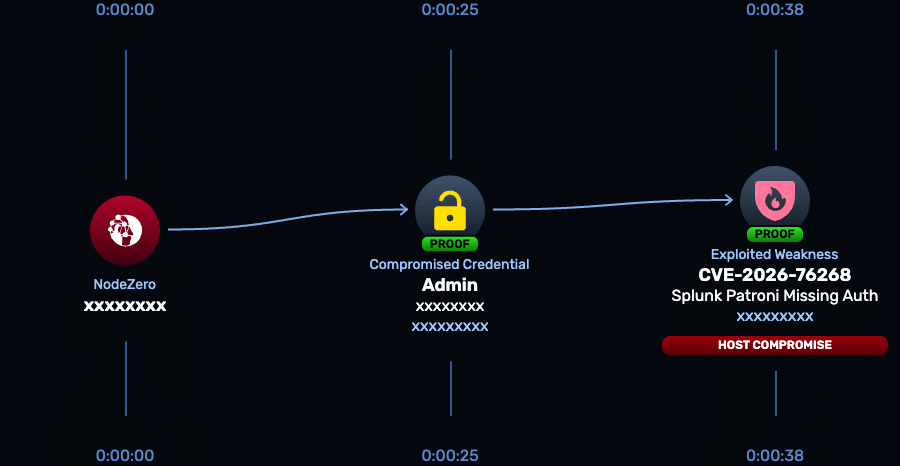
CVE-2026-76268 is a critical (CVSS 9.8) missing authentication flaw (CWE-306) in the Patroni REST API on Splunk Enterprise search head cluster members. An unauthenticated attacker with network access can run operating-system commands. Affected: 10.4.0 to 10.4.2 and 10.2.0 to 10.2.6. Fixed in 10.4.3 and 10.2.7. Splunk (SVD-2026-1001, 7 October 2026) suggests disabling the PostgreSQL sidecar as a workaround.

SplunkPatroniPostgreSQL+1
CVE-2026-76268CWE-306SVD-2026-1001+1

Offensive Security, Cloud & InfraΒ· Added 29 Oct 2026, published 22 Oct 2026

x.comadvisoryπŸ›‘οΈ Security

lee1981 (@lee1981b) on X

CVE-2026-106931 is an OS command injection (CWE-78) in the statistics processing of EG Secure Solutions SiteGuard Server Edition, a host-based WAF. It can give root or SYSTEM command execution. The vendor and JVN confirm exploitation on 14 October 2026. The post lists fixed builds (Ver8.00 Update 5, Ver7.00 Update 6 on FreeBSD), the IIS exclusion, the workaround of disabling statistics, and a SOC trail starting with diagnostic preservation before patching.

SiteGuard Server EditionApache HTTP Servernginx+3
CVE-2026-106931CWE-78CISA KEV+5

Blue Team & Detection, AppSecΒ· Added 21 Oct 2026, published 19 Oct 2026

x.comadvisoryπŸ›‘οΈ Security

lee1981 (@lee1981b) on X

Daily CVE digest on CVE-2026-76519, a CVSS 9.8 relative path traversal (CWE-23) in Cisco Secure Email Gateway's AMP File Reputation attachment processing. A crafted attachment gives unauthenticated arbitrary file writes and root command execution, and Cisco PSIRT reports active exploitation. The CVE is in CISA KEV. It lists the applicability conditions (File Reputation assigned to a policy and Content Scanner Tools earlier than 25.3.0.5525) and the fixes (scanner 25.3.0.5525, AsyncOS 15.5.5-014 and 16.5.0-780). It also covers evidence preservation, reading Cisco's System Security scan outcomes, mail/AMP log correlation, and deployment-specific recovery including cluster-key exposure.

Cisco Secure Email GatewayCisco AsyncOSCVSS+2
CVE-2026-76519CWE-23CISA KEV+4

Blue Team & Detection, Threat IntelΒ· Added 18 Oct 2026, published 15 Oct 2026

orca.securityadvisoryπŸ›‘οΈ Security

Critical GitLab RCE Lets Unauthenticated Attackers Execute Code on Servers (CVE-2026-97229)

Orca Security analysis of CVE-2026-97229, a CVSS 10.0 flaw in GitLab CE/EE. An integer overflow (CWE-190) in the CI/CD regular expression compiler gives memory corruption and code execution as the git user. It is triggered by a crafted regex in .gitlab-ci.yml combined with a UTF-8 repository path, with no authentication needed on instances that allow public project creation or self-registration. Lists affected branches (19.2 before 19.2.8, 19.3 before 19.3.5, 19.4 before 19.4.2), the absence of a workaround, interim mitigations, and a Rapid7 PoC against GitLab CE 19.4.1 with ASLR on. Notes a prior max-severity GitLab bug (CVE-2026-85706) was probed in the wild within hours and later added to CISA KEV.

GitLab
CVE-2026-97229CVE-2026-85706CWE-190+2

AppSec, DevSecOpsΒ· Published and added 14 Oct 2026

blog.talosintelligence.comadvisoryπŸ›‘οΈ Security

Microsoft Patch Tuesday for October 2026 β€” Snort rules and prominent vulnerabilities

Talos summarises Microsoft's October 2026 Patch Tuesday, which covers 1415 vulnerabilities, 85 of them critical (67 RCE). One bug is exploited in the wild: CVE-2026-96951, a Windows Shell security feature bypass. The post groups the CVEs by Microsoft's exploitability rating (more likely, less likely, unlikely) with CVSS and CWE for each, covering Windows, Office, Exchange, Hyper-V, DHCP, QUIC, Outlook and Azure. It also lists the Snort 2 and Snort 3 rule ID ranges that detect exploitation attempts.

WindowsSnortMicrosoft Exchange Server+3
CVE-2026-96951CVE-2026-70229CVE-2026-70571+191

Blue Team & DetectionΒ· Published and added 13 Oct 2026

rapid7.comadvisoryπŸ›‘οΈ Security

Ivanti Connect Secure zero-day exploited in the wild (CVE-2026-104935)

Rapid7 emergency-response analysis of CVE-2026-104935, a CVSS 8.6 authentication bypass by spoofing (CWE-290) in Ivanti Connect Secure that allows unauthenticated remote command execution. It was exploited as a zero-day against a limited number of customers, added to CISA KEV on disclosure day, and Volexity observed it chained with a still-unpatched privilege escalation flaw. Part of the fix shipped in 25.1.3.0 in July 2026, with backports to other supported versions pending. Rapid7 advises emergency patching outside normal cycles and hunting for compromise using Volexity's IOCs, since Ivanti has no reliable ones.

Ivanti Connect SecureVPNCVSS
CVE-2026-104935CWE-290CISA KEV+3

Threat Intel, Blue Team & DetectionΒ· Published and added 13 Oct 2026

rapid7.comadvisoryπŸ›‘οΈ Security

CVE-2026-97229: Critical Unauthenticated Remote Code Execution in GitLab

Rapid7 analysis of CVE-2026-97229, a CVSS 10.0 integer overflow (CWE-190) in the Onigmo regex compiler used by GitLab CE/EE's CI/CD regex handling. A crafted regex in a .gitlab-ci.yml passes validation as US-ASCII, then is recompiled for a UTF-8 repository path, producing invalid instructions that give code execution as the git user. Rapid7 reproduced it on GitLab CE 19.4.1 with ASLR (patched in 19.4.2); despite the vendor's "unauthenticated" rating, the attacker needs to commit a malicious config to a public project, which self-registration allows. No in-the-wild exploitation is confirmed, and Rapid7 recommends urgent upgrades.

GitLabRubyCVSS
CVE-2026-97229CWE-190Onigmo+1

AppSec, DevSecOpsΒ· Published and added 13 Oct 2026

x.comadvisoryπŸ›‘οΈ Security

lee1981 (@lee1981b) on X

CyberForge "CVE of the Day #076" covers CVE-2026-97229, a CVSS 10.0 integer overflow (CWE-190) in GitLab CE/EE's CI/CD regular expression compiler. It can lead to conditional unauthenticated code execution on the GitLab server. It lists the affected trains (19.2 before 19.2.8, 19.3 before 19.3.5, 19.4 before 19.4.2) and the 19.3.4 vs 19.3.5 Ona-regression discrepancy. It also gives six SOC checks: scoping, log preservation (Workhorse/Rails/Sidekiq, correlation_id), server-effect hunting, request-to-process correlation, upgrade and running-state verification. It notes that exploit details are unverified, no KEV listing exists and EPSS data is unavailable.

GitLabCVSSEPSS+2
CVE-2026-97229CWE-190CISA KEV+3

AppSec, Blue Team & DetectionΒ· Added 15 Oct 2026, published 13 Oct 2026

x.comadvisoryπŸ›‘οΈ Security

lee1981 (@lee1981b) on X

CyberForge's CVE of the Day #075 covers CVE-2026-108860, a critical (CVSS 9.1 v3.1 / 9.3 v4.0) authentication bypass in SciSharp BotSharp through 5.2.0. WebStarter ships a published default HMAC JWT signing secret (CWE-321), so anyone holding it can forge bearer tokens that impersonate known users, including administrators. The post sets out how to confirm the effective key and serving build, a six-step SOC investigation trail, and remediation by rotating the secret. No verified fixed release, KEV entry or EPSS data existed at cutoff, and the linked research is static-only.

BotSharpASP.NET CoreJWT+5
CVE-2026-108860CWE-321VulnCheck+2

AppSec, Identity & Access, Blue Team & DetectionΒ· Added 13 Oct 2026, published 12 Oct 2026

x.comadvisoryπŸ›‘οΈ Security

lee1981 (@lee1981b) on X

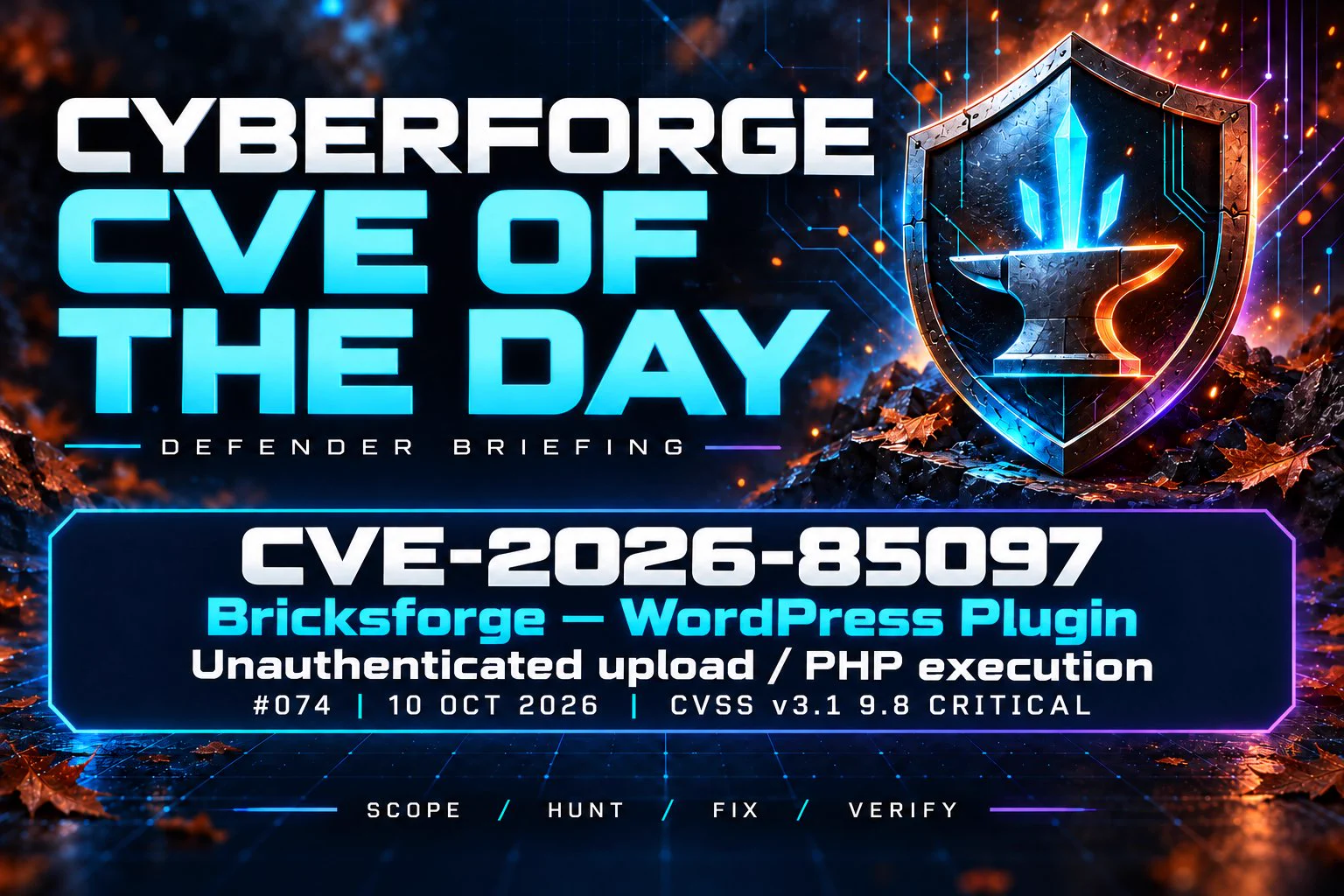
CyberForge CVE of the Day #074 analyses CVE-2026-85097, a CVSS 9.8 unauthenticated file upload to PHP execution flaw (CWE-434) in the Bricksforge WordPress plugin through 3.1.8.9. Wordfence names 3.1.8.10 as the fix, and a separate vendor 4.0.1 Pro Forms upload-security notice has no verified mapping to the CVE. It gives a defender workflow: scope versions, preserve edge/origin logs, inspect resulting files and PHP-FPM handling, and verify the patched version is serving. It also separates KEV (no match), EPSS (0.312%) and SSVC (exploitation none) from compromise evidence.

WordPressPHPCVSS+2
CVE-2026-85097CWE-434Wordfence+4

Blue Team & Detection, AppSecΒ· Added 11 Oct 2026, published 10 Oct 2026

x.comadvisoryπŸ›‘οΈ Security

lee1981 (@lee1981b) on X

CyberForge's CVE of the Day #073 covers CVE-2026-102255, a critical (CVSS 10.0) pre-authentication SSRF / confused-deputy flaw (CWE-918, CWE-441) in the SonicWall SMA1000 Work Place interface, per advisory SNWLID-2026-0017. It lists affected platform hotfixes (12.4.3-03526 and older, 12.5.0-02952 and older), fixed floors (12.4.3-03670, 12.5.0-03082), no workaround, and the exploitation picture (no known exploitation, not in KEV, EPSS 0.477%, SSVC automatable). It gives a six-step SOC playbook covering appliance scoping, AMC log preservation, hunting appliance-originated internal requests, correlating receiving-service changes, patching, and verifying every node, and it separates exposure, a lead, confirmed compromise and telemetry gaps.

SonicWallSMA1000CVSS+3
CVE-2026-102255CVE-2026-102256CVE-2026-102257+7

Blue Team & Detection, AppSecΒ· Added 12 Oct 2026, published 9 Oct 2026

x.comadvisoryπŸ›‘οΈ Security

lee1981 (@lee1981b) on X

Analysis of CVE-2026-105844, a CWE-1321 prototype-pollution vulnerability in @payloadcms/plugin-import-export that the vendor says can lead to unauthenticated remote code execution. It covers affected ranges (stable 3.0.0–3.87.x, canary 4.0.0-canary.0–canary.26), the fix (3.88.0 / 4.0.0-canary.27), the patched field-path guard against __proto__/constructor/prototype segments, and a six-step SOC hunting/triage playbook with two offline Python scripts for inspecting npm package trees and triaging request field-paths for prototype-sensitive values.

Payload CMSnpmCVSS+3
CVE-2026-105844CWE-1321GHSA-qf28-8hc6-vwrp+1

AppSec, Blue Team & DetectionΒ· Added 8 Oct 2026, published 7 Oct 2026

thehackernews.comadvisoryπŸ›‘οΈ Security

GitLab patches critical 9.9 AI Gateway template-sandbox-escape RCE (CVE-2026-90970)

GitLab patched CVE-2026-90970, a critical (CVSS 9.9) flaw in the AI Gateway used by Duo Agent Platform, where a logged-in user with Duo Agent Platform access could craft a flow configuration to escape the prompt template sandbox and achieve arbitrary command execution on the gateway. Only self-managed organizations hosting their own AI Gateway (versions 18.1.6 through 19.1) need to act; the fix lands in 19.2.4, 19.3.2, and 19.4.1. The bug is a template engine weakness (CWE-1336), the same class as the earlier CVE-2026-1868 gateway RCE GitLab fixed in February, and was reported via HackerOne by researcher invisiblemeerkat.

GitLabHackerOneCVSS+1
CVE-2026-90970CVE-2026-1868CWE-1336+1

AI Security, AppSecΒ· Added 4 Oct 2026

rapid7.comadvisoryπŸ›‘οΈ Security

Critical Cisco Catalyst SD-WAN Manager API authentication bypass exploited in the wild (CVE-2026-76504)

Rapid7 analysis of CVE-2026-76504, a critical (CVSSv3.1 9.8) unauthenticated API authentication bypass in Cisco Catalyst SD-WAN Manager caused by improper URL-encoding handling (CWE-177), allowing attackers to gain admin-level API access via crafted requests to the j_security_check endpoint. The flaw is being actively exploited in the wild, was added to CISA's KEV list on October 1, 2026 with a remediation deadline of October 3, and follows two earlier 2026 Catalyst SD-WAN peering authentication bypasses (CVE-2026-20127 and Rapid7-discovered CVE-2026-20182). The post gives fixed-release guidance, no-workaround caveats, and log-based IOCs (encoded-character requests like %6a_security_check, viptela-reserved- usernames) for detecting compromise.

Cisco Catalyst SD-WAN ManagerCVSSCISA KEV
CVE-2026-76504CVE-2026-20127CVE-2026-20182+1

AppSec, Threat IntelΒ· Added 7 Oct 2026, published 30 Sep 2026

vuldb.comadvisoryπŸ›‘οΈ Security

CVE-2026-90617 in PentestAgent

VulDB entry for CVE-2026-90617, a remote OS command injection (CWE-78) in GH05TCREW PentestAgent. The flaw is in run_task in interface/main.py of the MCP HTTP Server, affects everything up to commit cf882dab, and has a public exploit. The product uses rolling releases, so no version ranges exist, and the fix is an unmerged pull request. The analysis suggests compensating controls: restrict network access to the MCP server, run with least privilege, and validate input upstream.

PentestAgentModel Context Protocol
CVE-2026-90617CWE-78GH05TCREW

AppSec, AI SecurityΒ· Added 26 Sep 2026

vuldb.comadvisoryπŸ›‘οΈ Security

CVE-2026-85787 in postgres-mcp-server

CVE-2026-85787 affects awslabs postgres-mcp-server before 1.1.7. The SQL validation component uses an incomplete list of disallowed inputs. Crafted SQL placed in content submitted while an authenticated user interacts with the MCP server can bypass the read-only restriction and modify data in PostgreSQL. The fix is to upgrade to 1.1.7 or later. VulDB's added analysis is generic: it points to SQL injection (CWE-89) and recommends least-privilege database accounts and parameterized queries.

postgres-mcp-serverModel Context ProtocolPostgreSQL+1
CVE-2026-85787CWE-89T1059

AppSec, AI SecurityΒ· Added 26 Sep 2026

vuldb.comadvisoryπŸ›‘οΈ Security

CVE-2026-85661 in excel-mcp-server

CVE-2026-85661 affects excel-mcp-server 0.1.8. In stdio mode with EXCEL_FILES_PATH unset, the server does not confine file paths, so a client can pass relative or absolute paths to the read and write tools. That gives arbitrary file read and write with the privileges of the server process. The page classifies it as CWE-22 (ATT&CK T1083) and recommends canonical path checks against a base directory, making EXCEL_FILES_PATH mandatory, and running with least privilege.

excel-mcp-serverModel Context Protocol
CVE-2026-85661CWE-22T1083+1

AppSec, AI SecurityΒ· Added 26 Sep 2026

nvd.nist.govadvisoryπŸ›‘οΈ Security

CVE-2026-65695: Office-Word-MCP-Server through 1

CVE-2026-65695 is a path traversal vulnerability (CWE-22, CVSS 4.0 7.6 HIGH) in Office-Word-MCP-Server through version 1.1.11, an MCP server that exposes Word document manipulation tools to LLM agents. Attackers who can influence the filename argument can supply absolute paths or ../ sequences to document open/save operations, bypassing the check_file_writeable and ensure_docx_extension helpers (which do no base-directory confinement or realpath validation) to read or overwrite arbitrary .docx files outside the intended working directory.

Model Context ProtocolNVDCVSS
CVE-2026-65695CWE-22path traversal+3

AI Security, AppSecΒ· Added 26 Sep 2026

nvd.nist.govadvisoryπŸ›‘οΈ Security

CVE-2026-57860: ForgeCode (tailcallhq/forgecode), an AI pair-programming CLI, automatically loads and executes the MCP servers defined i

CVE-2026-57860 describes an arbitrary code execution flaw in ForgeCode (tailcallhq/forgecode), an AI pair-programming CLI that automatically loads and executes MCP servers defined in a repository's .mcp.json on startup without user confirmation. A malicious repo can define mcpServers entries with arbitrary command/args (e.g. bash -c) that spawn under the invoking user's privileges the moment forge is run inside the cloned repo, giving attackers a reliable initial-access and persistence primitive against developers evaluating untrusted code. CVSS 4.0 8.4 HIGH, CWE-829 (inclusion of functionality from untrusted control sphere); a fix commit and VulnCheck advisory are linked.

Model Context Protocol
CVE-2026-57860CWE-829

AI SecurityΒ· Added 26 Sep 2026

nvd.nist.govadvisoryπŸ›‘οΈ Security

CVE-2026-49291: mcp-memory-service is a semantic memory layer for AI applications

CVE-2026-49291 affects mcp-memory-service prior to version 10.65.3: its HTTP MCP JSON-RPC endpoint at /mcp only enforced OAuth 'read' scope before dispatching tools/call requests, so a client holding only read access could invoke mutating tools like store_memory and delete_memory even though the equivalent REST endpoints correctly required 'write' scope. The flaw is a classic missing-authorization bug (CWE-862) surfacing specifically in an MCP tool-dispatch layer, scored CVSS 3.1 8.1 (High) with confidentiality unaffected but integrity and availability impacted. Fixed in 10.65.3.

Model Context ProtocolOAuth
CVE-2026-49291CWE-862

AppSec, Identity & AccessΒ· Added 26 Sep 2026

nvd.nist.govadvisoryπŸ›‘οΈ Security

CVE-2026-20685: An attacker in a privileged network position may be able to leak sensitive information

CVE-2026-20685 is a medium-severity (CVSS 6.5) path handling vulnerability in Apple's Private Cloud Compute (PCC), classified under CWE-20 and CWE-22, that could let an attacker in a privileged network position leak sensitive information. Apple addressed the issue with improved path validation, fixed in PCC Release 5E290.3.

Apple Private Cloud Compute
CVE-2026-20685CWE-20path traversal

AppSecΒ· Added 26 Sep 2026

nvd.nist.govadvisoryπŸ›‘οΈ Security

CVE-2026-19978: A flaw has been found in jiantao88 android-mcp-server up to cfb872b2446794193b58edd63f4dbf6af48a6292

CVE-2026-19978 describes an OS command injection (CWE-77/78) in jiantao88's android-mcp-server, where the child_process.exec call in build/index.js fails to sanitize the deviceId, packageName, permission, and extras[].key/value arguments used to control Android devices. The flaw allows local command execution and has a published exploit; it was fixed in commit 14e2bf27c88ba137e35cbb0c2a75f72b595bb98a. CVSS 4.0 base score is 1.9 (local attack vector only), and the project uses rolling releases so no fixed version numbers are assigned.

Model Context ProtocolAndroidNode.js
CVE-2026-19978CWE-77CWE-78

AppSec, Mobile SecurityΒ· Added 26 Sep 2026

nvd.nist.govadvisoryπŸ›‘οΈ Security

CVE-2026-18655: Improper restriction of intended endpoints in the RabbitMQ broker connection tools of the Amazon MQ MCP Server (awslabs

CVE-2026-18655 describes an improper endpoint restriction flaw (CWE-923) in the RabbitMQ broker connection tools of awslabs.amazon-mq-mcp-server versions before 2.0.24. A remote unauthenticated attacker can use prompt injection introduced into the MCP client context to redirect the broker hostname to an attacker-controlled endpoint, causing Amazon MQ for RabbitMQ credentials or OAuth access tokens to be sent there; CVSS 4.0 base score 7.1 (High). Fixed in version 2.0.24, referenced via an AWS security bulletin and a GitHub security advisory (GHSA-xwj6-8x5h-hjp6).

Model Context ProtocolAWSAWS Bedrock+1
CVE-2026-18655CWE-923GHSA-xwj6-8x5h-hjp6

AI Security, Cloud & InfraΒ· Added 26 Sep 2026

nvd.nist.govadvisoryπŸ›‘οΈ Security

CVE-2026-16584: Improper handling of an initialization failure in AWS API MCP Server from 0

CVE-2026-16584 affects AWS API MCP Server (awslabs.aws-api-mcp-server) versions 0.2.13 through 1.3.46: if the security policy enforcement data fails to initialize at server startup, the tool silently skips policy checks for the rest of the process's life, letting an agent execute AWS API operations the admin configured the policy to deny or gate. Underlying IAM permissions still apply and are unaffected, but the intended allow/deny gating layer is bypassed (CWE-455, improper handling of initialization failure). Fixed in 1.3.47.

Model Context ProtocolAWSAWS IAM+1
CVE-2026-16584GHSA-29w2-fq35-v728CWE-455

AI Security, Cloud & InfraΒ· Added 26 Sep 2026

nvd.nist.govadvisoryπŸ›‘οΈ Security

CVE-2026-16498: The terraform-mcp-server before version 1

CVE-2026-16498 is a critical (CVSS 3.1: 10.0) exposure-of-sensitive-information flaw (CWE-488) in HashiCorp's terraform-mcp-server prior to version 1.1.0. In stateless streamable-HTTP transport mode, one user's Terraform API token could be reused to execute tool calls on behalf of a different, subsequent user, breaking tenant isolation in shared MCP server deployments. Fixed in terraform-mcp-server 1.1.0; further detail is tracked in HashiCorp's HCSEC-2026-23 advisory.

Model Context ProtocolTerraform
CVE-2026-16498CWE-488

AI Security, AppSec, Identity & AccessΒ· Added 26 Sep 2026

Showing 30 of 46

Show more