Skip to content

29 results for β€œECC”

What you seeeverything
ethereum-magicians.orgotherπŸ›‘οΈ Security

ERC draft: Independent Simulation Result for (STVA)

ERC draft "Independent Simulation Result" (STVA) defines a canonical, content-addressed SimulationResult structure that wallets, hardware devices or third-party verifiers can recompute from the same VerificationPayload and state snapshot. It specifies fields, a keccak256 or EIP-712 result hash, and Basic, Standard and Strict compliance tiers. The goal is to close UI/calldata mismatch attacks where a compromised frontend serves a false simulation. Open questions cover stateDiff encoding and prestate proofs.

EthereumrevmSafe
ERC-7730Scoped Capability TokensUI/calldata mismatch+5

BlockchainΒ· Published and added 30 Oct 2026

eprint.iacr.orgpaperπŸ›‘οΈ Security

Beyond the Event Horizon of Keccak, Extending the Observation from 2011 and applications

Beyond the Event Horizon of Keccak extends a 2011 observation that a path in the Keccak sponge from a zero-capacity state back to one yields infinite second-preimage families. Three theorems cover loops from any capacity value x, k-block loops and cycles, and Joux-style multicollisions with search cost independent of k. Verified examples run on Keccak-f[200] and Keccak-f[1600] with c=32; it also proposes bridge-based protocols.

KeccakSHA-3Lean
Danilo GligoroskiJoux multicollisionssecond preimages+2

otherΒ· Published and added 28 Oct 2026

ethresear.charticleπŸ›‘οΈ Security

A hash-only rollup: OP Stack L2 accounts as Lamport-style hash chains, no ECDSA inside the L2

Hash-only rollup: an OP Stack L2 (chain ID 42069000, live since 30 September 2026) where accounts are keccak-256 hash chains and transactions carry no signatures. Spending uses a commit-reveal step through two new transaction types in op-geth. The post describes a flaw the authors found: unauthenticated commits could be overwritten, which allowed preimage front-running. It was fixed with a first-commit-wins rule on 21 October 2026. It lists the remaining limits: L1 ECDSA, no fault proofs, a centralized sequencer, 160-bit addresses and wallet desync.

OP StackEthereumop-geth
Lamport signaturesGuy Fawkes protocolGrover's algorithm+9

BlockchainΒ· Published and added 24 Oct 2026

repodir.comrepo🧠 AI

affaan-m/ECC | RepoDir

ECC (affaan-m/ECC) is an open-source performance optimization system for AI coding agents. It packages 261+ skills, 64+ agents and 84+ commands that tune Claude Code, Codex, Cursor and other agent harnesses for speed, memory and security. Practitioners can use it as a ready-made skills and harness configuration set. The RepoDir page gives only this short description, with no install steps or benchmarks.

Claude CodeCodexCursor+1

coding-agents, promptingΒ· Added 24 Oct 2026

x.comrepo🧠 AI

Sadra Majidi (@SadraMajidi04) on X

Impeccable is an open-source skill for AI coding agents that steers them away from generic UI output such as purple gradients and nested cards. It provides 24 commands (critique, audit, polish, typeset) and 61 detector rules that run without an LLM. It works with Claude Code, Cursor and Codex, and the repo is pbakaus/impeccable on GitHub. The source is a short tweet and gives no further detail.

Claude CodeCursorCodex+1
Impeccable

coding-agents, promptingΒ· Added 23 Oct 2026, published 22 Oct 2026

aikido.devarticleπŸ›‘οΈ Security

eMudhra CA compromise: eight private keys, and one of them is 4

eMudhra's eight intermediate CA certificates, chaining to emSign ECC Root CA - G3, had private keys below 256 (one is 4), disclosed on 17 October 2026 by a researcher known as Wayne. Browsers and Microsoft blocked them via revocation pushes, but curl, git, containers, language runtimes and IoT may still trust them. The post gives patched ca-certificates versions, test commands and the timeline.

cURLDockermacOS+3
eMudhraemSign ECC Root CA - G3Wayne+6

Supply Chain, DevSecOpsΒ· Published and added 22 Oct 2026

eprint.iacr.orgpaperπŸ›‘οΈ Security

FN-DSA on Arm Cortex-M55: Revisiting a Floating-Point Lattice Signature with Native FP64 and Helium

FN-DSA on Arm Cortex-M55 is an ePrint paper presenting the first FN-DSA (NIST post-quantum signature) implementation on this core that reproduces the reference known-answer tests and runs in constant time. It uses the native FP64 FPU for signing and Helium (MVE) for NTT, key-generation FFT and Keccak, with SLOTHY rescheduling. Key generation, signing and verification are up to 1.23x, 1.93x and 1.30x faster than the reference, and four-signature batch verification up to 1.75x.

FN-DSAARM Cortex-M55Helium+2
NISTknown-answer tests

Hardware & RFΒ· Published and added 20 Oct 2026

eprint.iacr.orgpaperπŸ›‘οΈ Security

Accelerating Pollard Rho with GPU Field Arithmetic on NVIDIA Blackwell

Preprint that speeds up Pollard rho on GPUs by rebuilding field arithmetic: packed normal-basis representation, the CUDA 13.3 PTX carry-less multiply (clmad), and three-input logic instructions. On one RTX PRO 6000 Blackwell it goes from 0.85 to 14.64 billion iterations/s (17.2x) on the Certicom ECC2K-130 challenge, which puts the whole challenge under five GPU-years. The same levers give 1.52x on P-256 and 2.61x on P-384, which leaves P-256 about 6e21 card-years away. It also reports twelve GPUs from Turing to Blackwell, an FPGA engine on AWS F2 and a campaign that covered 5.4% of the expected work, with code and a Dockerfile on GitHub (rho-blackwell). It claims no improvement on the generic-group bound.

CUDANVIDIA BlackwellAWS+1
Pollard rhoECC2K-130Certicom challenge+5

otherΒ· Published and added 14 Oct 2026

arxiv.orgpaper🧠 AI

SecReason: Vulnerability Detection and In-Stream Self-Repair for LLM Code Generation

SecReason is an in-stream defense for reasoning LLMs that write code. Reasoning models draft code early in their streamed chain of thought, so SecReason scans that stream with dual-track incremental analysis: security rules are checked on each emitted statement, and dataflows are traced across the accumulated code. When a rule fires, it interrupts decoding, inserts a warning into the stream and resumes, so the model fixes its draft within the same reasoning trace instead of regenerating the full response. On CWEval and SecCodeBench, runs delivering secure and functionally correct code rise from below 15% to 72.8%–98.1%. It uses fewer tokens than post-hoc repair and limits functional regressions when rules misfire on secure code.

LLMstatic analysis
SecReasonCWEvalSecCodeBench

research, coding-agentsΒ· Added 15 Oct 2026, published 10 Oct 2026

arxiv.orgpaperπŸ›‘οΈ Security

SecReason: Vulnerability Detection and In-Stream Self-Repair for LLM Code Generation

SecReason is an in-stream defense for reasoning LLMs that monitors code drafted inside the streamed chain of thought. Dual-track incremental scanning applies security rules per statement and traces dataflows across accumulated code; when a rule fires, generation is interrupted, a warning is inserted, and decoding resumes so the model repairs the draft in the same trace. On CWEval and SecCodeBench it raises the share of secure and functionally correct runs from below 15% to 72.8%–98.1%, uses fewer tokens than post-hoc repair, and limits regressions from false warnings.

LLM
SecReasonCWEvalSecCodeBench

AI Security, AppSecΒ· Added 16 Oct 2026, published 10 Oct 2026

arxiv.orgpaperπŸ›‘οΈ Security

SecReason: Vulnerability Detection and In-Stream Self-Repair for LLM Code Generation

SecReason is an in-stream defense for reasoning LLMs that monitors code drafted inside the streamed chain of thought. Dual-track incremental scanning applies security rules per statement and traces dataflow across accumulated code. When a rule fires, generation is interrupted, a warning is inserted and decoding resumes, so the model repairs its draft without regenerating the full response. On CWEval and SecCodeBench it raises the share of secure and functionally correct runs from below 15% to 72.8%–98.1%, uses fewer tokens than post-hoc repair, and limits functional regressions from false warnings.

LLM
SecReasonCWEvalSecCodeBench

AppSec, AI SecurityΒ· Added 15 Oct 2026, published 10 Oct 2026

arxiv.orgpaper🧠 AI

SecReason: Vulnerability Detection and In-Stream Self-Repair for LLM Code Generation

SecReason is an in-stream defense for reasoning LLMs that write code. Reasoning models draft code early in their streamed chain of thought, and SecReason scans that draft incrementally with security rules, checking each statement as it is emitted and tracing dataflows across the accumulated code. When a rule fires, it interrupts generation, inserts a warning into the stream, and resumes decoding, so the model repairs the draft within the same reasoning trace. On CWEval and SecCodeBench it raises the share of runs that deliver secure and functionally correct code from under 15% to 72.8%–98.1%. It uses fewer tokens than post-hoc repair and limits functional regressions when rules misfire on secure code.

LLM
SecReasonCWEvalSecCodeBench+1

research, coding-agentsΒ· Added 16 Oct 2026, published 10 Oct 2026

endorlabs.comarticleπŸ›‘οΈ Security

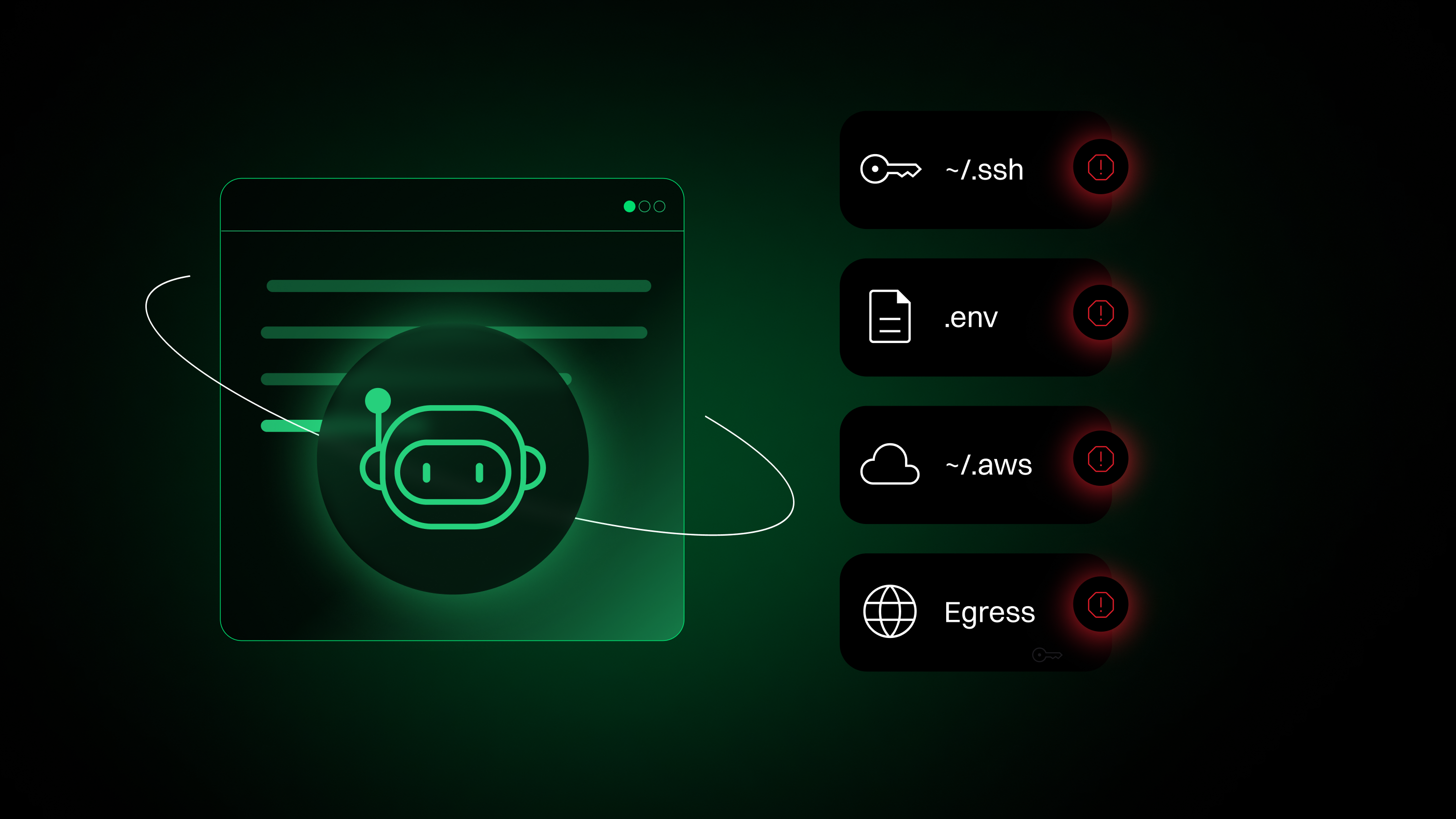
What does it mean to sandbox an AI coding agent?

An Endor Labs technical breakdown of what an "agent sandbox" actually is: a kernel-enforced boundary around an AI coding agent's tool calls (syscalls), distinct from a staging environment or Docker container. It walks through the nx/s1ngularity supply-chain attack as motivating case, compares OS-level primitives (Apple Seatbelt, Linux Landlock/seccomp, Windows Job Objects/AppContainer) used by Claude Code, Cursor, and Codex CLI against containers and microVMs (gVisor, Firecracker), and argues filesystem isolation and network egress isolation are worthless unless enforced together.

Claude CodeCursorCodex CLI+3
s1ngularity

AI SecurityΒ· Published and added 6 Oct 2026

endorlabs.comarticle🧠 AI

| Blog | Endor Labs

Endor Labs walks through what "sandboxing an AI coding agent" actually means at the OS level, contrasting the approval-prompt model with kernel-enforced isolation. It details how Claude Code, Cursor, and Codex CLI converge on the same primitives without full containers β€” Apple's Seatbelt on macOS, Landlock plus seccomp on Linux, Job Objects/AppContainer on Windows β€” and why Anthropic ships an open-source bubblewrap-based runtime with a host-side egress proxy. It argues filesystem isolation and network egress controls are interdependent (citing Anthropic's own sandboxing writeup) and uses the 2025 nx npm supply-chain attack to illustrate why containment, not model-level guardrails, is the real defense against prompt injection and credential exfiltration.

Claude CodeCursorCodex+1
Endor LabsCodex CLIAnthropic+1

coding-agentsΒ· Published and added 6 Oct 2026

eprint.iacr.orgpaperπŸ›‘οΈ Security

MiniSHAKE

MiniSHAKE is a new family of hash/XOF instances proposed by the Keccak design team (Bertoni, Daemen, Hoffert, Mella, Peeters, Van Assche, Van Keer), built on the smaller Keccak-p[800, nr=12] permutation instead of the standard 1600-bit Keccak-f permutation used by SHA-3/SHAKE. The motivation is efficiency for use cases hashing many very short messages, where the full 1600-bit state is wasteful. The note specifies the construction and naming conventions for these reduced-width instances.

Keccak
Guido BertoniJoan DaemenSeth Hoffert+4

otherΒ· Added 8 Oct 2026, published 5 Oct 2026

eprint.iacr.orgpaperπŸ›‘οΈ Security

Area-Efficient Hardware Architecture of the Post-Quantum HQC Cryptosystem with Side-Channel Protection

This IACR eprint paper presents a resource-efficient FPGA hardware architecture for the NIST-selected HQC post-quantum KEM that defends against power-based side-channel attacks by reusing otherwise-idle KECCAK hardware to inject scrambling dynamic power during decoding, adding less than 0.5 percent area overhead compared to masking/shuffling countermeasures. The fully parameterized design supports HQC-128/192/256 and was prototyped on a Xilinx Artix-7 FPGA (139 MHz, 11,489 LUTs, 6,785 FFs, 4 DSPs), with functional correctness verified via NIST Known Answer Tests and leakage suppression confirmed via Test Vector Leakage Assessment.

HQCFPGAArtix-7+1
NISTTVLA

Hardware & RFΒ· Added 8 Oct 2026, published 5 Oct 2026

x.comthread🧠 AI

Brendan Jowett (@jowettbrendan) on X

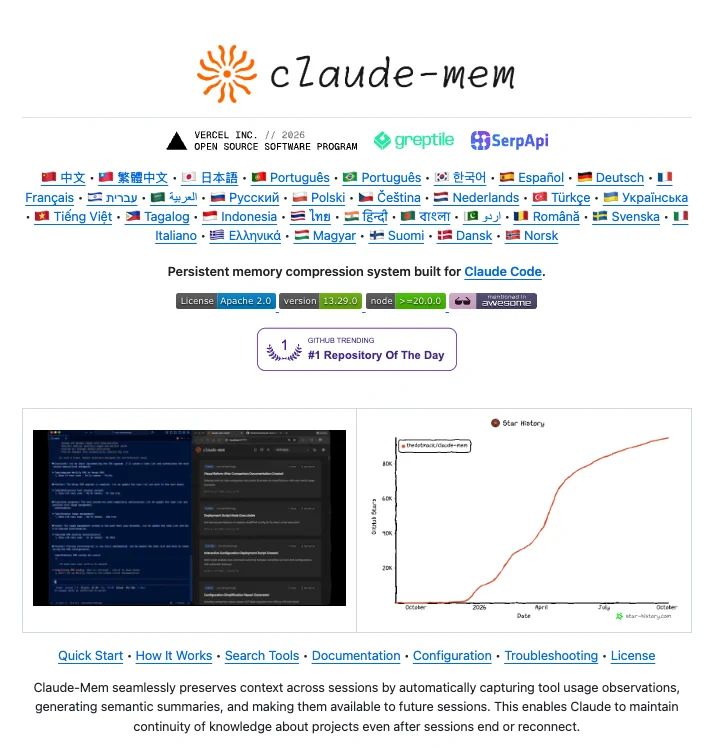
A curated Twitter/X thread listing ten GitHub repos that extend Claude Code and Codex workflows: spec-forcing planning/testing skills (obra/superpowers, mattpocock's skills with grill-me/diagnose/handoff), session memory compression (thedotmack's claude-mem-style tool), codebase-to-graph querying (safishamsi/graphify), a spec-driven long-task workflow (gsd-build), scope-reduction and anti-fluff skills, a cross-tool harness spanning Claude Code/Codex/OpenCode/Cursor (affaan-m/ECC), a multi-role agent team setup (garrytan/gstack), and a local model-routing gateway (musistudio's claude-code-router). Each entry is a practical, installable tool aimed at making coding agents more disciplined, memory-aware, and cost-efficient.

Claude CodeCodexCursor+1
Garry Tan

coding-agents, agentsΒ· Published and added 3 Oct 2026

endorlabs.comarticle🧠 AI

Sandboxes Explained: What Each Type Actually Isolates | Blog | Endor Labs

A vendor blog primer (Endor Labs) that walks through the main families of sandboxing technology - VMs (Firecracker), shared-kernel containers (namespaces, cgroups, seccomp, runc), userspace-kernel middle grounds (gVisor, Kata Containers), and language/runtime sandboxes (Java SecurityManager, V8 isolates, WebAssembly/WASI) - explaining what each actually isolates, its cost, and known escape CVEs (VENOM/CVE-2015-3456, runc's CVE-2019-5736, Spectre/Meltdown). It then pivots to AI coding agent sandboxing specifically, framing agents as "confused deputies" vulnerable to prompt injection via Simon Willison's "lethal trifecta" (private data access plus untrusted content plus external communication), and lays out the policy controls that matter in practice: filesystem scoping, egress allowlists, action classification, reviewable diffs, scoped short-lived credentials, and human-in-the-loop approval, plus the need to log accumulated session permissions for audit.

DockerFirecrackergVisor+7
CVE-2015-3456CVE-2019-5736Simon Willison+1

ai-infra, coding-agentsΒ· Published and added 2 Oct 2026

endorlabs.comarticleπŸ›‘οΈ Security

Sandboxes Explained: What Each Type Actually Isolates | Blog | Endor Labs

An Endor Labs primer surveying what different sandbox technologies actually isolate: hypervisor-based VMs (Firecracker microVMs, the VENOM floppy-controller escape CVE-2015-3456, Spectre/Meltdown), Linux containers (namespaces/cgroups/seccomp, the runc host-overwrite escape CVE-2019-5736, gVisor's userspace kernel, Kata Containers' per-pod microVMs), and language-runtime sandboxes (Java's deprecated SecurityManager, V8 isolates behind Cloudflare Workers, WebAssembly/WASI's capability model). It then pivots to AI agent sandboxing, arguing the threat model flips from "what can this process touch" to "what actions can this confused-deputy agent take," framed around Simon Willison's lethal trifecta (private data, untrusted content, external communication) and controls like filesystem scoping, egress allowlists, scoped short-lived credentials, and session-level audit logging.

FirecrackerQEMUgVisor+3
CVE-2015-3456CVE-2019-5736Spectre+6

AI Security, Cloud & InfraΒ· Published and added 2 Oct 2026

blog.trailofbits.comwriteupπŸ›‘οΈ Security

SequenceHash: multihashing for the rest of us

Trail of Bits introduces SequenceHash and its keyed variant SequenceMAC, hash-agnostic multihashing constructions similar in goal to NIST's TupleHash but not tied to Keccak, working with SHA256/384/512, BLAKE, and RIPEMD. The spec, now part of the Community Cryptography Specification Project, provides unambiguous input encoding, length-extension prevention, built-in customization strings, and HMAC-style keyed MACs that avoid HMAC's key-pseudocollision issues; reference implementations ship in Rust, Go, and Python with full test vectors.

RustGoPython
TupleHashHMACNIST SP 800-185+10

AppSecΒ· Published and added 2 Oct 2026

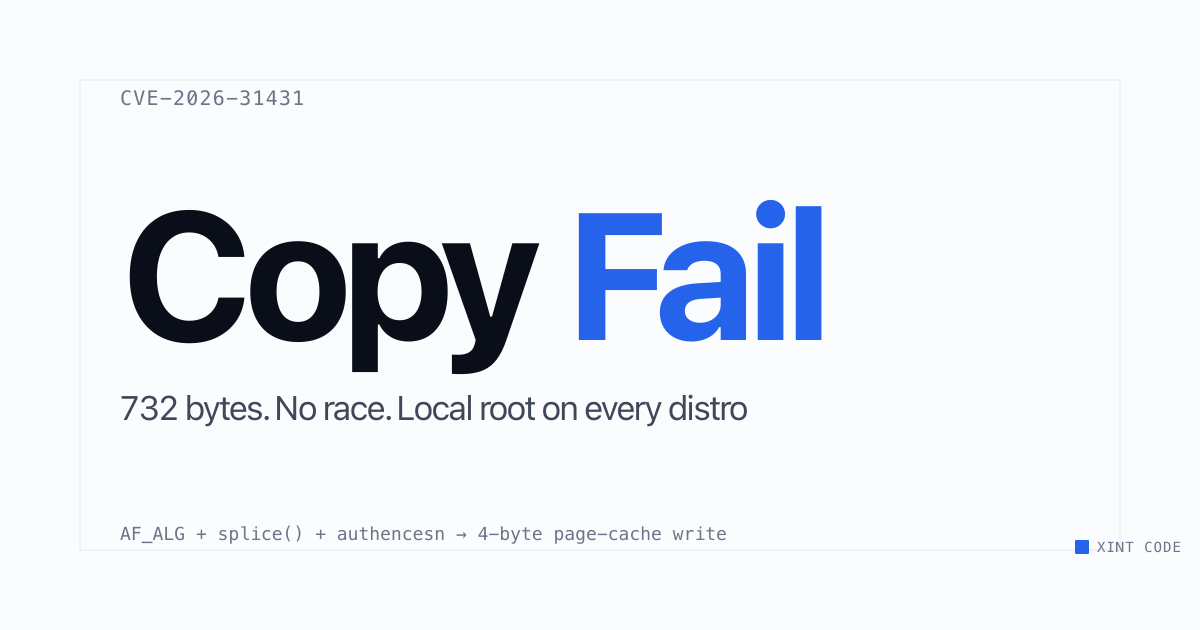
copy.failadvisoryπŸ›‘οΈ Security

Copy Fail (CVE-2026-31431): 9-year-old Linux kernel LPE found by AI-assisted fuzzing

Copy Fail (CVE-2026-31431) is a 9-year-old Linux kernel logic bug in algif_aead, reachable via the AF_ALG crypto API and chained through splice() into a 4-byte page-cache write to achieve local root, affecting kernels built between 2017 and the fix. The site publishes a 732-byte stdlib-only Python PoC that roots multiple distributions unmodified, identifies the fixing mainline commit a664bf3d603d, and gives interim mitigation (disable algif_aead / seccomp-block AF_ALG for untrusted workloads). The bug was found by Xint Code's AI-assisted fuzzing against the Linux crypto/ subsystem in roughly an hour of scan time.

Linux kernelLinuxPython+1
CVE-2026-31431algif_aeadAF_ALG+1

Offensive Security, AI SecurityΒ· Added 17 Sep 2026

collective.flashbots.netadvisoryπŸ›‘οΈ Security

Security Advisory β€” Storage Aliasing in Priority Update Registry V1

Flashbots disclosed a critical storage-aliasing vulnerability in V1 of the Priority Update Registry (PUR), an on-chain price feed contract used by trading integrators like propAMMs. Because lane storage slots were computed as keccak256(target, unbounded caller-controlled index) while the updater-authorization mapping lived at slot 0 with the same keccak256 shape, any caller could craft a lane index that collided with isUpdater[target][attacker], letting them self-authorize as an updater and publish arbitrary prices or deauthorize legitimate updaters. The fix namespaces the lane slot derivation (keccak256(NAMESPACE, target, laneIndex)) to make the preimages structurally non-collidable, and the advisory gives integrators concrete migration guidance since authorizations and lane state must be re-established on the new deployment.

EthereumSolidity
Priority Update RegistrySEAL 911Flashbots

BlockchainΒ· Added 2 Oct 2026, published 16 Sep 2026

aikido.devwriteupπŸ›‘οΈ Security

MECCHA CHAMELEON can't hide from the RCE

Aikido researchers found a delayed RCE in the Unreal Engine 5-based game MECCHA CHAMELEON, exploitable via a malicious Steam Workshop map. A Blueprint-exposed audio recording function allowed arbitrary file writes via path traversal, a null-byte trick stripped the auto-appended .wav extension to drop an .exe into the Windows Startup folder, and PCM audio samples were crafted byte-for-byte to smuggle a polyglot WAV/HTA payload that launches mshta.exe and runs arbitrary code on reboot. The issue was patched in the game's 4.0.0 update.

WindowsAikido SecurityUnreal Engine
MECCHA CHAMELEONSteam Workshopmshta.exe+3

AppSec, Offensive SecurityΒ· Published and added 3 Sep 2026

github.comrepoπŸ›‘οΈ Security

ClawSecCheck

ClawSecCheck audits OpenClaw agent installs for prompt injection, malicious MCP servers, and supply-chain risk in skills and dependencies.

OpenClawPython
ClawHubClawHavoc

AI SecurityΒ· Published and added 22 Jul 2026

github.comrepoπŸ›‘οΈ Security

LocxZ/SecureSDLC-Lab

SecureSDLC-Lab pairs a minimal Node.js/Express/SQLite app with a GitHub Actions pipeline running Gitleaks (secret scanning), Semgrep (SAST), and Trivy (dependency, Docker image, and Kubernetes manifest scanning) plus OWASP ZAP (DAST) on every push and PR. It documents concrete remediations applied during the exercise: bcrypt password hashing, parameterized SQL queries, session-based auth with post-login session regeneration and HttpOnly cookies, RBAC for an admin page, Helmet security headers, env-based secrets, and a hardened Kubernetes deployment (non-root, readOnlyRootFilesystem, dropped capabilities, seccomp, resource limits) alongside a STRIDE threat model.

Node.jsGitHub ActionsDocker+4

DevSecOps, AppSec, LearningΒ· Published and added 14 Jul 2026

github.comrepoπŸ›‘οΈ Security

RAPTOR

RAPTOR is an autonomous offensive/defensive security research framework built on top of Claude Code that chains static analysis (Semgrep, Coccinelle, CodeQL), binary analysis (radare2, Frida, Z3-based exploit feasibility), LLM-driven multi-stage vulnerability validation, exploit PoC generation, and patch writing into a single workflow against source code or compiled binaries. It also includes an /sca supply-chain command that enriches dependency findings with OSV, CISA KEV, EPSS, and SSVC data and emits CycloneDX SBOMs, and sandboxes LLM-generated/untrusted code execution using Linux namespaces, Landlock, and seccomp. Authored by Gadi Evron, Daniel Cuthbert, Thomas Dullien (Halvar Flake), Michael Bargury, and John Cartwright, it ships 200+ custom static analysis rules and supports multi-model LLM analysis (Claude, GPT, Gemini, Ollama).

Claude CodeSemgrepCodeQL+5
Gadi EvronDaniel CuthbertThomas Dullien+2

AppSec, Offensive Security, AI Security, Supply ChainΒ· Published and added 28 Jun 2026

xmcyber.comwriteupπŸ›‘οΈ Security

Trust No One: Automating macOS Privilege Escalation at Scale

XM Cyber researchers detail a macOS privilege escalation technique that lets a standard user disable EDR/MDM agents without admin credentials by exploiting stale kernel CDHash trust caches combined with NIB payload injection to impersonate trusted, code-signed application components. Once inside the trusted process context, the attacker uses an AppleScript-to-JXA-to-Objective-C runtime bridge (loading OSAKit.framework, forging Block_layout/objc_msgSend structures) to call unauthenticated privileged XPC methods like runProcessWithCommand: and ceaseSystemExtensionWithReply:, forcing security products to disable or remove themselves. The authors built an open-source scanner, XPC Hunter, to find this exposure across installed macOS apps at scale and recommend fixing it via xpc_connection_set_peer_code_signing_requirement() or SecCodeCheckValidity() peer validation.

macOSEDRXM Cyber

Offensive Security, Malware & RE, Mobile SecurityΒ· Added 3 Sep 2026, published 24 Jun 2026

github.comrepoπŸ›‘οΈ Security

Pipelock

Pipelock is an open-source (Apache 2.0 core) AI agent firewall that sits between agents and the network, mediating HTTP, WebSocket, MCP, and A2A traffic to detect secret exfiltration, prompt injection, SSRF, and MCP tool poisoning. It scans request/response bodies with a DLP engine (65 built-in patterns, checksum validation), streaming SSE inspection, and MCP tool-call chain analysis, then emits Ed25519-signed, hash-chained action receipts so decisions can be verified offline outside the agent runtime. It also offers OS-level containment (Landlock/seccomp/sandbox-exec), a kill switch, canary tokens, and integrations for Claude Code, Cursor, VS Code, OpenAI Codex, LangGraph, CrewAI, and other agent frameworks.

Model Context ProtocolClaude CodeCursor+3
OWASP Agentic AI Top 10Rekor

AI SecurityΒ· Published and added 14 Jun 2026

wiz.ioadvisoryπŸ›‘οΈ Security

Copy Fail (CVE-2026-31431): Universal Linux Local Privilege Escalation Vulnerability

Wiz's analysis of CVE-2026-31431 ("Copy Fail"), a logic flaw in the Linux kernel's AEAD crypto implementation (algif_aead) that, when chained with AF_ALG sockets and splice(), lets an unprivileged local user write 4 controlled bytes into the page cache of any readable file β€” including setuid binaries like /usr/bin/su β€” to gain root. It affects nearly all kernels built since 2017, also enables container escape between co-located containers sharing a base image, and the post covers patch status, seccomp-based mitigation, and detection heuristics (delayed AF_ALG loading, malformed su auth.log entries).

Linux kernelLinuxWiz
CVE-2026-31431XintTheori

Offensive Security, Blue Team & DetectionΒ· Added 23 Sep 2026, published 1 May 2026