Skip to content

69 results for “Exploitation”

What you seeeverything
cisa.govadvisory🛡️ Security

CISA Adds Two Known Exploited Vulnerabilities to Catalog

CISA added two Ivanti Connect Secure vulnerabilities to its Known Exploited Vulnerabilities (KEV) Catalog on 30 October 2026, citing evidence of active exploitation: CVE-2026-111357 (missing authentication for a critical function) and CVE-2026-118527 (generation of predictable numbers or identifiers). The alert restates BOD 26-04, which requires federal civilian agencies to remediate KEV-listed flaws on exposed assets and check for prior compromise. It also links the KEV nomination form.

Ivanti Connect SecureCISA KEVVPN
CVE-2026-111357CVE-2026-118527BOD 26-04+1

Threat Intel, GRC· Published and added 30 Oct 2026

cisa.govadvisory🛡️ Security

CISA Adds Two Known Exploited Vulnerabilities to Catalog

CISA alert of 29 October 2026 adding two vulnerabilities to the Known Exploited Vulnerabilities catalog on evidence of active exploitation: CVE-2026-97229, an integer overflow in GitLab CE/EE, and CVE-2026-76418, a NULL pointer dereference from an unchecked return value in Cisco Secure Firewall ASA and FTD. It restates BOD 26-04 remediation duties for federal civilian agencies and links the KEV nomination form.

CISA KEVGitLabCisco Secure Firewall ASA+1
CVE-2026-97229CVE-2026-76418BOD 26-04+3

Threat Intel, GRC· Published and added 29 Oct 2026

cisa.govadvisory🛡️ Security

Hitachi Energy CoreTec Product

CISA advisory ICSA-26-302-03, republished from Hitachi Energy PSIRT 8DBD000258, covers OS command injection (CVE-2026-13162) and the Dirty Frag vulnerability (CVE-2026-43284) in Hitachi Energy CoreTec. CoreTec5 up to 3.4.0 and 5.0.0 are affected by both, and CoreTec4 up to 3.4.0 by CVE-2026-13162. The advisory was released 27 October 2026 and lists generic ICS mitigations. SSVC rates exploitation as none.

Hitachi Energy CoreTec
CVE-2026-13162CVE-2026-43284Dirty Frag+5

Hardware & RF· Added 29 Oct 2026, published 28 Oct 2026

cisa.govadvisory🛡️ Security

CISA Adds Two Known Exploited Vulnerabilities to Catalog

CISA alert of 28 October 2026 adding two vulnerabilities to the Known Exploited Vulnerabilities Catalog on evidence of active exploitation: CVE-2026-41709 (Broadcom VMware ESX insufficient logging) and CVE-2026-46300 (Linux kernel missing variable initialization). It restates BOD 26-04, which requires federal civilian agencies to prioritize fast remediation of KEV CVEs on exposed assets and to check for prior compromise. It also links the KEV nomination form.

CISA KEVVMware ESXLinux kernel
CVE-2026-41709CVE-2026-46300BOD 26-04+1

Threat Intel, GRC· Added 29 Oct 2026, published 28 Oct 2026

cisa.govadvisory🛡️ Security

CISA Adds Two Known Exploited Vulnerabilities to Catalog

CISA alert of 27 October 2026 adding two vulnerabilities to the Known Exploited Vulnerabilities (KEV) Catalog on evidence of active exploitation: CVE-2026-48356, an unrestricted upload of a dangerous file type in Adobe Commerce and Magento, and CVE-2026-111497, an unchecked return value in Google Brotli. It restates BOD 26-04, which makes federal civilian agencies prioritise KEV flaws on exposed assets and check for prior compromise. No technical detail or IOCs are given.

Adobe CommerceMagentoBrotli
CVE-2026-48356CVE-2026-111497CISA KEV+2

AppSec, GRC· Added 29 Oct 2026, published 27 Oct 2026

cisa.govadvisory🛡️ Security

CISA: Critical Vulnerabilities in PHP Require Immediate Patching

CISA alert on CVE-2026-109618 and CVE-2026-109619 ("php2shell"), unauthenticated remote code execution flaws affecting PHP installations serving web requests, including mod_php, PHP-FPM, php-cgi, FrankenPHP and LiteSpeed. Fixed in PHP 8.5.12, 8.4.27, 8.3.36 and 8.2.35. Updated 23 October 2026 with a Sigma rule, partner advisories (NSA, NCSC-UK, ASD ACSC, NCSC-NL, NCSC-NZ, Cyber Centre) and guidance to inventory PHP, patch internet-facing systems first, and watch for PHP workers spawning shells. No in-the-wild exploitation had been observed.

PHPApachePHP-FPM+3
CVE-2026-109618CVE-2026-109619PHP2Shell+2

AppSec, Blue Team & Detection· Added 24 Oct 2026

horizon3.aiadvisory🛡️ Security

CVE-2026-109618 / CVE-2026-109619 | NodeZero Rapid Response Check Now Available

PHP2Shell is the name for CVE-2026-109618 and CVE-2026-109619, critical unauthenticated RCE flaws in PHP core fixed on 21 October 2026 in PHP 8.2.35, 8.3.36, 8.4.27 and 8.5.12. The page explains the out-of-memory corruption and stale global state causes, mod_php and PHP-FPM exposure, interim mitigations, hunting guidance, exploitation reports from October 2026, and the 23 October CVE-2026-115560 upload-progress advisory. Horizon3 also announced a non-exploiting NodeZero check.

PHPPHP-FPMApache+3
CVE-2026-109618CVE-2026-109619CVE-2026-115560+5

AppSec, Blue Team & Detection· Added 29 Oct 2026, published 23 Oct 2026

x.comadvisory🛡️ Security

lee1981 (@lee1981b) on X

CVE-2026-111497 is an out-of-bounds write in the Brotli decoder bundled with Node.js (CWE-787, CWE-252), rated CVSS v4.0 9.2 by the Google CNA and High by the Node.js project. Fixes are Node 22.23.4, 24.22.1 and 26.12.1, and 24.22.1 still labels Brotli 1.2.0 because the fix was cherry-picked. The post gives a SOC trail from input to worker, with remediation and verification steps. It notes no KEV match, CISA SSVC exploitation none, and only unverified public lab claims.

Node.jsBrotliCVSS+3
CVE-2026-111497CWE-787CWE-252+3

Blue Team & Detection, AppSec· Added 26 Oct 2026, published 23 Oct 2026

blog.talosintelligence.comadvisory🛡️ Security

Two critical RCEs in PHP core

Cisco Talos advisory on "php2shell", two unauthenticated RCE flaws in PHP core, CVE-2026-109618 and CVE-2026-109619 (CVSS v4.0 9.2), affecting every build since PHP 5.4. One flaw is an out-of-memory handling bug leaving request data partly initialized; the other reuses stale state after free. PHP 8.1 and older get no patch (about 50% of PHP systems). Includes ini-level mitigations and Snort SIDs 67359 and 67360. No exploitation seen as of 21 October 2026.

PHPWordPressCVSS
CVE-2026-109618CVE-2026-109619php2shell+2

AppSec, Blue Team & Detection· Published and added 21 Oct 2026

watchtowr.comadvisory🛡️ Security

PHP Remote Code Execution ("PHP2Shell" CVE-2026-109618 & CVE-2026-109619)

PHP2Shell is the name for CVE-2026-109618 (out-of-memory corruption) and CVE-2026-109619 (stale global state), two unauthenticated PHP remote code execution flaws rated CVSS 4.0 9.2. Details leaked before the 21 October 2026 patch release, and watchTowr's honeypots saw exploitation. The page lists fixed versions (8.5.12, 8.4.27, 8.3.36, 8.2.35), states that .ini mitigations do not work, gives a timeline, and describes compromise checks.

PHPApacheFrankenPHP+2
CVE-2026-109618CVE-2026-109619PHP2Shell+3

AppSec, Threat Intel· Added 28 Oct 2026, published 21 Oct 2026

orca.securityadvisory🛡️ Security

Critical PHP “PHP2Shell” RCE Vulnerabilities Allow Unauthenticated Remote Code Execution (CVSS 9.2)

PHP2Shell is the informal name for CVE-2026-109618 and CVE-2026-109619 (CVSS v4.0 9.2), unauthenticated remote code execution flaws in the PHP core runtime. Patches for branches 8.2 to 8.5 were scheduled for 21 October at 14:00 UTC, while PHP 8.1 and older get no fix; about 884,000 internet-facing hosts run those versions. watchTowr reproduced CVE-2026-109618, no public PoC existed at writing, and Sansec expects mass exploitation within 15 minutes of release.

PHP
CVE-2026-109618CVE-2026-109619PHP2Shell+4

AppSec· Published and added 21 Oct 2026

aikido.devadvisory🛡️ Security

Critical vulnerabilities in PHP (PHP2SHELL)

PHP2SHELL is Aikido Security's advance notice of two critical remote code execution flaws in PHP itself, CVE-2026-109618 and CVE-2026-109619, both CVSS v4.0 9.2, with all versions treated as affected. The PHP security team will release fixes at 14:00 UTC on 21 October 2026, a day early after details leaked on 20 October. The post withholds exploitation details and workarounds.

PHPCVSS
CVE-2026-109618CVE-2026-109619PHP2SHELL+1

AppSec· Published and added 21 Oct 2026

unit42.paloaltonetworks.comadvisory🛡️ Security

Threat Brief: Active Exploitation of PAN-OS CVE-2026-0257 (Updated Oct 20)

Unit 42 threat brief on active exploitation of CVE-2026-0257, a PAN-OS GlobalProtect authentication bypass added to CISA KEV on May 13, 2026. It lists IP addresses, host IDs and PoC-derived client values to hunt in GlobalProtect logs. The October 2026 updates cover Qilin and Inc ransomware operators, MFA bypass, pivots to vCenter and ESXi with offline VMDK credential dumping, and management interface exposure on ports 4443 and 3879.

PAN-OSGlobalProtectVPN+3
CVE-2026-0257CVE-2023-27532Spikey Scorpius+10

Threat Intel, Blue Team & Detection, Identity & Access· Added 21 Oct 2026, published 20 Oct 2026

news-web.php.netadvisory🛡️ Security

Upcoming Critical PHP Security Release

The PHP security team announces an upcoming PHP security release that fixes two critical vulnerabilities, both rated CVSS v4.0 9.2. The release is scheduled for Wednesday, 21 October 2026 at 14:00 UTC. The team says it may release earlier if details become public or exploitation in the wild is seen. The notice gives no CVE IDs, affected versions or technical details.

PHPCVSS
PHP security team

AppSec· Added 21 Oct 2026, published 20 Oct 2026
watchtowr.comadvisory🛡️ Security

Frequently Asked Questions About PHP Remote Code Execution (PHP2Shell CVE-2026-109618 & CVE-2026-109619)

PHP2Shell is the name for CVE-2026-109618 and CVE-2026-109619, two unauthenticated remote code execution flaws in PHP, both CVSS v4.0 9.2. One stems from out-of-memory corruption during request setup, the other from stale global state reused by the next request. watchTowr reports exploitation since 21 October 2026, lists fixed releases (8.5.12, 8.4.27, 8.3.36, 8.2.35) and says PHP 5 is also affected. PHP says no configuration change fully mitigates.

PHPApacheCVSS
CVE-2026-109618CVE-2026-109619PHP2Shell+3

AppSec, Threat Intel· Added 30 Oct 2026, published 20 Oct 2026

php.netadvisory🛡️ Security

Upcoming Critical PHP Security Release

The php.net 2026 news archive opens with the PHP security team's advance notice of a release scheduled for 21 October 2026 at 14:00 UTC. It fixes two critical vulnerabilities, both rated CVSS v4.0 9.2, and may ship earlier if details leak or exploitation appears. Details and fixed versions come with the release. The archive also lists 2026 security releases (8.2.34, 8.3.35, 8.4.26, 8.5.11), PHP 8.6 RC3 and conference announcements.

PHPCVSS
PHP 8.2.34PHP 8.3.35PHP 8.4.26+1

AppSec· Added 21 Oct 2026, published 20 Oct 2026

x.comadvisory🛡️ Security

lee1981 (@lee1981b) on X

CVE-2026-106931 is an OS command injection (CWE-78) in the statistics processing of EG Secure Solutions SiteGuard Server Edition, a host-based WAF. It can give root or SYSTEM command execution. The vendor and JVN confirm exploitation on 14 October 2026. The post lists fixed builds (Ver8.00 Update 5, Ver7.00 Update 6 on FreeBSD), the IIS exclusion, the workaround of disabling statistics, and a SOC trail starting with diagnostic preservation before patching.

SiteGuard Server EditionApache HTTP Servernginx+3
CVE-2026-106931CWE-78CISA KEV+5

Blue Team & Detection, AppSec· Added 21 Oct 2026, published 19 Oct 2026
x.comadvisory🛡️ Security

S2W_DailyThreat (@S2W_DailyThreat) on X

S2W post on CVE-2026-97229, a CVSS 10.0 remote code execution flaw in the GitLab CE/EE CI/CD regex compiler, disclosed October 13, 2026. Insufficient regex validation plus an integer overflow during encoding conversion lets an attacker who can add CI/CD config use a malicious regex and a UTF-8 repository path to run commands as the git user. Affects self-managed 19.2 before 19.2.8, 19.3 before 19.3.5 and 19.4 before 19.4.2. Rapid7 published analysis and a public PoC exists, with no in-the-wild exploitation confirmed as of October 15. No workaround exists, so patch or restrict access to a management network or VPN.

GitLabCVSS
CVE-2026-97229Rapid7S2W+1

AppSec, DevSecOps· Added 17 Oct 2026, published 16 Oct 2026

x.comadvisory🛡️ Security

Dark Web Intelligence (@DailyDarkWeb) on X

Summary of Vercel's Oct 14, 2026 out-of-band Next.js security release fixing two critical unauthenticated RCEs: one in App Router apps with Cache Components where a "use cache" function returns multiple typed arrays (GHSA-673q-mjm6-r5xr, upstream React GHSA-xqc2-xf4c-x3h3, no workaround), and one in the Image Optimization API handling SVG on glibc Linux via a memory bug in a library used through sharp (CVE-2026-96889 / GHSA-2464-fhr4-w9xw, workaround sharp 0.35.5+). Also covers a high-severity Server Actions DoS (GHSA-p3m5-59mp-jv5r). Fixes ship in two supported Next.js LTS lines. No in-the-wild exploitation reported.

Next.jsVercelReact+2
CVE-2026-96889GHSA-673q-mjm6-r5xrGHSA-xqc2-xf4c-x3h3+2

AppSec· Added 17 Oct 2026, published 16 Oct 2026

x.comadvisory🛡️ Security

lee1981 (@lee1981b) on X

Daily CVE digest on CVE-2026-76519, a CVSS 9.8 relative path traversal (CWE-23) in Cisco Secure Email Gateway's AMP File Reputation attachment processing. A crafted attachment gives unauthenticated arbitrary file writes and root command execution, and Cisco PSIRT reports active exploitation. The CVE is in CISA KEV. It lists the applicability conditions (File Reputation assigned to a policy and Content Scanner Tools earlier than 25.3.0.5525) and the fixes (scanner 25.3.0.5525, AsyncOS 15.5.5-014 and 16.5.0-780). It also covers evidence preservation, reading Cisco's System Security scan outcomes, mail/AMP log correlation, and deployment-specific recovery including cluster-key exposure.

Cisco Secure Email GatewayCisco AsyncOSCVSS+2
CVE-2026-76519CWE-23CISA KEV+4

Blue Team & Detection, Threat Intel· Added 18 Oct 2026, published 15 Oct 2026

x.comadvisory🛡️ Security

♫Why♥Not♪ (@Python_s_) on X

Alert summarizing XBOW's disclosure of a three-stage Chrome for Windows exploit chain: V8 Maglev memory corruption (CVE-2026-85045), Animated WebP decoder memory corruption (Chromium issue 548509153), then a Crashpad sandbox escape (CVE-2026-78952). Loading a crafted page was enough; no click or download needed. Human researchers working with GPT-5.6 Sol agents built it in six days, Google paid $250,000, all three bugs are fixed, and no in-the-wild exploitation is confirmed. It advises updating Chrome and restarting, and gives forensic triage pointers.

ChromeV8Crashpad+3
CVE-2026-85045CVE-2026-78952Chromium issue 548509153+2

Offensive Security, AI Security, Threat Intel· Added 15 Oct 2026, published 14 Oct 2026

x.comadvisory🛡️ Security

Dark Web Intelligence (@DailyDarkWeb) on X

Summary of SAP's October 13, 2026 Security Patch Day (16 new notes, 4 GitHub advisories). It leads with CVE-2026-89111, a CVSS 10.0 OAuth2 SSRF in SAP Cloud SDK for Python before 0.45.2, where an attacker-controlled tenant_subdomain redirects token requests and exfiltrates client credentials. It also lists three other critical flaws: broken access control in NetWeaver Visual Composer, code injection in S/4HANA substitution/validation rules, and a missing authorization check in the Manufacturing Integration and Intelligence (XMII) Configuration Service. It notes that none are in CISA KEV and SAP reports no in-the-wild exploitation.

SAP Cloud SDK for PythonSAP NetWeaverSAP S/4HANA+3
CVE-2026-89111CVE-2026-89110CVE-2026-89107+5

AppSec, Identity & Access· Added 15 Oct 2026, published 13 Oct 2026

blog.talosintelligence.comadvisory🛡️ Security

Microsoft Patch Tuesday for October 2026 — Snort rules and prominent vulnerabilities

Talos summarises Microsoft's October 2026 Patch Tuesday, which covers 1415 vulnerabilities, 85 of them critical (67 RCE). One bug is exploited in the wild: CVE-2026-96951, a Windows Shell security feature bypass. The post groups the CVEs by Microsoft's exploitability rating (more likely, less likely, unlikely) with CVSS and CWE for each, covering Windows, Office, Exchange, Hyper-V, DHCP, QUIC, Outlook and Azure. It also lists the Snort 2 and Snort 3 rule ID ranges that detect exploitation attempts.

WindowsSnortMicrosoft Exchange Server+3
CVE-2026-96951CVE-2026-70229CVE-2026-70571+191

Blue Team & Detection· Published and added 13 Oct 2026

rapid7.comadvisory🛡️ Security

CVE-2026-97229: Critical Unauthenticated Remote Code Execution in GitLab

Rapid7 analysis of CVE-2026-97229, a CVSS 10.0 integer overflow (CWE-190) in the Onigmo regex compiler used by GitLab CE/EE's CI/CD regex handling. A crafted regex in a .gitlab-ci.yml passes validation as US-ASCII, then is recompiled for a UTF-8 repository path, producing invalid instructions that give code execution as the git user. Rapid7 reproduced it on GitLab CE 19.4.1 with ASLR (patched in 19.4.2); despite the vendor's "unauthenticated" rating, the attacker needs to commit a malicious config to a public project, which self-registration allows. No in-the-wild exploitation is confirmed, and Rapid7 recommends urgent upgrades.

GitLabRubyCVSS
CVE-2026-97229CWE-190Onigmo+1

AppSec, DevSecOps· Published and added 13 Oct 2026

x.comadvisory🛡️ Security

♫Why♥Not♪ (@Python_s_) on X

Alert on CVE-2026-106610, a critical (CVSS 9.8) incorrect privilege assignment flaw in the miniOrange OTP Verification WordPress plugin, versions 5.5.7 and earlier. Unauthenticated remote attackers can gain elevated permissions, potentially administrator, with no user interaction. Fixed in 5.5.8; no in-the-wild exploitation or public PoC verified. It advises auditing unexpected admin accounts and role changes, and warns that Patchstack's mitigation blocks legitimate requests too.

WordPressCVSS
CVE-2026-106610PatchstackminiOrange OTP Verification+1

AppSec, Identity & Access· Published and added 11 Oct 2026

x.comadvisory🛡️ Security

lee1981 (@lee1981b) on X

CyberForge CVE of the Day #074 analyses CVE-2026-85097, a CVSS 9.8 unauthenticated file upload to PHP execution flaw (CWE-434) in the Bricksforge WordPress plugin through 3.1.8.9. Wordfence names 3.1.8.10 as the fix, and a separate vendor 4.0.1 Pro Forms upload-security notice has no verified mapping to the CVE. It gives a defender workflow: scope versions, preserve edge/origin logs, inspect resulting files and PHP-FPM handling, and verify the patched version is serving. It also separates KEV (no match), EPSS (0.312%) and SSVC (exploitation none) from compromise evidence.

WordPressPHPCVSS+2
CVE-2026-85097CWE-434Wordfence+4

Blue Team & Detection, AppSec· Added 11 Oct 2026, published 10 Oct 2026

x.comadvisory🛡️ Security

lee1981 (@lee1981b) on X

CyberForge's CVE of the Day #073 covers CVE-2026-102255, a critical (CVSS 10.0) pre-authentication SSRF / confused-deputy flaw (CWE-918, CWE-441) in the SonicWall SMA1000 Work Place interface, per advisory SNWLID-2026-0017. It lists affected platform hotfixes (12.4.3-03526 and older, 12.5.0-02952 and older), fixed floors (12.4.3-03670, 12.5.0-03082), no workaround, and the exploitation picture (no known exploitation, not in KEV, EPSS 0.477%, SSVC automatable). It gives a six-step SOC playbook covering appliance scoping, AMC log preservation, hunting appliance-originated internal requests, correlating receiving-service changes, patching, and verifying every node, and it separates exposure, a lead, confirmed compromise and telemetry gaps.

SonicWallSMA1000CVSS+3
CVE-2026-102255CVE-2026-102256CVE-2026-102257+7

Blue Team & Detection, AppSec· Added 12 Oct 2026, published 9 Oct 2026

securityweek.comadvisory🛡️ Security

Citrix Urges Immediate Patching of Critical NetScaler Vulnerability

Citrix disclosed CVE-2026-107406 (CVSS 9.5), a critical memory overflow in NetScaler ADC and NetScaler Gateway that can lead to remote code execution or denial of service when appliances are configured as a SAML SP or SAML IdP, also affecting Secure Private Access Hybrid deployments using NetScaler. Patches are available in versions 14.1-73.46, 13.1-64.29, and the corresponding FIPS/NDcPP builds; Citrix says it is not aware of exploitation yet but urges immediate upgrades. The bulletin follows two other recently exploited NetScaler RCE/DoS zero-days (CVE-2026-88771, CVE-2026-88772) used against government, financial, education, legal, and professional-services organizations, and a separate DoS zero-day (CVE-2026-88779).

Citrix NetScalerSAML
CVE-2026-107406CVE-2026-88779CVE-2026-88771+1

AppSec, Identity & Access· Published and added 9 Oct 2026

watchtowr.comadvisory🛡️ Security

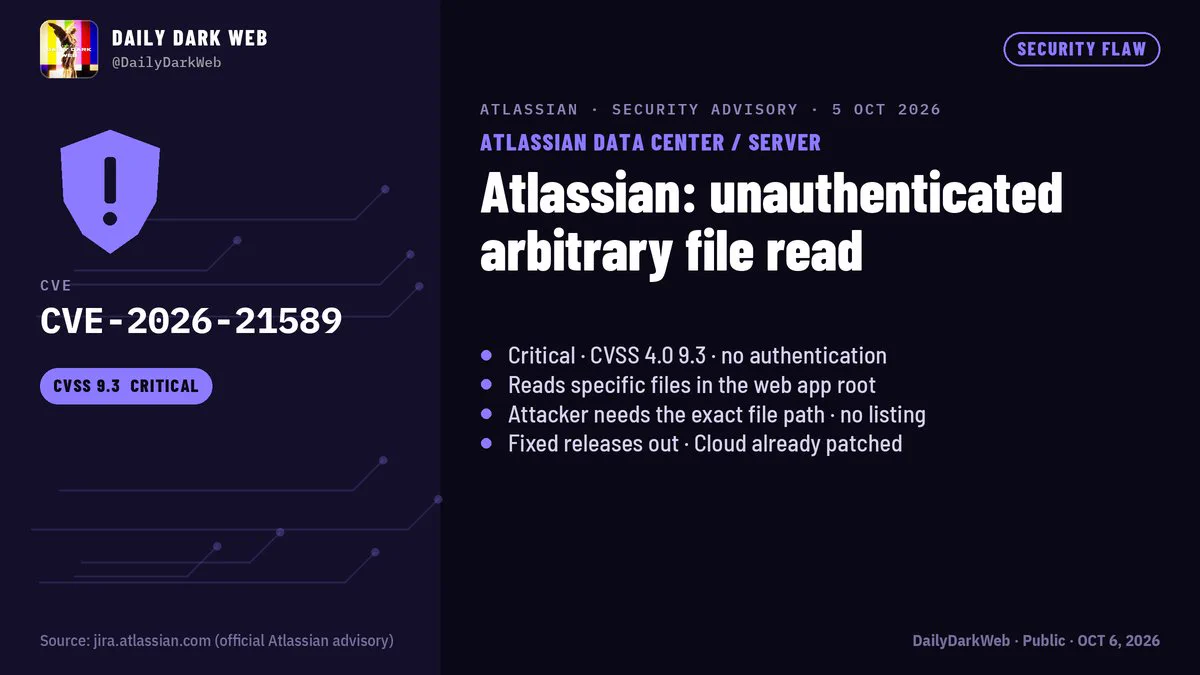
Frequently Asked Questions About the Atlassian Jira & Confluence Arbitrary File Read Vulnerability (CVE-2026-21589)

CVE-2026-21589 is an unauthenticated arbitrary file read in eight self-hosted Atlassian products: Bitbucket, Confluence, Jira Service Management, Jira Software, Bamboo, Crowd, Crucible and Fisheye Data Center. Attackers must know the exact file path, and watchTowr Intel observed exploitation by 6 October 2026. The FAQ covers the timeline (Atlassian advisory 5 October 2026), upgrade and WAF mitigations, and log searches for two dots next to a slash, backslash or double colon.

JiraConfluenceBitbucket+2
CVE-2026-21589path traversalCISA KEV+1

AppSec, Blue Team & Detection· Added 30 Oct 2026, published 6 Oct 2026

x.comadvisory🛡️ Security

Dark Web Intelligence (@DailyDarkWeb) on X

Atlassian disclosed CVE-2026-21589, a critical (CVSS 9.3) unauthenticated path traversal flaw allowing remote attackers to read specific files within the web application root across its self-managed Data Center/Server products — Jira Software, Jira Service Management, Confluence, Bitbucket, Bamboo, Crowd, Crucible, and Fisheye. Fixed versions are listed for each product (e.g. Jira 9.12.40/10.3.26/11.3.12, Confluence 9.2.26/10.2.19), and Atlassian Cloud is already patched; WAF/URL-rewrite mitigations are available for those who can't upgrade immediately. The post's analyst note clarifies exploitation requires knowing the exact target file path (no directory listing), and as of Oct 5, 2026 it is not yet in CISA KEV with no public exploit reported.

JiraConfluenceBitbucket+3
CVE-2026-21589path traversal

AppSec· Added 7 Oct 2026, published 6 Oct 2026

Showing 30 of 69

Show more