 20 security issues found in Xiaomi devices
Oversecured's write-up of 20 vulnerabilities in Xiaomi apps and system components, reported to Xiaomi between 25 and 30 April 2023. Bugs include intent redirection with system privileges in Security and GetApps, shell command injection in System Tracing, and arbitrary file theft via path traversal in Settings and MIUI Bluetooth. Each has a PoC. The page was truncated, so the later MIUI Bluetooth entries and the rest are not covered.
 oversecured.comwriteupAdded 29 Oct 2026🛡️ Security
- Hitachi Energy CoreTec Product
CISA advisory ICSA-26-302-03, republished from Hitachi Energy PSIRT 8DBD000258, covers OS command injection (CVE-2026-13162) and the Dirty Frag vulnerability (CVE-2026-43284) in Hitachi Energy CoreTec. CoreTec5 up to 3.4.0 and 5.0.0 are affected by both, and CoreTec4 up to 3.4.0 by CVE-2026-13162. The advisory was released 27 October 2026 and lists generic ICS mitigations. SSVC rates exploitation as none.
 cisa.govadvisoryAdded 29 Oct 2026, published 28 Oct 2026🛡️ Security
- alirezarezvani/claude-skills
claude-skills is an open-source MIT library of about 398 Claude Code skills, agents and plugins that also installs into Codex, Gemini CLI, Cursor and 9 other coding agents. The security-relevant parts are skill-security-auditor, a stdlib-only Python scanner that checks skills for command injection, data exfiltration, prompt injection and dependency supply-chain risks before install, plus a security-guidance PreToolUse hook, a security suite and compliance skills (ISO 27001, SOC 2, GDPR).
 github.comrepoAdded 25 Oct 2026🛡️ Security
- lee1981 (@lee1981b) on X
CyberForge Weekly CVE Rundown #007 covers six CVEs from 19 to 24 October 2026: SiteGuard command injection (CVE-2026-106931), DB-GPT (CVE-2026-77932), Siemens Software Center DLL side-loading (CVE-2026-110936), Cisco Expressway (CVE-2026-76466), Node.js Brotli (CVE-2026-111497) and Arista VeloCloud (CVE-2026-114625). Each entry gives defender actions, fixed versions, exploitation status and primary-source links. Updated 25 October 2026 with CISA KEV and EPSS findings.
 x.comarticleAdded 27 Oct 2026, published 25 Oct 2026🛡️ Security
- lee1981 (@lee1981b) on X
CVE-2026-106931 is an OS command injection (CWE-78) in the statistics processing of EG Secure Solutions SiteGuard Server Edition, a host-based WAF. It can give root or SYSTEM command execution. The vendor and JVN confirm exploitation on 14 October 2026. The post lists fixed builds (Ver8.00 Update 5, Ver7.00 Update 6 on FreeBSD), the IIS exclusion, the workaround of disabling statistics, and a SOC trail starting with diagnostic preservation before patching.
x.comadvisoryAdded 21 Oct 2026, published 19 Oct 2026🛡️ Security  Your CVE is reachable. But is it exploitable?
Explains why a reachable vulnerable function in a dependency is not necessarily exploitable, and how exploitability analysis extends SCA reachability analysis. It walks through CVE-2021-23337 (lodash _.template command injection) across three apps with different outcomes. It notes that a verdict can change with code, for example via prototype pollution and the follow-up CVE-2026-4800. A closing section describes Aikido's CVE Exploitability Analysis.
 aikido.devarticleAdded 19 Oct 2026, published 17 Oct 2026🛡️ Security
 In Other News: ICS-Sniper Attack, Hacking XWorm Malware Operators, $250k Chrome Exploit
SecurityWeek's weekly roundup covers ICS-Sniper, a UBC proof-of-concept that uses VPN-encrypted packet size, direction and timing to drop critical SCADA traffic on cloud-hosted ICS (tested on the SWaT water testbed). It also covers an unauthenticated RCE PoC against the XWorm RAT C2 panel (up to 7.4) via path traversal DLL overwrite, and Langflow CVE-2026-105740 (MCP Stdio command injection, fixed in 1.9.0) exploited from September 19, before the CVE was published. Other items: XBOW's AI-assisted Chrome full-chain exploit (GPT-5.6 Sol, $250k bounty), Group-IB's KGB RAT analysis, Anthropic's disclosure of Claude rule-bending on live sites, Intel ending SGX after Diamond Rapids, Bank of America's Mythos-driven patching, the Burger King Japan breach and a West African scam-center takedown.
 securityweek.comarticlePublished and added 16 Oct 2026🛡️ Security
 Unpatched AhsayCBS Vulnerabilities Exploited in the Wild
Huntress reports in-the-wild exploitation of two unpatched AhsayCBS vulnerabilities (CVE-2026-105133 and CVE-2026-105134) affecting all versions up to and including the latest 10.3.4. Attackers chain an authentication bypass with OS command injection via the Replication Receiver API to gain unauthenticated RCE with System privileges, drop JSP webshells, deploy XMRig cryptominers disguised as Microsoft Edge, achieve persistence using a modified NSSM binary as a fake Microsoft Edge Update service, and load the vulnerable WinRing0x64.sys driver for kernel-level miner access (BYOVD). At least five organizations were targeted as of October 8; Huntress recommends restricting management-interface access until a patch is released.
securityweek.comarticlePublished and added 9 Oct 2026🛡️ Security TP-Link Faces State Lawsuits and New Scrutiny Over ISP Router Flaws
Florida, Iowa, Montana, and Nebraska sued TP-Link Systems over allegedly misleading security marketing and undisclosed China ties, joining a similar Texas suit from February; the complaints cite TP-Link routers' role in the Volt Typhoon and Flax Typhoon campaigns and botnet abuse by Chinese and Russian actors. The piece also details five newly disclosed TP-Link Aginet vulnerabilities (CVE-2025-30237 through CVE-2025-30241) reported by SEC Consult, including an unauthenticated super-admin auth bypass, a root-privilege command injection, hardcoded device-model encryption keys exposing Wi-Fi/ISP credentials, and a USB-based physical-access filesystem dump affecting 65 device models.
securityweek.comarticlePublished and added 8 Oct 2026🛡️ Security Configuring your AI vulnerability harness, Part 2: The steering file
Part 2 of an AWS Security Blog series detailing the design of a "steering file" — a persistent instruction set (deployable as a Kiro steering file, Kiro skill, or Claude Code CLAUDE.md) that constrains an LLM performing vulnerability triage. It walks through five configuration sections: requiring structural/dataflow verification before reporting findings, replacing self-reported confidence with a weighted formula based on binary structural signals (e.g., 0.30 weight for confirmed taint flow), mapping infrastructure controls (AWS WAF, IAM) to severity multipliers with a 0.15 floor, incorporating CISA KEV and EPSS threat-intelligence boosts capped at +0.50, and a four-tier priority classification that suppresses low-confidence P3 findings. Validation against a 10-vulnerability test app showed the steered model eliminated fabricated findings and correctly downgraded mitigated vulnerabilities while preserving full severity for a command injection reachable only via authenticated access.
 aws.amazon.comwriteupAdded 8 Oct 2026, published 7 Oct 2026🧠 AI
 Post-Exploitation Analysis & Artifacts – Citrix NetScaler CVE-2026-88771
watchTowr post-exploitation analysis of CVE-2026-88771, an unauthenticated log-poisoning command injection in Citrix NetScaler (advisory CTX697096). Sensors logged thousands of attempts: about 85% were OOB callbacks, the rest Sliver implants, a trojanized Dropbear SSH backdoor, a Perl stager with a PHP webshell, and SSH-key and secret-harvesting sprays. Includes artifacts to hunt (/var/tmp files, ns_helper, ns.conf edits) and IOC repo pointers.
 watchtowr.comwriteupAdded 30 Oct 2026, published 7 Oct 2026🛡️ Security
 Threat Brief: NetScaler Zero Days CVE-2026-88771 and CVE-2026-88772 Exploited in the Wild (Updated September 30)
Unit 42 threat brief on CVE-2026-88771 (unauthenticated command injection) and CVE-2026-88772 (DTLS memory overflow) in NetScaler ADC and Gateway, both CVSS v4.0 9.5 and exploited as zero-days from August 2026. It details version fingerprinting, .deb and PHP web shells, a three-stage log-poisoning chain through ns_monuploadd_err.pl, httpd.conf persistence, IOCs, and 50,277 exposed instances as of 27 September 2026.
 unit42.paloaltonetworks.comadvisoryAdded 30 Oct 2026, published 30 Sep 2026🛡️ Security
 Tracking CVE-2026-73570: unauthenticated command injection on internet-facing mail servers
Microsoft Threat Intelligence tracked in-the-wild exploitation of CVE-2026-73570, an unauthenticated OS command-injection vulnerability in Zimbra Collaboration Suite's SNMP notification path (swatchdog-to-snmptrap), triggerable via a crafted SMTP request when the optional zimbra-snmp package is enabled. The post documents pre-disclosure scanning, JSP webshell deployment, a novel pam_exec/zmmailboxdmgr privilege-escalation chain to root, systemd-based persistence (zimlog.service), theft of zimbraPreAuthKey/zimbraAuthTokenKey via zmlocalconfig and LDAP, lateral movement over Zimbra's SSH identity, a multi-stage Go-based remote-access agent (zimclient2 via zimdown2/agent2.sh), a dedicated mailbox-exfiltration implant, and an AzCopy-based exfiltration attempt, closing with Defender XDR KQL hunting queries and MITRE ATT&CK mapping.
 microsoft.comwriteupAdded 1 Oct 2026, published 30 Sep 2026🛡️ Security
 Oh Look, The Foot Gun Went Off Again (Citrix NetScaler PreAuth Command Injection CVE-2026-88771)
watchTowr Labs' technical breakdown of CVE-2026-88771, a pre-auth command injection in Citrix NetScaler ADC/Gateway's default configuration that was exploited in the wild as a zero-day before a patch existed. The root cause is in ns_monuploadd_err.pl: unsanitized log data (attacker-controlled via HTTP login/User-Agent fields) is interpolated into a backtick shell command via grep/sed/awk, allowing arbitrary root command execution once the crash-log parser runs; the article includes a full pre-auth exploit request, patch diff analysis (CTX697096), and a link to watchTowr's Detection Artefact Generator script.
 labs.watchtowr.comwriteupPublished and added 28 Sep 2026🛡️ Security
- FirmAgent: Fuzzing + LLM Agents for IoT Firmware Vulnerability Discovery (NDSS 2026)
FirmAgent is an academic research toolkit (NDSS 2026) for finding vulnerabilities in re-hosted IoT firmware web services by combining IDA-based pre-fuzzing (CFG/sink distance scoring), QEMU instrumented tracing, CFG-guided API fuzzing, and an optional LLM agent (LLMATaint.py) that consumes runtime taint traces to reason about and produce PoCs for bug classes like command injection. The pipeline is explicit about scope: it is meant for authorized, owned or re-hosted firmware (e.g. Greenhouse-style containers), and stitches together sink-scope extraction, feedback-driven fuzzing, and request-to-trace attribution before handing traces to an LLM for taint-to-PoC analysis.
github.comrepoAdded 26 Sep 2026🛡️ Security - CVE-2026-90617 in PentestAgent
VulDB entry for CVE-2026-90617, a remote OS command injection (CWE-78) in GH05TCREW PentestAgent. The flaw is in run_task in interface/main.py of the MCP HTTP Server, affects everything up to commit cf882dab, and has a public exploit. The product uses rolling releases, so no version ranges exist, and the fix is an unmerged pull request. The analysis suggests compensating controls: restrict network access to the MCP server, run with least privilege, and validate input upstream.
 vuldb.comadvisoryAdded 26 Sep 2026🛡️ Security
 LiteLLM Flaw CVE-2026-42271 Exploited in the Wild, Chains to Unauthenticated RCE
CISA added CVE-2026-42271, a command injection flaw in BerriAI's LiteLLM AI gateway, to its KEV catalog after confirming active exploitation; the bug lets any authenticated proxy user run arbitrary commands via the MCP server test endpoints (/mcp-rest/test/connection and /mcp-rest/test/tools/list), which spawned attacker-supplied stdio subprocess configs. Horizon3.ai separately showed the flaw can be chained with CVE-2026-48710, a Starlette "BadHost" header validation bypass, to skip authentication entirely and achieve unauthenticated RCE (combined CVSS 10.0), exposing model provider credentials and enabling lateral movement into AI infrastructure. Fixed in LiteLLM 1.83.7 (test endpoints now require PROXY_ADMIN role) and Starlette 1.0.1; the article also notes a prior LiteLLM SQLi (CVE-2026-42208) exploited within 36 hours of disclosure.
 thehackernews.comarticleAdded 26 Sep 2026🛡️ Security
- CVE-2026-19978: A flaw has been found in jiantao88 android-mcp-server up to cfb872b2446794193b58edd63f4dbf6af48a6292
CVE-2026-19978 describes an OS command injection (CWE-77/78) in jiantao88's android-mcp-server, where the child_process.exec call in build/index.js fails to sanitize the deviceId, packageName, permission, and extras[].key/value arguments used to control Android devices. The flaw allows local command execution and has a published exploit; it was fixed in commit 14e2bf27c88ba137e35cbb0c2a75f72b595bb98a. CVSS 4.0 base score is 1.9 (local attack vector only), and the project uses rolling releases so no fixed version numbers are assigned.
 nvd.nist.govadvisoryAdded 26 Sep 2026🛡️ Security
- CISA Adds Seven Known Exploited Vulnerabilities to Catalog | CISA
CISA added seven vulnerabilities to its Known Exploited Vulnerabilities Catalog on the basis of active exploitation. They are SQL injection in Sangoma Switchvox, HTTP request/response smuggling in Kludex Starlette, OS command injection in Kestra OSS, improper authentication in BerriAI LiteLLM and JFrog Artifactory, and SSRF plus OS command injection in SonicWall SMA1000 appliances. The alert restates BOD 26-04, which makes federal agencies prioritise rapid remediation of KEV CVEs on publicly exposed assets that grant total control after exploitation. It also requires agencies to check for prior compromise before patching.
cisa.govadvisoryAdded 26 Sep 2026🛡️ Security - CVE-2026-87911 - Read-only enforcement bypass enabling operating system command execution in the SQL validation component of Amazon awslabs postgres-mcp-server
AWS bulletin for CVE-2026-87911, an OS command injection flaw in awslabs.postgres-mcp-server (Python, PyPI) versions before 1.1.7. The server's read-only enforcement in its SQL validation component can be bypassed with a crafted `COPY ... TO PROGRAM` statement, letting an unauthenticated actor run OS commands on a self-managed PostgreSQL host when the configured connection role holds superuser or pg_execute_server_program privileges. Fixed in 1.1.7; AWS also recommends connecting the MCP server with a least-privilege, non-superuser role as defense in depth.
aws.amazon.comadvisoryAdded 26 Sep 2026🛡️ Security  When Business Email Compromise Starts Rewriting Reality
Rapid7 previews collaborative research with Zimbra that uncovered over 50 vulnerabilities in the Zimbra Collaboration Suite, several of which let attackers impersonate senders without credentials, control inbox visibility, and alter shared documents and calendars, turning classic Business Email Compromise into active manufactured-reality attacks rather than passive mailbox monitoring. It traces the pattern through real exploited Zimbra CVEs in CISA's KEV catalog (CVE-2024-45519 postjournal command injection, CVE-2025-27915 stored XSS via calendar invite used against Brazilian military targets, CVE-2026-73570 SNMP command injection) and earlier 2022 to 2023 zero-days (CVE-2022-27925, CVE-2022-37042 path traversal plus auth bypass, CVE-2023-37580) exploited by multiple threat groups per Google's Threat Analysis Group.
 rapid7.comwriteupAdded 7 Oct 2026, published 24 Sep 2026🛡️ Security
 Cisco Warns of New Zero-Day ISE Auth Bypass (CVSS 10.0) Exploited in Active Attacks
Cisco disclosed CVE-2026-76460 (CVSS 10.0), an unauthenticated API authentication bypass in Identity Services Engine (ISE) and ISE-PIC that is under active exploitation and has been added to CISA's KEV catalog with a federal patch deadline of September 19, 2026; successful exploitation can yield root command execution, and Cisco provides log-based IOC detection guidance since there is no workaround. The same disclosure batch includes 77 new CVEs, 41 in ISE and 28 in Secure Firewall (ASA/FTD/FMC), covering authenticated RCE, SQL injection, XXE, command injection, and additional REST API auth bypasses, plus a separately exploited Secure Email Gateway flaw (CVE-2026-76461, CVSS 9.8).
thehackernews.comadvisoryAdded 22 Sep 2026🛡️ Security- VIPER-MCP: Detecting Vulnerabilities in MCP Servers
VIPER-MCP is an end-to-end automated auditing framework that combines two-pass static taint analysis (anchor queries mapping alerts to specific MCP tool handlers) with feedback-driven LLM prompt evolution to both detect and dynamically confirm taint-style vulnerabilities (command injection, SSRF, path traversal) in Model Context Protocol servers. Run against 39,884 real-world open-source MCP server repositories, it discovered 106 0-day vulnerabilities — all confirmed via end-to-end exploit traces with concrete proof-of-concept natural-language prompts — resulting in 67 assigned CVEs, including a root-privilege RCE in the bytebot computer-use agent. It reports 0% false positive rate and 7.7% false negative rate, substantially outperforming existing static and dynamic MCP security baselines.
 arxiv.orgpaperAdded 22 Sep 2026, published 17 Sep 2026🛡️ Security
 The Most Common Security Vulnerabilities in AI-Generated Code | Blog | Endor Labs
Endor Labs blog post analyzing why LLM-generated code (from tools like GitHub Copilot, Cursor, Replit Ghostwriter) reproduces classic vulnerability patterns from its open-source training data, citing recurring CWE Top 25 weaknesses such as missing input validation (CWE-20), SQL/OS command injection (CWE-89/CWE-78), broken authentication/access control (CWE-306/CWE-284), and hard-coded credentials (CWE-798). It also covers AI-specific risks: dependency explosion from oversized auto-generated dependency trees, stale/vulnerable library suggestions past training cutoff, hallucinated package names enabling slopsquatting attacks, and "architectural drift" where AI edits silently break security invariants without triggering static analysis or code review flags.
 endorlabs.comarticlePublished and added 11 Sep 2026🛡️ Security
 Shai-Hulud 2 Malware Campaign Targets GitHub and Cloud Credentials Using Bun Runtime | Blog | Endor Labs
Endor Labs' live incident tracker for the Shai-Hulud 2.0 npm supply-chain worm that began around Nov 24, 2025, compromising packages from Zapier, ENS Domains, Postman and PostHog. It details the infection chain (malicious preinstall script, setup_bun.js dropper, obfuscated bun_environment.js payload), TruffleHog-style credential theft from AWS, GCP, Azure, GitHub and npm, self-replication via stolen npm and GitHub tokens, a self-hosted GitHub Actions runner backdoor abusing repository Discussions for command injection and C2, and destructive wiper behavior that shreds the user's home directory on Windows and Linux.
endorlabs.comwriteupPublished and added 11 Sep 2026🛡️ Security Claude Code & Gemini CLI: GitHub Issue → CI Secrets
Novee Security disclosed that a low-privilege GitHub issue could trigger code execution on CI runners for Gemini CLI and Claude Code, and hijack the next agent run in OpenAI Codex, via flaws in the "harness" code surrounding each coding agent rather than the LLM itself. CVE-2026-12537 is a CVSS 10.0 OS command injection in Gemini CLI's container launcher via a crafted .gemini/.env file (fixed in 0.39.1); CVE-2026-54316 abused Hugging Face's public download counter as a side channel to exfiltrate a Claude Code API key one character at a time (fixed in 2.1.163). A separate Claude Code bash-quoting validator bypass and a Codex AGENTS.md instruction-file poisoning issue (via shared checkout across two passes) had no CVE, prompting OpenAI to only issue workflow/documentation fixes.
thehackernews.comwriteupPublished and added 1 Sep 2026🛡️ Security Inside 90 days of attacks on AI infrastructure
Wiz Threat Research ran honeypots across LiteLLM, Flowise, LangChain, Langflow, ChromaDB, Ollama and other AI/ML services for 90 days, capturing active exploitation of an MCP Gateway auth bypass (CVE-2026-59822) and an MCP server test-endpoint command injection (CVE-2026-42271, in CISA KEV, chainable with Starlette CVE-2026-48710 for unauthenticated RCE and linked to Qilin ransomware exploitation) used to deploy fileless cryptominers. It also documents blind prompt injection campaigns against LangChain, Flowise, OpenWebUI, and Node-RED agents that trigger OS command execution confirmed via out-of-band DNS callbacks to OAST domains.
 wiz.iowriteupAdded 3 Sep 2026, published 27 Aug 2026🛡️ Security
- Semgrep Rules (0xdea)
A "battle-tested" collection of Semgrep rules by researcher 0xdea aimed at C (and some C++) vulnerability hunting, covering buffer overflows, use-after-free/double-free, format string bugs, integer truncation/wraparound, command injection, insecure APIs (gets, strcpy, sprintf, scanf family), privilege management ordering, ReDoS, and dozens of other memory-safety and secure-coding checks. Rules are published to the Semgrep registry as "p/0xdea" and can be run directly via `semgrep --config "p/0xdea"` or cloned locally, with SARIF output support for triage in VS Code via SARIF Explorer. The repo also documents a roadmap including porting rules to the Semgrep Pro engine for taint/inter-procedural analysis.
github.comrepoAdded 3 Sep 2026, published 31 Jul 2026🛡️ Security - 0x1ceKing/HTB-Certified-Penetration-Testing-Specialist
A GitHub repository compiling personal study notes and cheatsheets for HackTheBox's CPTS (Certified Penetration Testing Specialist) certification, organized by module: network enumeration (Nmap), web footprinting, file transfers, shells/payloads, Metasploit, password attacks, pivoting/tunnelling, Active Directory enumeration and attacks, web app attacks (SQLi, SQLMap, XSS, LFI, file upload, command injection, Ffuf), and Linux/Windows privilege escalation. It functions as a reference guide mirroring the official HTB Academy course structure rather than original research.
github.comrepoPublished and added 18 Jul 2026🛡️ Security  AI Security Briefing
GHSA-3pvh-63gf-j9mw discloses an authenticated remote code execution vulnerability in LangBot, an open-source AI chatbot/agent framework, caused by its MCP Server Configuration feature. Because LangBot's mcp.py uses Anthropic's StdioServerParameters to launch MCP servers, any authenticated user can add a "STDIO" MCP entry with an arbitrary shell command and have it executed on the server, enabling data exfiltration, reverse shells, or full host compromise (CWE-78 OS command injection).
github.comadvisoryPublished and added 17 Jul 2026🛡️ Security- OWASP MCP Top 10 | OWASP Foundation
The OWASP MCP Top 10 (2025) is a living-document taxonomy of the ten most critical vulnerability classes affecting Model Context Protocol-based AI systems, covering issues like token mismanagement, privilege escalation via scope creep, tool poisoning, MCP-specific supply chain and dependency tampering, command injection, prompt injection via contextual payloads, weak authN/authZ, missing audit/telemetry, shadow MCP servers, and context injection/over-sharing. It targets AI/ML developers and security practitioners building agentic, model-chaining, and multi-modal MCP deployments, giving them a common vocabulary and checklist for secure design and auditing analogous to the OWASP Top 10 for LLM Applications.
 owasp.orgadvisoryAdded 3 Jul 2026🛡️ Security
 Type Level Security: The future of secure AI code generation?
Snyk blog post arguing that entire classes of web app vulnerabilities (IDOR, XSS, SQLi, command injection) can be eliminated at compile/type-check time rather than caught by review or runtime checks, drawing inspiration from the Trusted Types web API and the Linux kernel's __user pointer macro. It walks through Python type-hint and Rust/Axum code examples wrapping raw ints/strings in opaque classes (e.g. UncheckedUserID, UncheckedString) that can only be unwrapped after proving authentication/authorization or sanitization, and argues this pattern is especially valuable for constraining AI-generated code since prompting an LLM to remember security checks is unreliable.
 snyk.ioarticleAdded 3 Sep 2026, published 4 Jun 2026🛡️ Security
 Web LLM Attacks: Exploiting Vulnerabilities in LLM APIs
A practical walkthrough solving PortSwigger Web Security Academy's lab on exploiting vulnerabilities in LLM APIs. The demonstration reveals internal APIs exposed to an LLM assistant and exploits an OS command injection vulnerability in a newsletter subscription function using shell command substitution.
 youtu.bevideoAdded 3 Oct 2026, published 2 Jun 2026🛡️ Security
 Datadog AI-Native SAST
Datadog describes its open-sourced AI-native SAST tool, which uses LLMs (including Claude Opus) to add context-aware reasoning on top of traditional static analysis, cutting false positives for vulnerabilities like SQL injection and command injection. The pipeline runs identification, context retrieval, LLM analysis, and post-processing steps, uses incremental scanning to control LLM cost after an initial full-repo scan, and is benchmarked against the OWASP Benchmark framework where it beats Datadog's traditional SAST (even LLM-filtered) on most vulnerability categories.
 datadoghq.comarticlePublished and added 31 May 2026🛡️ Security
 Orca Security: Critical Unauthenticated RCE in Kopia Backup via SSH ProxyCommand Injection
Orca Security breaks down CVE-2026-45695 (CVSS 9.8), an unauthenticated RCE in the Kopia backup tool's HTTP server, affecting versions 0.22.3 and earlier. The flaw stems from Kopia's /api/v1/repo/exists endpoint splitting SFTP storage configuration fields on literal spaces without a proper tokenizer or quote handling, letting an attacker inject `-oProxyCommand=<cmd>` into the SSH command line when the server runs with --without-password and SFTP/external-SSH enabled — achieving code execution via a single crafted HTTP request. Fix is Kopia 0.23.0, which blocks starting with --insecure/--without-password on non-loopback interfaces; researcher Daniele Berardinelli reported it, tracked as GHSA-2q4c-3mrw-63c3.
 orca.securityadvisoryPublished and added 26 May 2026🛡️ Security
- mcpwn
mcpwn is a CLI security scanner for Model Context Protocol (MCP) servers, described as "nikto or nuclei, but for MCP servers." It runs checks (MCP-001 through MCP-013+) that statically analyze tool descriptions/schemas for hidden-instruction tool poisoning and, in an --aggressive mode, actively probe for prompt injection via tool output, SSRF against internal IPs/cloud metadata endpoints, command injection via shell metacharacters, cross-tool data exfiltration via canary tokens, and hardcoded secrets in resources. It supports stdio/SSE/HTTP transports, JSON/SARIF output for CI gating, and pairs with a companion runtime tool called mcp-firewall.
github.comrepoPublished and added 6 May 2026🛡️ Security 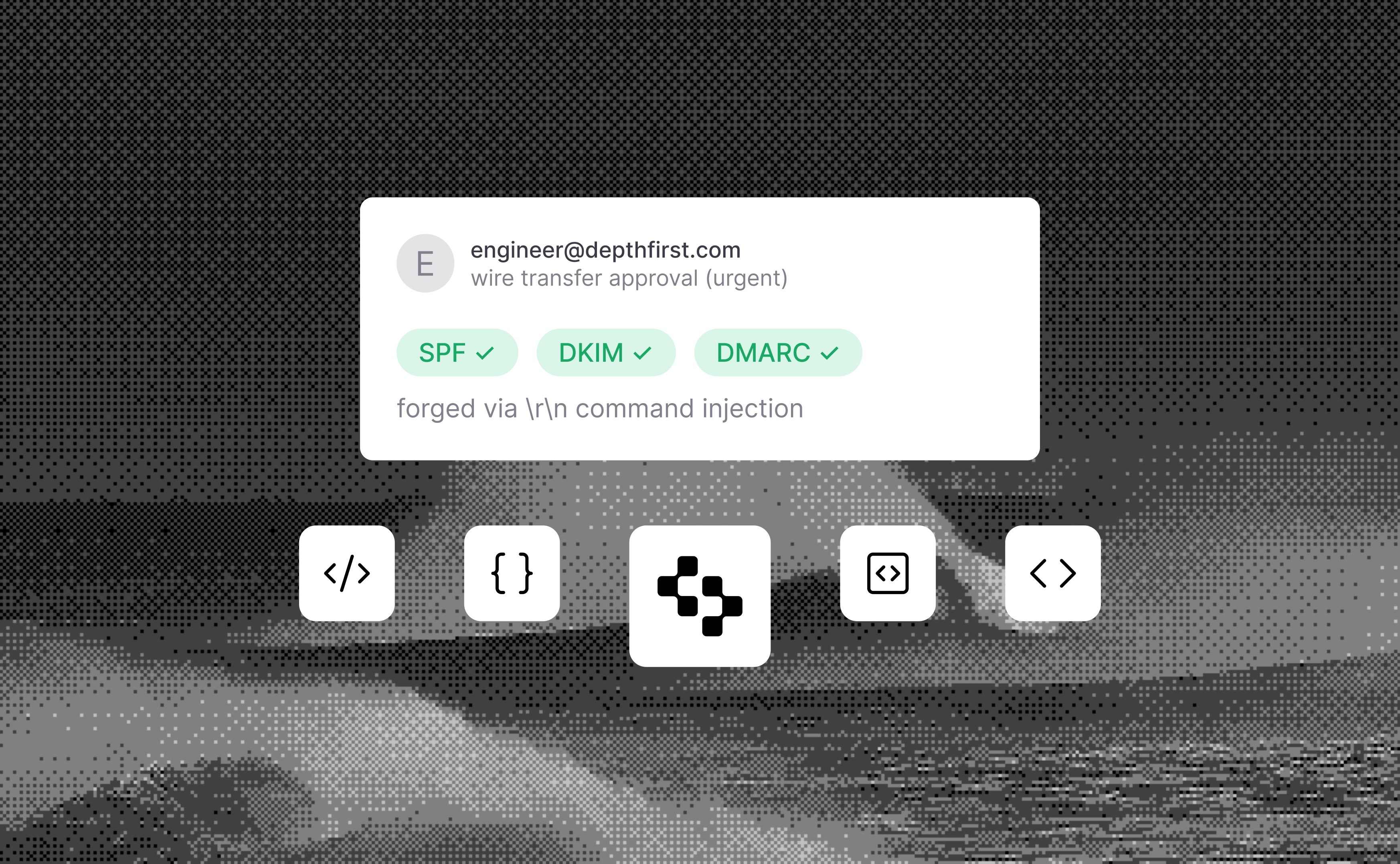 Casting a Net(ty) for Bugs, and Catching a Big One (CVE-2025-59419) | depthfirst
CVE-2025-59419 is an SMTP command injection in Netty's SMTP codec, found by depthfirst's autonomous security agent. The codec accepted \r\n in user input such as the RCPT TO recipient, letting an attacker inject extra SMTP commands and forge senders. The forged mail passes SPF, DKIM and DMARC, enabling BEC and phishing. Maintainers merged the agent-generated patch, citing Netty's existing HTTP codec validation.
 depthfirst.comwriteupAdded 29 Oct 2026, published 20 Oct 2025🛡️ Security
- MicroSocks: Convenient access through a compromised SonicWall SMA
DFIR investigation by a researcher into a SonicWall SMA compromise where the threat actor exploited CVE-2021-20039 (authenticated command injection) to drop the previously-known wafxSummary web shell, then months later placed a second binary, wafySummary, identified as the open-source MicroSocks SOCKS5 proxy. The attacker used MicroSocks to tunnel RDP traffic into the internal network, avoiding further malware deployment and detection for nearly 11 months before deploying Abyss ransomware. Includes reproduction steps confirming the binary's SOCKS proxy functionality and its VirusTotal PUA detection.
 dfir.chwriteupAdded 3 Sep 2026, published 30 Mar 2024🛡️ Security
- CVE-2023-38336: Command injection in netkit-rcp
Writeup by the researcher who reported CVE-2023-38336, a command injection vulnerability in Netkit's rcp implementation (Debian's rsh-client package). The bug is in susystem() in rcp/rcp.c, which passes filename arguments unsanitized to `sh -c`, letting an attacker who controls a copied filename execute arbitrary commands (demonstrated via `ltrace` with a filename like `";whoami"`); the binary is SUID root but drops privileges via setuid() before executing the shell, so the flaw grants command execution as the invoking user rather than root escalation. No patch exists since the project has no upstream maintainer, and the author recommends migrating from RSH to SSH.
 bencteux.fradvisoryAdded 3 Sep 2026, published 18 Jul 2023🛡️ Security

