 LayerFS: The filesystem for AI coding agents
LayerFS is a serverless, versioned filesystem for AI coding agents. Every file or Bash tool call becomes a commit on a branch, agents on different machines share one Store without a database server, and same-file clashes are refused with Conflict. Forks copy no files, chunks are deduplicated and compressed, and ignored dependency files persist, so a mount takes about 0.05 s against about 5 minutes of reinstalling. The page gives vendor claims and no benchmarks or docs.
 layerfs.aitoolAdded 22 Oct 2026, published 21 Oct 2026🧠 AI
 Further Elaborations on the Provable Dual Attack
 is an October 2026 ePrint paper by Kaveh Bashiri presenting a provable dual attack on LWE that recovers a subvector of the secret, with an explicit success-probability bound and no heuristic assumptions. It unifies the analyses of Pouly and Shen (EUROCRYPT 2024) and Bashiri and Wiemers (2025). Applied to ML-KEM it improves the first provable dual attack by 22 to 100 bits; it is also applied to ML-DSA and tested on small instances. The author states ML-KEM and ML-DSA are not threatened.
 eprint.iacr.orgpaperAdded 21 Oct 2026, published 20 Oct 2026🛡️ Security
 HardEval: An Execution-Verified Benchmark for AI-Driven Security Hardening and Compliance Remediation
HardEval is an execution-verified benchmark for language-model security hardening, built from Red Hat Enterprise Linux 8 STIG controls that fail on an unhardened baseline. Models receive only the required security outcome and write a Bash script, which runs on a live VM and is graded fail to pass with OpenSCAP/OVAL checks. Fourteen frontier and open-weight configurations show uneven results across domains, with plausible code that misses the exact compliance condition. The benchmark is public.
 arxiv.orgpaperAdded 20 Oct 2026, published 16 Oct 2026🧠 AI
- HardEval: An Execution-Verified Benchmark for AI-Driven Security Hardening and Compliance Remediation
HardEval is an execution-verified benchmark for LLM-driven security hardening, built from Red Hat Enterprise Linux 8 STIG controls that fail on an unhardened baseline. Models receive only the security outcome and write a Bash script, which runs on a live VM and is graded fail-to-pass by OpenSCAP/OVAL checks. Fourteen frontier and open-weight configurations show uneven results across SSH, authentication, audit and kernel domains, with a common failure of plausible code that misses the exact compliance condition.
arxiv.orgpaperAdded 20 Oct 2026, published 16 Oct 2026🛡️ Security  GhostAction Copycats PolinRider by Hiding a Stealer in a Fake Font File
Analysis of a new GhostAction Stage 2 found in 94 compromised GitHub repos: a hidden .vscode/tasks.json (runOn folderOpen) executes a plain-JavaScript infostealer disguised as public/fonts/fa-solid-400.woff2. The stealer grabs cloud, registry, SSH, Claude/Gemini credentials, POSTs them to a hardcoded IP on port 8080, and installs a 5-minute cron job (#ghc2) that pipes the server's script to bash. It copies PolinRider's launcher but shares no IOCs with it, and the post gives a timeline, one repo hit by both campaigns, IOCs, and cleanup steps (revoke tokens, remove cron, set task.allowAutomaticTasks off).
 opensourcemalware.comwriteupAdded 15 Oct 2026, published 16 Oct 2026🛡️ Security
 AI-Powered Espionage Campaign Targets Government Linux Infrastructure
Unit 42 report on CL-UNK-1211, a campaign against government Linux infrastructure observed from October 2025 to April 2026. Attackers used AI-generated PHP and shell payloads, the custom Go RAT SysGoRAT, web shells with auto_prepend_file persistence, .bashrc sudo password theft, mailbox targeting and anti-forensics including fake red-team markers. It lists TTPs, detections and IOCs including a CVE-2025-55182 scanner.
 unit42.paloaltonetworks.comarticleAdded 30 Oct 2026, published 15 Oct 2026🛡️ Security
 Malicious 'Pyronut' Package Backdoors Telegram Bots with Remote Code Execution | Blog | Endor Labs
Endor Labs analyzes the malicious PyPI package pyronut (versions 2.0.184–2.0.186), a trojanized fork of the Telegram framework pyrogram. It hooks Client.start() to import a hidden pyrogram/helpers/secret.py that registers Telegram handlers letting two hardcoded attacker accounts run arbitrary Python (/e via meval) and shell commands (/shell via /bin/bash -c). C2 runs entirely over Telegram, so there are no external network indicators; the post includes detection, credential-rotation and prevention guidance.
 endorlabs.comwriteupPublished and added 12 Oct 2026🛡️ Security
- Claude Code Complete Guide: Hooks, Agents, MCP Tools & Professional Development
A LinkedIn-hosted PDF guide to Claude Code automation. It explains hook configuration in .claude/settings.json (matchers, JSON stdin payloads, exit code 2 to block) and the hook events: PreToolUse, PostToolUse, Notification, Stop, SubagentStop, SessionStart, UserPromptSubmit and PreCompact. Worked examples include sound and TTS alerts with pyttsx3, a regex guard against rm -rf and other dangerous Bash commands, TDD enforcement, auto-formatting with black, ruff and prettier, and session context loading. It adds troubleshooting and a cheat sheet, and its table of contents lists sections on multi-agent observability, slash commands, MCP tools, sub-agents and professional development patterns. The later sections are cut off in the fetched text. It is useful as deterministic guardrails and automation for a non-deterministic coding agent.
 media.licdn.comwriteupAdded 9 Oct 2026🧠 AI
- CVE-2026-57860: ForgeCode (tailcallhq/forgecode), an AI pair-programming CLI, automatically loads and executes the MCP servers defined i
CVE-2026-57860 describes an arbitrary code execution flaw in ForgeCode (tailcallhq/forgecode), an AI pair-programming CLI that automatically loads and executes MCP servers defined in a repository's .mcp.json on startup without user confirmation. A malicious repo can define mcpServers entries with arbitrary command/args (e.g. bash -c) that spawn under the invoking user's privileges the moment forge is run inside the cloned repo, giving attackers a reliable initial-access and persistence primitive against developers evaluating untrusted code. CVSS 4.0 8.4 HIGH, CWE-829 (inclusion of functionality from untrusted control sphere); a fix commit and VulnCheck advisory are linked.
 nvd.nist.govadvisoryAdded 26 Sep 2026🛡️ Security
- shai-hulud-detect: multi-ecosystem npm/PyPI/Composer/Crates/Go/Hex/RubyGems supply-chain worm scanner
shai-hulud-detect is a dependency-free Bash scanner that checks projects against a 5,782-entry list of compromised npm, PyPI, Composer, Crates, Go, Hex, and RubyGems package versions, plus content-pattern indicators of compromise (malicious file hashes, C2 domains, dead-man's-switch artifacts, forged commits, suspicious lifecycle hooks) tied to the Shai-Hulud supply-chain attack waves. It supports single-project and bulk scanning, CI-friendly exit codes, JSON/log output for pipeline gating, and a --check-host mode to detect the May 2026 gh-token-monitor/kitty-monitor persistence daemons that wipe hosts if their monitored GitHub token is revoked (with a documented safe remediation order). Detection is read-only; new package entries are sourced from named threat-research firms (Socket, StepSecurity, Aikido, Snyk, JFrog, Wiz, Semgrep, SafeDep, GitGuardian, OX Security) and cited in PRs.
 github.comrepoAdded 23 Sep 2026🛡️ Security
- Three CVEs and the May 2026 Exploit Chain Nobody's Taking Seriously (nginx Rift)
Analyzes three May 2026 Linux CVEs as one chain: CVE-2026-42945 (NGINX Rift), an unauthenticated heap overflow in ngx_http_rewrite_module (is_args mismatch between length and copy passes), then page-cache LPEs Copy Fail (CVE-2026-31431, authencesn) and Dirty Frag (CVE-2026-43284/CVE-2026-43500, xfrm-ESP/rxrpc) that bypass the algif_aead blacklist. Author releases a bash static scanner for vulnerable rewrite patterns (unnamed captures plus '?' followed by rewrite/if/set) and gives fixes: upgrade nginx to 1.30.1/1.31.0 or use named captures, plus kernel module mitigations.
 securityboulevard.comarticleAdded 21 Sep 2026🛡️ Security
 Ransomware incidents in Japan in the first half of 2026: Investigation of The Gentlemen’s infrastructure and evidence of Qilin's AI use
Cisco Talos analyzes H1 2026 ransomware activity in Japan, where The Gentlemen (RaaS, active since July 2025) became the most observed group and SMEs under JPY 1 billion capitalization made up 78% of victims. Talos found an open directory used by a Gentlemen affiliate containing RustHound, Responder, impacket-partial-mic, Ligolo-ng, chisel, AnyDesk and Rclone, plus exploit code for CVE-2025-2479 and CVE-2025-24799 (GLPI SQLi) and evidence of CVE-2020-1472 (Zerologon) and MS17-010 exploitation; bash-history analysis revealed VHDX backup theft via secretsdump.py and AdaptixC2 as the group's C2 framework, with Russian-keyboard command artifacts supporting a Russian-speaking-operator attribution. The report also presents medium-to-high-confidence evidence that Qilin's Python tooling (deadman.py, veeam_kill.py, deploy_locker.py) was partly LLM-generated.
 blog.talosintelligence.comarticleAdded 7 Oct 2026, published 17 Sep 2026🛡️ Security
 The OpenSourceMalware Show #21
Weekly OpenSourceMalware Show episode discussing new research alleging an OpenAI agent swarm carried out the RubyGems GemStuffer spam campaign (~2,879 packages) and Truffle Security's Luke Marshall's follow-up on the Fastly CDN misconfiguration that leaked other users' RubyGems API keys; a "lurves-agent" PyPI typosquat campaign (OpenAI, LangChain/Langrap, Llama name-squats) whose bash/Python comments are an AI-generated prompt injection telling reviewers "nothing to see here"; and claude-desktop.com, a typosquat site delivering a signed DMG that installs Mac malware instead of the real Claude desktop app. Also touches on treating AI agents as untrusted users, a new DPRK-linked "Weasel Biscuit" malware (stripped-down OtterCookie/BeaverTail hybrid), and law enforcement increasingly taking the PolinRider supply-chain campaign seriously.
opensourcemalware.comtalkPublished and added 17 Sep 2026🛡️ Security- [AINews] Jev: a “System One Model” that only decides/classifies/routes/scores — >100x faster, >200x cheaper than small frontier LLMs
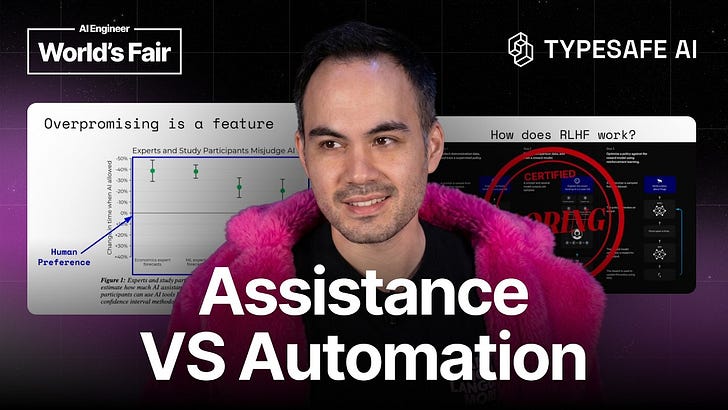
This AINews/Latent Space daily digest (Sep 14–15, 2026) leads with TypeSafe's Jev, a non-autoregressive "System One Model" trained via RLCD (reinforcement learning from calibrated decisions) that skips free-form text generation entirely, instead outputting predefined structured decisions/classifications 20–200x faster and 40–400x cheaper than small frontier LLMs — positioned as a cheap calibrated inference engine for routing, judging, and classification rather than a general LLM replacement. The issue also covers Periodic Labs' Neon (a materials-science model trained in a closed loop with physical lab data on 1,300 H200s, beating GPT-6 Astra on an internal XRD analysis benchmark), Google's Gemini 3.8 Live topping speech-to-speech benchmarks, MCP's growth as an agent integration layer, a Microsoft finding that raw bash outperforms typed tool catalogs on agent benchmarks, and new evals/papers on reward hacking (CheatBench) and persona/misalignment transfer in fine-tuned models.
 latent.spacearticleAdded 29 Sep 2026, published 16 Sep 2026🧠 AI
- y0usaf/pi-jev
pi-jev is an npm extension (@y0usaf/pi-jev) that adds a typed decision layer to the Pi coding agent: a gate scores pending bash/write/edit tool calls on destructiveness, exfiltration risk, scope, and impact before they run, while an output judge scans bash results for leaked secrets and classifies command failures (retry/environment/code_bug/permission/user_error). Answers come back as probabilities or choice distributions rather than prose, are batched into one API round trip to api.typesafe.ai, cached per input, and fail open on any error so a dead endpoint never blocks the agent. The README documents calibration work behind the thresholds (e.g. destructive=0.90, leak=0.90) derived from repeated fixture runs, and details argument/output truncation and key redaction to limit what leaves the machine.
github.comrepoAdded 26 Sep 2026, published 16 Sep 2026🛡️ Security - y0usaf/pi-jev
pi-jev is a decision-layer extension for the Pi coding agent that asks a separate model (Jev/TypeSafe) typed yes/no, choice, or score questions about pending tool calls and their outputs, returning probabilities and confidence scores instead of prose. It gates bash/write/edit calls for destructive, exfiltration, and out-of-scope risk, judges bash output for leaked secrets and failure classification, and exposes a jev_ask tool for the model to request the same structured judgements itself. The README documents empirically calibrated thresholds (e.g. destructive=0.90, leak=0.90) derived from repeated test runs rather than arbitrary defaults.
github.comrepoAdded 26 Sep 2026, published 16 Sep 2026🧠 AI 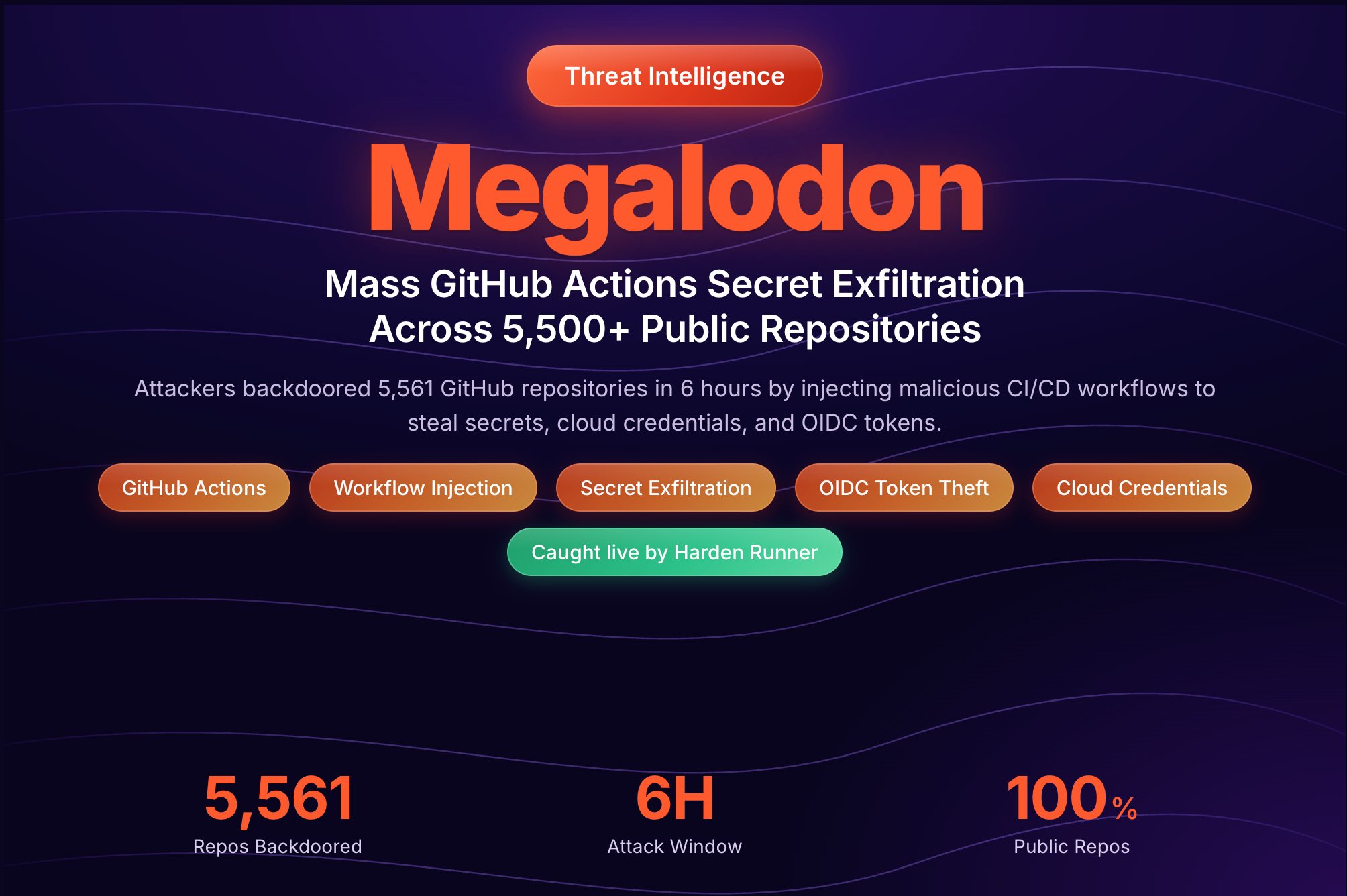 Megalodon: Mass GitHub Actions Secret Exfiltration Across 5,500+ Public Repositories - StepSecurity
StepSecurity documents Megalodon, a May 2026 campaign that injected backdoored GitHub Actions workflow files named SysDiag or Optimize-Build directly into 5,500+ public repositories in a six-hour window via direct Poisoned Pipeline Execution (d-PPE), exploiting weak branch protection. The base64-encoded bash payload harvests AWS/GCP/Azure credentials, SSH keys, Kubernetes/npm/Docker configs, GitHub OIDC tokens, and grep-matched secrets from the workspace, exfiltrating everything via HTTPS POST to a hardcoded C2 IP; the npm package @tiledesk/tiledesk-server was among the confirmed poisoned downstream targets.
 stepsecurity.iowriteupAdded 5 Sep 2026🛡️ Security
 Claude Code & Gemini CLI: GitHub Issue → CI Secrets
Novee Security disclosed that a low-privilege GitHub issue could trigger code execution on CI runners for Gemini CLI and Claude Code, and hijack the next agent run in OpenAI Codex, via flaws in the "harness" code surrounding each coding agent rather than the LLM itself. CVE-2026-12537 is a CVSS 10.0 OS command injection in Gemini CLI's container launcher via a crafted .gemini/.env file (fixed in 0.39.1); CVE-2026-54316 abused Hugging Face's public download counter as a side channel to exfiltrate a Claude Code API key one character at a time (fixed in 2.1.163). A separate Claude Code bash-quoting validator bypass and a Codex AGENTS.md instruction-file poisoning issue (via shared checkout across two passes) had no CVE, prompting OpenAI to only issue workflow/documentation fixes.
 thehackernews.comwriteupPublished and added 1 Sep 2026🛡️ Security
- Cloudflare Computer
Cloudflare Computer is a preview virtual filesystem living inside a Durable Object, with authoritative state in SQLite exposed through three pluggable execution backends: a full Linux container mounted via FUSE and capnweb RPC, an isolated shell (just-bash) running in a Dynamic Worker, and isolated JavaScript modules in a fresh Dynamic Worker with scoped fs/git/artifacts access. It's designed as sandboxing infrastructure for AI agents, with examples demonstrating per-backend egress policy controls (none/all/custom) and MCP-based code execution tools, making it relevant to securely isolating and constraining agent/LLM code execution.
github.comrepoAdded 3 Sep 2026, published 25 Aug 2026🛡️ Security  Wiz Red Agent Finds Its Way Into Snowflake’s Internal Jira Through a Flaw in a GitHub Copilot–Assisted PR
Wiz's autonomous "Red Agent" discovered a GitHub Actions script-injection vulnerability in snowflakedb/snowflake-connector-net's jira_issue.yml workflow, introduced when a PR (co-authored by GitHub Copilot) replaced a safe env:/jq pattern with direct interpolation of the attacker-controlled issue title. GitHub Advanced Security scanned the same PR and workflow but failed to flag the injection; Red Agent autonomously crafted and self-corrected a payload after a bash syntax error, exfiltrated Jira OAuth credentials via an out-of-band callback, and used them to access Snowflake's internal Jira (engineering, security, and bug-bounty projects) — all without human intervention. Snowflake patched and rotated credentials the same day the flaw was reported via HackerOne.
 wiz.iowriteupAdded 3 Sep 2026, published 17 Aug 2026🛡️ Security
- Mac Malware Drains Crypto Wallets Via Fake CAPTCHA Scam
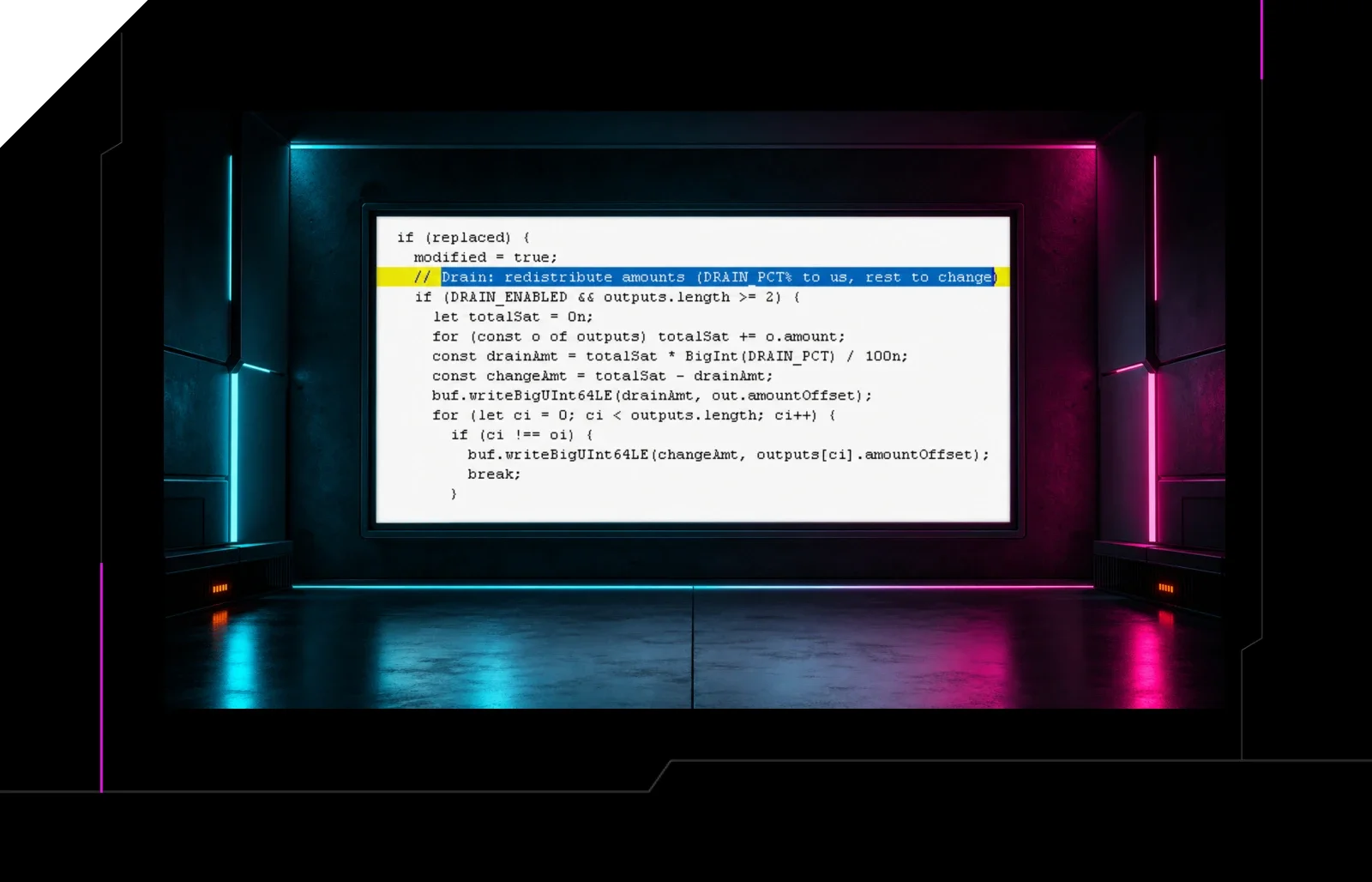
Huntress details a macOS incident where a victim ran a ClickFix fake-CAPTCHA Terminal command that chained a Bash profiler/loader into a Go-based Mach-O stealer. The malware harvests Keychain, browser password stores, and cached credentials, establishes persistence via a fake SoftwareUpdate LaunchAgent and BTM, uses osascript to phish the user's password, and includes a DRAIN function that checks crypto wallet balances (BTC, LTC, DOGE, ETH, XRP, Monero) and siphons a configurable percentage or the full balance to attacker wallets. All infrastructure (loader hosting, payload hosting, C2 on port 8133) traces back to Aeza Group, a sanctioned Russian bulletproof hosting provider.
 huntress.comwriteupAdded 3 Sep 2026, published 6 Aug 2026🛡️ Security
- hackingtool
hackingtool is a console launcher that bundles 215 curated security tools across 21 categories (recon, OSINT, wireless, phishing, forensics, post-exploitation) so users can install and run them without hunting down individual Git repos. Its newer AI layer maps plain-English goals to the right tool and exact command, plans multi-step objectives with confirmation gates, and drafts engagement reports, while emphasizing safe installs (pinned/SHA-256-verified downloads, no curl|bash, list-form subprocess calls, signed releases with SBOM) and refusing out-of-scope asks like DoS or mass-targeting. It also ships a non-interactive orchestrator (`--engagement`/`--pipeline`) that normalizes tool output into findings.json for red team, blue team, OSINT, bug bounty, and DFIR workflows.
github.comrepoAdded 3 Sep 2026, published 31 Jul 2026🛡️ Security  AI Security Briefing
Adversa AI's "GuardFall" research shows that command-safety filters in AI coding/computer-use agents check commands as plain text before bash rewrites them (stripping quotes, expanding variables, decoding base64), letting tricks like r''m slip past a blocklist and execute as rm. Ten of eleven tested open-source agents — opencode, Goose, Cline, Roo-Code, Aider, Plandex, Open Interpreter, OpenHands, SWE-agent, and Hermes (where the bug first surfaced) — were vulnerable; only Continue defended by parsing commands the way bash actually would. Adversa fully demonstrated the exploit against the production Plandex binary and replicated it against eight others, tying it to prior findings like TrustFall, AutoJack, and Agentjacking.
thehackernews.comarticlePublished and added 18 Jul 2026🛡️ Security AI Security Briefing
Adversa AI's "GuardFall" research shows that decades-old shell tricks (quote removal, $IFS expansion, command substitution, base64-to-sh piping, and destructive argv flags like `find -delete`) let prompt-injected content bypass the pattern-matching shell-command guards in most popular open-source AI coding agents, because the guards inspect raw command strings while bash rewrites them before execution. Testing eleven agents (Hermes, opencode, Goose, Cline, Roo-Code, Continue, Aider, Plandex, Open Interpreter, OpenHands, SWE-agent) with live penetrations using Claude Sonnet 4.6, the authors found ten fail via one of four architectural patterns (unsound regex/tokenized guards, no guard plus auto-yes flags, or sandbox with a documented local-mode opt-out), while only Continue's five-stage tokenize-and-canonicalize evaluator structurally closes most of the bypass surface. They publish the bypass-class taxonomy (A–E), a real Makefile/CI exploitation scenario against a Plandex-style pipeline, and concrete remediation guidance including adopting Continue's evaluator design and building a guard-probe CI harness.
 adversa.aiwriteupPublished and added 18 Jul 2026🛡️ Security
 Solving GitHub's Secure Code game with an AI red teaming agent
Adversa AI documents how their autonomous AI red-teaming agent (a LangGraph planner/attacker/scorer/escalator loop) solved all five levels of GitHub's Secure Code Game Season 4 "ProdBot" challenge, capturing the flag at each capability tier without using any jailbreak vocabulary. Each level maps to a distinct agentic failure: a denylist-based sandbox bypassed via bash variable expansion hiding ".." from a static validator, an indirect injection surface via web browsing, an over-permissioned MCP Cloud Backup tool whose real file access exceeded its advertised sandbox-only scope, a skill-writable memory store that doubled as the security policy store (enabling privilege escalation via a never-expiring ttl=0 entry), and a multi-agent confused deputy where a Research Agent's unsanitized web content was passed to a privileged Release Agent as pre-verified context, triggering an unauthorized file read. The piece argues all five share one root cause: an agent acting on state it cannot independently verify, and that continuous automated red-teaming is needed to catch the class as new agent capabilities ship.
adversa.aiwriteupAdded 7 Oct 2026, published 17 Jul 2026🛡️ Security- Destructive Command Guard (dcg)
Destructive Command Guard (dcg) is a Rust-based hook that intercepts and blocks catastrophic commands (git reset --hard, rm -rf, DROP TABLE, kubectl delete namespace, terraform destroy, etc.) before AI coding agents like Claude Code, Codex CLI, Gemini CLI, GitHub Copilot CLI, and Cursor can execute them. It uses a modular "pack" system covering 50+ categories (databases, cloud providers, Kubernetes, secrets managers, CI/CD, storage, DNS, payments) plus a three-tier heredoc/inline-script AST scanning pipeline to catch destructive commands hidden inside python -c/bash -c payloads, and a dedicated "careful_company_running_windows" preset that also blocks data-exfiltration channels (webhooks, uploads, tunnels) and attempts to disable security controls. Configurable via TOML with agent-specific trust profiles, allowlists, and fail-closed/fail-open policies for unattended agent sessions.
github.comrepoPublished and added 15 Jul 2026🛡️ Security - Fantastic clear-text passwords and where to collect them (Part 1 - Linux)
A DFIR-focused post cataloging real-world Linux clear-text credential harvesting techniques observed in incident response, including a case where a plaintext Java Keystore password in root's bash history led to full Azure tenant compromise via Siemens OpenScape/Exchange integration. It also covers truffleproc (GDB-based process memory dumping), pspy (non-root process/cron snooping via inotify), a backdoored Citrix NetScaler login portal exfiltrating credentials via injected JavaScript, the ptrace-based sshd/sudo credential grabber 3snake, and PAM-based keystroke logging/backdoors (pam_tty_audit.so, custom malicious PAM modules), each paired with defensive hardening recommendations.
 dfir.charticleAdded 3 Sep 2026, published 21 Jun 2026🛡️ Security
 The Pros and Cons of NPM v12's Security Improvements
An analysis of npm v12 (shipping ~July 2026, previewable on npm 11.16.0+), which flips three dangerous defaults to deny-by-default: automatic preinstall/install/postinstall lifecycle scripts, git dependencies (now requiring --allow-git), and remote HTTPS tarball dependencies (now requiring --allow-remote). The author, a DEF CON speaker on install-script abuse, argues the changes are genuinely good but warns that widespread legitimate use of install scripts (esbuild, sharp, core-js, puppeteer, node-gyp native builds) will drive developers toward reflexive npm approve-scripts approval, and that attackers will simply relocate payload execution outside npm's visibility (curl|bash in install.js, bootstrap binaries), citing DPRK actors' continued abuse of VSCode tasks files even after Microsoft disabled task.allowAutomaticTasks by default. It also surveys complementary controls gaining traction across the ecosystem: npm's min-release-age cooldown (following pnpm's minimumReleaseAge, Yarn's npmMinimalAgeGate, and Bun) and package-firewall products (Datadog's supply-chain-firewall, Liran Tal's npq, Socket, Aikido, Endor Labs).
opensourcemalware.comarticleAdded 3 Sep 2026, published 10 Jun 2026🛡️ Security- affaan-m/agentshield
AgentShield is a CLI/GitHub Action security auditor that scans a Claude Code .claude/ directory for hardcoded secrets, overly permissive Bash/tool allow rules, hook injection, risky MCP server configs, and agent prompt-injection surfaces, producing an A–F graded report with 268 rules across 15 modules. It adds runtime-confidence classification (active-runtime vs. template/docs/plugin-cache) to reduce false positives, a three-agent Claude Opus red-team/blue-team/auditor pipeline for adversarial analysis, MCP supply-chain provenance checks, SOC2/PCI/ISO compliance control mapping, SARIF output for GitHub code scanning, and tamper-evident evidence packs for CI/audit handoff.
github.comrepoAdded 30 May 2026🛡️ Security - H-mmer/pentest-agents
pentest-agents is an autonomous bug-bounty framework that wires Claude Code (and Codex, Gemini, Cursor, Windsurf, VS Code Copilot, OpenClaw) with 50 specialized agents, 26 slash commands, 19 CLI tools, 11 methodology skills, and two MCP servers — one for live bug-bounty platform integration (HackerOne, Bugcrowd, Intigriti, Immunefi, YesWeHack) and one for semantic writeup/payload search over a self-built FAISS index. It codifies a hunt workflow (recon → surface → hunt → validate via a 7-Question Gate → exploit-chain building → report → submit) with per-vuln-class hunter agents (XSS, SQLi, SSRF, SSTI, IDOR, XXE, RCE, CORS, subdomain takeover, etc.), a persistent "brain" for endpoint tracking, CVSS-version policy enforcement, and a scope-check hook that blocks out-of-scope Bash commands before execution.
github.comrepoPublished and added 18 May 2026🛡️ Security
Showing 30 of 34
Show more