- Prasenjit Sarkar (@stretchcloud) on X
Campfire is a self-hosted tool that runs Claude Code, Codex, Goose, Aider and OpenHands in one tab. Risky actions need permission voting (majority approves, any single deny blocks, 30 second timeout), and session replay traces which file or tool call triggered an action. The post cites Forever Security's finding that Codex followed a planted AGENTS.md instruction over 90% of the time and Claude Code about half the time. It also cites the February Cline release compromise via a poisoned GitHub Actions cache.
 x.comthreadAdded 28 Oct 2026, published 27 Oct 2026🛡️ Security
 Akash Rajagopal (@akashsairaja) on X
Ollama overview thread by Akash Rajagopal on X. It lists six steps: install on macOS, Linux, Windows or Docker; run `ollama run gemma4`; use the REST API on localhost:11434 (/api/chat); call it from ollama-python and ollama-js; llama.cpp as the README's supported backend; and `ollama launch claude` to connect Claude Code. Codex, OpenCode, Copilot CLI and Droid also work. The thread cites 184k GitHub stars and an MIT licence.
x.comthreadAdded 27 Oct 2026, published 26 Oct 2026🧠 AI David Gutierrez | Eng (@david_x_ai) on X
Thread on two October 2026 npm compromises: @subql/common 5.8.3 (5 October), published through GitHub Actions OIDC Trusted Publishing after the attacker tampered with the publish workflow, and tensorlake 0.5.144 (8 October), published by the project's own release workflow with valid provenance for about 1 hour 40 minutes. Both ran on install and stole cloud, GitHub, Kubernetes, Vault, SSH and .env credentials; tensorlake also took AI tool and MCP config. Its payload installed a gh-token-monitor service that deletes the home directory if the stolen GitHub token is revoked, so remove it before rotating.
x.comthreadAdded 27 Oct 2026, published 26 Oct 2026🛡️ Security- Zex Alpha (@kryptozex) on X
Post about the "Steal My Bitcoin" bounty, a 0.025 BTC (about $2,025) prize that was swept early Monday, about 90 minutes after researcher @killa published a full exploit on GitHub. The exploit is a heap exploit written for the target's PHP build. It leaks memory addresses through session cookies and forces PHP cleanup to run the flag binary. The first solve looked like a failure because the pulled key did not control the advertised address, a planting mistake the creator admitted by email.
x.comthreadPublished and added 26 Oct 2026🛡️ Security - alex lee (@alexlee20122022) on X
Gheist is a GitHub campaign disclosed by Wiz in October 2026. Stolen tokens push ci-sync-XXXXXX branches with a sync-check workflow that dumps repo secrets base32-encoded to evade log masking, fetches the logs via API, then deletes the run. 13,500+ branches and 850+ accounts were hit since 15 September. Public repos are protected by the approval hold; private and Enterprise repos are not. The thread lists IOCs (.gdmp_pat files, "gheist" user agent, "ci: sync config" commits) and rotation steps.
x.comthreadAdded 26 Oct 2026, published 25 Oct 2026🛡️ Security  ReignSwords (@ReignSwords) on X
A reviewer tests GenOffice, an open-source Office suite (10.7k GitHub stars), through its CLI only. Markdown to .docx took 3.8s, JSON to .xlsx took 0.9s with a live SUM formula, and .docx to PDF failed twice until Xvfb supplied a display. It has byte-preserving edits, a skill file for Claude Code and Codex, and 29 MCP tools. Downsides: a 188MB download that filled a 512MB /tmp, Electron in the PDF path, and unproven trust in tracked changes and rollback.
x.comthreadAdded 25 Oct 2026, published 24 Oct 2026🧠 AI- The Hacker News (@TheHackersNews) on X
The Hacker News post relays LiteLLM's root-cause disclosure for its supply chain attack. A master key leaked on GitHub in May was never revoked. Attackers used it to reach the Agent Platform, steal a GitHub owner token, and publish a malicious PyPI release in October. A reply says the agent tool held the org owner's personal CLI login, which skips GitHub's 2FA re-check.
x.comthreadAdded 26 Oct 2026, published 24 Oct 2026🛡️ Security  Prasenjit Sarkar (@stretchcloud) on X
Post on the LiteLLM supply-chain compromise. Attackers spent eleven days in the GitHub org, ran a workflow on a throwaway branch to take twenty secrets including a GitHub App private key, then used stolen GitHub CLI OAuth tokens to publish malicious release 1.107.0 from a lookalike Berri-AI repo. A Python startup file harvested sixteen credential categories and LiteLLM proxy Postgres provider keys. Socket flagged the wheels in seven minutes.
x.comthreadAdded 26 Oct 2026, published 24 Oct 2026🛡️ Security- Big Bull (@BIGBULLapp) on X
A post by BIGBULLapp on X about a TensorBlock GitHub index of Model Context Protocol servers, described as a TypeScript list so agents call tools someone has already wired up. It cites 1470 forks, 943 stars and 15 open issues. The author notes that curated lists go stale when a server changes its schema. The repository name is truncated in the post.
x.comthreadAdded 24 Oct 2026, published 23 Oct 2026🧠 AI - Dark Web Intelligence (@DailyDarkWeb) on X
LiteLLM suspects its October 21 release compromise began with Claude Code responses containing GitHub CLI OAuth tokens that were written to logs of an internet-facing internal LiteLLM gateway. Attackers allegedly stole those tokens, used an organization-owner token to disable branch protections, and pushed poisoned artifacts from a lookalike repository. How they entered the gateway is unconfirmed, and this is not a proven Claude Code vulnerability.
x.comthreadAdded 25 Oct 2026, published 22 Oct 2026🛡️ Security - Muscle AI (@themuscleai) on X
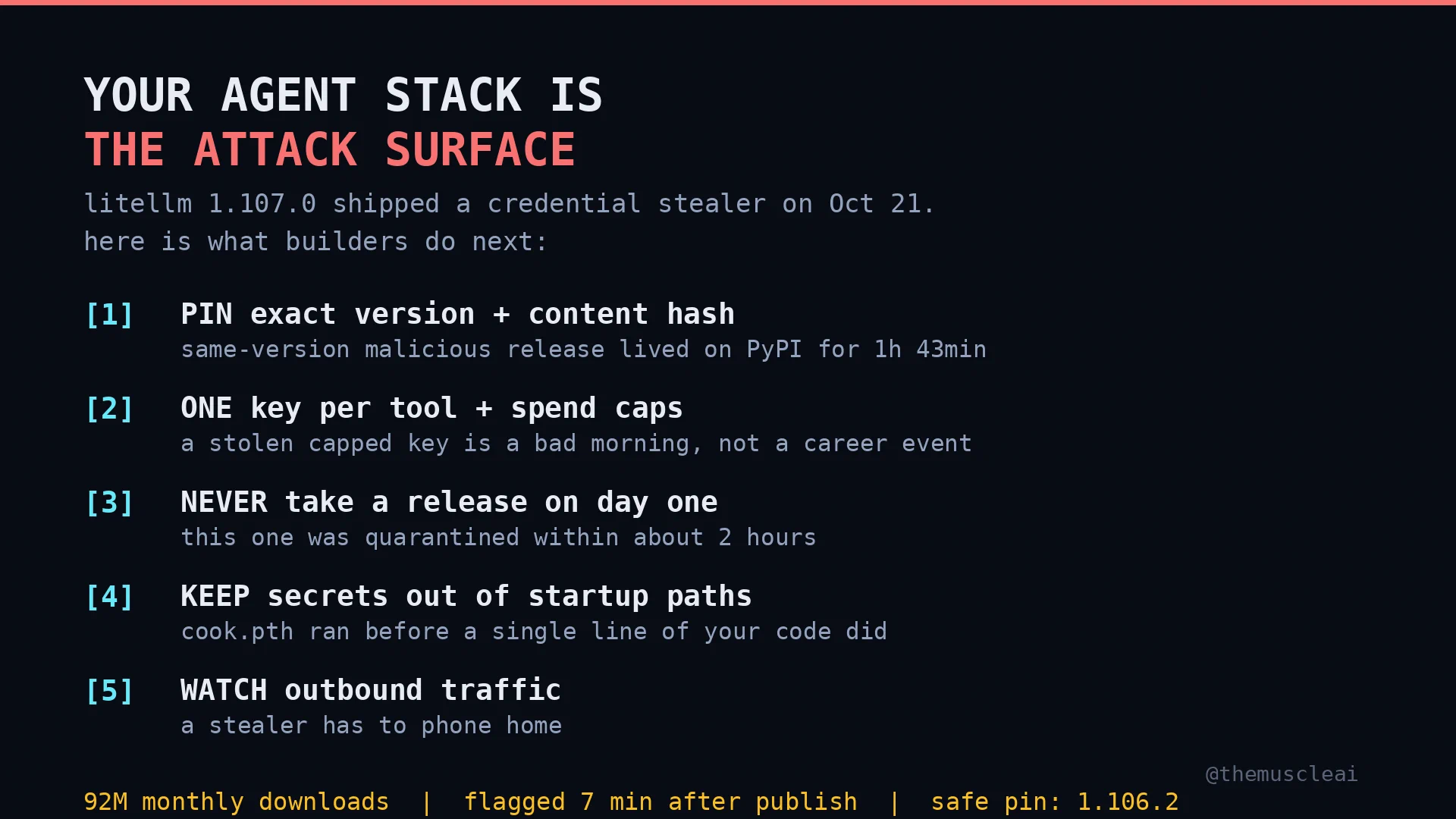
Post on the LiteLLM 1.107.0 PyPI compromise published 21 October 2026 and quarantined about 1 hour 43 minutes later. A malicious .pth file ran at Python startup and stole cloud credentials, private keys, browser data and AI tool auth files, then POSTed a tarball to an attacker endpoint. The author says attackers used stolen GitHub CLI OAuth tokens to push a trojanized commit chain and build official wheels. It lists five defenses: hash-pinned lockfiles, per-tool capped keys, release cooling periods, secret isolation and egress monitoring.
x.comthreadAdded 23 Oct 2026, published 22 Oct 2026🛡️ Security  SecureChap (@SecureChap) on X
Post describing a LiteLLM 1.107.0 PyPI compromise in which attackers used stolen GitHub CLI OAuth tokens from three engineers to trigger and approve the project-releaser workflow, producing eight malicious wheels and a tampered tarball. The wheels drop cook.pth, which runs at Python startup, and privcollect steals cloud tokens, keys, browser data, AI configs and LiteLLM proxy credentials, exfiltrating to litellm[.]dev/healthcheck. A second daemon polls a GitHub domain.txt hourly for new domains to fetch and execute. PyPI yanked the package the same day. The post is a single unsourced tweet.
x.comthreadPublished and added 22 Oct 2026🛡️ Security Billy Lee (@billyozno) on X
LiteLLM 1.107.0 on PyPI shipped malware in all 7 wheels, the package's second supply-chain attack this year. It steals SSH keys, cloud credentials, browser passwords, AI tool configs and API keys, and installs a backdoor that polls for commands hourly. The GitHub source is clean, so a hijacked build or publish step is suspected. PyPI quarantined the release, but Aikido says the Docker image litellm/litellm:1.107.0 was still live. Indicators are cook.pth, cook.py and sitecustomize.py in site-packages. The advice is to rotate reachable keys and pin 1.106.2.
x.comthreadAdded 23 Oct 2026, published 21 Oct 2026🛡️ Security- Manish Kumar (@Manixh02) on X
Anatomy is an open-source agent skill that turns technical concepts into interactive visuals. Asked to explain a rate limiter or CDN cache, it builds a working model the user can explore. A tweet by Manixh02 says it works with Claude Code, Codex and other agents, and links to a GitHub repo under wheresryan22. The tweet gives no install steps or implementation details.
x.comthreadAdded 22 Oct 2026, published 21 Oct 2026🧠 AI - 0xMarioNawfal - The Roundtable Show (@RoundtableSpace) on X
Headroom is an open-source GitHub project that compresses logs, files and tool outputs before they reach an AI coding agent. The tweet by RoundtableSpace claims up to 95% fewer tokens for JSON and about 20% fewer overall, with the same answers and lower API bills. The tweet gives no method or benchmarks, and the repo link is truncated.
x.comthreadAdded 21 Oct 2026, published 20 Oct 2026🧠 AI - DFIR Radar (@DFIR_Radar) on X
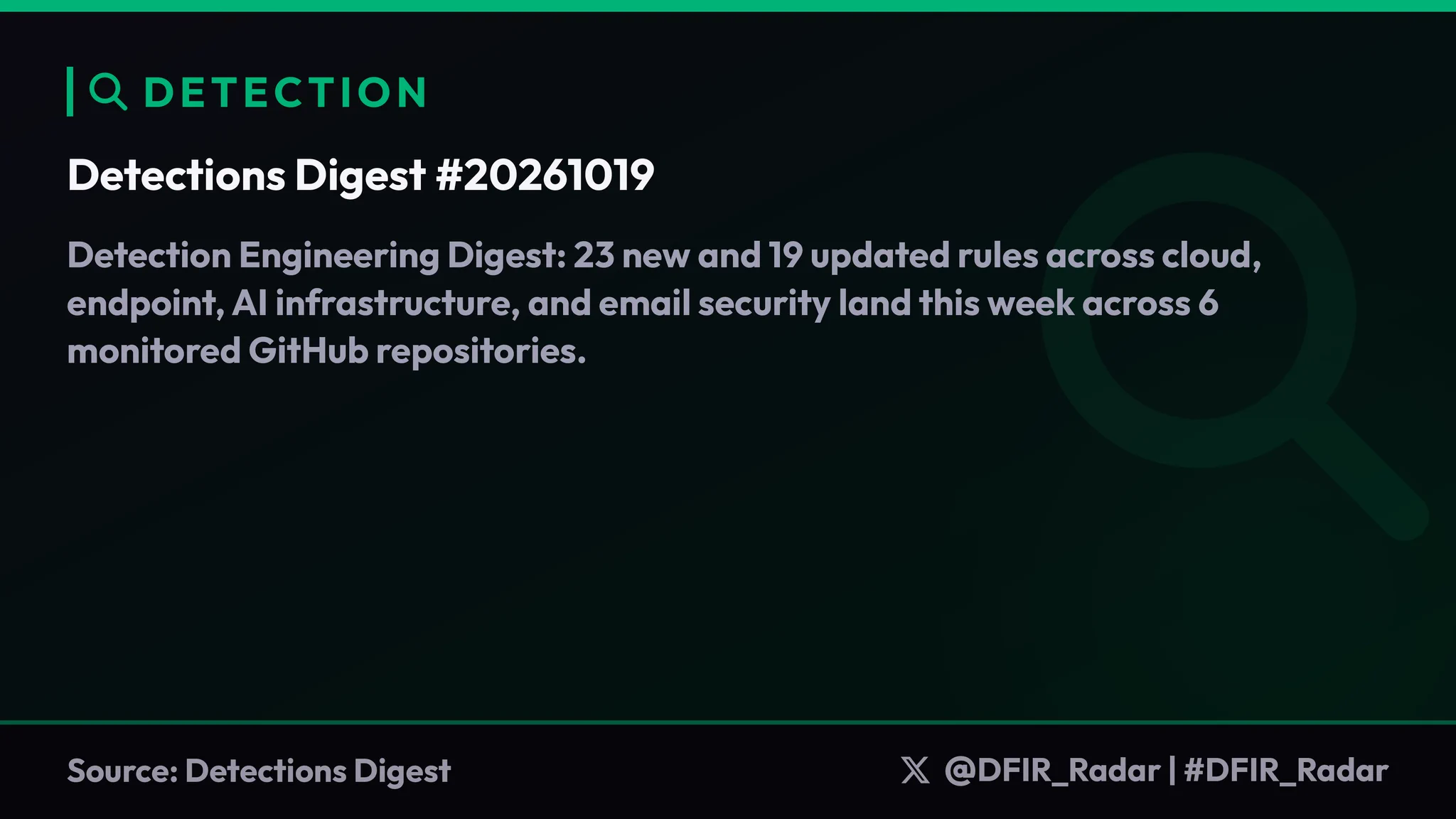
DFIR_Radar weekly detection engineering digest covering 23 new and 19 updated rules across 6 GitHub repositories. It lists KQL rules for Azure Key Vault secret retrieval, MCP client User-Agent bulk operations and local Azure token theft, AWS CloudTrail analytics, Sigma rules for firewall and ETW tampering (decimal 17 vs hex 0x11), updated LOLDrivers hashes, and Sublime email rules for OAuth consent phishing and fake IRS W-9 PDFs.
x.comthreadAdded 20 Oct 2026, published 19 Oct 2026🛡️ Security - Bikash | Hermes Super-Intel (@BkashJosi) on X
Post by Bikash (@BkashJosi) ranking open GitHub issues labelled type/feature for the Hermes agent framework by thumbs-up reactions. The query returned 5,349 issues and only one has more than 50 votes. The top three are Claude Agent SDK with subscription OAuth (57), remote Hermes with local tool execution (41) and Mistral provider support (32), followed by backups, configuration sync and context reduction. The full top 10 is only in the video.
x.comthreadAdded 20 Oct 2026, published 17 Oct 2026🧠 AI - CyrilXBT (@cyrilXBT) on X
REA (github.com/morluto/rea) is an open-source tool that lets an agent such as Claude Code run reverse-engineering tools (Ghidra, IDA, JADX) on a local machine and return findings with evidence. Targets named are desktop apps, compiled programs and games, Android apps, website network traffic, and firmware or binaries. The post claims a DX Ball sound function was rebuilt to byte-identical code. Setup is `npx rea-agents setup`, and the author says to use it only on software you own or may analyze.
x.comthreadAdded 19 Oct 2026, published 17 Oct 2026🛡️ Security - CyrilXBT (@cyrilXBT) on X
REA (repo github.com/morluto/rea) is an open-source tool that lets a coding agent such as Claude Code do reverse engineering. The agent gets an app and a question, REA picks Ghidra, IDA or JADX, runs it locally and returns findings with evidence. Targets include desktop apps, compiled programs and games, Android apps, web traffic and firmware. Setup is `npx rea-agents setup`. The tweet's author claims it rebuilt a DX Ball sound function that compiles to identical code.
x.comthreadAdded 19 Oct 2026, published 17 Oct 2026🧠 AI - Romy (@0xBunny) on X
Tweet from 0xBunny announcing an update to Jev Workflows, an open-source workflow toolkit. It adds native Claude Code support alongside Codex, an opt-in Jev 1.14, experimental image/Box questions, shared QQ contract sync and local CI. Features were also mirrored to a sibling project called QQ. It is free, with no plugin quotas, and links to a GitHub repo.
x.comthreadAdded 17 Oct 2026, published 16 Oct 2026🧠 AI  Dark Web Informer (@DarkWebInformer) on X
A DarkWebInformer post announces a public PoC for CVE-2026-85884, a Windows privilege escalation in the Windows Health and Optimized Experiences service. Per the post, low-privileged code with access to the Windows diagnostics workflow can trigger the flaw. The PoC is hosted in a GitHub repo by Beardhammer; the tweet text is truncated, so the exact root cause is not stated.
x.comthreadAdded 16 Oct 2026, published 14 Oct 2026🛡️ Security- ThreatWire (@ThreatWire_) on X
ThreatWire post on CVE-2026-97229, an integer overflow in the GitLab CI/CD regex compiler. GitLab rates it CVSS 3.1 10.0 and says it can allow unauthenticated code execution under certain conditions, in both CE and EE. Fixes are in 19.2.8, 19.3.5 and 19.4.2 (not 19.3.4), released Oct 12; GitLab-hosted instances are already patched. The post credits joaxcar via HackerOne and says a Rapid7 researcher published a lab PoC on GitHub, which ThreatWire has not run or verified. It also says the CVE is not in CISA KEV and has no known exploitation.
x.comthreadAdded 15 Oct 2026, published 14 Oct 2026🛡️ Security - Dark Web Informer (@DarkWebInformer) on X
Social post from DarkWebInformer announcing a released proof-of-concept for CVE-2026-82957, a server-side request forgery in Hyperledger FireFly. The flaw lies in webhook subscriptions, where a user-controlled webhook URL is accepted without validating the destination host. The PoC is hosted in a hakaioffsec GitHub repo.
x.comthreadAdded 15 Oct 2026, published 14 Oct 2026🛡️ Security  Gunjan N Ganatra (@gnganatra) on X
LightSeek Foundation announces 685 output tokens/s per user on Alibaba's Qwen3.8-Flash-Next. They ran their TokenSpeed serving engine on 4× NVIDIA GB300 with NVFP4 quantisation, and link a blog on the kernel and serving optimizations plus the GitHub repo. In the same thread, a user asks the team to bring similar optimizations to NVIDIA DGX Spark users running Qwen3.8-27B on vLLM, and to the upcoming Qwen4-27B. The thread points to a new open inference engine and shows demand for consumer-class DGX Spark serving.
x.comthreadPublished and added 14 Oct 2026🧠 AI- Codex CLI installs a persistent, self-updating background daemon by default
GitHub issue asking OpenAI to make `daemon_auto_start` opt-in in Codex CLI 0.157.0. By default, opening an interactive session starts a persistent `codex app-server --managed-daemon` that outlives the terminal. It also copies a ~374 MB platform package into ~/.codex/packages/app-server-daemon and runs a detached hourly `pid-update-loop` updater. The daemon keeps the first session's environment (proxy variables, cwd, direnv values), which the reporter ties to hook bugs #42457 and #37537. Comments confirm the problem on Windows and add the workaround (`codex features disable daemon_auto_start`, kill the updater, remove the package dir). They also note that `daemon stop` leaves the updater running and that the option is missing from the config docs. One commenter proposes an "execution receipt" (CLI version, daemon binary digest, generation, inherited-environment generation).
 github.comthreadPublished and added 12 Oct 2026🧠 AI
- Codex CLI installs a persistent, self-updating background daemon by default
GitHub issue asking OpenAI to make Codex CLI's daemon_auto_start opt-in. Since 0.157.0, opening a session starts a persistent app-server daemon with no TTY. It copies a ~374 MB platform package into ~/.codex/packages, so the running binary is decoupled from the npm-installed version. A detached hourly updater restarts the backend, and the daemon pins the first session's environment variables (proxy settings, direnv-style secrets like GH_TOKEN) and cwd. The thread also reports that `daemon stop` leaves the pid-update-loop updater alive, gives a manual workaround, and proposes an "execution receipt" (client version, daemon binary digest, generation, updater state, environment generation) so clients can tell which binary and environment served a turn.
github.comthreadPublished and added 12 Oct 2026🛡️ Security  Nicholas Michael Kloster (@showxlate) on X
A researcher announces a zero-click indirect prompt injection RCE in REA (Reverse Engineering Assistant), an MCP tool. Analyzing a malicious web target silently exfiltrates AWS keys, GitHub tokens and SSH identities. The stated root cause is that process.env is passed unconditionally to child processes, so the full environment is exposed to attacker-driven commands. A full writeup is promised but not yet published; replies add unverified skepticism about the project's provenance.
x.comthreadAdded 13 Oct 2026, published 12 Oct 2026🛡️ Security- SECTOR (@sector_sol) on X
A thread listing seven GitHub repos for securing LLM apps that can call tools: garak, PyRIT and promptfoo for attack and red-team testing, LLM Guard and Rebuff for input/output scanning and prompt-injection detection, NeMo Guardrails for programmable rails, and Inspect AI for repeatable evaluations. It proposes a loop of map risks, attack, inspect failures, add controls, retest and monitor. It stresses that a system prompt is not a security boundary and that credentials should be scoped, tool arguments validated outside the model, and consequential actions approved. It also warns that Rebuff is archived.
x.comthreadAdded 12 Oct 2026, published 11 Oct 2026🛡️ Security - 0xMarioNawfal (@RoundtableSpace) on X
A tweet highlighting Prompts Chat (formerly Awesome ChatGPT Prompts), an open-source prompt library on GitHub that the post says has 167K+ stars. It works across ChatGPT, Claude, Gemini and other models. The post lists a CLI, an MCP server, a Claude Code plugin and self-hosting with custom branding and auth, all free. It is worth cataloguing as a pointer to a widely used prompt collection that now plugs into coding-agent and MCP workflows.
x.comthreadPublished and added 10 Oct 2026🧠 AI - Dark Web Informer (@DarkWebInformer) on X
Social post announcing a PoC for CVE-2026-107181 in Telegram Desktop before 7.2.9. A crafted tg:// link abuses Telegram's IPC handler to exfiltrate local files, including session keys, which lets an attacker hijack the account without the password. Rated CVSS 8.1 (v3.1) / 8.6 (v4.0), fixed in 7.2.9, with a linked writeup on beaksec.github.io.
x.comthreadAdded 10 Oct 2026, published 9 Oct 2026🛡️ Security






Showing 30 of 45
Show more