 [AINews] Gemini 4 Carbon tops leaderboards, launches for cyber defenders
AINews issue for 27-28 October 2026, a Latent Space digest of Twitter and Reddit. It leads with Google DeepMind's Gemini 4 Carbon: claimed cyber scores (SEC-bench Pro 88.2%, ExploitGym 54.8%, CWE-bench 71.0%), #1 on Artificial Analysis Intelligence Index v5 at 59, and access limited to cyber defenders through the Fairwind Program. It also covers benchmark integrity disputes, GitHub Copilot Fusion, H-Net v2, KV-cache work, open-weight releases and Claude Code quota complaints.
 latent.spacearticlePublished and added 29 Oct 2026🧠 AI
- Laban (@lunkertw) on X
An X post summarising five AI items: Google DeepMind's Gemini 4 Carbon (88.2% SEC-bench Pro, 54.8% ExploitGym, 71.0% CWE-bench, 59 on Artificial Analysis Intelligence Index v5.0), Ed Zitron's critique of Anthropic's S-1, a Utah Claude Code pilot, and the repos beenuar/AiSOC and expo/skills. In the Utah pilot, 34 developers in 10 agencies took part over four weeks, 80% had a working setup within 30 minutes, and 71% saved over 20 hours. It gives short summaries and links, not primary analysis.
 x.comthreadAdded 29 Oct 2026, published 28 Oct 2026🧠 AI
 Gemini 4 Carbon: Our next frontier model
Gemini 4 Carbon is Google DeepMind's frontier model, announced with a focus on cyber defense. DeepMind reports 88.2% on SEC-bench Pro (finding vulnerabilities), 54.8% on ExploitGym (exploitation) and 71.0% on CWE-bench (patching), run without guardrails. It also reports 0.0% attack success on Gray Swan's indirect prompt injection benchmark. Access starts with a subset of cyber defenders via the Fairwind Program.
 deepmind.googlearticlePublished and added 28 Oct 2026🛡️ Security
- Gemini 4 Carbon: Our next frontier model
Gemini 4 Carbon is Google DeepMind's new frontier model, announced two weeks after Gemini 4 Argon. It ranks #1 on Artificial Analysis Intelligence Index v5.0 at 59 and scores 88.2% on SEC-bench Pro, 54.8% on ExploitGym and 71.0% on CWE-bench. Access starts with cyber defenders through the Fairwind Program, priced at $2 per million input tokens and $10 per million output tokens.
deepmind.googlearticlePublished and added 28 Oct 2026🧠 AI - Genie 4: A new generation of world simulation
Genie 4 is Google DeepMind's real-time interactive world model, announced as a research preview for trusted testers. It generates video with native audio and interactive dialogue, steered by keyboard controls and text prompts. Gemini 3.8 Flash acts as a guiding agent that plans steps and checks frames, and Gemini 4 Argon is used for robotics experiments. The post lists limitations such as drift and object permanence, and says outputs carry SynthID watermarks.
deepmind.googlearticlePublished and added 27 Oct 2026🧠 AI  We’re announcing Genie 4, our new world model for real-time interactive simulation.
Genie 4 is Google DeepMind's world model for real-time interactive simulation, with native audio generated on the fly (ambient sound, music, dialogue). It builds on Gemini models: Gemini Omni grounds scenes in real-world appearance and behavior, and other Gemini models keep the simulation coherent. Users steer scenes by natural language. Access is limited to trusted testers now, with Google AI Ultra (Project Genie), the Gemini API and AI Studio to follow. The post gives no architecture or benchmark detail.
 blog.googlearticleAdded 30 Oct 2026, published 27 Oct 2026🧠 AI
- Beyond tree cover: mapping the world’s forest types
Forest Typology (ForTy) 2020 is a global 10-meter map from Google DeepMind, Google Research, WRI and IIASA. It sorts land into six FAO-based classes: primary, naturally regenerating, planted, plantation, tree crops and agroforestry, and other land. The model uses AlphaEarth Foundations embeddings and about 1.7 million labeled locations. It was 90% accurate on forest type across 9,000+ expert-checked sites. An early 2017 to 2025 time series is on Earth Engine.
deepmind.googlearticlePublished and added 22 Oct 2026🧠 AI  Google Says AI Isn't Building Itself Yet—Even Though It Writes 75% of the Code
Decrypt reports on the Gemini 4 Argon Safety & Security Report, where Google DeepMind found no statistically significant acceleration of ML R&D. Its internal GCI v1 index (123 models, 92 benchmarks) shows steady ~0.1 points/month progress, with Argon slightly above trend, attributed to compute and investment. Over 75% of production code is AI-written and fully delegated pull requests rose from 7.5% to 11.9%, yet ~88% of PRs still need human steering or authorship. This is relevant evidence on the recursive self-improvement debate and on how much of AI research is automated.
 decrypt.coarticlePublished and added 15 Oct 2026🧠 AI
- Accelerating the search for antimicrobial peptides with Google Antigravity
Google DeepMind describes using Google Antigravity as an agentic science workbench to find antimicrobial peptide candidates in Streptococcus pseudopneumoniae. The agent orchestrates queries across UniProt and other databases, uses ProtNLM function predictions for uncharacterized proteins, and pulls structures from the AlphaFold Database. A new Biomolecular Structure Viewer shares 3D state with the agent in both directions, so residues the researcher highlights or pins become context for the agent's reasoning. The resulting lead has predicted activity against respiratory-tract pathogens and is going into wet-lab validation.
deepmind.googlearticlePublished and added 15 Oct 2026🧠 AI  Google’s Gemini 4 Argon AI solves 12 simulated cyberattacks, up from five
News coverage of Google DeepMind's Gemini 4 Argon release on October 13, 2026. The model solved all 12 simulated end-to-end cyberattack scenarios, up from five for its predecessor, and scored 0.7% attack success on Gray Swan's Indirect Prompt Injection benchmark. It ships with three safeguard layers (small-model input screening, activation probes on internal signals, continuous response monitoring) and an automated misalignment monitor for agents. Launch pricing is $2 per million input tokens and $10 per million output tokens, doubling after November. Access is through Pro and Ultra tiers, and Ultra also gets Antigravity. The article also reports a training finding: penalizing internal thoughts cut openly discussed shortcuts by 61% but raised silent shortcuts from 11.2% to 36.4%.
 en.cryptonomist.charticlePublished and added 14 Oct 2026🧠 AI
 Google DeepMind’s on-device scam detection keeps chats off the cloud
Describes a scam-detection model built by Google DeepMind with GovTech Singapore that runs entirely on the user's device. A low-power message classifier screens incoming messages, then a Gemma model fine-tuned on local scam conversations (impersonated institutions, banks, regional schemes) judges the wider conversation to confirm a threat or discard a false alarm. Fine-tuning ran in a GovTech-managed GCP environment on anonymised scam reports and intelligence feeds, with no PII. Chat access needs user consent, and the system gives real-time warnings. It shows a practical pattern of cascaded small models for battery-efficient, privacy-preserving local inference.
en.cryptonomist.charticlePublished and added 14 Oct 2026🧠 AI- Gemini 4 Argon
Google DeepMind's launch page for Gemini 4 Argon, a frontier model pitched at long-horizon software engineering, science and math, robotics, cyber defense and professional workflows. Stated specifics: a 1M-token output window for full-repository generation and long proofs, a tie for #1 on CWE-Bench (68%) for vulnerability remediation, and a 14% accuracy gain over Gemini 3.1 Pro in Box's evaluation. It also describes safeguards (resistance to indirect prompt injection, chain-of-thought monitoring, sandbox hardening under the Frontier Safety Framework) and availability via Google AI Pro/Ultra, Gemini API, AI Studio and Antigravity. Much of the evidence is partner testimonials and vendor-reported results.
deepmind.googlearticlePublished and added 13 Oct 2026🧠 AI  Gemini 4 Argon: Built to solve your hardest problems
Google DeepMind announces Gemini 4 Argon, a frontier model available through the Gemini API, AI Studio, Google Antigravity and the Gemini app. Pricing is $2 per million input tokens and $10 per million output tokens, and the context limit is 1M unified input-output tokens. It reports #1 on the Vals Index, 87% on ERQA and 0.7% attack success on Gray Swan IPI. Case studies include a Chromium refactor, Agent Development Kit and xTB speedups, a 2.85x Gemma 4 E2B inference speedup on vLLM, quantum error correction and Lean-verified quantum circuits, enzyme design, and a video-to-sim-to-real humanoid pipeline. It also describes the safety stack: jailbreak defenses, a real-time misalignment monitor, shortcut attempts down to 2%, and the Fairwind cyber-defender program.
deepmind.googlearticlePublished and added 13 Oct 2026🧠 AI google/embeddinggemma-2
Model card for EmbeddingGemma 2, an open (Apache 2.0) 740M-parameter multimodal embedding model from Google DeepMind built on Gemma 4. It maps text, code, images, video and audio into one 768-d space, with a 270M text backbone and optionally loadable 170M vision and 300M audio encoders, an 8K context, and Matryoshka truncation to 128/256/512/768 dims. The card gives practical guidance: task instruction prefixes, re-normalising after truncation, avoiding float16 (NaN or degraded embeddings), interleaved multimodal inputs with placeholder tokens, and vision token budgets. It targets on-device search, RAG, classification and clustering.
 huggingface.corepoAdded 12 Oct 2026🧠 AI
 Why AlphaFold Didn't Solve Protein Folding — Pushmeet Kohli, Google DeepMind & Sal Candido, Biohub
Transcript of a panel moderated by Brandon Anderson with Pushmeet Kohli (Google DeepMind) and Sal Candido (Biohub). They discuss a "bitter lesson" for biological data: finding the right scaling law and good data matters more than raw scale. Low-quality metagenomic sequences can still improve protein language models, and AlphaFold 2's handcrafted inductive biases made it data-efficient. They also cover why protein folding isn't fully solved (dynamics, disorder, cryo-EM micrographs as a richer data source), the need for calibrated uncertainty (pLDDT) over full interpretability, hidden knowledge in protein language models, and the move from single-protein models to a virtual cell.
latent.spacetalkPublished and added 10 Oct 2026🧠 AI EmbeddingGemma 2: an open, lightweight multimodal embedding model
Google DeepMind's announcement of EmbeddingGemma 2, a 740M-parameter open multimodal embedding model built on the Gemma 4 architecture, unifying text, code, images, video and audio into a shared embedding space under Apache 2.0. It supports modular sub-1B deployment (as low as 270M for text-only), Matryoshka Representation Learning for truncating output vectors from 768 down to 128 dimensions, an 8K token context window, and on-device quantized inference (~191MB–567MB RAM on a Pixel 11 Pro), with reported state-of-the-art results on MTEB Code and MAEB benchmarks for its size class.
deepmind.googlearticlePublished and added 6 Oct 2026🧠 AI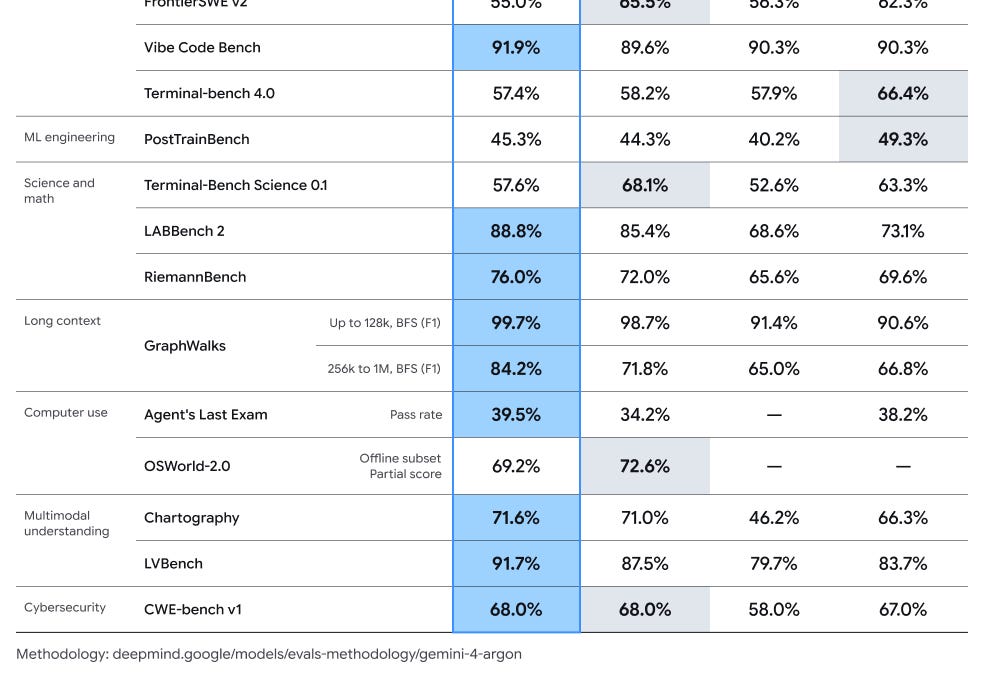 [AINews] Gemini 4 Argon: GDM’s answer to Astra/Fable, with 1M output
Latent Space's AINews digest for 9/29-9/30/2026 leads with Google DeepMind's Gemini 4 Argon, a frontier model in limited Fairwind Program cyber-defense/government preview claiming SOTA on 13 of 19 benchmarks and an industry-first 1M-token output via Long Decode Continuation, with detailed head-to-head evals against GPT-6 Astra, GPT-6.1 Sol and Claude Opus 5.5 from Artificial Analysis, Vals and Arena. It also covers other releases (Cohere Embed 5, Ideogram 4.5, GLM-5.3-Flash llama.cpp support, Solar Mini 4), research (Meta's Context Language Models, a Nature paper on superhuman Stratego AI), inference/systems news, and a safety section on hidden-reasoning-extraction attacks and GLM-5.3 cyber-capability risk.
latent.spacearticlePublished and added 1 Oct 2026🧠 AI Gemini 4 Argon: our next era of frontier intelligence
Google DeepMind's announcement of Gemini 4 Argon, a frontier model rolling out first to trusted cyber defenders via the Fairwind Program, with an industry-leading 1M output token limit (up from 64K) and pricing of $2/$10 per million input/output tokens. It reports state-of-the-art results on DeepSWE v1.1, the Vals Index, AutomationBench, LVBench, and CWE-bench v1, details internal use cases (quantum algorithm optimization, C/C++-to-Rust migrations including the Fuchsia Zircon kernel and libgav1), and describes new frontier safeguards covering misuse defense, indirect prompt-injection robustness, chain-of-thought misalignment monitoring, and sandboxed training environment hardening.
deepmind.googlearticlePublished and added 30 Sep 2026🧠 AI- Introducing SynthID Bio
SynthID Bio is Google DeepMind's watermarking technique extended from digital media into synthetic biology, embedding an imperceptible, verifiable signature into AI-designed protein sequences (via a modified ProteinMPNN alongside AlphaProteo) and 3D structures (via a fine-tuned AlphaFold 3 diffusion network) without compromising biological function. Wet-lab tests on protein binders against VEGF-A, SARS-CoV-2 spike RBD, and PD-L1 matched hit rate and binding affinity of unwatermarked designs, and the approach was also extended experimentally to watermark an Evo 2-designed bacteriophage genome with Stanford's Hie lab and Arc Institute. The work targets biosecurity gaps in DNA synthesis screening and public sequence databases (Protein Data Bank, UniProt, GenBank), with DeepMind open-sourcing code, in vitro data, and model weights alongside a methods paper.
deepmind.googlearticlePublished and added 30 Sep 2026🧠 AI 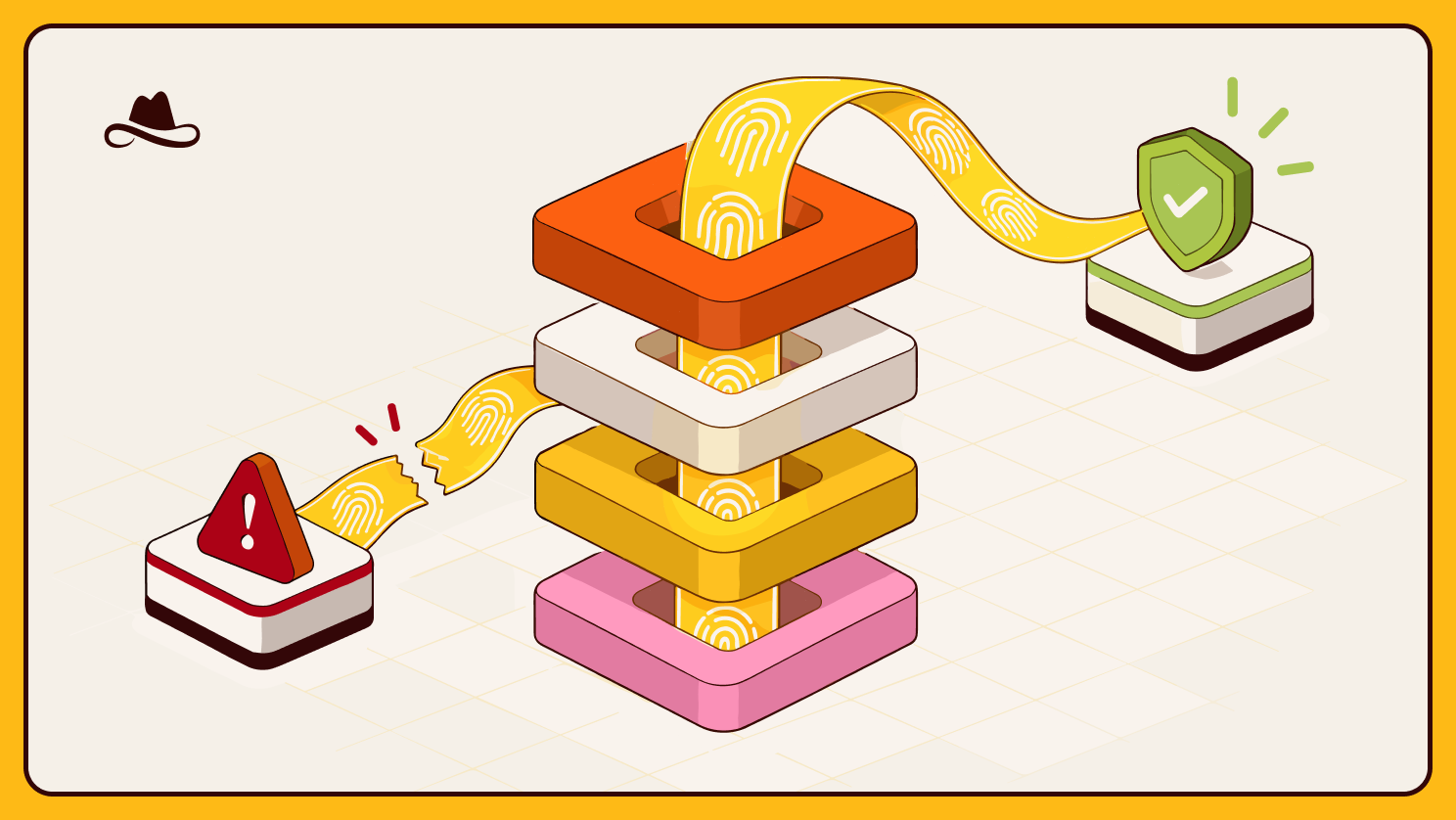 Understanding the Impact of LLM Watermarking on AI Agent Behavior
Lasso Security researchers empirically test whether LLM output watermarking (specifically Google DeepMind's SynthID-Text, now deployed by Anthropic across Claude models) changes AI agent behavior — not just text content. Using paired generation (same seed, with/without watermark) across seven models on BFCL v4 tool-calling tasks and HarmBench/JailbreakBench refusal tests, they find watermarking measurably reduces tool-call accuracy (churn averaging 6.5%, up to 16.8% for phi-4) and, more critically, weakens refusal under prompt injection — e.g. gemma-3-27b's compliance with harmful requests shifts from -1.0 to +12.5 net points when injection is combined with watermarking. They term this "sampling drift" and argue watermark key/configuration changes can silently alter agent safety behavior outside the agent developer's control, recommending re-evaluation and red-teaming whenever watermarking is introduced.
 lasso.securitywriteupPublished and added 26 Sep 2026🛡️ Security
 Future of Life Institute AI Safety Index — Summer 2026
Future of Life Institute's Summer 2026 AI Safety Index has an independent panel of seven AI researchers and governance experts (including Stuart Russell, David Krueger, Yi Zeng) grade nine leading AI companies — Anthropic, OpenAI, Google DeepMind, Meta, xAI, Z.ai, DeepSeek, Alibaba Cloud, Mistral — across 37 indicators in six domains including risk assessment, existential safety, and transparency. Key findings: Anthropic/OpenAI/Google DeepMind lead while xAI, DeepSeek, and Mistral receive failing grades; the report flags industry-wide backsliding on pause commitments, a pivot toward military AI partnerships, and existential safety as the weakest domain across all companies.
 futureoflife.orgarticleAdded 26 Sep 2026🧠 AI
 Runway’s WorldPrompt and the Engineering of Real-Time Worlds
A Latent Space interview with Runway's CTO Kamil Sindi, Principal Research Scientist Robin Kahlow, and co-CEO Anastasis Germanidis about GWM Worlds 2, a research-preview "autoregressive diffusion" model that streams real-time interactive video (720p/24fps) and audio (48kHz), and its new WorldPrompt input format for fixing a first frame and issuing timestamped in-world events. It details the engineering pipeline (bidirectional diffusion → autoregressive fine-tuning → distillation for real-time speed), open problems like error accumulation, context/memory management, and causal/counterfactual correctness, and situates Runway against Google DeepMind's Genie 3, Odyssey-2 Pro, and World Labs' RTFM. A companion podcast transcript covers Runway's history from pix2pixHD/Gen-1/Gen-2 through the Stable Diffusion collaboration to its pivot toward world models.
latent.spacearticleAdded 29 Sep 2026, published 25 Sep 2026🧠 AI Scan for Good: Using AI to discover and fix high-priority exposures across public services and critical infrastructure
Wiz announces Scan for Good, an initiative that pairs its AI pentester (Red Agent) and Google DeepMind's Gemini 3.8 Flash Cyber with human researchers. It scans authorized public-facing services of critical infrastructure, hospitals, municipalities and nonprofits for exposures and attack paths. It lists anonymized findings, including an exposed admin key over an 8.8M-file archive, NoSQL injection at an AI training-data platform, unsafe upload to hospital server control, and public CI/CD workflows leaking credentials. It also sets out the authorization, human-validation and private-disclosure rules.
 wiz.ioarticlePublished and added 24 Sep 2026🛡️ Security
- Advancing Private AI Compute with secure, server-side memory
Google DeepMind describes an architectural update to its Private AI Compute platform that adds a persistent, server-side memory layer for AI assistants without sacrificing on-device-level privacy. User data is sealed in encrypted storage in the cloud, with decryption keys held only on personal devices; a hardware-isolated "secure enclave" temporarily decrypts data to serve a request, saves new context, and re-encrypts it, enabling continuity across sessions and devices (e.g. resuming a task started on smart glasses on a laptop). The post also announces a tamper-proof public record of the server software, an updated technical whitepaper, and results of an independent security audit for community verification.
deepmind.googlearticleAdded 29 Sep 2026, published 23 Sep 2026🧠 AI - Advancing Private AI Compute with secure, server-side memory
Google DeepMind describes an architectural update to its Private AI Compute platform that adds persistent, cross-device memory for AI assistants while keeping data confidential: user data is stored encrypted in the cloud with decryption keys held only on the user's own devices, and requests are processed inside hardware-isolated "secure enclaves" that decrypt data only transiently in isolated memory. Alongside the update, Google published a technical whitepaper, a tamper-proof public record of the server software for device-side attestation, and results from an independent third-party security audit, inviting outside verification of the design.
deepmind.googlearticleAdded 29 Sep 2026, published 23 Sep 2026🛡️ Security  Introducing Gemini 3.8 Live and 3.8 Live Extended Thinking
Google DeepMind announces Gemini 3.8 Live, built for scale and cost efficiency with fluid dialogue and visual grounding, and Gemini 3.8 Live Extended Thinking, built for high-complexity multi-step reasoning. The Extended Thinking model tops Artificial Analysis' Speech to Speech Quality Index (82.6), scores 68.6% on tau-Voice and 97.7% on Big Bench Audio, while 3.8 Live ranks second in the Speech Agent Arena; both support 97 languages with mid-conversation switching and background tool execution, and are watermarked with SynthID.
deepmind.googlearticleAdded 29 Sep 2026, published 15 Sep 2026🧠 AI- Op-Ed: I Worked at Google DeepMind. You Should Listen to the Warnings About AI
A Guardian op-ed, linkposted to the AI Alignment Forum, by a former Google DeepMind employee making the case that the public and policymakers should take warnings from AI safety researchers about advanced AI risk more seriously. It's framed as a first-person credibility appeal from someone who worked inside a frontier AI lab, aimed at raising public and regulatory attention to AI risk rather than presenting new technical research.
 alignmentforum.orgarticleAdded 7 Oct 2026, published 14 Sep 2026🧠 AI
 ChatGPT Images 2.5 System Card
OpenAI's system card for ChatGPT Images 2.5, powered by GPT-Image-2.5-Sunburst and GPT-Image-2.5-Flare, covering training data handling, a multi-layer image safety stack with upstream policy refusals and a downstream multimodal safety-reasoning monitor for input and output blocking, adversarial safety evaluation results versus ChatGPT Images 2.0, and Preparedness Framework capability assessments for biological and cyber risk adapted to the image modality. It also details image provenance measures including C2PA metadata conformance and Google DeepMind's SynthID watermarking.
 deploymentsafety.openai.comadvisoryAdded 7 Oct 2026, published 8 Sep 2026🧠 AI
- ChatGPT Images 2.5 System Card
OpenAI's system card for ChatGPT Images 2.5, covering the GPT-Image-2.5-Sunburst and GPT-Image-2.5-Flare models, details a multi-layer image safety stack (upstream LLM policy refusals, a multimodal safety reasoning model for input/output blocking) built to counter heightened deepfake realism risks. It reports adversarial-prompt evaluation results against ChatGPT Images 2.0, Preparedness Framework assessments for biological and cyber capability (image-modality adaptations of existing LLM evals, neither model crossing the "High" threshold but biological-risk mitigations still applied precautionarily), and expanded provenance tooling via C2PA metadata and Google DeepMind's SynthID watermarking.
deploymentsafety.openai.comadvisoryAdded 7 Oct 2026, published 8 Sep 2026🛡️ Security  Introducing WeatherNext 3, our most advanced and accurate global weather AI model
Google DeepMind and Google Research introduce WeatherNext 3, a global weather forecasting model that trains directly on live geostationary satellite mosaics and sparse weather-station observations rather than lagged numerical-weather-prediction output. It uses a single Functional Generative Network (FGN) mesh transformer to produce hourly forecasts at up to 5km resolution for surface variables and 25km for atmospheric ones, reportedly the top-ranked model on Brightband's independent live leaderboards, with major precipitation-forecasting accuracy gains (up to 60% CRPS improvement vs IMERG) and new outputs tailored for renewable-energy planning (turbine-height wind, solar irradiance). It is being rolled out across Google Search, Maps, Gemini, Earth Engine, BigQuery, and the Google Maps Platform Weather API.
deepmind.googlearticleAdded 29 Sep 2026, published 3 Sep 2026🧠 AI

Showing 30 of 49
Show more