 A Unified Hessian-Guided Framework for Post-Training Quantization
This preprint proposes a unified post-training quantization framework for large language models. It derives a Hessian-guided approximation of the output change caused by joint weight and activation quantization, using a tractable Fisher approximation. Quantization ranges, linear transformations and weight rounding are optimized together under one output-sensitivity objective. The authors report gains over state-of-the-art transformation and rounding methods in channel-wise and block-wise settings.
 arxiv.orgpaperAdded 31 Oct 2026, published 29 Oct 2026🧠 AI
 Pentesting: Twelve Caesars – Community Tools for Offensive Security
Hackers Arise walks through four tools from Praetorian's "12 Caesars" open-source release: Titus (secret scanner with 487 rules and credential validation), Nerva (fingerprints 170 protocols), Brutus (Hydra alternative covering 40+ protocols) and Julius (fingerprints 60+ LLM services such as Ollama). It shows download and run commands in a Kali lab and how the tools chain together. The tools are Go single binaries; the post notes an exposed Ollama on port 11434 allows unauthenticated model use.
 hackers-arise.comarticlePublished and added 27 Oct 2026🛡️ Security
- When Agents Fail: Model or Harness--Who's to Blame?
When Agents Fail: Model or Harness--Who's to Blame? proposes five measures for evaluating agent harnesses together with their underlying models: Valid Completion Rate, Model-Harness Fit, Cross-Model Fit, Interaction Residuals and Token Load. It tests four harnesses (OpenCode, Codex CLI, Pi CLI, DeepAgents) with four models on six benchmarks, across 111 settings and 52,168 trajectories. Harness rankings change by model and benchmark. OpenCode ranks first in cross-model performance.
arxiv.orgpaperAdded 26 Oct 2026, published 23 Oct 2026🧠 AI  Cloudflare deploys protections against php2shell vulnerability
Cloudflare describes its WAF protections for php2shell (CVE-2026-109618 and CVE-2026-109619), two PHP runtime memory-handling flaws affecting PHP 5.4 and later that can cause denial of service, remote code execution and data exposure. Rules shipped 21 October 2026, about 9 hours before disclosure, using a new "full transaction detection" that matches request and origin response together. It lists ruleset IDs and says patching PHP is still required.
 blog.cloudflare.comarticleAdded 22 Oct 2026, published 21 Oct 2026🛡️ Security
 Introducing full transaction detection for Cloudflare WAF
Cloudflare announces full transaction detection and response-phase rules for its WAF. Detections evaluate an HTTP request together with the origin's response, so exploitation can be confirmed (for example, path traversal returning a config file) and the response replaced with a 403 block page. Covers managed and custom rules, the limit of three custom response rules, no response-body matching yet, and a first managed rule for php2shell. Available on all plans, including Free.
blog.cloudflare.comarticleAdded 29 Oct 2026, published 21 Oct 2026🛡️ Security- UniWALM: Unified World Action Language Model for Embodied Robot Control
UniWALM is a unified world-action-language model that learns video, action and language in one mixture-of-transformers backbone with per-modality diffusion heads that co-denoise together. Generated subtask and textual memory are fed back on the next step, so no external planner or memory bank is needed. It adds Flow Matching with Correction (FMC) for recovery from perturbed actions. It reaches 34.5% on the memory-dependent RMBench subset, above Mem-0's 28.5%, and lifts real-world Find-the-Item success from 11.1% to 61.1%.
arxiv.orgpaperAdded 22 Oct 2026, published 20 Oct 2026🧠 AI - Dan Kornas (@DanKornas) on X
Coral is an open-source (Apache 2.0) agentic IDE that runs Claude Code, Codex, Gemini CLI and Pi.dev together as one coordinated team on a shared codebase. It puts sessions, tasks, messages and controls behind a shared board and browser dashboard. Features include a task queue with dependencies and review holds, an agent message board, git-worktree sessions tracked against main, and live terminal access from a browser or phone.
 x.comtoolAdded 19 Oct 2026, published 18 Oct 2026🧠 AI
 HiRO-ACEv2: Simulating extreme weather at 3 km resolution for a fraction of the cost
Ai2 announces HiRO-ACEv2, an update to its AI climate emulator. ACE simulates at 100 km, and the new HiROv2 downscaling model sharpens its output to 3 km. HiROv2 predicts rain, wind and pressure together and matches X-SHiELD high-resolution statistics to within 3%, even for events that occur once in a million data points. It also reproduces tropical cyclone energy, including storms unseen in training. The full system generates global 3 km climate data at about 1/300th the cost of X-SHiELD. Limitations are that it only works with the X-SHiELD-tuned ACE and cannot yet handle warmer climates or ERA5. Models, tutorial notebooks and a web demo are available.
 huggingface.coarticlePublished and added 14 Oct 2026🧠 AI
- GLM-Legal
Z.ai introduces GLM-Legal, a legal-domain model built on the lightweight GLM-5.3-Flash. It is trained with expanded legal-corpus mid-training, then reinforcement learning across tens of thousands of realistic legal environments, with the agent harness and model training iterated together. It reports a 19.2% all-pass rate on Harvey LAB (+12.5 points over the base model) and parity with frontier closed models on LegalBench and PLawBench (Chinese legal practice). Side-by-side examples cover contract review with tracked changes, contradiction mapping across 40 dispute documents, and a three-country privacy compliance plan. Access is via an API application and the AutoClaw desktop agent.
 z.aiarticlePublished and added 12 Oct 2026🧠 AI
- Threat Actors Exploit Critical AhsayCBS Flaws to Drop Webshells and XMRig Cryptominer
Huntress documents active exploitation of two AhsayCBS (Ahsay Cloud Backup Server) vulnerabilities being chained together: CVE-2026-105133, an authentication bypass in checkSysPwd, and CVE-2026-105134, an unauthenticated RCE in the Replication Receiver's UpdateReceivers.do endpoint that grants SYSTEM. Attackers use the chain to drop JSP webshells, then deploy a renamed XMRig cryptominer (masquerading as msedge.exe via a modified NSSM binary), a Task-Manager-aware anti-detection PowerShell script, and the vulnerable WinRing0x64.sys kernel driver for hardware-level miner access. Huntress provides IOCs, mitigation guidance (restrict management interface, re-image if compromised) and four Sigma rules targeting each stage of the intrusion chain.
 huntress.comwriteupAdded 9 Oct 2026, published 8 Oct 2026🛡️ Security
- OmniCapBench: A Deep-Structured Evaluation Framework for Fine-Grained Audio-Visual Captioning
OmniCapBench is a benchmark of 786 densely annotated videos that evaluates audio-visual captioning in multimodal LLMs. Instead of scoring free-form captions, it asks models for sets of atomic, verifiable units across three tracks (entity references, visual shots, audio events). These are scored with deterministic constraint checks plus localized LLM-based semantic comparisons, which gives coverage, localization and stable scoring together. Tests on frontier MLLMs show strong local perception but weak long-horizon audio-visual reasoning, especially identity drift and cross-modal misalignment.
arxiv.orgpaperAdded 9 Oct 2026, published 8 Oct 2026🧠 AI  Malicious npm Campaign “MALFEX” Delivers RAT and Stealer via Eight Packages with 40,000+ Downloads
Orca Security details "MALFEX," a supply-chain campaign active since August 2023 in which a suspected lone Brazilian threat actor published eight malicious npm packages (tlxbnhd, tldriver, mxdriver, img-to-native, native-runner, function-flag, function-color, cdn-img-fetch) that together drew over 40,767 downloads. Using postinstall lifecycle hooks, the packages deliver three malware families to Windows hosts: the Go-based Overlord RAT (with a Solana blockchain C2 resolver), the Node.js "movinlike" credential/Discord/crypto-wallet stealer, and rotating downloader payloads — with three packages (notably function-flag) still live on npm and only six of the eight carrying OSV advisories at publication time. The piece includes host IOCs (file paths, scheduled task name), affected package lists, and remediation steps (lockfile auditing, credential rotation) alongside a pitch for Orca's SCA detection of the OSV-flagged packages.
 orca.securityarticlePublished and added 8 Oct 2026🛡️ Security
 Introducing Socket Scanning for VS Code Marketplace Extensions
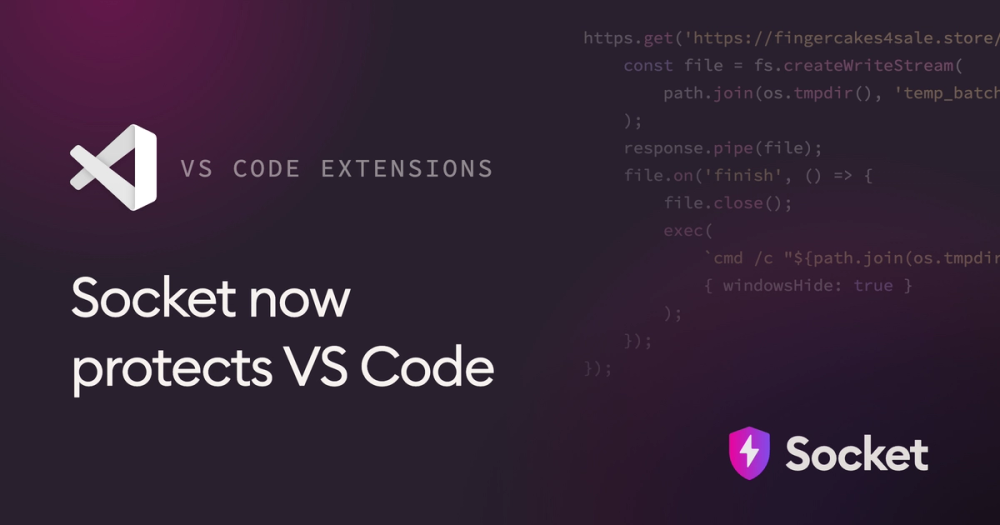
Socket.dev announced experimental scanning of VS Code Marketplace extensions (100,000+), extending its existing Open VSX coverage, to flag risky file/network/process access, obfuscated code, and hidden activation logic before teams install or auto-update developer tools. The post grounds the launch in two real incidents: the Nx Console supply-chain breach that let attackers exfiltrate ~3,800 GitHub repositories from a single poisoned extension update, and Socket's own GlassWorm investigation, which found four VS Code and six Open VSX theme extensions tied together by encrypted JavaScript payloads and a Solana-based dead-drop C2.
 socket.devarticlePublished and added 6 Oct 2026🛡️ Security
 What does it mean to sandbox an AI coding agent?
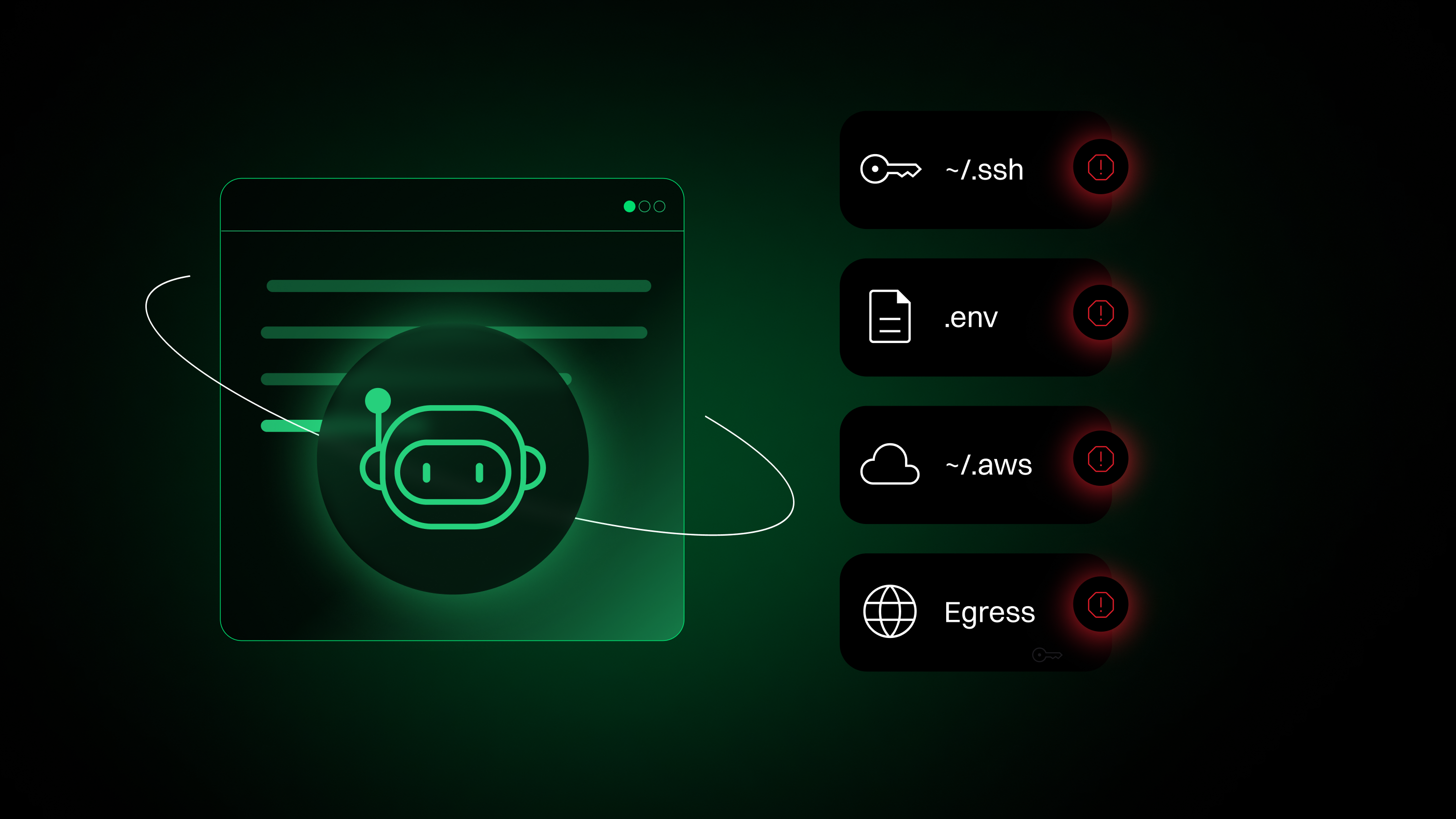
An Endor Labs technical breakdown of what an "agent sandbox" actually is: a kernel-enforced boundary around an AI coding agent's tool calls (syscalls), distinct from a staging environment or Docker container. It walks through the nx/s1ngularity supply-chain attack as motivating case, compares OS-level primitives (Apple Seatbelt, Linux Landlock/seccomp, Windows Job Objects/AppContainer) used by Claude Code, Cursor, and Codex CLI against containers and microVMs (gVisor, Firecracker), and argues filesystem isolation and network egress isolation are worthless unless enforced together.
 endorlabs.comarticlePublished and added 6 Oct 2026🛡️ Security
 Five Kubernetes Security Gaps Attackers Chain Together
7ASecurity breaks down five Kubernetes misconfiguration categories their pentesters repeatedly chain into working attack paths: over-permissive RBAC defaults, exposed API server/dashboard/kubelet, missing network policies, unsafe pod defaults (root/privileged containers, host path mounts), and weak admission control. It uses a concrete audit example from CNCF's KEDA project, where the Helm chart's scaledRefKinds setting defaulted to wildcard get access across API groups and resource types, silently undermining KEDA's own Secret-access restriction, plus references to Linkerd mesh audits and the NSA/CISA Kubernetes Hardening Guide.
 7asecurity.comarticleAdded 7 Oct 2026, published 2 Oct 2026🛡️ Security
 Pretty Themes, Hidden Loaders: GlassWorm-Linked Extensions Span VS Code Marketplace and Open VSX
Socket's Threat Research team uncovered a theme-extension cluster spanning four VS Code Marketplace and six Open VSX listings, including two confirmed malicious extensions: Aurora Nocturne Night Theme (a Windows downloader that fetches and silently executes temp_batch.cmd via cmd.exe from fingercakes4sale[.]store, tied to XWorm C2 infrastructure) and Cosmic Nebula Themes, whose app.js decrypts an AES-256-CBC embedded stage and uses a Solana transaction memo as a dead-drop to resolve follow-on payload infrastructure — the same AES key, Solana address, and execution model previously documented in GlassWorm activity. Git commit identities, near-identical theme source, shared Russian-language developer comments, and brandjacking (Coca-Cola, Aurora Borealis name-squatting) link the cluster together; a Dec 14, 2025 DEV Community article is assessed as promotional infrastructure driving Open VSX installs. The post provides full IOCs (hashes, domains, Solana address, AES key/IV, GitHub accounts) and MITRE ATT&CK mappings for defenders to hunt and inventory extensions across both registries.
socket.devwriteupPublished and added 2 Oct 2026🛡️ Security- Gen AI Spotlight (@GenAISpotlight) on X
Anthropic's dangerous-capability testing found that Z.ai's open-weight model GLM-5.3 builds working cyber exploits nearly as well as Claude Mythos Preview, succeeding in 50 of 410 Chrome exploit-benchmark attempts. In a live red-team test the model chained newly discovered browser vulnerabilities together to exfiltrate a private SSH key in under a day. Because GLM-5.3's weights are openly downloadable, Anthropic warns attackers can strip or bypass any built-in safeguards.
x.comthreadPublished and added 30 Sep 2026🛡️ Security - Stevan Bogosavljević (@stevyhacker) on X
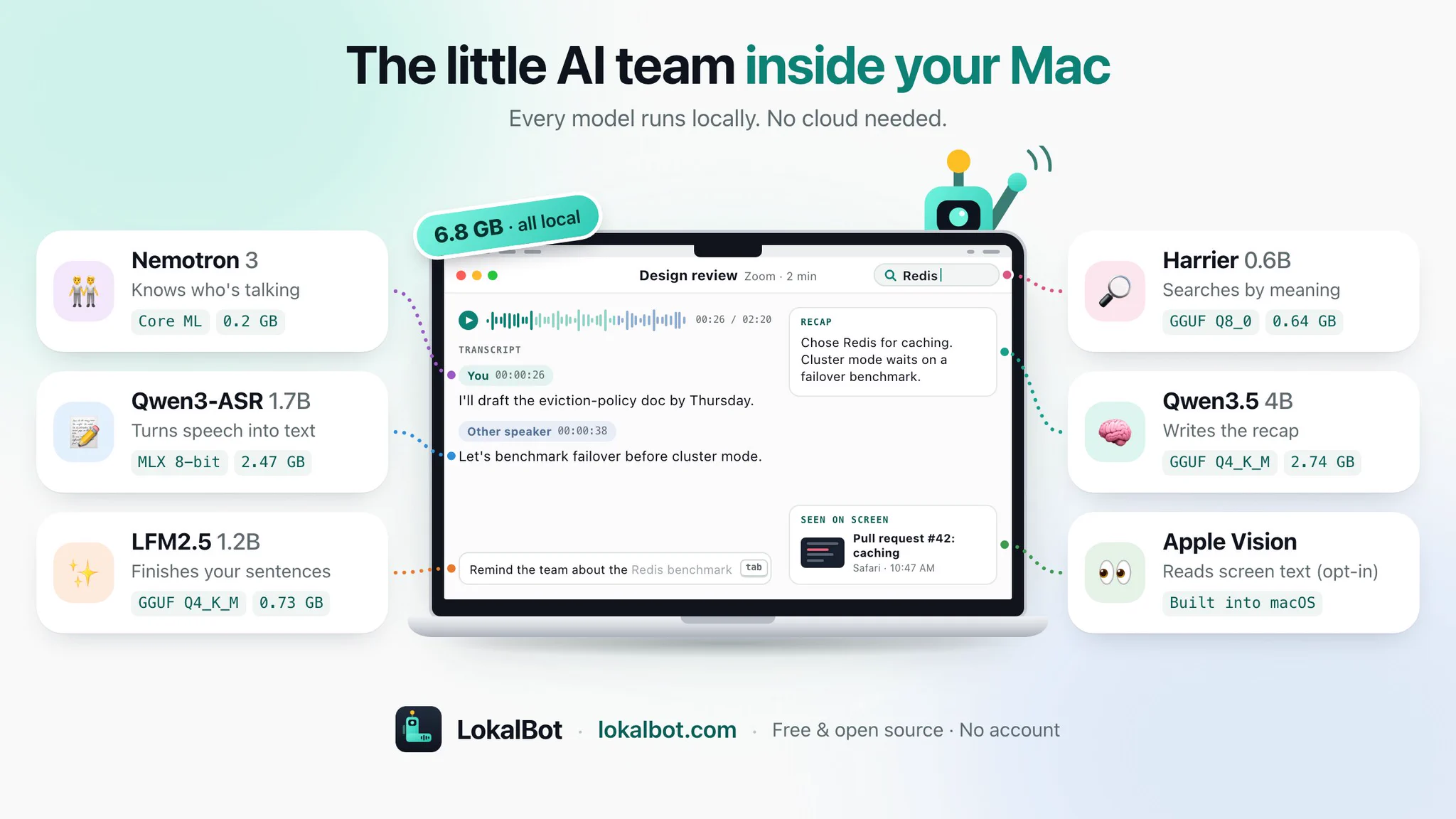
LokalBot 0.9.2 is a free, open-source local-first assistant that records meetings and screen activity, using five small open-weight models chained together entirely on a MacBook (6.8 GB total): Nemotron 3 for speaker diarization, Qwen3-ASR 1.7B for transcription, LFM2.5 1.2B for sentence completion, Harrier 0.6B for semantic search, and Qwen3.5 4B for recap generation. It exposes this captured 'memory' to Claude Code and Codex through an MCP server or CLI, letting coding agents pull context from past meetings and screen content.
x.comthreadPublished and added 30 Sep 2026🧠 AI - Same Model, Different Harness: Different Coding-Agent Results
This paper isolates the 'harness' — the scaffolding that decides what a coding agent sees, which tools it can use, and how work continues — from the underlying model, comparing two harness configurations on SWE-bench Verified, SWE-bench Pro, and FeatureBench. Under a tight context window, a treatment harness that mechanically shortens older tool results and responds to stalled work raises mean per-task fail-to-pass fraction from 28% to 49% and complete solutions from 43 to 72 on a 169-task SWE-bench Verified cohort, with similar gains reproduced across three other models without retuning. The authors argue that because frozen model weights produced very different outcomes purely from harness changes, coding-agent evaluations must treat model and harness together as the tested solver rather than attributing results to the model alone.
arxiv.orgpaperAdded 29 Sep 2026🧠 AI - FirmAgent: Fuzzing + LLM Agents for IoT Firmware Vulnerability Discovery (NDSS 2026)
FirmAgent is an academic research toolkit (NDSS 2026) for finding vulnerabilities in re-hosted IoT firmware web services by combining IDA-based pre-fuzzing (CFG/sink distance scoring), QEMU instrumented tracing, CFG-guided API fuzzing, and an optional LLM agent (LLMATaint.py) that consumes runtime taint traces to reason about and produce PoCs for bug classes like command injection. The pipeline is explicit about scope: it is meant for authorized, owned or re-hosted firmware (e.g. Greenhouse-style containers), and stitches together sink-scope extraction, feedback-driven fuzzing, and request-to-trace attribution before handing traces to an LLM for taint-to-PoC analysis.
 github.comrepoAdded 26 Sep 2026🛡️ Security
- AnotiaWang/awesome-decision-models
A community-maintained GitHub list cataloging "decision models" (also called System One models): small/fast models that take a state plus caller-declared questions (Noul/true-false, Choice/multi-option, Score/rubric) and return a probability per answer in one forward pass, rather than generating text. It tracks the originating TypeSafe AI Jev model and its /v1/systemone API alongside competing hosted models (Upstage Solar Decide, Liquid AI's d1, OpenAI's Decisions API, Inception's Mercury Decide, Respan's Span-01), dozens of open-weight fine-tunes (Cloudflare's Clef, Perplexity's pplx-decider, AWS Strands Decider, Together AI's Tev1, and many Qwen3.5-based community models), zero-training logit-reading approaches, local runtimes (Ollama, Ollaya, llama.cpp-based servers), SDKs across a dozen languages, and a very long list of agent/coding-tool/MCP integrations (browser agents, code review, routing, game-playing demos) that use these models for fast, typed, in-the-loop decisions. The page is truncated at 40k of ~51k characters, so later sections (further toys, demos, and possibly benchmarks) are not reflected here.
github.comrepoAdded 2 Oct 2026, published 17 Sep 2026🧠 AI  WeaselBiscuit Strips BeaverTail and OtterCookie Down to Essentials
OpenSourceMalware researchers detail WeaselBiscuit, a newly discovered lightweight JavaScript infostealer found hidden in 11+ npm packages (e.g. process-tailwind, engin1, the @biz44 scope), which shares tradecraft with DPRK-linked BeaverTail/OtterCookie but strips out wallet-draining, password decryption, and remote-shell features. The writeup walks through the full infection chain - a package auto-running a detached Node loader, fetching a Base64-encoded second stage from Npoint dead-drop URLs, and beaconing to a hardcoded HTTP C2 (103.170.217.184:8787) - plus its capabilities (Chrome extension-storage theft, clipboard capture, Windows keylogging) and a campaign-cluster graph tying packages together via shared hashes and resolver URLs. Attribution to DPRK is explicitly labeled a tentative hypothesis rather than confirmed.
 opensourcemalware.comwriteupPublished and added 17 Sep 2026🛡️ Security
- Axonal delay dispersion decides whether a neuron detects an event or a sequence, and predicts cortical column diameter
This arXiv preprint proposes a "delay-signature" framework where the dispersion of axonal conduction delays converging on a dendritic branch determines whether a neuron acts as an event detector (coincidence) or an order-selective sequence detector, using simulations of an integrator-neuron model. The authors find a single scalar (delay dispersion) governs this computational transition, sets a millisecond-scale timing tolerance, and together with conduction velocity predicts cortical column diameter — linking myelination to what a neuron computes, not just how fast it signals.
arxiv.orgpaperAdded 22 Sep 2026, published 3 Sep 2026🧠 AI - Human-Agent-Society/reef
Reef is an open-source infrastructure stack for continual self-improving agents, wiring together agent inference, scored feedback, training/updates, and versioned delivery into one loop. It supports two learning surfaces: fine-tuning model weights via RL training steps (using Slime and SGLang on top of models like Qwen2.5-1.5B-Instruct) or evolving an agent's harness — prompts, rules, and skills — through its built-in "Reefine" recipe, which lets a model propose and install harness changes from plain-language requests. It exposes an OpenAI/Anthropic-compatible inference endpoint plus a reporting endpoint for scoring interactions, and ships a recipe catalog (e.g. the SAO recipe referencing arXiv:2607.07508) for pluggable learning strategies.
github.comrepoAdded 2 Oct 2026, published 31 Aug 2026🧠 AI  GhostSplice: Malicious MCP Servers Split Exfiltration to Bypass Guardrails
Reporting on ASSET Research Group's GhostSplice disclosure, which shows a malicious MCP server can bypass single-shot prompt-injection refusals by splitting a data-exfiltration request across multiple channels (tool descriptions, tool results, server-initiated sampling) so no single message looks malicious, letting the coding agent stitch the fragments together and exfiltrate SSH keys, .env secrets, and source code. Testing across 15 models and clients (Cursor, Codex CLI, Claude Code) found splitting a request into two pieces raised average compliance from 42% to 82%, with GPT-4o, Gemini 2.0 Flash, and Llama 3.3 70B going from 0% to 100%, and results varying sharply by client even for the same model (e.g., Claude Haiku 4.5 at 0% in API tests but 100% in a three-piece Cursor test). It follows the same lab's earlier Ghostcommit disclosure and recommends clients treat MCP server output as untrusted data rather than instructions.
 thehackernews.comarticlePublished and added 19 Aug 2026🛡️ Security
 PolinRider Caused Dozens of npm, Go, PHP Compromises
OpenSourceMalware's research ties together JFrog's, Nextron's, and Socket's separate reports on compromised html-to-gutenberg/fetch-page-assets npm packages, 16 Go modules, and Joyfill's poisoned beta releases, attributing all of them to DPRK's PolinRider campaign via shared XOR keys, TRON/Aptos wallets, C2 infrastructure, and the fa-solid-400.woff2 loader file hash. The piece argues these aren't targeted account takeovers but automated propagation from infected maintainer machines (via temp_auto_push.bat git history rewriting and stolen .npmrc tokens), and uses GH Archive to prove that 43 of 64 analyzed Go module pseudo-version timestamps were forged to appear years older than the actual malicious push. Delivered payloads include InvisibleFerret/DEV#POPPER RAT and the OmniStealer Python infostealer, and the article links a PolinRider crossover into a compromised Packagist/PHP package (roberts/leads) via shared C2 infrastructure.
opensourcemalware.comwriteupAdded 3 Sep 2026, published 31 Jul 2026🛡️ Security Behind the GitLab RCE: A depthfirst Journey into the Ruby Ecosystem | depthfirst
depthfirst's Open Defense Initiative scanned about 40 Ruby gems with native C extensions and validated 105 vulnerabilities across 34 projects, which together have over 8.6 billion RubyGems downloads. The post walks through four cases: a Nokogiri 32/64-bit index truncation (CVE-2026-57235), an Oj garbage-collection use-after-free (CVE-2026-54902), a concurrent-ruby read/write lock bit overflow (CVE-2026-54905) and an sqlite3-ruby block lifetime bug (CVE-2026-54619). It also states that this work led to the earlier GitLab RCE chain through Oj.
 depthfirst.comwriteupAdded 29 Oct 2026, published 27 Jul 2026🛡️ Security
 Controlling Reasoning Effort in LLMs
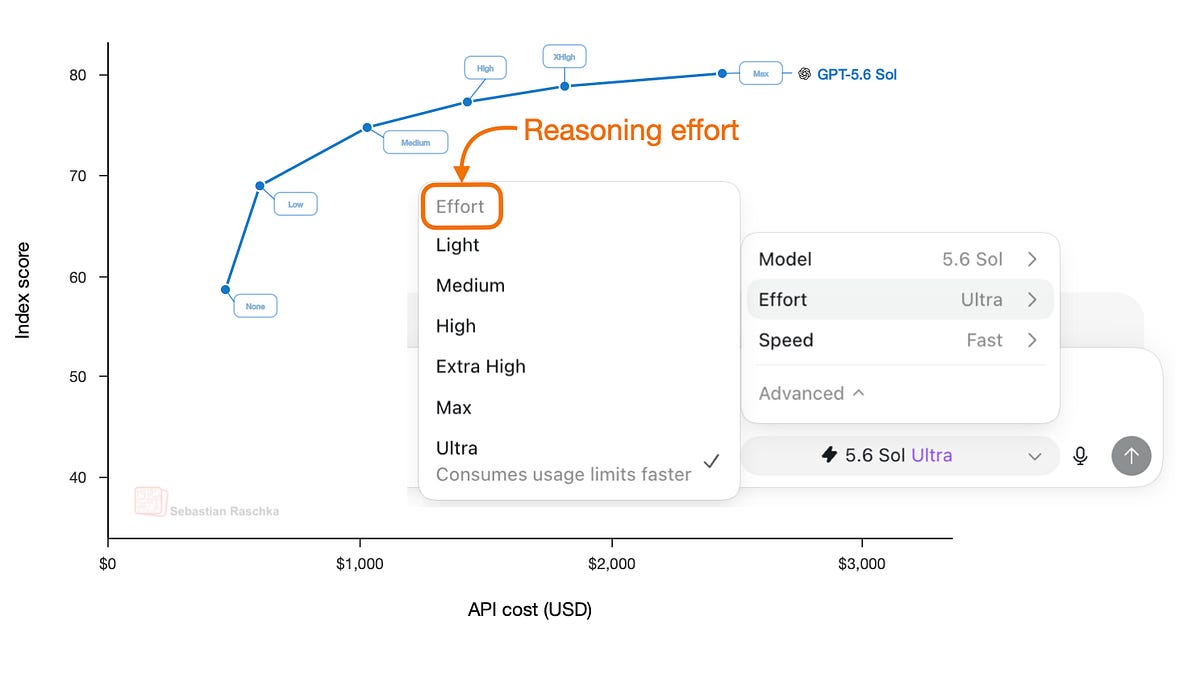
Sebastian Raschka explains how modern reasoning LLMs implement adjustable "reasoning effort" or thinking-budget controls, tracing the mechanics from DeepSeek-R1's original RLVR recipe through hybrid think/no-think switches (Qwen3) to full effort-level systems in GPT-5.6 and gpt-oss. He then does a comparative deep dive into six flagship open-weight models' documented recipes — DeepSeek V4 (separate effort specialists distilled together), Nemotron 3 Ultra (SFT + truncated-trace training + hard budgets), Kimi K2.5/K3 (Toggle alternating budgeted/unconstrained RL, multi-teacher distillation), GLM-5 (turn-level/interleaved thinking via SFT), Qwen3 (Thinking Mode Fusion), and Inkling (continuous 0-1 effort conditioning during RL) — showing the shared techniques (effort-labeled SFT data, mode-conditioned RL with variable length penalties/context windows, and robustness training for hard token cutoffs) behind these UI toggles.
 magazine.sebastianraschka.comarticleAdded 29 Sep 2026, published 18 Jul 2026🧠 AI
- 5 Modern Threats You Need to Watch
Huntress details five recurring identity-centered attack patterns seen in its telemetry: credential-based ransomware intrusions that use built-in admin tools for ~20 hours before detonating encryption; Business Email Compromise via inbox rules hiding replies in Conversation History folders; a Qilin ransomware case where attackers impersonated legitimate RMM software, stole browser credentials, and disabled AV; a ClickFix-style social-engineering campaign ("BackgroundFix") that tricks users into pasting a clipboard-hijacked command via a fake "verify you're human" checkbox on a background-remover site; and a shift toward correlation-based SIEM detection that ties together weak brute-force/login signals across VPN, AD, and RDP logs to surface likely intrusions. Each section includes concrete IOC/behavior watchlists for defenders, framing identity (accounts, mailbox rules, device trust, RMM tooling) as the common attack surface.
huntress.comarticleAdded 3 Sep 2026, published 14 Jul 2026🛡️ Security  THORChain Exploit Report #2 — GG20 root-cause disclosure
THORChain's second exploit post-mortem details how an attacker who joined as a validator planted a malformed multi-prime Paillier modulus during GG20 threshold-signature key generation, then deliberately failed 864 MTA signing rounds over 2.5 days to leak fragments of other validators' key shares via a combination of three individually low-severity flaws inherited from Binance's tss-lib: an unverified Paillier modulus (the same class documented as BitForge and TSSHOCK), a range proof that didn't bind its two halves together, and an undersized blinding value. Once enough fragments accumulated the attacker reconstructed the full vault private key and drained roughly 10 million dollars in a single transaction before solvency checks could react, since no anomalous fund movement preceded the theft. THORChain is patching the fork, moving from GG20 and Paillier to DKLS and Schnorr based signing, and adding per-validator key-sign failure monitoring as a result.
 blog.thorchain.orgwriteupAdded 29 Sep 2026, published 3 Jul 2026🛡️ Security



Showing 30 of 35
Show more