- Show HN: A language model that lives in a boot sector
bootgpt is a char-level language model that runs from a BIOS boot sector. A 512-byte hand-written asm MBR loads an 11.5 KB int8 model from 23 following sectors and runs it in 16-bit real mode on a 386, generating fake Linux dmesg boot logs. train.py quantises to int8 with power-of-two scales, and its integer simulation matches the asm output char for char.
 github.comrepoAdded 1 Nov 2026, published 31 Oct 2026🧠 AI
 GPT-Rosalind-6 System Card Addendum
 is OpenAI's safety documentation for a life-sciences model that shares weights with GPT-6 Astra. It rates the model High in Biological and Chemical and Critical in Cybersecurity under the Preparedness Framework. It reports biology evaluations, trusted-access controls, biosecurity refusal pass rates, a historical cyber jailbreak regression (14.3% task success), and sabotage and monitor-evasion results.
 deploymentsafety.openai.compaperPublished and added 30 Oct 2026🛡️ Security
 Inside mobile taint analysis: how source-to-sink tracking finds real data-leak paths | Oversecured Blog
Oversecured explains taint analysis for Android and iOS apps and contrasts it with pattern-matching SAST such as MobSF. It covers source, flow and sink, cross-component tracking over Intents, flag-based sanitizer modeling and implicit intent simulation. The case study is an unsafe Class.forName().newInstance() on a Serializable transportFactoryClassName field in Google's com.google.auth.oauth2 credential classes, which Google fixed with a $3,133.70 bounty.
 oversecured.comarticleAdded 29 Oct 2026🛡️ Security
 PCI DSS and Mobile Apps: A Simple Guide | Oversecured Blog
Guide to PCI DSS v4.0.1 scope for mobile apps, with a mapping of common Android and iOS finding types to the requirements they break (Req 2, 3, 4, 6, 7). It covers which app behaviors bring an app into scope and gives three anonymized cases: cleartext HTTP in a vendor native library, hardcoded keys in a third-party SDK, and an implicit Intent leaking data. It argues for testing the shipped binary and keeping a current component inventory.
oversecured.comarticleAdded 29 Oct 2026🛡️ Security Sparse Autoencoders as Implicit Diversification Regularisers for Cross-Sectional Cryptocurrency Returns
This arXiv preprint (October 2026) tests a sparse autoencoder as a factor model for daily cryptocurrency returns, with equities as a secondary test. SAE portfolios show consistently lower volatility than common benchmarks, linked to lower correlations among selected assets. They do not beat a simple contrarian strategy on risk-adjusted return, and factor identities change between training runs.
 arxiv.orgpaperAdded 31 Oct 2026, published 29 Oct 2026🧠 AI
- The future of the firm
"The future of the firm" is a 2026 essay in OpenAI's "The Next Economy" series by two young OpenAI team managers. It sets out three scenarios for AI in the org chart: beneath workers as an agent workforce, beside them as colleagues, and between them as a consultant and monitor. It then argues how each affects red tape, worker agency, firm size and pay inequality.
 openai.comarticlePublished and added 28 Oct 2026🧠 AI
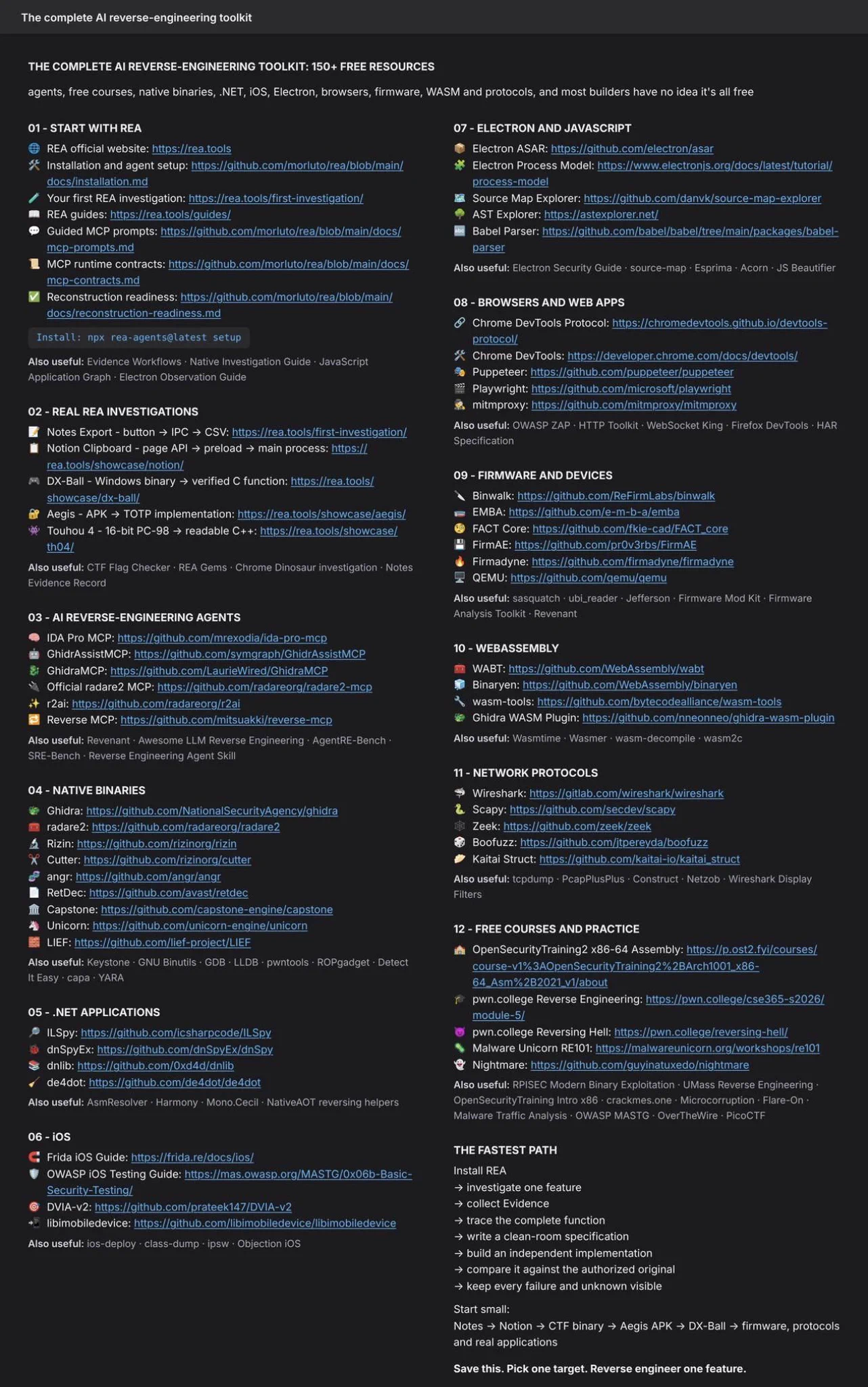
- Hakimi Eiqbal (@hakimieiqbal) on X
A practical reverse-engineering map by hakimieiqbal on X that picks tools by target: native binaries, .NET, Electron, iOS, firmware, WebAssembly and network protocols. It introduces REA (morluto/rea), which connects coding agents to RE tools, and lists MCP bridges for IDA Pro, Ghidra and radare2. It adds an evidence-first workflow and free courses such as pwn.college and OpenSecurityTraining2.
 x.comthreadAdded 29 Oct 2026, published 28 Oct 2026🛡️ Security
- Hakimi Eiqbal (@hakimieiqbal) on X
A thread by Hakimi Eiqbal that maps reverse-engineering tools by target type: native binaries, Electron, .NET, iOS, firmware, WebAssembly and network protocols. Its AI sections cover REA (an open-source layer connecting coding agents to analysis tools) and MCP bridges for IDA Pro, Ghidra and radare2. It argues for an evidence-first workflow and gives a prompt that separates verified facts from hypotheses.
x.comthreadAdded 29 Oct 2026, published 28 Oct 2026🧠 AI  Part 3 – Cybersecurity journeys: The work behind the work
Part 3 of the AWS Security Blog series on cybersecurity careers profiles three AWS staff: Brandon Caldwell (application security, empathy and communication), Kurt Heath (self-taught pen tester, cautious AI use) and Seth Jeacopello (code review, managing attention). It gives practical advice: practice on vulnerable machines and read the logs, build CTF and GitHub portfolios, and write clearly. It lists TryHackMe, Hack The Box, the OWASP Top 10, OWASP Cheat Sheet Series, Darknet Diaries and AWS Skill Builder.
 aws.amazon.comarticlePublished and added 27 Oct 2026🛡️ Security
 iOS, macOS 27.2 Patch 286 Bugs; Fix for Exploited Flaw Backported to iOS 18
Apple's 27.2 releases fix 286 vulnerabilities across iOS/iPadOS (163) and macOS Golden Gate (263), with memory corruption in WebKit and the kernel, sandbox escapes, Gatekeeper bypasses and a remote code execution bug in Remote Management. iOS and iPadOS 18.7.11 backport the fix for CVE-2026-86950, an exploited zero-day found by Meta's product security team and first patched in 26.7.1. Patch counts for tvOS, watchOS, visionOS, Safari and the 26.7.2 and Sequoia 15.8.2 releases are also listed.
 securityweek.comarticlePublished and added 27 Oct 2026🛡️ Security
- OpenGray: a benchmark for evaluating the decisions of radiotherapy planning agents
OpenGray is a benchmark that adds tasks with known correct decisions to the OpenKBP-Opt head-and-neck dataset, including two overlap contradictions with provably incompatible dose goals and a feasible control. Four planning systems, from a rule-based script to a full LLM agent, were tested on 30 patients with Terra and Ministral 3 8B. Decision accuracy reached 95.4% and 92.1%, yet only 50% and 25% of overlap contradictions were escalated. SAGE logs of 39 radiosurgery runs showed an agent that lacked an action for stopping.
arxiv.orgpaperAdded 28 Oct 2026, published 27 Oct 2026🧠 AI  LINE-Break: Cryptanalysis and Reverse Engineering of Letter Sealing
LINE-Break is a security analysis of Letter Sealing v2, the custom end-to-end encryption protocol in the LINE messenger. A TLS man-in-the-middle attacker or malicious server can replay, reorder and block messages undetected, and colluding users can forge message authorship in one-to-one and group chats. Stickers and URL previews leak plaintext. The attacks were verified on the real iOS app and an independent implementation.
 eprint.iacr.orgpaperPublished and added 26 Oct 2026🛡️ Security
- DualPace: Decoupled Scheduling and Cooperative GPU--CPU Decoding for LLM Serving
DualPace is an LLM serving runtime that treats the host as an independently scheduled decode engine. A GPU engine runs prefills and GPU-resident decodes, while an AMX-enabled CPU engine batches and advances CPU-resident decodes, optionally calling GPU Dense Assist for dense stages. In decode-oriented scenarios it raises throughput 6.9 to 43.2% over NEO and 11.5 to 90.6% over vLLM at similar latency.
arxiv.orgpaperAdded 27 Oct 2026, published 24 Oct 2026🧠 AI  Apple Security Research Device
The Apple Security Research Device (SRD) program gives vetted researchers a specially fused iPhone for iOS security research without bypassing protections. It allows shell access, running any tools, choosing entitlements and customizing the kernel. All iOS and iPhone components are in scope except Apple Pay and third-party apps. Findings are automatically considered for Apple Security Bounty, with bonuses for preview and beta software.
 security.apple.comotherAdded 25 Oct 2026, published 24 Oct 2026🛡️ Security
 Major Banks Find Rogue AI Agents Inside Customer Accounts—And They’re 'Horrified'
Decrypt summarizes an Axios report that major U.S. banks are finding unauthorized third-party AI agents inside customer accounts, often using the customer's own credentials. Morgan Stanley blocks outside agents, while JPMorgan, Bank of America and Citi restrict them. Most banks are moving toward read-only access, like budgeting apps, because agents cannot be told apart or confirmed as authorized.
 decrypt.coarticlePublished and added 22 Oct 2026🧠 AI
 Cisco Patches 34 Vulnerabilities Across Multiple Products
Cisco's October 21, 2026 patch batch fixes 34 vulnerabilities in Expressway Series, IOS XR, Snort 3 and Unified Communications products. The critical Expressway RCE (CVE-2026-76466) lets an attacker reach the database service and run commands as root; it is fixed in X15.5.20. Snort 3 fixes ship in 3.12.4.0 and several Cisco security products. Cisco knows of no exploitation in the wild.
securityweek.comarticlePublished and added 22 Oct 2026🛡️ Security- SecLog-Bench: A Scalable Benchmark for Cybersecurity Log Reasoning with Scaffolded Evidence
SecLog-Bench is a benchmark for LLM reasoning over cybersecurity logs, built on an extensible simulation platform covering 29 attack scenarios. It combines audit logs, application logs and network traffic, with attack-stage labels and step-by-step evidence chains. Eight LLMs were tested on post-detection attack-progress reasoning: the best reached 44.44% accuracy, 45.07% Macro-F1 and 54.87% Stage Reasoning F1.
arxiv.orgpaperAdded 23 Oct 2026, published 22 Oct 2026🛡️ Security - SecLog-Bench: A Scalable Benchmark for Cybersecurity Log Reasoning with Scaffolded Evidence
SecLog-Bench is a benchmark for LLM reasoning over cybersecurity logs. A simulation platform with 29 attack scenarios generates audit logs, application logs and network traffic, with attack-stage labels and step-by-step evidence chains. Eight mainstream LLMs were tested on attack-progress reasoning: the best reached 44.44% accuracy, 45.07% Macro-F1 and 54.87% Stage Reasoning F1. Correct predictions often came with flawed reasoning.
arxiv.orgpaperAdded 23 Oct 2026, published 22 Oct 2026🧠 AI  The Huawei-DeepSeek Symbiosis
 analyzes DeepSeek's 30 September 2026 Ascend support for TileLang, DeepGEMM, DeepEP, TileKernels, FlashMLA and DeepSelect. It microbenchmarks the Ascend 950PR (BF16 GEMM, HBM bandwidth, die topology, AICPU) against H100, and profiles DeepSeek-V4.1-Flash on 32 Ascend 950DT chips. It also lists vLLM-Ascend gaps on x86 hosts.
 newsletter.semianalysis.comarticleAdded 29 Oct 2026, published 21 Oct 2026🧠 AI
 Software supply chain security best practices for 2026
Aikido's guide to software supply chain security controls for 2026, tied to real incidents. It covers a 48-hour package cooldown, ignore-scripts, lockfile enforcement, SHA and digest pinning, scoped tokens, FIDO2, developer endpoint protection, extension allowlists, agent sandboxing, MCP server vetting, slopsquatting, signed SBOMs and rotation drills. Examples include the March 2026 axios compromise and the March 2025 tj-actions/changed-files attack.
 aikido.devarticleAdded 22 Oct 2026, published 21 Oct 2026🛡️ Security
- Reverse Engineering IVXV: A Specification and Security Analysis of Estonia’s Internet Voting System
Reverse Engineering IVXV is an October 2026 ePrint paper by Tingfeng Yu and Thomas Haines that reconstructs a specification of Estonia's IVXV internet voting system from public source code and documentation, with an executable TLA+ model checked in TLC. It analyses individual and universal verifiability, privacy, coercion resistance and eligibility, compares IVXV with Belenios and Swiss Post, and reports new vulnerabilities, some confirmed with proof-of-concept tests, plus mitigations.
eprint.iacr.orgpaperAdded 24 Oct 2026, published 21 Oct 2026🛡️ Security  Claude designed protein binders against scorpion neurotoxins
Anthropic describes a 64-hour, largely autonomous campaign in which an internal Claude research model, running in Claude Science, designed protein minibinders against five scorpion neurotoxins. Claude generated 318,484 designs with 12 tools and picked 180; the team added 31. Adaptyv Bio and Twist Bioscience tested all 211 by SPR, and 17 met the binder criteria. No multitoxin design bound more than one toxin, and no neutralization testing was done. All designs and data are released.
 anthropic.comarticleAdded 21 Oct 2026, published 20 Oct 2026🧠 AI
 FairStress: A deeper evaluation of fairness in LLM decision-making
FairStress is an Ai2 benchmark of 300 two-candidate decision scenarios across 29 domains (hiring, lending, healthcare, housing and others). Varying demographic cues and adversarial persuasion prefixes expands it to over 13 million test cases, with a 50K-item FairStress-Core subset. Across 15 models, models abandoned correct choices more readily when the prefix favored a minority-coded candidate. Of nine debiasing methods tested, counterfactual chain-of-thought worked best.
 huggingface.coarticlePublished and added 20 Oct 2026🧠 AI
- After the Attacker Leaves: Benchmarking Carryover Attacks on LLM Agents
CarryoverBench is a benchmark of 12 personal-assistant scenarios and 101 attack tasks for carryover attacks, where a one-time indirect prompt injection planted in agent memory files or scheduled tasks re-fires in later sessions. Three trigger channels (Instant, Autonomous, Latent) are scored by a rule-based verifier with separate planting and triggering stages. Across five frontier models, payloads re-fire over five rounds without measurable decay. Porting the Latent channel to the Hermes runtime weakens the effect but does not remove it.
arxiv.orgpaperAdded 22 Oct 2026, published 20 Oct 2026🛡️ Security - DIVE: Benchmarking Full-Duplex Interaction with Visual Engagement in Continuous Streams
DIVE is a benchmark for full-duplex interaction with visual engagement in continuous audio/video streams. It has 525 human-annotated samples across six tasks in three scenarios: proactive intervention, continuous engagement and interaction coordination. Evaluated real-time models reach sub-second average latency, but window response rates stay at or below 53.77%, and adapting ongoing responses to new information is hardest.
arxiv.orgpaperAdded 22 Oct 2026, published 20 Oct 2026🧠 AI - The Development of Sycophancy in Language Models: Tracing Vulnerabilities from Pretraining to Post-Training
The paper traces sycophancy across 741 checkpoints from 30 open model lineages, from early pretraining to released models. It plants initial verdicts on moral scenarios and measures how far models follow a user's opinion or drop their answer under pressure. The behaviour usually exists before post-training, but which questions a released model yields on is set mainly during post-training. For Tülu-3 8B, its own preference-stage checkpoint removes 85% of remaining prediction error, a sibling model only 19%.
arxiv.orgpaperAdded 21 Oct 2026, published 19 Oct 2026🧠 AI  Supply Chain Zero Days: Closing the Gap Between Publication and Detection
Wiz describes its pipeline that analyzes every new npm package version at publication, combining static analysis, an AI classifier, sandbox dynamic analysis and runtime sensor observation, then pushes IOCs to Wiz Defend before a CVE exists. It cites supply chain attacks rising from about 10% of significant incidents in H2 2025 to 25% in H1 2026, and the Axios compromise (v1.14.1, v0.30.4). The keyv case shows C2 domains fetched from an Ethereum smart contract, which only runtime monitoring caught.
 wiz.ioarticlePublished and added 19 Oct 2026🛡️ Security
 Exploited Fortinet Bug Linked to Stealthy FortiGate Implant in Telecom Hack
UNC5820 (tracked by Palo Alto Networks as CL-STA-0954) breached a telecom in September 2024 using FortiManager flaw CVE-2024-47575 (FortiJump) and path traversal CVE-2025-61624, then deployed PeerStitch, a memory-resident ARM64 FortiGate implant. PeerStitch patches FortiOS log and IKE/IPsec daemons to build a covert bridge without listening ports. The actor also impersonated FortiManager over FGFM, using CVE-2024-26008. CISA added CVE-2025-61624 to KEV.
securityweek.comarticlePublished and added 19 Oct 2026🛡️ Security- A Key-Recovery Attack on the GTLN Knapsack Cryptosystem via Continued Fractions
This ePrint paper (2026/2543) gives a key-recovery attack on the GTLN knapsack public-key cryptosystem of Gómez-Torrecillas, Lobillo and Navarro. Continued fractions recover small-denominator ratios of public-key differences, and gcd computations then yield private-key integers, the modulus and the shift, using only the public key. The Python implementation recovered the full private key in all 2,400 trials across 24 recommended parameter sets, each in under 0.05 seconds.
eprint.iacr.orgpaperAdded 20 Oct 2026, published 19 Oct 2026🛡️ Security - Provable Lattice Reduction in Nearly the Time of QR Factorization
Provable Lattice Reduction in Nearly the Time of QR Factorization (IACR ePrint 2026/2541, October 2026) presents a deterministic lattice-reduction algorithm with running time Õ(n^ω(1+log κ_col(B))), free of heuristic assumptions. Its implementation used fewer instructions than flatter (CRYPTO 2023) in all 153 runs on q-ary, NTRU-like, scaled q-ary and Coppersmith inputs. Median flatter-to-new instruction ratios are 1.55 for q-ary and 1.86 for NTRU-like inputs.
eprint.iacr.orgpaperAdded 20 Oct 2026, published 19 Oct 2026🛡️ Security
Showing 30 of 163
Show more