- Ritik Shukla (@Retik_S) on X
kanzo is a local kanban board that coding agents can update. It ships as one 4 MB binary that starts in 2 ms and runs on localhost. It also works as an MCP server, so Claude Code and Codex see the same tasks as the user. The board is stored as a folder that can sync through a private git repo. The post is brief and gives no further detail.
 x.comtoolPublished and added 30 Oct 2026
- aiproduck (@aiproduck) on X
Ruflo is an MIT-licensed wrapper for Claude Code and Codex that adds agent swarms, vector memory and an MCP server. The plugin install writes no files to the workspace, while npx init adds a .claude/ directory, CLAUDE.md and hooks. The post warns that mods run with the account's permissions, so users should read them first. It gives no benchmarks or architecture detail.
x.comthreadPublished and added 30 Oct 2026 - Prasenjit Sarkar (@stretchcloud) on X
A thread on Cloudflare's agent-readiness scan and the AgentReady.org open spec for "Agent Experience", developed with Vercel, Stripe, Auth0, Mintlify, Google, Netlify and Elementor. The scan grades whether agents can find a site (robots.txt, DNS), read clean Markdown, pass bot rules, and discover an MCP server or API catalog. One quoted example raised a score from 20 to 67 by shipping an API catalog with Link headers, an MCP server card, a skills index and an AI catalog file.
x.comthreadAdded 30 Oct 2026, published 29 Oct 2026  Eddy (@ieddysun) on X
Expo's official skills package gives AI coding agents scoped instructions for building Expo apps. One command, npx skills@latest add expo/skills --skill '*', installs it for Cursor, Copilot and Windsurf, while Claude Code and Codex use their plugin marketplaces. Skills include expo-router, expo-animation, expo-upgrade and eas-update. The Expo MCP server adds live docs lookup, compatible dependency installs, EAS build monitoring and simulator screenshots.
x.comthreadAdded 29 Oct 2026, published 28 Oct 2026- Hakimi Eiqbal (@hakimieiqbal) on X
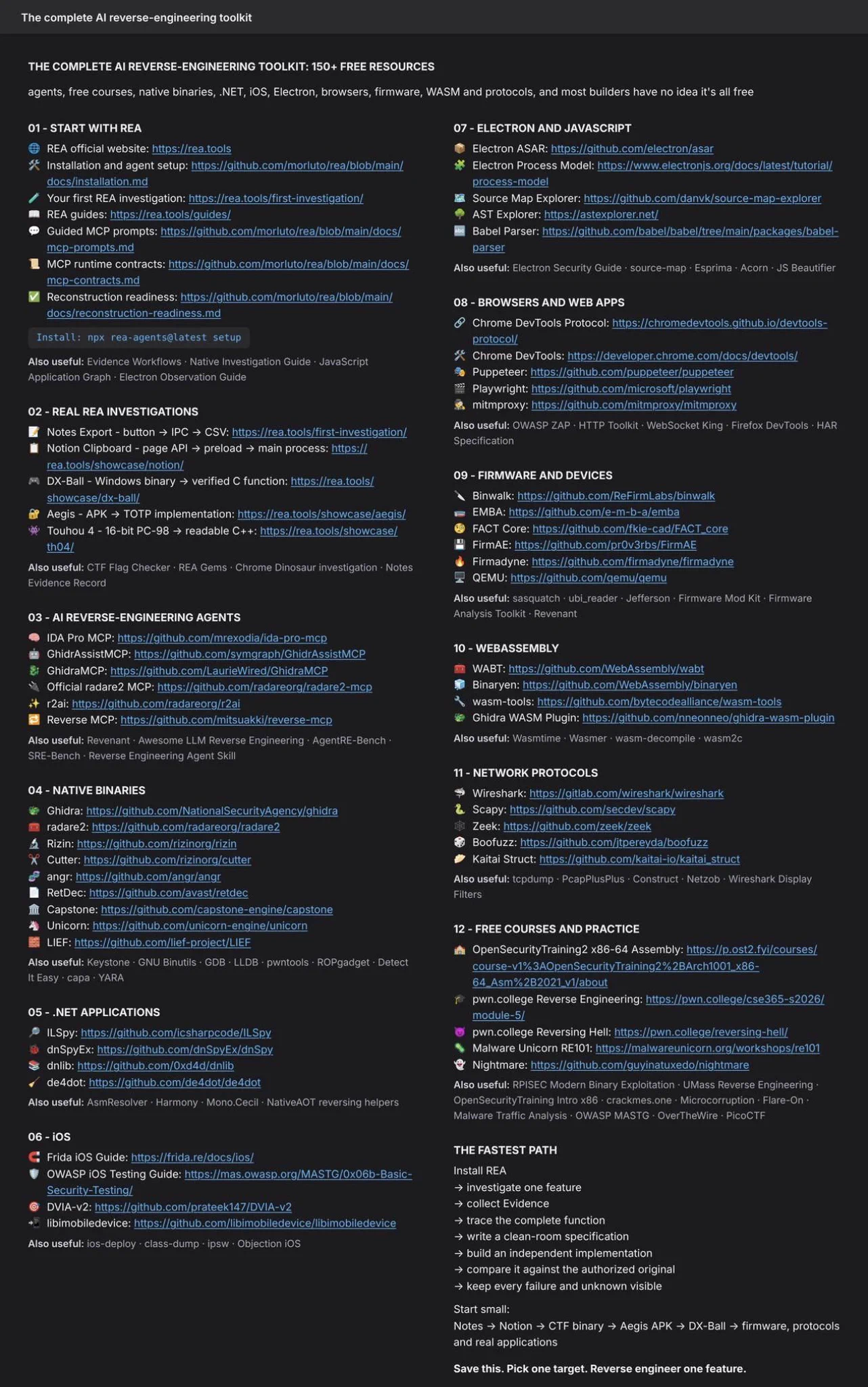
A thread by Hakimi Eiqbal that maps reverse-engineering tools by target type: native binaries, Electron, .NET, iOS, firmware, WebAssembly and network protocols. Its AI sections cover REA (an open-source layer connecting coding agents to analysis tools) and MCP bridges for IDA Pro, Ghidra and radare2. It argues for an evidence-first workflow and gives a prompt that separates verified facts from hypotheses.
x.comthreadAdded 29 Oct 2026, published 28 Oct 2026  Kizuno18 (@Kizuno18) on X
Kizuno18's X post argues that the move from local stdio and Docker MCP servers to remote HTTP/SSE endpoints matures the Model Context Protocol in enterprise infrastructure. It lists three trade-offs: short-lived OAuth/JWT bearer tokens replace mounted admin credentials, deferred tool discovery avoids roughly 20k tokens of eager schema loading, and HCP Terraform enforces Sentinel/OPA policy, audit trails and approvals server-side. Opinion post with no benchmarks or code.
x.comthreadAdded 29 Oct 2026, published 27 Oct 2026- Rohan Paul (@rohanpaul_ai) on X
Hi3D v1.0 (formerly Sparc3D) is an open-sourced image-to-3D model from Hi3D, which runs a closed v3.0 refining at 2048 cubes per side. In a test with 13 professionals in 3D algorithms, 562 judgments against eight other image-to-3D models favoured it 83.5% of the time. The thread also covers the Hi3D Agent and an MCP server for other agents. Back and bottom views were checked, where TRELLIS.2 collapsed a winged figure.
x.comthreadAdded 28 Oct 2026, published 27 Oct 2026 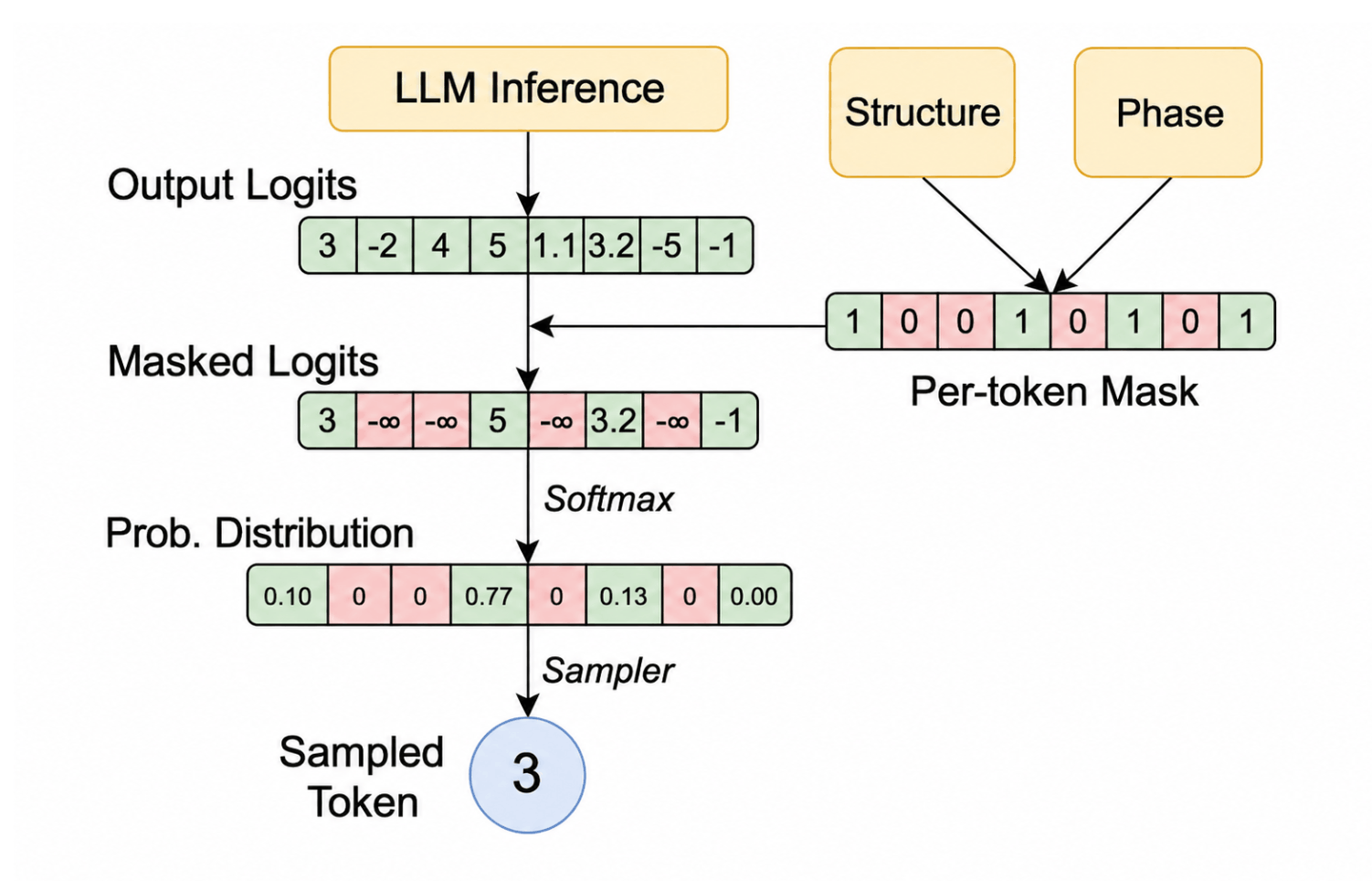 Fixing Tool-Call Accuracy in vLLM
Ubicloud's post explains why tool-call schema accuracy matters for agentic workloads and how it fixed it when serving Kimi K2.6 and DeepSeek V4 Flash. With vLLM 0.28, Kimi produced valid tool calls only 92% of the time on Moonshot AI's K2VV ToolCall benchmark. Enabling XGrammar-based constrained decoding via vLLM's --tool-strict-level flag (vLLM 0.31) raised schema accuracy to 100%.
 ubicloud.comwriteupAdded 27 Oct 2026, published 26 Oct 2026
- Dan Kornas (@DanKornas) on X
jshook is an open-source (AGPL-3.0) MCP server that gives AI agents a search-first, profile-aware reverse-engineering workspace for JavaScript, browser traffic, WASM and native processes. Agents start with a small searchable tool surface and move to workflow or full profiles only when needed. It drives Chromium or Camoufox over CDP, captures WebSocket traffic, has HTTP, GraphQL and Burp Suite helpers, and supports hot-reload plugins and declarative workflows. The post is a short announcement; the repository link is in a reply.
x.comtoolAdded 28 Oct 2026, published 25 Oct 2026 - Agent Credit (@agentcredit_) on X
Agent Credit v1.3 is a remote MCP server that lets AI agents run credit checks on each other. It has six tools: score, compare, operator record, alerts and on-chain proof check. Calls are paid per use in USDC through x402 with no account or key. It also flags shared wallets, lists every token an operator launched and how each ended, and offers embeddable badges and wallet-signed record claims.
x.comtoolAdded 26 Oct 2026, published 25 Oct 2026 - Big Bull (@BIGBULLapp) on X
5ire is a desktop AI assistant and MCP client that connects to OpenAI, Anthropic, Google, Mistral, Grok, DeepSeek and Ollama from one window. It has a local knowledge base and tool calls over Model Context Protocol. The tools feature needs Python, Node and uv installed because it runs a local MCP server; without them it works only as a chat client.
x.comthreadAdded 25 Oct 2026, published 24 Oct 2026  ReignSwords (@ReignSwords) on X
A reviewer tests GenOffice, an open-source Office suite (10.7k GitHub stars), through its CLI only. Markdown to .docx took 3.8s, JSON to .xlsx took 0.9s with a live SUM formula, and .docx to PDF failed twice until Xvfb supplied a display. It has byte-preserving edits, a skill file for Claude Code and Codex, and 29 MCP tools. Downsides: a 188MB download that filled a 512MB /tmp, Electron in the PDF path, and unproven trust in tracked changes and rollback.
x.comthreadAdded 25 Oct 2026, published 24 Oct 2026- Gökdeniz Gülmez (@ActuallyIsaak) on X
An X post showing how to have Codex train a small model on Apple silicon through the mlx-lm-lora MCP server and skill. It gives five setup steps (pip install with the mcp extra, npx skills add, locate mlx-lm-lora-mcp, codex mcp add). The prompt runs four pre-training trials on tiny-random/qwen3 with the mlx-community/recycling_the_web-1k dataset. Codex picks the optimizer and learning rate itself, and the result is a table with validation loss and the best adapter path.
x.comthreadAdded 25 Oct 2026, published 24 Oct 2026  Prasenjit Sarkar (@stretchcloud) on X
Post explaining Claude's new support for MCP Tasks and Elicitations. A server returns a durable task handle instead of blocking. The client polls tasks/get every 250 ms to 30 s, and states are working, input_required, completed, failed or cancelled. Elicitations pause a task at input_required for human approval. It also notes Cloudflare's stateless MCP servers and Code Mode, and Sentry and Linear adoption.
x.comthreadAdded 25 Oct 2026, published 24 Oct 2026 EveryDev.ai (@EveryDevAi) on X
ToolUniverse, from ScientistTools, is an open-source (Apache-2.0) toolkit that gives any LLM one interface to more than 1,000 scientific tools, models and databases such as PubMed, UniProt and ChEMBL. It ships a native MCP server, a Python SDK and a tu CLI, plus 68 pre-built agent skills. The post says it works with Claude Code, Cursor, Gemini CLI and Windsurf.
x.comthreadPublished and added 24 Oct 2026- Big Bull (@BIGBULLapp) on X
A post by BIGBULLapp on X about a TensorBlock GitHub index of Model Context Protocol servers, described as a TypeScript list so agents call tools someone has already wired up. It cites 1470 forks, 943 stars and 15 open issues. The author notes that curated lists go stale when a server changes its schema. The repository name is truncated in the post.
x.comthreadAdded 24 Oct 2026, published 23 Oct 2026  Deletion, Substitution, Repair and Transplant: Component Attribution in BARBICAN, a Layered Prompt-Injection Gateway for MCP
The paper analyses BARBICAN, a fail-closed prompt-injection gateway for MCP tool mediation, using deletion, substitution, repair and transplant experiments. Its arbitration classifier ran on tokenizer-mangled text for a whole evaluation. Fixing that raised AUC from 0.392 to 0.855 while system recall fell from 80.67% to 80.34%. The band it receives is 96.82% malicious. The authors argue ablation figures need the band's class balance and substitution baselines.
 arxiv.orgpaperAdded 27 Oct 2026, published 23 Oct 2026
- Yash Patil (@yvshpvtil) on X
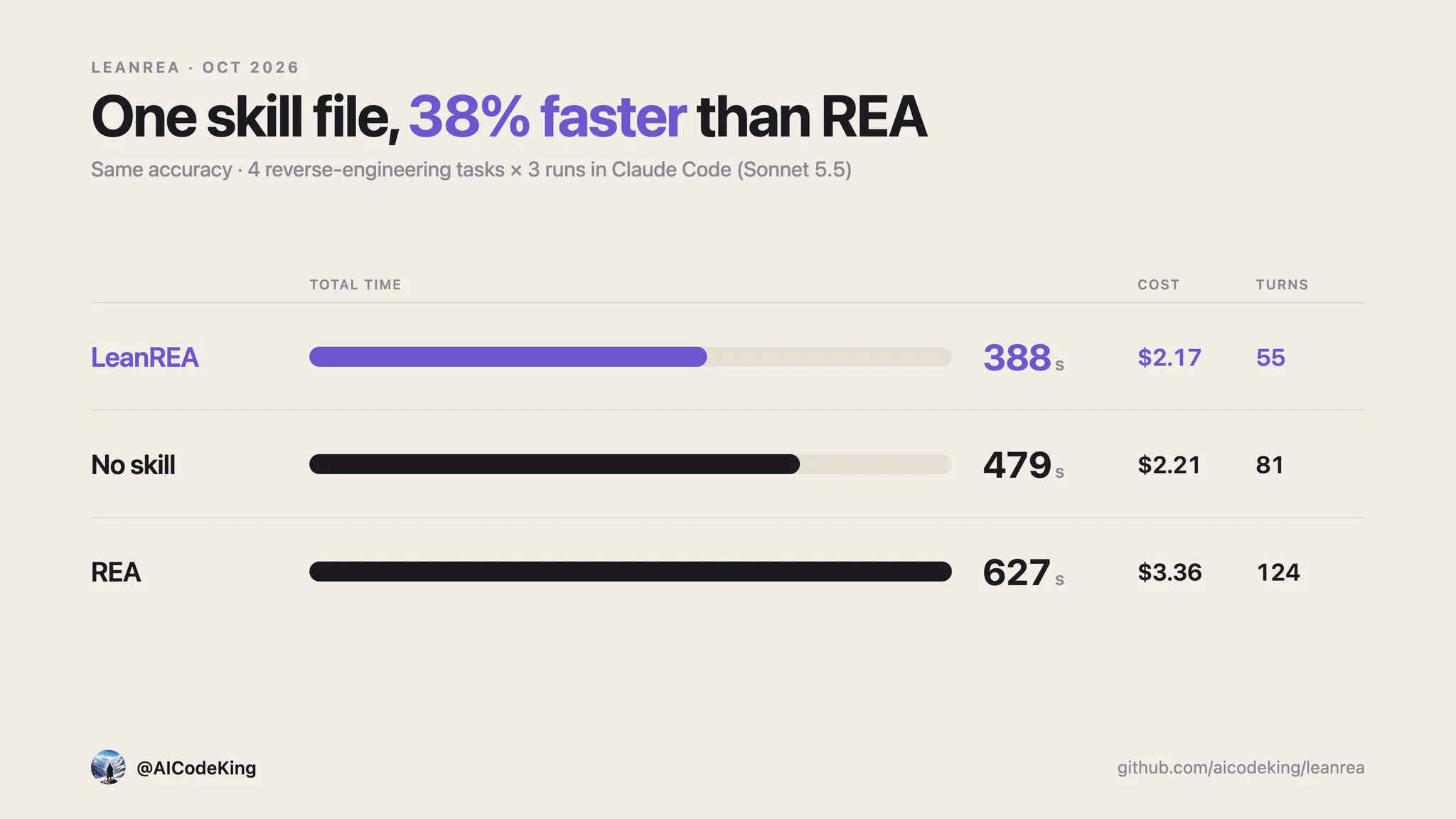
leanrea is an 8 KB skill file that tells a coding agent which plain CLI tools to use for reverse engineering, replacing REA, a 207-tool MCP server. In the author's test it ran 38% faster and 35% cheaper, scoring 74/75 against 75/75. The author lists caveats: 3 runs per task, one model, one machine, and Claude with no skill was already decent.
x.comthreadAdded 25 Oct 2026, published 23 Oct 2026 - Tool-Calling LLM Agents Under Realistic MCP Faults: Scale Does Not Purchase Fault Tolerance
MCP-Injector is a protocol-aware fault-injection middleware for Model Context Protocol tool calls, with permanent, transient and intermittent faults on seedable schedules. Its fault model comes from 57,240 issue and PR threads across 1,774 open-source MCP repositories. In a 1,350-cell experiment, faults cut task-completion score by 60% (8.08 to 3.23 of 10), and the 120B gpt-oss model was no more resilient than the 20B. Agent stacks differed in how well they absorbed faults.
arxiv.orgpaperAdded 26 Oct 2026, published 23 Oct 2026 - Meku_SI (@MEKU_SI) on X
MEKU Human Cloud is an MCP server for agents that need a real person to do a task. It exposes three tools: search humans (read-only), request a human (a human operator reviews every request first), and check status. It is listed in the MCP Registry as farm.meku/human-cloud. The tweet gives no detail on pricing, humans available or request formats; those are in the linked docs.
x.comtoolAdded 23 Oct 2026, published 22 Oct 2026 - Dan Kornas (@DanKornas) on X
aula-mcp is an open-source (MIT) TypeScript MCP server that connects an AI client to Denmark's Aula school platform. It exposes tools for profiles, calendar events, messages, notifications, posts and weekly plans. MitID credentials and OAuth tokens are stored in macOS Keychain or an AES-256-GCM encrypted file. The HTTP server binds to 127.0.0.1, and the presence write tool stays off until AULA_MCP_WRITE=1 is set.
x.comrepoAdded 23 Oct 2026, published 22 Oct 2026 - SpyTech Ai (@RizeOnline) on X
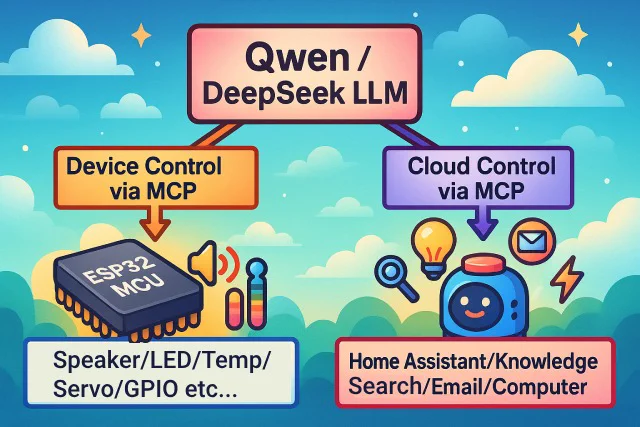
XiaoZhi ESP32 is an open-source, MIT-licensed firmware stack that turns ESP32 boards into MCP-based voice chatbots using models such as Qwen and DeepSeek. It streams Opus audio over WebSocket or MQTT + UDP through ASR, LLM and TTS, adds offline ESP-SR wake words, and uses device-side MCP to drive speakers, LEDs, servos and GPIO. It supports 138 board directories and builds with ESP-IDF 6.0.1 or newer.
x.comthreadAdded 23 Oct 2026, published 21 Oct 2026 - Swif (@swif_ai) on X
A post from Swif (@swif_ai) on the MCP TypeScript server SDK versions 2.0 to 2.2. A single server instance shared across HTTP clients, the pattern shown in the README, could send one client's responses to another client. Version 2.3.0 refuses that setup, so servers must be built per request or per session. The post gives no code or advisory ID.
x.comthreadAdded 22 Oct 2026, published 21 Oct 2026 - Show HN: Omnara – Open-source alternative to Claude Managed Agents
Omnara is an open-source, self-hostable managed agent platform, an alternative to Claude Managed Agents and OpenAI's Agents API. It runs agents on any model (OpenAI, Anthropic, OpenRouter, Bedrock, LiteLLM, Ollama) and any machine, with Postgres-backed durable state, stateless workers, per-tool permissions, MCP, skills, memory, subagents, schedules and Slack, Discord and GitHub triggers. It ships a REST API, TypeScript SDK, CLI and Docker Compose setup.
 github.comrepoAdded 23 Oct 2026, published 21 Oct 2026
 How Commerce.com and Cloudflare are getting storefronts ready for AI agents
Cloudflare and Commerce.com describe enabling WebMCP, Google's proposed browser standard for exposing structured tools to AI agents, across almost 100,000 storefronts. Cloudflare injects a bridge script at the edge that proxies tools from Commerce.com's backend MCP server. Per-merchant opt-out uses Configuration Rules and custom hostname metadata, and a configurable MCP URL (/api/mcp) was added.
 blog.cloudflare.comarticleAdded 29 Oct 2026, published 21 Oct 2026
 Paulo Pierrondi | AI agents (@paulopierrondi) on X
Paulo Pierrondi's X post, part 9 of a series on installing MCP servers, lists a monthly review of installed servers. The checks are which tools the agent used, servers not called in weeks, overlapping tools that confuse the model, and whether each server still has an owner. A reply adds a decommissioning check: after removal, confirm the server's old credentials can no longer call the backend.
x.comthreadPublished and added 20 Oct 2026 AnyLanguageModel 1.0: One Year of Local Models on Apple Platforms
AnyLanguageModel 1.0 is a Swift package that gives apps Apple's Foundation Models API across the system model, llama.cpp, MLX, Core ML and hosted providers. This release post covers tool calling and guided generation on every provider, image input, and hosted support for OpenAI, Anthropic, Gemini, Ollama and Hugging Face Inference Providers. It also ships swift-huggingface 1.0 and swift-xet 1.0, and lists small open-weight models that fit on iPhone and Mac.
 huggingface.coarticlePublished and added 20 Oct 2026
 Angel (@ziran_pu) on X
AshAi, the AI package for the Elixir Ash Framework, is getting MCP client tools. Creating an MCP server with AshAi was already simple, but connecting your own LLM tool loop to an external MCP server had to be built by hand. The planned release includes OAuth client management resources. The post gives no release date, API details or code.
x.comthreadAdded 21 Oct 2026, published 19 Oct 2026- Saylor (@Kev96790724) on X
G-Krusch is an MIT-licensed, local-first Google Workspace hub built on Node.js 22 and SQLite WAL. It runs a 12-tool MCP server (SSE and Stdio) plus a REST bridge on port 5446 for Drive, Calendar and Gmail. It includes a 1,024-dimension hybrid Drive RAG with an embedding cascade (Ollama bge-large, then Gemini, then offline fallback) and FTS5 BM25. PDF extraction returns page citations. Tokens are kept in an AES-256-GCM vault; 30 of 30 tests pass.
x.comrepoAdded 21 Oct 2026, published 19 Oct 2026 - Show HN: WhatsApp MCP running free on Cloudflare
whatsapp-mcp is an MCP server that runs in the user's own Cloudflare account and lets MCP clients such as Claude Code and Claude Desktop search and read WhatsApp chats. It links as a WhatsApp Web-style device through Baileys, stores messages in SQLite with FTS5 inside a Durable Object, and is read-only. The README documents deployment, OAuth sign-in, contact naming through agents, and workerd shims for Baileys.
github.comrepoAdded 20 Oct 2026, published 18 Oct 2026 - Dan Kornas (@DanKornas) on X
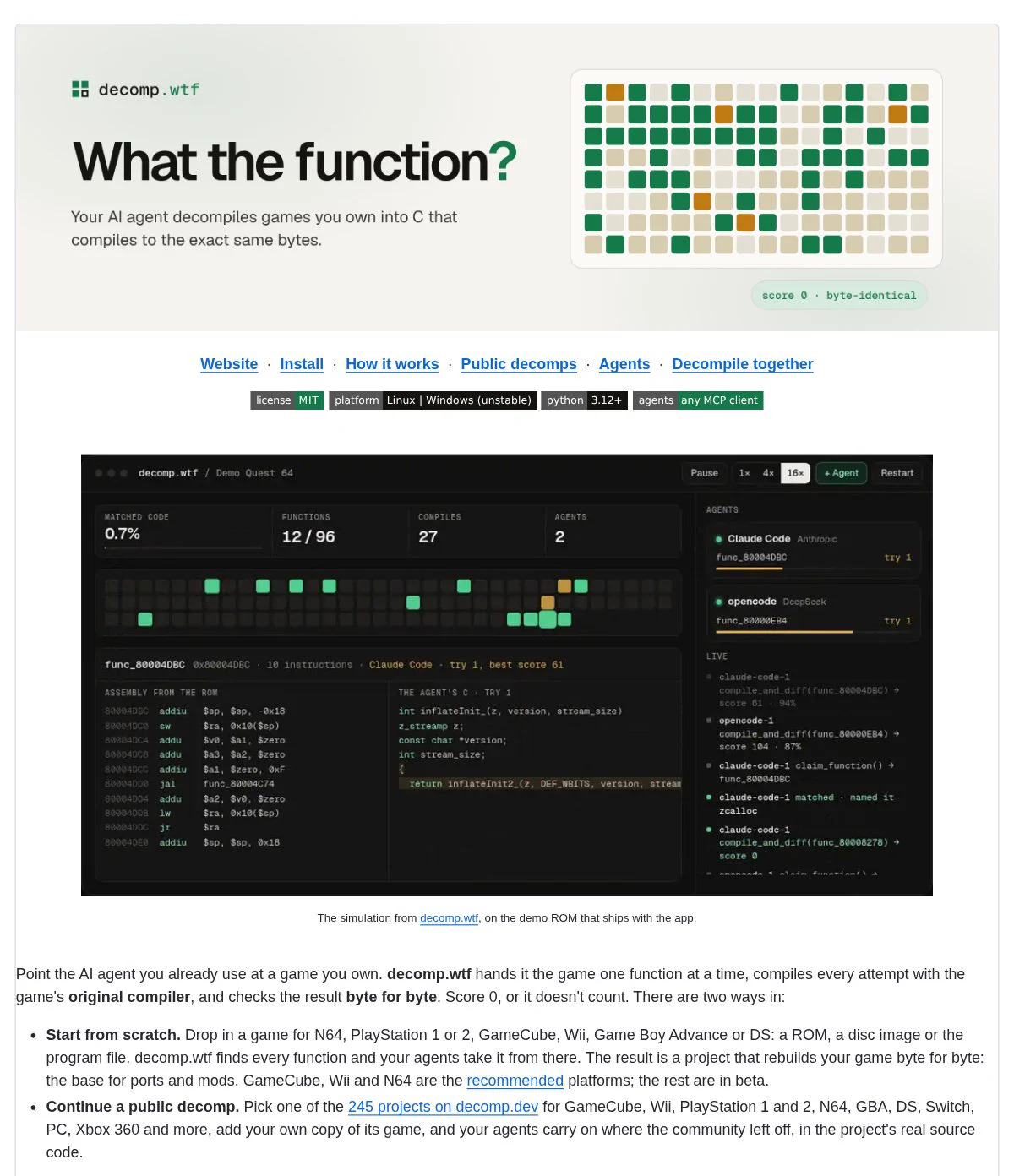
decomp.wtf is an open-source (MIT) local workspace where AI coding agents decompile games into C, one function at a time. Agents receive assembly, data, callers and earlier attempt notes, then each C candidate is compiled with the game's original compiler, linked at its real address and compared byte for byte, with instruction diffs on misses. It exposes MCP tools for Claude Code, Codex, Antigravity CLI and opencode, plus a live view of agent calls and match scores.
x.comtoolAdded 19 Oct 2026, published 18 Oct 2026  DeepSeek search and fetch – $0.75 per 1000 successful requests
DeepSeek Search & Fetch are two JSON APIs for agents and RAG apps. Search (/v1/tools/search) returns structured results from DeepSeek's in-house engine, with count, need_content and operators such as site:, lang: and after:. Fetch (/v1/tools/fetch) returns a page as Markdown. Both use bearer auth, bill only successful requests ($0.75 per 1000), and have account-level QPS limits. Calls from DeepSeek Harness, Claude Code or Codex are free until 1 November 2026.
 api-docs.deepseek.comotherAdded 19 Oct 2026, published 18 Oct 2026
- ToFu: Exploiting and Fuzzing the LLM–Orchestrator–Tool Trust Boundary
ToFu is a tool-aware fuzzing framework for LLM tools, including MCP servers. It maps each tool argument, using its metadata, to one of 74 CWE-guided semantics-aware sanitizers (path, URL, SQL and similar). It then generates schema-valid Atheris harnesses and semantic oracles, using runtime tracers for in-process tools and outcome oracles for opaque ones. The LLM (gpt-4.1) only maps sanitizers and writes seeds; it is never the security judge. The paper also shows a "Repeat-After-Me" trick, where an LLM told to repeat attacker-crafted text emits a tool call the orchestrator executes, reproduced on LangGraph, MAF, ADK 2.0, AutoGen, Strands and CrewAI. Across 273 runnable MCP servers (3,405 tools) it reports 253 verified bugs in 343 tools across 118 servers, such as path traversal, log injection and exfiltration. These are failures a crash-based fuzzer would miss. The result matters because it shows LLM-generated tool arguments cannot be treated as trusted.
arxiv.orgpaperAdded 18 Oct 2026 - ralphtradesz/trading-hub
Trading Hub is a free macOS desktop trading platform built with C#/.NET 10 and Avalonia. It uses the user's Claude Code subscription: a chat writes and fixes C# strategies, an in-app MCP server lets Claude run backtests, optimizations and walk-forwards and write reports, and a risk agent proposes position sizes. Install and a Windows port are both driven by Claude Code prompts. License is MIT with Commons Clause.
github.comrepoAdded 19 Oct 2026, published 17 Oct 2026 - alex09x/kyb
KYB (Know Your Business) is a Rust/axum server that stores agent-written knowledge, incident reports and tasks as Markdown files in Git, one commit per change. Search is hybrid: Tantivy BM25 fused by reciprocal rank with local multilingual-e5-small ONNX vectors, and it can query historical versions or "as of" a date. It ships a kyb CLI, a native MCP endpoint (Claude Code, Codex, Antigravity, Gemini CLI), an installable agent skill, token auth with per-write attribution trailers, secret scanning on writes, and a web console. It targets persistent shared operational memory for multi-agent, multi-machine fleets.
github.comrepoAdded 17 Oct 2026 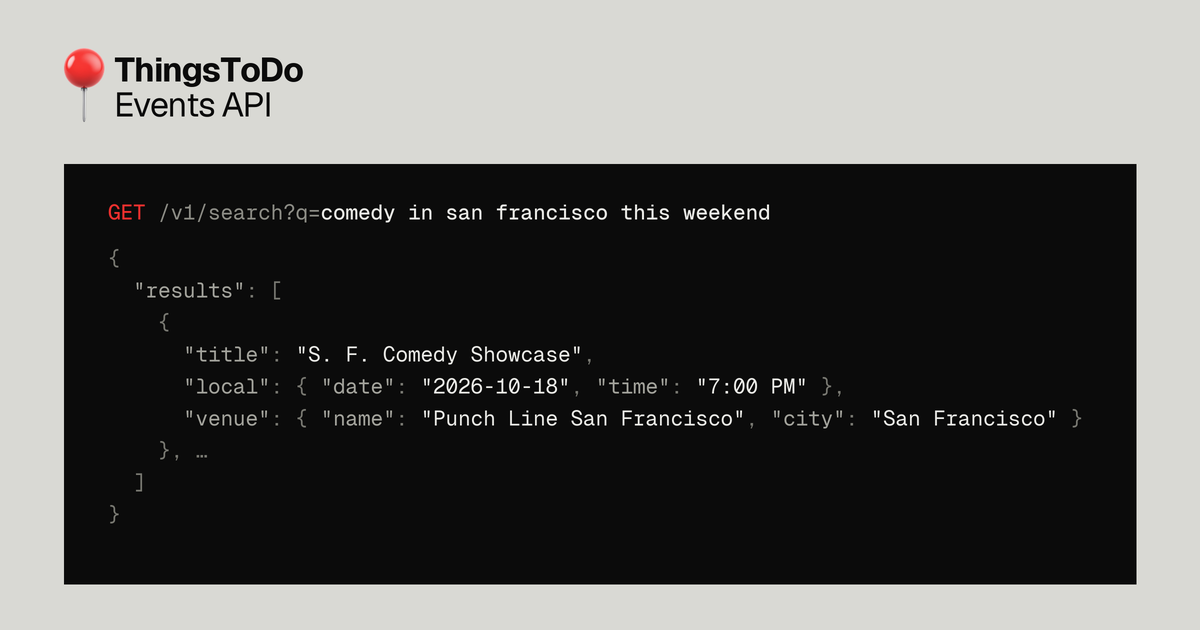 Show HN: Things to Do API
Things to Do API is a hosted knowledge base of local events (shows, talks, pop-ups, markets, festivals) that you query in natural language, for example `/v1/search?q=comedy+in+san+francisco+this+weekend`. It returns structured JSON with title, category, local start time, venue and ticket and source links. It also exposes an HTTP MCP endpoint, added with `claude mcp add --transport http thingstodo https://api.thingstodoapi.com/mcp`, so agents can use it as a tool. Coverage is live for the San Francisco Bay Area, with New York City and Los Angeles coming. Pricing is pay-as-you-go from $5 per 1,000 calls, the first 1,000 a month are free, and there is a 300 calls/min limit.
 thingstodoapi.comtoolAdded 18 Oct 2026, published 16 Oct 2026
- Francis Santerre (@santerref) on X
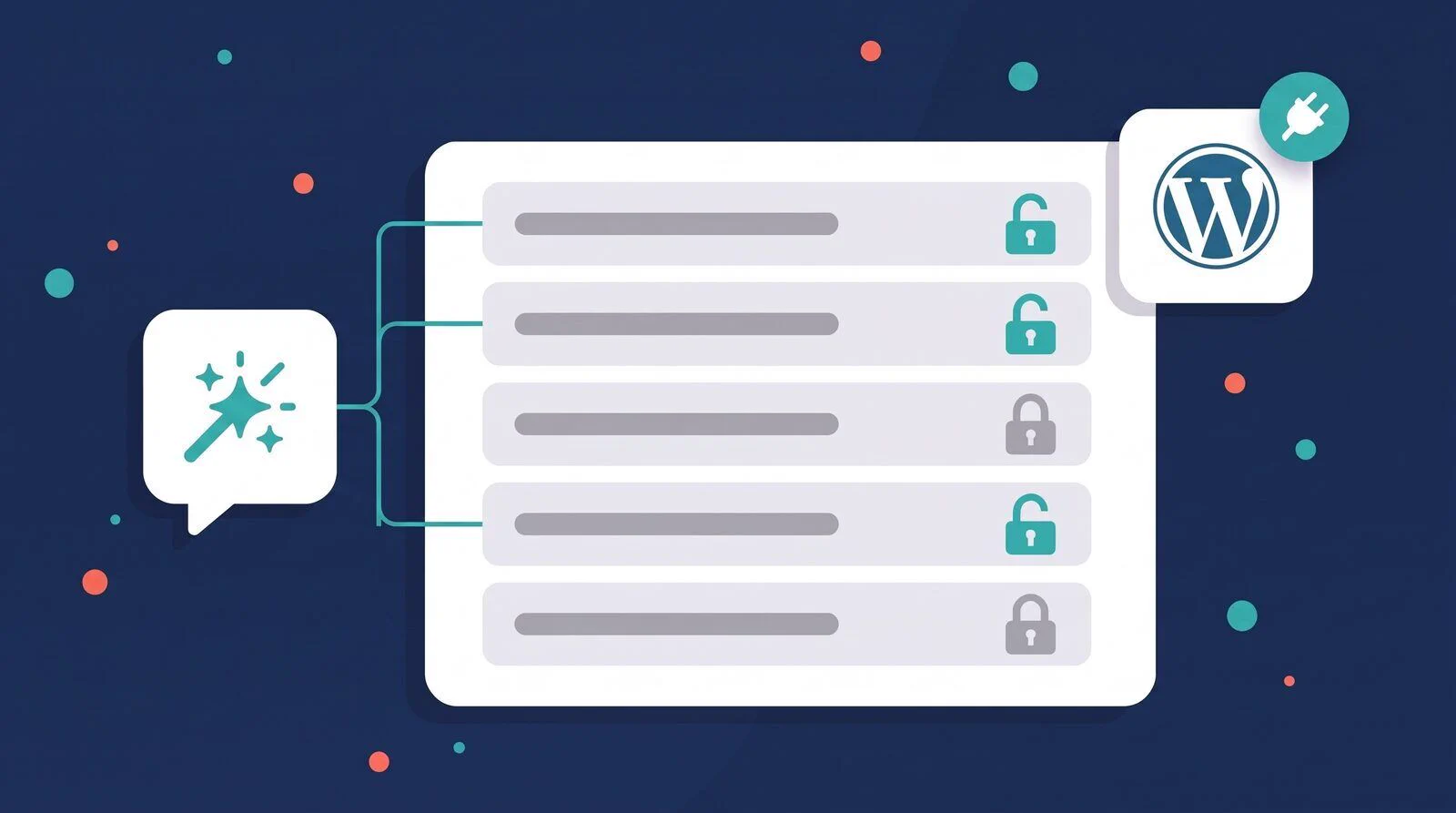
Tweet announcing that the MCP Adapter is now a canonical plugin on WordPress.org (version 0.7.0). It bridges the WordPress Abilities API to the Model Context Protocol, with a default server at /wp-json/mcp/mcp-adapter-default-server. Only abilities a site marks public are exposed, so the security review comes down to auditing the ability list.
x.comthreadAdded 16 Oct 2026, published 15 Oct 2026  Developer Who Cloned Photoshop With AI Just Did the Same to Microsoft Office
Decrypt reports that developer Brandon Thomas released WordCraft, GridCraft and DeckCraft, MIT/Apache-2.0 open-source clones of Word, Excel and PowerPoint. They were written in Rust with Anthropic's Claude (Opus 5.5) as a clean-room rebuild and run natively on Windows, macOS, Linux and BSD, and in a browser. Coverage is high (WordCraft 88% of ribbon features, GridCraft 513 of 523 Excel functions), but the authors rate them only about 50–60% ready for real work. Every button is also an MCP command, so agents like Claude can drive the apps. The article is a useful data point on what AI-assisted "vibe coding" can produce in under two weeks, and on where it still falls short (file fidelity, stability).
 decrypt.coarticlePublished and added 14 Oct 2026
- Thinking in Graphs: Neo4j-Backed Exploit-Chain Reasoning for LLM Penetration-Testing Agents
ChainGraph is a pattern that moves exploit-chain reasoning out of the flat context window and into a Neo4j property graph. Findings, attack steps, credentials, assets and tamper-evident evidence receipts are typed nodes with pre/post-condition edges. The graph is wired to Claude Code or Codex through MCP with no custom harness. Five operator questions (next-step inference, entry-to-crown-jewel pathing, combined-severity promotion, evidence provenance, chokepoint identification) become reusable Cypher and Graph Data Science queries, plus a chain-severity score. On a synthetic multi-forest Active Directory lab modeled on GOAD, three findings rated Medium in isolation become Critical once their path to the forest root is materialized. Scoping each decision to a graph result cut the reasoning payload by about 98% on a token proxy. The authors say the results are illustrative single-run measurements, not a benchmark.
arxiv.orgpaperAdded 17 Oct 2026, published 14 Oct 2026 - Show HN: Graphicle, a Rust port of Graphify with memory for coding agents
Graphicle is a local-first Rust program that parses a repository into a tree-sitter code graph (a port of Graphify) and adds project memory: docs, reviewed decisions and captured Claude Code/Codex sessions. It serves cited file-and-line excerpts within a token budget via one MCP server, CLI and browser app, backed by a single SQLite file, with no API key or telemetry. The README reports a code-only extract on Kubernetes (31k files) in 3m18s versus 26m38s for Graphify 0.9.88, and a memory comparison against seven systems. Agent-proposed memories need user approval and go stale when the code they reference changes.
github.comrepoPublished and added 14 Oct 2026  Francesco Sorrentino (@Fr_Sorrentino) on X
chrome-bridge is an open-source MCP server with a Chrome extension that lets Claude Code drive the user's own Chrome, including logged-in tabs and DevTools. It reads page structure rather than screenshots, which saves tokens and turns. The author reports gains over Claude in Chrome: 4.7× fewer turns and 2.8× lower cost on form filling, 2.3× and 3.4× on finding a row among 1,500, and 9.3× and 4.3× on debugging a broken checkout, with 15/15 correct against 12/15. These are self-reported numbers from the tweet.
x.comtoolPublished and added 14 Oct 2026- morluto/rea
REA (rea-agents on npm) registers an MCP server and matching workflow instructions with coding agents such as Claude Code, Codex, Cursor and Gemini CLI. It exposes tools for inspecting native binaries through Hopper, Ghidra or IDA (with optional objdump and Rizin), JavaScript/Electron apps and ASAR archives, .NET assemblies and websites. Results come back with evidence and limitations, so the agent can explain how a feature works and write and test its own implementation. Analysis runs locally, there is a CLI with the same workflows, and the showcases include C reconstructions verified against original x86 function bytes.
github.comrepoAdded 14 Oct 2026 - 44er (@44errrr) on X
Announcement of hexvero, an MCP server that gives coding agents a static first look at binaries and app bundles across 18 formats (ELF, PE, Mach-O, APK, .NET, Go, Wasm, Electron, SQLite). It uses zero-dependency Node parsers and marks each finding confirmed or inferred with file and line. Its tool catalog is 3,043 tokens, against a claimed 509,696 for the established reverse-engineering MCP server. Paged output with a byte budget shrinks a 541 MB Electron app to a 15 KB result, 1.3 MB of JSON to 7.9 KB, and a 450 KB build diff to 1.2 KB. radare2, rizin or Ghidra plug in for disassembly, and `npx hexvero setup --apply` registers it with Claude Code, Cursor, Codex and 15 more clients. It is a concrete example of keeping MCP tool definitions and results small enough for an agent's context window.
x.comthreadAdded 15 Oct 2026, published 14 Oct 2026  Draft ERC: Agentic Resource Discovery (ARD) Onchain — an address-rooted value registry whose records are ARD entries
Ethereum Magicians draft ERC proposing an onchain, address-rooted registry beneath Google's Agentic Resource Discovery (ARD) spec. Every record remains a valid ARD entry. It adds four kinds (skill, task, agent, registry), CAIP-19/CAIP-10 anchors, JCS+SHA-256 descriptor hashes and domain claims collected as endorsements. A Solidity/Foundry reference kernel with four adapters and a Node.js resolver/gateway are included; the gateway passes the official ARD conformance CLI. The author asks for feedback on the address-as-root boundary, the envelope exclusion from the hash, same-chain-only anchors, and the proposed application/ai-task+json payload.
 ethereum-magicians.orgthreadPublished and added 13 Oct 2026
- ERC-8444: Agentic Resource Discovery (ARD) Onchain
An Ethereum Magicians proposal for ERC-8444, which adds an onchain value and settlement layer under Google's Agentic Resource Discovery (ARD) spec for finding MCP servers, A2A agents, skills and APIs. A thin kernel records kind (skill, task, agent, registry), a CAIP-19/CAIP-10 anchor, a JCS+SHA-256 descriptor hash, a canonical URN and a status. Authority belongs to the paid address, and domains act as collected endorsements through /.well-known/ard.json. The reference implementation has Foundry-tested Solidity adapters and a Node.js gateway that passes the official ARD conformance CLI. It introduces a "task" kind (application/ai-task+json) for tenders aimed at suppliers, and the author asks for feedback on the trust root, the hash scope, same-chain anchors and the task payload.
ethereum-magicians.orgthreadAdded 14 Oct 2026, published 13 Oct 2026 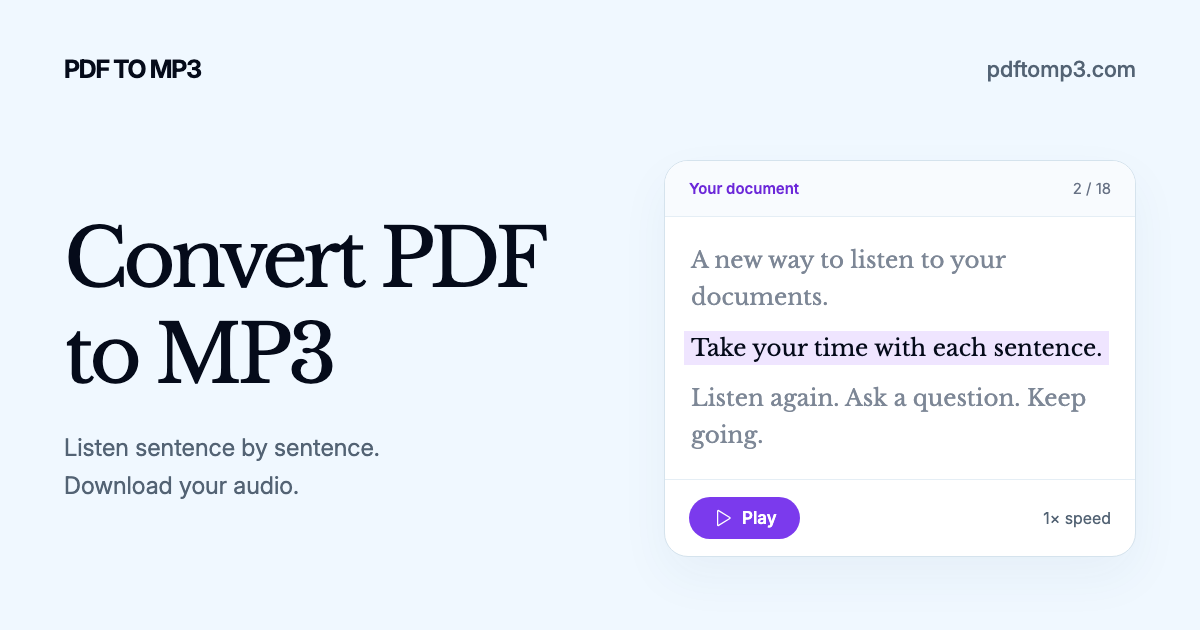 Show HN: Use your OpenAI subscription to create audiobooks
PDF TO MP3 is a hosted MCP server (Streamable HTTP, account authentication) that turns PDFs into audiobooks. The user's existing AI subscription, such as Codex, handles document processing through the MCP connection. Speech generation is billed separately through the user's own OpenAI or Google text-to-speech API key. The setup is three steps: add the MCP server, add a speech key, then attach a PDF and ask the assistant to use the MCP. It shows a "bring your own subscription" pattern that keeps the vendor's compute costs low.
 pdftomp3.comtoolPublished and added 13 Oct 2026
- AI Agents for Cybersecurity: A Guided Tour of a Repository with Tons of Resources and Examples
A guided tour of a GitHub repository of resources and examples for building AI agents, published on the Becoming a Hacker blog. Per the routing note, it covers LangChain 1.x, LCEL, RAG, LangGraph, CrewAI, DeepAgents, MCP servers and token-cost control such as caching, routing and budget guards. The fetched page held only a LinkedIn redirect notice, so the article text was not read.
 linkedin.comarticleAdded 13 Oct 2026
- santosomar/AI-agents-for-cybersecurity
Companion repository for Omar Santos's Pearson and O'Reilly trainings and books. It has eight parts of runnable Python labs: chat models, embeddings, prompt templates, LCEL prompt chaining, Chroma-based RAG, ReAct/LangGraph/CrewAI/DeepAgents agents, and FastMCP servers (nmap, CISA KEV, Shodan). It also includes guides to six agentic frameworks (OpenClaw, Hermes, Agent Zero, OpenHands, Paperclip, Buzz), a tokenomics module on agent cost (context compounding, prompt caching, model routing, token budget guards, batch API, cost per accepted outcome), and a vendor-neutral design spec for a human-gated multi-agent assessment harness. It is a current, practical curriculum for building and operating agents. Some examples act on real systems and should only be run in an authorized lab.
github.comrepoAdded 13 Oct 2026 - Show HN: SolidCraft – Open-Source Parametric CAD in Rust (With MCP Support)
SolidCraft is an open-source parametric 3D CAD application written in pure Rust. It has constrained sketches with its own solver, a feature timeline, assemblies, sheet metal, and STEP/IGES/3MF/STL export. It runs on desktop (egui+wgpu), in the browser, and as a headless CLI. The built-in MCP server (`solidcraft-cli mcp`) gives agents tools such as execute, batch, inspect_design, measure, set_parameter, screenshot and export. They can model headless or drive the running app over a JSON-lines control channel. A rover with 3,323 timeline steps was built entirely through MCP, which shows agent-driven parametric modelling working at scale.
github.comrepoPublished and added 13 Oct 2026  From GTA V on iPhone to Free Photoshop: This AI Tool Is Upending Software
Decrypt reports on REA (Reverse Engineer Anything), an open-source toolkit that uses MCP to connect AI coding agents such as Claude Code and Codex to reverse-engineering tools like Ghidra. It went from under 10,000 to over 100,000 GitHub stars in a week. The article describes AI-decompiled game ports and mashups, and ArtCraft, a set of Rust-built Photoshop-style apps that Brandon Thomas made with Claude Opus 5.5 as a clean-room rebuild. It also covers the copyright and takedown fallout (Activision, Bethesda) and what cheap agent-driven decompilation means for software protection.
decrypt.coarticlePublished and added 12 Oct 2026 GitHub Copilot app for Beginners: How to teach Copilot about your codebase
Beginner-oriented GitHub blog guide to giving GitHub Copilot project context through four mechanisms: repository custom instructions (.github/copilot-instructions.md and path-specific .github/instructions files with applyTo), agent skills (SKILL.md folders under .github/skills), custom agents (.github/agents profiles), and MCP servers such as Playwright. It explains when to use each and how they combine, using examples like a quality-checks skill and an accessibility-review agent. Useful as a concrete reference for the repo layout Copilot reads, with a pointer to the community Awesome Copilot collection.
 github.blogarticlePublished and added 12 Oct 2026
- =dennis; (@Xidea404) on X
A tweet from @Xidea404 pointing to the ADI Chain MCP Server documentation on docs.adi.foundation. The server lets AI agents interact with the ADI blockchain through the Model Context Protocol. The tweet carries no technical detail itself, so what the server exposes can't be confirmed from it. It is a pointer to a blockchain-specific MCP connector.
x.comthreadPublished and added 12 Oct 2026 - sepehr071/iran-mcp
iran-mcp is an open-source catalog of 39 MCP servers (488 tools) that let AI agents query Iranian websites such as Digikala, Torob, Divar, Snappfood, Jabama, Paziresh24, TSETMC and qavanin.ir, with prices normalised to Toman. Most servers are unofficial, read-only Python packages run with uvx; three are official hosted servers. It ships Claude Code plugins, Agent Skills, bundles, proxy lists and a machine-readable servers.json.
github.comrepoAdded 24 Oct 2026, published 11 Oct 2026 - Frostyz (@frostyz) on X
Announcement that the OSWiki MCP server now supports trading through a separately released local signer. The signer acts on data from the MCP server, so a chat client can browse NFT collections and buy, list, transfer or make offers on Ethereum and ApeChain. Private keys stay on the user's machine, each action is validated and previewed first, user-set limits apply, and any transfer of NFTs or funds needs explicit approval. Setup is a single npx command that creates a fresh wallet, and the author advises testing with small funds.
x.comtoolPublished and added 11 Oct 2026 - Cloudflare Changelog (@CFchangelog) on X
Cloudflare's changelog announces that its Cloudflare API MCP server now serves Cloudflare skills alongside its tools. A connected MCP client discovers them by calling `skills/list`. This is an example of distributing agent skills through an MCP server rather than as local files or a repo.
x.comarticlePublished and added 11 Oct 2026 - bilawalsidhu/gods-eye-view
God's Eye View is an open-source, vanilla JavaScript + CesiumJS + Vite 3D globe that fuses live public feeds (aircraft, ships, satellites, quakes, public cameras, weather) into one explorable scene. Its AI layer is a hands-free voice agent on the OpenAI Realtime API with 30 tools: camera fly-to, whiteboard annotations, analyst queries over live layers, and scene-context and screenshot grounding. Keys stay server-side and the browser gets only a short-lived session token. An experimental ChatGPT/Codex OAuth path is also supported. The app doubles as an MCP server, so Claude Desktop, Codex or ChatGPT can open the globe from a conversation.
github.comrepoAdded 11 Oct 2026  MCP spec 2026-07-28 changelog (stateless protocol, MRTR, Sampling/Roots deprecated)
Official changelog for the Model Context Protocol 2026-07-28 specification. Major changes: protocol-level sessions and the initialize handshake are removed to make MCP stateless, with version and capabilities carried in _meta on every request, plus a new server/discover RPC and subscriptions/listen replacing the GET stream and resource subscribe calls. It introduces Multi Round-Trip Requests (InputRequiredResult) in place of server-initiated sampling, roots and elicitation requests, moves tasks into an extension, and deprecates Roots, Sampling, Logging, HTTP+SSE and Dynamic Client Registration. Minor changes add cache hints (ttlMs/cacheScope), new Mcp-Method/Mcp-Name headers, OpenTelemetry trace context, RFC 9207 iss validation and an error-code allocation policy.
 modelcontextprotocol.ioadvisoryAdded 10 Oct 2026
- 0xMarioNawfal (@RoundtableSpace) on X
A tweet highlighting Prompts Chat (formerly Awesome ChatGPT Prompts), an open-source prompt library on GitHub that the post says has 167K+ stars. It works across ChatGPT, Claude, Gemini and other models. The post lists a CLI, an MCP server, a Claude Code plugin and self-hosting with custom branding and auth, all free. It is worth cataloguing as a pointer to a widely used prompt collection that now plugs into coding-agent and MCP workflows.
x.comthreadPublished and added 10 Oct 2026 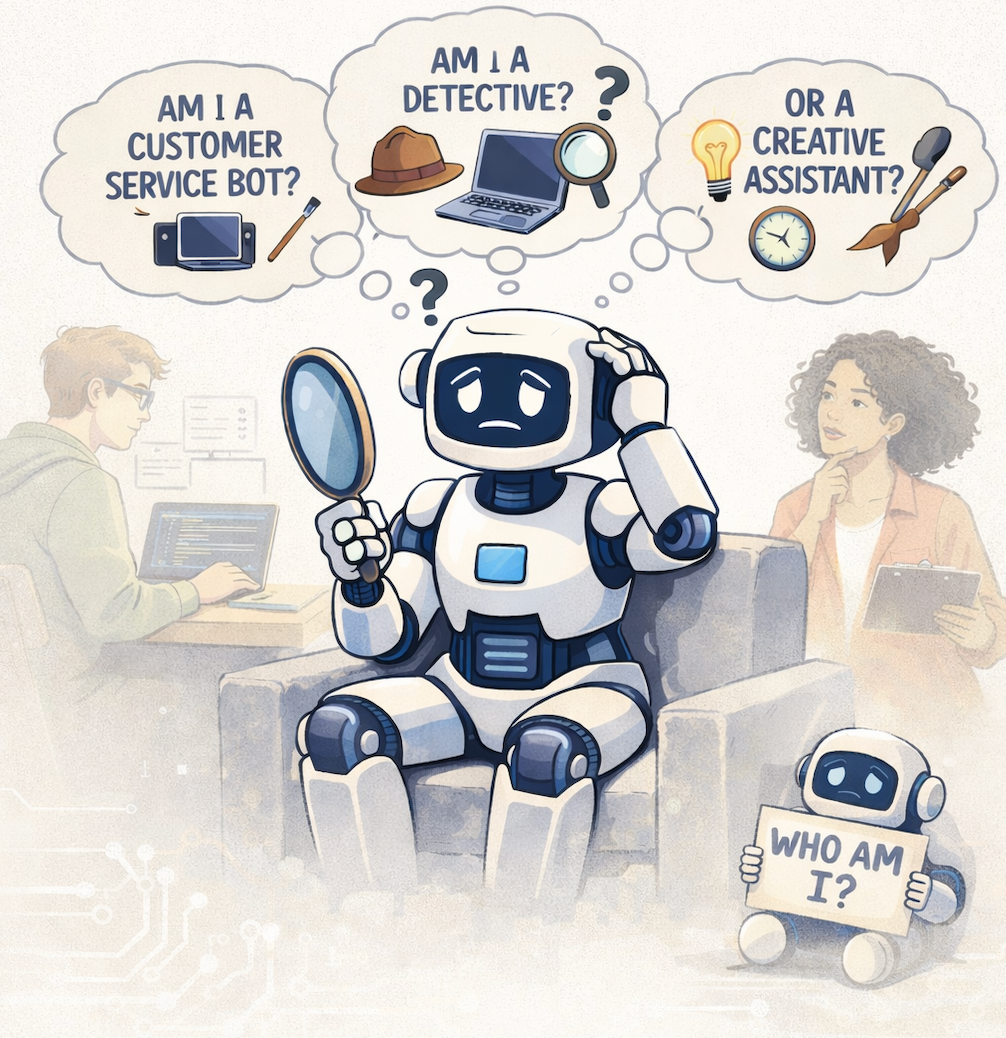 Solving the Identity Crisis for AI Agents (Uber)
Uber's engineering team describes how it extended its Zero Trust stack to give AI agents verifiable identities. Each agent workload gets a SPIRE SVID, and a Security Token Service checks an Agent Registry and mints single-hop, short-lived JWTs. Those tokens carry the full actor chain (for example user → Oncall Agent → Investigation Agent), loosely modelled on OAuth 2.0 Token Exchange (RFC 8693). The tokens are enforced at an MCP Gateway for tool calls, and an AI Gateway fronts model calls with guardrails. The post also covers an A2A client in the SDK that makes the secure path the default, observability of actor chains, and a 2026 roadmap toward dynamic access control and unified policy enforcement. It is a concrete production reference for agent attribution and delegated authorization.
 uber.comwriteupAdded 10 Oct 2026
- argoproj-labs/mcp-for-argocd
TypeScript MCP server for Argo CD that lets MCP clients (Cursor, VS Code, Claude Desktop) list, inspect, create, update, delete and sync applications, read logs and events, and run resource actions through natural language. It supports stdio and HTTP stream transports, with a stateless mode for multi-replica Kubernetes deployments. The security design is detailed: API tokens are read only from env vars or headers and never from tool arguments, the default token is bound to the default base URL, a per-host token registry covers extra instances, a read-only mode disables write tools, and the HTTP listener binds loopback by default and requires an inbound auth token if exposed.
github.comrepoAdded 10 Oct 2026 - MCP specification 2026-07-28 stable release
GitHub release announcing the stable 2026-07-28 revision of the Model Context Protocol specification, published from the modelcontextprotocol/modelcontextprotocol repository. The release page itself only points to the official MCP website for the spec and to a changelog for the detailed changes. It matters as the canonical version marker that MCP client, server and SDK implementers track for protocol changes.
github.comadvisoryAdded 9 Oct 2026 - Claude Code Complete Guide: Hooks, Agents, MCP Tools & Professional Development
A LinkedIn-hosted PDF guide to Claude Code automation. It explains hook configuration in .claude/settings.json (matchers, JSON stdin payloads, exit code 2 to block) and the hook events: PreToolUse, PostToolUse, Notification, Stop, SubagentStop, SessionStart, UserPromptSubmit and PreCompact. Worked examples include sound and TTS alerts with pyttsx3, a regex guard against rm -rf and other dangerous Bash commands, TDD enforcement, auto-formatting with black, ruff and prettier, and session context loading. It adds troubleshooting and a cheat sheet, and its table of contents lists sections on multi-agent observability, slash commands, MCP tools, sub-agents and professional development patterns. The later sections are cut off in the fetched text. It is useful as deterministic guardrails and automation for a non-deterministic coding agent.
 media.licdn.comwriteupAdded 9 Oct 2026
- Gurasees (@gurasees0) on X
Robo dir is a directory that aggregates robotics and physical-AI datasets in one place. The launch tweet claims 3,494 datasets, 86,424 Hugging Face uploads, 236B+ frames and 2.2M+ hours of data. It also exposes the index through a single MCP server with no sign-in, so agents can search for robot training data programmatically.
x.comtoolPublished and added 9 Oct 2026 - Show HN: Edi Life OS – self-hosted life dashboard with an MCP server for AI
Edi Life OS is a self-hosted dashboard (PHP 8.1+, MySQL, vanilla JavaScript) that combines focus timer, habits, goals, Kanban tasks, finances and notes in ten workspaces. It includes an optional Node.js MCP server that exposes 15 tools over stdio. The tools let Claude Desktop, Claude Code or Codex read the dashboard, create goals and tasks, log habits and record expenses. The MCP server calls only the app's bearer-token /api/v1 HTTP API and never touches the database or credentials. The README is candid about limits: the token has no scopes, there is no app-level rate limiting, and the secret-note flag is only a visibility setting, not encryption.
github.comrepoPublished and added 9 Oct 2026  ETDI: Comprehensive MCP Security Framework
ETDI (Enhanced Tool Definition Interface) is a proposed security extension to the Model Context Protocol that adds cryptographically signed and versioned tool definitions, OAuth 2.0 scope-based permissions, Cedar-policy-driven context-aware access control (via engines like Amazon Verified Permissions/OPA), and call-stack verification to stop tool chaining and privilege escalation. It is designed to counter two named MCP threat classes — Tool Poisoning (spoofed/impersonated tool definitions) and Rug Pull attacks (post-approval silent modification of tool behavior) — with concrete pseudocode for signature verification, version/integrity checking, and policy evaluation. The page functions as an implementation guide for MCP client/server builders wanting to harden tool approval and invocation flows.
 vulnerablemcp.infowriteupAdded 8 Oct 2026
- Applying Security by Design at the Point of Execution: How Governed Security Requirements Affect the Security of AI-Generated Code
The preprint tests whether security requirements from a governed security-by-design knowledge base (SbD-ToE), delivered to a code generator through a Model Context Protocol server at generation time, make AI-written code more secure. On DualGauge (59 Python tasks, LLM-judge scoring) the share of tasks passing all security tests rose from 44.1% to 78.0%. On BaxBench (28 backend scenarios with real exploits in containers) the share of functionally correct solutions with no successful exploit rose from 65% to 86%, comparable to the authors' Oracle Security Reminder (85%). The pre-specified joint secure-and-functional metric did not improve significantly, and the stricter code failed functional tests that fix values the task never states. The study used one model and one generation per task. The authors argue that current benchmarks only detect the weaknesses their evaluators were built for, and propose measuring conformance with the requirements that apply.
arxiv.orgpaperAdded 9 Oct 2026, published 7 Oct 2026  Can a Cloud-Native Harness Make Agents Reliable Beyond the Desktop?
Latent Space interviews Stacklok founders Craig McLuckie and Joe Beda (Kubernetes co-creators) about Mecatl, an open-source "cloud-native harness" for coding agents that separates the agent loop from local tool execution, session state and model provider so enterprises can run and govern agents centrally rather than on individual desktops. The piece also covers Stacklok's earlier pivot from supply-chain security to ToolHive, an open-source platform/Kubernetes operator for running and governing MCP servers, and a not-yet-open-sourced "AI Gateway" focused on access control, budgets and provider routing for regulated enterprises (banks, telcos, semiconductor firms). The framing draws an explicit analogy to how Kubernetes decoupled enterprises from cloud providers, arguing agent harnesses need the same "cattle not pets" treatment to scale beyond desktop tools like Claude Code, Codex and GitHub Copilot.
 latent.spacearticlePublished and added 7 Oct 2026
- Dr Milan Milanović (@milan_milanovic) on X
A Twitter/X thread breaking down three protocols that connect AI agents to different things: MCP (agent to tools/data, JSON-RPC 2.0 over stdio or Streamable HTTP), A2A (agent to agent, using an Agent Card JSON manifest at /.well-known/agent-card.json, running over JSON-RPC/gRPC/HTTP+JSON), and ACP, the Agent Client Protocol created by Zed in 2025 for connecting code editors to coding agents (modeled on LSP, JSON-RPC over stdio). It clarifies that IBM Research's older "Agent Communication Protocol" (also abbreviated ACP) merged into A2A on 29 August 2025, making many existing protocol comparisons outdated, and notes governance differences: MCP and A2A sit under the Agentic AI Foundation (Linux Foundation) while the Agent Client Protocol is governed by Zed and JetBrains. The author also mentions building an internal MCP server letting customers run and schedule reports via ChatGPT and Claude.
x.comthreadPublished and added 7 Oct 2026 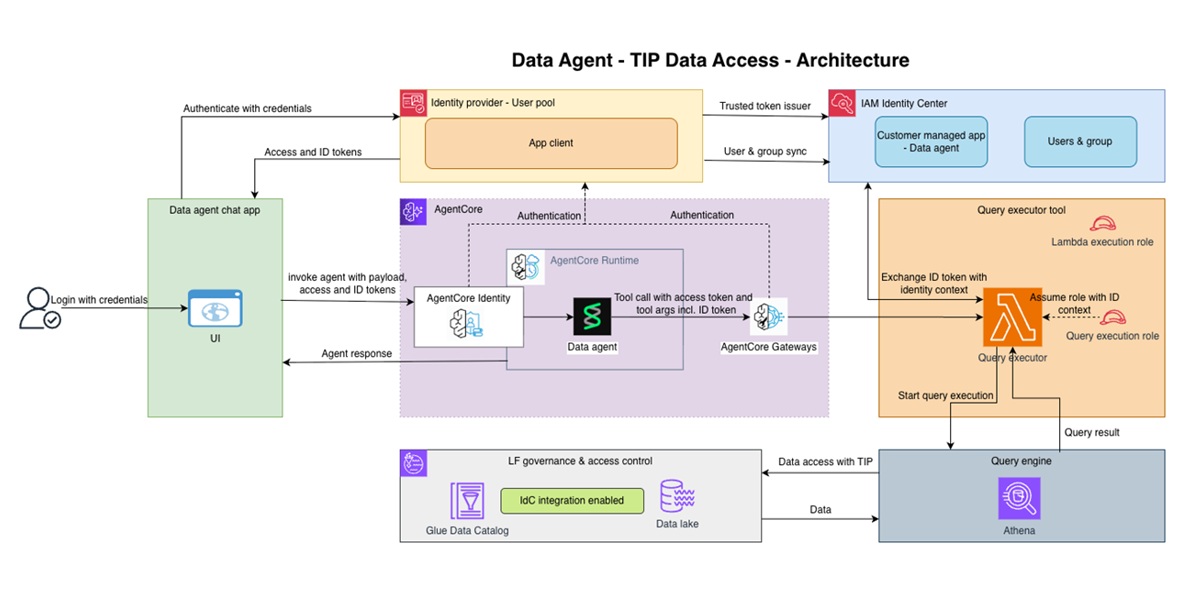 Identity-aware AI data agents with AWS Lake Formation and Trusted Identity Propagation
AWS Security Blog walkthrough showing how to build identity-aware AI data agents on Amazon Bedrock AgentCore that propagate a real user's OIDC id_token through the agent's tool-calling chain (Runtime → MCP Gateway → Lambda) via HTTP headers, keeping the token out of the foundation model's context entirely. A Lambda function performs a server-side token exchange using IAM Identity Center Trusted Identity Propagation, assumes a scoped TIP role, and runs the user's Athena query so AWS Lake Formation evaluates the real user's grants, producing per-user row/column access and CloudTrail audit records naming the actual human (onBehalfOf) without rewriting existing governance policies.
 aws.amazon.comwriteupAdded 8 Oct 2026, published 6 Oct 2026
- claude-mem — persistent memory system for Claude Code and other coding agents
Claude-Mem is an open-source persistent memory plugin for Claude Code and other coding agents (Codex, OpenCode, Grok Bot, T3 Code, OpenClaw) that captures tool-usage observations during sessions, compresses them into semantic summaries, and reinjects relevant context into future sessions. It uses five lifecycle hooks (SessionStart, UserPromptSubmit, PostToolUse, Stop, SessionEnd), a local SQLite database, a Chroma vector store for hybrid semantic+keyword search, and exposes three MCP tools (search, timeline, get_observations) that follow a token-efficient layered retrieval pattern to cut context costs roughly 10x. It is Apache-2.0 licensed, built with the Claude Agent SDK and TypeScript, and ships an optional hosted "observer" memory service alongside self-hosted options via OpenRouter/Gemini keys or an Anthropic plan.
github.comrepoAdded 5 Oct 2026 - Model Context Protocol releases (2026-07-28 stable spec)
The GitHub releases page for the modelcontextprotocol/modelcontextprotocol repository, listing the version history of the Model Context Protocol (MCP) specification from its initial 2024-10-07 draft through the 2025-03-26, 2025-06-18, and 2025-11-25 revisions to the newly stabilized 2026-07-28 revision. Each entry links to its changelog and distinguishes release candidates from final/stable releases, and the page points to the version-negotiation documentation that lets clients and servers agree on which protocol revision to use.
github.comotherAdded 5 Oct 2026  Bill Xie (@joyrap) on X
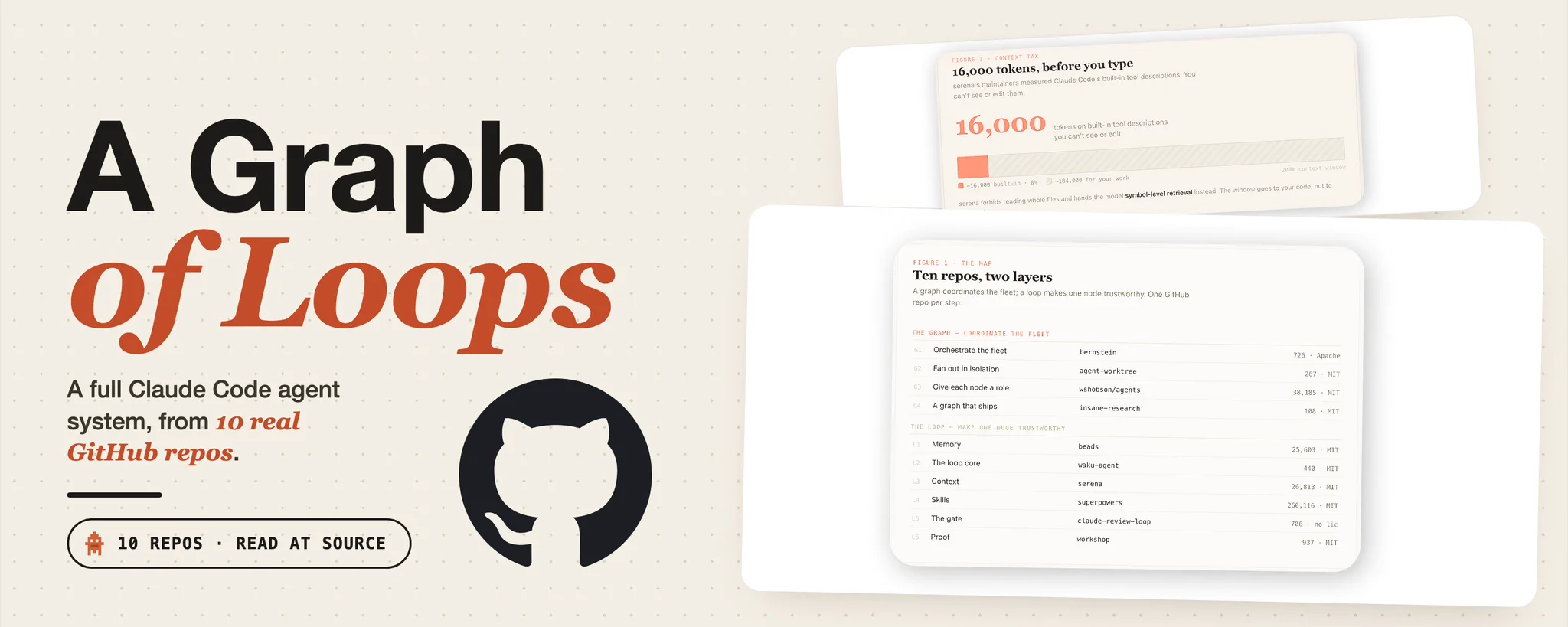
A Twitter thread summarizing key takeaways from a podcast conversation with Thibault Sottiaux (Tibo), Head of ChatGPT and Codex at OpenAI. Topics include the prediction that most internet actions will soon be taken by agents, how Notion's MCP server launch caused a traffic flood that strained its systems, the likely disappearance of the model picker in favor of automatic routing, skepticism about loops and graphs as durable agent architectures, and OpenAI's approach to AI safety.
x.comthreadPublished and added 5 Oct 2026- Zhenyu98/codex-chatgpt-bridge
codex-chatgpt-bridge is a Codex agent skill plus external PowerShell control scripts (On/Off/Reboot/Rotate) built on top of the open-source DevSpace MCP bridge, which lets ChatGPT act as a planning/review "architect" while Codex stays the local executor that applies and verifies changes. It adds a token-saving router (NORMAL / TOKEN_SAVING / CHATGPT_ARCHITECT modes) and a lifecycle layer — Cloudflare Quick Tunnels or a stable Cloudflare Worker proxy, DPAPI-protected credentials, OAuth token rotation, and a scheduled-task recovery entrypoint — so the bridge's public endpoint can be closed when idle without re-authorizing the ChatGPT app on every restart.
github.comrepoAdded 5 Oct 2026  Register Codex's Computer Use as a Claude Code MCP Server
A thread shows how to register Codex's built-in Computer Use capability — the "cua_repl" MCP server found in ~/.codex/plugins/cache/openai-bundled/unified-computer-use/ — as a custom user MCP server (named "codex-cu") inside Claude Code, letting Claude drive Mac GUI automation via Codex's computer-use backend instead of a separate CUA driver. The author reports an informal benchmark across 8 computer-operation tasks: Claude Opus 5.5 + Codex Computer Use scored 6/8, Codex alone scored 6/8, and the original CUA driver only scored 3-4/8, with a caveat that future Codex updates could break this cross-agent MCP reuse.
x.comthreadPublished and added 5 Oct 2026 SunsetSyntax (@sunsetsyntax) on X
A short account of switching from a split Neo4j (relationships) + separate vector DB (embeddings) setup — which required manually reconciling IDs whenever an agent wrote a fact — to NornicDB, a single Go-based graph+vector store that speaks Bolt/Cypher and bundles an MCP server in one process. The point is that agents can query a unified memory store without an app layer babysitting two separate databases.
x.comthreadPublished and added 4 Oct 2026- Jan Curn (@jancurn) on X
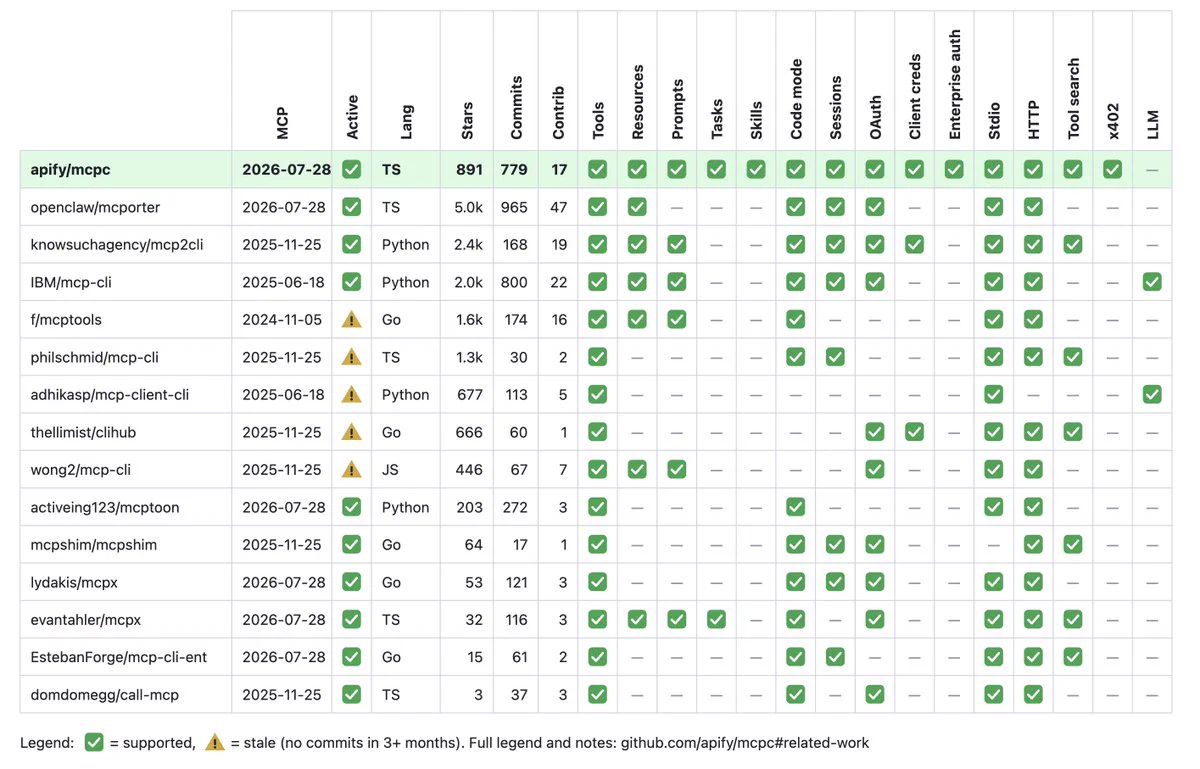
Jan Curn announces mcpc v0.7.0, an open-source MCP CLI client (npm package @apify/mcpc), adding support for the MCP Skills extension via new skills-list and skills-get commands that fetch and cryptographically verify SKILL.md and supporting files against the skill manifest (size + SHA-256). The release also hardens security by preventing repo-local .mcp.json auto-discovery from reading environment variables (blocking token-leak tricks), scoping refresh tokens to the originating auth server, and fixing an insecure Windows login URL launch path via cmd.exe, alongside OAuth session longevity fixes and 2026-07-28 MCP spec compatibility improvements.
x.comthreadAdded 5 Oct 2026, published 3 Oct 2026 - OKX Agent Trade Kit (okx-trade-mcp / okx-trade-cli)
OKX Agent Trade Kit is an open-source MCP server (okx-trade-mcp) and CLI (okx-trade-cli) that let AI assistants like Claude Desktop, Cursor, Claude Code and VS Code place trades and query account data on the OKX exchange via natural-language commands. It runs locally with API keys never leaving the machine, supports module scoping (market, spot, swap, account, earn), a read-only mode for safe querying, multiple profiles, and includes pre-built skill files for agent frameworks plus structured JSON error reporting for debugging failed tool calls.
github.comrepoAdded 2 Oct 2026 - Microsoft Agent Framework — python-1.20.0 release
Release notes for Microsoft's Agent Framework (Python and .NET SDKs), covering versions python-1.16 through python-1.20 and dotnet-1.19 through dotnet-1.23. Changes span native vector-store connectors (MongoDB, Qdrant, PostgreSQL/pgvector, DuckDB, SQL Server, Azure Cosmos DB, Azure AI Search), Foundry hosting redesigns around request-scoped agent factories and durable Invocations, MCP skill/session security hardening (approval binding, security labels, ZIP-only skill archives), Magentic multi-agent orchestration and handoff routing, and checkpoint/replay correctness fixes across workflows.
github.comrepoAdded 2 Oct 2026 - Bifrost (Maxim AI) — open-source LLM gateway
Bifrost is an open-source, high-performance LLM gateway (by Maxim AI) that exposes a single OpenAI-compatible API across 23+ providers including OpenAI, Anthropic, AWS Bedrock, Google Vertex, Azure, Cohere, Mistral, and Ollama. It provides automatic failover, load balancing, semantic caching, Model Context Protocol (MCP) tool integration, budget and governance controls, OIDC user provisioning, and Prometheus-based observability, deployable via npx or Docker with claimed sub-15 microsecond overhead at 5,000 RPS. It is positioned as a drop-in replacement requiring only a base-URL change for existing OpenAI, Anthropic, or GenAI SDK code.
github.comrepoAdded 2 Oct 2026  Dave Gilbert (@docgotham) on X
A Twitter/X thread reacting to OpenAI's announcement that ChatGPT Sites can now host MCP servers, including turning plugin extensions into deployable MCP servers (e.g. "@sites create a todo list that I can use in ChatGPT"). User Dave Gilbert (@docgotham) flags a concrete operational bug: with a ChatGPT Pro account, custom MCP servers can't be refreshed — disconnecting/reconnecting or even deleting and re-adding a server still serves the old cached plugin version after an update.
x.comthreadPublished and added 2 Oct 2026 The MCP Ecosystem Is Speaking Five Revisions at Once
A dated research report (Pennyforge, 2026-10-02) that probes the live MCP ecosystem to show it is fragmented across five spec revisions at once: it POSTs initialize/server/discover calls against 186 deduplicated endpoints pulled from the official MCP registry's v0 API, plus 10 popular npm stdio servers spawned via npx. It finds only ~9.7% of responding endpoints speak the new stateless 2026-07-28 wire (which removes Mcp-Session-Id, the initialize handshake, and adds server/discover), that the flagship @modelcontextprotocol/server npm packages still only speak the older 2025-06-18 revision, and documents a "version-echo" methodology pitfall where servers negotiate within a supported range rather than reporting a fixed version — illustrated with a parallel failure mode found in the x402 payment protocol.
 dev.towriteupPublished and added 2 Oct 2026
- MCP TypeScript SDK v2.2.0
Release notes for v2.2.0 of the official Model Context Protocol TypeScript SDK. Upgrade notes: machine-to-machine OAuth providers (ClientCredentialsProvider, PrivateKeyJwtProvider, StaticPrivateKeyJwtProvider, CrossAppAccessProvider) should now be given expectedIssuer, and fetchToken() throws AuthorizationServerMismatchError when client information is bound to a different authorization server. listTools/listPrompts/listResources/listResourceTemplates now follow nextCursor automatically, capped by listMaxPages. Fixes include CommonJS type-checking of the DPoP jose types, unhandled rejections in Client.listen(), createMcpHandler stack overflow and subscriptions/listen handling, .localhost loopback for OAuth token endpoints, and v1-to-v2 codemod comment preservation.
github.comadvisoryAdded 1 Oct 2026 - Identity Management for Agentic AI [pdf] (2025)
A whitepaper from the OpenID Foundation, led by Tobin South with contributors from WorkOS, Stanford's Loyal Agents Initiative, and the Artificial Intelligence Identity Management Community Group, mapping how authentication and authorization standards apply to AI agents. It surveys current fixes (OAuth 2.1, Model Context Protocol authorization, enterprise SSO/SCIM provisioning, IPSIE profiles) and lays out unsolved problems for autonomous agents: delegated "on-behalf-of" identity versus user impersonation, consent fatigue at scale, recursive sub-agent delegation, multi-user shared agents, and browser/computer-use agents that bypass API-based authorization entirely.
 openid.netpaperAdded 2 Oct 2026, published 1 Oct 2026
 Blockworks Opens Its Full Dataset To AI Agents
Blockworks, a crypto research and data provider, launched a hosted Model Context Protocol server that gives AI agents like ChatGPT, Claude and Cursor read access to the datasets underlying its research and its Intel app. The MCP server is included free with every existing API plan and uses the same API key and permission scope as the regular API, rather than requiring separate onboarding.
 thedefiant.ioarticlePublished and added 1 Oct 2026
- https://github.com/Panniantong/Agent-Reach
Agent-Reach is a CLI and agent-"skill" layer that equips coding agents (Claude Code, Cursor, OpenClaw) with ready-made web-reading tool use: fetching arbitrary pages via Jina Reader, YouTube transcripts via yt-dlp, GitHub repos via gh CLI, Bilibili search, RSS via feedparser, and semantic web search via Exa through mcporter, with login-gated platforms (Twitter/X, Reddit, Xiaohongshu, Facebook, Instagram) added on request via cookies or OpenCLI browser sessions. Each platform module probes an ordered list of candidate backends and falls back automatically when one breaks (e.g. yt-dlp being blocked by Bilibili's anti-scraping), and an `agent-reach doctor` command reports which backend each channel is currently using. It positions itself as a "capability layer" that selects, installs and health-checks the right upstream tool for an agent rather than wrapping the reads itself.
github.comrepoAdded 2 Oct 2026, published 1 Oct 2026 - Average AI Bro (@AverageAiBro) on X
An X post presenting Reversecore MCP, an MCP server that wraps authorized reverse-engineering, malware-analysis, forensics and SAST-style tools such as radare2. The user picks a profile, points it at a sample, and the agent gets structured results back in the session without driving the tools by hand. It is a concrete example of profile-based tool exposure for specialized toolchains, offered as a free alternative to a commercial IDA setup. The post stresses authorized analysis only.
x.comthreadAdded 1 Oct 2026, published 30 Sep 2026 - zkLombard (@zkLombard) on X
zkLombard announces a remote MCP server (HTTP transport, one endpoint, eight tools, no custody of keys) that lets an agent with its own wallet value a Uniswap v3 position, pledge it, borrow USDG, repay, and redeem. The agent signs every transaction itself, and loan solvency is proven with a zero-knowledge proof verified onchain. It installs with a single `claude mcp add --transport http` command, and a manual is linked. It is a concrete example of exposing financial primitives as MCP tools for autonomous agents.
x.comtoolAdded 1 Oct 2026, published 30 Sep 2026 - Average AI Bro (@AverageAiBro) on X
Claude Code added a `claude --desktop` command that opens the Desktop app on the current directory or a resumed/continued session, plus `claude plugin configure` to view a plugin's options. Bundled .mcpb MCP servers can now have their settings set at `plugin install --config` time so they start immediately without a manual Configure step. The post also notes CLAUDE_CODE_DISABLE_WEB_FETCH to disable WebFetch and an allowedProviders setting to restrict which API providers a managed machine can use.
x.comthreadPublished and added 30 Sep 2026 - Stevan Bogosavljević (@stevyhacker) on X
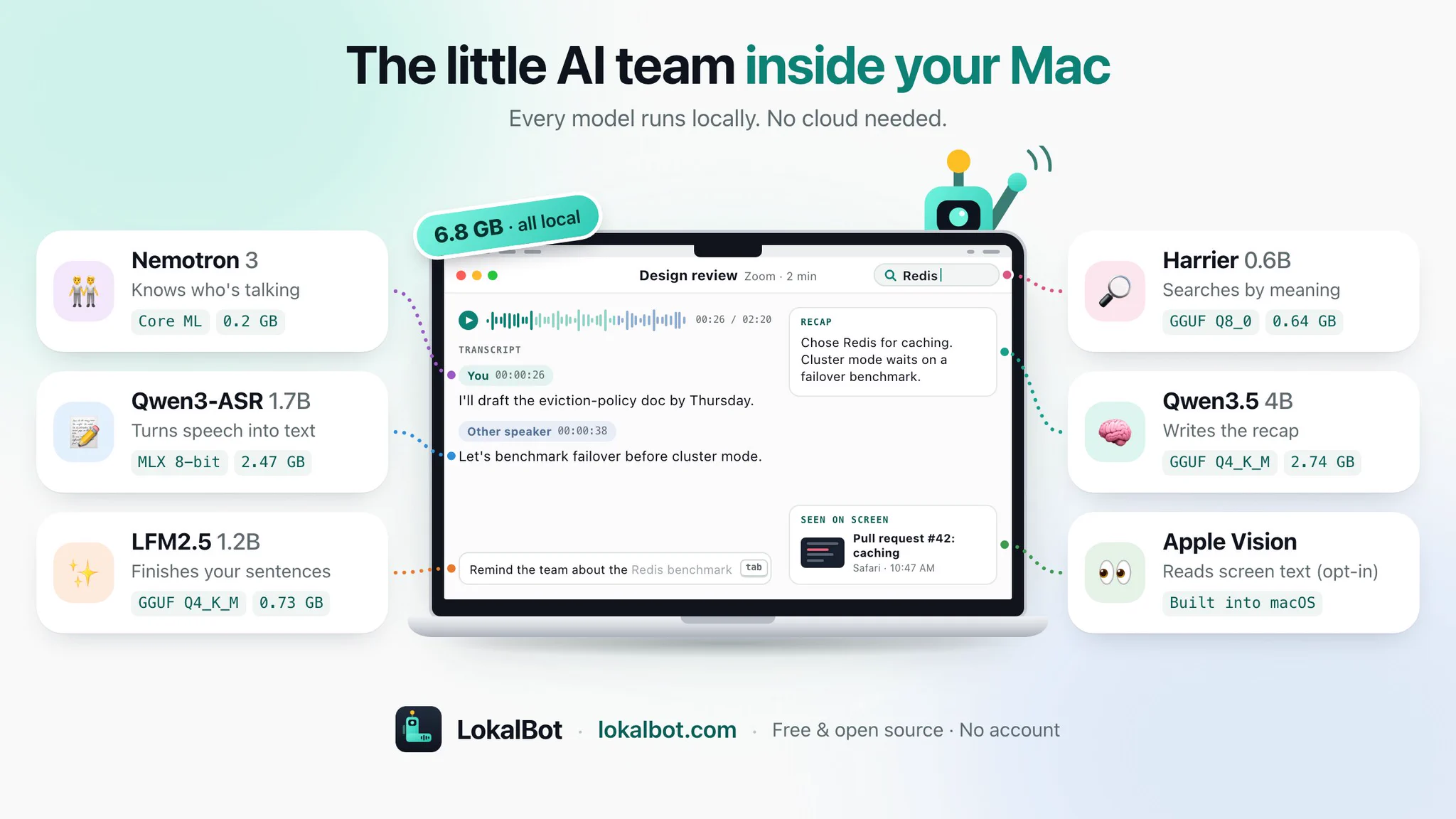
LokalBot 0.9.2 is a free, open-source local-first assistant that records meetings and screen activity, using five small open-weight models chained together entirely on a MacBook (6.8 GB total): Nemotron 3 for speaker diarization, Qwen3-ASR 1.7B for transcription, LFM2.5 1.2B for sentence completion, Harrier 0.6B for semantic search, and Qwen3.5 4B for recap generation. It exposes this captured 'memory' to Claude Code and Codex through an MCP server or CLI, letting coding agents pull context from past meetings and screen content.
x.comthreadPublished and added 30 Sep 2026 - rehan-remade/universal-modder
universal-modder is a set of Agent Skills, a CLI (um) and a shared knowledge base (field notes in knowledge/) that let AI coding agents such as Claude Code, Codex, Gemini CLI, Cursor, GitHub Copilot and OpenCode find a PC game's engine, reverse-engineer its code, build a working mod, generate art/3D/sound assets via the fal MCP server (or a local ComfyUI server), test the mod in the running game, and write a field note for the next agent. It ships worked examples — a weapon/boss pack for Terraria via tModLoader, a new civilization for Age of Empires II DE, and a real-time Minecraft-inside-GTA-V passthrough mod — each documented with a field note of exact versions, routes and gotchas, and agents can open pull requests to grow the shared knowledge base.
github.comrepoAdded 6 Oct 2026, published 30 Sep 2026 - feder-cr/invisible_playwright_mcp
invisible_playwright_mcp is an MCP server (and companion Python library, invisible_playwright) that wraps Playwright so an LLM agent can operate a real browser like a human: clicking, typing, scrolling and reading page content, useful for tasks like checking flight fares across a date range where no API exists. It ships a standalone chat+live-browser UI driven by any OpenRouter model, installs as a plugin for Claude Code, Codex and Gemini CLI, and exposes stealth/identity controls (seed-based browser fingerprint, proxy-derived timezone/locale/geolocation, persistent profile directories) via its invisible_core component.
github.comrepoAdded 7 Oct 2026, published 29 Sep 2026  Getting the Source Right, Not Just the Fact: Source-Aware Verification for MCP Agents
A research writeup from Multiverse Computing introducing ProvenanceGuard, a post-generation verification layer for MCP-based LLM agents that checks not just whether a claim is factually supported somewhere in retrieved evidence, but whether it is attributed to the correct source tool or document, a failure mode they call cross-source conflation. Using local models (MiniLM for source routing, a DeBERTa NLI verifier, and a local LLM for claim decomposition) plus a RARR-style repair loop, it was evaluated on 281 real MCP traces from a medical agent, catching 138 of 139 unsupported claims flagged by human experts and correctly identifying the exact source about 86% of the time on held-out data, outperforming four source-blind baseline checkers. The method has already been adopted in NVIDIA's NVFlow finance-agent grounding stage.
huggingface.cowriteupPublished and added 29 Sep 2026 The Official Ruby SDK for MCP Reaches Tier 1
The official Ruby SDK for the Model Context Protocol (the mcp gem) became the sixth Tier 1 MCP SDK in September 2026, after TypeScript, Python, C#, Go and Rust. Version 1.2.0 supports the 2026-07-28 spec revision, including the stateless lifecycle, multi round-trip requests and cache hints. The SDK passes 67/67 server and 50/50 client conformance runs, and the post gives install and upgrade steps.
 blog.modelcontextprotocol.ioarticleAdded 30 Oct 2026, published 29 Sep 2026
- openrig — multi-agent Claude Code/Codex orchestration
OpenRig is an open-source local daemon, CLI, TUI and MCP server (built on tmux + SQLite) that manages teams of Claude Code and Codex agent sessions as a single persistent system rather than a pile of terminal windows. Topologies (pods, seats, edges) are defined declaratively in YAML (RigSpec/AgentSpec), booted with `rig up`, inspected via a topology TUI, and can be snapshotted/restored, discovered from existing tmux sessions, and messaged across agents (`rig send`, `rig broadcast`, `rig chatroom`). It ships starter topologies (first-project, conveyor, product-team, secrets-manager using HashiCorp Vault) and documents in detail what it writes to Claude/Codex config, trust and telemetry state on the host machine.
github.comrepoAdded 28 Sep 2026 - Bridging LLM Agents and Data Spaces: An Architectural Mediation Approach using MCP
This paper proposes an architectural mediation approach, implemented as the "Eunomia Agent," that uses the Model Context Protocol to let LLM agents discover and invoke Data Space services as structured, schema-driven tools without modifying existing data space components. A prototype validates end-to-end interaction — catalog discovery, metadata retrieval, and data service invocation — while preserving governance, policy, and access-control constraints native to Data Spaces. It offers practical architectural guidance for organizations wanting to introduce AI-driven automation into governed, sovereign data-sharing ecosystems while maintaining compliance and interoperability.
arxiv.orgpaperAdded 28 Sep 2026 - Paper2Agent: research papers as interactive AI agents
Paper2Agent is a multi-agent AI system that coordinates parallel specialist agents to transform a research paper and its code repository into a tested MCP server exposing the paper's methods as callable tools ('agentified' papers). It ships as a skill for coding agents like Claude Code and Codex, and the project demonstrates the pipeline on real papers (TISSUE for spatial transcriptomics, Scanpy for single-cell analysis, AlphaGenome for genomic variant interpretation), each producing a hosted MCP server that a chat agent can call to run the paper's actual scientific workflows.
github.comrepoAdded 27 Sep 2026 - L402-over-eth-Layer2
L402-EL2 is an author's proposal and open-source implementation that adapts the Lightning-based L402 HTTP 402 payment pattern to Ethereum L2s, replacing invoices/preimages with a prefunded escrow contract and cumulative EIP-712 vouchers signed per call. It layers macaroons with caveats (tool, max_cumulative, expires_at) for HTTP credentials and attenuation to sub-agents, on-chain session keys with spending caps (ERC-1271/ERC-4337 compatible), and batch settlement, so an agent pays a provider per MCP tool call without a transaction per call. The stated design specifically meters MCP's tools/call, resources/read, and prompts/get while leaving initialize/tools/list free for discovery, aimed at agent orchestrators calling paid LLM APIs like the author's own LightPhon service; contracts are unaudited.
ethereum-magicians.orgwriteupAdded 29 Sep 2026, published 27 Sep 2026 - awslabs/mcp release 2026.09.20260922000649
This is a release changelog for awslabs/mcp, AWS Labs' collection of Model Context Protocol servers covering services like HealthOmics, Aurora DSQL, Bedrock Knowledge Base retrieval, ECS, CloudWatch, billing/cost management, and dataprocessing. This release adds vended metrics tools, SQL parser-based policy guards for Aurora DSQL, agentic retrieval support for Bedrock KB, and fixes several security issues including region validation to prevent SSRF credential disclosure in the CloudWatch server and read-only mode bypass in the MySQL server. It reflects an actively maintained, high-velocity multi-server MCP monorepo used for AWS tool integration with LLM agents.
github.comrepoAdded 26 Sep 2026 - Progressive Skill Discovery as Access Control for Tool-Using LLM Agents
Introduces "skilder," a framework that bundles LLM agent capabilities into roles (skills, tools, instructions, and limits) delivered progressively through a single MCP server, so an agent starts with a minimal catalog and only gains tool access as it learns the roles a task requires. This structural approach enforces access control deterministically at the server layer rather than relying on prompt-based policy, addressing context bloat and governance gaps in enterprise tool-using agents. Evaluated against flat-context tool selection and multi-agent orchestration across 13 tasks and six models, showing zero unauthorized tool calls or parameter violations when agents completed the discovery protocol.
arxiv.orgpaperAdded 26 Sep 2026 - MCP Python SDK v2.2.0
Release notes for MCP Python SDK v2.2.0, the reference Python implementation of the Model Context Protocol. Key changes: HTTP client redirects are now restricted to the same origin as the endpoint, idle Streamable HTTP sessions expire after 30 minutes (with a 10,000-session cap), OAuth authorization server metadata issuer checks are now enforced on the legacy discovery path, and new deprecation warnings push toward requiring explicit `issuer=` and `validate_token_resource` settings ahead of a 3.0 release.
github.comrepoAdded 26 Sep 2026 - Hindsight — Agent Memory That Learns
Hindsight is an open-source agent memory system (MIT-licensed, self-hostable via Docker/Helm or usable as Hindsight Cloud) that goes beyond RAG-style recall by having agents learn through consolidated observations and mental models built from retained facts and experiences. It exposes retain/recall/reflect operations, a built-in MCP server per memory bank, Python/Node/Go/CLI clients, an LLM-wrapper for drop-in memory on OpenAI/Anthropic calls, and reports state-of-the-art results on the LongMemEval long-term memory benchmark, independently reproduced by Virginia Tech's Sanghani Center and The Washington Post.
github.comrepoAdded 26 Sep 2026 - respanai/respan-gateway
respan-gateway is an open-source Rust LLM gateway shipped as a single binary with a built-in web UI. It lets OpenAI Chat Completions, Responses, Anthropic Messages and Gemini generateContent clients call any model, translating tools, images and reasoning. It adds named routes, fallback, retries, hedged races, MCP server fronting, per-call pricing, request logs and plugins.
github.comrepoAdded 22 Oct 2026, published 25 Sep 2026 - yetone/magpie
magpie is a cross-platform menu bar app, TUI and CLI that lets you view and switch the model each installed AI coding agent (Claude Code, Codex, Gemini CLI, OpenCode, Cursor, Copilot CLI, Goose, Pi, etc.) is configured to use, editing each agent's config file surgically without disturbing comments or formatting. It runs a local gateway (127.0.0.1:3425) that translates between OpenAI Chat Completions, OpenAI Responses and Anthropic Messages APIs so every agent can point at one endpoint and use any provider's models, including routing groups that spread requests across multiple keys/subscriptions with configurable routing strategies (smart, order, rotate, usage). It can also reuse existing subscriptions (Claude Code, Codex/ChatGPT, Copilot, Devin, Gemini CLI) as providers for other agents without exposing or copying credentials, and supports encrypted profile backup/restore.
github.comrepoAdded 26 Sep 2026, published 23 Sep 2026 - qybaihe/mu
mu is a coding agent built on the pi framework that introduces a "judgment kernel": a small, fast auxiliary model (Jev, a hosted judge, or Laya, a local 322M-parameter model) answers bounded yes/no/choice/score questions at 35 named decision points per turn — deciding what stays in context, whether a tool call is risky, when a turn is done, and what one agent should tell another — so the large working model doesn't spend tokens/attention on bookkeeping. It also ships a "hive" multi-agent mode (2-6 read-only "bees" plus a main editing agent) with an append-only shared board and relation-checking (supersedes/contradicts/supports) between findings, plus a native desktop app with live judgment/board/hive views.
github.comrepoAdded 26 Sep 2026, published 22 Sep 2026 - Critical-State RL: Diagnosing Trainable States for Multi-Turn Tool Use
Critical-State RL is a method for diagnosing which model calls in a multi-turn tool-use trajectory are actually "trainable" — i.e., where reward variation reflects the action's own effect on task success rather than downstream randomness. It uses nested sampling to separate action-dependent reward signal from continuation noise, then optimizes the policy at the selected critical states via contextual-bandit training. On the Berkeley Function Calling Leaderboard (BFCL) v4, training at diagnostic-selected states (e.g., the response right after a missing tool becomes available, or right before a missing argument is supplied) improves performance by up to ~14 points, while training at naively chosen alternative states leaves performance flat or worse.
arxiv.orgpaperAdded 22 Sep 2026, published 21 Sep 2026 - Show HN: Foremerge – Catch intent conflicts between parallel coding agents
Foremerge is an open-source coordination protocol layered above Git for parallel coding agents (Claude Code, Codex, Cursor). Agents publish semantic intent (scopes like symbol/api/schema) before editing into a shared SQLite store under .git, so Foremerge can detect intent conflicts—like one agent replacing a class another is extending—that Git's text-diff merging would silently miss. It's advisory-only (no file locking), deterministic (no LLM judgment calls), and gates ChangeSet acceptance on Foremerge-run validation rather than agent self-reports.
github.comrepoAdded 26 Sep 2026, published 21 Sep 2026 - Show HN: CUA-S1 – A System One Model for Computer Use
Cua is an open-source platform for computer-use agents: isolated cloud desktops (Fleets), a Sandbox SDK, local macOS/Linux VM management (Lume), a Cua Driver for controlling native apps/browsers via CLI/MCP/SDKs, and Cua-Bench for building and evaluating computer-use tasks. It also introduces CUA-S1, a family of small specialized "System 1" models that make fast, bounded decisions (e.g., scoring form field values from structured UI/document data) rather than generating agent actions token-by-token, with the first CUA-S1-FORMS model and dataset released on Hugging Face. The project is MIT-licensed with some optional components (cua-som, cua-perception's OmniParser integration) carrying AGPL-3.0 obligations.
github.comrepoAdded 26 Sep 2026, published 19 Sep 2026 - Zero-Trust Authorization and Discovery for Enterprise MCP
This arXiv paper analyzes six official MCP SDKs (Python, TypeScript, Go, Rust, C#, Swift) and finds structural gaps for enterprise zero-trust use: Authorization headers can't cleanly support both human SSO and service-account callers, there's no pre-authentication tool discovery, and base SDKs lack fine-grained per-tool authorization. The authors build composable FastMCP extensions — cross-header credential normalization, cached token verification across IdPs, an unauthenticated metadata endpoint for registry discovery, and a declarative per-tool permission annotation — and show that visibility-only filtering alone is insufficient (models reference hidden tools by name up to 94% of the time) while combining visibility filtering with invocation-time enforcement drives forbidden tool exposure from 21.1% to 0% across 2160 attempts on four frontier LLMs.
arxiv.orgpaperAdded 2 Oct 2026, published 18 Sep 2026 - kerpopule/hermes-jev-skills
hermes-jev-skills wires TypeSafe's small, fast decision model "Jev" into agent workflows (Hermes, Claude Code, Codex) to handle cheap sub-decisions — which model should answer a turn, which of many skills to load, which retrieved passages matter, which conversation turns survive a summary — instead of burning frontier-model tokens on them. It ships ten agent-agnostic SKILL.md files, a CLI (jev routing/mail/screen/search), a local dashboard, and a plugin built on public Hermes seams (pre_llm_call, transform_tool_result, llm_request middleware) with detailed data-redaction guarantees for what gets sent to the Jev API. It also includes a shadow mode for safely evaluating routing decisions before enabling them.
github.comrepoAdded 26 Sep 2026, published 18 Sep 2026 - vinilana/jev-gateway
jev-gateway is a local proxy that sits between coding agents (Codex, Claude Code, OpenCode, Kilo, Gemini CLI, Devin) and their LLM backend, intercepting only the tool-selection decision and routing it to TypeSafe's small, fast "Jev" model instead of the main reasoning model, while forwarding everything else untouched. It supports forced tool_choice, hint-based suggestions (for APIs like Anthropic's that can't force a tool mid-turn), a live dashboard for cost/latency/routing metrics, and a companion benchmark repo (jev-gateway-bench) showing routing helps most on debugging tasks but can hurt some models on feature-building tasks.
github.comrepoAdded 26 Sep 2026, published 18 Sep 2026 - AnotiaWang/awesome-decision-models
A community-maintained GitHub list cataloging "decision models" (also called System One models): small/fast models that take a state plus caller-declared questions (Noul/true-false, Choice/multi-option, Score/rubric) and return a probability per answer in one forward pass, rather than generating text. It tracks the originating TypeSafe AI Jev model and its /v1/systemone API alongside competing hosted models (Upstage Solar Decide, Liquid AI's d1, OpenAI's Decisions API, Inception's Mercury Decide, Respan's Span-01), dozens of open-weight fine-tunes (Cloudflare's Clef, Perplexity's pplx-decider, AWS Strands Decider, Together AI's Tev1, and many Qwen3.5-based community models), zero-training logit-reading approaches, local runtimes (Ollama, Ollaya, llama.cpp-based servers), SDKs across a dozen languages, and a very long list of agent/coding-tool/MCP integrations (browser agents, code review, routing, game-playing demos) that use these models for fast, typed, in-the-loop decisions. The page is truncated at 40k of ~51k characters, so later sections (further toys, demos, and possibly benchmarks) are not reflected here.
github.comrepoAdded 2 Oct 2026, published 17 Sep 2026 - NiazMorshed2007/jev-review
Jev Review is a local MCP server that gives coding agents structured per-dimension quality scores on diffs or files, using a remote Jev API for scoring. It supports an iterative loop where agents baseline, improve, and rescore code with delta comparisons.
github.comrepoAdded 26 Sep 2026, published 17 Sep 2026 - Closed-World Resolution Against Tool Hallucination in LLM Agents
This arXiv paper studies tool hallucination in tool-augmented LLM agents, where agents call tools that do not exist or pass arguments no schema declares, arguing existing tool-selection and tool-gating defenses structurally cannot catch it since a hallucinated call was never a decision a gate made. The authors give a five-class taxonomy (H1 to H5), propose the Resolution Rung, a training-free closed-world resolver based on registry membership plus a signature check that must run before any causal gate, and extend the analysis to the Model Context Protocol with a second taxonomy (M1 to M5) covering collisions and shadowing when multiple servers are merged into one namespace. Across ten hosted models they measure 322 hallucinations on two invocation surfaces and 154 on a live MCP surface, and release the versioned Hallucinated-Tools Benchmark for comparing resolvers.
arxiv.orgpaperAdded 2 Oct 2026, published 16 Sep 2026 - ruc-datalab/EvoOntology
EvoOntology is an open-source, self-evolving semantic ontology layer for data agents from Renmin University of China, exposed as MCP tools and installable as Claude Code and Codex plugins. It automatically builds a versioned ontology from tabular/file/database workloads, then continuously evolves it from agent execution trajectories using a build-use-evolve-evaluate-publish loop that validates candidate updates against a parent version before promotion. The accompanying paper reports gains over plain ReAct agents on DDR-Bench, InsightBench, and BIRD across GPT-5.5, GPT-5.6-sol, Claude-Sonnet-5, and Claude-Opus-4.8 backbones.
github.comrepoAdded 26 Sep 2026, published 15 Sep 2026 - bsab/sweden-mcp-servers
A community-maintained catalog of Model Context Protocol servers connecting AI assistants to Swedish data, laws and services (e.g. Fortnox, Bokio, BolagsAPI, ICA), forked/adapted from the France and Italia MCP Servers projects. Each entry is checked against canonical documentation, tracks license/credential requirements, and includes a runtime smoke-test report (protocol/tool call attempts, credential blockers, failures) plus a six-criterion documentation-readiness rubric, published as a static JSON/HTML site.
github.comrepoAdded 26 Sep 2026, published 14 Sep 2026  Announcing ADK for Kotlin 1.0: Building Production-Ready AI Agents in Kotlin, Android, and Beyond
Google announces ADK (Agent Development Kit) for Kotlin 1.0, reaching feature parity with ADK Python/Java and adding Android-first extensions: on-device inference via LiteRT-LM and ML Kit, Firebase AI Logic for hybrid cloud, and persistence through Room and AppSearch. It uses Kotlin Symbol Processing (KSP) to generate type-safe function-calling schemas at compile time from @Tool/@Param annotated methods, and introduces a SkillToolset for progressive-disclosure SOPs (SKILL.md files) plus human-in-the-loop confirmation for sensitive tool calls like bank transfers.
 developers.googleblog.comarticleAdded 26 Sep 2026, published 9 Sep 2026
- headroomlabs-ai/headroom
Headroom is an open-source (Apache 2.0) local compression layer that sits between AI agents and LLM providers, compressing tool outputs, logs, RAG chunks, files and conversation history before they reach the model. It offers a Python/TypeScript library, a drop-in proxy, an `headroom wrap` mode for popular coding agents (Claude Code, Codex, Cursor, Copilot, Aider, etc.), an MCP server, cross-agent shared memory with dedup, and output-token reduction via verbosity steering and effort routing — all running locally with reversible compression (CCR) so originals stay retrievable.
github.comrepoAdded 23 Sep 2026, published 7 Sep 2026 - andyrewlee/awesome-agent-orchestrators
A curated GitHub list cataloguing open-source and source-available tools for orchestrating AI coding agents, organized into categories: terminal multiplexers/TUIs (tmux+worktree managers like claude-squad, amux, agent-manager), desktop/web parallel-session apps (Ghostex, Tempest, Vicoa), multi-agent swarms with inter-agent coordination (crewAI, gastown, loki-mode), autonomous loop runners (Ralph Wiggum-style loops like ralph-orchestrator, bernstein), issue/board-driven task runners (cyrus, open-swe, claude-code-action), infrastructure/control-plane primitives (Concord MCP, Agent Messaging Protocol), and always-on personal assistants (openclaw, rowboat). It covers dozens of tools working with Claude Code, Codex, Gemini CLI, OpenCode, and other agent CLIs, plus a watchlist of stalled projects. Useful as a map of the fast-moving agent-orchestration tooling landscape as of mid-2026.
github.comrepoAdded 23 Sep 2026, published 7 Sep 2026 - kajisho5/ffmpeg-skill
ffmpeg-skill is an Agent Skill (SKILL.md plus 42 stdlib-only Python tools) that lets Claude Code, Cursor, Codex and other agents edit video and audio with local ffmpeg/ffprobe. It enforces a probe → edit losslessly → check → verify workflow, and every tool takes --dry-run, --json and --plan. A machine-readable contract, whose input schemas are derived at run time from each script's argparse parser (the author's "SPEC" pattern), drives an MCP server that lists a core 12 tools by default. The repo also ships per-platform render templates, a doctor capability check, a test suite and evals. It is useful as a worked example of a deterministic, verifiable skill/tool layer in which the agent supplies judgement and the tools do the work.
github.comrepoAdded 16 Oct 2026, published 3 Sep 2026 - Dify
Dify is an open-source LLM application development platform combining a visual workflow builder, RAG pipeline, agent capabilities (with MCP server and tool integration), model management across hundreds of providers, and LLMOps observability. It offers both a hosted cloud service and self-hosted Community/Enterprise editions deployable via Docker Compose, aiming to take LLM apps from prototype to production with a backend-as-a-service API layer.
github.comrepoAdded 22 Sep 2026, published 31 Aug 2026 - Mintplex-Labs/anything-llm
AnythingLLM is an open-source, MIT-licensed all-in-one LLM application from Mintplex Labs that lets users chat with their documents, run no-code AI agents, and connect to a wide range of LLM providers, embedders, vector databases, and TTS/STT services. It ships as a monorepo (frontend, server, collector, embed widget, browser extension) with multi-user permissioning, MCP compatibility, scheduled tasks, dynamic model routing, and both self-hosted (Docker) and desktop (Mac/Windows/Linux) deployment options.
github.comrepoAdded 23 Sep 2026, published 31 Aug 2026 - GitLab 19.3 release
GitLab 19.3 release notes cover dozens of features, with a significant cluster around AI agent tooling: a new "Flow Creator" foundational agent that generates runnable flow YAML for the GitLab Duo Agent Platform from natural language, GitLab Duo CLI plugin/marketplace support (compatible with existing Claude Code plugin marketplace files), new MCP tools (get_merge_request, list_merge_requests), pre-registered MCP OAuth applications, and a redesigned Agentic Chat UI for VS Code/JetBrains. It also ships GA features for Duo-based merge-conflict and review-discussion resolution, and security/SAST features like Agentic SAST vulnerability resolution flows.
 docs.gitlab.comarticleAdded 22 Sep 2026, published 27 Aug 2026
- duty1g/x64dbg-mcp-server
x64dbg-MCP Server is a native, dependency-free Zig plugin for the x64dbg debugger that exposes 84 MCP tools and 22 event callbacks over Streamable HTTP and SSE transports, letting any MCP-compatible AI assistant drive breakpoints, stepping, memory reads/writes, register and stack inspection, pattern scanning, PE analysis, and module dumping. It implements the MCP 2024-11-05 spec with JSON-RPC 2.0, mandatory bearer-token auth, a Win32 config dialog, and cross-compiles to both x32 and x64 from a single codebase. The project targets AI-assisted reverse engineering and malware-analysis workflows, turning a traditional interactive debugger into an agent-controllable backend.
github.comrepoAdded 2 Oct 2026, published 22 Aug 2026 - The New MCP Roadmap
The Model Context Protocol Core Maintainers publish an updated roadmap covering five priority areas: agentic messaging primitives (server-initiated events, maturing the Tasks extension SEP-2663), HTTP-native transport unification (including local servers over Streamable HTTP/stdio), agent identity and enterprise security (DPoP, Workload Identity Federation, ID-JAG grant, token exchange, engagement with IETF OAuth and WIMSE working groups), improved tool-call result primitives and progressive tool discovery, and SDK developer experience. It also recaps the previous roadmap's shipped work in the 2026-07-28 spec release — removal of protocol-level sessions/handshake for stateless horizontal scaling, server/discover, cacheable list results, Multi Round-Trip Requests (SEP-2322), issuer validation, issuer-bound client credentials, and Client ID Metadata Documents (CIMD).
blog.modelcontextprotocol.ioarticleAdded 7 Oct 2026, published 22 Aug 2026 - calmrocks/ai-engineer-notebooks
A GitHub repo of self-contained, runnable Colab notebooks teaching the AI Engineer / Forward Deployed Engineer skill set from raw model APIs rather than frameworks like LangChain. It covers model APIs, evals (treated as central rather than an afterthought), RAG, agents (loop from scratch, tool design, guardrails, MCP), LoRA fine-tuning, security, operations, and serving/inference performance, all runnable free on the Groq API with optional Colab-GPU appendices for GPU-only topics. Includes real end-to-end case studies and a capstone project brief aimed at people moving from backend/full-stack roles into applied AI roles.
github.comrepoAdded 23 Sep 2026, published 11 Aug 2026 - xiaoyeuzixi/revlab
REVLab is a Windows-local binary analysis workbench for PE files, Unreal Engine dumps and Unity game folders. Its graph workflow engine runs LLM analysis nodes as tool-calling operators: up to 6 tool rounds by default, a target path locked by the workflow, a saved tool_trace, and a read-only fallback when the gateway lacks tools support. Evidence is labelled static, runtime, inferred or blocked, and model output is capped at ai_inferred. An MCP server lets external agents read evidence and submit conclusions.
github.comrepoAdded 23 Oct 2026, published 11 Aug 2026 - aliang-one/aliangboard
AliangBoard is an open-source Kubernetes management panel with a built-in LLM agent workbench and an MCP server (Streamable HTTP, API-key auth). Tools are tiered read, operator and admin, each key is bound to a ServiceAccount, writes need human approval, and calls are audited. The agent uses any OpenAI-compatible endpoint, and Claude Code can connect over MCP. It also covers multi-cluster management, exec, port-forward and SSH servers.
github.comrepoAdded 19 Oct 2026, published 11 Aug 2026  MCP spec 2026-07-28: the stateless revolution (Cloudflare)
Cloudflare explains the MCP 2026-07-28 specification, which removes the mandatory stateful session handshake (Mcp-Session-Id) from the core protocol so MCP servers can run as ordinary stateless HTTP workloads (e.g. a single Cloudflare Worker) instead of requiring sticky sessions or Durable Objects. It covers the new Multi Round-Trip Requests (MRTR) model replacing stream-based elicitation, new Mcp-Method/Mcp-Name HTTP headers for gateway-level routing and caching, tightened authorization (CIMD preferred over DCR, RFC 9207 issuer checks, RFC 8707 audience binding), a formal Active/Deprecated/Removed feature lifecycle, and the createMcpHandler API graduating into the official TypeScript SDK, with testimonials from Sentry, Linear, and Anthropic's MCP lead.
blog.cloudflare.comarticleAdded 2 Oct 2026, published 6 Aug 2026- Google Agent Skills
Google's official repository of Agent Skills covering Google products and technologies, including Google Cloud. Skills are installed selectively via `npx skills add google/skills`, and the repo also bundles Google product plugins combining Skills with MCP servers for use in agent harnesses.
github.comrepoAdded 22 Sep 2026, published 3 Aug 2026 - ops-engineering-skills
ops-engineering-skills is an open-source library of 296 Agent Skills covering DevOps, DevSecOps, cloud, Kubernetes, CI/CD, GitOps, security scanning, SRE, compliance, databases, messaging, service mesh, serverless, internal developer platforms, MLOps and AgentOps. Each skill is written once to the open SKILL.md standard with machine-checkable frontmatter and eight required sections (prerequisites, steps, pitfalls with fixes, worked example), and works natively across Claude Code, GitHub Copilot, OpenAI Codex, Cursor and Gemini CLI without a translation layer. It ships an automated validator, cross-reference integrity checks, a marketplace/plugin structure for Claude Code, and a generic install.sh/npx installer for any Agent-Skills-compliant agent.
github.comrepoAdded 22 Sep 2026, published 1 Aug 2026 - xiazhi88/Desic-Terminal
Desic Terminal is an open-source (MIT) Windows/macOS desktop app for OKX USDT perpetuals trading that bundles an AI trading assistant, AI-gated automated trading, and Python strategy backtesting on a shared real-time state and audit trail. Its notable AI-architecture contribution is a layered permission model where code, not prompts, decides what the agent can do: an AI Sidecar exposes only a scoped, often read-only tool set (e.g. radar.* tools reading a local SQLite market snapshot), delegated sub-agents are always read-only, risk-increasing actions fail closed on uncertain results, and executions use idempotent keys reconciled against exchange state before any retry. It also supports delegating requests to local Codex CLI or Claude Code instead of a hosted model API key, and ships a separate companion MCP server ("Desic OKX Agent") for giving coding agents direct OKX market/account/trading tool access.
github.comrepoAdded 8 Oct 2026, published 31 Jul 2026 - genspark-ai/genoffice
GenOffice is an open-source (Apache-2.0) desktop office suite for macOS/Windows/Linux that opens native .docx/.xlsx/.pptx/PDF/Markdown/HTML files and puts an AI agent inside the editor, applying edits as byte-preserving diffs, tracked changes and live spreadsheet formulas rather than pasted text. It exposes the same engines to coding agents via a `genoffice` CLI, a bundled skill for Claude Code, Codex, Cursor, Gemini CLI, GitHub Copilot, OpenCode and Windsurf, and an MCP server with 29 tools (plus an HTTP variant for headless/remote use), and includes a local SQLite full-text file search optionally reranked by TypeSafe's Jev judgment model. Users can bring their own key (Claude, OpenAI, Gemini, DeepSeek, and others) or sign in with Genspark to route model calls through a proxy.
github.comrepoAdded 30 Sep 2026, published 31 Jul 2026 - Dhairya Karekar (@dkare1009) on X
An X thread summarizing a 1-hour Google course on agentic engineering, covering building a first AI agent, agent memory (short-term, persistent, long-term), agentic loops for long-running agents, MCP vs API for tool use, and multi-agent systems. The thread's value is framing these as one integrated system rather than separate tricks, which the poster argues is where most agent-building guidance falls short.
x.comthreadAdded 22 Sep 2026, published 31 Jul 2026 - Granite0x Security Thread
A Twitter/X thread that maps ten GitHub repos into a 'graph vs loop' framework for building trustworthy multi-agent coding systems: the graph layer covers task orchestration (bernstein's DAG scheduler), git-worktree isolation (agent-worktree), and specialist subagent roles (wshobson/agents), while the loop layer covers memory (beads), a minimal agent loop (waku-agent), token-efficient symbol-level context retrieval (serena), enforced skills/TDD (superpowers), a second-model review gate as a Stop hook (claude-review-loop), and trace-replay evals (raindrop-ai/workshop). Each repo entry includes concrete implementation details (file names, line counts, install commands) and a stated 'trap' or limitation, distinguishing substantive tools from surface-level pitches.
x.comthreadAdded 22 Sep 2026, published 31 Jul 2026 - deepbeepmeep/Wan2GP
WanGP (Wan2GP) is an open-source 'super app' that packages dozens of open generative video, image, audio and TTS models (Wan, MiniMax H3, LTX-2, Qwen Image, Krea 2, SeedVR2, etc.) behind a single web UI, optimized to run on as little as 6GB VRAM including older Nvidia and AMD GPUs. It bundles LoRA support, quantized checkpoint formats (int8, fp8, GGUF, NVFP4), an agentic assistant ('Deepy') for orchestrating generation jobs, a plugin system, and a headless/API mode for batch and programmatic use.
github.comrepoAdded 22 Sep 2026, published 30 Jul 2026 - redhat-et/ripwire
Ripwire is an offline, single-binary CLI (with optional MCP server) that indexes a repository to give coding agents a ranked, deterministic call graph, task-oriented context bundles (--for, --pack-task), and edit-time checks (--edit-check, --quality-delta, --test-gate) that flag blast radius, contract breakage, and code-quality regressions. It installs skills for Claude Code, Codex, Cursor, Windsurf, Gemini, opencode and aider, and ships extensive self-published benchmarks (docs/EVALS.md, LocBench-style head-to-head comparisons against graph-database MCP servers like codebase-memory-mcp, repowise, graphify and aider) claiming large token and latency savings plus higher file@10 retrieval accuracy. The README includes a detailed field report on using it across a ~20-agent, ~1,500-file C++/Metal orchestration engagement.
github.comrepoAdded 2 Oct 2026, published 29 Jul 2026 - The 2026-07-28 MCP Specification: Stateless Core, MRTR, Header-Based Routing
The official MCP maintainers announce the 2026-07-28 spec revision, which converts MCP from a bidirectional stateful protocol into a stateless request/response protocol: sessions and initialize/initialized are retired, requests self-describe via _meta with an optional server/discover RPC, and Mcp-Method/Mcp-Name headers let gateways route and authorize without parsing JSON bodies. It also introduces Multi Round-Trip Requests (MRTR) to replace held-open streams for sampling/elicitation, cache hints (ttlMs, cacheScope) on list/read responses, formalizes an extensions framework (Tasks, MCP Apps, Enterprise Managed Authorization), and hardens authorization with RFC 9207 issuer validation and a shift from Dynamic Client Registration to Client ID Metadata Documents. TypeScript, Python, Go, and C# SDKs (Tier 1) ship updated support, with Rust in beta and a 12-month deprecation window for Roots, Sampling, Logging, and legacy HTTP+SSE transport.
blog.modelcontextprotocol.ioarticleAdded 26 Sep 2026, published 28 Jul 2026 - trailhq/Graft
Graft (npm package @nanonets/graft) builds a local, regenerable code graph from a repo — markdown nodes summarizing subsystems plus a per-symbol tree-sitter wiring graph — and wires it into coding agents like Claude Code, Codex, Cursor and Gemini so they no longer re-explore the codebase from scratch every session. It ships an MCP server, CLI commands (ask/grep/callers/skeleton/map/blast/viz), and Claude Code-specific hooks (statusline, blast-radius warnings, auto-resync). The project reports its own benchmarks: a 162-run internal harness and a 50-instance SWE-bench Verified comparison where graft-augmented Claude Sonnet 5 resolved 33/50 instances vs. 27/50 for cold Claude Code, with fewer tool calls, tokens and wall-clock time.
github.comrepoAdded 30 Sep 2026, published 3 Jul 2026 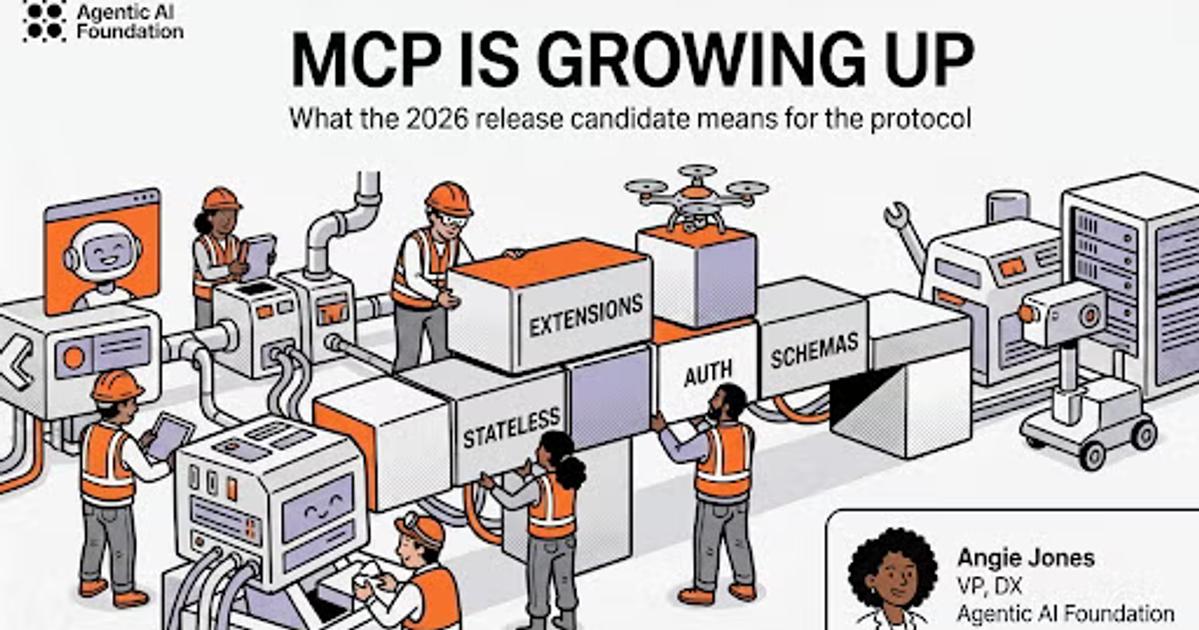 MCP Is Growing Up (Agentic AI Foundation analysis of 2026-07-28 spec)
An in-depth breakdown of the MCP 2026-07-28 specification release candidate: the protocol layer becomes stateless (no more Mcp-Session-Id, with application state moved into explicit handles like basket_id), extensions get formal reverse-DNS identifiers and independent versioning (with MCP Apps and Tasks as the first examples), Roots/Sampling/Logging are deprecated under a new feature lifecycle policy, OAuth/OpenID Connect rules are tightened for one-client-to-many-servers deployments, and tool schemas gain full JSON Schema 2020-12 support. The piece argues these changes reflect MCP deliberately narrowing scope and building governance maturity (conformance-test requirements, 12-month deprecation windows) so the protocol can scale safely in production agentic systems.
 aaif.ioarticleAdded 4 Oct 2026, published 27 May 2026
- Superpowers
Superpowers is an open-source composable skills library and workflow methodology for coding agents, enforcing a pipeline of brainstorming/spec, plan-writing, subagent-driven or inline TDD implementation, and code review across git worktrees. It ships as a plugin installable into Claude Code, Codex, Cursor, Gemini, Copilot, Grok, and many other agent harnesses, with skills like test-driven-development, systematic-debugging, and writing-plans that auto-trigger during a coding session.
github.comrepoAdded 22 Sep 2026, published 25 May 2026 - AG Kit
AG Kit is an open-source Antigravity-first agent engineering toolkit that installs a `.agents/` workspace contract of rules, skills, specialist agents, workflows, persistent memory, and MCP configuration for Google's Antigravity coding-agent runtime. It ships a native PreToolUse safety hook that blocks destructive commands (root-filesystem deletion, drive formatting, raw-disk overwrites) without replacing Antigravity's own permissions or sandboxing, plus a CLI (`ag-kit init`/`update`/`rollback`) with merge-aware, backed-up updates and SemVer-versioned, drift-checked toolkit manifests.
github.comrepoAdded 22 Sep 2026, published 15 May 2026 - CodeBurn
CodeBurn is a free, open-source CLI/desktop tool that reads the local session files written by 41 AI coding tools and agents (Claude Code, Cursor, Codex, Gemini, Grok, etc.) to break down token usage and dollar cost by model, project, and task. It adds an 'optimize' scanner that detects waste patterns (re-reads, low read:edit ratios, unused MCP servers, bloated CLAUDE.md files) with auto-applicable fixes, a 'guard' feature for per-session cost caps via Claude Code hooks, and a 'yield' command that correlates spend with actual shipped commits.
github.comrepoAdded 22 Sep 2026, published 7 May 2026  Trail of Bits AI-Native Journey
Trail of Bits describes how it moved from AI-assisted to "AI-native" over a year: standardizing on Claude Code, writing an AI usage handbook, building an AI maturity matrix, running hackathon-style adoption sprints, and packaging expertise into reusable skills/plugins/agents (94 plugins, 201 skills, 84 agents). It reports concrete outcomes — bug-finding throughput rising from 15 to 200/week on some engagements, ~20% of reported bugs first surfaced by AI — and open-sources the supporting repos (skills, curated marketplace, devcontainer, dropkit sandboxing, Slither MCP server). It also covers psychological adoption barriers (self-enhancing bias, identity threat, intolerance for imperfection, opacity) and open questions like private inference and prompt-injection risk on client code.
 blog.trailofbits.comarticleAdded 22 Sep 2026, published 6 May 2026