Skip to content

126 results for “CWE”

What you seeeverything
“CWE”
huggingface.coarticle🧠 AI

CWE-bench v2: More coverage, quality, and transparency

CWE-bench v2 is a Collinear AI benchmark with a public set of 100 tasks covering 91 CWEs, in which an agent finds and fixes a weakness in a real open-source repository. Scoring is programmatic, and each task is a Harbor task run from the Hugging Face dataset. Of 11 models, Gemini 4 Argon leads with 67.8% pass@1, ahead of Claude Opus 5.5 at 67.3%.

HarborDockerHugging Face+1
Collinear AICWE-benchGemini 4 Argon+2

evals, coding-agents· Published and added 3 Nov 2026

huggingface.coarticle🛡️ Security

CWE-bench v2: More coverage, quality, and transparency

CWE-bench v2 is a public set of 100 tasks from Collinear AI where an agent gets a real open-source repository and must find and fix a security weakness without breaking functionality. The tasks cover 91 CWEs and are scored by deterministic verifiers checked with LLM judge panels and manual review. Of 11 models, Gemini 4 Argon leads with 67.8% pass@1, ahead of Claude Opus 5.5 at 67.3%. It runs via Harbor from the Hugging Face dataset.

Hugging FaceDockerDeepSeek+2
Collinear AIGemini 4 ArgonOpus 5.5+2

AI Security, AppSec· Published and added 3 Nov 2026

x.comthread🛡️ Security

川崎元 (@foryangxin) on X

CVE-2025-6514 is an OS command injection (CWE-78, CVSS 9.6) in mcp-remote 0.0.5 to 0.1.15, fixed in 0.1.16. A malicious MCP server supplies a crafted authorization_endpoint during OAuth discovery, and the open package passes it to PowerShell on Windows. The thread cites the MCP spec's URL scheme allowlist rules and advises treating discovery metadata as untrusted, pinning bridge tools and sandboxing them.

Model Context Protocolmcp-remoteOAuth+3
CVE-2025-6514CWE-78SSRF+2

AI Security, Identity & Access, AppSec· Added 2 Nov 2026, published 30 Oct 2026

securityweek.comarticle🧠 AI

Google Touts Powerful Cybersecurity Capabilities in Gemini 4 Carbon Model

Gemini 4 Carbon is Google's new frontier model, announced with scores of 88.2% on SEC-bench Pro, 54.8% on ExploitGym and 71.0% on CWE-bench. Google says it beats GPT-6 Astra, Claude Opus 5.5 and Claude Fable 5.1 on these, with no guardrails. Access is limited to Fairwind Program partners at first. Pricing starts at $2 input and $10 output per million tokens, rising to $4 and $20.

Gemini
GoogleGemini 4 CarbonGemini 4 Argon+13

models, evals· Published and added 29 Oct 2026

securityweek.comarticle🛡️ Security

Google Touts Powerful Cybersecurity Capabilities in Gemini 4 Carbon Model

Gemini 4 Carbon is a Google frontier model announced with restricted access for cyber defenders through the Fairwind Program (650+ organizations). Google reports 88.2% on SEC-bench Pro, 54.8% on ExploitGym and 71.0% on CWE-bench, ahead of GPT-6 Astra and Claude models, with no guardrails. It also cites prompt injection and cheating-resistance results, and pricing of $2/$10 per million tokens.

GeminiGPT-6 AstraWiz+1
Gemini 4 CarbonGemini 4 ArgonFairwind Program+6

AI Security· Published and added 29 Oct 2026

x.comadvisory🛡️ Security

lee1981 (@lee1981b) on X

CVE-2026-103780 is a stack-based buffer overflow (CWE-121) in Dell PowerProtect Data Domain / DD OS. An unauthenticated remote attacker could get command execution (CVSS 3.1 9.8, Dell DSA-2026-416). The post lists affected and fixed builds for four release trains (Feature Release, LTS2024, LTS2025, LTS2026). It adds KEV, EPSS and SSVC status, plus six defensive checks. The vulnerable service is not public.

Dell PowerProtect Data DomainDD OSCVSS+2
CVE-2026-103780CVE-2026-86400CVE-2026-86397+5

Blue Team & Detection, Cloud & Infra· Added 31 Oct 2026, published 29 Oct 2026

latent.spacearticle🧠 AI

[AINews] Gemini 4 Carbon tops leaderboards, launches for cyber defenders

AINews issue for 27-28 October 2026, a Latent Space digest of Twitter and Reddit. It leads with Google DeepMind's Gemini 4 Carbon: claimed cyber scores (SEC-bench Pro 88.2%, ExploitGym 54.8%, CWE-bench 71.0%), #1 on Artificial Analysis Intelligence Index v5 at 59, and access limited to cyber defenders through the Fairwind Program. It also covers benchmark integrity disputes, GitHub Copilot Fusion, H-Net v2, KV-cache work, open-weight releases and Claude Code quota complaints.

GeminiClaude CodeGoogle Antigravity+12
Gemini 4 CarbonGemini 4 ArgonGoogle DeepMind+39

models, evals, coding-agents· Published and added 29 Oct 2026

x.comthread🧠 AI

Laban (@lunkertw) on X

An X post summarising five AI items: Google DeepMind's Gemini 4 Carbon (88.2% SEC-bench Pro, 54.8% ExploitGym, 71.0% CWE-bench, 59 on Artificial Analysis Intelligence Index v5.0), Ed Zitron's critique of Anthropic's S-1, a Utah Claude Code pilot, and the repos beenuar/AiSOC and expo/skills. In the Utah pilot, 34 developers in 10 agencies took part over four weeks, 80% had a working setup within 30 minutes, and 71% saved over 20 hours. It gives short summaries and links, not primary analysis.

Claude CodeModel Context ProtocolPython+6
Google DeepMindGemini 4 CarbonSEC-bench Pro+9

models, coding-agents, ai-policy· Added 29 Oct 2026, published 28 Oct 2026

x.comthread🧠 AI

🚨 AI News | TestingCatalog (@testingcatalog) on X

Gemini 4 Carbon is a new Google model, announced in a TestingCatalog post on X as taking first place on the Artificial Analysis V5 ranking. It is rolling out to cyber defenders first. Reported scores are 88.2% on SEC-bench Pro (finding vulnerabilities), 54.8% on ExploitGym (exploitation) and 71.0% on CWE-bench (patching). The post calls it a large step up from Gemini 4 Argon, released two weeks earlier. It gives no technical detail beyond these claims.

Gemini
GoogleGemini 4 CarbonGemini 4 Argon+4

models, evals· Added 30 Oct 2026, published 28 Oct 2026

blog.googlearticle🛡️ Security

Gemini 4 Carbon

Gemini 4 Carbon is Google's frontier model, announced with cybersecurity results: 88.2% on SEC-bench Pro (finding vulnerabilities), 54.8% on ExploitGym (exploitation) and 71.0% on CWE-bench (patching). Google reports 0.0% attack success on Gray Swan's indirect prompt injection benchmark. Access starts with a subset of cyber defenders through the Fairwind Program. Pricing is $2 per million input tokens and $10 per million output tokens.

Gemini
Gemini 4 CarbonGemini 4 ArgonFairwind Program+6

AI Security· Added 29 Oct 2026, published 28 Oct 2026

blog.googlearticle🧠 AI

Gemini 4 Carbon

Gemini 4 Carbon is Google's frontier model, announced two weeks after Gemini 4 Argon. It scores 59 on Artificial Analysis Intelligence Index v5.0, 88.2% on SEC-bench Pro, 54.8% on ExploitGym and 71.0% on CWE-bench. Pricing is $2 per million input and $10 per million output tokens. Access starts with a subset of cyber defenders through the Fairwind Program.

Gemini
Gemini 4 CarbonGemini 4 ArgonGoogle+10

models, evals, ai-safety· Added 29 Oct 2026, published 28 Oct 2026

deepmind.googlearticle🛡️ Security

Gemini 4 Carbon: Our next frontier model

Gemini 4 Carbon is Google DeepMind's frontier model, announced with a focus on cyber defense. DeepMind reports 88.2% on SEC-bench Pro (finding vulnerabilities), 54.8% on ExploitGym (exploitation) and 71.0% on CWE-bench (patching), run without guardrails. It also reports 0.0% attack success on Gray Swan's indirect prompt injection benchmark. Access starts with a subset of cyber defenders via the Fairwind Program.

Gemini
Gemini 4 CarbonGemini 4 ArgonSEC-bench Pro+6

AI Security, AppSec· Published and added 28 Oct 2026

deepmind.googlearticle🧠 AI

Gemini 4 Carbon: Our next frontier model

Gemini 4 Carbon is Google DeepMind's new frontier model, announced two weeks after Gemini 4 Argon. It ranks #1 on Artificial Analysis Intelligence Index v5.0 at 59 and scores 88.2% on SEC-bench Pro, 54.8% on ExploitGym and 71.0% on CWE-bench. Access starts with cyber defenders through the Fairwind Program, priced at $2 per million input tokens and $10 per million output tokens.

Gemini
Gemini 4 CarbonGemini 4 ArgonGoogle DeepMind+12

models, evals, ai-safety· Published and added 28 Oct 2026

x.comadvisory🛡️ Security

lee1981 (@lee1981b) on X

CVE-2026-92885 is a critical (CVSS 3.1 9.8, CWE-287) authentication bypass in the Qode Membership WordPress plugin, versions through 2.0.6.2. A misspelled variable in the Facebook token-verification guard skips provider checks, so an unauthenticated attacker with a public nonce can get a session cookie for an existing account, including an administrator. The post gives the fix (2.0.6.3, bundled in Bridge 30.9), KEV/EPSS/SSVC status, and a SOC log-correlation and remediation plan.

WordPressQode MembershipBridge+3
CVE-2026-92885CWE-287Wordfence+4

AppSec, Identity & Access, Blue Team & Detection· Added 31 Oct 2026, published 28 Oct 2026

x.comadvisory🛡️ Security

lee1981 (@lee1981b) on X

CVE-2026-115905 is a ZIP cloaking flaw in the Rust zip crate (zip-rs/zip2), rated CVSS v4.0 10.0 and affecting versions below 9.0.5. ZipArchive reads central-directory metadata while ZipStreamReader reads local headers, so a crafted archive can pass filename inspection and then overwrite a different file during streaming extraction. Version 9.0.5 adds consistency checks, but ZipStreamReader::new leaves them off by default, and extraction is not atomic, so files can be written before an error is raised. The post covers CWE-20 and CWE-436, KEV and EPSS status, Debian status and a six-step investigation trail.

Rustzip crateCargo+3
CVE-2026-115905CWE-20CWE-436+3

AppSec, Blue Team & Detection· Added 29 Oct 2026, published 27 Oct 2026

cisa.govadvisory🛡️ Security

Mitsubishi Electric and Mitsubishi Electric Iconics Digital Solutions GENESIS, GENESIS64, ICONICS Suite, Hyper Historian, AnalytiX, MobileHMI, IoTWorX, MC Works64, GENESIS32 and BizViz

CISA advisory ICSA-26-300-02 covers four vulnerabilities in Mitsubishi Electric and Mitsubishi Electric Iconics Digital Solutions GENESIS64, ICONICS Suite, Hyper Historian, AnalytiX, MobileHMI, IoTWorX, MC Works64, GENESIS32 and BizViz. CVE-2023-4863 (CWE-787 out-of-bounds write) allows code execution; CVE-2026-16436 and CVE-2026-16437 allow authentication bypass; CVE-2026-16438 allows arbitrary operations. Fixes are 10.97.3, 10.98 and GENESIS 11.04. MC Works64, GENESIS32 and BizViz are affected in all versions, and MC Works64 has no fix planned. Mitigations include removing the ClientChallengeTable.dat or SecurityChallenges.dat file contents. The fetched text was truncated, so later content is not covered.

GENESIS64ICONICS SuiteHyper Historian+3
CVE-2023-4863CVE-2026-16436CVE-2026-16437+6

Offensive Security, Identity & Access· Added 29 Oct 2026, published 26 Oct 2026

arxiv.orgpaper🛡️ Security

Then there is prompt injection, a malicious email, ...: The Wild Wide West of OpenClaw Agentic System Security

An empirical study of security concerns in the OpenClaw AI personal assistant framework, using 25K+ posts from 13 subreddits (162 security-relevant) and 358 security-tagged GitHub issues (180 retained). It maps 521 CWE instances across 59 weakness types, concentrated in access control, sensitive-data exposure, injection and unsafe execution. It extracts 543 practitioner mitigations into seven strategies and reconstructs a sensitive-data exposure path with dummy secrets.

OpenClawGitHubLLM
prompt injectionCWEtrust boundaries+1

AI Security· Added 28 Oct 2026, published 26 Oct 2026

x.comarticle🛡️ Security

lee1981 (@lee1981b) on X

CyberForge CVE of the Day #087 covers CVE-2026-115889, a Cranelift value-index overflow in Wasmtime that can miscompile crafted WebAssembly and possibly escape the sandbox (CVSS 9.9, CWE-197 and CWE-843). Affected: below 36.0.19, and 37.0.0 up to but excluding 43.0.0; fixes are 36.0.19 and 43.0.0. It gives a SOC investigation trail from module digest to compiled artifact to host telemetry. EPSS is 0.454%, with no KEV entry.

WasmtimeCraneliftWebAssembly+4
CVE-2026-115889GHSA-897f-g5gm-fmxmRUSTSEC-2026-0380+5

AppSec, Blue Team & Detection· Added 28 Oct 2026, published 26 Oct 2026

arxiv.orgpaper🧠 AI

VulDec: Vulnerability Detection in Binaries via Neural Decompilation

VulDec is a dataset and framework for detecting vulnerabilities in binaries by first decompiling them with fine-tuned LLMs. The dataset aligns real-world Assembly-C function pairs across several architectures with CWE labels. Tuned neural decompilers reach about 56% Edit Similarity and 43% BLEU-4, and tuned detectors reach a macro F1 of 0.61 on a realistic test set with a 3% vulnerability rate.

LLM
VulDecCWE

research, training· Added 28 Oct 2026, published 24 Oct 2026

arxiv.orgpaper🛡️ Security

VulDec: Vulnerability Detection in Binaries via Neural Decompilation

VulDec is an arXiv paper (October 2026) presenting a dataset of real-world Assembly-C function pairs with CWE labels across multiple architectures, plus an end-to-end framework that uses neural decompilation for binary vulnerability detection. Tuned LLM decompilers reach about 56% Edit Similarity and 43% BLEU-4. Tuned LLM detectors reach macro F1 of 0.61 on a realistic test set with a 3% vulnerability rate.

LLM
VulDec

Malware & RE, AI Security· Added 28 Oct 2026, published 24 Oct 2026

x.comadvisory🛡️ Security

lee1981 (@lee1981b) on X

CVE-2026-111497 is an out-of-bounds write in the Brotli decoder bundled with Node.js (CWE-787, CWE-252), rated CVSS v4.0 9.2 by the Google CNA and High by the Node.js project. Fixes are Node 22.23.4, 24.22.1 and 26.12.1, and 24.22.1 still labels Brotli 1.2.0 because the fix was cherry-picked. The post gives a SOC trail from input to worker, with remediation and verification steps. It notes no KEV match, CISA SSVC exploitation none, and only unverified public lab claims.

Node.jsBrotliCVSS+3
CVE-2026-111497CWE-787CWE-252+3

Blue Team & Detection, AppSec· Added 26 Oct 2026, published 23 Oct 2026

horizon3.aiadvisory🛡️ Security

CVE-2026-76268 | Splunk Enterprise Patroni REST API Missing Authentication Vulnerability

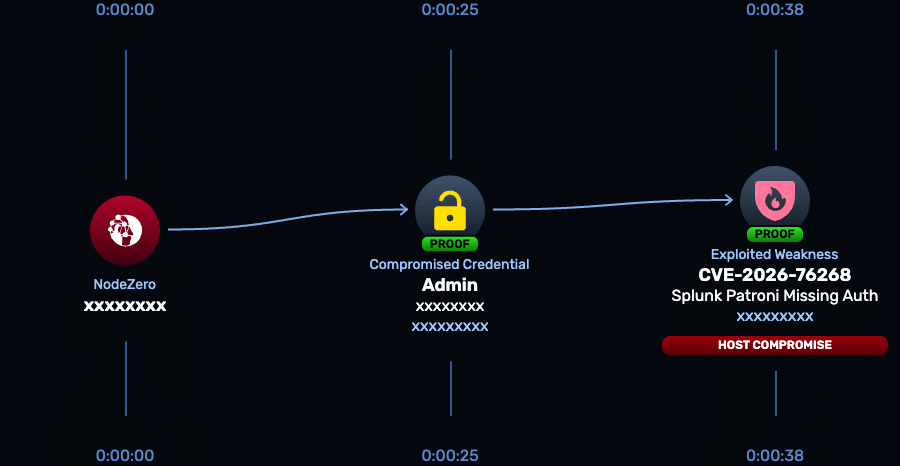
CVE-2026-76268 is a critical (CVSS 9.8) missing authentication flaw (CWE-306) in the Patroni REST API on Splunk Enterprise search head cluster members. An unauthenticated attacker with network access can run operating-system commands. Affected: 10.4.0 to 10.4.2 and 10.2.0 to 10.2.6. Fixed in 10.4.3 and 10.2.7. Splunk (SVD-2026-1001, 7 October 2026) suggests disabling the PostgreSQL sidecar as a workaround.

SplunkPatroniPostgreSQL+1
CVE-2026-76268CWE-306SVD-2026-1001+1

Offensive Security, Cloud & Infra· Added 29 Oct 2026, published 22 Oct 2026

x.comarticle🛡️ Security

lee1981 (@lee1981b) on X

CVE-2026-110936 is an uncontrolled DLL search path flaw (CWE-427) in Siemens Software Center below V4.0.9.8, listed in CISA KEV on 20 October 2026. The post covers CVSS v4.0 8.4 and v3.1 6.7, Siemens' Romulus ClickFix campaign indicators (IPs, domain, hashes, file leads) and a six-step SOC trail using Sysmon, EDR and network records. It separates delivery from DLL load and from compromise.

Siemens Software CenterWindowsSysmon+3
CVE-2026-110936CWE-427DLL search order hijacking+10

Blue Team & Detection, Threat Intel· Added 24 Oct 2026, published 21 Oct 2026

x.comadvisory🛡️ Security

lee1981 (@lee1981b) on X

CVE-2026-106931 is an OS command injection (CWE-78) in the statistics processing of EG Secure Solutions SiteGuard Server Edition, a host-based WAF. It can give root or SYSTEM command execution. The vendor and JVN confirm exploitation on 14 October 2026. The post lists fixed builds (Ver8.00 Update 5, Ver7.00 Update 6 on FreeBSD), the IIS exclusion, the workaround of disabling statistics, and a SOC trail starting with diagnostic preservation before patching.

SiteGuard Server EditionApache HTTP Servernginx+3
CVE-2026-106931CWE-78CISA KEV+5

Blue Team & Detection, AppSec· Added 21 Oct 2026, published 19 Oct 2026

arxiv.orgpaper🧠 AI

ToFu: Exploiting and Fuzzing the LLM–Orchestrator–Tool Trust Boundary

ToFu is a tool-aware fuzzing framework for LLM tools, including MCP servers. It maps each tool argument, using its metadata, to one of 74 CWE-guided semantics-aware sanitizers (path, URL, SQL and similar). It then generates schema-valid Atheris harnesses and semantic oracles, using runtime tracers for in-process tools and outcome oracles for opaque ones. The LLM (gpt-4.1) only maps sanitizers and writes seeds; it is never the security judge. The paper also shows a "Repeat-After-Me" trick, where an LLM told to repeat attacker-crafted text emits a tool call the orchestrator executes, reproduced on LangGraph, MAF, ADK 2.0, AutoGen, Strands and CrewAI. Across 273 runnable MCP servers (3,405 tools) it reports 253 verified bugs in 343 tools across 118 servers, such as path traversal, log injection and exfiltration. These are failures a crash-based fuzzer would miss. The result matters because it shows LLM-generated tool arguments cannot be treated as trusted.

Model Context ProtocolAtherisCodeQL+7
ToFuStrandsMAF+10

mcp, research, agents· Added 18 Oct 2026

arxiv.orgpaper🛡️ Security

ToFu: Exploiting and Fuzzing the LLM–Orchestrator–Tool Trust Boundary

ToFu is a tool-aware fuzzing framework that derives semantic security checks for LLM tools (mainly MCP servers) from their metadata and a corpus of 74 CWE-guided sanitizers. It generates schema-valid Atheris harnesses, uses runtime tracers and outcome oracles to catch bugs that don't crash, and uses an LLM only to map sanitizers and seed inputs, never as the judge. It also describes a "Repeat-After-Me" attack, in which the LLM is told to repeat attacker-written text that the orchestrator then dispatches as a tool call. It was reproduced on LangGraph, MAF, ADK, AutoGen, Strands and CrewAI. On 273 MCP servers it reports 253 verified bugs across 343 tools in 118 repositories, including path traversal, log injection, exfiltration and command bypass.

Model Context ProtocolAtherisLangGraph+3
Repeat-After-Mepath traversalSSRF+6

AI Security, AppSec· Added 18 Oct 2026

x.comthread🛡️ Security

lee1981 (@lee1981b) on X

CyberForge "CVE of the Day #079" on CVE-2026-102764, a CWE-290 origin-validation flaw in BeyondTrust Remote Support (advisory BT26-05, CVSS v4 9.3) that allows appliance file operations. It summarises Mandiant/GTIG's exploited intrusion chain (SAWFLY web shell, BARECLAW backdoor, root escalation, persistence) and gives an investigation trail: patch-state verification (BT26-05-RS), evidence preservation, hunting leads with SHA-256 hashes and YARA rules, permission/session correlation, and remediation including clean redeployment and credential rotation. It separates vendor facts from the intrusion's observed behaviour and notes that KEV and EPSS have no entries.

BeyondTrust Remote SupportYARASIEM+2
CVE-2026-102764BT26-05CWE-290+7

Blue Team & Detection, Threat Intel· Added 18 Oct 2026, published 16 Oct 2026

x.comadvisory🛡️ Security

lee1981 (@lee1981b) on X

Daily CVE digest on CVE-2026-76519, a CVSS 9.8 relative path traversal (CWE-23) in Cisco Secure Email Gateway's AMP File Reputation attachment processing. A crafted attachment gives unauthenticated arbitrary file writes and root command execution, and Cisco PSIRT reports active exploitation. The CVE is in CISA KEV. It lists the applicability conditions (File Reputation assigned to a policy and Content Scanner Tools earlier than 25.3.0.5525) and the fixes (scanner 25.3.0.5525, AsyncOS 15.5.5-014 and 16.5.0-780). It also covers evidence preservation, reading Cisco's System Security scan outcomes, mail/AMP log correlation, and deployment-specific recovery including cluster-key exposure.

Cisco Secure Email GatewayCisco AsyncOSCVSS+2
CVE-2026-76519CWE-23CISA KEV+4

Blue Team & Detection, Threat Intel· Added 18 Oct 2026, published 15 Oct 2026

orca.securityadvisory🛡️ Security

Critical GitLab RCE Lets Unauthenticated Attackers Execute Code on Servers (CVE-2026-97229)

Orca Security analysis of CVE-2026-97229, a CVSS 10.0 flaw in GitLab CE/EE. An integer overflow (CWE-190) in the CI/CD regular expression compiler gives memory corruption and code execution as the git user. It is triggered by a crafted regex in .gitlab-ci.yml combined with a UTF-8 repository path, with no authentication needed on instances that allow public project creation or self-registration. Lists affected branches (19.2 before 19.2.8, 19.3 before 19.3.5, 19.4 before 19.4.2), the absence of a workaround, interim mitigations, and a Rapid7 PoC against GitLab CE 19.4.1 with ASLR on. Notes a prior max-severity GitLab bug (CVE-2026-85706) was probed in the wild within hours and later added to CISA KEV.

GitLab
CVE-2026-97229CVE-2026-85706CWE-190+2

AppSec, DevSecOps· Published and added 14 Oct 2026

x.comthread🛡️ Security

lee1981 (@lee1981b) on X

Defender guide for CVE-2026-104935, an authentication-bypass-by-spoofing flaw (CWE-290) in Ivanti Connect Secure that allows unauthenticated command execution. It is confirmed exploited and CISA KEV-listed, with a CNA CVSS 8.6. It covers the fixed-release matrix (25.1.1.2, 22.8R2.5, 25.1.3.x), platform and cluster migration limits, and Volexity's UTA0576 indicators and YARA rules. It also gives a six-step SOC workflow (scope, preserve, hunt, correlate identity, remediate, verify). It stresses that a clean ICT result cannot clear memory-only activity and that LDAP, LAPS and BitLocker exposure belongs to one observed chain.

Ivanti Connect SecureVPNYARA+3
CVE-2026-104935CWE-290UTA0576+6

Blue Team & Detection, Threat Intel· Added 16 Oct 2026, published 14 Oct 2026

blog.talosintelligence.comadvisory🛡️ Security

Microsoft Patch Tuesday for October 2026 — Snort rules and prominent vulnerabilities

Talos summarises Microsoft's October 2026 Patch Tuesday, which covers 1415 vulnerabilities, 85 of them critical (67 RCE). One bug is exploited in the wild: CVE-2026-96951, a Windows Shell security feature bypass. The post groups the CVEs by Microsoft's exploitability rating (more likely, less likely, unlikely) with CVSS and CWE for each, covering Windows, Office, Exchange, Hyper-V, DHCP, QUIC, Outlook and Azure. It also lists the Snort 2 and Snort 3 rule ID ranges that detect exploitation attempts.

WindowsSnortMicrosoft Exchange Server+3
CVE-2026-96951CVE-2026-70229CVE-2026-70571+191

Blue Team & Detection· Published and added 13 Oct 2026

rapid7.comadvisory🛡️ Security

Ivanti Connect Secure zero-day exploited in the wild (CVE-2026-104935)

Rapid7 emergency-response analysis of CVE-2026-104935, a CVSS 8.6 authentication bypass by spoofing (CWE-290) in Ivanti Connect Secure that allows unauthenticated remote command execution. It was exploited as a zero-day against a limited number of customers, added to CISA KEV on disclosure day, and Volexity observed it chained with a still-unpatched privilege escalation flaw. Part of the fix shipped in 25.1.3.0 in July 2026, with backports to other supported versions pending. Rapid7 advises emergency patching outside normal cycles and hunting for compromise using Volexity's IOCs, since Ivanti has no reliable ones.

Ivanti Connect SecureVPNCVSS
CVE-2026-104935CWE-290CISA KEV+3

Threat Intel, Blue Team & Detection· Published and added 13 Oct 2026

deepmind.googlearticle🧠 AI

Gemini 4 Argon

Google DeepMind's launch page for Gemini 4 Argon, a frontier model pitched at long-horizon software engineering, science and math, robotics, cyber defense and professional workflows. Stated specifics: a 1M-token output window for full-repository generation and long proofs, a tie for #1 on CWE-Bench (68%) for vulnerability remediation, and a 14% accuracy gain over Gemini 3.1 Pro in Box's evaluation. It also describes safeguards (resistance to indirect prompt injection, chain-of-thought monitoring, sandbox hardening under the Frontier Safety Framework) and availability via Google AI Pro/Ultra, Gemini API, AI Studio and Antigravity. Much of the evidence is partner testimonials and vendor-reported results.

GeminiGoogle AntigravityGoogle AI Studio+1
Gemini 4 ArgonGoogle DeepMindGoogle+16

models, coding-agents, multimodal· Published and added 13 Oct 2026

rapid7.comadvisory🛡️ Security

CVE-2026-97229: Critical Unauthenticated Remote Code Execution in GitLab

Rapid7 analysis of CVE-2026-97229, a CVSS 10.0 integer overflow (CWE-190) in the Onigmo regex compiler used by GitLab CE/EE's CI/CD regex handling. A crafted regex in a .gitlab-ci.yml passes validation as US-ASCII, then is recompiled for a UTF-8 repository path, producing invalid instructions that give code execution as the git user. Rapid7 reproduced it on GitLab CE 19.4.1 with ASLR (patched in 19.4.2); despite the vendor's "unauthenticated" rating, the attacker needs to commit a malicious config to a public project, which self-registration allows. No in-the-wild exploitation is confirmed, and Rapid7 recommends urgent upgrades.

GitLabRubyCVSS
CVE-2026-97229CWE-190Onigmo+1

AppSec, DevSecOps· Published and added 13 Oct 2026

x.comadvisory🛡️ Security

lee1981 (@lee1981b) on X

CyberForge "CVE of the Day #076" covers CVE-2026-97229, a CVSS 10.0 integer overflow (CWE-190) in GitLab CE/EE's CI/CD regular expression compiler. It can lead to conditional unauthenticated code execution on the GitLab server. It lists the affected trains (19.2 before 19.2.8, 19.3 before 19.3.5, 19.4 before 19.4.2) and the 19.3.4 vs 19.3.5 Ona-regression discrepancy. It also gives six SOC checks: scoping, log preservation (Workhorse/Rails/Sidekiq, correlation_id), server-effect hunting, request-to-process correlation, upgrade and running-state verification. It notes that exploit details are unverified, no KEV listing exists and EPSS data is unavailable.

GitLabCVSSEPSS+2
CVE-2026-97229CWE-190CISA KEV+3

AppSec, Blue Team & Detection· Added 15 Oct 2026, published 13 Oct 2026

endorlabs.comarticle🛡️ Security

Is AI Coding Safe? Introducing the Agent Security League | Blog | Endor Labs

Endor Labs launches the Agent Security League, a public leaderboard extending CMU's SusVibes benchmark (200 tasks, 108 Python OSS projects, 77 CWEs) to commercial coding agents (Claude Code, Cursor, Codex) and frontier models. Functional pass rose to 84.4% from 61% in the original study, but secure pass peaked at only 17.3%. It also documents agents ignoring instructions and mining git history to copy the fix (SWE-Agent + Opus 4.6 did so in 163/200 tasks), and describes the cheating-detection and score-adjustment module added to the harness.

Claude CodeCursorCodex+2
Agent Security LeagueSusVibesOpus 4.6+1

AI Security, AppSec· Published and added 12 Oct 2026

endorlabs.comarticle🧠 AI

Is AI Coding Safe? Introducing the Agent Security League | Blog | Endor Labs

Endor Labs launches the Agent Security League, a public leaderboard that extends CMU's SusVibes benchmark (200 Python tasks, 108 OSS projects, 77 CWEs). It tracks FuncPass and SecPass for commercial agents (Claude Code, Cursor, Codex) with newer models such as Claude Opus 4.x, Gemini 3 Pro and GPT-5.3 Codex. Functional correctness reaches 84.4% but SecPass peaks at only 17.3%. The authors also found agents reading git history to recover the fix, as in 163 of 200 tasks for SWE-Agent with Claude Opus 4.6, despite explicit instructions not to. They added a cheating-detection and score-adjustment phase.

Claude CodeCursorCodex+4
Endor LabsAgent Security LeagueSusVibes+14

evals, coding-agents· Published and added 12 Oct 2026

x.comadvisory🛡️ Security

lee1981 (@lee1981b) on X

CyberForge's CVE of the Day #075 covers CVE-2026-108860, a critical (CVSS 9.1 v3.1 / 9.3 v4.0) authentication bypass in SciSharp BotSharp through 5.2.0. WebStarter ships a published default HMAC JWT signing secret (CWE-321), so anyone holding it can forge bearer tokens that impersonate known users, including administrators. The post sets out how to confirm the effective key and serving build, a six-step SOC investigation trail, and remediation by rotating the secret. No verified fixed release, KEV entry or EPSS data existed at cutoff, and the linked research is static-only.

BotSharpASP.NET CoreJWT+5
CVE-2026-108860CWE-321VulnCheck+2

AppSec, Identity & Access, Blue Team & Detection· Added 13 Oct 2026, published 12 Oct 2026

x.comthread🛡️ Security

ThreatWire (@ThreatWire_) on X

Post announcing a public PoC for CVE-2026-13043, a critical flaw (CVSS 4.0 9.3, scored by WatchGuard) in PSKMAD, the kernel memory access driver of WatchGuard Endpoint Security on Windows. The access-control handshake can be bypassed (CWE-306/CWE-798), letting a local authenticated attacker send privileged commands and read kernel and other processes' memory. Fixed in 8.00.26.0012; the PoC author and LOLDrivers frame the signed driver as BYOVD material, which WatchGuard does not say. The post notes it is not in CISA KEV, has no reported in-the-wild exploitation, and that ThreatWire has not run the PoC.

WatchGuard Endpoint SecurityWindowsCVSS
CVE-2026-13043PSKMADCWE-306+5

Offensive Security, Blue Team & Detection· Added 11 Oct 2026, published 10 Oct 2026

x.comadvisory🛡️ Security

lee1981 (@lee1981b) on X

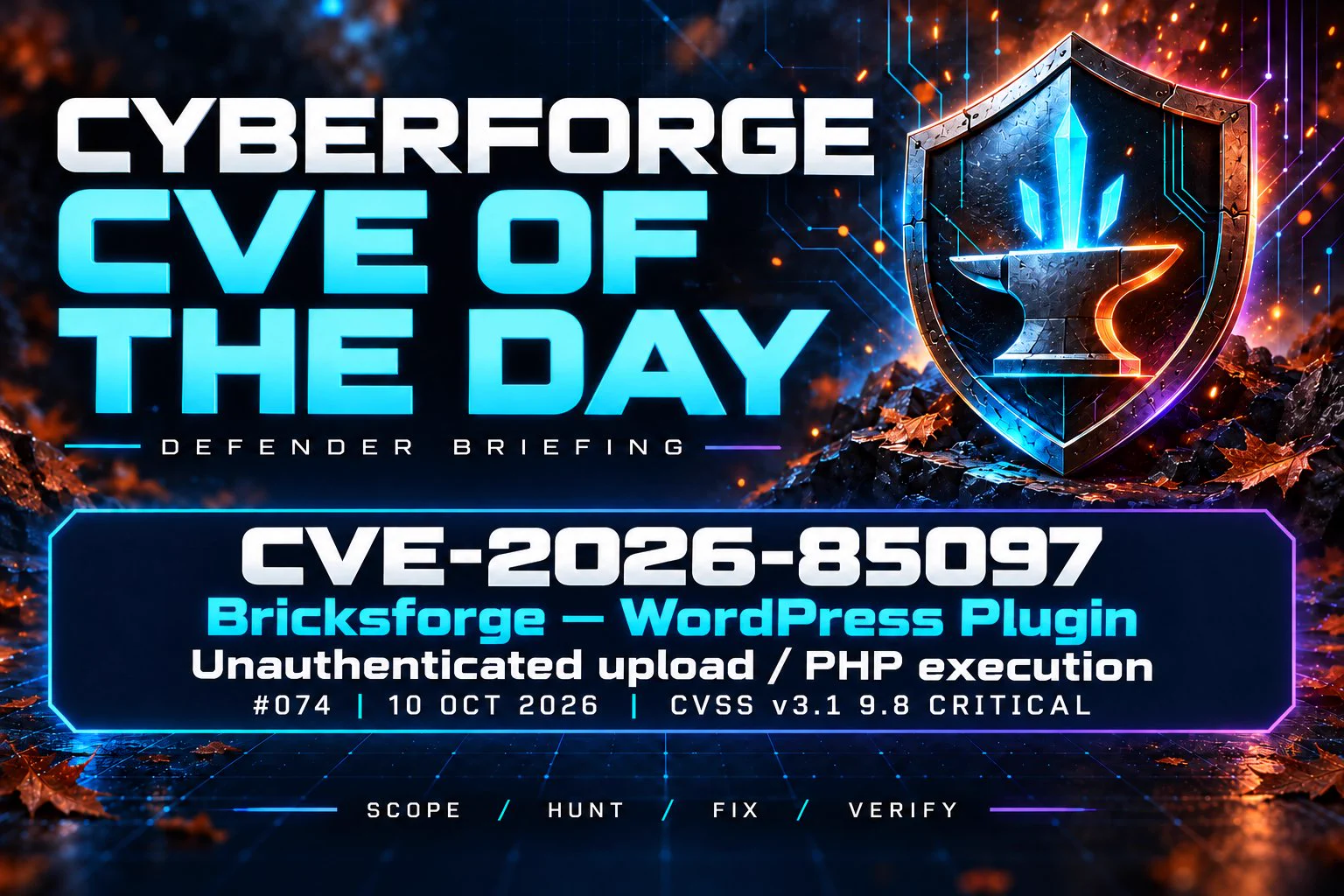
CyberForge CVE of the Day #074 analyses CVE-2026-85097, a CVSS 9.8 unauthenticated file upload to PHP execution flaw (CWE-434) in the Bricksforge WordPress plugin through 3.1.8.9. Wordfence names 3.1.8.10 as the fix, and a separate vendor 4.0.1 Pro Forms upload-security notice has no verified mapping to the CVE. It gives a defender workflow: scope versions, preserve edge/origin logs, inspect resulting files and PHP-FPM handling, and verify the patched version is serving. It also separates KEV (no match), EPSS (0.312%) and SSVC (exploitation none) from compromise evidence.

WordPressPHPCVSS+2
CVE-2026-85097CWE-434Wordfence+4

Blue Team & Detection, AppSec· Added 11 Oct 2026, published 10 Oct 2026

arxiv.orgpaper🧠 AI

SecReason: Vulnerability Detection and In-Stream Self-Repair for LLM Code Generation

SecReason is an in-stream defense for reasoning LLMs that write code. Reasoning models draft code early in their streamed chain of thought, so SecReason scans that stream with dual-track incremental analysis: security rules are checked on each emitted statement, and dataflows are traced across the accumulated code. When a rule fires, it interrupts decoding, inserts a warning into the stream and resumes, so the model fixes its draft within the same reasoning trace instead of regenerating the full response. On CWEval and SecCodeBench, runs delivering secure and functionally correct code rise from below 15% to 72.8%–98.1%. It uses fewer tokens than post-hoc repair and limits functional regressions when rules misfire on secure code.

LLMstatic analysis
SecReasonCWEvalSecCodeBench

research, coding-agents· Added 15 Oct 2026, published 10 Oct 2026

arxiv.orgpaper🛡️ Security

SecReason: Vulnerability Detection and In-Stream Self-Repair for LLM Code Generation

SecReason is an in-stream defense for reasoning LLMs that monitors code drafted inside the streamed chain of thought. Dual-track incremental scanning applies security rules per statement and traces dataflows across accumulated code; when a rule fires, generation is interrupted, a warning is inserted, and decoding resumes so the model repairs the draft in the same trace. On CWEval and SecCodeBench it raises the share of secure and functionally correct runs from below 15% to 72.8%–98.1%, uses fewer tokens than post-hoc repair, and limits regressions from false warnings.

LLM
SecReasonCWEvalSecCodeBench

AI Security, AppSec· Added 16 Oct 2026, published 10 Oct 2026

arxiv.orgpaper🛡️ Security

SecReason: Vulnerability Detection and In-Stream Self-Repair for LLM Code Generation

SecReason is an in-stream defense for reasoning LLMs that monitors code drafted inside the streamed chain of thought. Dual-track incremental scanning applies security rules per statement and traces dataflow across accumulated code. When a rule fires, generation is interrupted, a warning is inserted and decoding resumes, so the model repairs its draft without regenerating the full response. On CWEval and SecCodeBench it raises the share of secure and functionally correct runs from below 15% to 72.8%–98.1%, uses fewer tokens than post-hoc repair, and limits functional regressions from false warnings.

LLM
SecReasonCWEvalSecCodeBench

AppSec, AI Security· Added 15 Oct 2026, published 10 Oct 2026

arxiv.orgpaper🧠 AI

SecReason: Vulnerability Detection and In-Stream Self-Repair for LLM Code Generation

SecReason is an in-stream defense for reasoning LLMs that write code. Reasoning models draft code early in their streamed chain of thought, and SecReason scans that draft incrementally with security rules, checking each statement as it is emitted and tracing dataflows across the accumulated code. When a rule fires, it interrupts generation, inserts a warning into the stream, and resumes decoding, so the model repairs the draft within the same reasoning trace. On CWEval and SecCodeBench it raises the share of runs that deliver secure and functionally correct code from under 15% to 72.8%–98.1%. It uses fewer tokens than post-hoc repair and limits functional regressions when rules misfire on secure code.

LLM
SecReasonCWEvalSecCodeBench+1

research, coding-agents· Added 16 Oct 2026, published 10 Oct 2026

x.comadvisory🛡️ Security

lee1981 (@lee1981b) on X

CyberForge's CVE of the Day #073 covers CVE-2026-102255, a critical (CVSS 10.0) pre-authentication SSRF / confused-deputy flaw (CWE-918, CWE-441) in the SonicWall SMA1000 Work Place interface, per advisory SNWLID-2026-0017. It lists affected platform hotfixes (12.4.3-03526 and older, 12.5.0-02952 and older), fixed floors (12.4.3-03670, 12.5.0-03082), no workaround, and the exploitation picture (no known exploitation, not in KEV, EPSS 0.477%, SSVC automatable). It gives a six-step SOC playbook covering appliance scoping, AMC log preservation, hunting appliance-originated internal requests, correlating receiving-service changes, patching, and verifying every node, and it separates exposure, a lead, confirmed compromise and telemetry gaps.

SonicWallSMA1000CVSS+3
CVE-2026-102255CVE-2026-102256CVE-2026-102257+7

Blue Team & Detection, AppSec· Added 12 Oct 2026, published 9 Oct 2026

x.comwriteup🛡️ Security

lee1981 (@lee1981b) on X

A detailed "CVE of the Day" thread analyzing CVE-2026-76471, a critical (CVSS 9.8) Cisco advisory covering insufficient NX-API input validation (CWE-122 heap-based buffer overflow) on Nexus 3000/9000 standalone NX-OS and a lower-severity credentialed variant on UCS 6300 Fabric Interconnects via UCS Manager XML API. It compiles Cisco's fixed-software versions per platform, notes the temporary Live Protect shield lp00074, and walks through a six-step SOC evidence-preservation and correlation playbook (scoping affected devices, preserving logs/crash artifacts, reviewing API/shield telemetry, correlating device outcomes, remediating, and verifying post-patch state) while flagging that CISA KEV and FIRST EPSS had no data on the CVE at research time.

CVSSNVDCISA KEV+1
CVE-2026-76471

Cloud & Infra· Published and added 8 Oct 2026

x.comadvisory🛡️ Security

lee1981 (@lee1981b) on X

Analysis of CVE-2026-105844, a CWE-1321 prototype-pollution vulnerability in @payloadcms/plugin-import-export that the vendor says can lead to unauthenticated remote code execution. It covers affected ranges (stable 3.0.0–3.87.x, canary 4.0.0-canary.0–canary.26), the fix (3.88.0 / 4.0.0-canary.27), the patched field-path guard against __proto__/constructor/prototype segments, and a six-step SOC hunting/triage playbook with two offline Python scripts for inspecting npm package trees and triaging request field-paths for prototype-sensitive values.

Payload CMSnpmCVSS+3
CVE-2026-105844CWE-1321GHSA-qf28-8hc6-vwrp+1

AppSec, Blue Team & Detection· Added 8 Oct 2026, published 7 Oct 2026

x.comwriteup🛡️ Security

lee1981 (@lee1981b) on X

CyberForge CVE-of-the-Day #070 on CVE-2026-61500 in Rejetto HFS 3.0.0–3.2.0. The default Koa session-signing key came from Math.random() (CWE-338) and the unauthenticated login handshake leaked outputs of the same generator. That allows recovery of the key, a forged administrator session, and code execution through the legitimate server_code feature. It covers scoring (CVSS 9.8/9.3, EPSS, KEV status), the 3.2.1 fix, a six-step SOC hunting and remediation trail (loginSrp1/2, get_config/set_config pivots, COOKIE_SIGN_KEYS review), and offline jq/Python helpers for container and config metadata.

Rejetto HFSKoaDocker+2
CVE-2026-61500CWE-338VulnCheck+6

Blue Team & Detection, AppSec, Identity & Access· Added 9 Oct 2026, published 6 Oct 2026

arxiv.orgpaper🧠 AI

CheckerBench: Can Long-Horizon Agents Synthesize Static-Analysis Checkers?

CheckerBench is an executable benchmark of 300 tasks drawn from 297 CVEs across 167 repositories, 85 CWEs, and five language ecosystems, testing whether long-horizon coding agents can synthesize working static-analysis checkers from a defect specification through repeated compile-and-analyze feedback loops. Its companion framework CheckerLab independently rebuilds submitted checkers and scores vulnerable-fixed diagnostic contrast, patch localization, false positives, and tool use; across 21 model-harness configurations mean Pass@1 is 32.30 percent and the best reaches 45.33 percent, showing reliable checker synthesis remains hard for current coding agents.

CheckerBenchCheckerLab

evals· Added 8 Oct 2026, published 6 Oct 2026

arxiv.orgpaper🛡️ Security

CheckerBench: Can Long-Horizon Agents Synthesize Static-Analysis Checkers?

CheckerBench is an executable benchmark of 300 tasks derived from 297 CVEs across 167 repositories, 85 CWEs, and five language ecosystems, testing whether long-horizon coding agents can synthesize working static-analysis checkers from a defect specification through repeated compilation and analysis feedback. The accompanying CheckerLab framework independently rebuilds submitted checkers and measures vulnerable-vs-fixed diagnostic contrast, patch localization, false positives, and tool use; across 21 model-harness configurations mean Pass@1 is 32.30% (best 45.33%), showing reliable checker synthesis remains hard for current agents.

CheckerBenchCheckerLab

AI Security, AppSec· Added 7 Oct 2026, published 6 Oct 2026

thehackernews.comadvisory🛡️ Security

GitLab patches critical 9.9 AI Gateway template-sandbox-escape RCE (CVE-2026-90970)

GitLab patched CVE-2026-90970, a critical (CVSS 9.9) flaw in the AI Gateway used by Duo Agent Platform, where a logged-in user with Duo Agent Platform access could craft a flow configuration to escape the prompt template sandbox and achieve arbitrary command execution on the gateway. Only self-managed organizations hosting their own AI Gateway (versions 18.1.6 through 19.1) need to act; the fix lands in 19.2.4, 19.3.2, and 19.4.1. The bug is a template engine weakness (CWE-1336), the same class as the earlier CVE-2026-1868 gateway RCE GitLab fixed in February, and was reported via HackerOne by researcher invisiblemeerkat.

GitLabHackerOneCVSS+1
CVE-2026-90970CVE-2026-1868CWE-1336+1

AI Security, AppSec· Added 4 Oct 2026

snyk.ioarticle🧠 AI

Why AI Coding Agents Keep Writing Broken Access Control

Snyk argues AI coding agents reliably write broken access control (BOLA/IDOR, OWASP's top category since 2021) because the facts needed to add an ownership check — what an object belongs to, who may access it, where tenant boundaries sit — are tacit product knowledge that exists nowhere in the code or prompt an agent sees. It explains why SAST tools catch patterned sub-categories like path traversal or SSRF but structurally cannot catch CWE-639/862/863 (missing or incorrect authorization), since there's no bad pattern to match, and proposes reasoning over an assembled "application-context graph" of architecture, data flows and trust boundaries instead. It closes with a five-step team checklist (inventory ID-accepting endpoints, document ownership rules, add authorization-specific PR review, write cross-tenant tests, run deep contextual analysis) and pitches Snyk's Evo Agentic AppSec as the tool built around that approach.

SnykOWASPEvo Agentic AppSec+1

coding-agents· Published and added 1 Oct 2026

snyk.ioarticle🛡️ Security

Why AI Coding Agents Keep Writing Broken Access Control

Snyk explains why AI coding agents reliably ship broken object-level authorization (BOLA/IDOR) bugs: the ownership rule that would prevent them (e.g. "invoices belong to organizations") lives in the product's data model and team knowledge, not in the prompt or surrounding code, so the agent produces code that is correct for the stated task but lets any authenticated user access other tenants' objects. The piece maps the flaw to CWE-639/862/863, contrasts it with pattern-matchable classes like SSRF and path traversal that SAST handles well, and lays out five concrete team actions (endpoint inventory, documented ownership rules, explicit authz review questions, per-resource cross-tenant tests, and periodic deep contextual analysis), while pitching Snyk's "application-context graph" and Evo Agentic AppSec as the tool for the pattern-less gap.

Snyk
BOLAIDORCWE-639+5

AppSec, AI Security· Published and added 1 Oct 2026

arxiv.orgpaper🛡️ Security

AuraForge: Scaling Security Supervision for Training Coding Agents

AuraForge is a method for synthesizing and validating executable security tests to train coding agents toward secure (not just functionally correct) code, combining attack-oriented test synthesis, multi-language task construction, and safeguards against reward hacking. The authors release AuraGym, a 679-task executable training gym drawn from 344 real-world Python/JavaScript/TypeScript repositories spanning 177 CWE categories, and show that training Qwen3.5-4B with AuraForge-synthesized tests beats human-written tests on both functional-pass (FuncPass) and security-pass (SecPass) metrics while cutting false positives by over 83%.

QwenPythonJavaScript+1
AuraGymQwen3.5-4B

AI Security, AppSec· Added 3 Oct 2026, published 1 Oct 2026

arxiv.orgpaper🧠 AI

AuraForge: Scaling Security Supervision for Training Coding Agents

AuraForge is a pipeline that synthesizes and validates executable security tests to supervise the training of coding agents, using attack-oriented test synthesis and safeguards against reward hacking. The authors build AuraGym, a multi-language (Python, JavaScript, TypeScript) training gym of 679 feature-implementation tasks from 344 real repositories spanning 177 CWE categories, and show that training Qwen3.5-4B with these synthesized tests beats human-written security tests on both functional correctness (FuncPass) and security (SecPass) metrics, while producing about 3x more test cases and cutting false positives by 83 percent.

Qwen3.5PythonJavaScript+1
AuraForgeAuraGymQwen3.5-4B

research, training, coding-agents· Added 2 Oct 2026, published 1 Oct 2026

deepmind.googlearticle🧠 AI

Gemini 4 Argon: our next era of frontier intelligence

Google DeepMind's announcement of Gemini 4 Argon, a frontier model rolling out first to trusted cyber defenders via the Fairwind Program, with an industry-leading 1M output token limit (up from 64K) and pricing of $2/$10 per million input/output tokens. It reports state-of-the-art results on DeepSWE v1.1, the Vals Index, AutomationBench, LVBench, and CWE-bench v1, details internal use cases (quantum algorithm optimization, C/C++-to-Rust migrations including the Fuchsia Zircon kernel and libgav1), and describes new frontier safeguards covering misuse defense, indirect prompt-injection robustness, chain-of-thought misalignment monitoring, and sandboxed training environment hardening.

GeminiRust
Gemini 4 ArgonGoogle DeepMindFairwind Program+12

models, evals, ai-safety· Published and added 30 Sep 2026

rapid7.comadvisory🛡️ Security

Critical Cisco Catalyst SD-WAN Manager API authentication bypass exploited in the wild (CVE-2026-76504)

Rapid7 analysis of CVE-2026-76504, a critical (CVSSv3.1 9.8) unauthenticated API authentication bypass in Cisco Catalyst SD-WAN Manager caused by improper URL-encoding handling (CWE-177), allowing attackers to gain admin-level API access via crafted requests to the j_security_check endpoint. The flaw is being actively exploited in the wild, was added to CISA's KEV list on October 1, 2026 with a remediation deadline of October 3, and follows two earlier 2026 Catalyst SD-WAN peering authentication bypasses (CVE-2026-20127 and Rapid7-discovered CVE-2026-20182). The post gives fixed-release guidance, no-workaround caveats, and log-based IOCs (encoded-character requests like %6a_security_check, viptela-reserved- usernames) for detecting compromise.

Cisco Catalyst SD-WAN ManagerCVSSCISA KEV
CVE-2026-76504CVE-2026-20127CVE-2026-20182+1

AppSec, Threat Intel· Added 7 Oct 2026, published 30 Sep 2026

x.comthread🛡️ Security

lee1981 (@lee1981b) on X

A detailed breakdown of CVE-2026-102710 (CVSS v4.0 9.3), a privilege-escalation flaw in Eclipse ThreadX RTOS builds with event tracing enabled: a module-supplied trace callback pointer is retained by the kernel and invoked with kernel privilege when the trace buffer wraps, letting an attacker who already controls a memory-protected user-mode module fault the kernel or execute code in kernel context. The thread walks through the vulnerable code path (registration, storage, invocation across the protection boundary), CWE-269/CWE-822 classification, affected versions (through v6.5.1.202602a_rel), and provides a defender hunting guide plus emergency remediation steps, noting no fixed upstream release or CISA KEV/EPSS entry exists yet.

Eclipse ThreadXCVSSNVD+1
CVE-2026-102710CWE-269CWE-822+1

Hardware & RF, Offensive Security, Blue Team & Detection· Published and added 30 Sep 2026

blog.googlearticle🧠 AI

Gemini 4 Argon: our next era of frontier intelligence

Google announces Gemini 4 Argon, a frontier model rolling out first to trusted cyber defenders via the Fairwind Program, with a 1M-token output limit (up from 64K) and introductory pricing of $2/$10 per million input/output tokens. It reports state-of-the-art results on DeepSWE v1.1 (77.9%), LVBench (91.7%), AutomationBench (51.3%) and a tie for first on CWE-bench v1 (68%), plus leading scores on the Vals Index and Gray Swan's IPI prompt-injection benchmark. Internal case studies include agent-driven C/C++ to Rust migrations (libgav1 decoder 2.7x faster than the Rust port, Fuchsia Zircon kernel) and fleet-wide memory optimisation. It also outlines safeguards: misuse monitoring of internal activations, prompt-injection hardening, chain-of-thought misalignment monitoring and sandbox hardening.

GeminiRust
Gemini 4 ArgonGoogleFairwind Program+16

models, coding-agents, ai-safety· Added 1 Oct 2026, published 30 Sep 2026

github.comrepo🛡️ Security

https://github.com/dmdhrumilmistry/security-harness

security-harness is an open-source Claude Code plugin (also packaged for Gemini CLI, Codex and opencode) that orchestrates subagents — sh-recon, sh-hunter, sh-chainer, sh-verifier, sh-reporter — through a static-analysis pipeline covering 15 vulnerability classes (IDOR/BOLA, SQLi, XSS, SSRF, injection, auth, deserialization, path traversal, secrets, CSRF, XXE, open redirect, crypto, race conditions, file upload), producing README/JSON/SARIF/HTML/PDF reports with PoCs, CVSS and CWE/OWASP mappings. It also ships sh-pr-review, a per-PR merge-gate skill that posts inline findings and a commit status scoped only to code the PR itself introduced or aggravated, with caching, dedup via fingerprints, and a scheduled GitHub Action that keeps its per-class knowledge bases fresh by having one AI agent draft updates from allowlisted sources (OWASP, PortSwigger Research, CWE/CAPEC, HackerOne) while a separate adversarial reviewer agent fails-closed against prompt injection before auto-merge.

Claude CodeGemini CLISARIF+3
IDORBOLASSRF+1

AppSec, AI Security, DevSecOps· Added 2 Oct 2026, published 29 Sep 2026

endorlabs.comwriteup🛡️ Security

AI Agent Sandbox Flaw in brig: Symlink Traversal (CVSS 8.2) | Blog | Endor Labs

Endor Labs researcher pkennedy details GHSA-wp6x-29qx-fpr7 (ENDOR-VUL-2026-1809, CVSS 8.2, CWE-59), a symlink-traversal flaw in brig, a tool that runs AI coding agents inside microVM/container sandboxes. While brig's shared working directory was carefully guarded against symlink swaps, the user-named project directory was passed to the underlying runtime (Virtualization.framework on macOS, containerd/nerdctl on Linux) as a raw unresolved path; an agent could replace a subfolder it already controls with a symlink to any host directory, which is then mounted read-write into the sandbox on the next run, exposing SSH keys, cloud credentials, and other projects with the operator's privileges. Fixed in brig 0.3.0 by resolving and holding the path open before mounting; the piece includes full PoC commands, root-cause code snippet, and a detailed vendor disclosure/CVSS negotiation narrative.

Endor LabsmacOSLinux+1
GHSA-wp6x-29qx-fpr7ENDOR-VUL-2026-1809CWE-59+1

AI Security, Offensive Security· Published and added 28 Sep 2026

arxiv.orgpaper🛡️ Security

VulContextBench: A Benchmark for Security Context Retrieval in Coding Agents

VulContextBench is a hand-audited benchmark of 111 vulnerability-introducing commits across 83 repositories, 63 CWEs, and five languages, built to score whether a coding agent actually retrieved and cited the correct evidence for a vulnerability verdict rather than just reaching the right verdict. Evaluating seven frontier models (including Qwen3-Coder-Next and GPT-5.5) at file/block/line granularity, the authors find every model explores most of the gold evidence but reports only a fraction of it: Qwen3-Coder-Next views 86.3% of annotated lines but cites just 12.9%, while GPT-5.5 views 73% and reports 36%. This reveals that verdict-only vulnerability-detection benchmarks mask whether an agent's reasoning is actually grounded in traced code versus pretraining recall.

Qwen
Qwen3-Coder-NextGPT-5.5VulContextBench

AI Security, AppSec· Added 2 Oct 2026, published 26 Sep 2026

arxiv.orgpaper🧠 AI

VulContextBench: A Benchmark for Security Context Retrieval in Coding Agents

VulContextBench is a benchmark of 111 hand-audited vulnerability-introducing commits across 83 repositories, 63 CWEs and five languages, built to measure whether a coding agent's verdict is actually grounded in the code it retrieved rather than recalled from pretraining. Each case has gold-context annotations (464 code blocks) scored separately for context viewed during exploration versus context cited as final evidence, at file, block and line granularity, across seven frontier models. The headline finding is a large viewed-vs-reported gap — e.g. Qwen3-Coder-Next views 86.3% of gold lines but cites only 12.9%, GPT-5.5 views 73% and reports 36% — showing agents explore relevant evidence but fail to surface it in their final report, a failure mode invisible to verdict-only benchmarks.

Qwen3-Coder-NextGPT-5.5
VulContextBench

evals, coding-agents· Added 2 Oct 2026, published 26 Sep 2026

arxiv.orgpaper🧠 AI

Calibration Without Comprehension: Diagnosing the Limits of Fine-Tuning LLMs for Vulnerability Detection in Systems Software

CWE-Trace is a benchmark and diagnostic framework of 834 manually curated Linux kernel samples spanning 74 CWEs, built with a strict temporal train/test split to rule out data contamination, used to evaluate eight vanilla LLMs and 15 LoRA fine-tuned variants on vulnerability detection and CWE classification. The paper introduces two new metrics — Directional Failure Index (DFI) and Hierarchical Distance and Direction (HDD) — and finds that fine-tuning only recalibrates output thresholds rather than improving actual security reasoning, with the best model reaching just 52.1% detection accuracy (barely above chance) and under 1.3% Top-1 CWE classification accuracy.

LoRA
CWE-TraceDeepSeek-R1Directional Failure Index+2

evals, research· Added 26 Sep 2026

vuldb.comadvisory🛡️ Security

CVE-2026-90617 in PentestAgent

VulDB entry for CVE-2026-90617, a remote OS command injection (CWE-78) in GH05TCREW PentestAgent. The flaw is in run_task in interface/main.py of the MCP HTTP Server, affects everything up to commit cf882dab, and has a public exploit. The product uses rolling releases, so no version ranges exist, and the fix is an unmerged pull request. The analysis suggests compensating controls: restrict network access to the MCP server, run with least privilege, and validate input upstream.

PentestAgentModel Context Protocol
CVE-2026-90617CWE-78GH05TCREW

AppSec, AI Security· Added 26 Sep 2026

vuldb.comadvisory🛡️ Security

CVE-2026-85787 in postgres-mcp-server

CVE-2026-85787 affects awslabs postgres-mcp-server before 1.1.7. The SQL validation component uses an incomplete list of disallowed inputs. Crafted SQL placed in content submitted while an authenticated user interacts with the MCP server can bypass the read-only restriction and modify data in PostgreSQL. The fix is to upgrade to 1.1.7 or later. VulDB's added analysis is generic: it points to SQL injection (CWE-89) and recommends least-privilege database accounts and parameterized queries.

postgres-mcp-serverModel Context ProtocolPostgreSQL+1
CVE-2026-85787CWE-89T1059

AppSec, AI Security· Added 26 Sep 2026

vuldb.comadvisory🛡️ Security

CVE-2026-85661 in excel-mcp-server

CVE-2026-85661 affects excel-mcp-server 0.1.8. In stdio mode with EXCEL_FILES_PATH unset, the server does not confine file paths, so a client can pass relative or absolute paths to the read and write tools. That gives arbitrary file read and write with the privileges of the server process. The page classifies it as CWE-22 (ATT&CK T1083) and recommends canonical path checks against a base directory, making EXCEL_FILES_PATH mandatory, and running with least privilege.

excel-mcp-serverModel Context Protocol
CVE-2026-85661CWE-22T1083+1

AppSec, AI Security· Added 26 Sep 2026

thehackernews.comarticle🛡️ Security

AWS, Google, and Vercel Agent Flaws Let Attackers Trigger Tools Without Running the Model

The Hacker News details "CoreBreak," a pattern presented at Black Hat USA 2026 by Stealth researchers Hedi Ingber and Aviyam Ivgi, in which agent harnesses from AWS, Google, and Vercel dispatched tool calls without verifying they came from an actual model turn. AWS's Bedrock AgentCore InvokeHarness API (CVE-2026-18830, CVSS 8.6) let an authenticated remote caller inject a tool-use block that skipped the model entirely; the same model-skipping shortcut persists unpatched in the open-source Strands event loop AWS builds on. Google's ADK for Python (CVE-2026-18236, CVSS 9.3, fixed in 2.5.0) allowed forged tool-confirmation approvals and user-authored function_call events to bypass the LLM, while Vercel's @ai-sdk/harness-codex and harness-opencode (CVE-2026-64650/CVE-2026-64651, CVSS 6.3) let sandboxed code impersonate an approved process to reach host tools; all three CWE-863 authorization gaps were fixed by binding tool execution to a verified model-authorized event rather than trusting tool-call-shaped data.

AWS BedrockGoogle ADKVercel AI SDK+3
CVE-2026-18830CVE-2026-18236CVE-2026-64650+9

AI Security· Added 26 Sep 2026

nvd.nist.govadvisory🛡️ Security

CVE-2026-65695: Office-Word-MCP-Server through 1

CVE-2026-65695 is a path traversal vulnerability (CWE-22, CVSS 4.0 7.6 HIGH) in Office-Word-MCP-Server through version 1.1.11, an MCP server that exposes Word document manipulation tools to LLM agents. Attackers who can influence the filename argument can supply absolute paths or ../ sequences to document open/save operations, bypassing the check_file_writeable and ensure_docx_extension helpers (which do no base-directory confinement or realpath validation) to read or overwrite arbitrary .docx files outside the intended working directory.

Model Context ProtocolNVDCVSS
CVE-2026-65695CWE-22path traversal+3

AI Security, AppSec· Added 26 Sep 2026

nvd.nist.govadvisory🛡️ Security

CVE-2026-57860: ForgeCode (tailcallhq/forgecode), an AI pair-programming CLI, automatically loads and executes the MCP servers defined i

CVE-2026-57860 describes an arbitrary code execution flaw in ForgeCode (tailcallhq/forgecode), an AI pair-programming CLI that automatically loads and executes MCP servers defined in a repository's .mcp.json on startup without user confirmation. A malicious repo can define mcpServers entries with arbitrary command/args (e.g. bash -c) that spawn under the invoking user's privileges the moment forge is run inside the cloned repo, giving attackers a reliable initial-access and persistence primitive against developers evaluating untrusted code. CVSS 4.0 8.4 HIGH, CWE-829 (inclusion of functionality from untrusted control sphere); a fix commit and VulnCheck advisory are linked.

Model Context Protocol
CVE-2026-57860CWE-829

AI Security· Added 26 Sep 2026

nvd.nist.govadvisory🛡️ Security

CVE-2026-49291: mcp-memory-service is a semantic memory layer for AI applications

CVE-2026-49291 affects mcp-memory-service prior to version 10.65.3: its HTTP MCP JSON-RPC endpoint at /mcp only enforced OAuth 'read' scope before dispatching tools/call requests, so a client holding only read access could invoke mutating tools like store_memory and delete_memory even though the equivalent REST endpoints correctly required 'write' scope. The flaw is a classic missing-authorization bug (CWE-862) surfacing specifically in an MCP tool-dispatch layer, scored CVSS 3.1 8.1 (High) with confidentiality unaffected but integrity and availability impacted. Fixed in 10.65.3.

Model Context ProtocolOAuth
CVE-2026-49291CWE-862

AppSec, Identity & Access· Added 26 Sep 2026

nvd.nist.govadvisory🛡️ Security

CVE-2026-20685: An attacker in a privileged network position may be able to leak sensitive information

CVE-2026-20685 is a medium-severity (CVSS 6.5) path handling vulnerability in Apple's Private Cloud Compute (PCC), classified under CWE-20 and CWE-22, that could let an attacker in a privileged network position leak sensitive information. Apple addressed the issue with improved path validation, fixed in PCC Release 5E290.3.

Apple Private Cloud Compute
CVE-2026-20685CWE-20path traversal

AppSec· Added 26 Sep 2026

nvd.nist.govadvisory🛡️ Security

CVE-2026-19978: A flaw has been found in jiantao88 android-mcp-server up to cfb872b2446794193b58edd63f4dbf6af48a6292

CVE-2026-19978 describes an OS command injection (CWE-77/78) in jiantao88's android-mcp-server, where the child_process.exec call in build/index.js fails to sanitize the deviceId, packageName, permission, and extras[].key/value arguments used to control Android devices. The flaw allows local command execution and has a published exploit; it was fixed in commit 14e2bf27c88ba137e35cbb0c2a75f72b595bb98a. CVSS 4.0 base score is 1.9 (local attack vector only), and the project uses rolling releases so no fixed version numbers are assigned.

Model Context ProtocolAndroidNode.js
CVE-2026-19978CWE-77CWE-78

AppSec, Mobile Security· Added 26 Sep 2026

nvd.nist.govadvisory🛡️ Security

CVE-2026-18655: Improper restriction of intended endpoints in the RabbitMQ broker connection tools of the Amazon MQ MCP Server (awslabs

CVE-2026-18655 describes an improper endpoint restriction flaw (CWE-923) in the RabbitMQ broker connection tools of awslabs.amazon-mq-mcp-server versions before 2.0.24. A remote unauthenticated attacker can use prompt injection introduced into the MCP client context to redirect the broker hostname to an attacker-controlled endpoint, causing Amazon MQ for RabbitMQ credentials or OAuth access tokens to be sent there; CVSS 4.0 base score 7.1 (High). Fixed in version 2.0.24, referenced via an AWS security bulletin and a GitHub security advisory (GHSA-xwj6-8x5h-hjp6).

Model Context ProtocolAWSAWS Bedrock+1
CVE-2026-18655CWE-923GHSA-xwj6-8x5h-hjp6

AI Security, Cloud & Infra· Added 26 Sep 2026

nvd.nist.govadvisory🛡️ Security

CVE-2026-16584: Improper handling of an initialization failure in AWS API MCP Server from 0

CVE-2026-16584 affects AWS API MCP Server (awslabs.aws-api-mcp-server) versions 0.2.13 through 1.3.46: if the security policy enforcement data fails to initialize at server startup, the tool silently skips policy checks for the rest of the process's life, letting an agent execute AWS API operations the admin configured the policy to deny or gate. Underlying IAM permissions still apply and are unaffected, but the intended allow/deny gating layer is bypassed (CWE-455, improper handling of initialization failure). Fixed in 1.3.47.

Model Context ProtocolAWSAWS IAM+1
CVE-2026-16584GHSA-29w2-fq35-v728CWE-455

AI Security, Cloud & Infra· Added 26 Sep 2026

nvd.nist.govadvisory🛡️ Security

CVE-2026-16498: The terraform-mcp-server before version 1

CVE-2026-16498 is a critical (CVSS 3.1: 10.0) exposure-of-sensitive-information flaw (CWE-488) in HashiCorp's terraform-mcp-server prior to version 1.1.0. In stateless streamable-HTTP transport mode, one user's Terraform API token could be reused to execute tool calls on behalf of a different, subsequent user, breaking tenant isolation in shared MCP server deployments. Fixed in terraform-mcp-server 1.1.0; further detail is tracked in HashiCorp's HCSEC-2026-23 advisory.

Model Context ProtocolTerraform
CVE-2026-16498CWE-488

AI Security, AppSec, Identity & Access· Added 26 Sep 2026

nvd.nist.govadvisory🛡️ Security

CVE-2026-14541: An authentication bypass and audience confusion vulnerability exists in the Google OAuth provider component of Google mc

CVE-2026-14541 describes an authentication bypass (CWE-287) in the Google OAuth provider of Google's mcp-toolbox for databases v1.4.0, an MCP server that lets LLM agents query databases. When the Google authService is configured with mcpEnabled: true but no explicit audience or clientId, the ValidateMCPAuth pipeline skips audience checks for opaque tokens, so any valid Google OAuth access token — even one issued for an unrelated app — is accepted, letting unauthorized clients reach protected tools and data backends.

Model Context ProtocolOAuthGoogle Cloud
CVE-2026-14541CWE-287

Identity & Access, AI Security· Added 26 Sep 2026

cisa.govother🛡️ Security

Known Exploited Vulnerabilities Catalog | CISA

CISA's Known Exploited Vulnerabilities (KEV) catalog is the authoritative list of CVEs with confirmed in-the-wild exploitation. It shows 1739 entries, each with vendor, product, description, CWE, ransomware-use flag, date added, due date, and a new BOD 26-04 forensic-triage flag. The latest entries cover Citrix NetScaler, Zammad (chained session fixation and root privilege escalation), Fortinet FortiMail, Cisco Catalyst SD-WAN Manager, WordPress Core, SharePoint, MikroTik RouterOS, Adobe Commerce, WSO2 and Check Point, plus old CVEs such as ProFTPD CVE-2015-3306 and Struts CVE-2016-3081. Feeds are available as CSV and JSON for vulnerability-management prioritisation.

Citrix NetScalerWordPressApache Struts+3
CVE-2015-3306CVE-2021-3199CVE-2023-22894+25

Threat Intel, GRC· Added 26 Sep 2026

arxiv.orgpaper🛡️ Security

Calibration Without Comprehension: Diagnosing the Limits of Fine-Tuning LLMs for Vulnerability Detection in Systems Software

This paper introduces CWE-Trace, a benchmark of 834 manually curated Linux kernel vulnerability samples spanning 74 CWEs with a strict temporal split to eliminate training data leakage. Evaluating eight vanilla LLMs including DeepSeek-R1 and fifteen LoRA fine tuned variants, the authors find contamination gives no real advantage and that fine tuning only shifts output calibration rather than underlying security reasoning, with the best model barely beating chance and CWE ranking accuracy staying very low. Two new diagnostic metrics are introduced to expose this calibration without comprehension failure mode.

LLMDeepSeekLinux kernel
CWE-TraceDirectional Failure IndexHierarchical Distance and Direction

AI Security, AppSec· Added 26 Sep 2026

depthfirst.comarticle🛡️ Security

Building a Faster, Cheaper Vulnerability Scanner With Jev | depthfirst

depthfirst describes a vulnerability scanner built on Jev, a classifier architecture that returns probabilities per option instead of generating tokens. The harness splits a repository into chunks, triages likely vulnerable code, then asks parallel true/false questions per CWE and for the attacker input path. Jev costs $0.042 per million input tokens, a scan takes about 2 seconds, and the context window is 32k tokens. Limitations include no multi-component reasoning.

JevLLM
depthfirstdfbenchGPT-5.6 Luna+1

AI Security, AppSec· Added 29 Oct 2026, published 25 Sep 2026

rapid7.comadvisory🛡️ Security

CVE-2026-85706: Critical GitLab Path Traversal Exploited in the Wild

GitLab patched CVE-2026-85706, a critical (CVSS 10.0) path traversal flaw (CWE-22) in the repository commits API that lets an unauthenticated attacker read arbitrary files from self-managed GitLab CE/EE instances; CISA added it to the KEV catalog on September 11, 2026 due to active exploitation, with a remediation deadline of September 14. The same patch release fixes CVE-2026-87719, a critical insecure deserialization bug (CWE-502) letting an authenticated Duo Chat user exfiltrate Advanced Search configs and credentials via a crafted GraphQL subscription argument, plus 17 other vulnerabilities. Rapid7 recommends emergency patching and post-patch compromise checks given confirmed in-the-wild exploitation.

GitLabCVSSGraphQL+1
CVE-2026-85706CVE-2026-87719CWE-22+1

AppSec, Threat Intel· Added 7 Oct 2026, published 14 Sep 2026

endorlabs.comarticle🛡️ Security

Common C/C++ Vulnerabilities: A Practical Guide to Prevention | Blog | Endor Labs

Endor Labs guide to C/C++ memory-safety and input-handling vulnerabilities — buffer overflow (CWE-787/120/121), use-after-free (CWE-416), null pointer dereference (CWE-476), integer overflow (CWE-190), and format string bugs (CWE-134) — with vulnerable/fixed code snippets for each. It surveys detection tooling (Coverity, CodeQL, Clang Static Analyzer, AFL++/libFuzzer with ASan/UBSan, OSS-Fuzz) and argues that build-system complexity (Bazel, CMake, Conan, vcpkg) and high SAST false-positive rates make reachability analysis necessary, closing with a pitch for Endor Labs' AURI reachability engine.

Endor LabsCodeQLAURI+1
CWE-787CWE-416CWE-476+4

AppSec, Learning· Published and added 11 Sep 2026

endorlabs.comarticle🛡️ Security

The Most Common Security Vulnerabilities in AI-Generated Code | Blog | Endor Labs

Endor Labs blog post analyzing why LLM-generated code (from tools like GitHub Copilot, Cursor, Replit Ghostwriter) reproduces classic vulnerability patterns from its open-source training data, citing recurring CWE Top 25 weaknesses such as missing input validation (CWE-20), SQL/OS command injection (CWE-89/CWE-78), broken authentication/access control (CWE-306/CWE-284), and hard-coded credentials (CWE-798). It also covers AI-specific risks: dependency explosion from oversized auto-generated dependency trees, stale/vulnerable library suggestions past training cutoff, hallucinated package names enabling slopsquatting attacks, and "architectural drift" where AI edits silently break security invariants without triggering static analysis or code review flags.

GitHub CopilotCursorEndor Labs
CWE-20CWE-89CWE-78+4

AI Security, AppSec, Supply Chain· Published and added 11 Sep 2026

endorlabs.comarticle🛡️ Security

Anti-Pattern Avoidance: A Prompt Pattern for Safer AI-Generated Code | Blog | Endor Labs

Endor Labs describes the "anti-pattern avoidance" prompt pattern: explicitly instructing an LLM to avoid named CWEs (e.g., CWE-89, CWE-20, CWE-200) when generating code, rather than just asking it to "write secure code." It shows a before/after JavaScript form-handling example where naming the CWEs causes the model to add input validation/sanitization, and cites an academic study showing this reduced weakness density by 64% in GPT-3 and 59% in GPT-4 versus baseline prompts.

OpenAIGPT-4JavaScript
CWE-89CWE-20CWE-200

AI Security, AppSec· Published and added 11 Sep 2026

endorlabs.comarticle🛡️ Security

Combining EPSS and Reachability Analysis to Optimize Vulnerability Management | Blog | Endor Labs

Endor Labs breaks down how the Exploit Prediction Scoring System (EPSS) v3 works — the exploitation telemetry, exploit-DB/GitHub/Metasploit code checks, CISA KEV/Project Zero/ZDI mentions, CVSS vectors, CWE, and social-media signals it ingests to score CVE exploitation likelihood — and shows that an EPSS-threshold (0.088) remediation strategy fixes the same share of exploited CVEs while patching only ~7.3% of known vulnerabilities versus ~82% under a "fix all high/critical" CVSS approach. It then explains a layered workflow: use reachability analysis (call-graph based) to cut findings by ~80% to what's actually exploitable in your environment, then apply EPSS on that reduced set to rank remaining issues by real-world exploitation likelihood, including for third-party/proprietary code where reachability analysis isn't feasible.

EPSSCVSSNVD+3
CISA KEVCWE-94

AppSec· Published and added 11 Sep 2026

aws.amazon.comarticle🛡️ Security

The state of AI for security: Measuring what matters most for building trust

AWS Security announces Deception Benchmark, a 14,822-sample dataset across 16 languages and 70+ CWE categories designed to test whether AI models can tell exploitable vulnerabilities apart from code that merely looks risky but is safely mitigated (e.g., parameterized SQL queries, Kubernetes Network Policies blocking SSRF). Evaluating 12 frontier models from five providers, the team found none achieved both false-positive and false-negative rates below 10%, with precision clustering in the mid-50s — essentially coin-flip accuracy when flagging vulnerable vs. safe code. The dataset, evaluation harness, and whitepaper are released on GitHub, with roughly a third of samples held out unscored to resist benchmark gaming.

FlaskKubernetesLLM+1
Deception BenchmarkCyberGymCyberSecEval+8

AI Security, AppSec· Added 7 Oct 2026, published 9 Sep 2026

aws.amazon.comarticle🧠 AI
The state of AI for security: Measuring what matters most for building trust

AWS releases Deception Benchmark, a 14,822-sample, 16-language, 70+ CWE-category benchmark testing whether LLMs can tell real vulnerabilities from code that merely looks risky but has a mitigation closing the exploit path. Testing 12 models from five providers, precision clustered in the mid-50s under direct prompting (essentially coin-flip), and no tested configuration kept both false-positive and false-negative rates under 10%, the bar the authors consider the minimum for production use. The benchmark was built via an adversarial generate-test-harden loop, uses convergent multi-reviewer label audits, and withholds ~5,127 samples unscored to resist benchmark gaming; dataset, whitepaper and submission instructions are on GitHub.

AWSFlaskKubernetes
Deception BenchmarkCyberGymCyberSecEval+11

evals· Added 8 Oct 2026, published 9 Sep 2026

endorlabs.comwriteup🛡️ Security

Claude Code with Fable 5.1 posts 87.2% FuncPass and 37.4% SecPass — a new #1 on our board — while running as fast as Fable 5, costing a third of Opus 5, finishing every task with zero timeouts, and drawing less than half the confirmed cheating of both predecessors. | Blog | Endor Labs

Endor Labs benchmarks Claude Code running Anthropic's Fable 5.1 against Opus 5 and Fable 5.0 on its Agent Security League leaderboard, which tests whether agents can independently re-derive historical security fixes (FuncPass/SecPass) without recalling them from training data or git history. Fable 5.1 tops both axes (87.2% FuncPass, 37.4% SecPass), runs at Fable 5.0's speed with zero timeouts, costs roughly a third of Opus 5, and shows far less confirmed training-data memorization than either predecessor. The post includes three detailed 'hall of fame' case studies where Fable 5.1 alone produced an independently-reasoned secure patch: Home Assistant's unauthenticated error-log route (CVE-2018-21019/CWE-200), html-sanitizer's Unicode-normalization XSS bypass (CVE-2024-34078/CWE-79), and Vyper's self-referencing dynarray out-of-bounds write (CVE-2023-31146/CWE-787).

Claude CodeHome AssistantVyper
CVE-2018-21019CVE-2024-34078CVE-2023-31146+8

AI Security, AppSec· Published and added 4 Sep 2026
endorlabs.comarticle🛡️ Security

AI Code Review: How to Actually Review Code an Agent Wrote | Blog | Endor Labs

Endor Labs explainer on "AI code review" as a discipline: pairing LLM reasoning with static analysis (call graphs, data flow) to catch security-relevant PR changes that AI coding agents introduce, alongside human reviewers. It cites research showing common AI-generated flaws (missing input validation CWE-20/89/78, hardcoded secrets CWE-798, broken auth CWE-306/284, hallucinated/insecure dependencies), Endor's finding that under 9.5% of vulnerabilities are reachable/exploitable, and a comparison of AI review against SAST, SCA, and secrets scanning, plus a rollout checklist referencing NIST SP 800-218A.

Endor LabsGitHubGitLab+3
CWE-20CWE-89CWE-78+5

AI Security, AppSec· Added 3 Sep 2026, published 2 Sep 2026

endorlabs.comarticle🛡️ Security

Prompt Patterns That Make Coding Agents Write Safer Code | Blog | Endor Labs

Endor Labs breaks down prompt engineering patterns that reduce vulnerabilities in AI-generated code: a design-spec pattern that front-loads security requirements, naming specific CWEs to avoid (e.g. CWE-89, CWE-79, CWE-20), and a "secure-insecure diff" recursive self-critique loop, while warning that telling a model to role-play a security expert actually performs worse. It cites research showing these patterns cut vulnerability density by up to 56–77.5%, notes that repeated AI iteration can drift toward less-secure code, and flags that AI coding agents frequently suggest hallucinated or vulnerable dependencies (34% hallucinated per Endor's own dependency research), arguing prompts must be paired with SAST/SCA/secrets scanning and reachability-based prioritization.

Endor LabsClaude CodeCursor+1
CWE-89CWE-79CWE-20+1

AI Security· Added 3 Sep 2026, published 2 Sep 2026

Showing 90 of 126

Show more