Skip to content

35 results for β€œACE”

What you seeeverything
unit42.paloaltonetworks.comadvisoryπŸ›‘οΈ Security

Threat Brief: Critical Vulnerabilities in PHP: CVE-2026-109618, CVE-2026-109619 (Updated October 29)

Unit 42 threat brief on PHP2Shell, two PHP remote code execution flaws, CVE-2026-109618 and CVE-2026-109619 (CVSS 4.0 9.2), both caused by longjmp() error handling that leaves memory uninitialized or freed. Cortex Xpanse counted over 22.6 million exposed instances. The 29 October 2026 update says attackers chained PHP2Shell with a Linux kernel privilege escalation against internet-exposed PAN-OS management interfaces. An earlier 23 October claim of post-compromise activity was retracted on 25 October.

PHPPAN-OSLinux kernel+2
CVE-2026-109618CVE-2026-109619PHP2Shell+2

Threat Intel, AppSecΒ· Added 30 Oct 2026, published 29 Oct 2026

x.comadvisoryπŸ›‘οΈ Security

lee1981 (@lee1981b) on X

CVE-2026-92885 is a critical (CVSS 3.1 9.8, CWE-287) authentication bypass in the Qode Membership WordPress plugin, versions through 2.0.6.2. A misspelled variable in the Facebook token-verification guard skips provider checks, so an unauthenticated attacker with a public nonce can get a session cookie for an existing account, including an administrator. The post gives the fix (2.0.6.3, bundled in Bridge 30.9), KEV/EPSS/SSVC status, and a SOC log-correlation and remediation plan.

WordPressQode MembershipBridge+3
CVE-2026-92885CWE-287Wordfence+4

AppSec, Identity & Access, Blue Team & DetectionΒ· Added 31 Oct 2026, published 28 Oct 2026

blog.railway.comadvisoryπŸ›‘οΈ Security

Preliminary Report Oct 21st Security Incident

Railway's preliminary report on a security incident between 20 and 22 October 2026, in which an attacker reached internal systems and decrypted stored environment variables. At most 1.85% of workspaces (about 100,000) were confirmed affected. The attacker was after AI provider API keys for distillation. Railway notified vendors such as GitHub and Anthropic, rolled all keys, moved to single-tenant builders and advised customers to rotate secrets. Exploit details are withheld.

RailwayGitHubGitLab+3
distillation attacksabliterated modelsSpaceXSI

Threat Intel, DevSecOps, Blue Team & DetectionΒ· Added 24 Oct 2026, published 23 Oct 2026

github.comadvisoryπŸ›‘οΈ Security

Brotli vulnerability affects curl and Git

GHSA-9v8h-qqgm-4m35 is a critical buffer overflow (CVSS v4 9.2) in the Google Brotli decoder (c/dec/decode.c), affecting versions 1.0.3 through 1.2.0 on all platforms. A crafted compressed stream lets an unauthenticated remote attacker corrupt adjacent decoder state, leak memory, crash the process, or possibly execute code. Fixed in 1.0.10, 1.1.1 and 1.2.1. The page does not mention curl or Git, despite the title.

BrotliCVSSNVD
GHSA-9v8h-qqgm-4m35buffer overflow

AppSecΒ· Added 25 Oct 2026, published 23 Oct 2026

unit42.paloaltonetworks.comadvisoryπŸ›‘οΈ Security

Threat Brief: Active Exploitation of PAN-OS CVE-2026-0257 (Updated Oct 20)

Unit 42 threat brief on active exploitation of CVE-2026-0257, a PAN-OS GlobalProtect authentication bypass added to CISA KEV on May 13, 2026. It lists IP addresses, host IDs and PoC-derived client values to hunt in GlobalProtect logs. The October 2026 updates cover Qilin and Inc ransomware operators, MFA bypass, pivots to vCenter and ESXi with offline VMDK credential dumping, and management interface exposure on ports 4443 and 3879.

PAN-OSGlobalProtectVPN+3
CVE-2026-0257CVE-2023-27532Spikey Scorpius+10

Threat Intel, Blue Team & Detection, Identity & AccessΒ· Added 21 Oct 2026, published 20 Oct 2026

modelcontextprotocol.ioadvisory🧠 AI

MCP spec 2026-07-28 changelog (stateless protocol, MRTR, Sampling/Roots deprecated)

Official changelog for the Model Context Protocol 2026-07-28 specification. Major changes: protocol-level sessions and the initialize handshake are removed to make MCP stateless, with version and capabilities carried in _meta on every request, plus a new server/discover RPC and subscriptions/listen replacing the GET stream and resource subscribe calls. It introduces Multi Round-Trip Requests (InputRequiredResult) in place of server-initiated sampling, roots and elicitation requests, moves tasks into an extension, and deprecates Roots, Sampling, Logging, HTTP+SSE and Dynamic Client Registration. Minor changes add cache hints (ttlMs/cacheScope), new Mcp-Method/Mcp-Name headers, OpenTelemetry trace context, RFC 9207 iss validation and an error-code allocation policy.

Model Context ProtocolOAuthOpenTelemetry+4
SEP-2567SEP-2575SEP-2322+13

mcpΒ· Added 10 Oct 2026

x.comadvisoryπŸ›‘οΈ Security

lee1981 (@lee1981b) on X

CyberForge's CVE of the Day #073 covers CVE-2026-102255, a critical (CVSS 10.0) pre-authentication SSRF / confused-deputy flaw (CWE-918, CWE-441) in the SonicWall SMA1000 Work Place interface, per advisory SNWLID-2026-0017. It lists affected platform hotfixes (12.4.3-03526 and older, 12.5.0-02952 and older), fixed floors (12.4.3-03670, 12.5.0-03082), no workaround, and the exploitation picture (no known exploitation, not in KEV, EPSS 0.477%, SSVC automatable). It gives a six-step SOC playbook covering appliance scoping, AMC log preservation, hunting appliance-originated internal requests, correlating receiving-service changes, patching, and verifying every node, and it separates exposure, a lead, confirmed compromise and telemetry gaps.

SonicWallSMA1000CVSS+3
CVE-2026-102255CVE-2026-102256CVE-2026-102257+7

Blue Team & Detection, AppSecΒ· Added 12 Oct 2026, published 9 Oct 2026

thehackernews.comadvisoryπŸ›‘οΈ Security

Critical FortiMail Zero-Day Flaw (CVE-2026-104286)

CISA added CVE-2026-104286 (CVSS 9.8), a path traversal and NULL-byte handling flaw in Fortinet FortiMail, to its Known Exploited Vulnerabilities catalog after confirming active in-the-wild exploitation. The bug lets unauthenticated attackers write arbitrary files via crafted HTTP/HTTPS requests, affecting FortiMail 7.2 through 8.0.1; Fortinet published workarounds (disabling IBE, restricting management-interface access) ahead of patches and shared attacker IPs and modified/added files as IOCs. The article also lists several other actively exploited vendor flaws disclosed the same week (Check Point, Arista VeloCloud, F5 BIG-IP APM, Cisco Catalyst SD-WAN Manager, Citrix NetScaler).

FortiMailCISA KEVCVSS
CVE-2026-104286CVE-2026-85102CVE-2026-93616+9

Threat Intel, AppSecΒ· Added 3 Oct 2026

soliditylang.orgadvisoryπŸ›‘οΈ Security

Solidity 0.8.37 Release Announcement

Official release notes for Solidity v0.8.37 detailing three bug-bounty-reported compiler bugs: memory `delete` on a bytes-array element zeroing a full 32-byte word instead of one byte (corrupting adjacent memory, evmasm pipeline, up to v0.8.36); a stack-to-memory spill-slot collision under mutual recursion in the IR pipeline (`--via-ir`, v0.7.2–v0.8.36) that silently overwrites live variables; and named custom-error arguments in `require(...)` being ABI-encoded in call-site order rather than declaration order, so revert data misrepresents error values (v0.8.36 introduced but only affects revert data). Also covers two non-security miscompilations (uninitialized packed function pointers, checked/unchecked constant reuse), a new SSA-CFG stack shuffler, Amsterdam EVM's SLOTNUM opcode support, and removal/deprecation of LSP mode, Generic Solidity, and several EVM version pragmas.

SolidityEthereum
shaheenfazimNg Sze HonCarl (Cantina Security)+3

BlockchainΒ· Added 29 Sep 2026
orca.securityadvisoryπŸ›‘οΈ Security

Critical Citrix NetScaler Zero-Days Under Active Exploitation

Analysis of two CVSS 9.5 Citrix NetScaler ADC/Gateway zero-days, CVE-2026-88771 (unauthenticated RCE through improper input validation in the management interface, affecting default deployments) and CVE-2026-88772 (memory overflow in DTLS, enabled by default on VPN virtual servers). It lists six more high-severity flaws patched in advisory CTX697096, the affected and fixed versions, and the CISA KEV listing with a federal deadline of 2026-09-30. It advises checking for compromise before patching, since patching can destroy forensic evidence, and gives response steps: isolate, revoke credentials, rebuild firmware, rotate keys and certificates.

Citrix NetScalerVPN
CVE-2026-88771CVE-2026-88772CVE-2026-88773+7

Cloud & Infra, Threat IntelΒ· Published and added 29 Sep 2026

vuldb.comadvisoryπŸ›‘οΈ Security

CVE-2026-90617 in PentestAgent

VulDB entry for CVE-2026-90617, a remote OS command injection (CWE-78) in GH05TCREW PentestAgent. The flaw is in run_task in interface/main.py of the MCP HTTP Server, affects everything up to commit cf882dab, and has a public exploit. The product uses rolling releases, so no version ranges exist, and the fix is an unmerged pull request. The analysis suggests compensating controls: restrict network access to the MCP server, run with least privilege, and validate input upstream.

PentestAgentModel Context Protocol
CVE-2026-90617CWE-78GH05TCREW

AppSec, AI SecurityΒ· Added 26 Sep 2026

vuldb.comadvisoryπŸ›‘οΈ Security

CVE-2026-85787 in postgres-mcp-server

CVE-2026-85787 affects awslabs postgres-mcp-server before 1.1.7. The SQL validation component uses an incomplete list of disallowed inputs. Crafted SQL placed in content submitted while an authenticated user interacts with the MCP server can bypass the read-only restriction and modify data in PostgreSQL. The fix is to upgrade to 1.1.7 or later. VulDB's added analysis is generic: it points to SQL injection (CWE-89) and recommends least-privilege database accounts and parameterized queries.

postgres-mcp-serverModel Context ProtocolPostgreSQL+1
CVE-2026-85787CWE-89T1059

AppSec, AI SecurityΒ· Added 26 Sep 2026

github.comadvisoryπŸ›‘οΈ Security

Unauthenticated Administrator takeover exfiltrated via the MCP

GHSA advisory for SiYuan v3.7.1 (CVE-2026-66012) describing how the kernel's POST /mcp route registers 31 MCP tools β€” including a file tool with full read/write/delete/rename/copy over the workspace β€” gated only by CheckAuth with no admin or read-only check. When the Publish server runs in anonymous mode (a documented configuration for public docs sites), the Publish reverse proxy attaches an anonymous RoleReader JWT to every proxied request, letting an unauthenticated attacker reach /mcp, exfiltrate accessAuthCode/api.token/cookieKey from conf.json, escalate to Administrator, and plant a malicious Electron plugin (nodeIntegration:true, contextIsolation:false) for RCE on the desktop client. Includes a full working PoC and remediation (CheckAdminRole gate, proxy path allowlist, restricting the file tool).

Model Context ProtocolDockerElectron
CVE-2026-66012CWE-862GHSA-jqwg-75qf-vmf9+6

AppSecΒ· Added 26 Sep 2026

github.comadvisoryπŸ›‘οΈ Security

Ruby SSE Session Poisoning

A GitHub Security Advisory (GHSA-5p9g-j988-pcwv) documents a session poisoning flaw in the Ruby MCP SDK's Streamable/SSE HTTP transport: the server never validates that a POST to /messages/{session_id} actually belongs to the caller, so an attacker who obtains a victim's session ID (e.g. via logs or network sniffing) can silently execute tool calls whose responses are delivered into the victim's own SSE stream. The advisory includes a working PoC (attacker/legitimate client scripts against the SDK's example streamable_http_server.rb), notes that csharp-sdk and go-sdk correctly bind sessions to user identity while ruby-sdk does not, and distinguishes the bug from the related "Stream Replacement" advisory (GHSA-qvqr-5cv7-wh35), which disconnects rather than poisons the victim's stream.

Model Context ProtocolRuby
GHSA-qvqr-5cv7-wh35

AI Security, AppSecΒ· Added 26 Sep 2026

github.comadvisoryπŸ›‘οΈ Security

DNS TOCTOU race condition causes SSRF protection bypass (`/admin/gateways/test`)

GHSA-9hgc-g3w5-67cm details a DNS TOCTOU race in IBM mcp-context-forge's /admin/gateways/test endpoint: validate_gateway_test_url() resolves and vets a hostname against private/cloud-metadata IP ranges, but the actual request is made with httpx (via ResilientHttpClient), which independently re-resolves DNS at connection time with no IP pinning. An attacker with gateways.read permission can exploit DNS rebinding (short-TTL record flipping from a public IP to 169.254.169.254) to bypass SSRF protections and reach cloud instance metadata, exfiltrating IAM credentials where IMDSv1 is enabled. The advisory notes the codebase already acknowledges the gap in two comments and a tracked TODO (ICACF-15), and recommends pinning the validated IP into the connection.

Model Context ProtocolPythoncURL
SSRFGHSA-9hgc-g3w5-67cmGHSA-m8rv-5m6m-32ff+3

AppSecΒ· Added 26 Sep 2026

collective.flashbots.netadvisoryπŸ›‘οΈ Security

Security Advisory β€” Storage Aliasing in Priority Update Registry V1

Flashbots disclosed a critical storage-aliasing vulnerability in V1 of the Priority Update Registry (PUR), an on-chain price feed contract used by trading integrators like propAMMs. Because lane storage slots were computed as keccak256(target, unbounded caller-controlled index) while the updater-authorization mapping lived at slot 0 with the same keccak256 shape, any caller could craft a lane index that collided with isUpdater[target][attacker], letting them self-authorize as an updater and publish arbitrary prices or deauthorize legitimate updaters. The fix namespaces the lane slot derivation (keccak256(NAMESPACE, target, laneIndex)) to make the preimages structurally non-collidable, and the advisory gives integrators concrete migration guidance since authorizations and lane state must be re-established on the new deployment.

EthereumSolidity
Priority Update RegistrySEAL 911Flashbots

BlockchainΒ· Added 2 Oct 2026, published 16 Sep 2026

soliditylang.orgadvisoryπŸ›‘οΈ Security

Memory Byte Array Element Delete Clears Whole Word Bug

The Solidity team disclosed a code-generator bug (reported by Shaheen Fazim via the Ethereum Foundation bug bounty program) where `delete b[i]` on a bytes/string element located in memory incorrectly writes a full 32-byte zero word instead of a single byte, corrupting up to 31 subsequent bytes β€” either later elements of the same array or, for elements near the array's end, adjacent memory allocations like other variables. The bug affects only the default evmasm pipeline (not the IR pipeline via --via-ir) in all versions up to and including 0.8.36, is fixed in 0.8.37, and the equivalent assignment `b[i] = 0` is unaffected and serves as a workaround. A Sourcify scan of ~870,000 verified compilations found the triggering pattern in only two functions, neither actually exploitable in practice.

SolidityEthereum
Shaheen FazimEthereum Foundation bug bounty programSourcify

BlockchainΒ· Added 29 Sep 2026, published 10 Sep 2026

soliditylang.orgadvisoryπŸ›‘οΈ Security

Solidity 0.8.37 Release Announcement

Solidity 0.8.37 release notes disclosing three EF bug-bounty-reported compiler bugs with security implications: deleting an element of a memory bytes array (or converted string) zeroed the full 32-byte word instead of one byte, corrupting adjacent data in the evmasm pipeline (all versions ≀0.8.36); a stack-to-memory spill-slot collision in mutually recursive functions under --via-ir silently overwrote live variables (0.7.2–0.8.36); and require() with a custom error using named arguments encoded parameters in call-site rather than declaration order, producing structurally valid but semantically wrong revert data. The release also adds two non-security miscompilation fixes, an experimental planning-based stack shuffler for the SSA CFG backend, support for the Amsterdam EVM's SLOTNUM opcode (EIP-7843), and removes/deprecates several experimental features.

SolidityEthereum
shaheenfazimNg Sze HonCantina Security+2

BlockchainΒ· Added 29 Sep 2026, published 10 Sep 2026

soliditylang.orgadvisoryπŸ›‘οΈ Security

Misordered Named Parameters in require with Custom Errors Bug

The Solidity team discloses a bug (reported by Cantina Security via the Ethereum Foundation bug bounty) where the IR-based (--via-ir) code generator pushed named custom-error arguments in call-site order instead of declaration order before ABI-encoding, corrupting revert data for require(condition, ErrorName({...})) calls with reordered named parameters. Introduced in Solidity 0.8.26 and fixed in 0.8.37, the bug produces silently swapped or type-confused values in decoded revert data with no compiler warning, and can cause misaligned encoding in multi-slot-argument cases that either reverts with undecodable data or produces a plausible-but-wrong payload - a real concern for standards like ERC-3668 (CCIP Read) that treat revert data as part of the contract interface. Severity was rated "very low" since the affected transaction is already reverting and there is no attacker-controlled exploitation path, but audits of via-ir contracts using named custom-error arguments should check for it.

SolidityEthereum
Cantina SecurityEthereum FoundationERC-3668+1

BlockchainΒ· Added 29 Sep 2026, published 10 Sep 2026

securitylab.github.comadvisoryπŸ›‘οΈ Security

GHSL-2026-203: Same-second TOCTOU in jupyterlab/maintainer-tools

GitHub Security Lab discloses GHSL-2026-203 / CVE-2026-84973, a same-second time-of-check-to-time-of-use race condition in the jupyterlab/maintainer-tools update-snapshots-checkout GitHub Action. The action compares one-second-precision pushed_at and comment created_at timestamps to detect post-authorization pushes, but a strict greater-than check lets an attacker push a malicious commit in the same second as an authorized "please update snapshots" comment, causing the action to check out and later execute attacker-controlled code (including a local composite action and jlpm-driven package scripts) with the workflow's GITHUB_TOKEN (contents: write, pull-requests: write) in the jupyter/notebook repository. The issue was fixed in v1.0.0 and is a variant of the "pwn request" class of GitHub Actions vulnerabilities.

GitHub ActionsGitHubjlpm+1
CVE-2026-84973GHSA-wwhg-p79f-vfvmCWE-367+4

DevSecOps, Supply ChainΒ· Added 20 Sep 2026, published 4 Sep 2026

deploymentsafety.openai.comadvisory🧠 AI

GPT-6 Astra System Card

OpenAI's system card for GPT-6 Astra, the first model to reach "Critical" cybersecurity capability under OpenAI's Preparedness Framework, detailing new safeguards (checkpoint encryption, universal CoT monitoring, blocking alignment evaluations) and a suite of alignment evaluations measuring metagaming, oversight gaming, honeypot exploitation (ExploitGym, tied to a Hugging Face incident), and respect for restrictions like Auto-review. It also reports comparative robustness results against GPT-5.6 Sol on static/multiturn jailbreaks, Gray Swan indirect-prompt-injection benchmarks, HealthBench/HealthBench Professional, under-18 safety evaluations, and hallucination rates, while flagging that Astra's chain-of-thought monitorability has decreased under adversarial conditions. Appendices (added later) cover related models GPT-6 Sol, GPT-6 Luna, and an agent product called "dots" built on Astra. Note: analysis is based on the first 40,000 of 222,175 characters, so later sections (deployment simulations, full appendices) are not reflected here.

CodexChatGPTHugging Face
CVE-2023-6702CVE-2024-0517GPT-6 Astra+11

ai-safety, evals, modelsΒ· Added 7 Oct 2026, published 3 Sep 2026

unchained.comadvisoryπŸ›‘οΈ Security

Coldcard Security Advisory

Unchained client-facing security advisory responding to Coinkite disclosure that Coldcard hardware wallets (Mk3, Mk4, Mk5, and Q models) generated private keys using a lower-than-expected amount of random bits, weakening key-generation entropy. The advisory details risk to Bitcoin multisig vaults built with Coldcard-generated keys and describes an attack scenario where an attacker holding 2-of-3 compromised keys plus knowledge of a reused address can mount a Replace-By-Fee (RBF) replacement-cycling attack to redirect pending transactions, along with key-replacement remediation steps including Unchained Slipstream as RBF mitigation.

BitcoinColdcard
CoinkiteRBF attackreplacement-cycling attack+1

BlockchainΒ· Added 4 Oct 2026, published 31 Jul 2026

radar.offseq.comadvisoryπŸ›‘οΈ Security

CVE-2026-14699: Symlink Following in zcaceres markdownify-mcp - Live Threat Intelligence - Threat Radar | OffSeq.com

CVE-2026-14699 describes a local symlink-following vulnerability in the assertPathAllowed path-validation function of zcaceres' markdownify-mcp (an MCP server for converting content to Markdown), affecting versions up to 1.1.0. A local attacker can manipulate symbolic links to bypass the path allow-list and access or modify files outside the intended scope; a fix PR exists but is unmerged, so no patch is currently available.

Model Context ProtocolTypeScript
CVE-2026-14699

AppSecΒ· Added 26 Sep 2026, published 5 Jul 2026

vulncheck.comadvisoryπŸ›‘οΈ Security

Dify v1.14.1 Path Traversal via Plugin Daemon Internal API Access

VulnCheck advisory details a path traversal vulnerability in Dify v1.14.1 and prior, where insufficient URL path sanitization lets authenticated users manipulate requests forwarded to the Plugin Daemon's internal REST API. Using unencoded dot sequences in task identifiers or manipulated filename parameters, an attacker who knows a victim tenant's UUID can traverse outside their authorized tenant path to reach internal endpoints such as debug interfaces. The advisory notes Dify Cloud's open self-registration makes obtaining an authenticated account trivial, lowering the exploitation bar.

Dify
path traversal

AppSecΒ· Added 3 Jul 2026

orca.securityadvisoryπŸ›‘οΈ Security

Orca Security: Critical Unauthenticated RCE in Kopia Backup via SSH ProxyCommand Injection

Orca Security breaks down CVE-2026-45695 (CVSS 9.8), an unauthenticated RCE in the Kopia backup tool's HTTP server, affecting versions 0.22.3 and earlier. The flaw stems from Kopia's /api/v1/repo/exists endpoint splitting SFTP storage configuration fields on literal spaces without a proper tokenizer or quote handling, letting an attacker inject `-oProxyCommand=<cmd>` into the SSH command line when the server runs with --without-password and SFTP/external-SSH enabled β€” achieving code execution via a single crafted HTTP request. Fix is Kopia 0.23.0, which blocks starting with --insecure/--without-password on non-loopback interfaces; researcher Daniele Berardinelli reported it, tracked as GHSA-2q4c-3mrw-63c3.

KopiaSSHOpenSSH+1
CVE-2026-45695GHSA-2q4c-3mrw-63c3Daniele Berardinelli

AppSecΒ· Published and added 26 May 2026

orca.securityadvisoryπŸ›‘οΈ Security

Orca Security: Critical Coder Signature Bypass Exposes Developer Keys and Tokens

Orca analysis of CVE-2026-46354 (CVSS 9.1) in the Coder remote development platform. azureidentity.Validate() checks that the PKCS#7 signer certificate chains to a trusted Azure CA but never verifies the signature on the envelope. An unauthenticated attacker can send a forged envelope, using a public Azure IMDS certificate and a known vmId, to POST /api/v2/workspaceagents/azure-instance-identity. This yields workspace agent session tokens, and through them Git SSH keys and OAuth tokens. The post lists the affected v2 and v1 versions, the patched releases (v2.33.3, v2.32.2, v2.31.12, v2.30.8, v2.29.13, v2.24.5) and the workaround of disabling Azure instance identity auth. Coder v1 has no patch.

CoderAzureOAuth+2
CVE-2026-46354PKCS#7 signature bypassBen Tran+3

AppSec, Cloud & InfraΒ· Published and added 22 May 2026

orca.securityadvisoryπŸ›‘οΈ Security

Orca Security: Critical Pre-Auth RCE in ChromaDB Threatens AI Infrastructure

CVE-2026-45829 (CVSS 10.0) is a pre-authentication remote code execution flaw in ChromaDB's Python FastAPI server, versions 1.0.0 through 1.5.8. The server processes user-controlled embedding function configuration before authentication checks, letting an attacker send a crafted collection-creation request referencing a malicious HuggingFace model with trust_remote_code enabled to force arbitrary Python code execution pre-auth. Discovered by researcher Azraelxuemo and later HiddenLayer (dubbed "ChromaToast Served Pre-Auth"); Shodan-based scanning found roughly 73% of internet-exposed ChromaDB instances still vulnerable, with fixes shipped in 1.5.9.

ChromaDBPythonFastAPI+3
CVE-2026-45829HiddenLayerAzraelxuemo+1

AppSec, AI SecurityΒ· Published and added 22 May 2026

wiz.ioadvisoryπŸ›‘οΈ Security

Fragnesia: Linux Kernel Local Privilege Escalation via ESP-in-TCP | Wiz Blog

Wiz analyzes Fragnesia, a Linux kernel local privilege escalation in the XFRM ESP-in-TCP subsystem and a new variant of the Dirty Frag family, introduced as a side effect of a Dirty Frag patch. File-backed pages spliced into a TCP receive queue before the socket switches to espintcp ULP mode are decrypted in place, so AES-GCM keystream manipulation gives deterministic single-byte page-cache writes. The PoC uses user and network namespaces for CAP_NET_ADMIN, installs an ESP security association via NETLINK_XFRM, and overwrites /usr/bin/su in page cache to get a root shell. Ubuntu's AppArmor restrictions on unprivileged user namespaces partially mitigate it, and the post recommends vendor patches and disabling the vulnerable modules.

Linux kernelLinuxUbuntu
FragnesiaDirty FragHyunwoo Kim+7

Offensive Security, Cloud & InfraΒ· Added 5 Sep 2026, published 13 May 2026

blacksnufkin.github.ioadvisoryπŸ›‘οΈ Security

CVE-2026-3609: PPL-Bypassing Handle Leak in XIGNCODE3 (xhunter1.sys)

Analysis of CVE-2026-3609, a vulnerability in XIGNCODE3's kernel anticheat driver (xhunter1.sys) that leaks a handle allowing bypass of Protected Process Light (PPL) protections, enabling local privilege escalation. The post likely details how an unprivileged process can abuse the driver's IOCTL interface to obtain a handle to a protected process and escalate privileges on Windows.

XIGNCODE3Windows
CVE-2026-3609

Offensive Security, Malware & REΒ· Added 3 Sep 2026, published 12 May 2026

wiz.ioadvisoryπŸ›‘οΈ Security

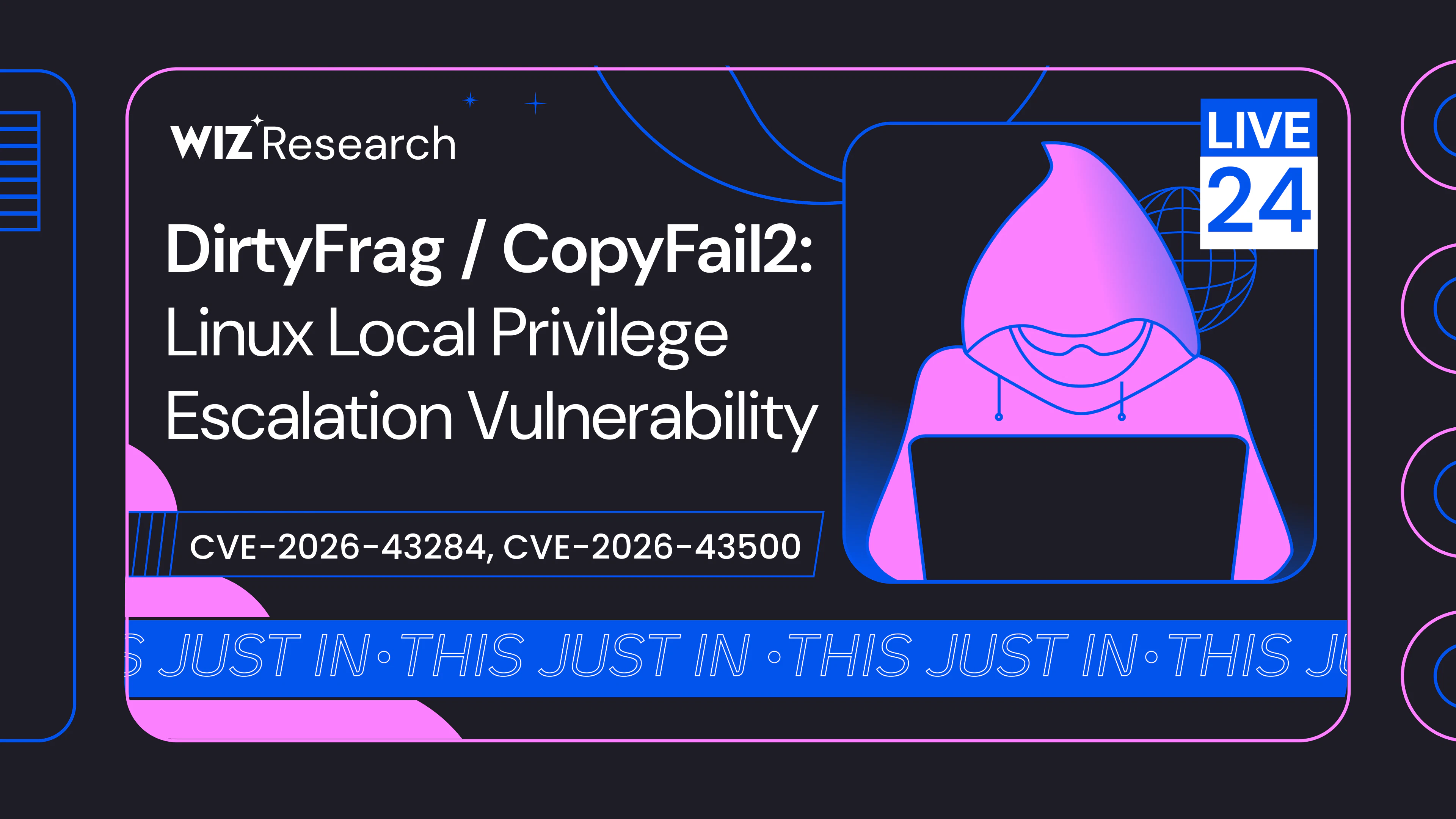
Dirty Frag (CVE-2026-43284) Linux Privilege Escalation | Wiz Blog

Wiz details "Dirty Frag" (CVE-2026-43284 and CVE-2026-43500), a Linux kernel local privilege escalation chain combining page-cache write primitives in the xfrm-ESP (IPsec) and RxRPC subsystems that let an unprivileged-but-CAP_NET_ADMIN attacker corrupt page-cache-backed memory to gain root. It is a deterministic (non-race-condition) bug class similar to Dirty Pipe and is a successor to the earlier Copy Fail (CVE-2026-31431); a public PoC exists but no official patch is available yet, and affected code paths date back to 2017 (ESP) and 2023 (RxRPC).

Linux kernelWiz
CVE-2026-43284CVE-2026-43500CVE-2026-31431+5

Offensive SecurityΒ· Added 5 Sep 2026, published 8 May 2026

Showing 30 of 35

Show more